Clinical Significance of Tumor Necrosis Factor-
a
Inhibitors in the Treatment of Sciatica: A Systematic
Review and Meta-Analysis
Yun Fu Wang1, Ping You Chen2, Wei Chang3, Fi Qi Zhu4, Li Li Xu1, Song Lin Wang1, Li Ying Chang5, Jie Luo1*, Guang Jian Liu1*
1Department of Neurology, Taihe Hospital Affiliated to Hubei University of Medicine, Shiyan City, Hubei Province, China,2Medical Imaging Center, Taihe Hospital Affiliated to Hubei University of Medicine, Shiyan City, Hubei Province, China,3Department of Spine Surgery, Taihe Hospital Affiliated to Hubei University of Medicine, Shiyan City, Hubei Province, China,4Department of Neurology, Yuebei People’s Hospital Affiliated to Shantou University Medical College, Shaoguan City, Guangdong Province, China,5Department of Neurology, Xiangyang Center Hospital Affiliated to Hubei University of Arts and Science, Xiangyang City, Hubei Province, China
Abstract
Background and Objective:Currently, no satisfactory treatment is available for sciatica caused by herniated discs and/or spinal stenosis. The objective of this study is to assess the value of tumor necrosis factor (TNF)-ainhibitors in the treatment of sciatica.
Methods: Without language restrictions, we searched PubMed, OVID, EMBASE, the Web of Science, the Clinical Trials Registers, the Cochrane Central Register of Controlled Trials and the China Academic Library and Information System. We then performed a systematic review and meta-analysis on the enrolled trials that met the inclusion criteria.
Results:Nine prospective randomized controlled trials (RCTs) and two before-after controlled trials involving 531 patients met our inclusion criteria and were included in this study. Our systematic assessment and meta-analysis demonstrated that in terms of the natural course of the disease, compared with the control condition, TNF-ainhibitors neither significantly relieved lower back and leg pain (both p.0.05) nor enhanced the proportion of patients who felt overall satisfaction (global perceived effect (satisfaction)) or were able to return to work (return to work) (combined endpoint; p.0.05) at the short-term, medium-term and long-term follow-ups. In addition, compared with the control condition, TNF-a inhibitors could reduce the risk ratio (RR) of discectomy or radicular block (combined endpoint; RR = 0.51, 95% CI 0.26 to 1.00, p = 0.049) at medium-term follow-up, but did not decrease RR at the short-term (RR = 0.64, 95% CI 0.17 to 2.40, p = 0.508) and long-term follow-ups (RR = 0.64, 95% CI 0.40 to 1.03, p = 0.065).
Conclusion:The currently available evidence demonstrated that other than reducing the RR of discectomy or radicular block (combined endpoint) at medium-term follow-up, TNF-ainhibitors showed limited clinical value in the treatment of sciatica caused by herniated discs and/or spinal stenosis.
Citation:Wang YF, Chen PY, Chang W, Zhu FQ, Xu LL, et al. (2014) Clinical Significance of Tumor Necrosis Factor-aInhibitors in the Treatment of Sciatica: A Systematic Review and Meta-Analysis. PLoS ONE 9(7): e103147. doi:10.1371/journal.pone.0103147
Editor:Malu´ G. Tansey, Emory University, United States of America
ReceivedMarch 1, 2014;AcceptedJune 26, 2014;PublishedJuly 22, 2014
Copyright:ß2014 Wang et al. This is an open-access article distributed under the terms of the Creative Commons Attribution License, which permits unrestricted use, distribution, and reproduction in any medium, provided the original author and source are credited.
Funding:This study received financial support from the Sowers Foundation for Evidence-Based Medicine of Taihe Hospital (2013). The funders had no role in study design, data collection and analysis, decision to publish, or preparation of the manuscript.
Competing Interests:The authors have declared that no competing interests exist.
* Email: [email protected] (GJL); [email protected] (JL)
Introduction
Disk herniation-induced sciatica is one of the most common causes of lower back and leg pain among young adults. Previous studies have demonstrated that the outcomes of conservative treatment, such as medication and physical therapy, are similar to the natural course of this disease [1]. Although epidural steroid injections can relieve a portion of patients’ pain, they cannot restore the patients’ physical function [2]. Recently, some scholars have stated that non-opioid analgesic agents, discectomy and epidural steroid injection are effective [3]; however, the opposing opinion indicates that discectomy is only effective for acute neurodynia, and its long-term outcome is not superior to that of conservative treatment [4]. In addition, because of nerve root
adhesions or epidural adhesions, epidural steroid injection cannot relieve pain in a considerable number of patients [5].
Tumor necrosis factor-alpha (TNF-a) is an inflammatory factor involved in the pathophysiological mechanism underlying disk herniation-induced sciatica [6,7]. In the past decade, some scholars have attempted to use TNF-ainhibitors to treat sciatica. Previous non-randomized controlled trials have shown that this type of agent has potential efficacy and a relatively high patient tolerance [8,9]. However, afterwards, various randomized con-trolled trials (RCTs) demonstrated that these agents yielded inconsistent outcomes. A newly published systematic review and meta-analysis revealed that the evidence supporting the use of TNF-ainhibitors to treat sciatica is inadequate [10]. Nevertheless,
this study has some limitations: (1) four high-quality RCTs [11–14] were missed; (2) among all of the enrolled trials, a visual analogue scale (VAS) score range of 0 to 100 was adopted in a portion of trials [15–19], while a score range of 0 to 10 was applied in others [20–22]. The authors used a weighted mean difference (WMD) technique to pool all of the data together; however, this is not a standard and conventional method commonly used in meta-analysis [23]; and (3) in addition, we disagree that the authors’ method of pooling together all of the data regarding the outcomes of discectomy, including the data obtained during short-term, medium-term and long-term follow-ups.
The primary purpose of this study was to evaluate the treatment
value of TNF-ainhibitors compared with placebos and steroids in
terms of five endpoints at short-term follow-up (#3 months),
medium-term follow-up (3 to 12 months) and long-term follow-up
($12 months). The five endpoints that were adopted were the
Oswestry Disability Index, VAS pain intensity in the leg, VAS pain intensity in the lower back, global perceived effect (satisfaction) or return to work (combined endpoint), and discectomy or radicular block (combined endpoint). The second-ary purpose was to evaluate the patient tolerance of the adverse
reaction of TNF-ainhibitors.
Methods
Using the ‘‘Preferred Reporting Items for Systematic reviews and Meta-Analyses (PRISMA)’’ [24] as a guideline, we conducted this systematic review and meta-analysis. The present study is a
complement to and update of the study performed by Williamset
al.[10].
Search Strategies
The searched database included the following: PubMed, OVID, EMBASE, the Web of Science, the Clinical Trials Registers, the Cochrane Central Register of Controlled Trials and the China Academic Library and Information System. The search terms included following: ‘‘anti-tumor necrosis factor agents OR tumor necrosis factor alpha inhibitor OR infliximab OR adalimumab
OR etanercept OR rituximab OR golimumab OR certolizumab OR efalizumab OR ustekinumab OR alefacept’’ AND ‘‘sciatica OR lumbosacral radiculopathy’’ AND ‘‘controlled trial’’ appear-ing in ‘‘title/abstract’’. Each database was searched from January 1, 2000 to July 1, 2013. No language restrictions were applied.
Trial Selection
The inclusion criteria were as follows: (1) Participants: all patients included were older than 18 years and were diagnosed with sciatica caused by lumbar disc herniation and/or lumbar spinal stenosis confirmed with CT/MRI, regardless of the duration of symptoms. Patients who planned to undergo discectomy soon or had comorbid liver disease, tuberculosis, spinal cord tumor, infection or trauma were excluded; (2)
Intervention: any trial that used TNF-a inhibitors in the TNF-a
inhibitor group and placebos or steroids in the control group and in which all drugs were locally injected or systematically administered; (3) Endpoints: any trial that used subjective parameters, such as the Oswestry Disability Index and VAS scores, to evaluate lower back and leg pain and used global perceived effect (satisfaction) or return to work (combined endpoint) to represent the proportion of patients who felt overall satisfaction or were able to return to work, and adopted an objective parameter, discectomy or radicular block (combined endpoint), to evaluate the risk ratio (RR) of discectomy or radicular block; (4) Study type: the controlled trials including randomized controlled trials (RCTs), cross-over controlled trial, non-randomized concurrent trials, before-after controlled trial, and case-control study, were included regardless of their sample size and trial results.
Data Extraction
Using a unified form, two investigators extracted the data and established the data spreadsheet independently. Finally, they confirmed the accuracy of the data together, and discrepancies were resolved via discussion until a consensus was reached. A portion of the endpoint data expressed only as a line graph or
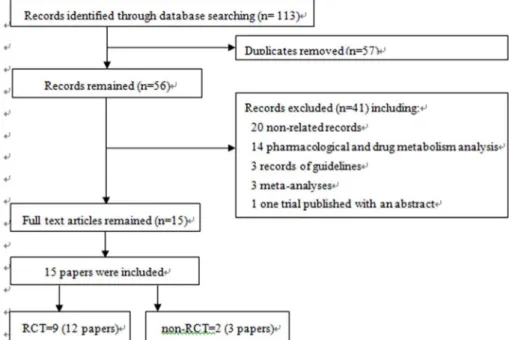
Figure 1. A flow diagram of the screening process.
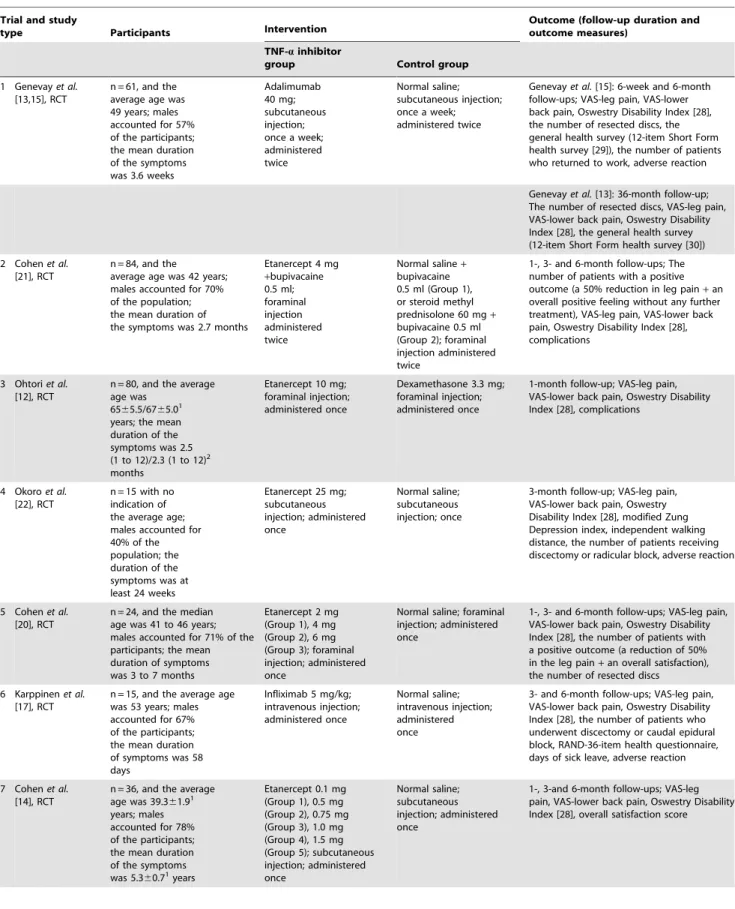
Table 1.Trial characteristics.
Trial and study
type Participants Intervention
Outcome (follow-up duration and outcome measures)
TNF-ainhibitor
group Control group
1 Genevayet al. [13,15], RCT
n = 61, and the average age was 49 years; males accounted for 57% of the participants; the mean duration of the symptoms was 3.6 weeks
Adalimumab 40 mg; subcutaneous injection; once a week; administered twice
Normal saline; subcutaneous injection; once a week; administered twice
Genevayet al.[15]: 6-week and 6-month follow-ups; VAS-leg pain, VAS-lower back pain, Oswestry Disability Index [28], the number of resected discs, the general health survey (12-item Short Form health survey [29]), the number of patients who returned to work, adverse reaction
Genevayet al.[13]: 36-month follow-up; The number of resected discs, VAS-leg pain, VAS-lower back pain, Oswestry Disability Index [28], the general health survey (12-item Short Form health survey [30])
2 Cohenet al. [21], RCT
n = 84, and the average age was 42 years; males accounted for 70% of the population; the mean duration of the symptoms was 2.7 months
Etanercept 4 mg +bupivacaine 0.5 ml; foraminal injection administered twice
Normal saline+ bupivacaine 0.5 ml (Group 1), or steroid methyl prednisolone 60 mg+ bupivacaine 0.5 ml (Group 2); foraminal injection administered twice
1-, 3- and 6-month follow-ups; The number of patients with a positive outcome (a 50% reduction in leg pain+an overall positive feeling without any further treatment), VAS-leg pain, VAS-lower back pain, Oswestry Disability Index [28], complications
3 Ohtoriet al. [12], RCT
n = 80, and the average age was
6565.5/6765.01 years; the mean duration of the symptoms was 2.5 (1 to 12)/2.3 (1 to 12)2 months
Etanercept 10 mg; foraminal injection; administered once
Dexamethasone 3.3 mg; foraminal injection; administered once
1-month follow-up; VAS-leg pain, VAS-lower back pain, Oswestry Disability Index [28], complications
4 Okoroet al. [22], RCT
n = 15 with no indication of the average age; males accounted for 40% of the population; the duration of the symptoms was at least 24 weeks
Etanercept 25 mg; subcutaneous injection; administered once Normal saline; subcutaneous injection; once
3-month follow-up; VAS-leg pain, VAS-lower back pain, Oswestry Disability Index [28], modified Zung Depression index, independent walking distance, the number of patients receiving discectomy or radicular block, adverse reaction
5 Cohenet al. [20], RCT
n = 24, and the median age was 41 to 46 years; males accounted for 71% of the participants; the mean duration of symptoms was 3 to 7 months
Etanercept 2 mg (Group 1), 4 mg (Group 2), 6 mg (Group 3); foraminal injection; administered once
Normal saline; foraminal injection; administered once
1-, 3- and 6-month follow-ups; VAS-leg pain, VAS-lower back pain, Oswestry Disability Index [28], the number of patients with a positive outcome (a reduction of 50% in the leg pain+an overall satisfaction), the number of resected discs
6 Karppinenet al. [17], RCT
n = 15, and the average age was 53 years; males accounted for 67% of the participants; the mean duration of symptoms was 58 days
Infliximab 5 mg/kg; intravenous injection; administered once Normal saline; intravenous injection; administered once
3- and 6-month follow-ups; VAS-leg pain, VAS-lower back pain, Oswestry Disability Index [28], the number of patients who underwent discectomy or caudal epidural block, RAND-36-item health questionnaire, days of sick leave, adverse reaction
7 Cohenet al. [14], RCT
n = 36, and the average age was 39.361.91 years; males accounted for 78% of the participants; the mean duration of the symptoms was 5.360.71years
Etanercept 0.1 mg (Group 1), 0.5 mg (Group 2), 0.75 mg (Group 3), 1.0 mg (Group 4), 1.5 mg (Group 5); subcutaneous injection; administered once Normal saline; subcutaneous injection; administered once
1-, 3-and 6-month follow-ups; VAS-leg pain, VAS-lower back pain, Oswestry Disability Index [28], overall satisfaction score Tumor Necrosis Factor-aInhibitors and Sciatica
histogram was obtained from the forest plots of the study
conducted by Williams et al. [10]. The extracted data mainly
included the sample size, intervention measures, the Oswestry Disability Index, VAS-leg pain, VAS-lower back pain, global perceived effect (satisfaction) or return to work (combined endpoint), and discectomy or radicular block (combined end-point) of the experimental and control groups at various follow-up points.
Quality Evaluation
One investigator performed a methodology quality assessment of all included studies based on a 17-item quality evaluating system [25].
Statistical Analysis
Using WMD, standardized mean difference (SMD) and RR, we performed a systematic review and meta-analysis of the afore-mentioned five endpoints according to the follow-up time and the type of control drugs used. For global perceived effect (satisfaction)
or return to work (combined endpoint), an RR.1 indicated that
the outcomes of the TNF-ainhibitor group were superior to those
of the control group; for discectomy or radicular block (combined
endpoint), an RR,1 indicated that the outcomes of the TNF-a
inhibitor group were superior to those of the control group; for Oswestry Disability Index, VAS-leg, and VAS-lower back, a negative WMD or SMD indicated that the outcomes of the TNF-a inhibitor group were superior to those of the control group. The data from reports concerning same trial were used for the analysis of the corresponding follow-up. Prior to the meta-analysis, for each
Table 1.Cont.
Trial and study
type Participants Intervention
Outcome (follow-up duration and outcome measures)
TNF-ainhibitor
group Control group
8 Beckeret al. [18], RCT
n = 84, and the average age was 54 years; males accounted for 62% of the participants; the duration of the symptoms was at least 6 weeks
Autologous conditioned serum (Group 1); epidural injections; administered three times
Triamcinolone 5 mg or 10 mg+local anesthetic 1 ml (Group 2 or Group 3); epidural injection; administered three times
6-, 10- and 22-week follow-ups; VAS-lower back pain, Oswestry Disability Index [28], adverse reaction
9 Korhonenet al. [11,16,19], RCT
n = 40, and the average age was 40 years; the males accounted for 60%; the mean duration of the symptoms was 61 days
Infliximab 5 mg/kg; intravenous injection; administered once Normal saline; intravenous injection; administered once
Korhonenet al.[19]: 3-month follow-up; The straight leg-raising test, VAS-leg pain, VAS-lower back pain, Oswestry Disability Index [28]
Autioet al.[11]: 6-month follow-up; The volume (mm3), thickness (mm) and the rim enhancement (%) of herniated nucleus pulposus, the number of resected discs, swelling of the nerve root
Korhonenet al.[16]: 12-month follow-up; The straight leg-raising test, leg pain, VAS-lower back pain, Oswestry Disability Index [28], RAND-36-item health questionnaire [31], the number of resected discs, adverse reaction
10 Karppinenet al.[9] and Korhonenet al. [27], non-RCT
n = 72, and the average age was 39 years; the males accounted for 80%; the mean duration of the symptoms was 7.2 weeks
Infliximab 3 mg/kg; intravenous injection; administered once Normal saline; Periradicular injection; administered once
Karppinenet al[9]: 3-month follow-up; The number of painless patients (75% decrease from baseline leg pain score), VAS-leg pain
Korhonenet al[27]: 6- and 12-month follow-ups; VAS-leg pain, VAS-lower back pain, Oswestry Disability Index [28], the number of sick leave days; clinical status, adverse effects
11 Genevayet al.[8], non-RCT
n = 20, and the average age was 47 years; the males accounted for 50%; the mean duration of the symptoms was 3.2 weeks
Etanercept 25 mg; subcutaneous injection; every 3 days; administered three
Methylprednisolone; 250 mg, intravenous injection;
administered three
6-weeks follow-up; The numbers with a good clinical result (leg pain VAS,30 or Oswestry Disability Index,20); VAS-leg pain, VAS-lower back pain, Oswestry Disability Index [28]; Roland Morris Disability Questionnaire (RMDQ) [32], the number of discectomies
RCT randomized controlled trial, non-RCT non-randomized control trial, VAS visual analogue scale. 1mean
6standard deviation. 2median (range).
Table 2.Methodological quality scoring [25] for all trials.
Check list item Trials
1 [13,15] 2 [21] 3 [12] 4 [22] 5 [20] 6 [17] 7 [14] 8 [18] 9 [11,16,19] 10 [9,27] 11 [8]
1. Is there a rationale for the study? yes yes yes yes yes yes yes yes yes yes yes
2. Is a clear study objective/goal defined? yes yes yes yes yes yes yes yes yes no yes
3. Are key elements of study design described (e.g. how were participants identified/recruited)?
yes yes yes yes yes yes yes yes yes no yes
4. Are the setting and selection criteria for the study population described?
yes yes yes yes yes yes yes yes yes yes yes
5. Is the follow-up period appropriate? yes yes no yes yes yes yes yes yes yes no
6. Are there any strategies to avoid loss to follow-up or address missing data?
no no no no no no no no no no no
7. Is the sample size justified? no no no no no no no no no no no
8. Is information presented about the instruments used to measure the prognostic variable(s), and does this enable replication (through the use of
standardized or valid measures)?
yes yes yes yes yes yes yes yes yes yes yes
9. Is the outcome selected and assessed appropriately? yes yes yes yes yes yes yes yes yes yes yes
10. Is the study sample described (demographic/clinical characteristics)?
yes yes yes no yes yes yes no yes yes yes
11. Is the final sample representative of the study’s target population?
yes yes yes yes no yes yes yes yes no no
12. Is loss to follow-up#20%? (If not, are there any significant differences in baseline variables between responders and non-responders to follow-up? If yes, have the implications been considered?)
yes yes yes yes no yes yes yes yes yes yes
13. Are the main results reported (including the prevalence of prognostic indicator(s) and outcome, strength of association, and statistical significance)?
yes yes yes yes yes yes yes yes yes yes yes
14. Is the statistical analysis appropriate and described? yes yes yes no yes yes yes yes yes yes yes
15. Were potential confounders and effect modifiers identified and accounted for (e.g. multivariate analysis)?
yes yes yes yes yes yes yes yes yes no no
16. Do the findings support the authors’ interpretations? yes yes yes yes yes yes yes yes yes yes yes
17. Do the authors discuss study limitations (e.g. biases/generali zability)?
no yes yes no yes no no no no no no
Total 14 15 14 12 13 14 14 13 14 10 11
Scoring: Total number of ‘‘yes’’ answers provides the overall score. 0 to 10 = poor quality, 11 to 14 = adequate quality, 15 to 17 = high quality [25]. doi:10.1371/journal.pone.0103147.t002
Tumor
Necrosis
Factor-a
Inhibitors
and
Sciatica
PLOS
ONE
|
www.ploson
e.org
5
July
2014
|
Volume
9
|
Issue
7
|
endpoint, Cochran’s Q statistic test was applied to assess the heterogeneity among the included studies. If a p-value of
Cochran’s Q statistic (Qp) $0.10, which indicated the absence
of heterogeneity, a fixed-effects model was applied; otherwise, a random effects model was applied for analysis. Stata statistical software version SE 12.0 (Stata Corp LP, College Station, TX, USA) was utilized for all statistical analysis.
Results
Search Results
A total of 113 records were identified through database searches, and 16 remained [8,9,11–22,26,27] after the exclusion of unrelated and repeated studies through a careful review of the titles, abstracts and partial main text. After the exclusion of one trial that was published as an abstract without full text available [26], 15 papers were ultimately enrolled in our study [8,9,11– 22,27]. These 15 papers included nine RCTs [11–22,27], two non-RCT (before-after controlled trials) [8,9,27], involving 531 patients; two of the trials were reports of the data from the 6-month and 36-6-month follow-up of the NCT00470509 trial [13,15], three of the trials were the reports of the data from the 3-month, 6-month and 12-month follow-ups of the FIRST II trial [11,16,19], and two records were the reports of the data from the 3-month, 6-month and 12-month follow-ups of same trial [9,27]. Among the included trials, seven used placebos as a control [9,14– 17,20,22], three used steroids as a control [8,12,18], and one used placebos and steroids as a dual control [21]; eight trials involved local injection [8,12–14,18,20–22], and three involved a system-atic medication [9,16,17]; the drugs were administered once in seven trials [9,12,14,16,17,22], twice in three trials [13,20,21], and three times in two trial [8,18]; six trials adopted VAS scoring in a range of 0 to100 [8,9,15–18], and five adopted VAS scoring in a range of 0 to 10 [12,14,20–22]. Figure 1 shows the screening process. The major features of the 11 trials are listed in Table 1.
Quality of all included studies
Table 2 lists the quality scores of the 11 trials, including one with high quality [21], nine with middle quality (12 records) [8,11– 20,22], and one with poor quality (two records) [9,27].
Oswestry Disability Index
The trial by Cohen et al. [20] demonstrated there was no
statistical difference in the Oswestry Disability Index between the two groups at post-injection Month 1 and Month 6 (p = 0.11, p = 0.78). Another trial by Cohenet al.[14] showed that there was
no intragroup or intergroup difference in the Oswestry Disability Index at post-injection Month 1, while the Oswestry Disability Index was restored to the baseline level at post-injection Month 6.
The trial conducted by Karppinenet al.[17] also indicated that
there was no statistical difference in the Oswestry Disability Index between the two groups at post-injection Month 6 (p = 0.52). In addition, in the FIRST II trial, there was no statistical difference in the Oswestry Disability Index between the two groups at post-injection Month 3 and Month 12 (p = 0.37, p = 0.79) [16,19].
The results derived from the meta-analysis showed that
compared with the placebo group, the TNF-a inhibitor group
had a WMD of 25.34 (214.50 to 3.82, p = 0.254, n = 7) at the
post-injection short-term follow-up, 28.19 (214.53 to 21.84,
p = 0.011, n = 5) at the medium-term follow-up (The sensitivity analysis demonstrated that after the exclusion of a low-quality trial [27], WMD = 8.69, 95% CI 19.00 to 1.61, p = 0.098, n = 4), and
20.73 (29.94 to 8.48, p = 0.877, n = 3) at the long-term follow-up;
compared with the steroid group, the TNF-ainhibitor group had
a WMD of20.82 (25.99 to 4.36, p = 0.757, n = 5) at the
post-injection short-term follow-up and 0.48 (22.75 to 3.72, p = 0.771, n = 2) at the medium-term follow-up (Figure 2).
VAS-leg pain
The trial by Cohenet al.[20] showed no statistical difference in the reduction of VAS between the two groups at post-injection
Month 1 (p = 0.15). Another trial by Cohenet al.[14] indicated
there was no difference in the VAS between the two groups at
post-injection Month 1 [14]. The trial by Karppinenet al. [17]
showed no statistical difference in the reduction of leg pain between the two groups at post-injection Month 6 (73% vs. 65%, p = 0.52). In addition, in the FIRST II trial, there was no statistical difference observed in the VAS-leg pain between the two groups at post-injection Month 3 and Month 12 (p = 0.82, p = 0.54) [16,19]; moreover, there was no statistical difference in the percentage of patients who achieved a VAS reduction of more than 75% between the two groups at post-injection Month 12 (p = 0.72) [16]. The meta-analysis showed that, compared with the placebo
group, the TNF-ainhibitor group had an SMD of20.41 (20.85
to 0.02, p = 0.061, n = 7) at the post-injection short-term follow-up,
20.24 (20.55 to 0.07, p = 0.122, n = 5) at the medium-term
follow-up, and 0.03 (20.54 to 0.60, p = 0.928, n = 3) at the long-term follow-up; compared with the steroid group, the TNF-a
inhibitor group had an SMD of21.22 (23.27 to 0.84, p = 0.246,
n = 3) at the post-injection short-term follow-up (Figure 3).
VAS-lower back pain
A trial by Cohenet al.[20] showed that the VAS-lower back
pain of the TNF-a inhibitor group was significantly lower than
that of the placebo group (p = 0.01) one month after drug injection. The trial by Karppinenet al.[17] showed no statistical difference in the VAS between the two groups at post-injection Months 3 and 6 (p = 0.13, p = 0.25). In addition, in the FIRST II trial, there was no statistical difference observed in the VAS-lower back pain between the two groups at post-injection Month 3 and Month 12 (p = 0.98, p = 0.68) [16,19]. The meta-analysis demon-strated that compared with the placebo group, the TNF-a
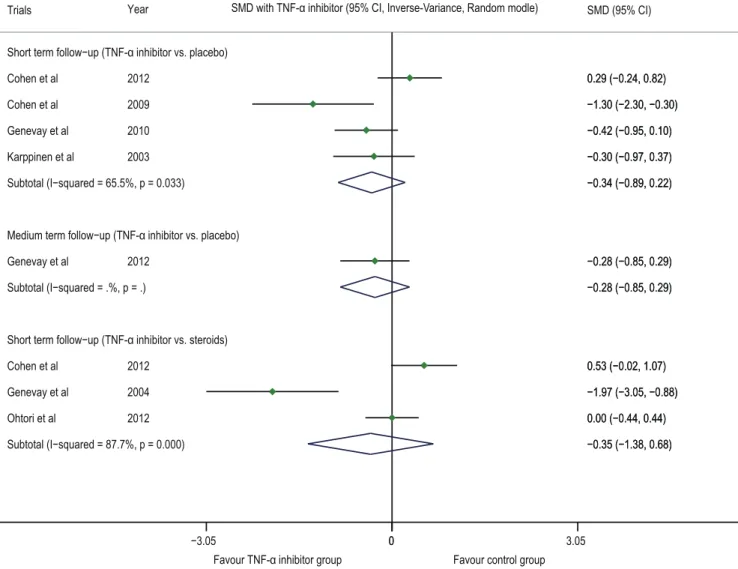
inhibitor group had an SMD of 20.34 (20.89 to 0.22,
p = 0.233, n = 4) at the post-injection short-term follow-up and
20.28 (20.85 to 0.29, p = 0.332, n = 1) at the medium-term
follow-up; compared with the steroid group, the TNF-ainhibitor
group had an SMD of20.35 (21.38 to 0.68, p = 0.503, n = 3) at
the post-injection short-term follow-up (Figure 4).
Global perceived effect (satisfaction) or return to work (combined endpoint)
The trial by Genevayet al.[13] demonstrated no difference in
the work capability or physical condition between the two groups, and the trial by Cohenet al.[14] also indicated no intragroup and intergroup difference in the patients’ global perceived effect. In the FIRST II trial, no statistical difference was observed between the two groups in the patients’ days of sick leave from work because of sciatica (p = 0.60) [16]. The meta-analysis indicated that compared
with the placebo group, the TNF-ainhibitor group had an RR of
1.19 (0.66 to 2.16, p = 0.554, n = 5) for global perceived effect (satisfaction) or return to work (combined endpoint) at the post-injection short-term follow-up, 1.18 (0.76 to 1.85, p = 0.465, n = 5) at the medium-term follow-up and 1.40 (0.81 to 2.44, p = 0.231, n = 2) at the long-term follow-up; compared with the steroid
group, the TNF-a inhibitor group had an RR of 1.10 (0.83 to
Discectomy or radicular block (combined endpoint) The results derived from the meta-analysis indicated that
compared with the control group, the TNF-ainhibitor group had
an RR of 0.64 (0.17 to 2.40, p = 0.508, n = 4) for the discectomy or radicular block (combined endpoint) at the post-injection short-term follow-up, 0.51 (0.26 to 1.00, p = 0.049, n = 3) at the medium-term follow-up and 0.64 (0.40 to 1.03, p = 0.065, n = 4) at the long-term follow-up (Figure 6A). The sensitivity analysis
showed that after the exclusion of the trials with a systematic drug administration [11,16,27], the RR was 0.47 (0.23 to 0.96, p = 0.037, n = 2) at the medium-term follow-up and 0.52 (0.27 to 1.00, p = 0.049, n = 2) at the long-term follow-up (Figure 6B).
Adverse reaction
Four reports indicated the absence of adverse reaction [11,12,19,22], six reports did not mention adverse reaction
Figure 2. Forest plot of Oswestry Disability Index.The difference in the Oswestry Disability Index (WMD) at the post-injection short-term, medium-term and long-term follow-ups between the TNF-ainhibitor group and placebo group was not statistically significant (p.0.05); there was no statistically significant difference at the post-injection short-term and medium-term follow-ups between the steroid group and the TNF-ainhibitor group (p.0.05). A. Results when the trials with poor quality were included; B. Results when the trials with poor quality were excluded. TNF-atumor necrosis factor-alpha, CI confidence interval, WMD weighted mean difference.
doi:10.1371/journal.pone.0103147.g002
Tumor Necrosis Factor-aInhibitors and Sciatica
[8,9,13,14,20,27], and four reported the occurrence of rhinitis, diarrhea, otitis media, maxillary sinusitis or a skin rash, but with only ‘‘mild symptoms’’ [15–17,21]. One patient had metastasis of cancer cells at the neck [17], and one patient had severe digestive tract bleeding after being treated with non-steroidal anti-inflam-matory agents [15]. One trial reported the occurrence of puncture-associated severe headache in both groups [18]. How-ever, there was no evidence proving the relationship between these
adverse events and the use of TNF-ainhibitors.
Discussion
The major findings of this study were that TNF-a inhibitors
could reduce the RR of discectomy or radicular block (combined endpoint) at medium-term follow-up, but not at short-term and
long-term follow-ups; during the natural disease course, TNF-a inhibitors neither provided additional pain relief nor improved the percentage of global perceived effect (satisfaction) or return to work (combined endpoint); the observed adverse reaction were mild and could not be proven to have any association with the use
of TNF-ainhibitors.
Previous studies have found that in patients with intervertebral disc herniation, the TNF-alevel on the articular surface increased
[33]; the TNF-a mRNA level on the annulus fibrosus, nucleus
pulposus and the yellow ligaments increased [34]; and the content of nucleus pulposus leaked to the epidural cavity, causing local acute inflammation, fiber deposition and adhesion [5]. The inflammatory reactions mediated by various biochemical and immunological factors can disturb intraradicular blood flow and disrupt the nerve-blood barrier, thus leading to swelling and
Figure 3. Forest plot of VAS-leg pain.The difference in the VAS-leg (SMD) at the post-injection short-term, medium-term and long-term follow-ups between the TNF-ainhibitor group and placebo group was not statistically significant (p.0.05); there was no statistically significant difference at the post-injection short-term follow-up between the steroid group and the TNF-ainhibitor group (p.0.05). VAS visual analogue scale, TNF-atumor necrosis factor-alpha, CI confidence interval, SMD standardized mean difference.
demyelination of the nerve root [35]. TNF-a is a pleiotropic cytokine, which can induce inflammatory responses of synapses and myelin sheath [35], promote cellular apoptosis due to its cytotoxic effect [6], and induce nerve swelling and neuropathic pain [35]. Thus, this cytokine plays a pivotal role in the pathophysiology of sciatica [36]. Animal experiments and clinical
studies have revealed that TNF-a inhibitors can prevent the
decline of nucleus pulposus-induced neural transmission speed and neural damage and thus have a protective effect on neurodegen-eration [7,37,38]. The results from clinical trials in terms of the
efficacy of TNF-ainhibitors on decreasing the RR of discectomy
or radicular block (combined endpoint) are inconsistent; a portion of the trials showed positive results [13,15], whereas others
reported that TNF-a inhibitors had efficacy similar to that of
placebos [8,9,11,12,14,16–22,27]. In this study, we found that
TNF-a inhibitors could decrease the RR of discectomy or
radicular block (combined endpoint) at the medium-term follow-up. We conservatively speculate that this effect might be related to their anti-inflammatory and neuroprotective functions.
Our explanations regarding the finding that TNF-a inhibitors
could reduce the risk of discectomy or radicular block (combined endpoint) but could not improve the pain were as follows: (1)
TNF-a inhibitors reduce the risk of discectomy or radicular block
(combined endpoint) because of their neuroprotective function.
Genevayet al.[13,15] believe that TNF-ainhibitors might have a
‘‘delayed mode of action on sciatica’’ or protective function on the nerve root, and thus the physical condition could recover better with TNF-ainhibitors; this result should be considered during the
selection of discectomy. The trial by Korhonenet al.[27] showed
that the recovery rate of nerve abnormalities was much higher in
the TNF-ainhibitor group than in the control group (p = 0.001),
indirectly indicating that TNF-ainhibitors had a protective effect on sciatic nerves. Because of this neuroprotective effect, TNF-a inhibitors can promote the recovery of physical function and reduce the risk of discectomy or radicular block (combined endpoint). (2) The anti-inflammatory effect of TNF-ainhibitors is not parallel to their pain-controlling effect. The mechanisms underlying leg pain and lower back pain remain unclear [39].
Figure 4. Forest plot of VAS-lower back pain.The difference in the VAS-lower back (SMD) at the post-injection short-term and medium-term follow-ups between the TNF-ainhibitor group and placebo group was not statistically significant (p.0.05); there was no statistically significant difference at the post-injection short-term follow-up between the steroid group and the TNF-ainhibitor group (p.0.05). VAS visual analogue scale, TNF-atumor necrosis factor-alpha, CI confidence interval, SMD standardized mean difference.
doi:10.1371/journal.pone.0103147.g004
Tumor Necrosis Factor-aInhibitors and Sciatica
Scholars generally believe the pain might result from the mechanical, chemical and inflammatory irritation of sinuvertebral nerves [40,41], while the pain might be associated with unstable lumbar spine or spinal stenosis in addition to inflammatory responses in a portion of patients. The trial by Andradeet al.[42] found that in the patients with disc herniation, the expression of
TNF-a, IL-1band IL-6 increased significantly, but the expression
levels of these cytokines were unrelated to the lower back pain; therefore, the authors concluded that ‘‘these cytokines may not play a leading role in maintaining a pain generating network’’, indicating that TNF is not the sole inflammatory factor and TNF-mediated inflammatory response is not the leading cause responsible for the pain of disc herniation patients. Moreover,
some studies demonstrated that the TNF-aexpression level in the
annulus fibrosus is negatively related to VAS [34], suggesting that TNF-mediated inflammatory response is not parallel to the level of
pain. Therefore, TNF-a inhibitors administered for
anti-inflam-mation might not be sufficient to simultaneously control both leg pain and lower back pain. (3) It is difficult to relieve the pain of patients who had a long disease course. Animal experiments have revealed that treatment immediately after the nerve root injury could be effective, while drug administration 10 days after the injury is often ineffective because of the occurrence of neuropathic pain [43]. Therefore, in the trials enrolled in the present study, the pain of patients with a disease course longer than 10 days was difficult to reduce. (4) Pain is not a decisive factor for the selection of discectomy. In clinical practice, the selection of discectomy depends mainly on the functional status, particularly the degree of
Figure 5. Forest plot of global perceived effect (satisfaction) or return to work (combined endpoint).The difference in the RR of global perceived effect (satisfaction) or return to work (combined endpoint) at the post-injection short-term, medium-term, and long-term follow-ups between the TNF-ainhibitor group and placebo group was not statistically significant (p.0.05); there was no statistically significant difference at the post-injection short-term and medium-term follow-ups between the steroid group and the TNF-ainhibitor group (p.0.05). TNF-atumor necrosis factor-alpha, CI confidence interval, RR risk ratio.
disability. Some scholars have stated that the disability level is unrelated to the acute or chronic pain [18]. Parameters such as the Oswestry Disability Index and the VAS are based on pain and thus cannot be used to assess the overall functional status of patients. In addition, Korhonenet al.[27] stated that there is no direct correlation between the selection of discectomy and the Oswestry Disability Index.
Interestingly, we found that TNF-ainhibitors could reduce the
RR of discectomy or radicular block (combined endpoint) at medium-term follow-up, but not at short-term and long-term follow-up. Regarding this phenomenon, our explanations are as
follows: (1) the neuroprotective role of TNF-a inhibitors cannot
been fulfilled within a short period of time; (2) we conservatively speculated that TNF-a-related inflammation and neurotoxicity are not the major pathophysiological mechanisms of sciatica; thus,
TNF-a inhibitors might not exhibit clinical value at long-term
follow-up; (3) the bias of drug administration approaches might be involved in this result. Although the currently available evidence is not sufficient to determine the superiority of local injection and systematic drug administration, the efficacy of intravenous injection is dubious. The sensitivity analysis demonstrated that after the exclusion of three trials in which the drugs were
Figure 6. Forest plot of discectomy of the radicular block (combined endpoint).The difference in the RR of discectomy or the radicular block (combined endpoint) at the post-injection short-term and long-term follow-ups between the TNF-ainhibitor group and placebo group was not statistically significant (p.0.05). At the medium-term follow-up, the RR of the TNF-ainhibitor group was 66% of that of the placebo group; after the exclusion of the three trials involving a systemic medication, the RR of the TNF-ainhibitor group was 47% of that of the placebo group at the medium-term follow-up, and was 52% of that of the placebo group at the long-term follow-up. A. Results when the trials involving a systemic medication were included; B. Results when the trials involving a systemic medication were excluded. TNF-a tumor necrosis factor-alpha, CI confidence interval, RR risk ratio.
doi:10.1371/journal.pone.0103147.g006
Tumor Necrosis Factor-aInhibitors and Sciatica
administered through intravenous injection [11,16,27], TNF-a inhibitors significantly decreased the risk of discectomy or radicular block (combined endpoint; p = 0.049; Figure 6B). In addition, Ohtoriet al.[12] stated their negative opinion regarding
the use of intravenous injection. Moreover, the ineffectiveness of intravenously administered steroids was also indicated in other studies [44].
Regarding the finding that TNF-ainhibitors reduced the risk of
discectomy or radicular block (combined endpoint) but did not increase the percentage of global perceived effect (satisfaction) or return to work (combined endpoint), we believe a possible explaination could be as following: the endpoint, global perceived effect (satisfaction) or return to work (combined endpoint), is related to the patients’ self-perceptions (such as pain), while discectomy or radicular block (combined endpoint) is related more closely to the patients’ functional status, particularly in the case of discectomy.
It is worth noting that in this study, we could not draw a definitive conclusion regarding the appropriate selection of the drug dose and the frequency of drug administration based on the current available evidence. Because the endpoint data of both the treatment and control groups changed proportionately (10 times), the differences in the VAS score ranges among the enrolled trials would not affect the quantitative analysis and result interpretation in the meta-analysis using SMD.
Compared with the study by Williamset al.[10], the present
study has the following differences: (1) This study used SMD for the meta-analysis of endpoints that had a different score range, such as VAS-leg pain and VAS-lower back pain. (2) The meta-analysis of discectomy or radicular block (combined endpoint) was conducted using the follow-up data from different time points, i.e. short-term, medium-term and long-term, to evaluate the treatment outcomes more precisely. (3) This study discovered that TNF-a inhibitors cannot provide additional pain relief at all follow-up
periods, but they can reduce the RR of discectomy or radicular block (combined endpoint) at the medium-term follow-up.
The limitations of this study are as follows: (1) the sample size was small, and the follow-up durations were inconsistent; (2) the data showed a skewed distribution, and data expressed with the mean value and without a standard deviation (e.g. the trial of Okoroet al.[22]) could not be included in the quantitative analysis of measurement data; (3) although the majority of the included trials were double-blinded or triple-blinded, most of the evaluating parameters adopted in these trials were subjective, and thus the outcomes of natural disease course or the medication treatment could not be distinguished; (4) most of the included trials only showed the results of the treatment analysis rather than the intention-to-treat (ITT) analysis.
Conclusion: According to the currently existing evidence, other than reducing the RR of discectomy of the radicular block (combined endpoint) at the medium-term follow-up, TNF-a inhibitors have limited clinical value in the treatment of sciatica caused by disc herniation and/or spinal stenosis.
Acknowledgments
We sincerely thank Mr. Ya Jun Li (the Library of Hubei University of Medicine) for his help with the literature search. We also greatly appreciate the help of Dr. Hui Nie. ([email protected]) with the translation of this paper.
Ethical approval.Not required. Author Contributions
Conceived and designed the experiments: YFW GJL JL. Analyzed the data: YFW GJL JL. Wrote the paper: YFW GJL JL. Performed the systematic review and meta-analysis: YFW GJL JL. Data extraction and quality evaluation: PYC WC FQZ LLX SLW LYC.
References
1. Luijsterburg PA, Verhagen AP, Ostelo RW, van Os TA, Peul WC, et al. (2007) Effectiveness of conservative treatments for the lumbosacral radicular syndrome: a systematic review. Eur Spine J 16: 881–899.
2. Buenaventura RM, Datta S, Abdi S, Smith HS (2009) Systematic review of therapeutic lumbar transforaminal epidural steroid injections. Pain Physician 12: 233–251.
3. Lewis R, Williams N, Matar HE, Din N, Fitzsimmons D, et al. (2011) The clinical effectiveness and cost-effectiveness of management strategies for sciatica: systematic review and economic model. Health Technol Assess 15: 1–578. 4. Jacobs WC, van Tulder M, Arts M, Rubinstein SM, van Middelkoop M, et al.
(2011) Surgery versus conservative management of sciatica due to a lumbar herniated disc: a systematic review. Eur Spine J 20: 513–522.
5. Lee JH, Lee SH (2012) Clinical effectiveness of percutaneous adhesiolysis using Navicath for the management of chronic pain due to lumbosacral disc herniation. Pain Physician 15: 213–221.
6. Kawakami M, Tamaki T, Matsumoto T, Kuribayashi K, Takenaka T, et al. (2000) Role of leukocytes in radicular pain secondary to herniated nucleus pulposus. Clin Orthop Relat Res: 268–277.
7. Chia S, Qadan M, Newton R, Ludlam CA, Fox KA, et al. (2003) Intra-arterial tumor necrosis factor-alpha impairs endothelium-dependent vasodilatation and stimulates local tissue plasminogen activator release in humans. Arterioscler Thromb Vasc Biol 23: 695–701.
8. Genevay S, Stingelin S, Gabay C (2004) Efficacy of etanercept in the treatment of acute, severe sciatica: a pilot study. Ann Rheum Dis 63: 1120–1123. 9. Karppinen J, Korhonen T, Malmivaara A, Paimela L, Kyllonen E, et al. (2003)
Tumor necrosis factor-alpha monoclonal antibody, infliximab, used to manage severe sciatica. Spine (Phila Pa 1976) 28: 750–753; discussion 753–754. 10. Williams NH, Lewis R, Din NU, Matar HE, Fitzsimmons D, et al. (2013) A
systematic review and meta-analysis of biological treatments targeting tumour necrosis factor alpha for sciatica. Eur Spine J.
11. Autio RA, Karppinen J, Niinimaki J, Ojala R, Veeger N, et al. (2006) The effect of infliximab, a monoclonal antibody against TNF-alpha, on disc herniation resorption: a randomized controlled study. Spine (Phila Pa 1976) 31: 2641–2645. 12. Ohtori S, Miyagi M, Eguchi Y, Inoue G, Orita S, et al. (2012) Epidural administration of spinal nerves with the tumor necrosis factor-alpha inhibitor, etanercept, compared with dexamethasone for treatment of sciatica in patients
with lumbar spinal stenosis: a prospective randomized study. Spine (Phila Pa 1976) 37: 439–444.
13. Genevay S, Finckh A, Zufferey P, Viatte S, Balague F, et al. (2012) Adalimumab in acute sciatica reduces the long-term need for surgery: a 3-year follow-up of a randomised double-blind placebo-controlled trial. Ann Rheum Dis 71: 560–562. 14. Cohen SP, Wenzell D, Hurley RW, Kurihara C, Buckenmaier CC, et al. (2007) A double-blind, placebo-controlled, dose-response pilot study evaluating intradiscal etanercept in patients with chronic discogenic low back pain or lumbosacral radiculopathy. Anesthesiology 107: 99–105.
15. Genevay S, Viatte S, Finckh A, Zufferey P, Balague F, et al. (2010) Adalimumab in severe and acute sciatica: a multicenter, randomized, double-blind, placebo-controlled trial. Arthritis Rheum 62: 2339–2346.
16. Korhonen T, Karppinen J, Paimela L, Malmivaara A, Lindgren KA, et al. (2006) The treatment of disc-herniation-induced sciatica with infliximab: one-year follow-up results of FIRST II, a randomized controlled trial. Spine (Phila Pa 1976) 31: 2759–2766.
17. Karppinen J, Korhonen T, Hammond A, Bowman C, Malmivaara A, et al. (2009) The Efficacy of Infliximab in Sciatica Induced by Disc Herniations Located at L3/4 or L4/5: A Small-Scale Randomized Controlled Trial. The Open Spine Journal 1: 9–13.
18. Becker C, Heidersdorf S, Drewlo S, de Rodriguez SZ, Kramer J, et al. (2007) Efficacy of epidural perineural injections with autologous conditioned serum for lumbar radicular compression: an investigator-initiated, prospective, double-blind, reference-controlled study. Spine (Phila Pa 1976) 32: 1803–1808. 19. Korhonen T, Karppinen J, Paimela L, Malmivaara A, Lindgren KA, et al.
(2005) The treatment of disc herniation-induced sciatica with infliximab: results of a randomized, controlled, 3-month follow-up study. Spine (Phila Pa 1976) 30: 2724–2728.
20. Cohen SP, Bogduk N, Dragovich A, Buckenmaier CC, Griffith S, et al. (2009) Randomized, double-blind, placebo-controlled, dose-response, and preclinical safety study of transforaminal epidural etanercept for the treatment of sciatica. Anesthesiology 110: 1116–1126.
22. Okoro T, TS, Longworth S, Sell PJ (2010) Tumor necrosis alpha-blocking agent (etanercept): a triple blind randomized controlled trial of its use in treatment of sciatica. J Spinal Disord Tech 23: 74–77.
23. Higgins JP, Green S (2011) Cochrane handbook for systematic reviewers of interventions version Version 5.1.0 [updated March 2011]. http://handbook. cochrane.org/(accessed July 21, 2013).
24. Liberati A, Altman DG, Tetzlaff J, Mulrow C, Gotzsche PC, et al. (2009) The PRISMA statement for reporting systematic reviews and meta-analyses of studies that evaluate health care interventions: explanation and elaboration. PLoS Med 6: e1000100.
25. Ashworth J, Konstantinou K, Dunn KM (2011) Prognostic factors in non-surgically treated sciatica: a systematic review. BMC Musculoskelet Disord 12: 208.
26. Kume K AS, Yamada S (2008) The efficacy and safety of caudal epidural injection with the TNF-alpha antagonist, etanercept, in patients with discherniation-induced sciatica. Results of a randomized, controlled, 1-month follow-up study. Ann Rheum Dis 67(Suppl II): 131.
27. Korhonen T, Karppinen J, Malmivaara A, Autio R, Niinimaki J, et al. (2004) Efficacy of infliximab for disc herniation-induced sciatica: one-year follow-up. Spine (Phila Pa 1976) 29: 2115–2119.
28. Fairbank JC, Couper J, Davies JB, O’Brien JP (1980) The Oswestry low back pain disability questionnaire. Physiotherapy 66: 271–273.
29. Ware JE Jr, Sherbourne CD (1992) The MOS 36-item short-form health survey (SF-36). I. Conceptual framework and item selection. Med Care 30: 473–483. 30. Ware J Jr, Kosinski M, Keller SD (1996) A 12-Item Short-Form Health Survey:
construction of scales and preliminary tests of reliability and validity. Med Care 34: 220–233.
31. Hays RD, Morales LS (2001) The RAND-36 measure of health-related quality of life. Ann Med 33: 350–357.
32. Roland M, Morris R (1983) A study of the natural history of back pain. Part I: development of a reliable and sensitive measure of disability in low-back pain. Spine (Phila Pa 1976) 8: 141–144.
33. Igarashi A, Kikuchi S, Konno S, Olmarker K (2004) Inflammatory cytokines released from the facet joint tissue in degenerative lumbar spinal disorders. Spine (Phila Pa 1976) 29: 2091–2095.
34. Andrade P, Visser-Vandewalle V, Philippens M, Daemen MA, Steinbusch HW, et al. (2011) Tumor necrosis factor-alpha levels correlate with postoperative pain severity in lumbar disc hernia patients: opposite clinical effects between tumor necrosis factor receptor 1 and 2. Pain 152: 2645–2652.
35. Di Martino A, Merlini L, Faldini C (2013) Autoimmunity in intervertebral disc herniation: from bench to bedside. Expert Opin Ther Targets 17: 1461–1470. 36. Habtemariam A, Virri J, Gronblad M, Seitsalo S, Karaharju E (1999) The role
of mast cells in disc herniation inflammation. Spine (Phila Pa 1976) 24: 1516– 1520.
37. Zhou QH, Sumbria R, Hui EK, Lu JZ, Boado RJ, et al. (2011) Neuroprotection with a brain-penetrating biologic tumor necrosis factor inhibitor. J Pharmacol Exp Ther 339: 618–623.
38. Wang X, Feuerstein GZ, Xu L, Wang H, Schumacher WA, et al. (2004) Inhibition of tumor necrosis factor-alpha-converting enzyme by a selective antagonist protects brain from focal ischemic injury in rats. Mol Pharmacol 65: 890–896.
39. Liang C, Li H, Tao Y, Shen C, Li F, et al. (2013) New hypothesis of chronic back pain: low pH promotes nerve ingrowth into damaged intervertebral disks. Acta Anaesthesiol Scand 57: 271–277.
40. Ito K, Creemers L (2013) Mechanisms of Intervertebral Disk Degeneration/ Injury and Pain: A Review. Global Spine J 3: 145–152.
41. Issack PS, Cunningham ME, Pumberger M, Hughes AP, Cammisa FP Jr (2012) Degenerative lumbar spinal stenosis: evaluation and management. J Am Acad Orthop Surg 20: 527–535.
42. Andrade P, Hoogland G, Garcia MA, Steinbusch HW, Daemen MA, et al. (2013) Elevated IL-1beta and IL-6 levels in lumbar herniated discs in patients with sciatic pain. Eur Spine J 22: 714–720.
43. Xie W, Strong JA, Meij JT, Zhang JM, Yu L (2005) Neuropathic pain: early spontaneous afferent activity is the trigger. Pain 116: 243–256.
44. Roncoroni C, Baillet A, Durand M, Gaudin P, Juvin R (2011) Efficacy and tolerance of systemic steroids in sciatica: a systematic review and meta-analysis. Rheumatology (Oxford) 50: 1603–1611.
Tumor Necrosis Factor-aInhibitors and Sciatica
![Table 2. Methodological quality scoring [25] for all trials.](https://thumb-eu.123doks.com/thumbv2/123dok_br/18314368.349098/5.1186.96.1101.138.732/table-methodological-quality-scoring-trials.webp)