NEW CORPORATE REPORTING TRENDS. ANALYSIS ON THE EVOLUTION OF INTEGRATED REPORTING
Dragu Ioana, Tudor-Tiron Adriana
Accounting and audit department, Faculty of Economics and Business Administration, Babes-Bolyai University, Cluj- Napoca, Romania
[email protected] [email protected]
Abstract: The objective of this paper is to present the new corporate reporting trends of the 21st century. Integrated reporting has been launched through a common initiative of the International Integrated Reporting Committee and global accounting organizations. However, the history of integrated reports starts before the initiative of the IIRC, and goes back in time when large corporations begun to disclose sustainability and corporate social responsibility information. Further on, we claim that the initial sustainability and CSR reports that were issued separate along with the financial annual report represent the predecessors of the current integrated reports. The paper consists of a literature review analysis on the evolution of integrated reporting, from the first stage of international non-financial initiatives, up to the current state of a single integrated annual report. In order to understand the background of integrated reporting we analyze the most relevant research papers on corporate reporting, focusing on the international organizations’ perspective on non-financial reporting, in general, and integrated reporting, in particular. Based on the literature overview, we subtracted the essential information for setting the framework of the integrated reporting evolution. The findings suggest that we can delimitate three main stages in the evolution of integrated reports, namely: the non-financial reporting initiatives, the sustainability era, and the revolution of integrated reporting. We illustrate these results by presenting each relevant point in the history of integrated reporting on a time scale axis, developed with the purpose of defining the road to integrated reporting at theoretical, empirical, and practical levels. We consider the current investigation as relevant for future studies concerning integrated reports, as this is a new area of research still in its infancy. The originality of the research derives from the novelty of integrated reporting, and the aim to explain its origin, which is important to know if we want to understand the present and the future of corporate reporting.
Keywords: non-financial information, sustainability and social responsibility, integrated reporting.
JEL classification:M41, M14.
1. Introduction
The paper presents the stages of integrated reporting evolution: international non-financial reporting initiatives, sustainability and CSR era, and finally the emergence of integrated reports.
Accountants, European Financial Reporting Advisory Group, Sustainability Accounting Standards Board, Climate Disclosure Standards Board, International Integrated Reporting Committee, Federation of European Accountants - have decided to take action and replied by implementing non-financial reporting initiatives.
The measures undertaken by international organizations generated a period of 20 years when corporations continuously improved their reporting strategies for non-financial information disclosure. Therefore, corporate non-non-financial reporting has developed from predominately single-issue reports that were mostly environmentally focused, to multi-issue reports or sustainability reports. Currently, this trend towards multi-issue reporting goes further towards integrated reporting, which means sustainability reporting integrated within the financial or annual report. This could be one of the major topics in the debate on the future of sustainability reporting.
In order to provide a deep understanding of the concept of integrated reporting we have gathered various definitions, opinions and facts upon the concept of integrated reporting.
2. Literature review
2.1. Non-financial reporting practices
Non-financial reporting had a remarkable evolution in time, both on regulation side and in practice.
In 2008, KPMG was conducting a study on the corporate reporting trends followed by the top 250 companies of the Fortune 500 and top 100 companies from 16 countries. They found that 77% of the sample companies implemented GRI guidelines while more than 80% issued sustainability reports (KPMG, 2008). In only one year, this number grew to approximately 1.400 corporations that according to Eccles & Saltzman (2011) published non-financial information. The scholars also mention than during the period 2008- 2010, the promoters and early adopter of non-financial reporting enlarged by 29%.
The financial crisis has changed the perspective upon the world economy, so that many called for a sustainable approach to rebalance the economy. In 2010, the UN Global Compact Leaders’ Summit militated for sustainability and non-financial reporting (UN Global Compact-Accenture, 2010).
2.2. Setting up regulations for non-financial reporting
If until now we discussed the implications of the corporate reporting practice, the following mentions refer to the initiatives in the form of regulations for non-financial information.
Responsibility in 2006, an organization that acts as promoter for corporate social responsibility and social-environmental integration.
In addition, TMX Group, NYSE Euronext, BM & FBOVESPA, Bourse de Luxembourg promote sustainability reporting. Further on, Johannesburg Stock Exchange mandates non-financial reporting and Bursa Malaysia has a series of corporate social responsibility requirements. If in Singapore public companies have to apply sustainability reporting on a voluntary basis, Shanghai stock exchanges introduced mandatory environmental disclosure.
2.3. Early literature on integrated reporting and non-financial information We argue that non-financial information is as much valuable as the financial one. From the investors’ perspective, the value of the extra financial information is beginning to increase in importance. This statement is supported by Clements & Brown (2012) who claim that ESG integration in long term strategy financial plans determines shareholder value. Radley (2012) mentions that nowadays decision making processes are influenced by socially responsible investors and socially responsible investment analysts. This perspective outlines the relevance of non-financial performance in the analysis of non-financial and extra-non-financial information. In testing the non-financial impacts, investors and analysts consider the following information: governance, natural resources, social and community, capital (human, intellectual). In addition, the Moody’s and Standard & Poor rating agencies favor sustainability reporting practices, developing ratings and indices on sustainability for measuring sustainability.
After a considerable overview on the actual need of the non-financial information (sustainability, corporate social responsibility reporting), we start a discussion on integrated reporting and its connection to sustainability. Mentioned for the first time by White (2005) in his study on corporations’ reports,integrated reportinghas known a continuous evolution as scholars and academics, as well as international organizations, became interested in research that implies the sphere of integrated reports. A study on ASX 50 listed organizations from Australia reveal six criteria for measuring the level of IR (ACCA, 2011: 13): mission and strategy, management approach, performance tracking, risk management, stakeholder engagement, format public reporting. Maroun and Solomon (2012) discuss mandatory integrated reporting for 10 South African corporations, aiming to find if mandatory requirements influence the level of IR disclosure. Eccles et al. (2010) expalins how corporations can adopt integrated reporting practices. Integrated reporting can be described as a mixture of integrated thinking, stewardship for manufactured, human, intellectual, natural and social capital, strategic objectives and value creation, long term vision, transparency and trust, flexibility, avoiding complex and extended reports, and implementing technologies and innovation (Farrar, 2011), disclosure of forward-looking information, assurance on the quality of this type of information, annual presentation, positive aspects and challenges, holistic and integrated view on financial and sustainability elements, performance areas as subject for reporting integration, assurance on material sustainability or non-financial issues (Rossouw, 2011).
sustainability elements (Ernst & Young, 2011). The International Integrated Reporting Committee- IIRC, sets integrated reporting at the intersection between strategy, financial performance, governance, and social, environmental, and economic pillars (Robinson and Tinker, 1998), so that stakeholders can have a complete picture of the organizations financial and non-financial performance (Deloitte, 2011).
Nowadays, corporations practice integrated reporting, tough there is no framework for the components of an integrated reports nor available standards or regulations. Loska (2010) considers that integrated reporting will lead to new standards in the area of non-financial reporting, although international organizations still have to face a series of challenges, in particular: stakeholder engagement and effective communication, connection between financial and non-financial information, establishing the IFRS perspective upon integrated reporting, and finally, the definition of sustainability. However, the IIRC is committed to develop a framework for integrated reports and has already issued a series of principles and content elements that should suit any proper integrated report. They are implementing a pilot program that surveys the adoption of integrated reporting. Up to now, more than 75 organizations have joined the IIRC pilot program. All of these early adopters issued integrated reports during the period 2009-2012. The main determinants of integrated reporting have been: engagement with shareholders, a strong commitment to sustainability cause, developing a “sustainable strategy” (Eccles & Saltzman, 2011: 58), and the perspective of social responsibility investors (Radley, 2012).
3. Methodology
We engage in a systematic literature review analysis with the purpose of identifying the most relevant stages of the evolution of integrated reporting. Therefore, we set up our framework based on the overview of corporate non-financial reporting, sustainability, and CSR literature, as well as previous empirical studies in the filed of IR. We build our case mainly on the background sustainability literature, as integrated reporting is in its early development stage. Organizations that adopt integrated reporting cannot rely on reporting standards or an agreed set of guidelines. Thus, in this particular situation, practice precedes theory and the subjects that follow on IR can contribute to the development of mandatory or voluntary requirements in the field.
4. Findings
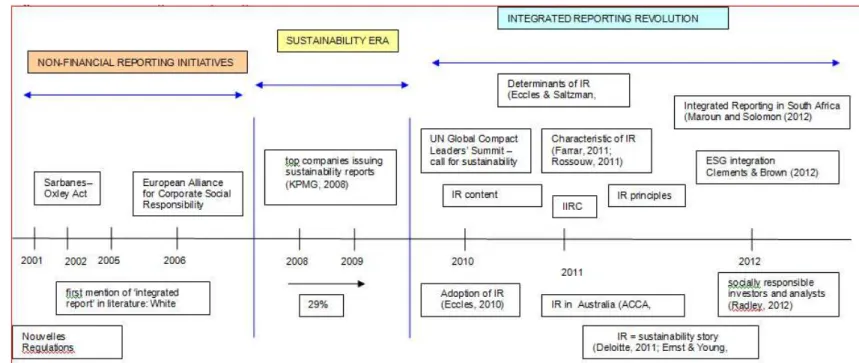
developed theoretical and empirical studies in the filed of integrated reporting. Their research involved mainly the subjects of IR determinants, adoption, and characteristics. More specific studies concentrate on the stage of integrated reporting with respect to a certain country (e.g. South Africa–with mandatory IR or Australia – IR on a voluntary basis). Others approach the process of ESG – environmental, sustainability, and governance- integration or the role of non-financial information in the decision making process when socially responsible investors and analysis are involved.
Figure 1:The Road to ntegrated Reporting
5. Conclusions
The current research was meat to present the stages of integrated reporting evolution. Reviewing the most relevant literature in the filed of non-financial reporting, sustainability/corporate social responsibility, and integrated reporting, we identified three main coordinates for IR: the international non-financial reporting initiatives, the sustainability era, and the IR revolution. In addition, the paper brings a deeper understanding upon the process of integrated reporting adoption, providing in the same time evidence on how this new reporting trend emerged both in theory and practice. The paper outlines research developed by scholars and academics as well as surveys and studies conducted by international organizations. The background literature in the area of integrated reporting suggests that organizations practices have preceded theory, as corporations have started to apply IR in the absence of standards and regulations. However, a common framework is necessary for the future development of integrated reporting. Therefore, the emergence of integrated reporting trend is limited by the gap between practice and regulation. From a regulatory perspective, the debate on voluntary versus mandatory integrated reporting remains an open question for the international corporate reporting environment. Some countries and stock exchanges already adopted mandatory integrated reporting, while other states and organizations militate for voluntary IR requirements. Voluntary or mandatory, we argue that integrated reporting should be assisted by a new set of global corporate reporting standards that would improve the IR practice and lead ahead the evolution of IR. We conclude by adding that is essential to know the history of integrated reporting, in order to understand the current reporting practices, and to be able to forecast future evolutions of corporate reporting.
References
ACCA. (2011), Adoption of integrated reporting by the ASX 50- A joint report from ACCA and the Net Balance Foundation, Available: www.accaglobal.com.
Clements, P.H. & Brown, G. (2012), Lenses and clocks: Financial stability and systemic risk, A joint paper presented by the United Nations Environment Programme Finance Initiative (UNEP FI), the International Institute for Sustainable Development (IISD), and The Blended Capital Group (TBCG).
Deloitte, (2011). Integrated Reporting: A Better View? , Global Sustainability and Climate Services.
Eccles R., Krzus, M.P., Tapscott, D. (2010).One Report: Integrated Reporting for a Sustainable Strategy, Wiley Publisher, 1st Edition.
Eccles, R.G.; Saltzman, D., “Achieving Sustainability through Integrated Reporting”, Stanford Social Innovation Review, Vol. 9, No. 3, pp.56–61.
Ernst & Young. (2011). ClimateChange and Sustainability. How Sustainability has expanded the CFO’s role, Available: http://www.ey.com/US/en/Services/Specialty- Services/Climate-Change-and-Sustainability-Services/How-sustainability-has-expanded-the-CFOs-role
Farrar, J. (2011). Integrated Reporting: can it solve the sustainability information gap?, Available: http://www.zdnet.com/blog/sustainability/integrated-reporting-can-it-solve-the-sustainability-information-gap/1635
KPMG, (2010). Integrated reporting: Closing the loop of strategy, Available:
Maroun, W., Solomon, J. (2012). Integrated reporting: the influence of King III on social, ethical and environmental reporting, The Association of Chartered Certified
Accountants, London, Available:
http://www.accaglobal.com/content/dam/acca/global/PDF-technical/integrated-reporting/tech-tp-iirsa.pdf
Radley Yelda. (2012). The value of extra- financial disclosure. What investors and analysts said, Accounting for Sustainability, Global Reporting Initiative, Available: https://www.globalreporting.org/information/news-and-press- center/Pages/Investors-and-analysts-use-extra-financial-information-in-decision-making-suggests-new-research.aspx
Robinson, J. & Tinker, J. (1998). Reconciling ecological, economic and social imperatives. In: Schnurr, J., Holtz, S. (Eds.), The Cornerstone of Development: Integrating Environmental, Social and Economic Policies, International Development Research Centre, Ottawa.
Rossow, R. (2011). Integrating Sustainability Reporting, Presentation delivered at the Women in Finance Conference, South Africa, Available: http://www.slideshare.net/Reana1/integrated-sustainability-reporting
UN Global Compact-Accenture CEO Study (2010).A New Era of Sustainability, CEO reflections on progress to date, challenges ahead and the impact of the journey toward a sustainable economy.