2013 July-Aug.;21(4):928-34 www.eerp.usp.br/rlae
Corresponding Author: Escolástica Rejane Ferreira Moura
Universidade Federal do Ceará. Departamento de Enfermagem Rua Alexandre Baraúna, 1115
Bairro: Rodolfo Teóilo
CEP: 60430-160, Fortaleza, CE, Brasil E-mail: [email protected]
Camila Félix Américo
1Paula Sacha Frota Nogueira
2Rebeca Pinho Romero Vieira
3Cleide Gomes Bezerra
4Escolástica Rejane Ferreira Moura
5Marcos Venícios de Oliveira Lopes
51 Doctoral student, Departamento de Enfermagem, Universidade Federal do Ceará, Fortaleza, CE, Brazil. 2 MSc, Professor, Universidade de Fortaleza, Fortaleza, CE, Brasil.
3 Master’s student, Departamento de Enfermagem, Universidade Federal do Ceará, Fortaleza, CE, Brazil. Scholarship holder from Programa de
Orientação e Operacionalização da Pós-Graduação Articulada à Graduação (PROPAG/REUNI).
4 Master’s student, Departamento de Enfermagem, Universidade Federal do Ceará, Fortaleza, CE, Brazil. 5 PhD, Associate Professor, Departamento de Enfermagem, Universidade Federal do Ceará, Fortaleza, CE, Brazil.
Objectives: to identify the knowledge of users of combined oral contraceptive about correct use, side effects and complications; to verify the correlation between knowledge about the method with age, education, family income and time of use. Method: cross-sectional study performed in Fortaleza, Ceará, Brazil, from March to July 2010, with 294 women. Data were collected through interviews. Results: 75% had substantial knowledge about the proper use and side effects and no knowledge about complications. The higher the educational level and family income, the higher the women’s knowledge about the correct use of the method. Positive correlation suggests that women who used the method for longer knew more about its side effects. Conclusion: there are knowledge gaps about the method, which are influenced by socioeconomic variables and use time.
Descriptors: Contraceptives, Oral, Combined; Knowledge; Socioeconomic Factors.
Introduction
The use of combined oral contraceptives (COC) is increasing in Brazil. Data from the last National Survey on Demographics and Health of Children and Women (NSDH) conducted in 2006 revealed that 24.7% of women with partners used COC as Contraceptive Method (CM). That represents an increase of 4.0% compared to the percentage found in the NDSH in 1996, when the percentage of method use among women with partners was 20.7%(1-2).
Its eficacy depends on correct use, which is the
woman’s responsibility herself to control, by using it every day, regularly and starting the cards on appropriate days. A failure rate of eight pregnancies to 100 users each year is estimated when considering the typical use. However, if there are no errors in usage, less than a pregnancy can occur for 100 women/year(3).
The misuse of COC is directly related to increased rates of method failure, as well as to increased side effects, an important reason for discontinuation of use(4).
In this context, the Brazilian Ministry of Health, based on the “Selected Practice for Contraceptive Use,” of the World Health Organization (WHO), provides technical information on the proper use of COC and orientates users to be informed about the relative
eficacy of the method, about correct use, its common
side effects, complications, and the risks and about the
beneits of the method for health(5-6).
Ensuring an informed, deliberate and oriented choice of COC to the adequate conduct of the user towards the common side effects minimize the chances of use interrruption, unplanned and/or unwanted pregnancy and provoked abortion(4,7).
The practical use of COC and possible complications are still unknown for most of the users. Beliefs and myths that relate the use of COC with infertility and cervix cancer, for example, persist among women and, not infrequently, that information is disseminated by health professionals(8-10). Therefore, despite the
clearly deined recommendations about what should
be informed by health professionals in the “Selected Practice for Contraceptive Use” gaps in users knowledge seem to prevail, justifying this research.
Given this context, and considering that, due to better tolerability, low-dose COC is the hormonal
contraceptive of choice, the most available in the Uniied
Health System (SUS) and the most used, the following questions arise: What do low-dose COC users know about the use, side effects and possible complications of this
method? What are the determinants of not knowing? In
order to answer these questions, the objectives deined
were: to identify the knowledge of low-dose COC users about to the correct use of the method, side effects and complications, and to verify the correlation between knowledge about correct use with age, education, family income and time of use of the method.
Methods
Cross-sectional, exploratory study, performed at the Municipal Health System of Fortaleza, capital of Ceará State, northeastern Brazil.
The population was 841,481 women of childbearing age (10-49 years) at the city(11). A sample of 264
women was calculated by the formula used for ininite populations, with conidence level of 95%, sampling
error of 5% and p ratio of 22.1%. The P value was based on the prevalence of COC users of NSDH of 2006(1).
Participants were selected based on the following inclusion criteria: being of childbearing age and using
low-dose COC. Low-dose COC is identiied by the
parameter of having estrogen dosage less than or equal to 0.035mg(3). Women who received contraceptive care
in private health services were excluded.
Once the user was asked about the commercial name of the COC, its estrogen level was checked through a framework developed by the authors. When the dosage was less than or equal to 0.035mg, therefore low, the research continued. The framework reunited 34 different COC presentations available in the public health system and in local pharmacies, with their respective trade names and dosage of estrogen.
Data were collected from March to July 2010 in seven Basic Health Units (BHU) distributed in six different
health regions of Fortaleza-CE, deined by a rafle.
Women were recruited in the waiting rooms of different services offered at the BHU (family planning, child care, prevention of cervical cancer and Hypertension-Diabetes Program), when the interviewer asked: “Which of you here uses contraceptive pills?”. The pill user, once accepting to participate in the survey, was escorted to a private place in the unit for the interview.
Rev. Latino-Am. Enfermagem 2013 July-Aug.;21(4):928-34.
practice of CM(6). The scales have not been validated,
which constitutes a limitation of the study.
Each scale item received punctuation, with the
knowledge classiied according to the number of correct
answers in each scale. When the participant did not mention any item of the scale, her knowledge was considered None (scale level 1); when the participant cited one item, her knowledge was considered limited (scale level 2); when the participant cited two items, knowledge was considered moderate (scale level 3); when the participant cited three items, knowledge was considered substantial (scale level 4); and when all items were cited, knowledge was considered extensive (scale level 5).
On the scale of assessment of knowledge about the correct use of the method, the items were: the participant reports that the start of the pill pack
must be in the irst ive days after the beginning of
menstruation or at any period of the menstrual cycle since not pregnant and after this period starting at any time, provided she is sure that she is not pregnant, associating a complementary method for seven days; the beginning of the subsequent pill pack should occur seven days after the end of the previous pack; the pill should be taken daily and always in the same schedule; when one forgets to take one or two pills, one should take a pill as soon as possible and follow the usual time or take both at the same time; if one recognizes that there is vomiting within two hours after ingestion of the pill, one should take another pill.
The items of the scale of assessment of knowledge about side effects were: the participant recognizes changes in the menstrual pattern (reduction, irregularity
and lack of menstrual low); recognizes changes in
the nervous system (mood alterations, irritability, dizziness and headache); recognizes changes on the gastrointestinal system (abdominal pain, nausea and vomiting); recognizes other systemic changes (breast tenderness, weight change).
In the assessment of knowledge about complications the following items were adopted: the participant reports blood clot in the deep veins of the legs (deep vein thrombosis); stroke; myocardial infarction (heart); increased blood pressure.
The data were analyzed in the Statistical Package for Social Sciences for Personal Computer
(SPSS-PC), version 13.0 through descriptive and inferential statistics using absolute and relative frequencies, mean (χ), Standard Deviation (SD),
percentiles and conidence intervals (IC). The
conidence intervals were used to estimate the value of
the proportion of women who demonstrated adequate knowledge about each of the topics valued. Thereby,
it is considered, with a 95% conidence, that the true
percentage of women who would correctly answer a given item is a value within the range built.
The Kolmogorov-Smirnov test was used to check if the distribution of quantitative variables was normal.
The Spearman’s correlation coeficient was calculated
to determine the linear relationship between two continuous variables. For this study the correlations
were classiied as follows: 0 ≤ |ρ| <0.2 – very weak; 0.2 ≤ |ρ| <0.4 - weak, 0.4 ≤ |ρ| <0.6 - moderate, 0.6 ≤ |ρ| <0.8 - strong, 0.8 ≤ |ρ| ≤ 1.0 - very strong.
The analysis of the level of knowledge was dibe by the description of the global average of the three types of knowledge assessed, and followed the same
logic of level classiication for each individual, ranging
from No knowledge (value 1) to Extensive knowledge (value 5). Thereby, no arbitrary cutoff point was adopted to dichotomize individuals in levels of knowledge, such as adequate or inadequate.
The project was approved by the Ethics Committee of Universidade Federal do Ceará, Protocol N. 04/10. The recommendations of Resolution 196/96 of the National Health Council were abided, which deals with research involving humans. Each participant signed a consent form for each participant.
Results
The participants were mostly young, predominantly between 20 to 28 years old, accounting for 139 (52.7%). However, the age ranged from 15 to 46 years old, with a considerable number of adolescents (11.8%). A stable relationship with a regular partner was reported by 222 (84.1%) participants.
Complete secondary education prevailed, corresponding to 124 (47%) participants. However, this variable ranged from no schooling to complete higher education. The participants lived with an average of 3.9 persons per family (SD=±1.50) and an average income of 2.4 minimum wages (SD=±0.85). That allows the inference about a socioeconomic unfavorable situation of the group.
Mean (±SD)
Percentiles
P25 P50 P75
Knowledge
Correct use 3.72 (±0.95) 3.00 4.00 4.00
Side effects 3.50 (±1.11) 3.00 4.00 4.00
Complications 1.13 (±0.43) 1.00 1.00 1.00
N % CI (95%)
Correct use
Reports that the pill should be taken daily and always at the same time schedule. 223 84.5 79.5-88.6
Correctly reports what to do if she forgets to take the pill. 213 80.7 75.4-85.3
Reports that the start of the pill pack must be in the irst ive days after the beginning of
menstruation or at any period of the menstrual cycle since not pregnant 174 65.9 59.8-71.6
Reports the beginning of the subsequent pill pack should occur seven days after the
end of the previous pack 110 41.7 35.7-47.9
Side effects
Recognizes alterations in the nervous system. 204 77.3 71.7-82.2 Recognizes other systemic alterations. 177 67.0 61.0-72.7
Recognizes alterations in the gastrointestinal system 167 63.3 57.1-69.1
Recognizes alterations in the menstrual pattern 116 43.9 37.9-50.2
Complications
Increased arterial blood pressure 15 5.7 3.2-9.2
Stroke 8 3.0 1.3-5.9
Acute myocardial infarction 6 2.3 0.8-4.9
Deep vein thrombosis 5 1.9 0.6-4.4
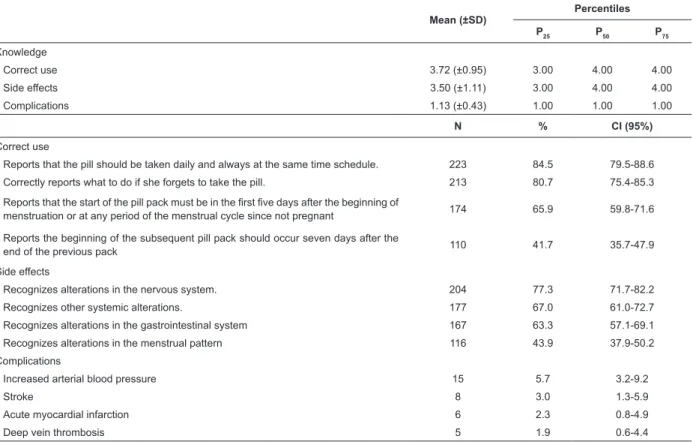
Table 1 - Distribution of the number of low-dose COC users according to the level of knowledge about correct use, side effects and complications of the method. Fortaleza Health System, CE, Brazil, 2010
P25: Percentile 25; P50: Percentile 50 or median; P75: Percentile 75; CI: Conidence interval
Daily use of the pill at a regular time was the item that participants were the most correct about regarding the correct use of the method (84.5%, 95% CI=79.5-88.6); the correct start of the subsequent pill pack was mentioned by 41.7% of participants (95% CI=35.7-47.9), the item that participants were the most wrong about in this knowledge area. Thus, the knowledge gap in the research group regarding the items assessing the correct use of COC, was about what to do if one forgets one or more pills, as well as the
beginning of the irst pack or subsequent pack.
Regarding the knowledge about side effects, up to 75% of participants had “substantial” knowledge and “changes in the nervous system” were cited by 77.3% of participants (95% CI = 71.7-82.2%). Changes in menstrual pattern were cited by 43.6% of participants (95% CI = 37.9-50.2), the least cited side effects. Nevertheless, this frequency can be considered relatively high.
Regarding complications related to the use of low-dose COC, 75% of women had no knowledge. Increased blood pressure and deep vein thrombosis were the most and least known complications, reported by 5.7% (95% CI = 3.2-9.2) and 1.9% (95% CI = 0.6-4.4%) of participants, respectively.
Table 2 shows that knowledge about the correct
use of low-dose COC signiicantly correlates positively
with schooling and family income, suggesting that the higher the education (r=0.164, p=0.008) and/or family income (r =0.135, p=0.029), the greater the knowledge of the participants on the proper use of COC. Women with higher educational level also knew more about the complications related to the use of the method (r=0.166, p=0.007). All these correlations are considered very
weak by the classiication adopted.
Table 2 - Correlation between knowledge about the correct use with age, education, family income and time of COC use, knowledge about side effects with time of COC use and complications with education. Fortaleza Health System, CE, Brazil, 2010
ρ p-value
Knowledge about the correct use of COC
Age - 0.063 0.308
Education 0.164 0.008
Monthly family income 0.135 0.029
Time of COC use 0.023 0.712
Rev. Latino-Am. Enfermagem 2013 July-Aug.;21(4):928-34.
Table 2 - (continuation)
ρ p-value
Knowledge about side effects
Time of COC use 0.189 0.002
Knowledge about complications related to the use of COC
Education 0.166 0.007
Regarding knowledge about side effects, the very weak positive correlation suggests that women who used COC longer knew more about its side effects (r = 0.189, p = 0.002).
Discussion
The predominance of “substantial” knowledge about the correct use and side effects related to low-dose COC among participants may be due in part to the investment of the Ministry of Health in this area of care, prioritizing since the 80s, promoting Family Planning (FP) services to the population, based on free and informed choice of the CM, recommending health professionals to conduct educational activities on the general characteristics of the CM.
The female autonomy and the interest about the control of offspring, linked to women insertion in the labor market and increased competitiveness of this market, requiring women more years of studies and
further reinement improvement, with the expansion of
information through informal channels, like the internet, have also contributed to this result.
However, there is lack of women’s knowledge about the correct start of low-dose COC pack, on the regularity of the time to take the pill and on the measures to be adopted when one forgets to take one or more pills.
Inadequate knowledge about the start of COC packs fell was about the interval required to start the
irst pack and subsequent packs. Regardless of the irst
or subsequent pack, participants reported to “start the
pack on the ifth day of menstruation”. It is known that
for better effectiveness of this COC, ti should preferably
be started on the irst day of the menstrual cycle or until the ifth day and a seven-day interval between a pack
and the next should occur, and the user must initiate use regardless of the day menstrual cycle(3).
One of the basic points to be considered to
guarantee the eficacy of low-dose COC is daily taking
at a regular time. Health professionals may discuss with their clients tips related to pill use, i.e., how to associate the time to take the pill with some daily activity. In this
regard, it is important to inform users about how regular ingestion of the pill contributes to the reduction of side effects(3).
There is, therefore, the need for improved knowledge of the participants, because they showed themselves exposed to increased risks of COC failure and side effects due to lack of knowledge about the correct use of the method.
Forgetting one or more pills can be faced by the user in different ways, depending on the number of missed pills: from one to three pills, there is a chance to keep using the same pack with little harm to the
eficacy of the method; when more than three pills are
forgotten, the pack in use must be interrupted and the woman must wait for the next menstrual period and start a new pack(3).
In the assessment of knowledge about side effects, substantial knowledge prevailed (scale level). Because they are unpleasant sensations, it is possible that women are more interested in clarifying its occurrence with health professionals or even in social life. It is also likely that health professionals, during FP consultations, orientate women about the most common side effects in order to avoid interruption of the use of the method. Authors claim that the use of the CM sought by women may be affected or suspended by the lack of knowledge.
It is assumed, yet, that adequate information about the side effects is being acquired by most study participants. Information about CM enables free choice of the method, tahe basic right to be provided to clients according to Law N. 9263/1996, about FPin Brazil. In particular, information about COC side effects of will reduce fear and insecurity of women, as well as provide better observation of those, greater persistence in
continuing to use the method, clariication about myths
related to its use and greater satisfaction with the use. Regarding complications related to COC use, increased blood pressure and deep vein thrombosis were the most and least known complications, reported by 15 (5.7%, 95% CI = 3.2-9.2) and 5 (1.9%, 95% CI = 0.6-4.4%) participants, respectively. This was the area of the lowest knowledge. The risks mentioned by women exposed were different from the literature(3)
and, unlike the systemic complications such as deep vein thrombosis, myocardial infarction and stroke, women reported complications in the female reproductive system, i.e., 132 (50%) reported mass accumulation in the uterus which, according to some participants, the “physician said” “scratch”, cysts or tumors, infertility,
Therefore, the perceptions in this knowledge were incorrect and underlie individual-user, community, but can also permeate health professionals who, not knowing or neglecting the transfer of information to customers, end up contributing to sedimentation of these myths, thereby, when the unveiling the correct information should occur(8).
The incorrect use of COC by women makes them
vulnerable to unplanned pregnancy, since the eficacy
of the method in these circumstances is compromised(3).
This vulnerability is not conined, however, to
developing countries, such as Brazil. Unplanned pregnancy in the presence of CM use is a reality also faced in countries such as Vietnam, United Kingdom and United States(5,13-14). In those countries, incorrect use of
CM is also evidenced as well as the need to implement educational strategies that engage individuals to perceive themselves at risk for unplanned pregnancy due to inadequate use of the method.
In a study performed with 278 adolescents in the city of Teresina-PI, a questionnaire and scales were used in order to measure objective knowledge about the use of oral contraceptives. In order to be considered as having adequate objective knowledge, it was necessary to answer correctly the four items in the scale that addressed their correct use of the method. It was found that 98.2% of these adolescents had low objective knowledge. The authors concluded that the
lack of knowledge relects the need for more accessible
communication techniques(15).
In the sample of the present study, there was greater knowledge about the correct use of COC among women with higher education and better economic situation; the better these conditions, the better the knowledge level (positive Spearman’s correlation).
In Brazil, the decline in fertility was higher in
more developed regions of the country, conirming
the relationship between socioeconomic status and effectiveness in contraceptive use(1,16).
Information about low-dose COC among women in this study should be provided with higher effectiveness. For such, activities of individual and collective orientation should not be punctual, circumscribed to the delivery of COC packs monthly, but developed in several opportunities for attention to their health as a priority area of care.
Conclusion
The participants had, in general, “substantial” knowledge level about the correct COC use and side
effects and “No” knowledge about complications with the use of COC. The knowledge about the correct use of COC was higher among women with higher education and better economic situation, i.e., the better these conditions, the better the level of this knowledge.
It is necessary that professionals in primary health care, especially nurses, develop strategies for health education in order to promote the acquisition of knowledge by COC users about the method. Supporting by the management of the local health system is fundamental, in order to ensure the necessary logistics to primary care teams.
The non-validation of the Likert scales used in this study constitutes a limitation of the research. Therefore, it is suggested for future research both the validation of such scales and the assessment of the impact of health education strategies aimed at improving knowledge of COC users.
References
1. Ministério da Saúde (BR). PNDS 2006- Pesquisa Nacional de Demografia e Saúde da Mulher e da Criança. Brasília: Ministério da Saúde; 2008.
2. Sociedade Bem-estar Familiar no Brasil (BEMFAM). Pesquisa Nacional sobre Demografia e Saúde. Rio de Janeiro: BEMFAM; 1997.
3. World Health Organization (WHO) and Johns Hopkins Bloomberg School of Public Health/Center for Communication Programs (CCP), INFO Project. Family Planning: A Global Handbook for Providers. Baltimore (MD); 2007.
4. Bahamondes L, Pinho F, Melo NR, Oliveira E, Bahamondes MV. Associated factors with discontinuation use of combined oral contraceptives. Rev Bras Ginecol Obstet. 2011;33(6):303-9.
5. Duong DV, Lee AH, Binns CW. Contraception within six-month postpartum in rural Vietnam: Implications on family planning and maternity services. Eur J Contracept Reprod Health Care. 2005;10(2):111-8.
6. Organización Mundial de la Salud. Recomendaciones sobre Prácticas Seleccionadas para el Uso de Anticonceptivos. Ginebra: OMS; 2005.
7. Pierre LAS, Clapis MJ. Family Planning in a Family Health Unit. Rev. Latino-Am. Enfermagem. 2010 nov-dez;18(6):1161-8.
Rev. Latino-Am. Enfermagem 2013 July-Aug.;21(4):928-34.
9. Moura ERF, Silva RM. Professional competence and contraceptive care. Rev Saúde Pública. 2005; 39(5):795-801.
10. Paniz VMV, Fassa AG, Silva MC. Knowledge about contraceptives in a population 15 years or older in a Southern Brazilian city. Cad Saúde Pública. 2005;21(6):1747-60.
11. Secretaria Municipal da Saúde (CE). Relatório de Gestão 2007. Fortaleza (CE): SMS; 2007.
12. Williamson LM, Parkes A, Wight D, Petticrew M, Hart GJ. Limits to modern contraceptive use among young women in developing countries: a systematic review of qualitative research. Reprod Health. 2009;6(3):1-12. 13. Kraft JM, Harvey SM, Thorburn S, Henderson JT, Posner SF, Galavotti C. Intervening with couples assessing contraceptive outcomes in a randomized pregnancy and HIV/STD risk reduction intervention trial. Women’s Health. 2007;17(1):52-60.
14. Mark H. The structure of contraceptive education and instruction within nurse led family planning clinics: a grounded theory study. J Clin Nurs. 2009; 18(18):2656-67.
15. Sousa MCR, Gomes KRO. Objective and perceived knowledge of oral contraceptive methods among adolescent mothers. Cad Saúde Pública. 2009;25(3):645-54.
16. Santos JC, Freitas PM. Family planning under the view of development. Ciênc Saúde Coletiva. 2011;16(3):1813-20.