245
ABSTRACT
BACKGROUND AND OBJECTIVES: Despite the widespread use of interferential current, controversy exists in the literature on the optimal stimulation parameters. he aim of this study was to evaluate the threshold and the total number of accommoda-tions in subjects stimulated by diferent amplitude-modulated frequencies.
METHODS: he study is a clinical, cross-over trial with ran-domized and blinded convenience sample consisted of 20 healthy subjects, with mean age of 20.35 years, of both genders. Volunteers underwent interferential current for 20 minutes, the bipolar form, with electrodes placed on the elbow joint being positioned one above the supericiality of the ulnar nerve and the other of the median nerve. Equipment parameters were: base fre-quency of 4,000Hz, amplitude-modulated frequencies 1, 10 or 100Hz (according to the subgroup). hreshold and total number of accommodations were assessed.
RESULTS: For the accommodation threshold no signiicant dif-ferences were found (p>0.05). With regard to the number of ac-commodations, there have been signiicant diferences between the frequencies of 10 and 100Hz (p<0.05).
CONCLUSION: here was no signiicant diference in the ac-commodation threshold; however, we observed signiicant difer-ences between the frequencies of 10 and 100Hz.
Keywords: Electric stimulation therapy, Physical therapy modalities, Sensory thresholds, Transcutaneous electric nerve stimulation.
Effect of interferential current of different amplitude-modulated
frequencies, on threshold and number of accommodations on healthy
painless individuals*
Efeito da corrente interferencial de diferentes frequências moduladas pela amplitude no limiar e
número de acomodações em indivíduos saudáveis sem dor
Beatriz Gavassa de Araújo1, Karina Maria Filipin1, Tathiane Pasqualli1, Lucinéia de Fátima Chasko Ribeiro1, Gladson Ricardo Flor
Bertolini1
*Received from State University of Western Paraná, Cascavel, PR, Brazil.
1. State University of Western Paraná, Cascavel, PR, Brazil.
Submitted in April 22, 2014.
Accepted for publication in September 17, 2014. Conlict of interests: none.
Correspondence to: Gladson Ricardo Flor Bertolini
Rua Universitária, 2069 – Jardim Universitário 85819-110 Cascavel, PR, Brasil.
E-mail: [email protected]
© Sociedade Brasileira para o Estudo da Dor
RESUMO
JUSTIFICATIVA E OBJETIVOS: Apesar do uso generalizado da corrente interferencial, há controvérsias na literatura sobre os parâmetros ideais de estimulação utilizados. O objetivo deste es-tudo foi avaliar o limiar e o número total de acomodações em indivíduos estimulados por diferentes frequências moduladas pela amplitude.
MÉTODOS: Trata-se de um ensaio clínico, cruzado, com amostra de conveniência aleatorizada e encoberta, composta por 20 indivíduos saudáveis, com idade média de 20,35 anos, de am-bos os gêneros. Os voluntários foram submetidos a corrente in-terferencial por 20 minutos, na forma bipolar, com os eletrodos localizados na articulação do cotovelo, sendo posicionados um sobre a supericialidade do nervo ulnar e outro do nervo me-diano. Os parâmetros do equipamento foram: frequência base de 4.000Hz, frequências moduladas pela amplitude de 1, 10 ou 100Hz (de acordo com o subgrupo do dia). Foi avaliado o limiar de acomodação e o número total de acomodações.
RESULTADOS: Para o limiar de acomodação não foram encon-tradas diferenças signiicativas (p>0,05); quanto ao número de acomodações houve diferenças signiicativas entre as frequências de 10 e 100Hz (p<0,05).
CONCLUSÃO: Observou-se que não houve diferença estatísti-ca quanto ao limiar de acomodações, porém, houve diferenças signiicativas entre as frequências de 10 e 100Hz.
Descritores: Estimulação elétrica neural transcutânea, Limiar sensorial, Modalidades de Fisioterapia,Terapia por estimulação elétrica.
INTRODUCTION
Interferential current (IC) is a widely used rehabilitation tool because it has few associated adverse efects1. Its primary objective is analgesia. Although precise mechanisms are still questioned, it is believed that the gate theory and increased nervous ibers depolarization threshold are involved2-5. Major IC characteristic is the mean frequency (2.4 or 8kHz) modulated by two slightly diferent sinusoidal currents, which generates amplitude-modulated frequency (AMF). Its efect is similar to that observed with low frequency current, such as
Rev Dor. São Paulo, 2014 oct-dec;15(4):245-7 ORIGINAL ARTICLE
246
Araújo BG, Filipin KM, Pasqualli T, Ribeiro LF and Bertolini GR
Rev Dor. São Paulo, 2014 oct-dec;15(4):245-7
transcutaneous electric nerve stimulation (TENS), however it brings less discomfort and goes deeper into tissues6. When just a pair of electrodes is used (bipolar application), currents inter-ference is inside the device, being considered pre-modulated5. here are still controversies about ideal modulation ranges as well as about the role of AMF7,8 and other parameters. Among them, there is Δf (frequency amplitude) and slope (Δf slope patterns, usually with variations in 1:1, 1:5:1 or 6:6 seconds, indicated for chronic, sub-acute and acute cases, respec-tively)9,10. Accommodation is a phenomenon induced by de-creased number of nervous depolarizations due to repetitive and prolonged stimulation. In case of electric stimulation, to get constant stimulation, it is necessary to increase intensity whenever the individual reports stimulation decrease11. In spite of generalized IC use, no studies were found analyz-ing whether diferent AMF have diferent efects on accom-modation. So, this study aimed at evaluating the threshold and total number of accommodations in individuals stimu-lated by diferent AMF for 20 minutes.
METHODS
his is a crossover trial with randomized and blind conve-nience sample. Data were collected at UNIOESTE’s Physical Rehabilitation Center (CRF) and volunteers came on prede-termined times. Sample was made up of 20 people (13 fe-males), with mean age of 20.35 years, mean weight of 63.95 kg, mean height of 1.69 m, and mean body mass index (BMI) of 22.13kg/m2.
After being explained about study objectives and procedures, volunteers were submitted to evaluation to identify possible non inclusion factors. Inclusion criteria were availability to participate in evaluations and tests in predetermined days and times. Exclusion criteria were heart disease, metal implant, gestation, chronic pain or left upper limb injury, sensitivity changes, rheumatic diseases or any other contraindication to the use of electric stimulation or interferential current. After accepting the invitation and having conirmed their eligibility for the study, volunteers have signed the Free and Informed Consent Term (FICT).
Electric stimulation protocol and evaluation
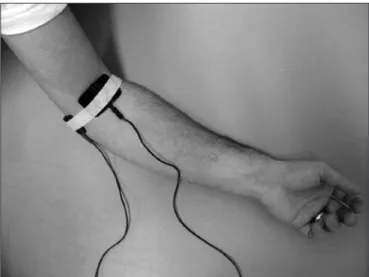
Volunteers received electric stimulation with the Neurovector (Ibramed®) device, in the bipolar form, with electrodes placed on left elbow joint, being one positioned ion the supericiality region of the ulnar nerve and the other on the median nerve (Figure 1). Volunteers remained comfortably seated during electric stimulation. Electrodes were made of rubber-silicone with 8cm2. Equipment parameters were: base frequency of 4000Hz, AMF according to the subgroup of the day, being the sample divided in three subgroups (A, B or C). Conside-ring the crossover characteristic of the study, all volunteers went through all AMF (1, 10 or 100Hz). Data were collected with at least one-week rest between each evaluation. No Δf was used, thus no slope, since the objective was just to evalu-ate diferent AMF.
After asepsis with cotton soaked in 70% alcohol, placement of electrodes and deinition of parameters, the evaluator has gradually increased current intensity until a sensation of par-esthesia was reported by the individual, with high, however not painful, current intensity. Volunteers were asked to report the moment when the sensation of paresthesia decreased, that is, accommodation threshold, which has been timed. hen, current intensity was increased until paresthesia returned to baseline level, and the increasing process was repeated in all opportunities volunteers have reported its decrease, being re-corded the number of times this has happened (total accom-modations), during 20 minutes of stimulation.
Statistical analysis
Analyzed data have not followed the normal curve and non-para-metric tests were used for analysis, being groups compared by Friedman test, with Dunn’s post-test. Signiicance level was 5%. his study was approved by the Ethics Committee for Human Beings Research, State University of Western Parana, under opinion 143/2013.
RESULTS
here have been no signiicant diferences (p>0.05) in accom-modations threshold. here has been signiicant diference in total number of accommodations between 10 and 100Hz fre-quencies (p<0.05) (Table 1).
Table 1. Comparison of accommodation threshold of different am-plitude-modulated interferential current frequencies used during 20 minutes of application.
1Hz 10Hz 100Hz
Accommodation
threshold Median 132.0s 127.5s 140.0s
Number of
accommodations Median 2.500n 1.500n* 3.000n*
*Signiicant difference between 10 and 100Hz; s: seconds; n: number of accommodations.
247
Efect of interferential current of diferent amplitude-modulated frequencies, on threshold and number of accommodations on healthy painless individuals
Rev Dor. São Paulo, 2014 oct-dec;15(4):245-7
DISCUSSION
IC has the advantage of reducing skin resistance, thus the dis-comfort normally produced by traditional low frequency cur-rents, being able to stimulate peripheral nerves6. Our study intended to evaluate the efects of diferent AMF on accommo-dations threshold and number in healthy volunteers, by bipolar application on elbow joint12. he objective was to ind an opti-mal stimulation pattern and also to prevent accommodations. In clinical practice, higher frequencies (for example, 100Hz) are used for analgesia and seem to act according to the gate theory. Lower frequencies (for example, 10Hz) seem to stimulate A-delta and C ibers with consequent endogenous opioids release, thus improving local blood low and physiologically blocking nervous conduction12. However, there are authors who do not believe that these frequencies may have physiological efects on hypoalgesia7, one hypothesis being the placebo efect13. For chronic low back pain, intensity considered as “high”, however “comfortable”, is able to decrease pain2.
IC has tools looking at preventing sensitivity to current ac-commodation, such as Δf and slope, however they have not shown to be efective to change accommodation threshold9,10. Previous studies investigating such parameters have shown frequencies similar to those investigated herein. Similar re-sults may be observed, being that the only diference found was with regard to the number of accommodations accord-ing to frequency (10 or 100Hz). On the other hand, these frequencies were not diferent from 1 Hz with regard to the number of accommodations. here are still controversies about the base frequency14 with regard to AMF7,15. However, this latter does not seem to be important for electric stimula-tion-induced analgesia.
Preventing current accommodation is important because it allows for the continuity of IC therapeutic efect and, al-though the tetrapolar form is able to go deeper, the bipolar form also produces high voltages in line with the circuit6. So, it is believed that stimulation tested in this study, in addition to being widely used, is feasible as bipolar electric analgesia standard: with high, however not painful, intensity.
he evaluation of healthy individuals may be considered a limi-tation to this study, since IC is clinically used in painful
pa-tients. So, future studies in individuals with painful syndromes are needed to observe analgesia and the efect of accommoda-tion to electric stimulaaccommoda-tion as parameter for pain relief.
CONCLUSION
here has been no diference in accommodation threshold ac-cording to frequencies, however there has been a lower num-ber of accommodations with 10Hz frequency as compared to 100Hz frequency. So, 10 Hz frequency seems to be more indicated for clinical use for this objective.
REFERENCES
1. Satter EK. hird-degree burns incurred as a result of interferential current therapy. Am J Dermatopathol. 2008;30(3):281-3.
2. Facci LM, Nowotny JP, Tormem F, Trevisani VF. Efects of transcutaneous electrical nerve stimulation (TENS) and interferential currents (IFC) in patients with nonspeciic chronic low back pain : randomized clinical trial. São Paulo Med J. 2011;129(4):206-16. 3. Fuentes CJ, Armijo-Olivo S, Magee DJ, Gross DP. A preliminary investigation into the
efects of active interferential current therapy and placebo on pressure pain sensitivity: a random crossover placebo controlled study. Physiotherapy. 2011;97(4):291-301. 4. Lara-Palomo IC, Aguilar-Ferrándiz ME, Matarán-Peñarrocha GA, Saavedra-Hernández
M, Granero-Molina J, Fernández-Sola C, et al. Short-term efects of interferential current electro-massage in adults with chronic non-speciic low back pain: a randomized control-led trial. Clin Rehabil. 2013;27(5):439-49.
5. Rocha CS, Lanferdini FJ, Kolberg C, Silva MF, Vaz MA, Partata WA, et al. Interferential therapy efect on mechanical pain threshold and isometric torque after delayed onset mus-cle soreness induction in human hamstrings. J Sports Sci. 2012;30(8):733-42. 6. Beatti A, Rayner A, Chipchase L, Souvlis T. Penetration and spread of interferential current
in cutaneous, subcutaneous and muscle tissues. Physiotherapy. 2011;97(4):319-26. 7. Fuentes CJ, Armijo-Olivo S, Magee DJ, Gross D. Does amplitude-modulated frequency
have a role in the hypoalgesic response of interferential current on pressure pain sensitivity in healthy subjects? A randomised crossover study. Physiotherapy. 2010;96(1):22-9. 8. Ozcan J, Ward AR, Robertson VJ. A comparison of true and premodulated interferential
currents. Arch Phys Med Rehabil. 2004;85(3):409-15.
9. Guerra TE, Bertolini GR. Efeitos da variação da rampa de entrega do ΔF sobre a acomo-dação da corrente interferencial em mulheres saudáveis. Rev Dor. 2012;13(1):25-9. 10. Pivetta KM, Bertolini GR. Efeitos do ΔF sobre a acomodação da corrente interferencial em
sujeitos saudáveis. Rev Bras Med Esporte. 2012;18(5):330-2.
11. Krueger-Beck E, Scheeren EM, Nogueira-Neto GN, Button VL da SN, Neves EB, Noha-ma P. Potencial de ação: do estímulo à adaptação neural. Fisioter Mov. 2011;24(3):535-47. 12. Artioli DP, Bertolini GR. Corrente interferencial vetorial: aplicação, parâmetros e
resulta-dos. Rev Soc Bras Clin Med. 2012;10(1):51-6.
13. Fuentes JP, Armijo Olivo S, Magee DJ, Gross DP. Efectiveness of interferential current therapy in the management of musculoskeletal pain: a systematic review and meta-analysis. Physher. 2010;90(9):1219-38.
14. Venancio RC, Pelegrini S, Gomes DQ, Nakano EY, Liebano RE. Efects of carrier fre-quency of interferential current on pressure pain threshold and sensory comfort in hu-mans. Arch Phys Med Rehabil. 2013;94(1):95-102.