ORIGINAL ARTICLE
Association between body image dissatisfaction and
depressive symptoms in adolescents
Fiorela Flores-Cornejo, Mayumi Kamego-Tome, Mariana A. Zapata-Pachas, German F. Alvarado
Escuela de Medicina, Universidad Peruana de Ciencias Aplicadas, Lima, Peru.
Objective:To determine the association between body image dissatisfaction (BID) and depressive symptoms in adolescents from a school in Lima, Peru.
Methods:A cross-sectional study was performed through a census of 875 high-school students, aged 13 to 17 years, from a school in Lima. Participants completed a survey containing the Body Shape Questionnaire (BSQ) and the Patient Health Questionnaire-9 (PHQ-9). Data regarding demographics, alcohol and tobacco use, self-esteem, and family history of depression were also obtained. To identify associated factors, Poisson regression with robust variance was used. Prevalence ratios with 95% confidence intervals were calculated.
Results:Of the 875 adolescents, 55.8% were male. The mean age was 14.161.5 years. Depressive symptoms were observed in 19.9% of participants. An association between BID and depressive symptoms was found. Alcohol and tobacco use were also associated with the outcome of interest.
Conclusions: Teens who had BID were 3.7 times more likely to report depressive symptoms. Additionally, those who used tobacco or alcohol were 1.5 and 1.4 times more likely to have depressive symptoms, respectively. Further studies targeting other populations and using longitudinal designs are recommended.
Keywords: Adolescents; body image; depression
Introduction
Depression is a public health problem that is present in 10-20% of the general population, according to the World Health Organization (WHO), and is considered the main cause of disability worldwide.1In Peru, the prevalence is similar at 10-20% overall and approximately 18% in Metro-politan Lima.2
The DSM-5 defines depression as ‘‘a depressed mood or loss of interest or pleasure in nearly all activities for a period of at least 2 weeks, considering that children and adolescents may be irritable instead of sad.’’3It is char-acterized by an episodic course with high rates of recur-rence (35% in 2 years and 60% in 12 years).
The relevance of this issue is that depression is associated with various potentially preventable public health problems, such as deterioration in personal and/or social functioning,4
substance abuse (alcohol and tobacco), and suicide.4-6 Several factors have been associated with the devel-opment of depressive symptoms in adolescents. Female sex and age have been found to be particularly impor-tant,5and some studies showed that alcohol and tobacco use are risk factors for depressive symptoms.6,7
According to research conducted in various countries, including the United States, Jamaica, and Spain, dis-torted body image could be a risk factor for develop-ing depressive symptoms.8-15 Body image is defined as
‘‘a concept that one has of their own shape, size, body mass and parts.’’16 Misperceptions can have a great impact on adolescents2 due to the extreme measures they might then take in pursuit of the ‘‘ideal image.’’17,18 Studies have shown that most teenagers have a dis-torted image of themselves.16,19-21 In a cross-sectional study by Santana et al. of 1,494 adolescents aged 11 to 17 in Salvador, state of Bahia, Brazil, own body dissat-isfaction was reported by 19.5% of adolescents, and was more prevalent in girls (26.6%) than boys (10%).19
In 2014, a Spanish study by Ferreiro et al. found that teens who had body image dissatisfaction (BID) were at increased risk of depressive symptoms.8Another study, conducted in 2014 by Blow et al. in a sample of 160 Hispanic college students in Texas, found the same association.14
On the other hand, a study conducted in Brazil by Fortes et al. in 2015 on 407 young people showed no association between these variables.22
It is important to know the difference between self-esteem and body image, as the two concepts might be confused. Self-esteem, according to Mann, is defined as ‘‘the eval-uative and affective dimension of self-concept and is considered an equivalent to self-regard and self-worth.’’23 Contrariwise, body image is based on a biopsychosocial construct, i.e., the image that society, peers, and oneself has according to their ideal body image.17
WHO has proposed that adolescents are a vulnerable population.24In reviewing the literature, we found studies linking low self-esteem with depression in adolescents; however, no investigations conducted in Latin American countries (except Brazil) have assessed whether depres-sion is associated with body image in this age group.25
Correspondence: Mariana Alejandra Zapata-Pachas, Julio Verne 165 Urb. Higuereta, Santiago de Surco, Lima 33, Peru.
E-mail: [email protected]
Submitted Feb 28 2016, accepted Nov 03 2016, Epub Mar 23 2017. Associac¸a˜o Brasileira de Psiquiatria
The present study aims to determine whether an associa-tion exists between BID and depressive symptoms in high school students. Secondary aims were to determine the prevalence of depressive symptoms in this population and whether depressive symptoms are associated with life-time alcohol and tobacco use.
Materials and methods
Design, sample population, and study site
From October 24 to 27, 2014, we conducted a cross-sectional study of all students enrolled for the 2014 school year in a private high school in Ate, Lima.
We excluded students who did not attend on the day of the surveys, students who did not return a consent form signed by their parents, and those who refused to answer the survey. The final sample comprised 875 students, and the response rate was 95.2% (Figure 1).
Sample size was calculated in Epidat 4.0 software. On the basis of data from previous studies,15a minimum sample size of 600 was established. Population 1 was the esti-mated proportion of people who had BID and depressive symptoms (30%) and population 2 was the estimated pro-portion of people without BID and depressive symptoms (20%). Confidence level was set to 95% and a statistical power of 80% was considered.15
Instruments
The questionnaire, a compendium of four previously vali-dated instruments, was anonymous and self-administered. Tobacco and alcohol use were assessed using standar-dized questions from the Spanish version of the Youth Risk & Resiliency Survey Center for Disease Control (CDC).26 For this study, only lifetime use was considered.
Self-esteem was assessed using the Self-esteem Test for Teens, which consists of 21 questions, evaluated on a Likert-type scale, covering four domains: cognitions about
yourself, cognition of competence, family relationship, and anger. This scale has no cutoff. The questionnaire has been validated for use in Spanish.27
Body image was assessed with the 34-item Body Shape Questionnaire (BSQ), scored on a Likert-type scale, which has also been validated for use in Spanish. BID was con-sidered if the score was higher than 105 points.28
Depressive symptoms were measured with the 14-item Patient Health Questionnaire (PHQ-9), validated in Spanish.29 Nine questions defined the score to determine whether depressive clinical features were present; a scoreX10 points was considered positive. This instrument is based on the DSM-IV.30
The questionnaire also collected demographic vari-ables such as age, grade, sex (male/female), and history of depression in first-degree relatives.
Procedures
After approval of the research project by the Ethics Commit-tee of the Universidad Peruana de Ciencias Aplicadas School of Health Sciences and the school authorities, the investigators went to the school as scheduled. First, lists of students from all secondary levels, stratified by grade and section, were obtained. Informed consent forms were sent in sealed envelopes to students’ parents, and informed assent was obtained from the students before administration of the survey. Data collection was performed on two days. On day one, first-, second-, and third-grade students were evaluated, while on day two, fourth- and fifth-graders were assessed. An investigator remained in each classroom to clear up any doubts from the students. The survey took approximately 15 to 25 minutes to complete.
Statistical analysis
Survey data were entered into a Microsoft Excel 2007 database by the double entry method. Statistical analyses were performed in STATA version 11.0.
Measures of central tendency and dispersion (for quanti-tative variables) and proportions (for categorical variables) were calculated. A t-test and chi-square test were used for bivariate analysis, and assumptions were verified. P-values o 0.05 were considered significant. Reliability
was assessed using Cronbach’s alpha for the self-esteem, BSQ, and PHQ-9 scales. Likewise, for the self-esteem scale, exploratory factor analysis with the principal com-ponents method was performed.
For multivariable analysis, we used Poisson regression with robust variance to model association between depres-sive symptoms and independent variables; the latter were included in the model if p o 0.2 on bivariate analysis.
Adjustments could not be applied to all factors of self-esteem at the same time because of collinearity between them. Crude and adjusted analyses were performed, reporting prevalence ratios (PR) and 95% confidence intervals (95%CI).
Ethical aspects
As mentioned, this study was approved by the Ethics Com-mittee of the Universidad Peruana de Ciencias Aplicadas School of Health Sciences. In addition, permission to conduct the study was obtained from school authorities. Participants’ parents were informed in advance of the study’s objectives, and only those participants who assented
and whose parents had signed informed consent forms were included and surveyed.
Results
Population characteristics
In 2014, 919 students were enrolled in the school in which the study was conducted. The overall non-response rate was 4.8% (n=44); 21 students completed the surveys incorrectly, 15 were absent on the days of data collection, and eight refused to take the survey. Thus, the final sample size was 875 (55.8% male). The mean age was 14.161.5 years (range: 11 to 17 years).
Overall, 19.9% of participants had depressive symp-toms and 11.3% had BID. Lifetime prevalence of alcohol and tobacco use was 60.3% and 25.1% respectively. Finally, 15.7% of participants had at least one family member diagnosed with depression (data not shown).
In general, we found associations between sex, tobacco use, alcohol use, family history of depression, the ‘‘cogni-tion about yourself’’ domain of the Self-esteem Test for Teens, and family relationship with BID (po0.05) (Table 1).
We did not find associations between the other variables and BID.
As explained in the Instruments section, the self-esteem variable has four factors: cognition about yourself,
Table 1 General characteristics of high school students in a school in Lima, Peru, 2014
Characteristics Body image dissatisfaction*
Yes (n=90) % No (n=700) % p-value
Age (years), mean (SD) 14.3 (1.5) 14.1 (0.5) 0.17
Sex o0.001
Female 62 68.8 295 41.8
Male 28 31.1 411 58.2
Grade 0.41
First (12-13 years old) 13 14.4 159 22.5
Second 18 20.1 142 20.1
Third 20 22.2 153 21.9
Fourth 19 21.1 133 18.8
Fifth (16-17 years old) 20 22.2 119 16.9
Self-esteemwz score, mean (SD)
Cognition about yourself -1.1 (1.1) 0.2 (0.9) o0.001
Cognition of competence 0.1 (1.0) -2*10-2(1.0) 0.18
Anger 0.1 (0.9) -3*10-2(1.0) 0.29
Family relationship 0.5 (1.3) -4*10-2(0.9) o0.001
Tobacco use= 0.04
Yes 30 33.7 168 23.8
No 59 66.3 537 76.2
Alcohol use= 0.006
Yes 66 73.3 408 58.4
No 24 26.7 291 41.6
Family history of depression 0.02
Yes 21 23.3 101 14.3
No 69 76.7 605 85.7
SD = standard deviation.
*Defined as a Body Shape Questionnaire (BSQ) scoreX105 points. wSelf self-esteem test for adolescents.
cognition about competence, anger, and family relation-ship. We found a Cronbach’s alpha of 0.89 for this instru-ment, and an exploratory factor analysis found the same four factors reported in the literature.27For the body image scale (BSQ), Cronbach’s alpha was 0.96; for depression (PHQ-9), Cronbach’s alpha was 0.85. Exploratory factor analysis was also performed for the BSQ and PHQ-9 (data not shown), and yielded structures similar to those already reported, i.e., a one-factor solution.28,31,32
Analysis of the percentage of lost data for the exposure (9%) (data not shown) did not show any association with the age and sex distribution of participants (p40.05).
Depressive symptoms and independent variables: bivariate analysis
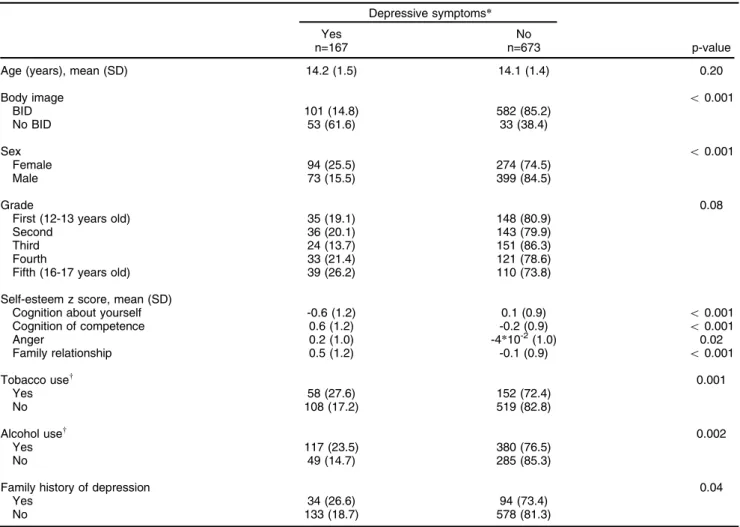
We did not find an association between age and depres-sive symptoms (p = 0.20) (Table 2); 61.6% of adolescents with BID endorsed depressive symptoms, vs. 14.8% without BID (po0.001). Each of the four factors of the self-esteem
variable was associated with depressive symptomatology (po0.05) (Table 2).
We found significant associations between tobacco and alcohol use and depressive symptoms (po0.01 for both
cases). Furthermore, 26.6% of students with a family history of depression reported depressive symptoms, as compared with 18.7% of those without such a family history (p = 0.04) (Table 2).
Multivariable analysis of association between depressive symptoms and independent variables
Table 3 shows the results of Poisson regression analysis. We found an association between BID and depressive symptoms (adjusted PR = 3.7; 95%CI 2.8-4.9; po0.001),
as well as associations between tobacco use and depres-sion (adjusted PR = 1.5; 95%CI 1.1-2.1; p = 0.01) and depression and alcohol use (adjusted PR = 1.4; 95%CI 1.0-2.0; p = 0.04). Other explored variables were not associated. We could not adjust by all self-esteem factors at the same time because of collinearity between them; however, adjustment with separate models by each factor of self-esteem (results not shown) yielded adjusted PRs for BID consistently above 3.0 (po0.001), except for the
first factor (‘‘cognition about yourself’’), for which the PR
Table 2 Bivariate analysis of association between depressive symptoms and body image dissatisfaction (BID) in a sample of high school students from Lima, Peru, 2014
Depressive symptoms*
Yes No
n=167 n=673 p-value
Age (years), mean (SD) 14.2 (1.5) 14.1 (1.4) 0.20
Body image o0.001
BID 101 (14.8) 582 (85.2)
No BID 53 (61.6) 33 (38.4)
Sex o0.001
Female 94 (25.5) 274 (74.5)
Male 73 (15.5) 399 (84.5)
Grade 0.08
First (12-13 years old) 35 (19.1) 148 (80.9)
Second 36 (20.1) 143 (79.9)
Third 24 (13.7) 151 (86.3)
Fourth 33 (21.4) 121 (78.6)
Fifth (16-17 years old) 39 (26.2) 110 (73.8)
Self-esteem z score, mean (SD)
Cognition about yourself -0.6 (1.2) 0.1 (0.9) o0.001
Cognition of competence 0.6 (1.2) -0.2 (0.9) o0.001
Anger 0.2 (1.0) -4*10-2(1.0) 0.02
Family relationship 0.5 (1.2) -0.1 (0.9) o0.001
Tobacco usew 0.001
Yes 58 (27.6) 152 (72.4)
No 108 (17.2) 519 (82.8)
Alcohol usew 0.002
Yes 117 (23.5) 380 (76.5)
No 49 (14.7) 285 (85.3)
Family history of depression 0.04
Yes 34 (26.6) 94 (73.4)
No 133 (18.7) 578 (81.3)
SD = standard deviation.
was 2.3 but still significantly associated with the outcome (po0.001).
Discussion
The main findings of this study were the prevalence of depressive symptoms and BID (19.9% and 11.3% respectively) and the association between depressive symptoms and BID (po0.001). Participants who met the
cutoff score for BID were 3.7 times more likely to report depressive symptoms than participants who did not endorse BID. Those who had ever used alcohol were 40% more likely to report depressive symptoms, while those who had ever used tobacco were 50% more likely to endorse such symptoms, after adjusting for all vari-ables in the equation.
The prevalence of depression found in our sample was in the range reported by WHO studies.1,33 Conversely,
the prevalence of BID was lower than that reported by other studies.9,19,21This may be explained by social and cultural differences between populations, by the use of different instruments, or both. However, it is important to note that BID is a concern because of its long duration and possible consequences, which include eating dis-orders, depression, and suicide risk.
After adjusting for potential confounders, a significant association was found between depressive symptoms and BID. This is consistent with previous studies that have found an association between these variables, such as that performed among Turkish adolescents by Ozmen in 200715and by Almeida in Portugal in 2013.9This asso-ciation might be mediated by bullying or chronic stress; the underlying mechanism is still unclear.34 Depressive
symptoms were also associated with lifetime prevalence of smoking and alcohol intake in our sample. A study by Goodman found that smoking was strongly associated with a higher probability of developing depressive symp-toms.35 Regarding drinking, Costello and Aalto-Seta¨la¨ reported an association between depressive disorders and alcohol intake.6,18The present study has not found an association between depression and sex.
Some important limitations of this study must be addres-sed. These include the potential for social desirability bias, because students knew their parents would receive a report with the results of the survey; nevertheless, any doubts were cleared up during a session. Likewise, the fact that participants completed the questionnaire in the same room as their classmates means their answers may have been influenced by peer pressure or a desire to be ‘‘socially correct.’’ Nevertheless, there was no conversa-tion in the classroom during this process; therefore, although this should be considered a limitation, we believe it is unlikely to have affected the results of this study. Classi-fication in the depressive symptoms group using a vali-dated instrument should not be considered equivalent to an evaluation performed by a trained clinician, although such epidemiological assessment correlates well with clinical evaluation.36In addition, some data were lost for the exposure variable (9%); nevertheless, we did not find an association between these lost data and the distribu-tion of sex or age. Not measuring bullying is a limitadistribu-tion, because it has been found that adolescents affected this problem are more likely to have a bad perception of their image and experience depression more often.37,38 Like-wise, we did not measure stress levels, eating disorders, or body mass index (BMI); the latter in particular is known
Table 3 Multivariate analysis of association between depressive symptoms and body image dissatisfaction (BID) in a sample of high schoolers from Lima, Peru, 2014
Characteristics Depressive symptoms
Crude model Adjusted model
PR* 95%CI p-value PR* 95%CI p-value
Body image
BIDw 4.2 3.2-5.3
o0.001 3.7 o0.001 0.001
No BID 1 Ref
Age (years) 1.1 1.0-1.2 0.22 1.0 0.9-1.1 0.48
Sex
Female 1.7 1.3-2.2 o0.001 1.2 0.9-1.7 0.14
Male 1 Ref
Family history of depression
Yes 1.4 1.0-2.0 0.04 1.1 0.8-1.5 0.59
No 1 Ref
Tobacco usew
Yes 1.6 1.2-2.1 0.001 1.5 1.1-2.1 0.01
No 1 Ref
Alcohol usew
Yes 1.6 1.2-2.2 0.002 1.4 1.0-2.0 0.04
No 1 Ref
BID = body image dissatisfaction; PR = prevalence ratio.
to be associated with depressive symptoms.39Finally, we assessed lifetime prevalence (cumulative occurrence) of tobacco and alcohol use; different results could have been found if we had used measures of more recent use, but this was not an aim of the present study.
Although the instruments used in this study had been validated for use in Spanish, they have not been validated for use in Peru. Thus, we performed exploratory factor analyses for the self-esteem, BSQ, and PHQ-9 variables. Also, the BSQ was originally developed for women, although the instrument is currently used in both sexes. Moreover, PHQ-9 was originally developed for adults, although nowadays it is also used in adolescents.40
This study was cross-sectional, not longitudinal; thus, if there is causality, it could be reverse, meaning that depressive symptoms may lead to BID. Finally, as our research was carried out in a private school, we cannot extrapolate conclusions to other populations (e.g., stu-dents of public schools).
A strong point of this study is that it was the first investigation to associate BID with depressive symptoms in Peru, and one of the first in Latin America and in developing countries to do so. As proposed by Thornicroft et al.,41more research in developing countries is needed to address the research gap in mental health.
It is important to highlight that the obtained results may advocate for further investigations, as this study popula-tion - adolescents - is considered vulnerable; it is important to focus on prevention, design and implement interven-tions, and instruct families with the objective of improving adolescent health. In addition to implementing a system of individualized psychological screening of students, con-tinued research into this issue with longitudinal studies, to confirm the direction of the association, is warranted. Studies involving more students in different settings and from different social strata are particularly recommended.
Acknowledgements
This publication is based on the undergraduate thesis of FFC, MKT, and MZP, submitted to the Universidad Peruana de Ciencias Aplicadas (UPC) School of Medi-cine. The authors of this paper would like to express their gratitude to their thesis advisers for the useful feedback provided. GFA acknowledges the UPC Office of the Vice Provost for Research for its support.
Disclosure
The authors report no conflicts of interest.
References
1 Kessler RC, Aguilar-Gaxiola S, Alonso J, Chatterji S, Lee S, Ormel J, et al. The global burden of mental disorders: an update from the WHO World Mental Health (WMH) surveys. Epidemiol Psichatr Soc. 2009;18:23-33.
2 Instituto Nacional de Salud Mental "Honorio Delgado-Hideyo Noguchi". Estudio epidemiolo´gico metropolitano en salud mental [Internet]. Anales de Salud Mental. 2002 [cited 2016 Nov 14]. www.insm.gob.pe/investigacion/ archivos/estudios/2002-ASM-EESM-M/files/res/downloads/book.pdf 3 American Psychiatric Association. Diagnostic and Statistical Manual
of Mental Disorders, Fifth Edition (DSM-5).Arlington: American Psy-chiatric Publishing; 2013.
4 Avenevoli S, Knight E, Kessler RC, Merikangas KR. Epidemiology of depression in children and adolescents. New York: Guilford; 2008. 5 De La O-Vizcarra M, Pimentel-Nieto D, Soto Maldonado BA, De la
O-Vizcarra TJ, Quintana-Vargas S. Frecuencia y factores de riesgo para depresio´n en adolescentes. Pediatr Mex. 2009;11:57-61. 6 Costello DM, Swendsen J, Rose JS, Dierker LC. Risk and protective
factors associated with trajectories of depressed mood from adoles-cence to early adulthood. J Consult Clin Psychol. 2008;76:173-83. 7 Pasco JA, Williams LJ, Jacka FN, Ng F, Henry MJ, Micholson GC,
et al. Tobacco smoking as a risk factor for major depressive disorder: population base study. Br J Psychiatry. 2008;193:322-6.
8 Ferreiro F, Seoane G, Senra C. Toward understanding the role of body dissatisfaction in the gender differences in depressive symp-toms and disordered eating: a longitudinal study during adolescence. J Adolesc. 2014;37:73-84.
9 Almeida S, Severo M, Arau´jo J, Lopes C, Ramos E. Body image and depressive symptoms in 13-year-old adolescents. J Paediatr Child Health. 2012;48:E165-71.
10 Johnson F, Wardle J. Dietary restraint, body dissatisfaction, and psychological distress: a prospective analysis. J Abnorm Psychol. 2005;114:119-25.
11 Paxton SJ, Eisenberg ME, Neumark-Sztainer D. Prospective pre-dictors of body dissatisfaction in adolescent girls and boys: a five-year longitudinal study. Dev Psychol. 2006;42:888-99.
12 Salafia EHB, Gondoli DM. A 4-year longitudinal investigation of the processes by which parents and peers influence the development of early adolescent girls’ bulimic symptoms. J Early Adolesc. 2011;31: 390-414.
13 Nichols SD, Dookeran SS, Ragbir KK, Dalrymple N. Body image perception and the risk of unhealthy behaviours among university students. West Indian Med J. 2009;58:465-71.
14 Blow J, Cooper TV. Predictors of body dissatisfaction and satisfaction in a Hispanic college student sample. Eat Behav. 2014;15:1-4. 15 Ozmen D, Ozmen E, Ergin D, Cetinkaya AC, Sen N, Dundar PE,
et al. The association of self-esteem, depression and body satisfac-tion with obesity among Turkish adolescents. BMC Public Health. 2007 May 16;7:80-80.
16 Lukianowicz N. ‘‘Body image’’ disturbances in psychiatric disorders. Br J Psychiatry. 1967;113:31-47.
17 Vaquero-Cristo´bal R, Alacid F, Muyor JM, Lo´pez-Min˜arro PA´ . [Body image; literature review]. Nutr Hosp. 2013;28:27-35.
18 Aalto-Seta¨la¨ T, Marttunen M, Tuulio-Henriksson A, Poikolainen K, Lo¨nnqvist J. Depressive symptoms in adolescence as predictors of early adulthood depressive disorders and maladjustment. Am J Psychiatry. 2002;159:1235-7.
19 Santana ML, Silva Rde C, Assis AM, Raich RM, Machado ME, de J Pinto E, et al. Factors associated with body image dissatisfaction among adolescents in public schools students in Salvador, Brazil. Nutr Hosp. 2013;28:747-55.
20 Mora ZS. Adolescencia e imagen corporal en la e´poca de la delga-dez. Rev Reflexiones. 2008;87:67-80.
21 Pinheiro AP, Giugliani ER. Body dissatisfaction in Brazilian school-children: prevalence and associated factors. Rev Saude Publica. 2006;40:489-96.
22 Fortes Lde S, Meireles JF, Paes ST, Dias FC, Cipriani FM, Ferreira ME. An association between the internalization of body image, depressive symptoms and restrictive eating habits among young males. Cienc Saude Colet. 2015;20:3457-65.
23 Mann M, Hosman CM, Schaalma HP, de Vries NK. Self-esteem in a broad-spectrum approach for mental health promotion. Health Educ Res. 2004;19:357-72.
24 World Health Organization. The health of young people: a challenge and a promise.Geneva: WHO; 1993.
25 Carvalho PHB, Conti MA, Neves CM, Meireles JFF, Oliveira FC, Ferreira MEC. Psychometric assessment of the Brazilian version of the Male Body Dissatisfaction Scale. Arch Clin Psychiatry. 2015; 42:90-4.
26 Youth Risk & Resiliency Survey. [Internet] Official NMYRRS Website [cited 2014 Feb 14].http://www.youthrisk.org/pdf/YRRS-2013-HS-S-Std.pdf
27 Caso J, Herna´ndez-Guzma´n L, Gonza´lez-Montesinos M. Prueba de autoestima para adolescentes. Rev Univ Psychol. 2011;10:535-43. 28 Castrillo´n-Moreno D, Montan˜o IL, Avendan˜o-Prieto G, Pe´rez-Acosta A.
corporal) BSQ para la poblacio´n colombiana. Act Colom Psicol. 2007;10:15-23.
29 Calderon M, Galvez-Bucollini JA, Cueva G, Ordonez C, Bromley C, Fiestas F. Validacio´n de la versio´n peruana del PHQ 9 para el diagno´stico de depresio´n. Rev Peru Med Exp Salud Publica. 2012;29:578.
30 Kroenke K, Spitzer RL, Williams JB. The PHQ-9: validity of a brief depression severity measure. J Gen Intern Med. 2001;16:606-13. 31 Warren CS, Cepeda-Benito A, Gleaves CH, Moreno S, Rodriguez S,
Fernandez MC, et al. English and Spanish versions of the Body Shape Questionnaire: measurement equivalence across ethnicity and clinical status. Int J Eat Disord. 2008;41:265-72.
32 Merz EL, Malcarne VL, Roesch SC, Riley N, Robins GR. A multigroup confirmatory factor analysis of the Patient Health Questionnaire-9 among English- and Spanish- speaking Latinas. Cultur Divers Ethnic Minor Psychol. 2011;17:309-16.
33 Kessler RC, Avenevoli S, Costello EJ, Georgiades K, Green JG, Gruber MJ, et al. Prevalence, persistence, and sociodemographic correlates of DSM-IV disorders in the National Comorbidity Survey Replication Adolescent Supplement. Arch Gen Psychiatry. 2012;69: 372-80.
34 Goldfield GS, Moore C, Henderson K, Buchholz A, Obeid N, Flament MF. Body dissatisfaction, dietary restraint, depression and weight status in adolescents. J Sch Health. 2010;80:186-92.
35 Goodman E, Capitman J. Depressive symptoms and cigarette smoking among teens. Pediatrics. 2000;106:748-55.
36 Haro JM, Arbabzadeh-Bouchez S, Brugha TS, de Girolano G, Guyer ME, Jin R, et al. Concordance of the Composite International Diagnostic Interview Version 3.0 (CIDI 3.0) with standardized clinical assessments in the WHO World Mental Health surveys. Int J Methods Psychiatr Res. 2006;15:167-80.
37 Kaltiala-Heino R, Fro¨jd S. Correlation between bullying and clinical depression in adolescent patients. Adolesc Health Med Ther. 2011; 2:37-44.
38 Wilson ML, Viswanathan B, Rousson V, Bovet P. Weight status, Body image and bullying among adolescents in Seychelles. Int J Environ Res Public Health. 2013;10:1763-74.
39 Eidsdottir ST, Kristjansson AL, Sigfusdottir ID, Garber CE, Allegrante JP. Association between, higher BMI and depressive symptoms in Icelandic adolescents: the mediational function of body image. Eur J Public Health. 2013;24:888-92.
40 Richardson LP, McCauley E, Grossman DC, McCarty CA, Richards J, Russo J, et al. Evaluation of the Patient Health Questionnaire-9 Item for detecting major depression among adolescents. Pediatrics. 2010;126:117-23.