THERAPY LANGUAGE AND THEORY OF MULTIPLE
INTELLIGENCES: RESEARCH IN RECORDS
Terapia fonoaudiológica de linguagem e teoria das inteligências
múltiplas: investigação em prontuários
Renata Gomes Camargo(1), Carolina Lisbôa Mezzomo(2)
(1) Universidade Federal de Santa Catarina (UFSC),
Florianó-polis, SC, Brasil.
(2) Universidade Federal de Santa Maria, Santa Maria, Rio
Grande do Sul, Brasil.
Conlict of interest: non-existent
Mathematical, Spatial, Bodily Kinesthetic, Musical, Interpersonal, Intrapersonal and Naturalistic.
Although there is inherent speciicity in each of the eight intelligences, they are inter-related and, so, they may interfere in each others’ development. This claim is based on the fact that the complexity of activities performed by human beings, mostly, demands the mobilization and use of skills which are inherent to more than one intelligence.
The linguistic intelligence, synonym of verbal language in this case, is impaired in some patients. In these subjects, it was investigated the development therapy from their patient records, being expressed as language delay or disorder3-5. This intelligence is
considered as an intellectual competence which is materialized in comprehension, oral and/or reading and writing production1,2,6,.
Through the Multiple Intelligences, areas of interest and individual potentials are more easily visualized. This identiication may help language, speech and hearing therapists and other profes -sionals who use the referred theory to support their practice, qualifying their service to people they care.
INTRODUCTION
The organization of therapeutic strategies and the efective results for speech therapy care may be investigated based on diferent aspects and perspectives. Thus, it is thought that the Theory of Multiple Intelligences may be suggested as a type of knowledge which aggregates a lot to speech therapy.
The referred theory explains the cognition complexity by presenting the comprehension that the human intellectual potential takes eight diferent approaches of identiied intelligences. In each subject, interaction and manifestation of skills, regarding each one of them, are singularly expressed 1,2. The referred intelligences are the
following: Linguistic (verbal language), Logical and
ABSTRACT
Purpose: to investigate the linguistic evolutions of patients with language disorders, with a focus
on the area (s) (s) of interest accessed (s) in speech therapy, ranging from the Theory of Multiple
Intelligences. Methods: this research appears as quantitative and qualitative. The 562 therapeutic
developments of 41 records of patients treated at the Department of Language, Speech and Hearing a service linked to a federal university of Brazil were investigated, two types of data analysis were conducted: content analysis through the organization of categories of analysis to data interpretation and, statistical analysis, with application of Chi-square test. Result: both the statistical analysis of the
data, as the content analysis, it became evident that the more therapeutic strategies beheld (s) area (s) of interest of the patient in therapy, it was his best performance in verbal language/intelligence linguistic focus of language intervention. Conclusion: when accessing other area (s) of interest related
to multiple intelligences, can promote further development of verbal language/linguistic intelligence of patients with a deicit or alteration in it.
Two types of data analysis were performed: content analysis and statistical analysis. The irst analysis directed towards the investigation of the qualitative data and the second analysis approached the quantitative data. So, this research is quantitative, qualitative and exploratory. About the qualitative component, it was performed a content analysis. In this methodology, categories analysis are selected, after detailed and careful data reading, in order to be interpreted9. Moreover, regarding the
quantitative component, it was performed statistical analysis, with appropriated test to treat quantiiable elements.
The documents research in records of patients from the Supervised Practice in Oral and Written Language resulted in a survey of 562 developments, considering all the period of therapy.
The content analysis was performed from three categories, selected after reading and rereading the material, focusing on the purpose of the study. Thus, the researchers believe it is important that the choice of those categories is not performed a priori, but after deep study of the collected data9.
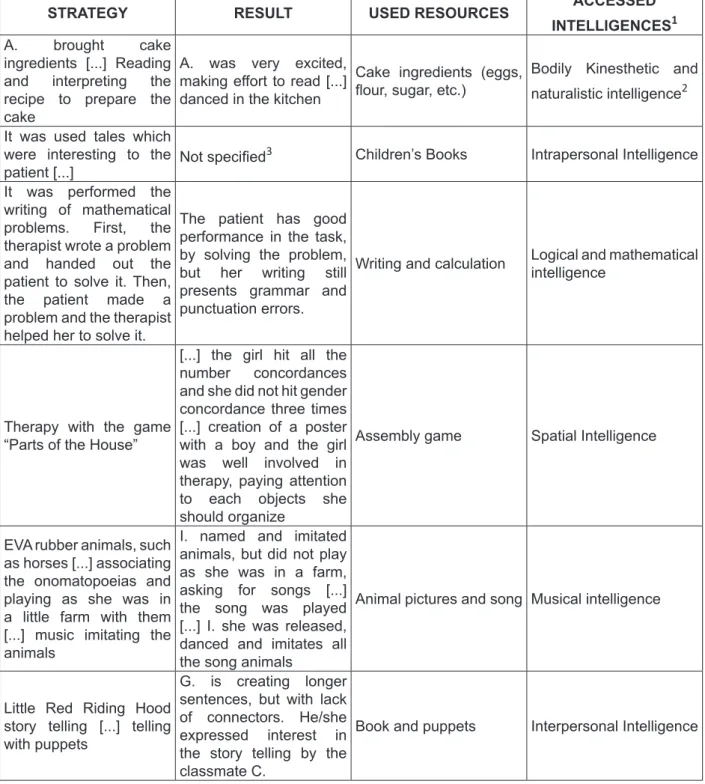
Figure 1 illustrates the break-up of developments in the analyzed categories. Each line represents only one development registration. The selected registration represented the eight multiple intelli-gences accessed in language therapy.
The category “Strategy” was chosen with the purpose of inding details in the activities developed during therapy, to better understand the two other categories. The study focus of the category “Result”
was on the appreciation of verbal language perfor
-mance and motivation regarding the intelligence area(s) accessed during therapy (one or more multiple intelligence(s)), apart from the linguistic intelligence. The category “Used resources” was investigated through the questioning of resources that exceed materials which consider the linguistic intelligence and its relationship with the second category. Finally, in the category “Accessed Intelligence(s)” it was identiied which was/were the approached intelligence(s) in the activities developed during Language, Speech and Hearing therapy.
The content analysis also allowed the researchers to identify each patient’s area of interest, visualized through the Theory of Multiple Intelligences. Therefore, after reading, thinking and discussing the development registrations, the referred area(s) was/were characterized, as well as the expression about it/them in every appointment. To perform the Hence, it is believed that by stimulating other intel
-ligences in therapy, apart from linguistic intelligence, better linguistic development may be reached.
The purpose of this research is to investigate linguistic development of patients with language alterations, focusing on interest areas accessed in language, speech and hearing therapy, through the Theory of Multiple Intelligences.
METHODS
The research which provided data for this article was approved in April, 2013 by the Ethics Committee from Universidade Federal de Santa Maria, protocol
n. 14702713.2.0000.5346.
It was analyzed the therapy development from 41 patients records, which were the sample for this research, including all patients from the Language Section, at the Language, Speech and Hearing Service from the same university. Therefore, the study data are all improvements from the patients’ records, every time they were received by students of the Supervised Practice in Oral and Written Language.
In relation to the inclusion criteria from the records, the following items were observed: all the records from children and teenagers received at the Language Section, who presented the care record and patient development, with reports of purposes, strategies and results from each session. In the observation of these criteria, six records were excluded because they did not present the development reports, three records were excluded because the patients were adults, in order to have a uniform sample, focusing on children and teenagers who were receiving therapy.
The characteristics of the patients whose records were analyzed are the following: minimal age of four years old (49 months) and maximal age of 17 years old (206 months); 15 male and 17 female. The patients records which were part of the sample presented the following diagnostic hypothesis: Language Disorder, Language Delay, Language disorder as part of global development delay, Language disorder caused by syndromes (to be clariied or clariied), Language disorder associated
to development global impairments, Learning dii
STRATEGY RESULT USED RESOURCES ACCESSED INTELLIGENCES1
A. brought cake
ingredients [...] Reading and interpreting the recipe to prepare the cake
A. was very excited, making efort to read [...] danced in the kitchen
Cake ingredients (eggs, lour, sugar, etc.)
Bodily Kinesthetic and naturalistic intelligence2
It was used tales which were interesting to the
patient [...] Not speciied
3 Children’s Books Intrapersonal Intelligence
It was performed the writing of mathematical problems. First, the therapist wrote a problem and handed out the patient to solve it. Then, the patient made a problem and the therapist helped her to solve it.
The patient has good performance in the task, by solving the problem, but her writing still presents grammar and punctuation errors.
Writing and calculation Logical and mathematical intelligence
Therapy with the game “Parts of the House”
[...] the girl hit all the number concordances and she did not hit gender concordance three times [...] creation of a poster with a boy and the girl was well involved in therapy, paying attention to each objects she should organize
Assembly game Spatial Intelligence
EVA rubber animals, such as horses [...] associating the onomatopoeias and playing as she was in a little farm with them [...] music imitating the animals
I. named and imitated animals, but did not play as she was in a farm, asking for songs [...] the song was played [...] I. she was released, danced and imitates all the song animals
Animal pictures and song Musical intelligence
Little Red Riding Hood story telling [...] telling with puppets
G. is creating longer sentences, but with lack of connectors. He/she expressed interest in the story telling by the classmate C.
Book and puppets Interpersonal Intelligence
1 It is implied that in all strategies the linguistic intelligence is being worked, so it is not mentioned in the chart, only the other intel
-ligences, according to Gardner (2010).
2 This development was put in the igure so the readers can visualize the complexity of the performed content analysis, as in most of
the developments there is the registration of the activities which approach more than one multiple intelligence, apart from the linguistic intelligence.
3 This example was inserted in the igure to illustrate that some developments approach only the activity description, not the patient’s
performance during therapy, making it impossible to make their content analysis.
focus, and the others, which are possibly more developed, are emphasized, as the patients try to perform activities which are related to it/them. Thus, they propitiate that, most of the time, the patient is able to perform activities which reach the proposed purposes of the therapy planning and of the session planning, which regard verbal language/linguistic intelligence.
Next, there are examples of registrations which illustrate the previous claims:
“Playing hopscotch […] playing with modeling clay […] C. demonstrated coordination […] C. liked the play and made shapes like animals to give to the therapist”;
“[...] doll house, pets and cooking utensils […] to stimulate language and the patient’s need of sleeping in a separated bedroom […] The patient vocalized a lot during interaction […] besides, the subject kept producing onomatopoeia, […] calmer behavior than in the others.”
“Computer activity, A. looked for another cake recipe […] A. wrote the recipe […] was excited with the possibility of cooking again”. “Interaction with gas station and cars […] M. was communicative and happy […] started to repeat verbs and is keeping concentration for longer time”.
It is valid to highlight that not every time the therapist accessed the patients’ area of interest, verbal language/linguistic intelligence during therapy it was positive. However, the registration of this type of occurrence was rare, about 50 developments, and, also, frequently, this impaired performance was related to external factors. Next, there is an excerpt of result which exempliies such situation, in which it was worked with the patient’s area of interest, observed in 15 development registrations. The following song takes into account the musical intel -ligence: “was agitated and overturned chairs, threw toys on the therapist and also spat. The patients got calm only with soap bubbles [...]”.
The patient’s behavior demonstrates that possibly extra therapy matters were interfering in his/her performance. In other example, the therapist emphasizes these extra therapy factors, registering only this result: “It was worked with a Barney video and drawings painting […] The patient was sleepy, he/she slept late”. So, although both
therapists organized therapy through the access to After surveying and organizing development
tables, the therapy results and the access to the patient’s area(s) of interest in each development were codiied, stipulating an identiication number of each data, in order to perform statistical analysis.
The results registered by the therapists were classiied in four categories, with their respective numbers: “totally reached the purpose of verbal language development dealing with certain(s) intelligence(s)”, number 1; “partially reached”, number 2; “did not reach”, number 3; and “not possible to identify”, number 4. The last category was used when the therapist did not register the therapy result and/or when aspects related to verbal language were not found in the registration. Also, it was codiied the access to the patients’ area of interest, based on the eight multiple intelligences: “totally reached the patient’s area(s) of interest”, number 1; “partially reached”, number 2; “did not reach”, number 3; “it was not possible to identify”, number 4.
In this research, it was used the statistical program BioEstat 5.0, because it was veriied as appropriate to treat the data. A statistical profes -sional applied the Chi-squared Test and performed the residual analysis of data. The referred analysis aimed at identifying the existence of correlations with statistical signiicance among the patients’ areas of interest in the perceived therapeutic strat -egies, in this article, through the Theory of Multiple Intelligences and the identiication of categories of the result.
RESULTS
In the investigation of the 562 developments, based on the content analysis, it is visualized the trajectory of each patient of the service and, hence, it is identiied their area(s) of interest through deep and detailed study of the developments of the 41 researched reports.
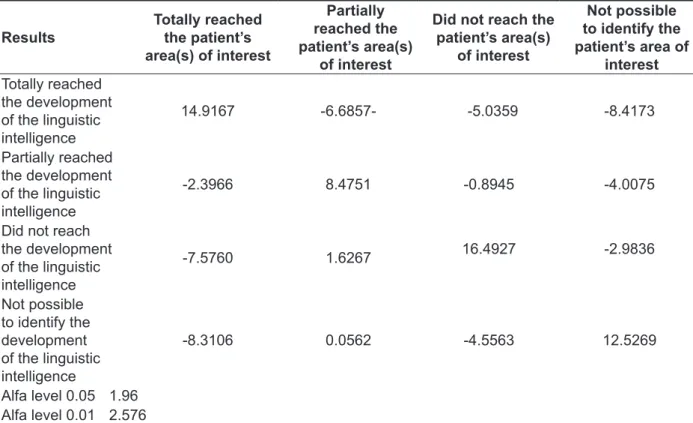
intelligence” was statistically signiicant. This corre -spondence was repeated in the other items.
After the statistical analysis of data, it is possible to infer: as much the patient’s interest area(s) is/are reached in the therapy strategies, the Language, Speech and Hearing session has more opportunity to present efectiveness in its purpose of better performing verbal language/linguistic intelligence.
As in data statistical analysis, as in the content analysis, it was evident that as much the thera -peutic strategies reached the patient’s areas(s) of interest in therapy, better was his/her verbal language/linguistic intelligence performance, focus of the Language, Speech and Hearing intervention. Therefore, in both analyses, the same results were found, what makes the research more conceivable. statistically signiicant, as it is presented in Table
1. The considered p value was < 0.001. It was veriied in this analysis the association with statis -tical signiicance among the items “totally reached”; “partially reached”; “did not reach”; and “not possible to identify” the development of the linguistic intel -ligence with the items “totally reached”; “partially reached”; and “not possible to identify” the patients’ areas(s) of interest, respectively.
The referred table shows that the perfor
-mance in verbal language/linguistic intelligence corresponds to the analyzed categories. In other words, when the therapeutic strategy was “totally reached the patients’ area(s) of interest”, the result “totally reached the development of the linguistic
Table 1 – Residual analysis of the Chi-Squared Test. Statistical test result
Results
Totally reached the patient’s area(s) of interest
Partially reached the patient’s area(s)
of interest
Did not reach the patient’s area(s)
of interest
Not possible to identify the patient’s area of
interest
Totally reached the development of the linguistic intelligence
14.9167 -6.6857- -5.0359 -8.4173
Partially reached the development of the linguistic intelligence
-2.3966 8.4751 -0.8945 -4.0075
Did not reach the development of the linguistic intelligence
-7.5760 1.6267 16.4927 -2.9836
Not possible to identify the development of the linguistic intelligence
-8.3106 0.0562 -4.5563 12.5269
Alfa level 0.05 1.96 Alfa level 0.01 2.576
implant, it was assured the need of investigating and evaluating the multiple intelligence areas and strong and weak points in children’s development, in diferent places they go, such as school and therapy clinic13.
The investigation in other knowledge ields, not health or Language, Speech and Hearing area, has applied the Theory of Multiple Intelligence to qualify practice. The ield of general education and foreign language teaching should be highlighted.
Hence, it is perceived that the approach of diferent multiple intelligences in activities with preschool children is an excellent way to promote
cognitive development14,15. Likewise, several
authors observe that foreign language learning with methodologies related exclusively to linguistic intel -ligence does not guarantee its efectiveness and signiication16-18.
Other studies approach the importance of recognizing the diferent cognitive styles to each person to, possibly, qualify the process of teaching/
learning12,19-22. Moreover, another study mentions the
use of multiple intelligence recognition as enabler of global development23.
In many development registration it was implicit that the therapist tried to reach, through the strat -egies, areas of interest and diferent multiple intel -ligences of patients. However, in no registration it was found systematic nature and clarity of this contemplation. This data veriies the relevance of new researches that approach the possibilities of acting in Language, Speech and Hearing therapy based on the Theory of Multiple Intelligence.
As the Theory of Multiple Intelligences do not detail the individual development of each of the eight intelligences, it can be thought about deeper inves -tigation in the approximation between the referred theory and language theories that present diferent epistemological basis, improving as scientiic knowledge as its possible applications. A possible discussion that should be better investigated is the approximation to the Language Connectionist Theories.
This understanding happens because the connexionism, as an empiricist line of thought, presents other possibilities to delineate language therapy and Theory of Multiple Intelligence. The connexionism may provide the understanding among access to diferent cognitive processes and language acquisition24-26.
In this sense, a research hypothesis may be
DISCUSSION
The Language, Speech and Hearing therapy, in its diferent intervention ields, observes general and speciic purposes which guide therapy strategies to be developed. These are related to qualiication of oral or written communicative skills.
The evaluations show which linguistic level(s) should be more focused in therapy. So, therapy planning systematization, sessions planning and therapy strategies begin.
However, the last item, which regards the therapy proposed activities, related to this research results, should reach other skills, not only verbal language/ linguistic intelligence. So, more than organizing the purposes that reach the patients’ needs, other factors should be considered in order to present more efectiveness in Language, Speech and Hearing therapy.
Among such aspects, the access to the patients’ area(s) of interest is highlighted10,11. It is understood
that these areas are more easily understood and visualized through multiple intelligences.
This way to manage therapy may be performed through qualiied mediation, providing to the patients activities with diferent resources and strategies. These may reach other types of intelligence, not only linguistic intelligence, focus of therapy.
It is important to mention that the singularity of each patient’s interaction helps therapists in the management of therapy strategies that qualify the therapy results1,2,6. The study and preparation of
therapy based on the Theory of Multiple Intelligences provide to therapists the developed activities according to the patients’ area(s) of interest and also the opportunity to know a range of activities that reach the same intelligence.
Therefore, the referred study provides to Language, Speech and Hearing therapists more possibilities of therapy strategies alternatives. At the same time, the Language, Speech and Hearing professional may reach as the patients’ interest as their possible potentials, regarding their diiculty area, reason for therapy, that is verbal language/ linguistic intelligence deicit.
In other words, the way and the emphasis of the language, speech and hearing therapy are altered and/or improved, aiming at qualifying the verbal language performance.
It is important to highlight that the studied ield was the supervised practice in language, speech and hearing therapy, thus, the therapists were in process of professional training. It is believed that the increasing acting experience tends to provide to therapists qualiication of the sensitivity to visualize the area(s) of interest. It is more common in patients
who did not develop speech, requiring more profes
-sional attention.
Finally, it is important to mention a challenge that is approaching these areas with verbal language/ linguistic intelligence intervention. Sometimes some intelligence and, perhaps, the speciic resources that mobilize the patients’ interest may be more diicult than others to be associated with the referred intelligence.
Therefore, thinking about several activities and possibilities of resources and activities into an intel -ligence, to work with verbal language/linguistic intel -ligence, depending on the patients’ area of interest, for example the Bodily Kinesthetic, may use from a simple strategy with modeling clay to the creation of circuits with several motor areas. Thus, diferent therapeutic strategies lead to diferent requirements and diiculties to language, speech and hearing therapists.
focusing on Language, Speech and Hearing therapy systematization and its results.
In the contextualization of these correlations, it is observed that diferent resources and strategies that exceed the limited access to learning may be explained in theory, when the linguistic intelligence is approached. The author suggests that when a linguistic area of intelligence is weak, for example, the writing in alphabetic codes, when mainly the auditory pathways are accessed for learning, it may be emphasized by other areas, such as spatial and Bodily Kinesthetic. These two areas are more emphasized in learning a written language with ideographic characters6 . Therefore, it is started
a study through pathways that are not children’s deicit, potentializing the development of their verbal language/linguistic intelligence.
CONCLUSION
The access to other area(s) of interest, related to multiple intelligences, may provide more devel -opment of verbal language/linguistic intelligence of patients who present deicit or alteration in these aspects. In this therapeutic movement, the focus on the speciic area which they present diiculty is taken away and the therapeutic strategy starts to be stimulated by other area(s)/intelligence(s), which potentialize the treatment of the area with deicit.
RESUMO
Objetivo: investigar as evoluções linguísticas de pacientes com alteração de linguagem, com foco
sobre a(s) área(s) de interesse acessada(s) na terapia fonoaudiológica, compreendidas a partir da Teoria das Inteligências Múltiplas. Métodos: esta pesquisa conigura-se como quanti-qualitativa.
Foram investigadas 562 evoluções terapêuticas de 41 prontuários de pacientes atendidos no Setor de Linguagem, de um Serviço Fonoaudiológico vinculado a uma universidade federal do Brasil, tendo sido realizados dois tipos de análise dos dados: análise de conteúdo, por meio da organização de categorias de análise para interpretação dos dados e, análise estatística, com aplicação do Teste
Qui-quadrado . Resultado: tanto na análise estatística dos dados, quanto na análise de conteúdo, icou
evidente que, quanto mais as estratégias terapêuticas contemplassem a(s) área(s) de interesse do paciente em terapia, melhor era o seu desempenho na linguagem verbal/inteligência linguística, foco
da intervenção fonoaudiológica. Conclusão: ao se acessar outras área(s) de interesse, relacionadas
as inteligências múltiplas, pode-se promover um maior desenvolvimento da linguagem verbal/ inteli
-gência linguística dos pacientes que apresentam um déicit ou alteração na mesma.
applied cochlear implantation in Turkey and Germany according to theory of multiple intelligence. Int. J. Pediatr. Otorhinolaryngol. 2011;75(12):1576-84. 14. Abdulkader FA, Gundogdu K, Eissa MA. The efectiveness of a multiple intelligences-based program on improving certain reading skills in 5th-year primary learning disabled students. Electronic Journal of Research in Educational Psychology. 2009;7(3):673-90.
15. Delgoshaei Y, Delavari N. Applying multiple-intelligence approach to education and analyzing its impact on cognitive development of pre-school children. Procedia – Social and Behavioral Sciences. 2012;32:361-6.
16. Glick, BG, Armstrong, J, Marchese, M. Evidence of Multiple Intelligences in FLES Classrooms. Learning Languages. 2010;15(2):31-5.
17. Savas, P. Pre-service English as a foreign language teachers’ perceptions of the relationship between multiple intelligences and foreign language learning. Learning and Individual Diferences. 2012;22(6):850-5.
18. Azizullah, M, Masoud, RD, Najmeh, H. Educational Psychology: An International Journal of Experimental Educational PsychologyExploring the relationship between reading strategy use and multiple intelligences among successful L2 readers. Intelligence.2013;41(5):735-7.
19. Chagas JF, Fleith DS. Habilidades, características pessoais, interesses e estilos de aprendizagem de adolescentes talentosos Revista de Psicologia da USF. 2010; 15(1):93-102.
20. Monteiro LP, Smole KS. Um caminho para atender às diferenças na escola. Educação e Pesquisa. 2010;36(1):357-71.
21. Natel, MC, Tarcia, RML, Sigulem, D. A aprendizagem humana: cada pessoa com seu estilo. Rev psicopedag. 2013;30(92):142-8.
22. Tutwiler S, Lin M, Chang C. The use of a gesture-based system for teaching multiple intelligences: A pilot study. British Journal of Educational Technology. 2013;44(5):133-8.
23. Kail RV. Developmental analyses of individual diferences in intelligence: Comments on Demetriou, Spanoudis, Shayer, Mouyi, Kazi, and Platsidou. Intelligence. 2013;41:735-7.
24. Poersch, JMP. Simulações conexionistas: a inteligência artiicial moderna. Linguagem em Discurso. 2004;4(2):441-58.
25. Poersch JMP. A new paradigm for learning language: Connectionist artiicial intelligence. Linguagem & Ensino. 2005;8(1):161-83.
REFERENCES
1. Gardner H. O nascimento e a Difusão de um “Meme”. In: Gardner H et al. Inteligências Múltiplas ao redor do mundo. 1ª ed. Porto Alegre: Artmed, 2010. P. 16-30.
2. Gardner H. Inteligencias múltiples: la teoria em la práctica. 1ª ed. Buenos Aires: Paidós, 2011. 3. Zorzi JL. A Intervenção Fonoaudiológica nas Alterações da Linguagem Infantil. 1ª ed. Rio de Janeiro, Revinter, 1999.
4. Jakubovicz, R. Atraso de linguagem: Diagnóstico pela Média dos Valores de Frase (MVF). 1ª ed. Rio de Janeiro: Editora Revinter, 2002.
5. Giacchini V, Tonial A, Mota HB. Aspectos de linguagem e motricidade oral observados em crianças atendidas em um setor de estimulação precoce. Rev Distúrb Comun. 2013;25(2):253-65. 6. Gardner H. Estruturas da Mente: A Teoria das Inteligências Múltiplas.Porto Alegre: Artes Médicas Sul, 1994.
7. Jakubovicz R, Leme MP. Exercícios de linguagem. Rio de Janeiro: Revinter, 2012.
8. Bei-Lopes DM, Nuñes CO, Cáceres AM. Correlação entre vocabulário expressivo e extensão média do enunciado em crianças com alteração especíica de linguagem. Rev CEFAC. 2013;15(1):51-7.
9. Bardin L. Análise de conteúdo. São Paulo: Edições 70, 2011.
10. Cogo-Moreira H, Andriolo RB, Yazigi L, Ploubidis GB, Brando de Vila CR, Mari JJ .Music education for improving reading skills in children and adolescents with dyslexia. Cochrane Database of Systematic Reviews. 2012;15(8):1-24.
11. Barnes J. Drama to promote social and personal well-being in six- and seven-year-olds with communication diiculties: the Speech Bubbles project.
Perspectives in Public Health. 2014;134(2):101-9. 12. Armstrong T. As inteligências múltiplas na sala de aula. 2ª ed. Porto Alegre: Artmed Editora, 2001. 13. Sahli S, Laszig R, Aschendorf A, Kroeger S, Wesarg T, Belgin E. Comparison of learning preferences of Turkish children who had been
Received on: December 19, 2014 Accepted on: March 26, 2015
Mailing address:
Renata Gomes Camargo