EXPERT SYSTEM TO SUPPORT THE DECISION IN TOPICAL THERAPY FOR VENOUS ULCERS
a Master in Health Technology, Professor at the Pontifical Catholic University of Paraná (PUCPR). Graduate degree in Nursing. Curitiba, Paraná, Brazil.
b Master in Health Technology, Graduate degree in Nursing. Curitiba, Paraná, Brazil.
c PhD in Applied Informatics. PhD in High Performance Computing. Professor at PUCPR. Postgraduate Program in Health Technology (PPGTS). Curitiba, Paraná, Brazil.
d PhD in Electrical Engineering and Computer Engineering. Professor at PUCPR. Postgraduate Program in Informatics (PPGIa). Curitiba, Paraná, Brazil.
Danielle SELLMERa, Carina Maris Gaspar CARVALHOb,
Deborah Ribeiro CARVALHOc, Andreia MALUCELLId
ABSTRACT
Although the treatment of venous ulcers requires a set of specific knowledge, non-specialist nurses are unaware of the appropriate therapy, which is a concern in the topical therapy for these skin lesions. This paper aims to present an expert system to support the nursing decision making process in the topical therapy of venous ulcers. It is a development research implemented in five stages: system modeling, knowledge acquisition, knowledge representation from production rules, and system implementation and evaluation. The production rules are presented, as well as some cases to simulate the expert system behavior, demonstrating the viability of its usage in nurse’s practice. The system may support the decision making about the topical therapy of venous ulcers. However, ulcer evaluation should be correctly made, so that the system provides appropriate suggestions, allowing better organization and planning assistance.
Descriptors: Nursing informatics. Leg ulcer. Venous ulcer. Expert systems.
RESUMO
Apesar de o tratamento das úlceras venosas exigir um conjunto de conhecimentos específicos, os enfermeiros não especialistas desconhecem as terapias adequadas, o que constitui uma dificuldade na terapia tópica dessas lesões de pele. Este artigo tem como objetivo apresentar um sistema especialista para apoiar o processo de decisão dos enfermeiros na terapia tópica das úlceras venosas. Trata-se de uma pesquisa de desenvolvimento, operacionalizada em cinco etapas: modelagem do sistema, aquisição do conhecimento, representação do conheci-mento a partir de regras de produção, implementação e avaliação do sistema. O conjunto das regras é apresentado, assim como casos que simulam o comportamento do sistema especialista, mostrando a viabilidade da sua utilização na prática do enfermeiro. O sistema poderá auxiliar na tomada de decisão sobre as condutas tópicas em úlceras venosas, porém, a avaliação da úlcera deve ser realizada de forma correta, a fim de que o sistema forneça sugestões adequadas, permitindo melhor organização e planejamento da assistência.
Descritores: Informática em enfermagem. Úlcera da perna. Úlcera varicosa. Sistemas especialistas.
Título: Sistema especialista para apoiar a decisão na terapia tópica de úlceras venosas.
RESUMEN
Aunque el tratamiento de las úlceras venosas exige un conjunto de conocimientos específicos, los enfermeros no especializados desconocen la terapia adecuada, lo que constituye una dificultad en la terapia tópica de esas lesiones de piel. Este artículo tiene como objetivo presentar un sistema especializado para apoyar el proceso de decisión de los enfermeros en la terapia tópica de las úlceras venosas. Se trata de una investigación del desarrollo, operado en cinco etapas: modelaje del sistema, adquisición de conocimientos, representación del conocimiento a partir de reglas de producción, de implementación y evaluación del sistema. El conjunto de reglas es presentado, así como algunos casos que simulan el comportamiento del sistema especializado. El sis-tema puede ayudar a tomar decisiones sobre la terapia tópica, pero, la evaluación de la úlcera se debe realizar correctamente para que el sistema proporcione sugerencias adecuadas, lo que permite una mejor organización y planificación de la asistencia.
Descriptores: Informática aplicada a la enfermería. Úlcera de la pierna. Úlcera varicosa. Sistemas especializados.
INTRODUCTION
It is estimated that venous ulcers, or leg ulcers, affect 1% to 2% of the world population, being more prevalent in people over 65 years old, interfering directly in their quality of life, because these are chronic conditions(1). They are a consequence of
chronic venous insufficiency caused by decreased venous return in the cases of deep venous throm-bosis and reflux of venous blood, forming chronic wounds that affect the lower limbs (2-3).
The quality of life of individuals affected by venous ulcers can be affected by several factors, including bad smell, oozing, pain, reduced mobility, decreased sleep, social isolation, long time to heal and frequent dressing changes that require the as-sistance by healthcare professionals, which implies several visits to healthcare units(1-4).
Nurses have traditionally been responsible for the care to patients (or clients, users...) af-fected by leg ulcer and also for topically treating the wounds(5-6-7). Topical therapy involves the
cleaning process, debridement (removal of dead tissue) and the choice of bandages, also known as covers(8). There are many covers for treating
these ulcers and each cover is intended for a specific need. The most commonly used cov-ers include those capable of maintaining moist conditions, absorbing excess moisture, removing devitalized tissues from the wound bed and also antibacterial covers(9). Also available are various
technological treatments for local care(10), e.g. the
use of ultrasound, laser, electrical stimulation, hyperbaric oxygen therapy and local negative pressure known as vacuum therapy.
Because of the complexity of venous ulcers and the many possible treatments appropriate knowledge and skills are required in profes-sional nursing. The care of patients with acute and chronic wounds, including leg ulcers, is the nursing specialty called stomatherapy. The stoma-therapist is the professional who has knowledge, training and ability to treat any type of acute or chronic wound, and such expertise should ensure and improve the level of individual and collective health of these patients .
Procedures based on evidence contain sci-entific recommendations (guidelines) for nurses, so that they are able to provide the best possible care for patients. These guidelines subsidize the
construction of protocols aimed to support pro-fessionals in making decisions regarding a given clinical situation. The use of protocols for assisting patients improved healing rates and reduced the costs of the treatment of venous ulcers(11).
However, there is a lack of specialists in stomatherapy in Brazil(12). Despite advances in
research, guidelines have not been established for the topical treatment of venous ulcers (8). In Brazil,
except for a few services, no protocols are used to benefit these patients, or else the protocols used were not constructed according to an appropriate methodology. Meanwhile, in countries like Eng-land, Canada, Spain and the United States there is a strong movement towards the elaboration of clinical protocols to improve the quality of care and the rates of healing of venous ulcers, as well as to reduce the costs of treatment(13).
Non-specialist public health nurses are not familiar with the specific therapies for patients with venous ulcers and report that the lack of a protocol to support their decision is an additional difficulty to treat these patients(5-6-7).
Therefore, the lack of adequate systematiza-tion and specialist nurses could be minimized with the use of technology, through the development of an expert system that supports the decision making process of nurses and provides, in ad-dition to a knowledge base(14), a database with
potential to support future research in this area. The availability of a database would be of criti-cal importance not only from the point of view of data collection, but also for supporting the decision-making process(15).
Expert systems are a class of Artificial In-telligence systems that perform functions similar to those usually performed by human specialists, allowing to represent the necessary human knowl-edge or expertise(16).
The use of expert systems provides some benefits particularly regarding the ability to extend decision-making to several persons, improvement of the productivity and performance of its users, decrease in the degree of dependence of specialists by healthcare centers, as well as the possibility of its use as a training tool (17).
Given this scenario, the present article aims to present an expert system to support decision-making in the topical therapy of venous ulcers.
METHOD
This research is aimed to systematize the actions of the professional nurse with the use of a protocol, as well as to facilitate the monitoring and recording of treatment evolution, the costs involved, and support decision on the most appro-priate topical procedure. An expert system called PROTUV (Protocol for the Treatment of Venous Ulcers) was developed in 2008, according to the following steps: system modeling, knowledge acqui-sition, knowledge representation, implementation and system evaluation.
The system modeling was performed by information technology professionals using ar-tifacts of Unified Modeling Language (UML) with the purpose of transforming the needs of nurse professionals and protocols in a formal specification that could be implemented. For the step of knowledge acquisition, a textual protocol elaborated by a stomatherapist was adopted (18).
Knowledge representation was made by means of production rules that form the knowledge base and that were built from the textual proto-col by information specialists. The system was implemented in JAVA programming language for the Web platform, using the Data Management System (DBMS), Microsoft Structured Query (SQL) Server and the Web Apache Tomcat ap-plication server. The system is integrated with the Drools tool to support the decision-making based on the characteristics of the ulcer. The Drools is a BRMS (Business Rule Management
System)engine that uses an inference engine that
crosses the data entered in the system with the rules or facts in the knowledge base. To evalu-ate the system, a stomatherapist developed cases simulating patients with venous ulcers, including the respective expected results. Thus, it has been
possible to test the system and assess whether its behavior was consistent with the behavior of a specialist nurse.
The project was not subjected to the Ethics Research Committee because its purpose was the development of an expert system, and no humans, sociological, anthropological or epidemiological studies were involved.
RESULTS
This section presents the production rules elaborated for the system (PROTUV), as well as some experiments on cases developed by a stomatherapist. It is important to stress that these cases consist of simulations of real situ-ations where the results of the procedure to be indicated by the system were previously known. These tests allow to evaluate whether the PRO-TUV effectively supports nurses, particularly non-specialist nurses..
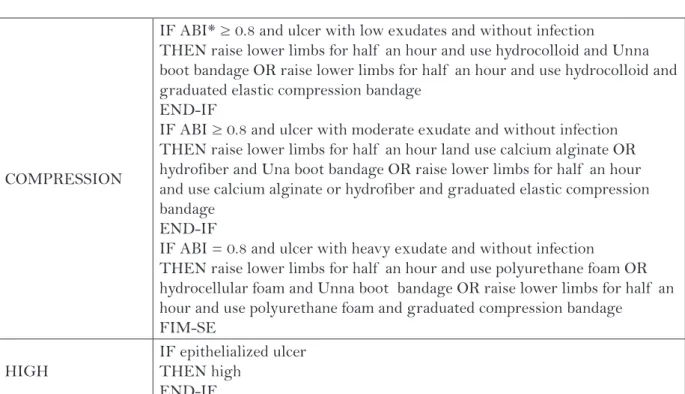
The rules designed to support the decision-making process of nurses in the topical therapy of venous ulcers are shown in Table 1.
An expert system in Portuguese language was implemented to systematize the actions of the professional nurse with the use of a protocol, as well as to facilitate the monitoring and recording of treatment evolution, the costs involved, and support decision on the most appropriate topical procedure.
The PROTUV records and monitors the evolution of the treatment, as well as the costs generated. For a more detailed monitoring, the system provides a history containing pictures of ulcers and charts that point to data such as the type of tissue in the ulcer bed, amount of exudates and ulcer size. The main functional-ities of the PROTUV are anamnesis, evaluation and registration of venous ulcers, indication for treatment, monitoring progress, schedule and reports(18).
PROCEDURE PRODUCTION RULE
CLEANING
IF dressing change
THEN clean the wound with SF 0.9% END-IF
DEBRIDEMENT
IF necrotic ulcer
THEN autolytic debridement with hydrogel OR hydrocolloid OR autolytic debridement with hydrogel and transparent film OR autolytic debridement with hydrogel and non-adherent gauze OR autolytic debridement with hydrogel and hydrocolloid combined with instrumental debridement OR autolytic debridement with hydrogel and transparent film combined with instrumental debridement OR autolytic debridement with hydrogel and non-adherent gauze combined with instrumental debridement OR enzymatic debridement with papain diluted 10% OR enzymatic debridement with papain gel 1% OR instrumental debridement
END-IF
IF ulcer covered by slough
THEN autolytic debridement with hydrogel and hydrocolloid OR autolytic debridement with hydrogel and transparent film OR autolytic debridement with hydrogel and non-adherent gauze OR enzymatic debridement with papain gel 1% OR enzymatic debridement with papain diluted 10% enzymatic debridement with papain diluted 10%
END-IF
CARE WITH THE SKIN AROUND THE ULCER
IF skin around the ulcer is dry or scaly
THEN Use AGE OR a cream that restores the pH of the skin END-IF
COVERS
IF ulcer with low amount of exudates and without infection, THEN Use hydrocolloid
END-IF
IF ulcer with moderate amount of exudates and without infection THEN Use calcium alginate or hydrofiber
END-IF
IF ulcer with moderate amount of exudates and infection
THEN Use calcium alginate with silver OR hydrofiber with silver END-IF
IF heavily exuding ulcer without infection
THEN Use polyurethane foam OR hydrocellular foam END-IF
IF ulcer with heavy exudates and infection THEN Use polyurethane foam with silver END-IF
IF painful ulcer without infection and low exudates THEN Use hydrocolloid
END-IF
IF painful ulcer without infection and moderate to heavy exudates THEN Use polyurethane foam
END-IF
the values assigned and suggests some procedures. By accepting a suggested treatment, the products associated to the treatment are shown, and it is possible to enter the amount of products used, thus maintaining an updated control of the costs. This control can assist the administrative process related to the care of these ulcers, in addition to its use for cost and benefit analysis regarding the procedures performed.
For those situations where the specialist nurse is not familiar with the procedure or of the products suggested by the system, an online glossary with explanations was included. The user can select the product or treatment to obtain the respective description.
Some experiments were conducted and two cases were selected for demonstration. The first case concerns M.J.S, 67 years old, female, with ve-nous insufficiency diagnosed 12 years ago at M.I.E, and physical examination showed edema, ABI = 0.8, ulcer in the malleolar region measuring 7.8 cm long by 5.2 cm wide, with granulation tissue at the edges and slough at the center of the ulcer, with moderate exudates and no smell.
By logging data on ulcer characteristics onto the system, the knowledge base is consulted to seek for rules that may help obtain the most appropriate procedure for a given situation. In this context, the following rules were implemented:
IF ABI ≥ 0.8 and ulcer with moderate exudate and without infection
THEN raise lower limbs for half an hour and use calcium alginate OR hydrofiber and Unna boot bandage OR raise lower limbs for half an hour and use calcium alginate or hydrofiber and graduated elastic compres-sion bandage
END-IF
IF ulcer covered by slough
THEN autolytic debridement with hydrogel and hydrocolloid OR autolytic debridement with hydrogel and transparent film OR au-tolytic debridement with hydrogel and non-adherent gauze OR enzymatic debridement with papain gel 1% OR enzymatic debride-ment with papain diluted 10%
END-IF COMPRESSION
IF ABI* ≥ 0.8 and ulcer with low exudates and without infection
THEN raise lower limbs for half an hour and use hydrocolloid and Unna boot bandage OR raise lower limbs for half an hour and use hydrocolloid and graduated elastic compression bandage
END-IF
IF ABI ≥ 0.8 and ulcer with moderate exudate and without infection THEN raise lower limbs for half an hour land use calcium alginate OR hydrofiber and Una boot bandage OR raise lower limbs for half an hour and use calcium alginate or hydrofiber and graduated elastic compression bandage
END-IF
IF ABI = 0.8 and ulcer with heavy exudate and without infection
THEN raise lower limbs for half an hour and use polyurethane foam OR hydrocellular foam and Unna boot bandage OR raise lower limbs for half an hour and use polyurethane foam and graduated compression bandage
FIM-SE
HIGH
IF epithelialized ulcer THEN high
END-IF
Table 1 – Production Rules to support decision making in the topical therapy of venous ulcers. Curitiba, PR, October – December 2007.
IF ulcer with moderate exudate and without infection
THEN use calcium alginate or hydrofiber END-IF
From these rules it is possible to realize that when the procedure “compression” is indicated and ABI ≥ 0.8mmHg, the specialist can choose to raise the lower limbs of the patient for half an hour in combination with the use of calcium alginate, or use hydrofiber and application of Unna boot bandage, or else raise lower limbs for half an hour combined with the use of calcium alginate or hydrofiber and application of graduated elastic compression bandage.
The rule for the procedure “debridement”, in turn, indicates that once there is slough in the ulcer bed, the specialist may choose among the following procedures: autolytic debridement with hydrogel and hydrocolloid, or autolytic debridement with hydrogel and transparent film, or else autolytic debridement with hydrogel and non-adherent gauze, or enzymatic debridement with papain gel 1%, or finally enzymatic debridement with papain diluted 10%.
Regarding the rule for the procedure “covers”, the system indicates the use of calcium alginate or hydrofiber for ulcer with moderate exudate and without infection.
In the second case the patient selected was J.J.G, 62 years old, male, with non diagnosed ulcer in the M.I.D for 5 years anos, and physical exami-nation showed ABI = 0.68, irregularly shaped, 6.0 cm² long and with a depth of 0.5 cm, slough and small amount of exudates, pain, inverted edge and dry peri-wound skin.
As in case 1, when the ulcer characteristics are entered in the system the knowledge base is con-sulted seeking for rules that may assist in the case. In this experiment the rules below were implemented:
IF ulcer with slough
THEN autolytic debridement with hydrogel and hydrocolloid OR autolytic debridement with hydrogel and transparent film OR au-tolytic debridement with hydrogel and non-adherent gauze OR enzymatic debridement with papain gel 1% OR enzymatic debride-ment with papain diluted 10%
IF painful ulcer with infection and low exudate
THEN use hydrocolloid END-IF
IF skin around the ulcer is dry or scaly THEN use AGE OR a cream to restor the pH of the skin
END-IF
With the implementation of the rule, the most indicated procedures are suggested, as well as their respective products. Figure 1 shows the system screen for this case. The characteristics of the ulcer can be seen on the left side of the screen and on the right side the suggestions made by the system.
DISCUSSION
As it can be seen, the nurse can choose among alternative procedures for the topical treatment of venous ulcers. The alternatives offered by the system are intended to contribute to the decision making of the non-specialist nurse regarding the most suitable procedure to be performed in a given situation, according to the availability of products in the health facility.
However, choosing the most appropriate action depends essentially on the nurse once as-sessment of the ulcer is a responsibility of this professional e.g.if the nurse is not able to identify the type of ulcer of a patient with venous ulcer in the lower limbs, he will not be able to enter the correct data on the system, and may induce the system to indicate inappropriate procedures for the case.
The choice of the procedure to be adopted in a given situation can also be influenced by the criteria used by the nurse to select one of the al-ternatives displayed in the system. For example, when the specialist enters ABI = 0.8 in the system some suggestions (procedures) are displayed by the system, and, thus, if the nurse decides to raise lower limbs for half an hour combined with the use of calcium alginate, he (she) should be aware that he (she) is not choosing compressive therapy, and such decision might not be the most appro-priate in Case 1 because the patient has edema, and, thus, compressive therapy is indicated in such case.(9). On the other hand, considering the
be feasible, for it is known that some facilities do not count on Unna boot bandage and graduated elastic compression bandages.
So in figure 1 alternative actions are sug-gested for the “debridement” procedure, and autolytic debridement with hydrogel and non-adherent gauze was considered the most ap-propriate action for Case 2. Nevertheless, it is important to stress that the nurse may decide to use another procedure or product, other than that indicated by the system, at the discretion of this health professional and considering the avail-ability of products in the health facility, since the system is aimed to support the decision and not replace the professional.
Therefore, it is expected that the PROTUV assists nurses to choose the most appropriate ac-tion among the various acac-tions suggested as topical therapies for venous ulcers. In the decision making process regarding the care to be provided to pa-tients with venous ulcer, it should also be stressed that, besides the choice of the most appropriate topical therapy, the nurse should also take into consideration the possible limitations imposed by the physical condition of the patient. These limita-tions can increase stress and concern, with impact on work and leisure, demonstrating that because
venous ulcers are chronic may cause them to affect the patient not only physically, but also emotionally and socially(19).
Also, it should be noted that the elderly popu-lation is increasing worldwide. According to the estimates of the Brazilian Institute of Geography and Statistics (IBGE), Brazil will have 63 million elderly people by 2050 , with 1.7 elderly individual for each young individual(20).
Thus, it is not enough to discuss the topi-cal therapy of venous ulcers. The emotional and social aspects of the individual, as well as the fact that the population is growing old should also be considered, aiming at a comprehensive approach to the treatment of patients with venous ulcers. Technology is a valuable asset that if used properly can help change the reality of the people affected by this condition, as well as increase the confidence and skills of the professionals who perform these treatments and who have not yet had the opportu-nity to obtain expert knowledge.
Finally, to ensure the successful use of a decision support system and hence effectiveness in nurse care, the use of resources that enable ongoing education of the nurse staff about the treatment of wounds, as well as on the use of the system.
CONCLUSIONS
Because its knowledge is based on a protocol, the PROTUV system may help the nurse staff in their decision making regarding the most appro-priate topical therapy for venous ulcers, based on updated scientific knowledge, standardizing the procedures in the health facilities, aimed to improve patient assistance and increase the confidence and skills of the professionals.
It should be emphasized that despite the sup-port of information systems for supsup-port to deci-sion, evaluation of the ulcer should be performed correctly even by nurses non specialist nurses to ensure that the system provides adequate solutions.
In addition to the expected improvements in healing rates, it is expected that the standardization of assistance may reduce costs and optimize the time of the nurse, as observed in other countries that have proposed to use protocols for topical procedures in venous ulcers.
The proposed and evaluated system will allow better organization and planning of the assistance and will provide a thorough overview of the cases offered. The system database will enable future research on the profile of the patients, on the characteristics of the ulcer, on more suitable treatments, costs, among others, which are not possible now because of the lack of a database that provides this information.
REFERENCES
1 Taverner T, Closs SJ, Briggs M. Painful leg ulcers: community nurses’ knowledge and beliefs, a feasibility study. Prim Health Care Res Dev. 2011;12(4):379-92.
2 Borges EL, Calin MHL, Hass VJ. Systematic review of topic treatment for venous ulcers. Rev Latinoam Enferm. 2007;15(6):1163-70.
3 Weller C, Evans S. Venous leg ulcer management in general practice -- practice nurses and evidence based guidelines. Aust Fam Physician. 2012;41(5):331-7.
4 World Health Organization. Wound and lynmphoe-dema management. Geneva: WHO; 2010.
5 Van Hecke A, Goeman C, Beeckman D, Heinen M, Defloor T. Development and psychometric evalu-ation of an instrument to assess venous leg ulcer lifestyle knowledge among nurses. J Adv Nurs. 2011;67(12):2574-2585.
6 Nix DP. Patient assessment and evaluation of hea-ling. In: Bryant RA, Nix DP: Acute& chronic wounds: current management concepts. 3rd ed. Philadelphia: Mosby; 2007.
7 Fonseca C, Franco T, Ramos A, Silva C. A pessoa com úlcera de perna, intervenção estruturada dos cuidados de enfermagem: revisão sistemática da literatura. Rev Esc Enferm USP. 2012;46(2):480-6.
8 Borges EL. Tratamento tópico de úlcera venosa: proposta de uma diretriz baseada em evidências [tese]. Ribeirão Preto: Faculdade de Enfermagem de Ribeirão Preto, Universidade de São Paulo; 2005.
9 Doughty DB, Holbrook R. Lower-extremity ulcer of vascular etiology. In: Bryant RA, NIX DP. Acute & chronic wounds: current management concepts. 3rd ed. St. Louis: Mosby; 2007. p.258-306.
10 Dyson M. Adjuvant therapies: ultrasound, laser therapy, electrical stimulation, hyperbaricoxygen and vacuum--assisted closure therapy. In: Morrison MJ, Moffat CJ, Franks PJ. Leg ulcers: a problem-based learning approach. Misouri: Mosby Elsevier; 2007. p.429-51.
11 Kelechi TJ, Johnson JJ. Guideline for the management of wounds in patients with lower-extremity venous disease: an executive summary. J Wound Ostomy Continence Nurs. 2012; 39(6):598-606.
12 Santos VLCG, Paula CAD, Secoli SR. Estomizado adulto no município de São Paulo: um estudo sobre o custo de equipamentos especializados. Rev Esc Enferm USP. 2008;42(2):249-55.
13 Kwansa TD, Morison MJ. Sources of knowledge, evidence-based practice, and the development and effective use of reflective portflolios to enhance pro-fessional practice. In: Morison MJ, Moffatt CJ, Franks PJ. Leg ulcers: a problem-based learning approach. Philadelphia: Mosby; 2007. p.13-35.
14 Rezende SO, Pugliesi JB, Varejão FM. Sistemas base-ados em conhecimento. In: Oliveira S, organizadora. Sistemas inteligentes: fundamentos e aplicações práticas. Barueri: Manole; 2005. p.13-49.
15 Huss S, Fronhoffs F, Büttner R, Heukamp LC. Web-based database for the management of tissue specimens in a transregional histological research facility. Diagn Pathol. 2011;6:17.
17 Mendes RD. Inteligência artificial: sistemas espe-cialistas no gerenciamento da informação. Cienc Inf. 1997;26(1):39-45.
18 Sellmer D. Sistema baseado no conhecimento para sistematização da terapia tópica de úlceras venosas [dissertação]. Curitiba (PR): Pontifícia Universidade Católica do Paraná; 2009.
19 Madox D. Effects of venous leg ulceration on patients quality of life. Nurs Stand. 2012;26(38):42-49.
20 Instituto Brasileiro de Geografia e Estatística (IBGE ). Perfil dos idosos responsáveis pelos do-micílios [Internet]. 2002 [citado 2012 Out 22]. Disponível em: www.ibge.gov.br/home/presidencia/ noticias/25072002pidoso.shtm
Author’s address / Endereço do autor / Dirección del autor
Andreia Malucelli
Rua Imaculada Conceição, 1155, Prado Velho 80215-901, Curitiba, PR
E-mail: [email protected]