Copyright © 2014 Revista Latino-Americana de Enfermagem
This is an Open Access article distributed under the terms of the Creative Commons Attribution Non-Commercial License (CC BY-NC).
This license lets others distribute, remix, tweak, and build upon your work non-commercially, and although their new works must also acknowledge you and be non-commercial, they don’t have to license their derivative works on the same terms.
DOI: 10.1590/0104-1169.3102.2393 www.eerp.usp.br/rlae
Corresponding Author:
Graziele de Lima Dalmolin
Universidade Federal de Santa Maria Departamento de Enfermagem
Av. Roraima, 1000, Prédio 26A, Sala 1305B Camobi
CEP: 97105-900 Santa Maria, RS, Brasil
Graziele de Lima Dalmolin
2Valéria Lerch Lunardi
3Guilherme Lerch Lunardi
4Edison Luiz Devos Barlem
5Rosemary Silva da Silveira
51 Paper extracted from doctoral dissertation “Moral distress and burnout syndrome: relations in nursing staff’s day-to-day working experiences
2012”, presented to Universidade Federal do Rio Grande, Rio Grande, RS, Brasil. Supported by Conselho Nacional de Desenvolvimento Científico e Tecnológico (CNPq), process #475366/2008-5.
2 PhD, Adjunct Professor, Departamento de Enfermagem, Universidade Federal de Santa Maria, Santa Maria, RS, Brazil.
3 PhD, Associate Professor, Departamento de Enfermagem, Universidade Federal de Santa Maria, Santa Maria, RS, Brasil.
4 PhD, Adjunct Professor, Instituto de Ciências Econômicas, Administrativas e Contábeis, Universidade Federal do Rio Grande, Rio Grande,
RS, Brasil.
5 PhD, Adjunct Professor, Escola de Enfermagem, Universidade Federal do Rio Grande, Rio Grande, RS, Brasil.
Objective: to identify relationships between moral distress and Burnout in the professional performance from the perceptions of the experiences of nursing workers. Methods: this is a survey type study with 375 nursing workers working in three different hospitals of southern Rio Grande do Sul, with the application of adaptations of the Moral Distress Scale and the Maslach Burnout Inventory, validated and standardized for use in Brazil. Data validation occurred through factor analysis and Cronbach’s alpha. For the data analysis bivariate analysis using Pearson’s correlation and multivariate analysis using multiple regression were performed. Results: the existence of a weak correlation between moral distress and Burnout was verified. A possible positive correlation between Burnout and therapeutic obstinacy, and a negative correlation between professional fulfillment and moral distress were identified. Conclusion: the need was identified for further studies that include mediating and moderating variables that may explain more clearly the models studied.
Descriptors: Nursing; Ethics, Nursing; Nursing, Team; Burnout, Professional.
Moral distress and Burnout syndrome: are there relationships
Rev. Latino-Am. Enfermagem 2014 Jan.-Feb.;22(1):35-42.
Introduction
Currently, great emphasis is given to the experiences of healthcare and nursing workers in
relation to ethical issues and conlicts. These situations,
involving divergences from one or more values, with uncertainties about the correct course of action to be followed, demanding decision-making and confrontations
on behalf of the workers, can be identiied as ethical
issues(1).
Initially, three categories of ethical issues
affecting nurses were identiied, moral distress, moral
uncertainty, and moral dilemmas. In situations of moral distress, employees recognize the ethically appropriate action, however, feel unable to act according to their conscience due to fear or circumstances beyond their ability, possibly leading to a compromise in their values and identity as moral agents. Moral uncertainty occurs when the professional does not know the ethically correct course of action, however, has a feeling of uncertainty, a feeling that something is not right. Finally, moral dilemmas occur when there are two or more opposing action options, which can equally ethically justify the agent, who is unable to perform both actions and is faced with a dilemma when having to choose a course action to follow as there is not an argument strong enough to indicate one option over another(2). From this
perspective, the discussion of these issues becomes relevant as, according to the Professional Nursing Code of Ethics (CEPE), it is the responsibility and duty of the nursing workers to ensure care free of damage originating from malpractice, negligence and recklessness, at the individual or collective level. This is because nursing is
structured under its own set of technical and scientiic
knowledge, involving a commitment to the health and quality of life of individuals, families and the community, in line with the ethical and legal considerations(3).
Circumstances associated with moral problems and moral distress can be encountered by nursing workers in their daily work, as well as in situations of questionable professional practices; therapeutic obstinacy; unequal distribution of resources(4-5); work overload; and when
there is disregard for their opinions in decision making, since the staff develop feelings of frustration and
helplessness due to the dificulty in inluencing their
working conditions(6).
These manifestations related to moral distress and to confronting ethical situations in the nursing quotidian are quite similar to those mentioned in the literature related to stress and Burnout(7). Burnout is a complex
and multifaceted phenomenon that affects aspects of the well-being of healthcare workers and the quality of care provided(8) and consist of the dimensions of
emotional exhaustion (or exhaustion, characterized as an individual response to stress, such as feeling fatigue), depersonalization (or cynicism regarding the negative reaction to others and the work) and reduced
professional fulillment (or professional ineffectiveness,
understood as a negative evaluation of their own achievements in the work)(9).
Moral distress and Burnout have appeared associated with the performance of the nurse’s role as
the advocate of the patient, being identiied as potential
sources of these dilemmatic phenomena of care versus cure, conlicts between legal and ethical obligations,
perceived powerlessness, power differences, excess
responsibility of nurses because of an insuficient
number of workers in the nursing team, a perception of inadequate medical treatment, and an aggressive style of communication by the medical team(10).
Although the nursing workers recognize the necessity to provoke questioning faced with moral problems, they can reveal themselves to be fearful of doing this, possibly due to the inequality of power experienced in the work environments(11), in the nursing
team itself, and in the institution as a whole, despite the implications for the users, which can be strongly associated with Moral Distress and Burnout Syndrome. Thus, the aim of this study was to identify relationships between moral distress and Burnout in the professional performance from the perceptions of the experiences of nursing workers.
Methodology
This was a survey study conducted in three hospitals (H1, H2, and H3) of southern Rio Grande do Sul, located in two different municipalities (M1 and M2). Institution H1 is a public federal university hospital with 186 beds and has 314 nursing workers, the majority being public workers contracted through the public examination process (Regime Jurídico Único). Institution H2 is a philanthropic hospital with 658 beds, in which 417 nursing workers operate, contracted through the Consolidation of Labor Laws process (Consolidação das Leis do Trabalho – CLT). Institution H3 is a philanthropic public teaching hospital with 291 beds and a staff of 482 nursing workers, also employed through the CLT process.
For data collection, two instruments were used,
of the Moral Distress Scale (MDS), and the second to investigate Burnout, an adaptation of the Maslach Burnout Inventory (MBI). A component to characterize the subject was also included in the instrument. The MDS was originally developed in the North American context(12) and was subjected to the process of reverse
translation, cultural adaptation and validation(4) when
it was realized that the situations identiied in our
reality as sources of moral distress were not adequately addressed, with it being adapted to consider these particularities(13). The questionnaire was composed of 39
questions, using a Likert type scale of seven points to assess the intensity and frequency of moral distress.
The other instrument used was an adaptation of the MBI, which went through the process of translation, adaptation and semantic validation, as well as validation and standardization for use in Brazil, in the Psychology of Work Laboratory of the National University of Brasilia (UNB)(14). The questionnaire consists of 22
items evaluated and divided into three subscales:
emotional exhaustion, professional fulillment, and
depersonalization. The response options were also on a Likert type scale of seven points.
The research subjects were the nursing workers of H1, H2 and H3. As the total number of workers in these institutions was 1213 individuals, a sample size selection formula was used(15), which estimated the
minimum number of 295 subjects for the performance of the statistical analysis. The inclusion criteria of the subjects considered the availability and interest in answering the instrument at the moment of data collection, constituting a non-probabilistic convenience sample. The questionnaires were self-administered, i.e., the members of the research team delivered the questionnaires to the place of practice of the research subjects, explaining how to participate in the study and scheduling the date for the collection of the material. Those who made themselves available to participate were handed a manila envelope containing the study instruments and two copies of the terms of free prior informed consent, so that the participant could respond to the instruments in the location of their choice. The return of the instruments occurred through scheduling according to the availability of the participant to return
them completed, with up to ive attempts being made.
Data collection was carried out from October 2010 to July 2011.A total of 500 questionnaires were delivered to the nursing workers, with 387 instruments returned. It should be noted that this number would have changed if other nursing workers, who at the time of data
collection were not found, had expressed an interest or later sought out the researchers in order to participate in the study. The exclusion criteria also adopted for the analysis procedures were, those respondents who, in the two instruments, used only two points of the scale, altering the adopted scale interval, and those who left more than ten items unanswered. Thus, with the
exclusion of 12 instruments, the inal sample for data
analysis was composed of 375 subjects.
After the data collection, two statistical tests were performed to ensure the validity of the instrument, factor analysis and Cronbach’s alpha. The data analysis was performed through bivariate analysis using Pearson’s correlation, seeking to summarize the strength of association between two variables (in this case moral distress and Burnout) and measure the possibility that the variation in one of them may be associated with the variation in the other(16). The strength of the association
presented by the correlation coeficient can be classiied
according to the intensity of the correlation, which ranges
from -1 to +1. The strength of association is classiied according to the coeficient variation, as shown below:
values between ±0.91 and ±1.00 are considered very strong; between ±0.71 and ±0.90, strong; between ±0.41 and ±0.70, moderate; between ±0.21 and ±0
40, weak, but deined; and between ±0.01 and ±0.20,
weak, almost imperceptible(16).
The second type of analysis, used to analyze the relationship between a dependent variable and various independent variables, was multivariate multiple linear regression. This type of analysis can describe and predict relationships between two or more metric
variables – making it possible to verify the inluence of
different aspects of moral distress on Burnout and the aspects of Burnout on moral distress(16). The Statistical
Package for the Social Sciences (SPSS) version 13.0 software was used.
All ethical considerations for research involving humans were respected and the study was approved by the local Research Ethics Committee (Protocol No. 70/2010).
Results
Rev. Latino-Am. Enfermagem 2014 Jan.-Feb.;22(1):35-42.
subjects (1.6%) did not answer this question. In relation to the place of work 70 (18.7%) subjects worked in H1, 197 (52.5%) in H2, and 108 (28.8%) in H3. The subjects presented a mean time of 5.6 years working in the institution, and 3.8 years working in the unit.
From the factor analysis of the moral distress evaluation instrument, it was possible to validate 20 of the 39 initially proposed questions. The criteria adopted for
the removal of items were, irstly, the process of gradual
exclusion of each of the questions that presented low correlations in their blocks (low factor loading, less than 0.40), then those that presented a high factor loading
in more than one factor (higher than 0.40) and, inally,
those that did not present conceptual coherence with the constructs formed, thus, a total of 19 questions were excluded. The 20 validated questions were grouped in four dimensions: lack of competence in the work team,
disrespect for patient autonomy, inadequate working conditions, and therapeutic obstinacy. The factor analysis of the Burnout evaluation instrument allowed 17 of the 22 proposed questions to be grouped according to the three dimensions of Burnout: emotional exhaustion,
professional fulillment, and depersonalization, ive
being excluded due to low factor loadings (less than 0.40), not presenting conceptual coherence with the group, or for forming isolated blocks.
The Kaiser-Meyer-Olkin measure veriied the
adequacy of the sample for the analysis, presenting a value of 0.944 for the moral distress instrument and 0.840 for the Burnout instrument. In the moral distress instrument, the four dimensions proposed explained 71.72% of the variance of the original questions, while in the Burnout instrument the three dimensions explained 49.31% of the variation, representing an adequate degree of synthesis of the data, facilitating its handling and interpretation.
The Cronbach alpha of the moral distress instrument
presented a value of 0.95, while the coeficients of each
of the four dimensions ranged between 0.78 and 0.96. The Burnout instrument presented a Cronbach’s alpha value of 0.61, and its dimensions presented values between 0.72 and 0.85. As values between 0.60 and 0.80 are suggested for exploratory studies, the reliability
of the two instruments and their identiied dimensions
was proven.
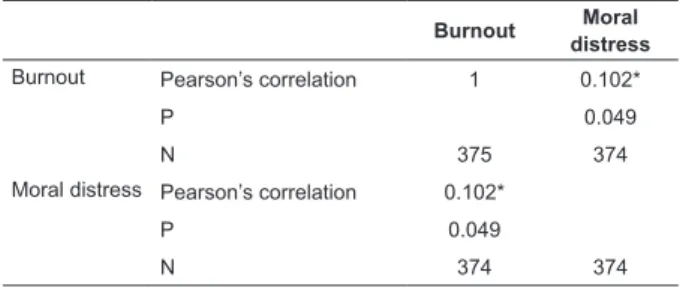
Through the Pearson’s Correlation analysis, the aim was to investigate the association between the moral distress and Burnout variables, and to identify whether the variation in one of these could be associated with the variation in another. It was observed that the
relationship between moral distress and Burnout is
signiicant (at 5%) and positive, however weak, almost
imperceptible(16), as summarized in Table 1.
Table 1 - Pearson’s Correlation Results, Rio Grande, RS, Brazil, 2012
*Signiicant correlation at 5%
Burnout Moral
distress
Burnout Pearson’s correlation 1 0.102*
P 0.049
N 375 374
Moral distress Pearson’s correlation 0.102*
P 0.049
N 374 374
Thus, with the identiication of the presence of
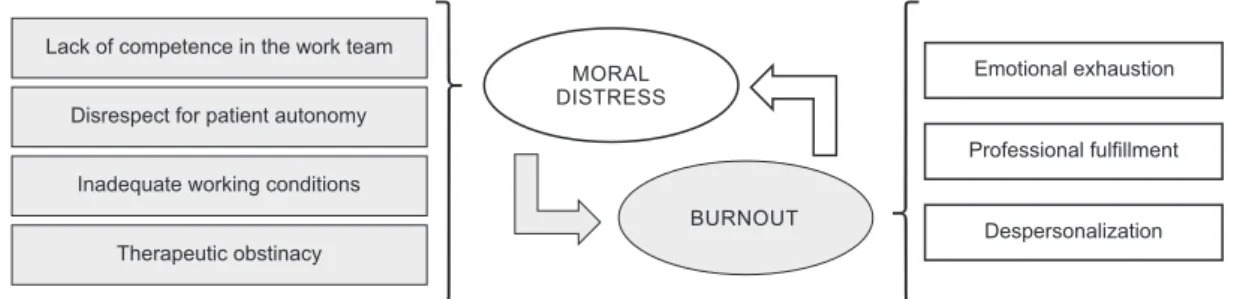
correlation between moral distress and Burnout, multiple regression analysis was performed in order to identify the main factors that contribute to the development of Burnout, considering the different dimensions of moral distress. Multiple regression was also used to verify the converse, i.e., to seek to determine which factors contribute to moral distress, considering Burnout. The representation of the two regression analyzes can be seen in Figure 1.
There were two regression analyzes, the irst
considering Burnout as the dependent variable and the second considering moral distress as the dependent variable. First, the effect of the four dimensions of moral distress on Burnout were evaluated, with the model
tested not presenting statistical signiicance (p=0.128),
with a very low adjusted coeficient of determination
(R²=0.009). These results can be seen in Table 2. Considering Table 2, it is possible to observe that none of the dimensions associated with moral distress
signiicantly contribute to the development of Burnout,
with only therapeutic obstinacy having a value close to the limit of 5%. In this case, there seems to be
proximity in relation to therapeutic obstinacy inluencing
the development of Burnout, i.e., nursing workers who experience situations of greater therapeutic obstinacy seem more prone to the development of Burnout.
In the second regression analysis the effects of the three dimensions of Burnout on the occurrence
of moral distress were evaluated, as deined in Figure 2. The model was also not statistically signiicant
(p= 0.086), presenting a very low adjusted coeficient of determination (R² = 0.010). This coeficient, which varies
Table 2 - Regression Analysis between the dimensions of moral distress according to burnout - Rio Grande, RS, Brazil, 2012
Table 3 - Regression Analysis between the dimensions of burnout regarding moral distress - Rio Grande, RS, Brazil, 2012
Figure 1 - Representation of factors of moral distress that can contribute to the development of burnout, and of factors of burnout that can contribute to the development of moral distress
*Value statistically signiicant at 5%
dependent variables used. In this case, it is clear that both Burnout and moral distress can not be explained by each other, with other mediator or moderator variables
which were not tested in this model possibly existing that explain this relationship. The results of this regression analysis can be seen in Table 3.
MORAL DISTRESS
BURNOUT
Emotional exhaustion
Professional fulfillment
Despersonalization Lack of competence in the work team
Therapeutic obstinacy Inadequate working conditions Disrespect for patient autonomy
Dimensions Beta p
Lack of competence in the work team -0.003 0.950
Disregard for patient autonomy 0.037 0.476
Inadequate working conditions 0.088 0.091
Therapeutic obstinacy 0.101 0.051
Dimensions Beta p
Emotional exhaustion 0.077 0.139
Professional fulillment -0.107 0.039* Depersonalization 0.022 0.670
When observing Table 3, it is clear that, although the model has a low level of explanation, one of the dimensions of Burnout associated with moral distress
was statistically signiicant. In this case, it is possible to say that professional fulillment negatively inluences
moral distress, showing that the higher the professional
fulillment, the lower the moral distress.
Discussion
Considering the indings it was possible to perceive that there is a signiicant, although weak, positive
relationship between moral distress and Burnout. Among the possible relationships between these phenomena, moral distress triggered by situations of therapeutic
obstinacy seems to be associated with the development of Burnout, as there is a relationship very close to the
signiicance level of 5%, however, further studies with different samples are required to conirm or reject this.
Therapeutic obstinacy consists of the implementation of therapeutic measures recognized by the nursing workers as futile and responsible for prolonging the suffering of terminally ill patients(5).
Moral distress resulting from therapeutic obstinacy,
which seems to have an inluence on the development
of Burnout, refers to situations contemplated in the questions of the instrument that comprised this item, i.e., q05 – To initiate intensive procedures to save the life, when it is believed that they merely delay the
death; q11 – To provide assistance to physicians who are performing procedures on patients after cardiac
recovery was unsatisfactory; and q12 – To issue medical prescriptions to conduct unnecessary tests and
treatments with terminally ill patients.
Accordingly, proximity between moral distress
and Burnout has been identiied related to activities
of the nurse as the advocate of the patient, especially in behaviors that involve perceptions of futile care.
Speciically, moral distress was also identiied due to
the negation of the role of the nurse as the advocate of the terminally ill patient, i.e., when nurses present
dificulties in acting in the defense of the rights of
terminally ill patients(13), which may also be associated
Rev. Latino-Am. Enfermagem 2014 Jan.-Feb.;22(1):35-42.
It was also noted that moral distress and possible Burnout resulting from therapeutic obstinacy and the provision of futile care by nursing workers may be
associated with dificulties in sharing opinions regarding
clinical decisions. In the multidisciplinary teams, other members, such as physicians, often represent and exercise greater power, with the knowledge of the nursing workers frequently undervalued, limiting them to participating informally in the decision making process at the bedside of patients due to the rigid and formal structure of decision making in the institutions(17).
These types of experiences of the nursing workers, such as clinical decision-making and organizational issues, add to feelings of their work not being valued and recognized, adding to the lack of autonomy and inability to provide quality care to patients,
primarily due to dificulty having their statements,
knowledge and role as patient advocate recognized and accepted(18).
In a certain way, the nursing workers seem to
face resistance dificulties, in their work environments,
especially in the situations that generate deterioration and moral distress. By analyzing the questions that composed the therapeutic obstinacy dimension, it was possible to see that moral distress occurs when the nursing workers perform procedures they believe to be unnecessary, thus acting against their own values and knowledge, which can also be associated with the development of Burnout. From this perspective, the importance of pastoral power and disciplinary power are emphasized. Power is understood as the multiplicity of force relations immanent and constitutive in the place in which they operate, as a constant game of struggle and confrontations that transforms them, that is, they are relationships that constitute a continuous confrontation, through strategies and techniques(19).
Pastoral power is exercised over bodies and populations, through techniques such as the direction of conscience and obedience, leading individuals to their
own mortiication, the renunciation of the world and of themselves. Thus, mortiication is a form of relationship
with oneself. In nursing, pastoral power refers to nurses’ actions which are based predominantly in obedience, resignation and self-denial, distancing these workers from their political competences and from confronting situations with the team or institution(20). Acting in
consonance with pastoral power, there is also the power to discipline, which has as its goal the formation of docile and useful bodies, i.e., it acts in the subjection of forces of the individuals, giving them a relationship of
docility-utility, i.e., as their economic utility increases, their political capacity and the ability to revolt, resist, and struggle and the counter-power reduces(21).
Therapeutic obstinacy associated with moral distress and Burnout in nursing, seems to relate mainly to the
dificulties of the workers to express their opinions and
take a more active role in the decision-making processes together with the multidisciplinary team, which seems to be associated with the moral construction of these workers, with the valorization of obedience and, in contrast, the normalizing sanction of the resistance. With the perception of their work and opinions devalued, when not participating in decision-making related to the best care for the patient, the nursing workers may feel helpless and without autonomy to confront
these moral conlicts, with dificulties to implement the
care they consider to be correct. These differences in the exercise of power are recognized as a sources of
conlict for the majority of these workers, contributing signiicantly to their inability to effectively advocate for
their patients, relegating to second place this attribute due to institutional constraints, family expectations, and medical opinions(22).
Also associated with these issues, is another
inding of this study, which demonstrates a signiicant negative correlation between professional fulillment
and moral distress, that is, with an increase in
professional fulillment, indicating a lower possibility of
Burnout, there is also a decrease in moral distress. The
professional fulillment dimension is explained from the
seven questions that compose it, these being: 4 – I feel stimulated after working side by side with my clientele; 6 – In my work, I deal with emotional problems very calmly; 11 – I can easily create a calm environment with my clientele; 12 – I feel that I am positively inluencing
other people’s lives through my work; 15 – I adequately treat the problems of my clientele; 18 – I can easily understand what my clients feel about things; and 22 – I have carried out many important things in this work.
When considering the issues presented, it can be said that the confrontations of the nursing workers are relevant and necessary for the maintenance of
professional fulillment, so that they feel respected,
valued and stimulated in their work environments, and
that, as evaluated, they can positively inluence the lives
of their patients. Furthermore, it is possible to observe that, among the results presented, there is a perceived coherence, through the experiences of the nursing
the occurrence of moral distress and Burnout. It was perceived that when the workers express professional
fulillment, i.e., feel that their expectations at work,
their needs and values are realized, they present lower possibilities of developing moral distress and Burnout, unlike when experiencing therapeutic obstinacy, in which a devaluation of their knowledge and values seems to occur, increasing the possibility of moral distress and Burnout.
Final Considerations
It can be observed that there is a correlation, even
though classiied as low, between moral distress and Burnout. It should be noted that, through the indings, it
was not possible to establish cause and effect between these two phenomena, since the models presented
were not signiicant and presented very low levels of
explanation, i.e., the relationship of cause and effect could be due to other variables that were not tested,
such as the characteristics and proile of the respondent,
job satisfaction, and interest in changing sector or leaving the profession.
Although the models presented were not
signiicant, some correlations between the dimensions
of moral distress and Burnout were observed. When
analyzing the inluence of the dimensions of moral
distress on Burnout, it was noted that therapeutic
obstinacy presented a signiicance level very close to
acceptable, which is in line with some approximations between the two phenomena already highlighted in the literature, which relate the provision of futile care and the non-performance of the nurse as the patient advocate. Regarding the dimensions of Burnout
associated with moral distress, a signiicant negative relationship between professional fulillment and moral
distress was found, i.e., with an increase in professional
fulillment there is a decrease in the perception of
moral distress.
These indings, together with the analysis of the
questions of the instruments, refer to the need for nursing workers to confront situations in their work places, strengthening their knowledge, values and beliefs, as well as their perception of what is the best care for their patients, i.e., not acting on behaviors they consider unsuitable, thus maintaining their professional
fulillment. This study presented some limitations such as
the non-inclusion of mediating and moderating variables that could contribute to better explain the relationship between moral distress and Burnout in nursing workers.
This leads to the suggestion that these are sought and tested in further studies, which could also use different samples, for example, random samples.
References
1. Canadian Nurses Association. Code of ethics for registered nurses. Ottawa, Canada: Centennial Ed; 2008. 2. Jameton A. Nursing Practice: The ethical issues. Prentice-Hall: Englewood Cliffs; 1984.
3. Conselho Federal de Enfermagem (BR). Resolução nº 311/2007 – Aprova a Reformulação do Código de Ética dos Profissionais de Enfermagem. Rio de Janeiro 8 fev 2007.
4. Barlem ELD, Lunardi VL, Lunardi GL, Dalmolin GL, Tomaschewski JG. Vivência de sofrimento moral na enfermagem: percepção da enfermeira. Rev Esc Enferm USP. 2012;46(3):681-8.
5. Carvalho KK, Lunardi VL. Therapeutic futility as an ethical issue: intensive care unit nurses. Rev. Latino-Am. Enfermagem. 2009;17(3):308-13.
6. Silén M, Tang PF, Wadensten B, Ahlström G. Workplace distress and ethical dilemmas in neuroscience nursing. J Neurosci Nurs. 2008;40(4):222-31.
7. Rodney P, Starzomski R. Constraints on the moral agency of nurses. Can Nurse. 1993;89(9):23-6.
8. Peterson U, Demerouti E, Bergström G, Samuelsson M, Asberg M, Nygren A . Burnout and physical and mental health among Swedish healthcare workers. J Adv Nurs 2008;62:84–95.
9. Maslach C. Understanding Burnout: Work and family issues. In: Halpern DF, Murphy SE. (Eds). From work-family balance to work-work-family interation: Changing the metaphor. Mahwah, NJ: Erlbaum; 2005.
10. Sundin-Huard D, Fahy K. Moral distress, advocacy and Burnout: theorizing the relationships. Int J Nurs Pract. 1999;5: 8-13.
11. Foucault M. História da sexualidade II: O uso dos prazeres. São Paulo: Graal; 1984.
12. Corley MC, Elswick RK, Gorman M, Clor T. Development and evaluation of moral distress scale. J Adv Nurs. 2001;33(2):250-6.
13. Barlem ELD. Sofrimento moral reconfigurado: uma visão foucaultiana [tese de doutorado]. Rio Grande (RS): Escola de Enfermagem da Universidade Federal do Rio Grande; 2012. 191 p.
Rev. Latino-Am. Enfermagem 2014 Jan.-Feb.;22(1):35-42.
Received: Jan. 7th 2013
Accepted: Sept. 30th 2013
15. Hill MM, Hill A. Investigação por questionário. Lisboa: Editora Sílado; 2002.
16. Hair JF, Anderson RE, Tatham RL, Black WC. Análise multivariada de dados. Porto Alegre: Artmed; 2005. 17. Austin W, Kelecevic J, Goble E, Mekechuk J. An overview of moral distress and the pediatric intensive care team. Nurs Ethics. 2009;16(1):57-68.
18. Dalmolin GL, Lunardi VL, Barlem ELD, Silveira RS. Implicações do sofrimento moral para os(as) enfermeiros(as) e aproximações com o Burnout. Texto Contexto Enferm. 2012;21(1):200-8.
19. Foucault M. História da sexualidade I. A vontade de saber. 19 ed. Rio de Janeiro: Edições Graal; 1988. 20. Foucault M. Ditos e escritos IV. Estratégia, Poder-Saber. Rio de Janeiro: Forense Universitária; 1994. 21. Foucault M. Vigiar e Punir: nascimento da prisão. 36 ed. Petrópolis: Vozes; 2009.