Quantitative assessment of the intensity of
palmar and plantar sweating in patients with
primary palmoplantar hyperhidrosis*
Avaliação quantitativa da intensidade da transpiração palmar e plantar em pacientes portadores de hiperidrose palmoplantar primária
Bruno Yoshihiro Parlato Sakiyama, Thaís Vera Monteiro, Augusto Ishy, José Ribas Milanez de Campos, Paulo Kauffman, Nelson Wolosker
Abstract
Objective: To compare individuals with and without hyperhidrosis in terms of the intensity of palmar and plantar sweating. Methods: We selected 50 patients clinically diagnosed with palmoplantar hyperhidrosis and 25 normal individuals as controls. We quantified sweating using a portable noninvasive electronic device that has relative humidity and temperature sensors to measure transepidermal water loss. All of the individuals had a body mass index of 20-25 kg/cm2. Subjects remained at rest for 20-30 min before the measurements in order to
reduce external interference. The measurements were carried out in a climate-controlled environment (21-24°C). Measurements were carried out on the hypothenar region on both hands and on the medial plantar region on both feet. Results: In the palmoplantar hyperhidrosis group, the mean transepidermal water loss on the hands and feet was 133.6 ± 51.0 g/m2/h and 71.8 ± 40.3 g/m2/h, respectively, compared with 37.9 ± 18.4 g/m2/h and
27.6 ± 14.3 g/m2/h, respectively, in the control group. The differences between the groups were statistically
significant (p < 0.001 for hands and feet). Conclusions: This method proved to be an accurate and reliable tool to quantify palmar and plantar sweating when performed by a trained and qualified professional.
Keywords: Hyperhidrosis; Sweat; Dermatology/instrumentation.
Resumo
Objetivo: Comparar a intensidade de transpiração em palmas das mãos e planta dos pés de indivíduos portadores de hiperidrose com a de um grupo controle. Métodos: Foram selecionados 50 pacientes com diagnóstico clínico de hiperidrose palmoplantar e 25 indivíduos controles. Um método objetivo de quantificação da transpiração foi utilizado com um aparelho eletrônico portátil, não invasivo, com sensores de umidade relativa e de temperatura capazes de quantificar a perda de água transepidérmica. Todos os indivíduos apresentavam índice de massa corpórea de 20-25 kg/cm2 e permaneceram em repouso por 20-30 min antes das medições para reduzir a interferência
externa. A mensuração foi realizada em sala climatizada com a temperatura de 21-24°C. Os locais determinados para a aferição foram região hipotenar da face palmar e região medial da face plantar. Resultados: No grupo com hiperidrose palmoplantar, as médias da intensidade de transpiração nas mãos e nos pés foram de, respectivamente, 133,6 ± 51,0 g/m2/h e 71,8 ± 40,3 g/m2/h, enquanto, no grupo controle, essas foram de 37,9 ±18,4 g/m2/h e
27,6 ± 14,3 g /m2/h. As diferenças das médias entre os grupos foram estatisticamente significativas (p < 0,001).
Conclusões: Este método de quantificação mostrou-se uma ferramenta precisa e confiável na avaliação da transpiração palmar e plantar, quando operado por um profissional treinado e capacitado.
Descritores: Hiperidrose; Suor; Dermatologia/instrumentação.
* Study carried out in the Department of Thoracic Surgery, University of São Paulo School of Medicine Hospital das Clínicas, São Paulo, Brazil.
Correspondence to: Bruno Yoshihiro Parlato Sakiyama Rua Caraíbas, 326, apto. 171, Vila Pompéia, CEP 05020-000, São Paulo, SP, Brasil.
Tel. 11 38039774. E-mail: [email protected] Financial support: None.
sweating, as measured by the abovementioned portable device.
Methods
Between February and May of 2011, we measured the intensity of sweating in 50 patients clinically diagnosed with palmoplantar hyperhidrosis (study group) and 25 individuals without hyperhidrosis (control group) by using the abovementioned portable device. The study was conducted in accordance with the guidelines of the local human research ethics committee. None of the patients had hyperhidrosis on other areas of the body. All of the patients had a body
mass index of 20-25 kg/cm2.
We measured palmoplantar sweating with the abovementioned device, which is a portable noninvasive instrument that has a closed measurement chamber that eliminates any interference from drafts (air conditioning and breathing, as well as the opening and closing of doors and windows), allowing accurate measurement of transepidermal water loss. The chamber contains relative humidity and temperature sensors. For the measurements, the device was positioned perpendicular to the skin, remaining in contact with the skin surface until signaling that the reading was finished. The evaporation rate was automatically calculated by the device on the basis of an increase in relative humidity in the closed chamber. This measurement expresses the increase in water mass (in g) in
relation to the area of evaporation (in m2) per
unit of time (in h), the unit of measurement
being therefore g/m2/h.
In order to standardize the quantification of sweating, all of the patients remained at rest for 20-30 min before the measurements in order to reduce external interference. The measurements were carried out in a climate-controlled environment (21-24°C) at the hyperhidrosis outpatient clinic of the institution. Measurements were carried out on the hypothenar region on both hands (Figure 1) and on the medial plantar region on both feet (Figure 2).
We compared individuals with and without hyperhidrosis in terms of the intensity of palmar and plantar sweating.
In the statistical analysis, we evaluated the mean transepidermal water loss on the hands and feet for each group of patients, the intensity of palmoplantar sweating having been measured
Introduction
Hyperhidrosis is a disorder characterized by excessive sweating (i.e., beyond what is physiologically necessary), especially on the palms, the axillae, the soles, and the face.(1,2) The etiology
of hyperhidrosis is unknown and is associated with severe emotional, occupational, and social
stress.(3) Hyperhidrosis begins in childhood or
adolescence(4) and leads to significant loss of
quality of life.(5) Between 12.5% and 56.5% of
all patients with hyperhidrosis have a family history of the disease.(6)
The treatment of hyperhidrosis aims at reducing sweating on the regions where there is sweat hypersecretion. Among clinical treatments are anticholinergic drugs—which inhibit the sympathetic impulses and whose side effects include dry mouth, visual disorders, urinary retention, constipation, and difficulty in chewing
and swallowing(7)—and dermatological treatments,
including application of astringent solutions or creams,(8) iontophoresis(9) (electrical saltwater baths
applied to the affected area), which can reduce sweating on specific areas for a short period, and subcutaneous injection of botulinum toxin.
(10) In contrast, surgical treatment is definitive
and consists of bilateral thoracic sympathectomy by video-assisted thoracoscopy, in which there is resection, thermal cauterization, or clipping of the sympathetic chain that is responsible for activating sweat glands in the region where one
wants to eliminate profuse sweating.(11,12) The
major side effect of the procedure is compensatory hyperhidrosis.(13,14) Most studies investigating the
intensity or progression of hyperhidrosis after the different types of treatment are based on subjective assessment, meaning that they depend
entirely on patient-reported data.(15) However,
tests have been developed in order to measure the intensity of sweating in an objective manner. The Delfin VapoMeter (Delfin Technologies Ltd., Kuopio, Finland), a portable device that can measure water vapor loss through the skin, has recently been used in order to evaluate the results of treating primary hyperhidrosis.(16,17) In Brazil,
reference values for palmoplantar sweating (based on objective measurements of sweating) have yet to be established.
with the Mann-Whitney U test. For all inferential
analyses, the probability of a type I (α) error
was set at 0.05.
Results
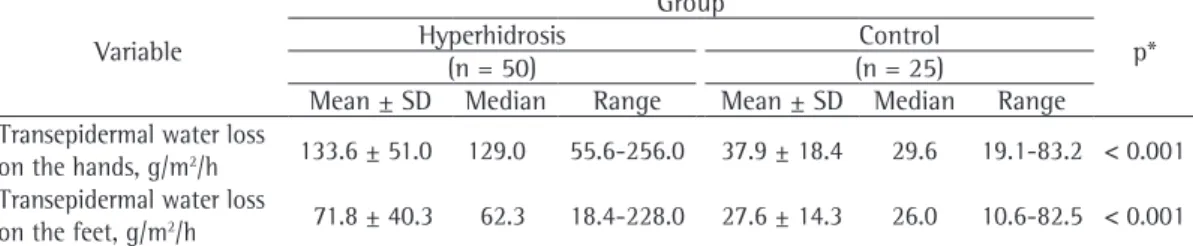
The results of the quantification of palmoplantar sweating in the palmoplantar hyperhidrosis group and in the control group are shown in Table 1. In the palmoplantar hyperhidrosis group, the mean transepidermal water loss on
the hands and feet was 133.6 ± 51.0 g/m2/h and
71.8 ± 40.3 g/m2/h, respectively, compared with
37.9 ± 18.4 g/m2/h and 27.6 ± 14.3 g/m2/h,
respectively, in the control group.
The mean values were higher in the palmoplantar hyperhidrosis group than in the control group, the differences between the groups being statistically significant (p < 0.001).
Discussion
The quantification of sweating plays an extremely important role in the evaluation of treatments for hyperhidrosis and other diseases in which transepidermal water loss on areas such as the face, the hands, the feet, the trunk, and the back might be altered, as is the case of carpal
tunnel syndrome(18) and diabetes.(19)
Currently, quality-of-life questionnaires and indicators of patient satisfaction are often used for measuring the intensity of hyperhidrosis. On the basis of such reports, various attempts have been made to modify the extent of resection of sympathetic ganglia in thoracic sympathectomy in order to eliminate or reduce compensatory hyperhidrosis. However, the information thus obtained is subjective and varies from patient to patient, including symptom duration, symptom severity, extent and distribution of the sites of sweating, previous interventions, and postoperative results.(20-22)
Figure 1 - Measurement of the intensity of palmar sweating.
Figure 2 - Measurement of the intensity of plantar sweating.
Table 1 - Transepidermal water loss on the hands and feet in the hyperhidrosis and control groups.a
Variable
Group
p*
Hyperhidrosis Control
(n = 50) (n = 25)
Mean ± SD Median Range Mean ± SD Median Range Transepidermal water loss
on the hands, g/m2/h 133.6 ± 51.0 129.0 55.6-256.0 37.9 ± 18.4 29.6 19.1-83.2 < 0.001
Transepidermal water loss
on the feet, g/m2/h 71.8 ± 40.3 62.3 18.4-228.0 27.6 ± 14.3 26.0 10.6-82.5 < 0.001
The quantitative sweat measurement system (Q-sweat, model 1.0; WR Medical Electronics Co., Stillwater, MN, USA) was developed to measure transepidermal water loss on small skin surfaces in humans. Rand et al.(24) used it in order to assess
the sweat response during electrical stimulation in patients with diabetes.
More recently, a device known as VapoMeter (Delfin Technologies Ltd.) was used in order to evaluate the results of sympathectomy by video-assisted thoracoscopy in the treatment of
primary palmar and plantar hyperhidrosis.(15,16)
The use of this device has been validated by
De Paepe et al.,(25) who demonstrated that the
measurements obtained by the device are more accurate and reliable than are those obtained by an open chamber device known as the Tewameter (Courage & Khazaka, Cologne, Germany), which is regarded as the reference standard.
To date, there have been no studies specifically focusing on measuring baseline sweating in hyperhidrosis patients or healthy individuals.
By using a portable device, we measured sweat rates in 50 hyperhidrosis patients and 25 healthy individuals and found that the former had much higher rates, the differences being statistically significant. We now have baseline data on the sweating response in normal individuals and in hyperhidrosis patients. These data can be used as a reference by professionals who might be interested in using the device in the evaluation of patients with hyperhidrosis.
Transepidermal water loss as measured by the device under study proved to be a very rapid, practical, and reliable technique for quantifying palmoplantar sweating when performed by a trained and qualified professional. Therefore, the technique can be used in medical practice and can be an ancillary test in the diagnosis of hyperhidrosis and in the assessment of disease severity.
References
1. Lear W, Kessler E, Solish N, Glaser DA. An epidemiological study of hyperhidrosis. Dermatol Surg. 2007;33(1 Spec No.):S69-75. PMid:17241417.
2. Vorkamp T, Foo FJ, Khan S, Schmitto JD, Wilson P. Hyperhidrosis: evolving concepts and a comprehensive review. Surgeon. 2010;8(5):287-92. PMid:20709287. 3. de Campos JR, Kauffman P, Werebe Ede C, Andrade
Filho LO, Kusniek S, Wolosker N, et al. Quality of life, before and after thoracic sympathectomy: report on 378 operated patients. Ann Thorac Surg. 2003;76(3):886-91. PMid:12963223.
There are few methods for the quantification of sweating. In 1996, Kalkan et al.(23) described an
objective method for measuring transepidermal water loss, known as the “pad glove” method. The method involved the use of special gloves (gauze gloves worn under surgical gloves) that were previously weighed on an electronic scale. The participants put on the gloves (on both hands) and then rested in a comfortable, stress-free environment where temperature and humidity were kept constant (19-22°C and 45-55%, respectively). After a given period of time, the gloves were carefully removed (in order to prevent the collected sweat from evaporating) and immediately weighed. The difference between the final weight and the initial weight of the gloves corresponded to the amount of transepidermal water loss, measured in g/h.
Another technique for the quantification of sweating is the use of a ventilated capsule system (SKD 1000, Skinos Co., Nagoya, Japan) through which the contents of the gas that fills the space between the skin surface and the capsule placed on it are measured by two humidity sensors; therefore, the resulting measurement indicates the amount of transepidermal water loss in µg/ cm2/min.(17,18)
Kuwabara et al.(18) used the ventilated capsule
system in order to assess the sympathetic sweat response in patients with carpal tunnel syndrome,
whereas Asahina et al.(19) used it in order to
measure transepidermal water loss in cases of autonomic dysfunction in patients with diabetes.
In order to evaluate changes in the sweating patterns of 17 patients submitted to bilateral thoracic sympathectomy by video-assisted
thoracoscopy, Bonde et al.(22) used a ventilated
than at T3 level for treating palmar hyperhidrosis? J Laparoendosc Adv Surg Tech A. 2008;18(1):102-6. PMid:18266585.
16. Ishy A, de Campos JR, Wolosker N, Kauffman P, Tedde ML, Chiavoni CR, et al. Objective evaluation of patients with palmar hyperhidrosis submitted to two levels of sympathectomy: T3 and T4. Interact Cardiovasc Thorac Surg. 2011;12(4):545-8. http://dx.doi.org/10.1510/ icvts.2010.252015
17. Tetteh HA, Groth SS, Kast T, Whitson BA, Radosevich DM, Klopp AC, et al. Primary palmoplantar hyperhidrosis and thoracoscopic sympathectomy: a new objective assessment method. Ann Thorac Surg. 2009;87(1):267-74; discussion 274-5. PMid:19101310.
18. Kuwabara S, Tamura N, Yamanaka Y, Misawa S, Isose S, Bae JS, et al. Sympathetic sweat responses and skin vasomotor reflexes in carpal tunnel syndrome. Clin Neurol Neurosurg. 2008;110(7):691-5. PMid:18485585. 19. Asahina M, Yamanaka Y, Akaogi Y, Kuwabara S, Koyama
Y, Hattori T. Measurements of sweat response and skin vasomotor reflex for assessment of autonomic dysfunction in patients with diabetes. J Diabetes Complications. 2008;22(4):278-83. PMid:18413213. 20. Wolosker N, Yazbek G, de Campos JR, Munia MA,
Kauffman P, Jatene FB, et al. Quality of life before surgery is a predictive factor for satisfaction among patients undergoing sympathectomy to treat hyperhidrosis. J Vasc Surg. 2010;51(5):1190-4. PMid:20299178. 21. Ribas Milanez de Campos J, Kauffman P, Wolosker
N, Munia MA, de Campos Werebe E, Andrade Filho LO, et al. Axillary hyperhidrosis: T3/T4 versus T4 thoracic sympathectomy in a series of 276 cases. J Laparoendosc Adv Surg Tech A. 2006;16(6):598-603. PMid:17243877. 22. Bonde P, Nwaejike N, Fullerton C, Allen J, Mcguigan
J. An objective assessment of the sudomotor response after thoracoscopic sympathectomy. J Thorac Cardiovasc Surg. 2008;135(3):635-41. PMid:18329485.
23. Kalkan M, Aydemir E, Karakoç Y, Körpinar M. The measurement of sweat intensity using a new technique. Turk J Med Sci 1998;28(5):515-7.
24. Rand S, Petrofsky JS., Zimmerman G. Diabetes: sweat response and heart rate variability during electrical stimulation in controls and people with diabetes. The J Appl Res. 2008;8(1):48-54.
25. De Paepe K, Houben E, Adam R, Wiesemann F, Rogiers V. Validation of the VapoMeter, a closed unventilated chamber system to assess transepidermal water loss vs. the open chamber Tewameter. Skin Res Technol. 2005;11(1):61-9. PMid:15691261.
4. Stolman LP. Hyperhidrosis: medical and surgical treatment. Eplasty. 2008;8:e22. PMid:18488053.
5. Weber A, Heger S, Sinkgraven R, Heckmann M, Elsner P, Rzany B. Psychosocial aspects of patients with focal hyperhidrosis. Marked reduction of social phobia, anxiety and depression and increased quality of life after treatment with botulinum toxin A. Br J Dermatol. 2005;152(2):342-5. PMid:15727649.
6. Ro KM, Cantor RM, Lange KL, Ahn SS. Palmar hyperhidrosis: evidence of genetic transmission. J Vasc Surg. 2002;35(2):382-6. PMid:11854739.
7. Harmsze AM, Houte M, Deneer VH, Tupker RA. Exercise-induced sweating in healthy subjects as a model to predict a drug’s sweat-reducing properties in hyperhydrosis: a prospective, placebo-controlled, double-blind study. Acta Derm Venereol. 2008;88(2):108-12. PMid:18311434. 8. Goh CL, Yoyong K. A comparison of topical tannic
acid versus iontophoresis in the medical treatment of palmar hyperhidrosis. Singapore Med J. 1996;37(5):466-8. PMid:9046194.
9. Köstler E. Significance of iontophoresis in dermatology. With special reference to the management of lymphedemas [Article in German]. Dermatol Monatsschr. 1977;163(9):689-99. PMid:336427. 10. Grunfeld A, Murray CA, Solish N. Botulinum
toxin for hyperhidrosis: a review. Am J Clin Dermatol. 2009;10(2):87-102. PMid:19222249. 11. Munia MA, Wolosker N, Kauffman P, de Campos JR,
Puech-Leão P. A randomized trial of T3-T4 versus T4 sympathectomy for isolated axillary hyperhidrosis. J Vasc Surg. 2007;45(1):130-3. PMid:17210397.
12. Munia MA, Wolosker N, Kaufmann P, de Campos JR, Puech-Leão P. Sustained benefit lasting one year from T4 instead of T3-T4 sympathectomy for isolated axillary hyperhidrosis. Clinics (Sao Paulo). 2008;63(6):771-4. http://dx.doi.org/10.1590/S1807-59322008000600011 13. Yazbek G, Wolosker N, Kauffman P, Campos JR, Puech-Leão P, Jatene FB. Twenty months of evolution following sympathectomy on patients with palmar hyperhidrosis: sympathectomy at the T3 level is better than at the T2 level. Clinics (Sao Paulo). 2009;64(8):743-9. http:// dx.doi.org/10.1590/S1807-59322009000800006 14. Lyra Rde M, Campos JR, Kang DW, Loureiro Mde P,
Furian MB, Costa MG, et al. Guidelines for the prevention, diagnosis and treatment of compensatory hyperhidrosis. J Bras Pneumol. 2008;34(11):967-77. http://dx.doi. org/10.1590/S1806-37132008001100013
About the authors
Bruno Yoshihiro Parlato Sakiyama
Physician. University of São Paulo School of Medicine Hospital das Clínicas, São Paulo, Brazil.
Thaís Vera Monteiro
Physician. University of São Paulo School of Medicine Hospital das Clínicas, São Paulo, Brazil.
Augusto Ishy
Thoracic Surgeon. University of São Paulo School of Medicine Hospital das Clínicas, São Paulo, Brazil.
José Ribas Milanez de Campos
Thoracic Surgeon. University of São Paulo School of Medicine Hospital das Clínicas, São Paulo, Brazil.
Paulo Kauffman
Vascular Surgeon. University of São Paulo School of Medicine Hospital das Clínicas, São Paulo, Brazil.
Nelson Wolosker