Methodology employed in the suite of COPD*
,**
,***
* Review articles published in the current issue of the Brazilian Journal of Pulmonology.
** Menezes AM, Macedo SE, Noal RB, Fiterman JC, Cukier A, Chatkin JM, et al. Pharmacological treatment of COPD. J Bras Pneumol. 2011;37(4):527-43.
*** Wehrmeister FC, Knorst M, Jardim JR, Macedo SEC, Noal RB, Martínez-Mesa J, et al. Pulmonary rehabilitation programs for patients with COPD. J Bras Pneumol. 2011;37(4):544-55.
Studies of COPD are incipient in Brazil, and, to date, there have been no surveys investigating the magnitude of the disease nationwide. A population-based study conducted in the city of São Paulo found the prevalence of COPD in adults aged ≥ 40 years to be 15.8% (95% CI: 13.5-18.1). There is a consensus that COPD is underdiagnosed and undertreated in Brazil.(1) In
view of these facts, governmental institutions have been searching for indicators and support, based on scientific evidence, in order to adopt health policies that can minimize the burden of the disease in the country. In response to a mandate issued by the Brazilian National Council for Scientific and Technological Development, a group of researchers working within the Federal University of Pelotas Graduate Program in Epidemiology, Pelotas, Brazil, conducted a systematic review of the pharmacological treatment and rehabilitation of patients with COPD. The study followed the principles of a systematic review,(2) which means
that the criteria for the type of study, the time frame, the sample selection, the sample size, the outcome measures, the measures of association, the identification of biases, and losses to follow-up, among others, were defined a priori. This method allowed us to find all of the studies published during a pre-established period, as well as to select and classify the studies in terms of scientific evidence (grade of recommendation A, B, or C), in a systematic and standardized manner, thereby ensuring the methodological rigor of the present review.
Criteria for the selection of articles
Databases
We searched five databases: PubMed; Web of Science; EMBASE; Cumulative Index to Nursing and Allied Health Literature; and LILACS. After concluding each database search, we excluded duplicate records.
Time frame
We selected articles published between 2005 and 2009, including those that were available online in 2009 and were slated to be published in 2010.
Languages
We selected articles written in English, Portuguese, or Spanish.
Free terms
Because there are problems and differences regarding database indexing processes, we chose to search the databases using free terms rather than controlled vocabulary (descriptors).
The strategy employed allowed us to retrieve a larger number of references, thereby ensuring that most of the studies meeting the pre-established criteria were identified. A librarian was responsible for that stage of the research. The terms “chronic obstructive pulmonary disease”, “pulmonary disease, “chronic obstructive”, and “chronic obstructive lung diseases” were combined with the associations and outcomes of interest, as proposed by Sin et al.(3) Chart 1
shows the terms used in order to find the articles, which were found by combining the terms in the left column with all of the terms in the right column. Because the present review did not aim to evaluate smoking treatment, vaccines, COPD medication doses, oxygen therapy, or ventilatory support, such terms were not included in the search.
Inclusion and exclusion criteria
The inclusion criteria were as follows: being an original article; having been indexed between January 1, 2005 and December 31, 2009; having an experimental design (being a clinical trial, randomized or otherwise) or an observational design (being a case-control study, cohort study, or before-and-after study);
The levels of scientific evidence (grades of recommendation) used in order to classify the studies included in the present review are described in Chart 2.
Definition of outcome measures
Mortality
As an outcome measure, mortality was defined as all-cause mortality (death from any cause) or cause-specific mortality (death from respiratory or cardiovascular causes) occurring during the follow-up period of the study.
Symptoms
The presence of and reduction in respiratory symptoms were evaluated. Dyspnea, as evaluated by standardized scores, such as the transition dyspnea index and the baseline dyspnea index, was the symptom that was most commonly having been conducted in humans; having
included ≥ 100 individuals (for articles regarding pharmacological treatment) or ≥ 50 individuals (for articles regarding rehabilitation); and having evaluated (as outcome measures) mortality, pulmonary function, symptoms, quality of life, adverse effects, COPD exacerbations, or exercise capacity/tolerance (for articles regarding rehabilitation). We excluded articles regarding rehabilitation in which adverse effects were evaluated as an outcome measure. We also excluded articles that analyzed the effects of drugs on the inflammatory process and those that analyzed immunity, as well as those evaluating cost-effectiveness. In addition, we excluded cross-sectional observational studies, phase I studies, phase II studies, and studies involving patients with asthma.
Levels of scientific evidence
Chart 1 - Terms used in order to identify, by combining the terms in the first column with those in the second, articles for a systematic review of COPD treatment.
Chronic obstructive pulmonary disease; pulmonary disease, chronic
obstructive; and chronic obstructive lung diseases
adrenergic beta-agonists; adrenergic (1N) beta; airway obstructive; antibiotics; beclomethasone; bronchodilators; budesonide; cholinergic antagonists; corticosteroids; emphysema; fluticasone; formoterol; glucocorticosteroids; ipratropium; medications; pulmonary emphysema; pulmonary rehabilitation; receptors adrenergic beta-2; salmeterol; scopolamine derivatives; tiotropium;
treatment; and triamcinolone.
Chart 2 - Levels of scientific evidence (grades of recommendation), in accordance with the criteria recommended by the Global Initiative for Chronic Obstructive Lung Disease.
Grade of recommendation
Source Definition
A RCTs. Rich body of data. Evidence is from well-designed RCTs that provide a consistent pattern of findings in the population for which the recommendation is made. Category A requires substantial numbers of studies involving substantial numbers of participants.
B RCTs. Limited body of data. Evidence is from outcomes of RCTs involving a small sample size, subgroup analyses of RCTs, or systematic reviews of RCTs. Category B pertains when few RCTs are available, they are small in size, they were undertaken in a population that differs from the target population of the recommendation, or the results are somewhat inconsistent.
C Uncontrolled or nonrandomized trials and observational studies.
Evidence is from uncontrolled clinical trials, nonrandomized clinical trials, or observational studies.
proposed by Anthonisen et al.(5) Hospitalizations
were considered to constitute episodes of exacerbation.
Adverse effects
Adverse effects constituted an outcome measure that was exclusive to articles regarding pharmacological treatment. The adverse effects evaluated were general adverse effects, respiratory adverse effects, and cardiovascular adverse effects, as reported by patients. Among such adverse effects, the most commonly reported were anticholinergic symptoms, risk of developing pulmonary infections, risk for cerebral events, cardiac ischemic events, changes in glucose metabolism, osteoporosis, and cardiac arrhythmias.
Health-related quality of life
investigated.(4) The need for rescue medication
use was also included in that outcome measure.
Pulmonary function
For studies evaluating pulmonary function as an outcome measure, it was defined as objective measurement of lung volume, lung capacity, and pulmonary flow. Such studies evaluated pre- and post-bronchodilator FVC and FEV1, as well as, although less commonly, pre- and post-bronchodilator PEF and inspiratory capacity. The annual rate of decline in pulmonary function was also evaluated.
Exacerbation of COPD
As an outcome measure, exacerbation of COPD was defined as a worsening of respiratory symptoms, including increased sputum volume, changes in sputum color, and increased intensity of dyspnea, in accordance with the definition
be of a class other than that of the drug under evaluation.
Article selection and analysis
Figure 1 shows all the stages of the process of selection of articles and the number of articles retrieved at each stage. The references retrieved were compiled into a single library with the program EndNote X3 (Thomson Reuters, Carlsbad, CA, USA). Two pulmonologists and a physical therapist were responsible for selecting and reading the articles in their entirety. After the selection of the articles, the EndNote X3 program was used in order to create two libraries—one for pharmacological treatment and the other for rehabilitation—which, together, contained all of the references selected and the respective full articles in PDF format. The In most of the studies evaluating quality of
life as an outcome measure, it was assessed by the St. George’s Respiratory Questionnaire, a previously validated instrument.(6)
Exercise capacity/tolerance
Exercise capacity/tolerance was an outcome measure that was exclusive to articles regarding rehabilitation. Exercise capacity/tolerance was mostly measured by the six-minute walk test and the functional capacity to perform physical activities. Energy expenditure was also included in this outcome measure. The use of a different type of drug in addition to that being investigated was considered to constitute “placebo”, meaning that the drugs used to treat COPD in the “placebo arm” of the study could
Table 1 - Number of analyses for the outcome measures studied, according to the various drugs compared with placebo.
Drugs Outcome measure Symptoms Pulmonary
function
Exacerbation Quality of life
Mortality Adverse effects
Total SAMA 0 0 1 0 0 0 1 SABA 0 0 0 0 1 2 3 SABA+LABA 2 1 2 1 0 1 7 LABA 7 11 2 6 1 10 37 LABA+IC 4 16 5 7 5 11 48 LAMA 14 17 9 9 6 14 66 LAMA+IC 1 1 0 1 0 0 3 IC 5 6 7 4 8 12 42 SC 0 0 0 0 0 4 4 Mucolytic+AO 1 2 3 2 0 2 10
PDE4 inhibitor 1 4 6 2 1 1 15 Total 35 58 35 32 22 54 236
SAMA: short-acting muscarinic anticholinergic; SABA: short-acting β2 agonist; LABA: long-acting β2 agonist; IC: inhaled corticosteroid; LAMA: long-acting muscarinic anticholinergic; SC: systemic corticosteroid; AO: antioxidant; and PDE4: phosphodiesterase-4.
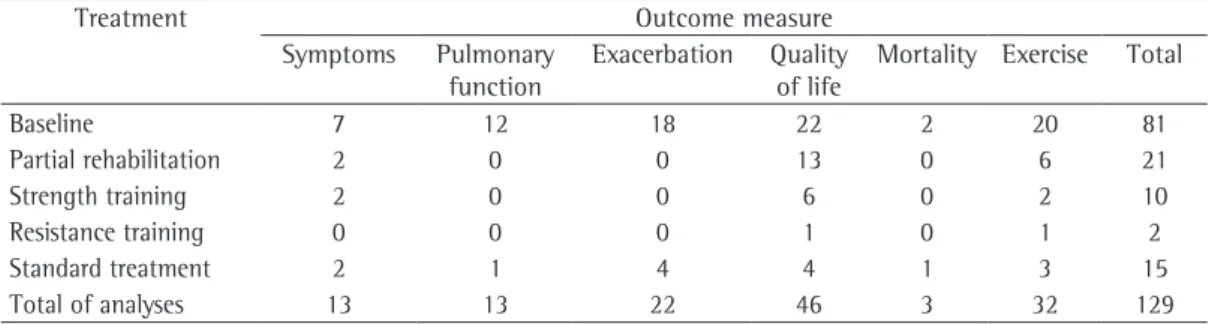
Table 2 - Number of analyses for the outcome measures studied, according to the various novel programs of rehabilitation compared with standard rehabilitation regimens.
Treatment Outcome measure Symptoms Pulmonary
function
Exacerbation Quality of life
analyses derived from the 40 articles selected; of those 181 analyses, 129 (71.3%) compared standard rehabilitation with a given rehabilitation program or with data at enrollment in a given rehabilitation program (Table 2).
References
1. Menezes AM, Perez-Padilla R, Jardim JR, Muiño A, Lopez MV, Valdivia G, et al. Chronic obstructive pulmonary disease in five Latin American cities (the PLATINO study): a prevalence study. Lancet. 2005;366(9500):1875-81. 2. Khan KS, Kunz R, Kleijnen J, Antes G. Systematic
Reviews to Support Evidence-Based Medicine. How to Review and Apply findings of Health Care Research. Abington: RSM Press; 2003.
3. Sin DD, McAlister FA, Man SF, Anthonisen NR. Contemporary management of chronic obstructive pulmonary disease: scientific review. JAMA. 2003;290(17):2301-12.
4. Mahler DA, Weinberg DH, Wells CK, Feinstein AR. The measurement of dyspnea. Contents, interobserver agreement, and physiologic correlates of two new clinical indexes. Chest. 1984;85(6):751-8.
5. Anthonisen NR, Manfreda J, Warren CP, Hershfield ES, Harding GK, Nelson NA. Antibiotic therapy in exacerbations of chronic obstructive pulmonary disease. Ann Intern Med. 1987;106(2):196-204.
6. Jones PW, Quirk FH, Baveystock CM. The St George’s Respiratory Questionnaire. Respir Med. 1991;85 Suppl B:25-31; discussion 33-7.
7. Global Initiative for Chronic Obstructive Lung Disease. Estratégia Global para Diagnóstico, Condução e Prevenção da Doença Pulmonar Obstrutiva Crônica. Bethesda: National Institutes of Health, National Heart, Lung, and Blood Institute; 2006.