Tinnitus in Elderly Individuals: Discomfort and
Impact in the Quality of Life
Adriane Ribeiro Teixeira
1Leticia Petersen Schmidt Rosito
2Andréa Kruger Gonçalves
3Michelle Gassen Paulo Nunes
4Silvia Dornelles
1Maira Rozenfeld Olchik
51Department of Health and Human Communication, Universidade Federal do Rio Grande do Sul, Porto Alegre, RS, Brazil
2Department of Otolaryngology - Head and Neck Surgery, Hospital de Clínicas de Porto Alegre, Porto Alegre, RS, Brazil
3Departamento de Educação Física, Universidade Federal do Rio Grande do Sul, Porto Alegre, RS, Brazil
4Arqué Segurança e Medicina do Trabalho, Porto Alegre, RS, Brazil 5Departamento de Cirurgia e Ortopedia, UFRGS, Porto Alegre, Rio RS,
Brazil
Int Arch Otorhinolaryngol 2017;21:66–71.
Address for correspondence Adriane Ribeiro Teixeira, MD, PhD, Department of Health and Human Communication, Universidade Federal do Rio Grande do Sul, Porto Alegre, Rio Grande do Sul, Brazil (e-mail: [email protected]).
Introduction
Tinnitus is a frequent symptom in individuals of several age groups. Age increase, however, is one of the factors that determine its presence,1and it is more common among the individuals from 40 years old on.2A study reveals that there may be a relation between the presence of tinnitus and the hearing loss presented by the elderly.3
The prevalence among elderly individuals is variably described in the consulted literature. A Japanese study reported the presence of tinnitus in 11.9% of middle-aged adults and elderly people. A population survey performed in the United States showed that tinnitus was present in 14.4% of the middle-aged adults and elderly individuals.4The infl u-ence of the gender variable on the presu-ence of tinnitus is still controversial in the specialized literature.
Keywords
►
tinnitus
►
elderly
►
quality of life
►
questionnaires
Abstract
Introduction
Tinnitus is a symptom that affects mainly the elderly and can negatively
in
fl
uence their quality of life.
Objective
The objective of our study is to evaluate the existence of a relationship
between the quality of life and the impact caused by tinnitus in elderly individuals,
considering the age and gender variables.
Method
We conducted a cross-sectional study in elderly people of both genders who
participate in the extension activities at the university. The evaluation was composed of
anamnesis and WHOQOL-OLD instruments, to evaluate the quality of life, and
Tinnitus
Handicap Inventory
(THI) for the evaluation of the tinnitus impact.
Result
We evaluated 36 elderly individuals with an average age of 68.6
6.8 years
old, 72.2 % of them were women. We veri
fi
ed that most of the subjects classi
fi
ed their
tinnitus as weak (44.4%) or medium (36.1%). The score average in the THI was 20 points,
with predominant classi
fi
cation of tinnitus impact as negligible (41.7%) or mild (30.6%).
In the WHOQOL-OLD, the average score was 15.6
1.6 points (total score). The
negative correlation between the THI score and the WHOQOL-OLD score was found in
the sensory domain operation and total score.
Conclusion
The results obtained in the study prove that the quality of life of the elderly
individuals evaluated is related to a discomfort caused by the tinnitus.
received October 31, 2015 accepted December 2, 2015 published online April 13, 2016
DOI http://dx.doi.org/ 10.1055/s-0036-1572562. ISSN 1809-9777.
Copyright © 2017 by Thieme-Revinter Publicações Ltda, Rio de Janeiro, Brazil Original Research
While some national and international studies state that gender does not influence tinnitus,5,6others highlight that it is more frequent in women1or in men.4,7
Some research states that the tinnitus can cause stress and emotional alterations, interfering in the quality of life and even preventing individuals from having a life consid-ered normal.2,7,8Other studies, however, highlight that the impact of the tinnitus in the quality of life is highly variable. While some individuals say that the symptom does not cause any trouble in their daily activities, others say they are highly harmed.5,9Thus, it is difficult to initially deter-mine whether tinnitus will or will not have a negative impact in the quality of life. The presence of depression, anxiety, neuroticism, psychasthenia, and schizoid aspects may be indicators that the tinnitus impact will be higher,10,11but there is still not enough scientific evidence that the use of antidepressants promotes improvement in tinnitus.12
The evaluation of tinnitus impact can be done in several ways. One of the most used instruments worldwide is the Tinnitus Handicap Inventory (THI), developed by Newman, Jacobson, and Spritzer.13It has a version in Brazilian Portu-guese.14The instrument is composed of 25 questions that evaluate how tinnitus interferes in daily activities.
Quality of life can be measured through different meth-ods, from the use of wide and qualitative questions to the use of closed questionnaires, allowing us to quantify differ-ent aspects of the variable. Because it is a widely impacting and important topic, it has been studied for some time by the World Health Organization (WHO) researchers. Based on several studies and with researchers from several coun-tries, quality of life is defined as“the individual's perception of their life position within the context of culture systems and values in which they are inserted and related to their objectives, expectations, standards, and concerns.”15From this definition, the researchers elaborated questionnaires to evaluate quality of life, initially broad and comprehen-sive and further reduced and applicable to specific pop-ulations, as the WHOQOL-OLD (World Health Organization Quality of Life - Older Adults), to be used specifically with the elderly.16
The application and the joint analysis of these two instru-ments can be useful in clinical practice, evaluation processes, diagnosis, and treatment of elderly with tinnitus, enabling a broad view of the individual, not limited to the specific aspect of the tinnitus. A search in the literature, however, showed that it is rare tofind papers in which instruments to evaluate the quality of life and to evaluate tinnitus are used together,5,8 specially in Brazil, or instruments for the evaluation of quality of life developed specifically for the elderly.
Therefore, considering the lack of studies, the fact that Brazil has a significant and ever-increasing number of elderly individuals, and given the need to study the disorders pre-sented by the population group with a focus on maintaining quality of life, we decided to carry out this study. Thus, the study aims to evaluate the relation between the quality of life and the impact caused by the tinnitus in elderly individuals, considering the age and gender variables.
Method
This is a study with a cross-sectional design. The sample was composed of elderly individuals of both genders, from 60 years old on, who had tinnitus. We selected the sample based on convenience. We considered all the seniors to be physically active because they would participate in extension projects in the institution, and they would practice physical exercises and other activities promoted by the projects (lectures and workshops).
The individuals included in the sample were elderly that reported tinnitus and were available to voluntarily partici-pate in the research, signing a free and clarified consent term (TCLE), andfilling out all questionnaires used for data collec-tion. The individuals excluded were the ones with a history of psychiatric cognitive alterations.
Initially, we approached the elderly individuals at the university facilities and invited them to participate in the research. Those who accepted were led to a room where they signed the TCLE and were instructed on filling out of the questionnaires used in the research. Elderly with difficulties in reading and writing received help from a trained research-er previously, in ordresearch-er not to induce answresearch-ers.
Initially, we carried out an anamnesis, aimed at obtaining sociodemographic data of the elderly. During the initial interview, the participants were questioned about their age, school level, marital status, and diseases. At this point, they were also invited to subjectively analyze the intensity of the tinnitus that they presented, classifying it as weak, medium, or strong. After that, everyone responded to the quality of life evaluation instrument of the World Health Organization, the WHOQOL-OLD, and the THI, to evaluate the impact of the tinnitus in their daily activities.
WHOQOL-OLD is an instrument developed by WHO, already translated and validated for Brazilian Portuguese,16developed to be specifically applied to elderly individuals. The questionnaire is composed of 24 items that allow the evaluation of six parts or domains: operation of the sensory domain; past, present, and future activities; social participation; death and dying; and intimacy. It is also possible to evaluate the total score obtained in the instrument. For each one of the 24 questions, the individual must check one of thefive alternatives presented. The higher the score obtained, the better the quality of life of the individual evaluated.
The impact of the tinnitus was evaluated by the THI instru-ment, also translated to and validated for Brazilian Portuguese.14 There are 25 questions that assess the influence of the tinnitus in daily situations. For each situation, the individual must check one of the three alternatives presented (yes—4 points; sometimes— 2 points; no—0 points). The total score varies from 0 to 100 points (or %), and the impact of the symptom can be considered negligible (0 to 16%), mild (18 to 36%), moderate (38 to 56%), severe (58 to 76%), or catastrophic (78 to 100%). Therefore, the higher the score, the higher the negative impact of the tinnitus in the life of the individual evaluated.
absolute and relative frequencies were calculated for the categorical variables and for the central tendency measures (mean and median) and variability (standard deviation, range and interquartile range) for the continuous variables, where for the latter the symmetry of distributions was checked by theKolmogorov-Smirnovtest.
The bivariate analysis between categorical variables was done by the Pearson Chi-square test and Fisher's exact test. In the comparison of the continuous variables between two indepen-dent groups, we used the t-Stuindepen-dent and the Mann Whitney test. When comparing three or more independent groups, we used the Variance Analysis (One Way)–Post Hoc Tukey–or Kruskal Wallys–Post Hoc Dunn test. To evaluate the linearity relation between the continuous variables, the Pearson or Spearman correlation coefficients were used. For statistical decision criteria, we adopted a level of significance adopted (α) 5%.
The Ethics Research Committee of the institution evaluat-ed and approvevaluat-ed the study, under number 2008-125H.
Results
The sample consisted of 36 elderly individuals, mainly women (72.2%). The age average was 68.66.8 years. Considering the age groups, there was greater concentration in the group aged 60 to 69 years, 63.9% (n¼23). Regarding school level, most indi-viduals had gone to basic school (63.9%), 38.9% having not completed it and 25% having completed it. When instructed to subjectively classify the sensation of the tinnitus intensity, approximately half of the sample said it was weak (44.4%). The characterization of the sample is found on►Table 1.
Regarding the score in the THI, this variable presented an asymmetric distribution, indicating that the estimates should occur as a function of the median and not of the mean. The median was 20 points.
As for the THI score classification, the largest part of the sample presented discomfort considered negligible and mild. The data are presented in►Table 2.
The analysis of the data between the THI score and the gender variable showed a significant difference (p<0.05), indicating that the scores for the men (median¼6.0 points) were smaller than for the women (median¼22.0 points) (►Table 3). When the THI score was compared with the age and to the age group, the significant differences were not confirmed, indicating that the THI score does not depend on the age of the individuals evaluated.
The evaluation data of the quality of life, evaluated through the WHOQOL-OLD, have shown that the elderly present average scores that vary according to the domain evaluated and are presented on►Table 4.
When the average of the domains was compared with each other, there were no significant differences (p>0.05), indicat-ing that the domains presented similar average scores. Therefore, although the averages of the domains have presented variations, they were expressive to the point of affirming that the quality of life in a certain domain is better than in the other.
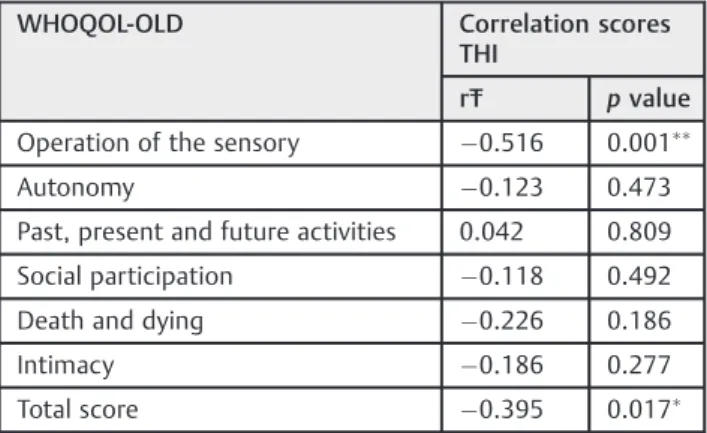
The comparative analysis that involved the WHOQOL-OLD domain scores and the THI scores showed that there was a significant negative correlation of moderate degree
(r¼-0.516; p¼0.001) between the operation of the sensory domain and the THI, indicating that the higher the score in the domain, the smaller the THI score.
Another significant correlation was between the total score in the WHOQOL-OLD and the THI score (r¼-0.395; p<0.05), where the total elevated scores in the WHOQOL-OLD were related to the low scores of the THI (or vice-versa). Therefore, the better the quality of life, the smaller the impact provoked by the tinnitus (►Table 5).
The average scores of the WHOQOL-OLD domains were also compared to the classification in the THI. A significant difference was observed in the domain of the sensory Table 1 Sample characterization
Variables n¼36
Gender–n (%)
Female 26 (72.2)
Male 10 (27.8)
Age (years)
AverageStandard Deviation 68.66.8
Minimum - Maximum 60–83
Age group (years)–n (%)
60 to 69 23 (63.9)
70 to 79 9 (25.0)
More than 79 4 (11.1)
Education
Never studied 2 (5.6)
Incomplete primary education 14 (38.9)
Primary education 9 (25.0)
Incomplete high school 1 (2.8)
High School 6 (16.7)
Incomplete university 2 (5.6)
University 2 (5.6)
Table 2 Absolute and relative distribution for the score and classification THI
Variables n¼36
Scores THI £
Median (Q1-Q3quartile) 20.0 (6.0–41.0)
Minimum - maximum 0–96
Classification THI–n(%)
Negligible (0–16%) 15 (41.7)
Mild (18–36%) 11 (30.6)
Moderate (38–56%) 7 (19.4)
Severe (58–76%) 1 (2.8)
Catastrophic (78–100%) 2 (5.6)
operation (p¼0.001), where the individuals with tinnitus classified as negligible and mild presented higher scores than the individuals with tinnitus impact considered moderate and severe/catastrophic. There were also differ-ences in the total score of WHOQOL-OLD, when again the averages in the THI classification rated negligible and mild showed significantly higher averages than the ones obtained by the individuals with moderate and severe/ catastrophic THI classification (►Table 6).
Discussion
The data obtained show that in the group of elderly evaluated, women had a predominant participation. This fact may be due to the place where the research was conducted. A study showed the massive participation of women in community groups,17,18with an average age and age group similar to the elderly researched.19The low education level of the partic-ipants is similar to the other national research and is a predominant characteristic in the country, and are taken into consideration when planning activities and programs for this age group.19
The THI score was similar to the study mentioned previ-ously, where part of the sample was also composed of elderly that practice physical activities,20
but inferior to other studies that evaluated adult and elderly individuals with tinnitus.2,21 Physical activity is beneficial to the individuals evaluated. A research highlighted that the practice of physical activities is a determining factor for a lesser negative impact of the tinnitus among the elderly, possibly because it promotes the wellbeing and diminishes the discomfort sensation.20
In the analysis of THI classification, a higher number of individuals with impact considered negligible and mild cor-roborates other national studies,22 but differs from others2,23,24that observed a greater number of individuals with negligible, mild and moderate discomfort. As in our study sample was composed of adult and elderly individuals, it is believed that this data can be taken into consideration, once the elderly can be more resilient, being able to adapt faster to unfavorable situations.25
When we analyzed the score obtained in the THI in our study, the elderly women presented scores superior to the men, which differs from some previous studies21,23,26but agrees with another.2A higher score in the evaluated women indicates that the impact provoked by the tinnitus is higher, causing a greater restriction in the social activities. Research shows that women are more careful regarding their health and that preventive care, for example, is not such an integral Table 3 Mean and standard deviation of the THI scores
according to gender and age group; and coefficient of correlation between the age and the score THI
Variables Score THI p
Gender–averageSD (median) 0.041
Female 30.826.8 (22.0)
Male 13.818.9 (6.0)
Abbreviation: SD, standard deviation; THI, Tinnitus Handicap Inventory. : Mann Whitney test.
Table 4 Measures of central tendency and variability for scores of WHOQOL-OLD domains
WHOQOL-OLD n¼36
Operation of the sensory
AverageSD 14.23.7
Minimum - Maximum 8–20
Autonomy
AverageSD 15.12.9
Minimum - Maximum 8–20
Past, present and future activities
AverageSD 15.52.3
Minimum - Maximum 10–20
Social participation
AverageSD 15.52.7
Minimum - Maximum 9–20
Death and dying
AverageSD 14.93.8
Minimum - Maximum 5–20
Intimacy
AverageSD 15.62.6
Minimum - Maximum 9–20
p (mean comparison between domains) 0.295
Total score
AverageSD 15.11.6
Minimum - Maximum 11.7–17.8
Abbreviation: SD, standard deviation; WHOQOL-OLD (World Health Organization Quality of Life -Older Adults.
: repeated measures analysis-Post HoctestBonferronip–p value.
Table 5 Correlation analysis between the scores on the WHOQOL-OLD and THI
WHOQOL-OLD Correlation scores
THI
rŦ pvalue
Operation of the sensory 0.516 0.001
Autonomy 0.123 0.473
Past, present and future activities 0.042 0.809
Social participation 0.118 0.492
Death and dying 0.226 0.186
Intimacy 0.186 0.277
Total score 0.395 0.017
Abbreviation: THI, Tinnitus Handicap Inventory; WHOQOL-OLD (World Health Organization Quality of Life -Older Adults.
part of men's routine.27In addition, elderly women present a self-perception regarding health that is more negative than men,28which must be taken into account in the execution of evaluations and treatments to be prescribed for them. This may have influenced the results obtained in the research.
In the evaluation of quality of life, carried out through the WHOQOL-OLD, we observed that the score was similar in all evaluated domains, which is comparable to the results obtained in national studies with elderly individuals from community groups and who practice physical activities.29,30 The data was also similar to that obtained in studies carried out in other countries.31,32In one of these studies, however, the score in the operation of the sensory domain was inferior to the one obtained in our study.32
The correlation analysis between the score of both instru-ments and the classification of the THI and the WHOQOL-OLD domains showed an association between THI and the opera-tion of the sensory domain and the total score of the WHOQOL-OLD. These results confirm the compromise of the quality of life of the elderly with tinnitus. The higher the THI score (higher discomfort provoked by the tinnitus), the lesser the score in the WHOQOL-OLD (the lesser the quality of life).
A study that used the THI and WHOQOL-bref (abbreviated instrument of evaluation of quality of life developed by WHO) showed that the quality of life of the elderly with tinnitus may be affected, especially if the elder presents insomnia.8 In another research that also used the THI and WHOQOL-bref, the results also showed a correlation with the functional and emotional domains.5The analysis of the quality of life in the elderly with or without tinnitus
is noteworthy among the individuals with the symptom; the score in the WHOQOL-bref is significantly smaller in all domains.33
Although the studies mentioned use another version of the quality of life evaluation instrument, they helped corroborate the findings in our research, whereby tinnitus harms the quality of life of the elderly. This fact must be taken into account by the professionals at the moment of the evaluation and treatment of the individuals. Therefore, elderly, which often suffer from several health disorders that compromise
their autonomy, independence, and quality of life, may present tinnitus, further decreasing their wellbeing sensa-tion. An interdisciplinary approach, however, can promote a better study of the symptom presented, helping not only in the process of evaluation and diagnosis, but also in the establishment of the appropriate treatment for each case, contributing to an improvement in the quality of life.
Conclusion
The results obtained in our study prove that the quality of life of the elderly individuals evaluated is related to a discomfort caused by the tinnitus.
References
1 Park KH, Lee SH, Koo JW, et al. Prevalence and associated factors of
tinnitus: data from the Korean National Health and Nutrition
Examination Survey 2009-2011. J Epidemiol 2014;24(5):417–426
2 Karatas E, Deniz M. The comparison of acoustic and psychic
parameters of subjective tinnitus. Eur Arch Otorhinolaryngol
2012;269(2):441–447
3 Nondahl DM, Cruickshanks KJ, Huang GH, et al. Generational
differences in the reporting of tinnitus. Ear Hear 2012;33(5):
640–644
4 Nondahl DM, Cruickshanks KJ, Huang GH, et al. Tinnitus and its
risk factors in the Beaver Dam offspring study. Int J Audiol 2011;
50(5):313–320
5 Zeman F, Koller M, Langguth B, Landgrebe M; Tinnitus Research
Initiative database study group. Which tinnitus-related aspects are relevant for quality of life and depression: results from a large international multicentre sample. Health Qual Life Outcomes 2014;12:7
6 Teixeira AR, Rosito LPS, Seimetz BM, Dall’Igna C, Costa SS. Chronic
tinnitus: pith, loudness, and discomfort in adults and elderly
patients. In: Atkinson CH. Handbook of hearing disorders
research. Nova BiomedicalNew York2015. p. 93–103.
7 Fujii K, Nagata C, Nakamura K, et al. Prevalence of tinnitus in
community-dwelling Japanese adults. J Epidemiol 2011;21(4):
299–304
8 Lasisi AO, Gureje O. Prevalence of insomnia and impact on quality
of life among community elderly subjects with tinnitus. Ann Otol
Rhinol Laryngol 2011;120(4):226–230
Table 6 Mean and standard deviation of the WHOQOL-OLD domains according to the classification THI
WHOQOL-OLD Classification THI p
Negligible (n¼15)
Mild (n¼11)
Moderate (n¼7)
Severe or catastrophic (n¼3)
Operation of the sensory 14.73.1a 16.62.6a 11.13.6b 10.02.0b 0.001
Autonomy 15.41.8 15.43.6 14.13.6 14.03.6 0.695
Past, present and future activities 15.72.0 15.52.8 14.32.5 17.01.0 0.362
Social participation 15.82.2 15.73.2 14.33.1 16.02.6 0.646
Death and dying 16.13.7 14.84.5 13.73.5 13.02.6 0.450
Intimacy 15.92.5 16.22.1 14.83.2 13.63.2 0.408
Total score 15.61.2a 15.71.8a 13.71.3b 13.91.2b 0.016
9 Turner O, Windfuhr K, Kapur N. Suicide in deaf populations: a literature review. Ann Gen Psychiatry 2007;6:26
10 Hoekstra CE, Wesdorp FM, van Zanten GA. Socio-demographic,
health, and tinnitus related variables affecting tinnitus severity.
Ear Hear 2014;35(5):544–554
11 Mucci S, Geocze L, Abranches DC, Antúnez AEA, Penido NdeO.
[Systematic review of evidence on the association between per-sonality and tinnitus]. Braz J Otorhinolaryngol 2014;80(5):
441–447
12 Baldo P, Doree C, Molin P, McFerran D, Cecco S. Antidepressants for
patients with tinnitus. Cochrane Database Syst Rev 2012;9: CD003853
13 Newman CW, Jacobson GP, Spitzer JB. Development of the Tinnitus
Handicap Inventory. Arch Otolaryngol Head Neck Surg 1996;
122(2):143–148
14 Schmidt LP, Teixeira VN, Dall’Igna C, Dallagnol D, Smith MM.
Adaptação para a língua portuguesa do questionário Tinnitus Handicap Inventory: validade e reprodutibilidade. Rev Bras
Otor-rinolaringol (Engl Ed) 1996;72:808–810
15 WHOQOL GROUP. The world health organization quality of life
assessment (WHOQOL): position paper from the World Health
Organization. Soc Sci Med 1995;41(10):1403–1409
16 Fleck MP, Chachamovich E, Trentini CM. WHOQOL-OLD Project:
method and focus group results in Brazil. Rev Saude Publica 2003;
37(6):793–799
17 Benedetti TRB, Mazo GZ, Borges LJ. Health status and physical
activity levels among the elderly who are participants and non-participants in social welfare groups in Florianópolis. Cien Saude
Colet 2012;17(8):2087–2093
18 Gonçalves AK, Griebler EM, Possamai VD, Teixeira AR. Qualidade
de vida e sintomas depressivos em idosos de três faixas etárias
praticantes de atividade física. Rev Kairós. 2014;17(3):79–94
19 Pilger C, Menon MH, Mathias TAF. Características
sociodemográf-icas e de saúde de idosos: contribuições para os serviços de saúde.
Rev Latino-Am de Enfermagem 2011;19:1230–1238
20 de Arizola HGA, Teixeira AR. Impacto do zumbido em idosos
praticantes e não praticantes de exercício físico. Conscientiae
Saúde 2015;14(1):80–88
21 Udupi VA, Uppunda AK, Mohan KM, Alex J, Mahendra MH. The
relationship of perceived severity of tinnitus with depression, anxiety, hearing status, age and gender in individuals with
tinni-tus. Int Tinnitus J 2013;18(1):29–34
22 Pinto PCL, Sanchez TC, Tomita S. Avaliação da relação entre
severidade do zumbido e perda auditiva, sexo e idade do paciente.
Braz J Otorhinolaryngol. 2010;76(1):18–24
23 Fioretti AB, Fusetti M, Eibenstein A. Association between sleep
disorders, hyperacusis and tinnitus: evaluation with tinnitus
questionnaires. Noise Health 2013;15(63):91–95
24 Gois RO, Gois BO, Pereira MCCS, Taguchi CK. Estado mental e
impacto do zumbido em idosos. Rev CEFAC 2014;16:798–809
25 Ferreira CL, Santos LMO, Maia EMC. Resilience among the elderly
cared for by the primary healthcare network in a city of northeast
Brazil. Rev Esc Enferm USP 2012;46(2):328–334
26 Alsanosi AA. Impact of tinnitus on the quality of life among Saudi
patients. Saudi Med J 2011;32(12):1274–1278
27 Alves RF, Silva RP, Ernesto MV, Lima AGB, Souza FM. Gênero e
saúde: o cuidar do homem em debate. Psicol Teor Prat 2011;
13:152–166
28 Silva RJS, Smith-Menezes A, Tribess S, Rómo-Perez V, Virtuoso JS Jr.
Prevalence and factors associated with negative health perception
by the Brazilian elderly. Rev Bras Epidemiol 2012;15(1):49–62
29 Serbim AK, Figueiredo AEPL. Qualidade de vida de idosos de um
grupo de convivência. Sci Med 2011;21:166–172
30 de Souza Santos CA, Dantas EEM, Moreira MHR. Correlation of
physical aptitude; functional capacity, corporal balance and quality of life (QoL) among elderly women submitted to a post-menopausal physical activities program. Arch Gerontol Geriatr
2011;53(3):344–349
31 Top M, Eris H, Kabalcioglu F. Quality of life (QoL) and attitudes
toward aging in older adults in Sanliurfa, Turkey. Res Aging 2012;
35:533–562
32 Bilgili N, ArpacıF. Quality of life of older adults in Turkey. Arch
Gerontol Geriatr 2014;59(2):415–421
33 Negrila-Mezei A, Enache R, Sarafoleanu C. Tinnitus in elderly
population: clinic correlations and impact upon QoL. J Med Life