Voice Outcome after Gore-Tex Medialization
Thyroplasty
Ismail Elnashar
1Mohammad El-Anwar
1Hazem Amer
1Amal Quriba
11Department of Otorhinolaryngology
–Head and Neck Surgery, Zagazig University, Zagazig, Egypt
Int Arch Otorhinolaryngol 2015;19:248–254.
Address for correspondence Mohammad Waheed El-Anwar, MD, Department of Otorhinolaryngology Head and Neck Surgery, Faculty of Medicine, Zagazig University, Zagazig 0020552309843, Egypt (e-mail: [email protected]).
Introduction
Glottic incompetence (GI) can be defined as incomplete glottic closure during phonation. It is a commonfinding in patients with vocal fold immobility, paresis, atrophy, and scar.1
Unilateral vocal fold paralysis (UVFP) is the most common cause of GI and usually presents with dysphonia and possibly with severe symptoms such as aspiration, poor coughing effort, or pneumonia, which may be life-threatening in debilitated
patients.2–4It was estimated that 23 to 53% of patients with UVFP demonstrated evidence of aspiration on videofluoroscopic examination.3–5If there is no recovery or if there is inadequate compensation after UVFP, procedures aiming to restore glottic competence include permanent and temporary vocal fold in-jections or laryngeal framework surgery, such as type 1 thyroplasty.6
Type I thyroplasty, with or without adjunctive arytenoids procedures, is widely considered the surgical management of choice for glottic insufficiency resulting from vocal fold Keywords
►
thyroplasty
►
voice
►
Gore-Tex
Abstract
Introduction
Although medialization thyroplasty utilizing Gore-Tex (Gore and
Asso-ciates, Newark, Delaware, United States) has been discussed in the literature, few
reports have assessed voice quality afterward, and they did not use a full assessment
protocol.
Objective
To assess the improvement in voice quality after medialization thyroplasty
utilizing Gore-Tex in patients with glottic insuf
fi
ciency of variable etiology.
Methods
Eleven patients with glottic insuf
fi
ciency of different etiologies that failed
compensation were operated by type 1 thyroplasty utilizing Gore-Tex. Pre- and
postoperative (1 week, 3 months, and 6 months) voice assessment was done and
statistical analysis was performed on the results.
Results
In all postoperative assessments, there was signi
fi
cant improvement in the
grade of dysphonia (
p
<
0.004) and highly signi
fi
cant reduction in the size of glottic gap
and prolongation of maximum phonation time (
p
<
0.0001). The difference in voice
parameters in the early (1 week) and the late (3 and 6 months) postoperative period was
not signi
fi
cant. None of the patients developed stridor or shortness of breath
necessitating tracheotomy, and there was no implant extrusion in any patient during
the study period.
Conclusion
Gore-Tex medialization provides reliable results for both subjective and
objective voice parameters. It leads to a satisfactory restoration of voice whatever the
etiology of glottic incompetence is. This technique is relatively easy and does not lead to
major complications. Further studies with larger number of patients and more extended
periods of follow-up are still required to assess the long-term results of the technique
regarding voice quality and implant extrusion.
received October 22, 2014 accepted
November 18, 2014 published online February 26, 2015
DOI http://dx.doi.org/ 10.1055/s-0034-1397339. ISSN 1809-9777.
Copyright © 2015 by Thieme Publicações Ltda, Rio de Janeiro, Brazil
immobility. Medialization using laryngeal implants has been shown to improve voice handicap index and perceptual voice measures as well as acoustic parameters of the voice.7–9Both Silastic and Gore-Tex (both Gore and Associates, Newark, Delaware, United States) thyroplasty implants have been shown to provide excellent long-term surgical rehabilitation of paralytic dysphonia.10,11The ideal surgical management of GI in patients with mobile vocal folds, however, is far less well established.
Gore-Tex, expanded polytetrafluoroethylene, was devel-oped by Gore and Associates in the late 1960s. The first application was in general vascular surgery, and the first vessel implants were described in 1971.12Since that time, the material has been described as a semiporous material with excellent tissue integration, minimal tissue inflammation, and low rates of extrusion and is easily removed when necessary.13,14
Gore-Tex medialization laryngoplasty wasfirst described by McCulloch and Hoffman in 1998.10The technique is fast and not technically demanding because the implant is simply layered into the paraglottic region and does not need to be carved. Medialization is reached in an incremental manner (inserting or removing portions of the Gore-Tex strip) until satisfactory vocal outcome is achieved, allowingfine intra-operative adjustments that do not involve removal and replacement of the entire implant.15
Although medialization thyroplasty utilizing Gore-Tex was discussed in the literature, few reports assessed the voice quality after the surgery, and even these did not use full assessment protocol.1,2,5The aim of this study was to assess the improvement in voice quality after Gore-Tex medializa-tion thyroplasty in patients with uncompensated GI using a full assessment protocol and comparing the immediate post-operative results to later results.
Methods
This study was conducted in between June 2007 and October 2013. The study included 11 patients who presented with insufficient glottic closure that failed to compensate at least 1 year after injury. Three patients were previously exposed to vocal fold injection at least 6 months prior to medialization, with poor results. The etiology of glottic insufficiency was vocal fold paralysis in 10 patients (post-thyroidectomy in 5 patients, idiopathic in 2, after spine surgery in 2, carotid body tumor in 1, and after cordectomy in 1). All the patients were operated using type 1 thyroplasty utilizing Gore-Tex. Preoperatively, all the patients had voice complaints in the form of breathy dysphonia, increased phonation effort, and vocal fatigue. All of them had glottic phonatory gap more than 3 mm at its widest point. Informed written consent was obtained from all included subjects. The patients were subjected to preoperative voice assessment protocol by the phoniatrician, who was blinded to the state of the patient (either preoperative or postoperative).16 This protocol passed through the following levels: elementary diagnostic procedures, clinical diagnostic aids, and additional instrumental measures.
Elementary Diagnostic Procedures
Diagnostic procedures included auditory perceptual assess-ment of the patient’s voice as a subjective evaluation of the voice with careful laryngeal examination. The presence or absence of vocal fold visible mobility was determined, along with its side and degree (normal or restricted) and the direction of restriction (abductor or adductor), to confirm the diagnosis. The phonatory gap (gap between vocal folds during average phonation) and respiratory chink (maximal glottic gap during respiration) were determined. They were measured in millimeters at their widest point compared with the length of the visible membranous vocal fold (proposed to be 15 mm in men and 10 mm in women).17Glottic gap was confirmed using the method described by Kotby et al.17 A millimeter-graded ruler was photographed in focus with the same magnification used in video laryngoscopy of the glottis. The printout of the glottis was obtained from the stroboscopy system, and a printout of the ruler image was obtained as well, and the gap was then measured.
Clinical Diagnostic Aids
This level of the protocol includes laryngo-video-stroboscopy using eitherflexible nasofibroscope or rigid 70-degree laryn-goscope, from Xion Medicals (Germany), connected to a camera in association with stroboscopic light. Phonatory gap size was confirmed during stroboscopic image with average comfortable phonation at the widest point of the vocal folds. Then documentation of the auditory perceptual assessment was done by means of high-fidelity voice record-ing, which included reading a standardized text, a counting task, and sustained vowel prolongation including /α/, /i/ and /u/ vowels. The recordings were done in a sound-treated room to minimize environmental noise. The recorded mate-rials for all patients were rated using the modified GRBAS (grade, roughness, breathiness, asthenia, strain) scale,18 which was confirmed by three experienced phoniatricians. This scale included 4 points (0 to 3; 0 for normal, 3 for severe) for determining the overall grade of dysphonia and character of voice including strained, leaky, breathy, and rough.
Additional Instrumental Measures
This level of assessment included acoustic analysis of voice using the Vocal Assessment Software from Dr Speech 4.5. The patient was asked to pronounce a prolonged /α/ in front of a microphone as long as possible after taking a deep inspiration. The following parameters were analyzed automatically: jitter (%), shimmer (%), and noise-to-harmonic ratio. Maximal phonation time (MPT) could be measured simultaneously during the same task.
Patients with mild glottic insufficiency were selected for vocal fold injection and were only operated by medialization if voice quality was unsatisfactory immediately or later after injection. Patients with moderate and severe glottic insufficiency were operated directly by Gore-Tex medialization thyroplasty. All the surgeries were done initially under local anesthesia. Postoperatively, voice assessment was repeated at 1 week, 3 months, and 6 months from the date of surgery.
version 17; Chicago, Illinois, United States) was used to analyze the data. Data of this work were found to be homogenous using variance homogeneity test. Analysis of distribution of data revealed that parametric tests could be applied. The chi-square test was used for qualitative variables, and the analysis of variance was used for quantitative variables. Turkey honest significant difference post hoc test was used to compare indi-vidual groups. A p value less than 0.05 was considered significant.
Surgical Technique
During this study, the standard Gore-Tex medialization laryngoplasty following the basic steps described McCulloch et al,10 with some modification, was adopted. After the administration of monitored anesthesia, 10% topical xylocaine and Oxymetazoline-soaked pledgets were placed into the nose. Topical local anesthetic spray was applied to the pharynx and aflexible nasopharyngoscope was introduced so that a clear image of the larynx was obtained. The nasopharyngo-scope wasfixed to a table at the patient’s head and could be handled by an assistant to maintain a clear image of the larynx during the procedure. Local anesthesia, 0.5% lidocaine 1:200,000 epinephrine with 0.25% bupivacaine, was then administered. A 3-cm incision was made in a natural skin
crease overlying the thyroid ala. The strap muscles were reflected laterally, and a laterally based perichondrial flap was elevated. The inferior thyrotomy as measured 5 mm above the inferior border of the thyroid cartilage, and a 5- to 7-mm window was then created with a no. 3 course diamond burr 5 mm from the midline in women and 7 mm from the midline in men. The inner perichondrium was identified and elevated carefully from the thyroid alae without incision. Utilizing flexible laryngoscopic guidance, the Gore-Tex was then placed with care to appropriately augment the posterior and mid-portions of the glottis. At the same time, the patient was asked to phonate until the best voice quality was reached. The perichondrium was draped back over the thyrotomy, and the incision was closed in layers with absorbable suture. A small drain as used and removed after 24 hours. Patients received 1 week of oral postoperative antibiotics and were discharged home the day after surgery.
Results
The study included 11 patients (5 men and 6 women) with ages ranging between 22 and 56 years.►Table 1 shows the demographic characteristics of the patients and the etiology of glottic incompetence.
Table 1 Descriptive data for patients included in the study before surgery
Patient no. Sex Age (y) Cause of paralysis Side Duration till surgery (mo)
Previous inter-vention
Glottic gap size (mm)
1 F 22 After thyroidectomy Left 14 None 4
2 F 43 After thyroidectomy Left 13 None 5
3 M 39 Spine surgery Right 24 Vocal injection
(fat)
4
4 F 28 Idiopathic Left 12 None 4
5 M 53 Carotid body tumor Right 15 Vocal injection (fat)
6
6 F 38 After thyroidectomy Left 12 Vocal injection (Restylane®, USA)
5
7 M 55 Spine surgery Right 16 None 4
8 F 47 After thyroidectomy Right 12 None 4
9 M 33 idiopathic Right 13 None 4
10 F 25 After thyroidectomy Left 12 None 5
11 M 56 Cordectomy Right 18 None 4
Table 2 Comparison between preoperative and postoperative results of the grade of dysphonia
Grade of dysphonia Preoperative 1 wk postoperative 3 mo postoperative 6 mo postoperative χ2 p
0 0 (0%) 1 (9%) 2(18%) 2 (18%) 23.9 0.004a
1 0 (0%) 5 (45%) 5 (45%) 4 (36%)
2 2 (18%) 4 (36%) 3 (27%) 4 (36%)
3 9 (82%) 1 (9%) 1 (09%) 1 (9%)
aSigni
There was satisfactory improvement in the grade of dys-phonia after surgery. This was confirmed by the presence of a significant difference between preoperative and all postoper-ative results of the grade of dysphonia (►Table 2). The improvement in the grade of dysphonia continued through-out the follow-up period as comparison between postopera-tive results of the grade of dysphonia revealed nonsignificant difference (►Table 3).
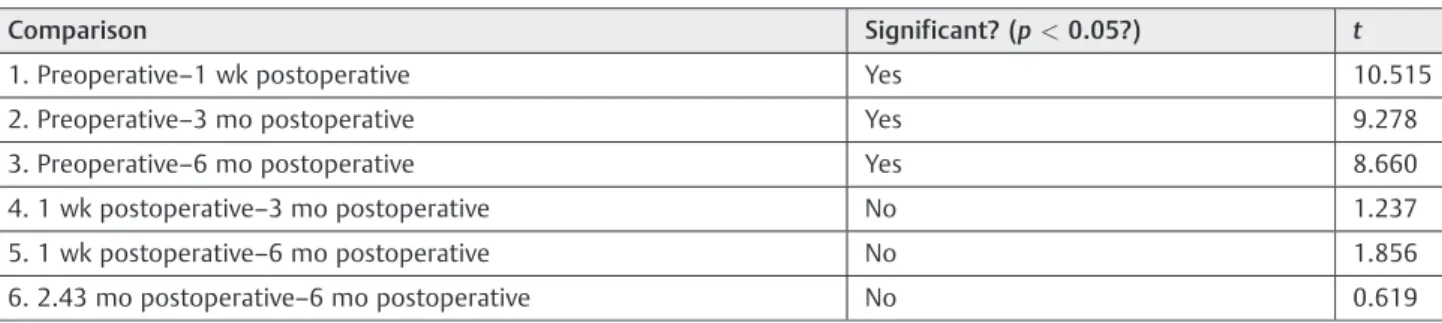
It was clear in all postoperative assessment that there was a decrease in the size of glottic gap. This was evident from the highly significant difference between preoperative and post-operative measures of glottic gap size (►Table 4). Comparison between individual groups of the study confirmed the post-operative improvement (►Table 5). This improvement in the size of the glottic gap continued throughout the study period (►Table 6).
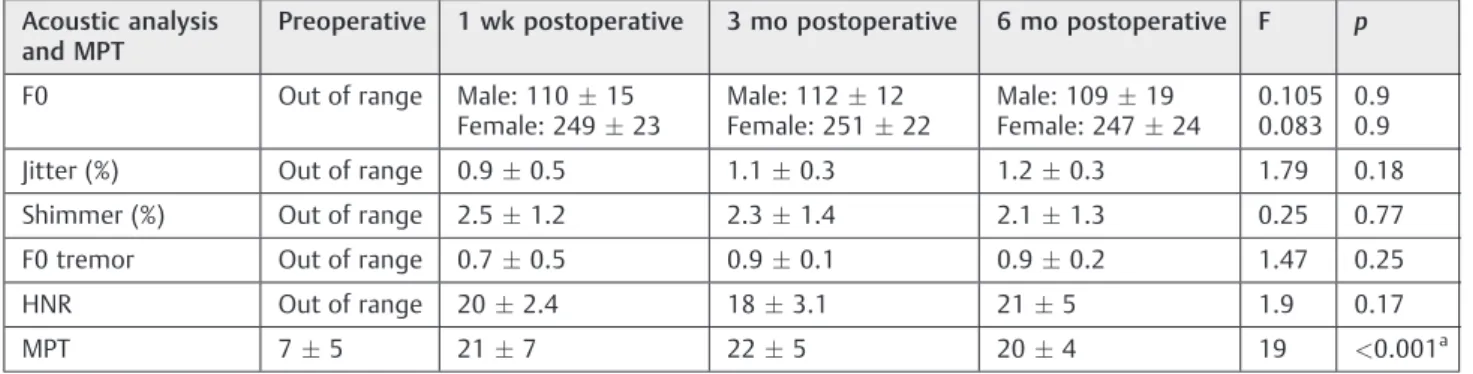
MPT was prolonged sufficiently after surgery, and this improvement continued throughout the study period. This was evident from the highly significant difference between preoperative and postoperative measurements (►Table 7) and the nonsignificant difference between postoperative measurements (►Table 8). These results were confirmed by comparison between individual groups (►Table 9).
Assessment of the preoperative acoustic analysis was impossible in all the patients due to the severe change in
voice, which was detected by the software as out of range signals. Immediately after surgery, acoustic signals could be detected and calculated. This means that there was im-provement of voice after surgery, and this imim-provement continued until the end of the study.
The surgery was done under local anesthesia in all patients except one patient (no. 6), who was converted to general anesthesia due to severe irritability. Five patients developed minor postoperative complications: three with wound ecchy-mosis and two with vocal fold hematoma. All of them recovered within a few days without any intervention. None of the patients developed stridor or shortness of breath necessitating tracheot-omy, and there was no implant extrusion in any patient during the study period.
Discussion
The laryngeal framework surgery medialization timeline began in 1915 with Payer and has had many recent important and landmark contributions from Isshiki and others.19–21
Relatively small glottic gaps between membranous vocal folds are generally accepted to be more appropriate for injection laryngoplasty, whereas larger glottic gaps with asymptomatic posterior glottic chinks are found to be ideal for medialization thyroplasty.15In our study, glottic phona-tory gaps3 mm were excluded from study. Three of the
Table 4 Comparison between preoperative and postoperative results of glottic phonatory gap
Preoperative 1 wk postoperative 3 mo postoperative 6 mo postoperative F p
Size of glottic gap (mm)
4.50.7 1.10.6 1.50.9 1.70.8 46.16 <0.001a
Note: Results are meanstandard deviation. F: one-way analysis of variance. aHighly signi
ficant difference.
Table 3 Comparison between different postoperative results of the grade of dysphonia
1 wk postoperative 3 mo postoperative 6 mo postoperative X2 p
1 (9%) 2 (18%) 2 (18%) 0.725 0.99
5 (45%) 5 (45%) 4 (36%)
4 (36%) 3 (27%) 4 (36%)
1 (9%) 1 (09%) 1 (9%)
Table 5 Post hoc test for results of comparison between phonatory gap sizes
Comparison Significant? (p<0.05?) t
1. Preoperative–1 wk postoperative Yes 10.515
2. Preoperative–3 mo postoperative Yes 9.278
3. Preoperative–6 mo postoperative Yes 8.660
4. 1 wk postoperative–3 mo postoperative No 1.237
5. 1 wk postoperative–6 mo postoperative No 1.856
included patients were previously exposed to vocal fold injection at least 6 months prior to medialization, with poor results. The poor results for injection of those patients are expected to be due to faulty selection of the surgical technique, as they had gap size more than 3 mm. Another reason may be atrophy and scarring of the vocal cord after injection.
Despite the great advantages of Gore-Tex medialization laryngoplasty, some studies reported delayed extrusion of the Gore-Tex prosthesis.22,23 In these studies, the inner perichondrium was incised or removed. We did not incise the inner perichondrium, and we did not have any cases of
implant extrusion. The importance of preservation of the inner perichondrium of the thyroid cartilage was also emphasized by other authors.24They recommend that one should proceed very carefully and cautiously while dissecting the inner perichondrium, otherwise hemorrhage may devel-op, and in performing hemostasis, the coagulation may damage the delicate structure.
The authors of this work agree with Bihari et al that when performing thyroplasties using the techniques reported by Isshiki et al.19 overcorrection is recommended.24 After listening to the voice of the patient and obtaining an optimal result, medialization of the vocal cord 1 mm more is Table 6 Comparison between postoperative results of glottic phonatory gap size
1 wk postoperative 3 mo postoperative 6 mo postoperative F p
1.10.6 1.50.9 1.70.8 1.7 0.2
Note: Results are meanstandard deviation. F: one-way analysis of variance.
Table 7 Comparison between preoperative and postoperative results of acoustic analysis and MPT
Acoustic analysis and MPT
Preoperative 1 wk postoperative 3 mo postoperative 6 mo postoperative F p
F0 Out of range Male: 11015 Female: 24923
Male: 11212 Female: 25122
Male: 10919 Female: 24724
0.105 0.083
0.9 0.9
Jitter (%) Out of range 0.90.5 1.10.3 1.20.3 1.79 0.18
Shimmer (%) Out of range 2.51.2 2.31.4 2.11.3 0.25 0.77
F0 tremor Out of range 0.70.5 0.90.1 0.90.2 1.47 0.25
HNR Out of range 202.4 183.1 215 1.9 0.17
MPT 75 217 225 204 19 <0.001a
Abbreviations: MPT, maximum phonation time; NHR, noise to harmonic ratio. Note: Results are meanstandard deviation. F: one-way analysis of variance. aHighly signi
ficant difference.
Table 8 Comparison between postoperative results of maximum phonation time (MPT)
1 wk postoperative 3 mo postoperative 6 mo postoperative F p
MPT 217 225 204 0.367 0.69
Note: Results are meanstandard deviation. F: one-way analysis of variance.
Table 9 Post-hoc test for results of comparison between MPT
Comparison Significant? (p<0.05?) t
1. Preoperative–1 wk postoperative Yes 6.123
2. Preoperative–3 mo postoperative Yes 6.561
3. Preoperative–6 mo postoperative Yes 5.686
4. 1 wk postoperative–3 mo postoperative No 0.437
5. 1 wk postoperative–6 mo postoperative No 0.437
advisable. This is important, because there is always some edema during surgery. If this overcorrection is not done, a small gap will result after the edema is eliminated. This occurred in some of our patients and was clear in thefirst postoperative assessment (1 week postoperatively). So both grade of dysphonia and size of glottic gap were better, though nonsignificant, than the later assessments. This occurs most probably due to the effect of edema, which was absorbed gradually later on. Although edema is absorbed in the late postoperative evaluations, results were still satisfactory until the end of study. The significant difference between the preoperative and postoperative grade of dysphonia revealed the success of the surgery in improving patients’voice. The highly significant difference between preoperative and post-operative gap size revealed the ability of Gore-Tex medial-ization in approximating the edges of the glottis and eliminating the gap.
In the current study, preoperative acoustic analysis, which is a more objective tool for assessment of voice, could not be assessed due to the large size of the gap, which led to very severe breathy dysphonia. This type of voice could not be detected by our software, although postoperatively the voice signals could be detected and analyzed easily. The compari-son between different postoperative results revealed nonsig-nificant difference. This was evidence of constant improvement of voice signals until the end of the study.
In preoperative assessment, the mean MPT was 7 seconds, which is very short and reveals a great deficiency in the respiratory support for phonation. This was directly due to the large glottic gap, which permitted escape of large amount of air from the chest and larynx. This was corrected after surgery and was clear in the prolongation of MPT (the mean was 20 seconds at the end of the study). The presence of a highly significant difference between preoperative and post-operative MPT confirmed the improvement of the sphincteric mechanism of the glottis. Although the overall improvement of the voice was evident, we cannot deny heterogeneous results of postoperative assessments. This is a logicalfinding as the initial sample was also heterogeneous.
Piazza et al used type 1 thyroplasty for correction of major GI after endoscopic cordectomy.25 When compared with Montgomery Thyroplasty Implant System, they found Gore-Tex to be easier and more reliable with a smaller extrusion rate. We had only one patient who had endoscopic laser cordectomy for carcinoma in situ. This patient showed signif-icant improvement in his voice quality after Gore-Tex medialization.
The current study demonstrated that the main advantage of Gore-Tex medialization, in addition to the easiness and safety of the procedure, is the excellent and sustained post-operative voice quality. Other advantages include the biocom-patibility and safeness of the material itself that was demonstrated by some reports,26,27 in which neither an allergic response nor a foreign material reaction were seen during Gore-Tex use. The material is highly compliant and easy to handle. The porous structure of Gore-Tex permits limited cellular infiltration with minimal capsule formation, allowing the material to be isolated from surrounding tissues
and easily removed to ensure the reversibility of the surgical procedure. Furthermore, the use of Gore-Tex does not pre-clude an association with other techniques (e.g., fat injection or anterior commissure laryngoplasty).28
Conclusion
Gore-Tex medialization provides reliable, constant results for both subjective and objective voice parameters. It leads to satisfactory restoration of voice. This technique is relatively easy and does not lead to major complications. Further studies with a larger number of patients and more extended periods of follow-up are still needed to prove the exact efficiency of the technique.
References
1 Buckmire RA, Bryson PC, Patel MR. Type I Gore-Tex laryngoplasty for glottic incompetence in mobile vocal folds. J Voice 2011;25(3): 288–292
2 Benninger MS, Ahuja AS, Gardner G, Grywalski C. Assessing out-comes for dysphonic patients. J Voice 1998;12(4):540–550 3 Bhattacharyya N, Kotz T, Shapiro J. Dysphagia and aspiration with
unilateral vocal cord immobility: incidence, characterization, and response to surgical treatment. Ann Otol Rhinol Laryngol 2002; 111(8):672–679
4 Heitmiller RF, Tseng E, Jones B. Prevalence of aspiration and laryngeal penetration in patients with unilateral vocal fold motion impairment. Dysphagia 2000;15(4):184–187
5 Lam PK, Ho WK, Ng ML, Wei WI. Medialization thyroplasty for cancer-related unilateral vocal fold paralysis. Otolaryngol Head Neck Surg 2007;136(3):440–444
6 Mallur PS, Rosen CA. Vocal fold injection: review of indications, techniques, and materials for augmentation. Clin Exp Otorhinolar-yngol 2010;3(4):177–182
7 Spector BC, Netterville JL, Billante C, Clary J, Reinisch L, Smith TL. Quality-of-life assessment in patients with unilateral vocal cord paralysis. Otolaryngol Head Neck Surg 2001;125(3):176–182 8 Dursun G, Boynukalin S, Ozgursoy OB, Coruh I. Long-term results
of different treatment modalities for glottic insufficiency. Am J Otolaryngol 2008;29(1):7–12
9 Lu FL, Casiano RR, Lundy DS, Xue JW. Longitudinal evaluation of vocal function after thyroplasty type I in the treatment of unilateral vocal paralysis. Laryngoscope 1996;106(5 Pt 1): 573–577
10 McCulloch TM, Hoffman HT. Medialization laryngoplasty with ex-panded polytetrafluoroethylene. Surgical technique and preliminary results. Ann Otol Rhinol Laryngol 1998;107(5 Pt 1):427–432 11 Zeitels SM, Mauri M, Dailey SH. Medialization laryngoplasty with
Gore-Tex for voice restoration secondary to glottal incompetence: indications and observations. Ann Otol Rhinol Laryngol 2003; 112(2):180–184
12 Soyer T, Lempinen M, Cooper P, Norton L, Eiseman B. A new venous prosthesis. Surgery 1972;72(6):864–872
13 Neel HB III. Implants of Gore-Tex. Arch Otolaryngol 1983;109(7): 427–433
14 Schoenrock LD, Chernoff WG. Subcutaneous implantation of Gore-Tex for facial reconstruction. Otolaryngol Clin North Am 1995; 28(2):325–340
15 Selber J, Sataloff R, Spiegel J, Heman-Ackah Y. Gore-Tex medializa-tion thyroplasty: objective and subjective evaluamedializa-tion. J Voice 2003; 17(1):88–95
17 Kotby MN, Bassiouny SE, Youssef M, Abou-elsaad TS. Linear measurements at the vocal fold level. Scientific Journal of AL-Azhar Medical Faculty 1995;16:1 (girls)
18 Kotby MN. Voice disorders: recent diagnostic advances. Egypt J Otolaryngol 1986;3(10):69–98
19 Isshiki N, Morita H, Okamura H, Hiramoto M. Thyroplasty as a new phonosurgical technique. Acta Otolaryngol 1974;78(5–6):451–457 20 Montgomery WW, Blaugrund SM, Varvares MA. Thyroplasty: a new
approach. Ann Otol Rhinol Laryngol 1993;102(8 Pt 1):571–579 21 Netterville JL, Stone RE, Luken ES, Civantos FJ, Ossoff RH. Silastic
medialization and arytenoid adduction: the Vanderbilt experi-ence. A review of 116 phonosurgical procedures. Ann Otol Rhinol Laryngol 1993;102(6):413–424
22 Laccourreye O, Hans S. Endolaryngeal extrusion of expanded polytetrafluoroethylene implant after medialization thyroplasty. Ann Otol Rhinol Laryngol 2003;112(11):962–964
23 Cohen JT, Bates DD, Postma GN. Revision Gore-Tex medialization laryngoplasty. Otolaryngol Head Neck Surg 2004;131(3):236–240
24 Bihari A, Mészáros K, Reményi A, Lichtenberger G. Voice quality improvement after management of unilateral vocal cord paralysis with different techniques. Eur Arch Otorhinolaryngol 2006; 263(12):1115–1120
25 Piazza C, Bolzoni Villaret A, Redaelli De Zinis LO, Cattaneo A, Cocco D, Peretti G. Phonosurgery after endoscopic cordectomies. II. Delayed medialization techniques for major glottic incompetence after total and extended resections. Eur Arch Otorhinolaryngol 2007;264(10):1185–1190
26 Ustundag E, Boyaci Z, Keskin G, Kaur A, Ozkarakas H. Soft tissue response of the larynx to silicone, Gore-Tex, and irradiated carti-lage implants. Laryngoscope 2005;115(6):1009–1014
27 Durucu C, Kanlikama M, Mumbuc S, Bayazit Y, Bakir K, Karatas E. Medialization laryngoplasty with Gore-Tex: an animal study. J Voice 2007;21(5):632–639