www.bjorl.org
Brazilian
Journal
of
OTORHINOLARYNGOLOGY
ORIGINAL
ARTICLE
Topical
therapy
with
high-volume
budesonide
nasal
irrigations
in
difficult-to-treat
chronic
rhinosinusitis
夽
Eduardo
Macoto
Kosugi
∗,
Guilherme
Figner
Moussalem,
Juliana
Caminha
Simões,
Rafael
de
Paula
e
Silva
Felici
de
Souza,
Vitor
Guo
Chen,
Paulo
Saraceni
Neto,
José
Arruda
Mendes
Neto
SectorofRhinology,DepartmentofOtorhinolaryngologyandHeadandNeckSurgery,EscolaPaulistadeMedicina, UniversidadeFederaldeSãoPaulo(EPM/UNIFESP),SãoPaulo,SP,Brazil
Received1February2015;accepted24March2015 Availableonline7September2015
KEYWORDS Sinusitis; Nasalpolyps; Therapeutic irrigations; Corticosteroids; Endoscopy
Abstract
Introduction:Chronic rhinosinusitis (CRS) istermed difficult-to-treat when patients do not reach acceptablelevelofcontroldespiteadequate surgery,intranasal corticosteroid treat-ment andup to 2short courses ofsystemic antibiotics or corticosteroidsinthe preceding year.Recently,high-volumecorticosteroidnasalirrigationshavebeenrecommendedforCRS treatment.
Objective: Toassesshigh-volumebudesonidenasalirrigationsfordifficult-to-treatCRS.
Methods:Prospectiveuncontrolledinterventiontrial.Participantswereassessedbefore-and 3monthsafternasalirrigationwith1mgofbudesonidein500mLofsalinesolutiondailyfor2 days.Subjective(satisfactoryclinicalimprovement)andobjective(SNOT-22questionnaireand Lund---Kennedyendoscopicscores)assessmentswereperformed.
Results:Sixteenpatientswereincluded,and13(81.3%)describedsatisfactoryclinical improve-ment.SNOT-22meanscores(50.2---29.6;p=0.006)andLund---Kennedymeanscores(8.8---5.1;
p=0.01)improvedsignificantly.Individually,75%ofpatientsimprovedSNOT-22scores,and75% improvedLund---Kennedyscoresafterhighvolumebudesonidenasalirrigations.
Conclusion: High-volumecorticosteroidnasalirrigationsareagoodoptionindifficult-to-treat CRScontrolofdisease,reaching81.3%successcontrolandsignificantimprovementofSNOT-22 andLund---Kennedyscores.
© 2015 Associac¸ão Brasileira de Otorrinolaringologia e Cirurgia Cérvico-Facial. Published by Elsevier Editora Ltda. This is an open access article under the CC BY license (http://creativecommons.org/licenses/by/4.0/).
夽 Pleasecitethisarticleas:KosugiEM,MoussalemGF,SimõesJC,deSouzaRPSF,ChenVG,Saraceni-NetoP,etal.Topicaltherapyofnasal
irrigationwithhigh-volumebudesonidesolutionindifficulttotreatchronicrhinosinusitis.BrazJOtorhinolaryngol.2016;82:191---7. ∗Correspondingauthor.
E-mail:[email protected](E.M.Kosugi).
http://dx.doi.org/10.1016/j.bjorl.2015.03.014
PALAVRAS-CHAVE Sinusite;
Póliposnasais; Irrigac¸ãoterapêutica; Corticosteroides; Endoscopia
Terapiatópicadeirrigac¸ãonasaldealtovolumecomsoluc¸ãodebudesonida
emrinossinusitecrônicadedifíciltratamento
Resumo
Introduc¸ão:Arinossinusitecrônica(RSC)dedifíciltratamentoéaquelainadequadamente con-troladacomcirurgia,corticosteroidestópicosemsprayeatédoisciclosdemedicac¸ãosistêmica emumano.Atualmente,temsidopreconizadoousodeirrigac¸õesnasaisdecorticosteroides emaltovolumeparaseutratamento.
Objetivo:Avaliarousodaterapiatópicadeirrigac¸õesnasaiscombudesonidaemaltovolume nospacientescomRSCdedifíciltratamento.
Método: Estudoprospectivodeintervenc¸ãonãocontroladoemRSCdedifíciltratamentocom3 mesesdeterapiatópicadeirrigac¸ão(1mgdebudesonidadiluídoem500mLdesorofisiológico paraserutilizadoemdoisdias).Realizadaavaliac¸ãosubjetiva(melhoraclínicasatisfatória)e objetiva(questionárioSNOT-22eclassificac¸ãoendoscópicadeLund-Kennedy).
Resultados: Foramincluídos 16 pacientes, sendo que13 (81,3%) consideraramsuamelhora clínicasatisfatória.HouvemelhorasignificantedasmédiasdeSNOT-22(50,2a29,6;p=0,006) e de Lund-Kennedy(8,8 a5,1; p=0,01).Individualmente, 75%dos pacientes apresentaram melhoradoSNOT-22e75%,doLund-Kennedy.
Conclusão:Aterapiatópicadeirrigac¸ãodealtovolumedecorticosteroideéumaboaopc¸ão nocontroleclínicodospacientescomrinossinusitecrônicadedifíciltratamento,comcontrole adequadode81,3%destespacientesemelhorasignificantedoSNOT-22edoLund-Kennedy. © 2015 Associac¸ão Brasileira de Otorrinolaringologia e Cirurgia Cérvico-Facial. Publicado por Elsevier Editora Ltda. Este é um artigo Open Access sob a licença de CC BY (http://creativecommons.org/licenses/by/4.0/).
Introduction
Chronicrhinosinusitis(CRS) isdefinedasachronic inflam-matory process of nasal mucosa and paranasal sinuses, lastingmore than 12 weeks, without complete resolution of symptoms.1 There is a growing perception that CSR is
nota singledisease,but aspectrum of differentdiseases withsimilarclinical presentations,whose common patho-physiologicalmechanismisachronicinflammation.2Inother
words,thetermCSRis nothingmorethanalargelabelor umbrellathathostsanumberofdifferentdiseasesfeaturing typically nasal obstruction, rhinorrhea, olfactory changes and/orfacialpain.
Althoughnota life-threateningentity,CSR canbe con-sideredpotentiallyserious,takingintoaccounttheimpact producedinqualityof lifeofaffected patients,measured by generic quality of life questionnaires, such as SF-363
or questionnaires specific to the disease, such as Sino-Nasal Outcomes Test (SNOT)-22,4 even after treatment.5
Thisgreatimpactbecomesevenmorerelevant ifwe con-siderthat5.51%ofthepopulationover12yearsinSãoPaulo citymeetepidemiologicaldiagnosticcriteriaforCRS,which correspondstoapproximately500,000individualswithCRS.6
Ingeneral,CRSisinitiallytreatedmedically,followedby surgicaltreatmentifnecessary,andsupplementedby post-operativetopicaltreatment.Theinitialmedicaltreatment isalsoknownas‘‘maximalclinicaltreatment’’,becauseit consistsof a combination of different classes of drugs in ordertooptimizetherapyandtoavoidsurgery.Butthereis noconsensusonthecompositionanddurationofmaximal clinicaltreatment,7withhighlyvariablesuccessrates.8,9In
addition,theoptimizedandprolongeduseofdrugssuchas
oral antibiotics and corticosteroids can leadtosignificant adverse effects;thus, thereisan effort forreplacing sys-temic therapy bytopicalnasaltherapy toachieve control ofCRS.10Thedirectadministrationofthedrugtoinflamed
tissueallowsanincreasedlocalconcentrationwithless sys-temicabsorption,enhancingtherapeuticefficacy.11Forthis
reason, surgery has been considered an essential step in treatingCRS,byopeningspacesandallowforanadequate distributionofthedrugthroughnasalcavities.10,12,13
TheobjectiveofCRStreatmentistoachieveand main-taincontrol ofthe disease,which is definedasa state in which patients have no symptoms (or their symptoms do notbotherthem),combinedwithnasalendoscopyshowing healthyoralmosthealthymucosa,andinneedonlyof top-icalnasal medication.1 Dueto thelarge heterogeneity of
CRS,thereexistsaprofileofpatientswho,despiteclinical and surgical treatments, continue to experience exacer-bation of symptoms and inadequate clinical control. The EuropeanPositionPaperonRhinosinusitis andNasalPolyps (EPOS)2012 definesdifficult-to-treatrhinosinusitisasthat entityinwhichpatientsdonotshowanappropriateclinical control leveldespite sinonasal surgery,intranasal cortico-steroids and up to two cycles of antibiotics or systemic corticosteroidsinthelastyear.1
Recently therehas been a perception that sprays and aerosolsarenotabletoreachparanasalsinuses,andthat, inmostcases,theseproductsdonotevenreachthemiddle meatusarea. Ifthat is so,such methods shouldbe disre-garded in favor of high-volumemethods,14,15 with a daily
irrigationofatleast200mL.11Inviewofevidenceof
dosesrangingfrom250gto1mgofbudesonidehavebeen
used,withencouragingresults.16Inthisline,subgroups
tra-ditionallymoredifficulttocontrol(e.g.,CRSwithpolypsand increasedtissueeosinophilia)hadevenbettertherapeutic responsethantheothersubgroups.10
Taking into account the promising results of the use ofnasalirrigationwithcorticosteroids, especiallyinthose moredifficultcases,theaimofthisstudywastoevaluate theuseoftopicaltherapywithhigh-volumenasalirrigation withbudesonide solutioninpatientswithdifficult-to-treat chronicrhinosinusitis.
Method
Studypopulation
The study included sixteen patients diagnosed with CRS, withorwithoutnasalpolyps(CRSwNPorCRSw/oNP, respec-tively) who met the criteria for difficult-to-treat CRS, i.e.inadequateclinical controlafter endoscopicsinonasal surgery,useoftopicalnasalcorticosteroidsinsprayandwith uptotwocyclesoforalantibioticsand/orcorticosteroidsin thelastyear,withfollow-upinarhinologyoutpatientclinic. The diagnosis of CRS was defined according to search criteriasuggestedbyEPOS2012.1
Patientsyoungerthan18yearsorwhodidnotwishto par-ticipateinthestudywereexcluded.Thestudywasapproved by the Ethics Committeeof the Institution under number 940.101.
Studydesign
Thisisaprospective,interventional,uncontrolledstudyin patients withdifficult-to-controlCRS. The study interven-tionwasthehigh-volumetopicaltherapybynasalirrigation withbudesonidesolution.
Budesonide wasprepared by a manipulation pharmacy (VIP Parma, SãoPaulo, Brazil) asfollows: 200mL of max-imally ground budesonide in a mortar, to which 1mL of glycerin was added in order to completely dissolve the product. After checking the solubility, this product was transferredtoacupandsupplementedwithglyceroltomake up20mL,resultinginaglycerolsolutionof1%budesonide. Therefore, each 1mL contained 10mg of budesonide; or each2dropscontained1mgofthedrug.
Patientswereinstructedtodilute2dropsofglycerin solu-tionofbudesonide1%(correspondingto1mgofbudesonide) in500mLofsalinesolution.Patientswerealsoinstructedto dividethis500mLvolumeinhalf,i.e.instilling250mLeach day for two days,irrigating his/her nostrilswith a 20-mL syringeinpulsesor jets,andtocontinue thisregimenfor 3months.Nopreviousrecommendationwasproposedasto frequencyofirrigations;thepatientshouldonlyapplythe amountof250mLonadailybasis(correspondingtotheuse of500g/dayofbudesonide).
Patients were evaluatedbefore and after 3 monthsof topical irrigation therapy. The following epidemiological characteristics wereevaluated: gender, age,type ofCSR, presenceofcomorbidityandnumberofprevious sinonasal surgeries.Moreover,theprescriptionanduseofantibiotics and/or systemic corticosteroids, or of other medications
thatmightinterferewiththetreatmentofCRSduringtopical therapybyirrigation,wasdocumented.
The subjective outcomes evaluated were subjective improvementanddegree ofsatisfactionpost-topical ther-apy by irrigation. When the topical therapy by irrigation cameatanend,patientswereaskediftherewas improve-mentoftheirclinicalcondition(totalimprovement,partial improvement, no improvement, worsening), and whether they were satisfied with the degree of this subjective improvement(satisfiedor dissatisfied). ‘‘Therapeutic suc-cess’’wasdefinedasasatisfactorysubjectiveimprovement presentedbythepatient.
Objective outcomes evaluated were scores of the SNOT-22 questionnaire in Portuguese4 and endoscopic
classification of Lund---Kennedy.17 These outcomes were
quantitatively and qualitatively evaluated. Quantitative evaluation of objective outcomes involved statistical cal-culations comparing pre- and post-topical therapy by irrigation. For the qualitative evaluation, the following parameterswereused:theminimallyimportantdifference of SNOT-22=14 points4; therefore, differences in
post-pre scores between −7 and +7 were considered as ‘‘no
improvement’’. When pre-post difference scores reached values<−7, they were considered as‘‘improvement’’. In
theotherhand,pre-postdifferences>7wereconsideredas ‘‘worsening.’’
AbsolutescoresofSNOT-22(Portugueseversion)between 0 and 8 areconsidered normal18; thus, when the patient
showedadifferencevalue<−7andscoresforpost-topical
therapy by irrigation≤8, were considered as ‘‘complete
improvement’’.As toLund---Kennedy scores, post-pre dif-ferences=zerowereconsideredas‘‘noimprovement’’,any negative value in the post-pre difference was regarded as ‘‘improvement’’ and any positive value of the differ-enceas‘‘worsening’’.Apost-topicaltherapyLund---Kennedy score=zerowasconsidered‘‘completeimprovement’’.
Epidemiologicalcharacteristicsandoutcomeswere com-pared among patients with and without satisfactory improvement. Quantitative variables were compared by Student’s t test or Mann---Whitney U test, depending on thehomogeneityandnormalityofsamples;andqualitative variableswereevaluatedbyFisher’schi-squaredorFisher’s exacttest.Forallstatisticaltests,p-values<0.05were con-sideredassignificant.
Results
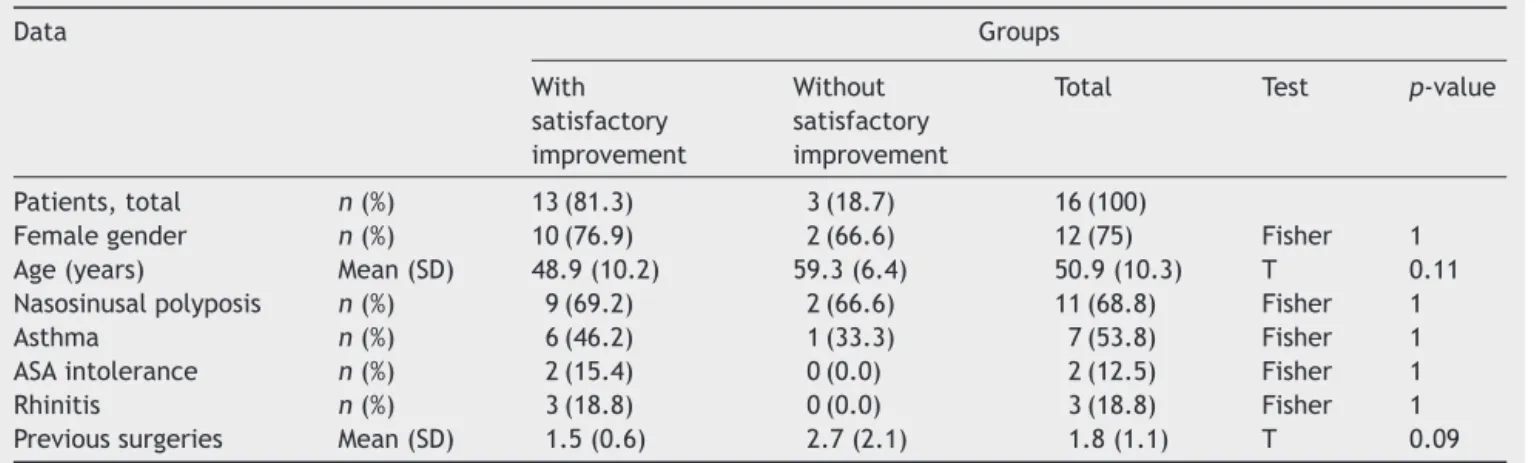
Thecharacteristicsof16patientswithdifficult-totreatCRS includedinthisstudyaredetailedinTable1.The epidemio-logicalcharacteristicsofthestudypopulationarepresented inTable2.
T able 1 P atient characteristics and satisfactory subjective improvement. P atient Gender Age Diagnosis Asthma Intolerance to ASA Rhinitis Commorbities P revious surgery Main complaint Subjective improvement Satisfaction 1 F 52 CRSwNP Ye s N o No W oakes 5 P ost. Rhin. P artial No 2 F 61 CRSwNP No No Yes Hypothyroidism 1 P ost. Rhin. Total Ye s 3 M 50 CRSwNP Ye s N o Yes W ithout 1 P ost. Rhin. P artial Ye s 4 M 60 CRSwNP No No Yes W ithout 1 Obstruction Total Ye s 5 F 29 CRSwNP Ye s N o No W ithout 3 P ost. Rhin. P artial Ye s 6 F 56 CRSw/oNP No No No Churg---Strauss 2 Obstruction Total Ye s 7 F 59 CRSwNP Ye s No No W ithout 1 Ant. Rhin. Total Ye s 8 F 37 CRSw/oNP No No No VCID 1 Ant. Rhin. P artial Ye s 9 M 47 CRSwNP No No No Intol. Dipirone 1 Hiposmia P artial Ye s 10 M 64 CRSwNP No No No R enal Tx 1 Ant. Rhin. P artial No 11 F 58 CRSwNP Ye s Ye s No W ithout 1 Ant./P ost. Rhin. P artial Ye s 12 F 53 CRSwNP Ye s Ye s No W ithout 2 Ant. Rhin. P artial Ye s 13 F 47 CRSw/oNP No No No W ithout 2 P ost. Rhin. Total Ye s 14 F 62 CRSw/oNP No No No W ithout 2 Obstruction W ithout improvement No 15 F 40 CRSwNP Ye s N o No W ithout 2 Ant. Rhin. P artial Yes 16 F 39 CRSw/oNP No No No R enal Tx 2 P ost. Rhin. Total Ye s SNOT -22, SinoNasal Outcome Test-22; F, female; M, male; CRSwNP , chronic rhinosinusitis with polyps; CRSw/oNP , chronic rhinosinusitis without polyps; Rhin., rhinorrhea; Ant., anterior; P ost., posterior; VCID, common variable immunodeficiency; Tx, transplant.
study,andweresimilartothedosesusedinthesixmonths priortothestudy.
Aftertopicaltherapy byirrigation, weasked questions onsubjectiveoutcomestoall16patients(detailedinTable 1). Of these, 6 reportedoverall subjective improvement; 9 informedpartial subjective improvement; and only one patient feltnoimprovement, totaling15 patients (93.8%) with clinical subjective improvement. In addition to the patient without improvement, two patients with partial subjective improvement were not satisfied with the out-come of their topical therapy by irrigation, totaling 13 patients(81.3%)withsatisfactorysubjectiveimprovement. All patients who did not exhibit satisfactory subjective improvementreceivedanindicationforanewsurgical pro-cedure,withorientationtorestarttheirtopicaltherapyby irrigationpostoperatively.
Quantitative evaluation of objective outcomes is pre-sented in Table 3. Globally, our quantitative evaluation showedsignificantimprovementinSNOT-22(meanof50.2in preto29.6inpost;p=0.006)andinLund---Kennedy(mean of 8.8inpre-to5.1in post-;p=0.01) scoresin ourstudy population.Corroboratingsubjectivedata,patientswithout satisfactorysubjective improvementshowednosignificant improvementinSNOT-22andLund---Kennedyscores,unlike therestofourstudypopulation.
Qualitativeevaluationofobjectiveoutcomesis demon-stratedinTable4;thisassessmentshowedthatnopatient exhibited poorer SNOT-22 scores, 4 (25%) showed no improvement,and12(75%)improved.Ofthetwelvepatients withimprovement,oneofthemwasconsideredas achiev-ingtotalimprovement(6.3%).AstoLund---Kennedyscores, nopatientsufferedworsening,4(25%)showedno improve-ment,and12(75%)improved.Ofthese12patients,5(31.3%) achievedfullrecoveryintheirendoscopicscore.
There were no predictive factors of subjective ther-apeutic success in our study sample. However, patients with satisfactory subjective improvement had signifi-cantly greater reduction and lower final values for their Lund---Kennedyscore(Table3).
Discussion
Intheevaluationofdifficult-to-treatpatients,thatis,those who had already undergone endoscopic sinonasal surgery without adequate clinicalcontrol withtopicalnasal corti-costeroidsintheformofsprayanduptotwocyclesoforal antibioticsand/orcorticosteroidsintheprecedingyear,the present study demonstratedefficacy of high-volumenasal irrigationwithasolutionofbudesonide,with81.3%of suc-cessinclinicalmanagement.Althoughthisdesigndoesnot allow for ahigh-level of evidence,we must considerthat the study achieved a high success rate in patients who hadpreviouslyfailedtreatmentwithtopicalnasal cortico-steroids in the form of spray. Considering only objective criteria, topical therapy by irrigation was able to signifi-cantlyreduceSNOT-22andLund---Kennedyscores,resulting in75%improvementinobjectiveparameters.
Table2 Epidemiologicalcharacteristicsandsubjectiveoutcomes.
Data Groups
With satisfactory improvement
Without satisfactory improvement
Total Test p-value
Patients,total n(%) 13(81.3) 3(18.7) 16(100)
Femalegender n(%) 10(76.9) 2(66.6) 12(75) Fisher 1
Age(years) Mean(SD) 48.9(10.2) 59.3(6.4) 50.9(10.3) T 0.11 Nasosinusalpolyposis n(%) 9(69.2) 2(66.6) 11(68.8) Fisher 1
Asthma n(%) 6(46.2) 1(33.3) 7(53.8) Fisher 1
ASAintolerance n(%) 2(15.4) 0(0.0) 2(12.5) Fisher 1
Rhinitis n(%) 3(18.8) 0(0.0) 3(18.8) Fisher 1
Previoussurgeries Mean(SD) 1.5(0.6) 2.7(2.1) 1.8(1.1) T 0.09
n,number;%,percentage;SD,standarddeviation;ASA,acetylsalicylicacid.
irrigation19---21;however,low-volumeirrigationmethods
can-not reach paranasal sinuses,12 and are clearly inferior to
high-volume irrigation,15 as demonstrated in the present
study. The only well-designed study (a randomized con-trolledclinicaltrial---level1b)usinghigh-volumeirrigation showednodifferenceamonggroupsofirrigationwithsaline, nasalirrigationbyspraywithbudesonide,andhigh-volume irrigationwith budesonide in patients withSamter’s triad soonafterendoscopicsinonasalsurgery.22 However,inthis
studypatientswhorequiredsystemiccorticosteroidsinthe post-operative period were excluded, and this may have selecteda moreneutrophilicphenotype, whichwould not benefitsomuchwithnasalirrigationwithcorticosteroids.10
The first pilot study with high-volume irrigation with budesonideonlywaspublishedin2009bySteinkeetal.,and reportedthat6(75%)ofeightpatientsstudiedshowed signif-icantimprovementofsinonasalsymptomsinavisualanalog scale andin Lund---MacKayscores.16 Anotherretrospective
studyconductedbyJangetal.comparedpatientsinperiods when theyused versus did notuse high-volume irrigation with budesonide after endoscopic sinonasal surgery; the
study showedthat 55% of 60 patients had lower SNOT-20 scores, and 56% of 60 patients had lower Lund---Kennedy scoreswhileusingtopicaltherapybyirrigation.The SNOT-20scoresmeasuredduringtopicaltherapybyirrigationwere significantlylowerthanwithouttopicaltherapy.Thiswasnot thecasewithLund---Kennedyscores.23Thelargeststudywas
conductedbySnidvongsetal.;theseauthorsprospectively recruited111patients,alsosoonaftertheirendoscopicsinus surgery, and introduced high-volume irrigation as topical therapywithsignificant improvement in Likertsymptoms’ score and in SNOT-22 and endoscopic scores. Moreover, an adequate control in 94.6% of patients was obtained afterthreemonths,withsixpatients(5.4%)requiring oral corticosteroids,andonlyfourrequiringanewsurgical treat-mentsubsequently.10Ourstudyshowed75%ofpatientswith
improvement of SNOT-22 scores, similar to the study of Steinke et al.16 and with more success than Jang et al.
study23; this also occurred with respect to improvement
ratesofLund---Kennedyscores(75%vs.56%).SNOT-22scores exhibitedasignificantreductioninthisstudy,aswellasin Snidvongsetal.10 andJangetal.23 studies.Lund---Kennedy
Table3 Quantitativeassessmentofobjectiveoutcomes.
Data Groups
With satisfactory improvement
Without satisfactory improvement
Total ttestp-value
Withvs.without improvement
Patients,total n(%) 13(81.3) 3(18.7) 16(100)
SNOT-22pre Mean(SD) 47.7(19.6) 61.0(16.4) 50.2(19.3) 0.31 SNOT-22post Mean(SD) 25.3(19.3) 48.0(16.5) 29.6(20.4) 0.13 DifferenceSNOT-22 Mean(SD) 22.4(23.4) 13.0(4.4) 20.6(21.6) 0.19 Prevs.postttestp-value 0.007a 0.39 0.006a
Lund---Kennedypre Mean(SD) 8.5(3.5) 10.3(1.5) 8.8(3.3) 0.19 Lund---Kennedypost Mean(SD) 4.2(4.3) 9.3(1.2) 5.1(4.4) 0.002a
DifferenceLund---Kennedy Mean(SD) 4.3(4.0) 1.0(1.0) 3.7(3.8) 0.02a
Prevs.postttestp-value 0.009a 0.42 0.01a
N,number;%,percentage;SD,standarddeviation.
T able 4 Qualitative assessment of objective outcomes. P atient Gender Age Diagnostic SNOT -22 pre SNOT -22 post P ost-pre difference Objective improvement SNOT
-22 Lund- --K ennedy pre Lund- --K ennedy post P ost-pre difference Objective improvement
Lund---K ennedy 1 F 52 CRSwNP 79 64 − 15 Improvement 10 10 0 W ithout improvement 2 F 61 CRSwNP 61 12 − 49 Improvement 10 7 − 3 Improvement 3 M 50 CRSwNP 75 0 − 75 Total improvement 9 0 − 9 Total improvement 4 M 60 CRSwNP 27 15 − 12 Improvement 10 0 − 10 Total improvement 5 F 29 CRSwNP 67 17 − 50 Improvement 10 9 − 1 Improvement 6 F 56 CRSw/oNP 52 34 − 18 Improvement 5 0 − 5 Total improvement 7 F 59 CRSwNP 6 8 2 W ithout improvement 5 0 − 5 Total improvement 8 F 37 CRSw/oNP 65 40 − 25 Improvement 11 0 − 11 Total improvement 9 M 47 CRSwNP 27 11 − 16 Improvement 6 6 0 W ithout improvement 10 M 64 CRSwNP 47 31 − 16 Improvement 12 10 − 2 Improvement 11 F 58 CRSwNP 33 17 − 16 Improvement 12 10 − 2 Improvement 12 F 53 CRSwNP 54 61 7 W ithout improvement 10 10 0 W ithout improvement 13 F 47 CRSw/oNP 51 39 − 12 Improvement 0 0 0 W ithout improvement 14 F 62 CRSw/oNP 51 49 − 2 W ithout improvement 9 8 − 1 Improvement 15 F 40 CRSwNP 58 58 0 W ithout improvement 10 8 − 2 Improvement 16 F 39 CRSw/oNP 44 17 − 27 Improvement 12 4 − 8 Improvement SNOT -22, Sino-Nasal Outcome Test-22; F, female; M, male; CRSwNP , chronic rhinosinusitis with polyps; CRSw/oNP , chronic rhinosinusitis without polyps.
scores also fell significantly in this study, similarto Snid-vongs etal.10 study,butthiswasnotevident inthe study
byJangetal.23 The clinicalcontrolratein thisstudywas
81.3%,afigurelowerthanthepercentageof94.6%obtained bySnidvongsetal.10
It is noteworthy that the variability of results among studies couldbedue totheheterogeneity ofthe patients included.Theprofileofpatientsrecruitedinourstudywas that of difficult-to-control CRS, which, in theory, would encompass a worse prognostic group, in comparison with thoseintheother studies.Moreover,despitethefactthat all patients in this study had been previously operated, the topical therapy by irrigation was not started in the immediatepost-operativeperiod,asitwasinthestudyof Snidvongsetal.10Thislengthyintervalbetweensurgeryand
the onset of nasal irrigationtherapy couldallow a worse endoscopic appearance to develop, including blockage of sinusesbyinflammatorytissue,whichwouldnotallowfora properpenetrationoftopicaltherapybyirrigationintonasal sinuses,24 andcontributetothelower successratein this
study.Furthermore,in thestudy ofSnidvongs etal.,with earlypostoperativepatients,thereis nowaytodissociate successratesoftopicaltherapyversussurgeryitself.10
Thecorticosteroid dose isanother variablethatshould be considered: thestudies cited used1mg/day of budes-onide or betamethasone, while in the present study our patients used budesonide 500g/day. We choose a lower
dose because this is closer to the usual dose of budes-onide nasal spray for CRS, which is 400g/day. But this
option may havealso contributedtoa lowersuccess rate ofthisstudy,whencomparedtothatof Snidvongsetal.10
On the other hand, the dose we chose leads to another consideration: all patients included in this study did not achieve clinical control when using 400g/day of
budes-onide nasal spray; however, with a small increase in the amountofcorticosteroids(500g/day)andachangeinthe
formofadministration(high-volumenasalirrigation),81.3% of thesepatients didachieveclinical control.This finding cancorroboratetheconceptthathigh-volumenasal irriga-tionswithbudesonidesolutionnotonlyhavetheadvantage ofadrugdistributiondirectlytoparanasalsinuses,butalso bringthebenefitmechanicalwashingswithsaline.24Thanks
tothequalityandquantityofaggregatedevidence, irriga-tionswithsalineareapossiblerecommendationforusein CRS patients,whilehigh-volumeirrigationastopical ther-apywithcorticosteroidsisstillconsideredonlyatherapeutic optionforCSRpatients.11
Conclusion
High-volumeirrigationwithcorticosteroidsastopical ther-apy is a goodoption in the management ofpatients with difficult-totreatchronicrhinosinusitis,significantly improv-ingtheirobjectiveandsubjectiveparameters.BothSNOT-22 and Lund---Kennedyscores improved in 75% of cases,with satisfactorysubjectivecontrolin81.3%ofthesepatients.
Conflicts
of
interest
References
1.FokkensWJ,LundVJ,MullolJ,BachertC,AlobidI,BaroodyF, etal.Europeanpositionpaperonrhinosinusitisandnasalpolyps 2012.RhinolSuppl.2012;50:1---298.
2.TimperleyD,SchlosserRJ,HarveyRJ.Chronicrhinosinusitis:an educationandtreatmentmodel.OtolaryngolHeadNeckSurg. 2010;143Suppl.3:S3---8.
3.GlicklichR,MetsonR.Thehealthimpactofchronicsinusitisin patientsseekingotolaryngologiccare.OtolaryngolHeadNeck Surg.1995;113:104---9.
4.KosugiEM, ChenVG, FonsecaVM,CursinoMM, MendesNeto JA, Gregório LC. Translation, cross-cultural adaptation and validationofSinoNasalOutcomeTest(SNOT):22toBrazilian Portuguese.BrazJOtorhinolaryngol.2011;77:663---9.
5.MascarenhasJG,FonsecaVM,ChenVG,ItamotoCH,SilvaCA, GregórioLC, etal. Long-term outcomes of endoscopicsinus surgeryforchronicrhinosinusitiswithandwithoutnasalpolyps. BrazJOtorhinolaryngol.2013;79:306---11.
6.PilanRR,PinnaFR,BezerraTF,MoriRL,PaduaFG,BentoRF, etal.PrevalenceofchronicrhinosinusitisinSãoPaulo. Rhinol-ogy.2012;50:129---38.
7.SylvesterDC,CarrS,NixP.Maximalmedicaltherapyforchronic rhinosinusitis: a survey of otolaryngology consultants in the UnitedKingdom.IntForumAllergyRhinol.2013;3:129---32. 8.YoungLC,StowNW,ZhouL,DouglasRG. Efficacyofmedical
therapyintreatmentofchronicrhinosinusitis. AllergyRhinol (Providence).2012;3:e8---12.
9.LundVJ.Maximalmedical therapy forchronic rhinosinusitis. OtolaryngolClinNorthAm.2005;38:1301---10.
10.SnidvongsK,PrattE,ChinD,SacksR,EarlsP,HarveyRJ. Corti-costeroidnasalirrigationsafterendoscopicsinussurgeryinthe managementofchronicrhinosinusitis.IntForumAllergyRhinol. 2012;2:415---21.
11.RudmikL,HoyM,SchlosserRJ,HarveyRJ,WelchKC,LundV, etal.Topicaltherapiesinthemanagementofchronic rhinosi-nusitis--- anevidence-basedreviewwithrecommendations.Int ForumAllergyRhinol.2013;3:281---98.
12.SnidvongsK,ChaowanapanjaP,AeumjaturapatS,ChusakulS, PraweswararatP.Doesnasalirrigationenterparanasalsinuses inchronicrhinosinusitis?AmJRhinol.2008;22:483---6.
13.GeorgalasC,Cornet M,Adriaensen G,Reinartz S,HollandC, ProkopakisE,etal.Evidence-basedsurgeryforchronic rhinosi-nusitiswithandwithoutnasalpolyps.CurrAllergyAsthmaRep. 2014;14:427.
14.WormaldP-J,Cain T,Oates L,HawkeL,WongI.A compara-tivestudyofthreemethodsofnasalirrigation.Laryngoscope. 2004;114:2224---7.
15.AbadieWM,McMainsKC,WeitzelEK.Irrigationpenetrationof nasaldeliverysystems:acadaverstudy.IntForumAllergy Rhi-nol.2011;1:46---9.
16.Steinke JW,Payne SC, TessierME, BorishLO,HanJK, Borish LC.Pilotstudyofbudesonideinhalantsuspensionirrigationsfor chroniceosinophilicsinusitis.JAllergyClinImmunol.2009;124, 1352---4.e7.
17.LundVJ, KennedyDW.Stagingfor rhinosinusitis. Otolaryngol NeckSurg.1997;117:S35---40.
18.Gregório LL, Andrade JS, Caparroz FA, Saraceni Neto P, Kosugi EM. Influence of age and gender in the normal val-uesofSinoNasalOutcomeTest-22.ClinOtolaryngol.2015;40: 115---20.
19.DelGaudioJM,WiseSK.Topicalsteroiddropsforthetreatment ofsinusostiastenosisinthepostoperativeperiod.AmJRhinol. 2006;20:563---7.
20.SachanandaniNS,PiccirilloJF,KramperMA,ThawleySE, Vlahio-tisA.Theeffectofnasallyadministeredbudesoniderespuleson adrenalcortexfunctioninpatientswithchronicrhinosinusitis. ArchOtolaryngolHeadNeckSurg.2009;135:303---7.
21.Kanowitz SJ, Batra PS, Citardi MJ. Topical budesonide via mucosal atomization device in refractory postoperative chronicrhinosinusitis.OtolaryngolHeadNeckSurg.2008;139: 131---6.
22.RotembergB,ZhangI,ArraI,PaytonK.Postoperativecarefor Samter’s triadpatientsundergoing endoscopic sinus surgery: a double-blinded randomizedcontrolled trial. Laryngoscope. 2011;121:2702---5.
23.JangDW,LachanasVA,SegelJ,KountakisSE.Budesonidenasal irrigationsinthepostoperativemanagementofchronic rhinos-inusitis.IntForumAllergyRhinol.2013;3:708---11.