Association between voice disorder and self-reported
temporomandibular dysfunction symptoms in teachers
Associação entre distúrbio de voz e sintomas de disfunção
temporomandibular autorreferidos por professores
Ilza Maria Machado1, Esther Mandelbaum Gonçalves Bianchini2, Denise Cintra Villas Boas3, Susana Pimentel
Pinto Giannini4, Léslie Piccolotto Ferreira4
ABSTRACT
Purpose: To verify the relationship between voice disorder and
temporo-mandibular dysfunction (TMD) in elementary and middle school teachers. Methods: The participants of this study were 138 teachers - 96 women
and 42 men, with a mean age of 38 years. The teachers responded to a questionnaire with five questions on voice disorder and temporomandibu-lar dysfunction symptoms. The data were analyzed using an association test (Chi-square) to verify the association between voice disorder and temporomandibular dysfunction symptoms, as well as the relationship of the symptoms with sex and age. Results: The temporomandibular dysfunction symptoms reported by the teachers, from the most to least frequently mentioned, were as follows: headache or facial pain, pain at the end of the day, and pain when speaking excessively. The results showed a statistically significant difference for the symptom pain when speaking excessively, pain at the end of the day, and temporomandibular joint snap in teachers without voice disorder. A statistically significant difference was observed for the female sex, regarding temporomandibular dysfunction. Temporomandibular dysfunction was more frequently reported than voice disorder, with higher incidence in female than in male teachers. Conclu-sion: The findings showed a statistical association between voice disorder
and temporomandibular dysfunction in teachers. Further studies with integrated clinical assessment on the relationship between voice symptoms and TMD in different age groups are warranted.
Keywords: Voice; Voice disorders; Temporomandibular joint
dysfunc-tion syndrome; Facial pain; Articuladysfunc-tion disorders
RESUMO
Objetivo: Verificar a relação entre distúrbio de voz e sintomas de
disfun-ção temporomandibular em professores do ensino fundamental. Métodos: Participaram deste estudo 138 professores, 96 do gênero feminino e 42 do gênero masculino, com média de idade de 38 anos. Os professores respon-deram questionário, com cinco questões de autorreferência à presença de alteração de voz no presente e sintomas de disfunção temporomandibular. Os dados foram analisados por meio de teste de associação (Qui-quadrado) para verificar associação entre distúrbio de voz e sintomas de disfunção temporomandibular, além da relação de cada um deles quanto a gênero e idade. Resultados: Os sintomas de disfunção temporomandibular relata-dos pelos professores foram: dor de cabeça ou na face, dor ao final do dia e dor ao falar muito. Os resultados mostraram diferença significativa para os sintomas de dor ao falar muito, dor ao final do dia e estalido na articulação temporomandibular, em professores sem distúrbio de voz. Houve diferença significativa para o gênero feminino, quanto a distúrbio de voz. Consta-tou-se maior número de autorreferência à disfunção temporomandibular, quando comparado ao distúrbio de voz, com diferença significativa para o gênero feminino. Conclusão: Os achados apontam associação estatística entre distúrbio de voz e sintomas de disfunção temporomandibular, em professores. Destaca-se a importância de outras pesquisas com avaliação clínica integrada, para aprofundar dados referentes a sintomas vocais e DTM, em relação à idade.
Descritores: Voz; Distúrbios da voz; Síndrome da disfunção da
articula-ção temporomandibular; Dor facial; Transtornos da articulaarticula-ção
The study was conducted at the Pontifícia Universidade Católica – PUC-SP – São Paulo (SP), Brasil.
(1) Pontifícia Universidade Católica – PUC-SP, Post-graduate studies Program (Master Degree) in Speech Therapy, São Paulo (SP), Brazil. (2) Universidade Veiga de Almeida – UVA, Post-graduate Program, Rio de Janeiro (RJ), Brazil.
(3) Pontifícia Universidade Católica – PUC-SP, Post-graduate studies Program in Speech Therapy (PhD), São Paulo (SP), Brazil. (4) Pontifícia Universidade Católica – PUC-SP, Department of Speech Therapy, São Paulo (SP), Brazil.
Conflict of interests: No
Authors’ contribution: IMM the main researcher, conducted the research, prepared the schedule, performed literature review, collected and analyzed the data,
wrote, and submitted the manuscript; EMGB advisor, conducted the research, analyzed data, edited the manuscript, and approved the final version; DCVB surveyed
the data, edited and submitted the manuscript; SPPG collected and analyzed the data; LPF advisor, conducted the research, prepared the schedule, analyzed data,
edited the manuscript, and approved the final version.
Correspondence address: Ilza Maria Machado. R. Dr. Diogo de Faria, 892, Vila Clementino, São Paulo (SP), Brazil, CEP: 04037-000. E-mail: [email protected]
INTRODUCTION
Voice disorder in teachers may be related to several etio-logies such as organic lesions of the vocal chords, inefficient control of breathing, laryngeal tension(1), and changes in the
temporomandibular joint (TMJ) articulation(2). It is fundamental
to understand the above relationship in clinical assessment of voice disorder (VD)(3), especially when dealing with
profes-sionals who rely on voice.
Several studies have shown different vocal symptoms in tea-chers with VD(4-12). The most common symptoms include
hoar-seness, vocal fatigue, and tiredness or pain when speaking(13,14).
On the other hand, the most frequent complaints in subjects with temporomandibular disorder (TMD) are joint noises(15), pain
when speaking or facial pain(16-18), deviations and displacement of
the mandible, vocal fatigue, catching mandible, hoarseness(13,19),
reduced vertical amplitude, and deviation of mandibular move-ments during speech(20). As noted from the brief description of
symptoms, some are common to VD as well as TMD.
The correlation between VD and TMD could be because of the prolonged use of one’s voice, resulting in severe laryngeal tension, TMJ pain, and difficulty in performing mandibular movements(2,21). TMDs, in turn, can cause changes in the
man-dibular movements because of muscle and joint conditions(19).
The literature(22) also states that TMDs directly interfere with
mandibular muscles and the cervical region because of im-proper posture and movement of the head and hyoid bone. As a result, the suprahyoid muscle and laryngeal activities are modified. Further, the phonation function is compromised because of the disharmony(22).
The relationship between VD and TMD could be directly associated with pain in the masticatory muscles(23). In most
cases, the pain is related to changes in muscular activity, which may involve hypofunctioning or hyperfunctioning of various muscles of mastication(24).
In a previous study(25), the authors were unsuccessful in
verifying the relationship between pain in the muscles involved in the physiological process of mastication, lateral and poste-rior structures of the TMJ, and vocal acoustic measures of the glottal source. However, the authors stated that TMD could be accompanied by muscle tension, latching of the mandibular opening, and excessive cervical and shoulder girdle tensions.
Another study(26) involving voice assessment through
audio-perceptual analysis showed that patients with TMD ex-perienced progressive voice deterioration because of changes in resonance, loudness, pitch, and articulation.
From theoretical and clinical perspectives, it is essential to understand the correlation between VD and TMD, because such problems involve multifactorial causes, thus, requiring multidisciplinary care(27). In addition, actions that include the
promotion of health and prevention of changes, which are both related to VD and symptoms of TMD, may improve the vocal wellbeing of teachers.
The purpose of this study was to investigate the association between VD and symptoms of TMD in elementary and high school teachers, as well as possible associations of the disorders in terms of gender and age.
METHODS
This cross-sectional and observational study was appro-ved by the Committee of Ethics in Research of the Pontifícia Universidade Católica de São Paulo (PUC-SP), under No. 137/08. After a detailed explanation of the study, the teachers signed a Free and Informed Consent Form.
A workshop was conducted on the World Voice Day. One-hundred and thirty-eight teachers (96 women and 42 men; age, between 22 and 58 years) from public elementary schools in the city of Barueri, São Paulo participated in the workshop. Before beginning the research activity, all teachers were informed about the procedures.
The teachers received an adapted questionnaire(28,29)
(Appendix 1) that contained five closed questions with alter-natives “yes/no” that were related to self-reported VD (if you have or had altered voice) and symptoms of TMD (headache or facial conditions involving pain, pain score, snapping noises when opening and closing the mouth, limitation and difficulty in moving the jaw, and episodes of lockjaw). Data regarding functional status and vocal habits were not investigated in this study because this was not part of the research objective.
We conducted a descriptive analysis of the data and the association with the variables of age, gender, self-reference to VD, and symptoms of TMD.
For analysis of the age variable, participants were divided into two groups based on the mean age (≤ 38 and ≥ 39 years). For assessing the TMD, the group with ages more than 39 ye-ars comprised 105 teachers and the group with ages less than 38 years comprised 33 teachers. For assessing VD, the group with ages more than 39 years comprised 61 teachers and the group with ages less 38 years comprised 77 teachers. In both the groups, teachers with and without complaints of TMD and VD were considered.
A teacher was considered to have TMD if he/she confirmed headache or facial pain and three or more symptoms under “pain,” which is an indispensable symptom for characterization of TMD(28). A subject was considered to have VD when he/she
self-referenced to the presence of altered voice.
The association between VD and symptoms of TMD based on variables such as gender and age was performed using the chi-square test. For all analyses, a significance level of 5% was utilized.
RESULTS
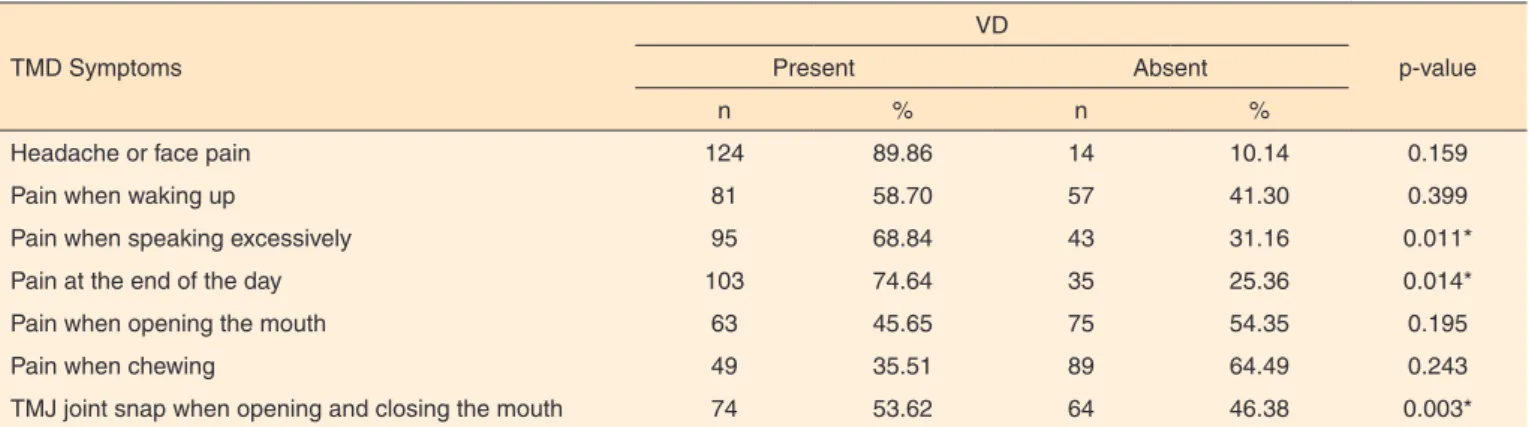
(89.86%), pain at the end of the day (74.64%), and pain when speaking excessively (68.84%). TMD symptoms and significant VD, in descending order, were as follows: snapping of TMJ, pain when speaking excessively, and pain at the end of the day (Table 1). Significant differences were noted for gender (fema-le) for self-reported TMD (Table 2). No age-related differences were found between VD and symptoms of TMD (Table 3).
DISCUSSION
Symptoms of headache or face pain due to TMD, which is the main symptom reported by participants, were accompanied by three or more characteristics(2,18). Among the main
character-istics observed in the present study, the most common were as follows: symptoms of pain when speaking excessively, waking up, chewing, and opening the mouth, and TMJ snapping. Such symptoms can further reduce the amplitude of jaw opening
while speaking(19), and therefore, may affect voice quality(23),
thereby causing VD.
Statistically significant associations were observed between VD and symptoms of pain while talking excessively, pain at the end of the day, and TMJ snapping when opening and closing the mouth. Previous studies(2,22) have shown that the occurrence
of VD is associated with a change in laryngeal activity because of the stress when speaking and tension in the suprahyoid mus-cles. Similar data have been reported in studies conducted in teachers and the general population(2,4,13,15,17). For teachers, the
above symptoms may be because of the long periods of speech, considering that most teachers speak in classrooms with several students in noisy conditions, and therefore, compelling them to speak loudly or exert force while speaking.
According to the findings of this study, the symptoms of pain when speaking excessively, pain at the end of the day, and TMJ snapping when opening and closing the mouth, appear
Table 1. Distribution of temporomandibular dysfunction symptoms associated with the presence of voice disorder
TMD Symptoms
VD
p-value
Present Absent
n % n %
Headache or face pain 124 89.86 14 10.14 0.159
Pain when waking up 81 58.70 57 41.30 0.399
Pain when speaking excessively 95 68.84 43 31.16 0.011* Pain at the end of the day 103 74.64 35 25.36 0.014* Pain when opening the mouth 63 45.65 75 54.35 0.195
Pain when chewing 49 35.51 89 64.49 0.243
TMJ joint snap when opening and closing the mouth 74 53.62 64 46.38 0.003*
*Significant values (p<0.05) – Chi-square test
Note: TMD = Temporomandibular dysfunction; VD = Voice disorder
Table 2. Gender-based distribution of self-reported voice disorder and temporomandibular dysfunction
Gender
TDM VD
Present Absent
p-value Total Present Absent p-value Total
n % n % n % n % n % n %
Male 27 64.29 15 35.71
0.032* 42 100.00 16 38.10 26 61.90 0.197 42 100.00 Female 78 81.25 18 18.75 96 100.00 48 50.00 48 50.00 96 100.00 Total 105 76.09 33 23.91 138 100.00 64 46.40 74 53.62 138 100.00
*Significant values (p<0.05) – Chi-square test
Note: TMD = Temporomandibular dysfunction; VD = Voice disorder
Table 3. Age-based distribution of temporomandibular dysfunction symptoms and voice disorder
Age
TDM VD
Present Absent
p-value Total Present Absent p-value Total
n % n % n % n % n % n %
≤ 38 15 45.45 18 54.55
0.868 33 100.00 35 45.50 42 54.55 0.807 77 100.00
≥ 39 46 43.81 59 56.19 105 100.00 29 47.50 32 52.46 61 100.00 Total 61 44.20 77 55.80 138 100.00 64 46.40 74 53.62 138 100.00
Chi-square test (p<0.05)
to be related to excessive orofacial muscle activity, TMJ im-balance, and laryngeal structure disharmony due to prolonged voice use. The above data are similar to those shown in previous studies(2,21), indicating that prolonged voice use is the main
cause of VD appearance and symptoms of TMD in teachers. The statistical association between vocal change and TMJ snap when opening and closing the mouth confirms pre-vious findings(20) of complaints of TMJ noise during speech.
According to the literature(13,15-17,19), joint noises, pain when
talking, orofacial pain, deviations and displacement of the mandible, vocal fatigue, hoarseness, and locking of the jaw are common symptoms in subjects with TMD. Considering the continuous speech activity and professional use of voice in teachers, the observed association is relevant and supported in the literature(2,21,22).
More women were classified as having TMD or VD, althou-gh in the statistical analysis, this difference was only verified for TMD. These findings are in agreement with those in previous studies(2,5,11) that showed high incidences of TMD and VD in
females. However, the results differed from those in some other studies that showed high incidences of only VD in women(6,12).
Studies(1,2,10,11) have shown that VDs in women may be
related to stress, physiological and biological conditions of the larynx, and an overload of female cultural and social roles. However, the present study results showed no significant di-fferences between genders for VD. Perhaps the study sample, which had higher numbers of female teachers, contributed to the results.
No differences between the two established age groups were observed, in both TMD and VD. The researched TMD and VD symptoms were self-reported by both female and male participants of both age groups, by considering the mean age (≤38 and ≥39 years) as reference. The age group differed from that shown in previous studies(2) in terms of the
association of among age, TMD, and VD. Thus, the study result does not rule out the importance of verifying the age factor in further studies.
The positive association between VD and TMD for elemen-tary and high school teachers observed in our study reinforces the importance of speech assessment of symptoms of TMD in subjects with VD to understand and properly direct this relationship in any clinical assessment VD(3).
On the basis of the study findings, we suggest that speech therapists show special attention to the symptoms of TMD and include specific strategies in promoting the prevention or therapeutic intervention of VD.
Considering the methodology used in this study, it seems appropriate that further studies investigate the relationship between TMD and VD by including clinical evaluation beyond self-reported assessment in teachers and other professionals who rely on voice.
For future research with clinical evaluation of symptoms of TMD and VD, we recommend a clinical evaluation,
although questionnaires should not be ruled out, because this is a cost-effective and important tool that could be utilized as a first-line survey in determining the extent of knowledge the subject has on his or her voice condition and TMD. In any action performed by speech therapists on teachers, self--reported diagnoses provide an informal view of factors that affect an individual.
CONCLUSION
The results of this study indicate a statistical association between VD and TMD symptoms based on the pain characte-ristics when speaking excessively, pain at the end of the day, and TMJ snap. TMD predominantly occurred in females than in males. No differences in the incidence of VD between genders were observed.
REFERENCES
1. Nerrière E, Vercambre MN, Gilbert F, Kovess-Masféty V. Voice disorders and mental health in teachers: a cross-sectional nationwide study. BMC Public Health. 2009;2(9):370.
2. Machado IM, Bianchini EMG, Silva MAA, Ferreira LP. Voz e disfunção temporomandibular em professores. Rev CEFAC. 2009;11(4):630-43.
3. Piron A, Roch JB. Temporomandibular dysfunction and dysphonia (TMD). Rev Laryngol Otol Rhinol (Bord). 2010;131(1):31-4.
4. Ferreira LP, Giannini SPP, Figueira S, Silva EE, Karmann DF, Souza TMT. Condições de produção vocal de professores da Prefeitura do Município de São Paulo. Distúrb Comun. 2003;14(2):275-308.
5. Fuess VLR, Lorenz MC. Disfonia em professores do ensino municipal: prevalência e fatores de risco. Rev Bras Otorrinolaringol. 2003;69(6):807-12.
6. Roy N, Merril RM, Thibeault S, Gray SD, Smith EM. Voice disorders in teachers and the general population: effects on work performance, attendance, and future career choices. J Speech Lang Hear Res. 2004;47(3):542-52.
7. Simões M, Latorre MRDO. Prevalência de alteração vocal em educadoras e sua relação com a auto-percepção. Rev Saúde Pública. 2006;40(6):1013-8.
8. Jardim R, Barreto SM, Assunção AA. Voice disorder: case definition and prevalence in teachers. Rev Bras Epidemiol. 2007;10(4):625-36. 9. Silvério KCA, Gonçalves CGO, Penteado RZ, Vieira TPG, Libardi A, Rossi D. Ações em saúde vocal: proposta de melhoria do perfil vocal de professores. Pró-Fono R Atual Cient. 2008;20(3):177-82.
10. Ceballos AGC, Carvalho FM, Araújo, TM, Reis EJFB. Avaliação perceptivo-auditiva e fatores associados à alteração vocal em professores. Rev Bras Epidemiol. 2011;14(2):285-95.
11. Marçal CCB, Peres MA. Alteração vocal auto-referida em professores: prevalência e fatores associados. Rev Saúde Pública. 2011;45(3):503-11.
13. Tavares EL, Martins RH. Vocal evaluation in teachers with or without symptoms. J Voice. 2006;21(4):407-14.
14. Ferreira LP, Santos JG, Lima MFB. Sintoma vocal e sua provável causa: Levantamento de dados em uma população. Rev CEFAC. 2009:11(1):110-8.
15. Manfredini D, Basso D, Salmaso L, Guarda-Nardini L. Temporomandibular joint click sound and magnetic resonance-depicted disk position: Which relationship? J Dent. 2008;36(4):256-60.
16. Farina D, Bodin C, Gandolfi S, De Gasperi W, Borghesi A, Maroldi R. TMJ disorders and pain: assessment by contrast-enhanced MRI. J Radiol. 2009;70(1):25-30.
17. Conti PCR, Silva RS, Rossetti LM, Silva ROF, Valle AL, Gelmini M. Palpation of the lateral pterygoid area in the myofascial pain diagnosis. Oral Surg Oral Med Oral Pathol Oral Radiol Endod. 2008;105(3):e61-6. 18. Machado IM, Pialarissi PR, Minici TD, Rotondi J, Ferreira LP. Relação dos sintomas otológicos nas disfunções temporomandibulares. Arq Int Otorrinolaringol. 2010;14(3):274-9.
19. Bianchini EMG, Paiva G, Andrade CRF. Mandibular movement patterns during speech in subjects with temporomandibular disorders and in asymptomatic individuals. Cranio. 2008;26(1):50-8.
20. Taucci RA, Bianchini EMG. Verificação da interferência das disfunções temporomandibulares na articulação da fala: queixas e caracterização dos movimentos mandibulares. Rev Soc Bras Fonoaudiol. 2007;12(4):274-80.
21. Van Lierde KM, De Ley S, Clement G, De Bodt M, Van Cauwenberge P. Outcome of laryngeal manual therapy in four Dutch adults with persistent moderate-to-severe vocal hyperfunction: a pilot
study. J Voice. 2004;18(4):467-74.
22. Rockland A, Teixeira AVA, Silva JV, Lima SAA, Oliveira AV. Influência da disfunção temporomandibular muscular nas alterações da qualidade vocal. Rev Port Estomatol Med Dent Cir Maxilofac. 2010;51(1):41-7.
23. Silva AMT, Morisso MF, Cielo CA. Relação entre grau de severidade de disfunção temporomandibular e a voz. Pró-Fono R Atual Cient. 2007;19(3):279-88.
24. Bérzin F. Surface electromyography in the diagnosis of syndromes of the cranio-cervical pain. Braz J Oral Sci. 2004;3(10):484-91. 25. Boton LM, Morisso MF, Silva AMT, Cielo CA. Dor muscular em cabeça e pescoço e medidas vocais acústicas de fonte glótica. Rev CEFAC. 2012;14(1):104-13.
26. Ferreira THP, Balata PMM, Silva HJ. Análise acústica e perceptivo-auditiva da voz na disfunção temporomandibular. Int J Dent. 2008;7(4):212-8.
27. Ferreira LP, Latorre MRDO, Giannini SPP, Ghirardi AC, Karmann DF, Silva EE, et al. Influence of abusive vocal habits, hydration, mastication, and sleep in the occurrence of vocal symptoms in teachers. J Voice. 2010;24(1):86-92.
28. Bianchini EMG, organizador. Articulação temporomandibular: implicações, limitações e possibilidade fonoaudiológicas. Avaliação fonoaudiológica da motricidade oral: anamnese, exame clínico, o quê e por que avaliar. Carapicuíba: Pró-Fono, 2000. p.81-104.
Appendix 1. Questionnaire on voice disorder and temporomandibular dysfunction in teachers
Dear teacher: The table below aims to conduct a survey on the conditions of temporomandibular articulation and voice. Please answer all the questions with an x in the appropriate spaces or fill in the blanks as requested.
Description of temporomandibular dysfunction symptoms (TMD) and voice disorder (VD)
1. Do you have headaches or facial pain? ( ) no ( ) yes
2. When does this situation occur?
2.1. When you wake up ( ) no ( ) yes 2.2. At the end of the day ( ) no ( ) yes 2.3. When you chew ( ) no ( ) yes 2.4. When you speak excessively ( ) no ( ) yes 2.5. When you open your mouth too much ( ) no ( ) yes
3. How would you classify this pain? ( ) Absent ( ) Soft ( ) Moderate ( ) Acute
4. Do you have a “snap” noise when opening and closing the mouth? ( ) no ( ) yes
5. Do you have or have you ever experienced a change in your voice? ( ) no ( ) Yes, I have ( ) Yes, I have
Adapted from:
Bianchini EMG, organizador. Articulação temporomandibular: implicações, limitações e possibilidade fonoaudiológicas. Vol. 1. Capítulo 8. Avaliação fonoaudiológica da motricidade oral: anamnese, exame clínico, o que e por que avaliar. Carapicuíba: Pró-Fono, 2000. p.81-104.