*Correspondence: D. S. P. Abdalla. Faculdade de Ciências Farmacêuticas, Universidade de São Paulo, Av. Prof. Lineu Prestes, 580, Cidade Universitária, 05508-900 - São Paulo – SP, Brasil. E-mail: [email protected]
A
rti
Pharmaceutical Sciences vol. 45, n. 3, jul./sep., 2009
Cholesterol oxides inhibit cholesterol esteriication by
lecithin:cholesterol acyl transferase
Eder de Carvalho Pincinato
2, Patricia Moriel
3, *Dulcinéia Saes Parra Abdalla
11Department of Clinical and Toxicological Analysis, Faculty of Pharmaceutical Sciences, University of São Paulo, 2Mackenzie
Presbyterian University, 3Department of Clinical Pathology, Faculty of Medical Sciences, State University of Campinas
Cholesterol oxides are atherogenic and can affect the activity of diverse important enzymes for the lipidic metabolism. The effect of 7β-hydroxycholesterol, 7-ketocholesterol, 25-hydroxycholesterol,
cholestan-3β,5α,6β-triol,5,6β-epoxycholesterol, 5,6α-epoxycholesterol and 7α-hydroxycholesterol on
esteriication of cholesterol by lecithin:cholesterol acyl transferase (LCAT, EC 2.3.1.43) and the transfer of esters of cholesterol oxides from high density lipoprotein (HDL) to low density lipoproteins (LDL) and very low density lipoproteins (VLDL) by cholesteryl ester transfer protein (CETP) was investigated. HDL enriched with increasing concentrations of cholesterol oxides was incubated with fresh plasma as source of LCAT. Cholesterol and cholesterol oxides esteriication was followed by measuring the consumption of respective free sterol and oxysterols. Measurements of cholesterol and cholesterol oxides were done by gas-chromatography. 14C-cholesterol oxides were incorporated into HDL
2 and HDL3 subfractions and then incubated with fresh plasma containing LCAT and CETP. The transfer of cholesterol oxide esters was followed by measuring the 14C-cholesterol oxide-derived esters transferred to LDL and VLDL. All the cholesterol oxides studied were esteriied by LCAT after incorporation into HDL particles, competing with cholesterol by LCAT. Cholesterol esteriication by LCAT was inversely related to the cholesterol oxide concentration. The esteriication of 14C-cholesterol oxides was higher in HDL3 and the transfer of the derived esters was greater from HDL2 to LDL and VLDL. The results suggest that cholesterol esteriication by LCAT is inhibited in cholesterol oxide-enriched HDL particles. Moreover, the cholesterol oxides-derived esters are eficiently transferred to LDL and VLDL. Therefore, we suggest that cholesterol oxides may exert part of their atherogenic effect by inhibiting cholesterol esteriication on the HDL surface and thereby disturbing reverse cholesterol transport.
Uniterms: Cholesterol/oxides. Cholesterol/acyl transferase. Lecithin. Protein/cholesteryl ester transfer. Lipoprotein/high density. Cholesterol/reverse transport.
Os óxidos de colesterol são aterogênicos e podem afetar a atividade de diversas enzimas importantes para o metabolismo lipídico. Este estudo investigou o efeito dos óxidos 7β-hidroxicolesterol,
7-cetocolesterol, 25-hidroxicolesterol, colestan-3β,5α,6β-triol, 5,6β-epoxicolesterol, 5,6α-epoxicolesterol
e 7α-hidroxicolesterol na esteriicação do colesterol por ação da lecitina colesterol aciltransferase (LCAT,
colesterol. A esteriicação dos óxidos de colesterol foi maior na HDL3 e a transferência desses ésteres foi maior a partir da HDL2 para a LDL e VLDL. Estes resultados indicam que a esteriicação do colesterol pela LCAT é inibida nas partículas de HDL enriquecidas com óxidos de colesterol e que os ésteres de óxidos de colesterol são eicientemente transferidos para a LDL e VLDL. Portanto, sugere-se que os óxidos de colesterol exercem parte de seu efeito aterogênico pela inibição da esteriicação do colesterol na superfície da HDL, causando um distúrbio no transporte reverso do colesterol, além de aumentar o potencial aterogênico da LDL e VLDL.
Unitermos: Colesterol/óxidos. Colesterol/aciltransferase. Lecitina. Proteína/de transporte de éster de colesterol. Lipoproteína/de alta densidade. Colesterol/transporte reverso.
INTRODUCTION
High density lipoprotein (HDL) is the only anti-atherosclerotic lipoprotein in plasma (Kawano et al., 2008) and plays an important role in the reverse cholesterol transport by removing cholesterol from peripheral cells to the liver and steroidogenic organs (Fielding and Fielding, 1995; Von Eckardstein, 1996; Oram and Yokoyama, 1996). There is a widespread view that HDL protects against the development of atherosclerosis and counteracts the effects of LDL by removing cholesterol from cells of the arterial intima, thus preventing the formation of foam cells (Field-ing, Field(Field-ing, 1995). In a speciic pathway preβ1-HDL
(a HDL subfraction), interacts with cell membranes and takes up cholesterol via ATP-binding cassette (ABC) A1 expressed on the cell surface (Kawano et al., 2008). The second major and critical step in reverse cholesterol trans-port is the esteriication of cholesterol on the HDL surface in a reaction catalyzed by lecithin:cholesterol acyl trans-ferase (LCAT; EC 2.3.1.43). LCAT catalyzes the transfer of sn-2 acyl group from phosphatidylcholine to cholesterol (Glomset, 1968; Aron et al., 1978; Fielding, 1990), result-ing in the movement of the formed cholesteryl esters to the center of the HDL, leaving the particle surface depleted of cholesterol. This creates a concentration gradient that promotes the transfer of cholesterol from cell membranes to HDL. An increased rate of LCAT-catalyzed cholesterol esteriication will, therefore, enhance the rate of reverse cholesterol transport (Barter, Rye, 1996). This process is followed by the transfer of cholesteryl esters from HDL to apo B-containing lipoproteins in exchange for triglyc-erides mediated by the cholesterol ester transfer protein (CETP) (Iglesias et al., 1996). This way, the cholesteryl esters formed in the HDL are mainly channeled to VLDL and LDL, and are inally removed primarily by the liver.
The interest on cholesterol oxides is mainly due to their various biological effects, such as, cytotoxicity, inhibition of HMG-CoA reductase activity, activation of ACAT, inhibition of LDL binding to cell receptors (Peng
et al., 1991) as biomarker of oxidative stress (Ferderbar
et al., 2007) and inhibition of cholesterol eflux from cells (Kilsdonk et al., 1995; Schroepfer, 2000).
Oxysterols are the 27-carbon products of cholesterol oxidation by both enzymatic and non-enzymatic mecha-nisms. Their roles on cholesterol homeostasis, as well as in diseases in which oxidative damage and lipid peroxidation are implicated (e.g. atherosclerosis), have been investi-gated (Van Reyk et al., 2006). However, considering that the reverse cholesterol transport is a protective pathway of lipoprotein metabolism against cholesterol accumulation in the body, and considering that this mechanism would be interfered by cholesterol oxides, we investigated the effect of cholesterol oxides on cholesterol esteriication by LCAT and the transfer of resulting cholesteryl esters formed in HDL to VLDL and LDL by CETP.
MATERIAL AND METHODS
Material
Cholesterol oxides (7β-hydroxyholesterol,
7-keto-cholesterol, 25-hydroxy7-keto-cholesterol, cholestan-3β,5α,6β
-triol, 5,6β-epoxycholesterol, 5,6α-epoxycholesterol and
7α-hydroxycholesterol) were purchased from Steraloids,
Inc. (Wilton NH, USA); 14C-cholesterol was obtained from
Amersham, Inc (Arlington Heights, IL); methanol (99 %), ethanol (99 %), chloroform (99 %), bis (trimethylsilyl)-triluoracetamide (BSTFA-98 %), N-hexane, acid acetic diethyl ether and N,N,dimethylphormamide were pur-chased from Merck (Darmstadt, Germany); linoleic acid, lipoxidase from Glycine max (soybean), Na2 EDTA and NaCl were obtained from Sigma Aldrich (St. Louis, USA).
Lipoprotein isolation
d>1.210) were separated by preparative sequential ul-tracentrifugation with a Beckman 40T rotor (Redgrave, 1975). HDL2 (1.065<d>1.125) and HDL3 (1.125<d>1.210) were separated from total HDL by saline gradient ultracen-trifugation in a Hitachi 4 ST rotor (Redgrave, 1975). All the lipoproteins and the LPDS were exhaustively dialyzed at 4 °C against 0.15 M NaCl/1 mM-Na2EDTA, pH 7.4.
14C-cholesterol oxides formation
To obtain 14C-cholesterol oxides, a solution
con-taining 1.89 µmol of 14C-cholesterol and 9.45 µmol of
linoleic acid in ether was prepared. Borate buffer (0.2 M, pH 9.0) was added to the solution and mixed to form micelles. After the solvent evaporation, lipoxidase (EC 1.13.11.12 - 300.000 U) was added (Fruebis et al., 1992) and conjugated dienes kinetic formation was monitored at 234 nm (spectrophotometer UV-Vis U3000, Hitachi, Japan), to evaluate the lag phase of lipid peroxidation. When the lag phase was inished, more 300.000 U lipoxi-dase were added to the system to ensure the total choles-terol oxidation (Esterbauer et al., 1992). The solution was mixed overnight and the cholesterol oxides were isolated from cholesterol and other lipids as described previously (Sevanian, Mcleod, 1987). In this procedure 68 % of
14C-cholesterol was oxidized. The pool of 14C-cholesterol
oxides yielded from 14C-cholesterol oxidation was used
in all experiments.
14C-cholesterol oxides and cholesterol oxides
incorporation into HDL
Non-labeled cholesterol oxide standards or the pool of 14C-cholesterol oxides (0.15 µCi/mL) were added to
glass vials and the solvent was evaporated under nitrogen. These cholesterol oxides were re-suspended in ethanol and a 2 mL solution of HDL (35 mg/dL cholesterol) was added. The mixture was incubated at 37 °C for 3 h in a shaking
water bath. An aliquot of red blood cells suspension was added as described (Oda et al., 1990) to adsorb the cho-lesterol and chocho-lesterol oxides not incorporated into HDL.
Esteriication of cholesterol oxides (standards and radiolabeled)
Cholesterol oxide-enriched HDL particles (along with radiolabeled cholesterol or cholesterol oxide stan-dards) were incubated with lipoprotein deficient serum (LPDS, 60 µg/mL protein, source of LCAT) at 37 °C, for
1h, in a shaking water bath. Immediately afterwards, the reaction was stopped by placing the tubes in ice. Aliquots
were collected at the moment of LPDS addition and at the end of speciied incubation times and analyzed by GC-FID (Hewlett Packard, HP-6890) to measure cholesterol oxides and by cintilography to evaluate 14C-cholesterol oxides. For
the chromatographic analyzes samples were derivatized to trimethylsilyl (TMS) ethers and 4 µL aliquots were injected
into the gas chromatograph equipped with lame ionization detector as described elsewhere (Sevanian et al., 1994).
Transfer of 14C-cholesteryl oxide esters from HDL
to apoB-containing lipoproteins
14C-cholesterol-HDL subfractions (HDL
2 and HDL3,
previously incubated with LCAT) were incubated with LDL (140 mg/dl cholesterol) and VLDL (25 mg/dL choles-terol) for 6 hours at 37 °C. The reactions were stopped on
ice and lipoproteins reisolated by sequential ultracentrifu-gation. Aliquots were extracted with chloroform:methanol (2:1) and the radioactivity analyzed in a liquid scintillation counter (Packard 1900 TR-liquid scintillation analyzer, Meriden, CT 06450). 5,5-Dithiobis-(2-nitrobenzoic acid (DTNB) was added in the transfer experiments to inhibit LCAT and p-chloromercuriphenylsulfonic acid (pCMPS) was added for CETP inhibition.
Free and esteriied 14C-cholesterol oxide analysis
Free and esteriied 14C-cholesterol oxides were
sepa-rated by thin layer chromatography using a solvent mixture consisting of n-hexane/diethyl ether/acetic acid/methanol (85:20:1:1; v/v/v/v) and the chromatographic plates were visualized using iodine vapor. The spots corresponding to free cholesterol and cholesteryl esters were scraped from the plates and re-suspended in scintillation solution (POPOP - 0,15 g; PPO - 5,0g; Triton - 500 mL; toluene q.s.p 1000 mL) to measure the radioactivity.
Statistical Analysis
Data are reported as means ± SEM. Statistical analysis was performed by the Tukey test as a post-test after ANOVA, with p < 0.05 considered to be signiicant (Sigma Stat software).
RESULTS AND DISCUSSION
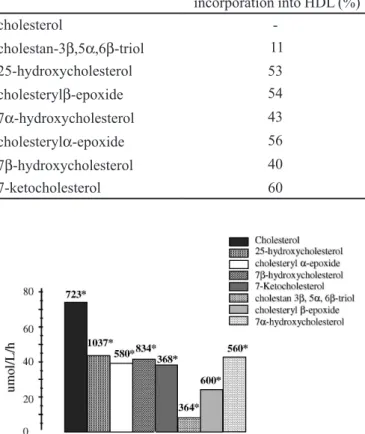
of triol may be related to its higher hydrophilicity. All the cholesterol oxides incorporated into HDL were esteriied by LCAT from human plasma (Figure 1). This is in accordance with data previously described for LCAT catalyzed esterii-cation of oxysterols in discoidal bilayer particles (Nishida
et al., 1993). However, the esteriication yield varied among the different cholesterol oxides with the lowest esteriica-tion taking place with triol. This suggests that triol is not an eficient substrate for LCAT, possibly due to its higher hydrophilicity compared to the other cholesterol oxides, and/or steric hindrance from the 5,6-hydroxyl moieties, whi-ch may reduce interaction with the hydrophobic catalytic site of LCAT (Peelman et al., 1998)
Figure 2 shows the esteriication intensity of both cho-lesterol and chocho-lesterol oxides in the same HDL particle. It is noteworthy that the esteriication of cholesterol is affected by the presence of cholesterol oxides in HDL. Most of the cholesterol oxides, except the triol and 7α
-hydroxycholes-terol, showed a trend for greater esteriication compared to
cholesterol. However, signiicant differences were observed only for 7-ketocholesterol and 5,6β-epoxycholesterol. The
most pronounced inhibition of cholesterol esteriication by LCAT was induced by 7-ketocholesterol.
The esteriication of oxysterols catalyzed by LCAT was also affected when examined in HDL subfractions.
14C-cholesterol oxide-enriched HDL subfractions showed
different degrees of esterification efficiency. The 14
C-cholesterol oxides esteriication was higher in the HDL3 subfraction (2.6 ± 0.5 nCi, n=6) as compared to HDL2 (1.4 ± 0.3 nCi, n=6), as occurs for cholesterol esteriication by
LCAT. Accordingly, Fielding et al. (1989) proposed that the efflux of radiolabeled cholesterol from fibroblasts promoted by HDL, and its further esteriication on this lipoprotein by LCAT, differed among HDL subfractions. The enhancement of LCAT activity was directly related with the increase of HDL3 and inversely correlated with HDL2 (Dobiasova et al., 1991, 1992).
The investigation of the inluence of cholesterol oxi-des concentration on cholesterol esteriication showed that the inhibition of cholesterol esteriication by LCAT was strongly dependent on cholesterol oxides concentration. As it can be seen at Table II, a concentration-dependent inhibition of cholesterol esteriication was found, as the cholesterol oxide concentration increases in HDL particle.
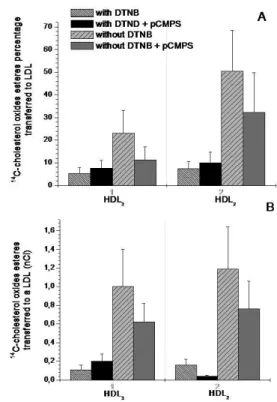
Another important step for reverse cholesterol transport is the transfer of cholesteryl esters formed in HDL to the apo-B containing lipoproteins. Figures 3 and 4 show the transfer of labeled cholesterol oxides present in HDL subfractions to LDL and VLDL, respectively. 14
C-cholesterol oxides were irst esteriied in HDL enriched particle in the presence or absence of DTNB (
5,5-Dithio-bis-(2-nitrobenzoic acid), a LCAT inhibitor. Later, these
cholesterol oxides-enriched HDL particles were separately incubated with LDL and VLDL and LPDS, as source of
TABLE I -Incorporation of cholesterol oxides into HDL
incorporation into HDL (%)
cholesterol
-cholestan-3β,5α,6β-triol 11 25-hydroxycholesterol 53 cholesterylβ-epoxide 54 7α-hydroxycholesterol 43 cholesterylα-epoxide 56 7β-hydroxycholesterol 40
7-ketocholesterol 60
FIGURE 1 - Esteriication rate of cholesterol oxides incorporated into HDL, in relation to an HDL particle containing no cholesterol oxides. *Initial concentrations of cholesterol oxides (uM) incorporated into HDL.
CETP, in the presence or absence of pCMPS (p -chloro-mercuriphenylsulfonic acid) which inhibits CETP. The results show that DTNB eficiently inhibited esteriication by LCAT, although pCMPS inhibited only 50% of CETP activity. The transfer of labeled cholesterol oxide esters from HDL to LDL and VLDL was similar for both particles (approximately 50% of the labeled substrates being trans-ferred in each case), which were incubated separately with HDL. The transfer of radiolabeled cholesterol oxide esters was higher in HDL2 subfraction (approximately 50%) as compared with HDL3 subfraction (approximately 13%). This may be due either to the HDL2 subfraction contai-ning more cholesteryl esters or by a major interaction of this particle with CETP, as proposed by Jonas (1991) for cholesterol transfer. The major esteriication of cholesterol and cholesterol oxides in HDL3 dynamically modiies this subfraction to the form HDL2, which is a better substrate for CETP that transforms the HDL2 again into HDL3.
TABLE II - Dependence of cholesterol and cholesterol oxide esteriication rate on cholesterol oxide concentration
Cholesterol
oxide Concentration(uM)
Cholesterol esteriication rate (umol/L/h) Cholesterol oxide esteriication rate (umol/L/h) 25-hydroxy-cholesterol 35 52 74.4 163 23.2 13.4 10.3 1.6 2.9 3.0 3.9 6.9
cholestan 3β, 5α, 6β-triol
24.6 93 232 444 52.0 46.6 45.4 17.4 2.0 6.9 15.5 16.1
7α -hydroxy-cholesterol 405 544 620 744 52.8 43.9 38.2 36.1 67.5 77.9 82.5 86.8
5,6β -epoxy-cholesterol 152 348 487 1491 38.4 35.6 36.6 32.2 5.1 17.6 65.6 164.5 7-ketocholesterol 187 343 603 1100 38.4 35.7 24.8 13.9 54.2 100.0 148.6 184.2
7β -hydroxy-cholesterol 91 98 209 397 54.2 53.1 45.1 35.1 13.4 14.0 27.9 39.5
5,6 α
-epoxy-cholesterol 64.5 497 1512 3338 165.0 165.9 104.8 92.7 20.9 162.3 312.1 609.8
FIGURE 3 - Transfer of 14C-cholesterol oxide esters from HDL 3 and HDL2 to LDL, (A) in % of 14C-cholesterol transferred and (B) in nCi. Both with DTNB (LCAT inhibitor), with DTNB plus pCMPS (CETP inhibitor) , without DTNB and, without DTNB plus pCMPS.
CONCLUSIONS
In conclusion, this study shows that cholesterol oxides are esteriied by LCAT and that the eficiency of esteriication differs among the different cholesterol oxi-des present in HDL. Cholesterol oxioxi-des diminished the LCAT-catalyzed cholesterol esteriication and this may have an important effect on reverse cholesterol transport. Thus, these data indicate that the effect of cholesterol oxi-des on cholesterol esteriication in HDL and on transfer of these cholesteryl esters to LDL and VLDL may contribute to the atherogenicity of these oxysterols.
AKNOWLEDGMENTS
This work was supported by Fundação de Ampa-ro à Pesquisa do Estado de São Paulo (FAPESP, grant 96/12164-0 to DSPA). Éder C. Pincinato was a fellowship holder of Fundação de Amparo à Pesquisa do Estado de São Paulo (FAPESP).
REFERENCES
ARON, L.; JONES, S.; FIELDING, C.J. Human plasma lecithin-cholesterol acyltransferase. Characterization of cofactor-dependent phospholipase activity. J. Biol. Chem. v.253, n.20, p.7220-7226, 1978.
BARTER, P.J.; RYE, K.A. Molecular mechanisms of reverse cholesterol transport. Curr. Opin. Lipidol., v.7, n.2, p.82-87, 1996.
DOBIASOVA, M.; STRIBRNA, J.; PRITCHARD, P.H.; FROHLICH, J.J. Cholesterol esterification rate in plasma depleted of very low and low density lipoproteins is controlled by the proportion of HDL2 and HDL3 subclasses: study in hypertensive and normal middle-aged and septuagenarian men.
J. Lipid Res., v.33, n.10, p.1411-1418, 1992.
DOBIASOVA, M.; STRIBRNA, J.; SPARKS, D.L.; PRITCHARD, P.H.; FROHLICH, J.J. Cholesterol esteriication rates in very low density lipoprotein- and low density lipoprotein-depleted plasma. Relation to high density lipoprotein subspecies, sex, hyperlipidemia, and coronary artery disease. Arterioscler. Thromb., v.11, n.1, p.64-70, 1991.
ESTERBAUER, H., GEBICKI, J., PUHL, H., JURGENS, G. The role of lipid peroxidation and antioxidants in oxidative modification of LDL. Free Radical Biol. Med., v.13, n.4, p.341-390, 1992.
FERDERBAR, S.; PEREIRA, E.C.; APOLINÁRIO, E.; BERTOLAMI, M.C.; FALUDI, A.; MONTE, O.; CALLIARI, L.E.; SALES, J.E.; GAGLIARDI, A.R.; XAVIER, H.T.; ABDALLA, D.S. Cholesterol oxides as biomarkers of oxidative stress in type 1 and type 2 diabetes mellitus. Diabetes Metab. Res. Rev., v.23, n.1, p.35-42, 2007.
FIELDING, C. J. Lecithin: cholesterol acyltransferase. In: ESFAHANI, M.; SWANEY, J. B. (Eds.). Advances in cholesterol research. New Jersey: Telford Press, 1990. p. 271-314.
FIELDING, C.J.; FIELDING, P.E. Molecular physiology of reverse cholesterol transport. J. Lipid Res. v.36, n.2, p.211-228, 1995.
FIELDING, P. E.; ISHIKAWA, Y.; FIELDING, C. J. Apolipoprotein E mediates binding of normal very low density lipoprotein to heparin but is not required for high afinity receptor binding.
J. Biol. Chem., v.264, n.21, p.12462-6, 1989.
FRUEBIS, J., PARTHASARATHY, S., STEINBERG, D. Evidence for a concerted reaction between lipid hydroperoxides and polypeptides. Proc. Natl. Acad. Sci. USA, v.89, n.22, p.10588-10592, 1992.
GLOMSET, J.A. The plasma lecithins:cholesterol acyltransferase reaction. J. Lipid Res. v.9, n.2, p.155-167, 1968.
IGLESIAS, A.; ARRANZ, M.; ALVAREZ, J.J.; PERALES, J.; VILLAR, J.; HERRERA, E.; LASUNCIÓN, M.A. Cholesteryl ester transfer activity in liver disease and cholestasis, and its relation with fatty acid composition of lipoprotein lipids. Clin. Chim. Acta., v.248, n.2, p.157-174, 1996.
JONAS, A. Lecithin-cholesterol acyltransferase in the metabolism of high-density lipoproteins. Biochim. Biophys. Acta., v.1084, n.3, p.205-220, 1991.
KAWANO, M.; NAGASAKA, S.; YAGYU, H.; ISHIBASHI, S. Pitavastatin decreases plasma prebeta1-HDL concentration and might promote its disappearance rate in hypercholesterolemic patients. J. Atheroscler. Thromb., v.15, n.1, p. 41-46, 2008.
NISHIDA, H.I.; ARAI, H.; NISHIDA, T. Cholesterol ester transfer mediated by lipid transfer protein as inluenced by changes in the charge characteristics of plasma lipoproteins. J. Biol. Chem., v.268, n.22, p.16352-16360, 1993.
ODA, H.; YAMASHITA, H.; KOSAHARA, K.; KUROKI, S.; NAKAYAMA, F. Esterified and total 7 alpha-hydroxycholesterol in human serum as an indicator for hepatic bile acid synthesis. J. Lipid Res., v.31, n.12, p.2209-2218, 1990.
ORAM, J.F.; YOKOYAMA, S. Apolipoprotein-mediated removal of cellular cholesterol and phospholipids. J. Lipid Res. v.37, n.12, p.2473-2491, 1996.
PEELMAN, F.; VINAIMONT, N.; VERHEE, A.; VANLOO, B.; VERSCHELDE, J.L.; LABEUR, C.; SEGURET-MACE, S.; DUVERGER, N.; HUTCHINSON, G.; VANDEKERCKHOVE, J.; TAVERNIER, J.; ROSSENEU, M. A proposed architecture for lecithin cholesterol acyl transferase (LCAT): identiication of the catalytic triad and molecular modeling. Protein Sci., v.7, n.3, p.587-599, 1998.
PENG, S.K.; HU, B.; MORIN, R.J. Angiotoxicity and atherogenicity of cholesterol oxides. J. Clin. Lab. Anal., v.5, n.2, p.144-152, 1991.;
REDGRAVE, T.G.; ROBERTS, D.C.; WEST, C.E. Separation of plasma lipoproteins by density-gradient ultracentrifugation.
Anal. Biochem., v.65, n.1-2, p.42-49, 1975.
SCHROEPFER, G.J. JR. Oxysterols: modulators of cholesterol metabolism and other processes Physiol. Rev., v.80, n.1, p.361-554, 2000.
SEVANIAN, A.; MCLEOD, L.L. Cholesterol autoxidation in phospholipid membrane bilayers. Lipids, v.22, n.9, p.627-636, 1987.
SEVANIAN, A.; SERAGLIA, R.; TRALDI, P.; ROSSATO, P.; URSINI, F.; HODIS, H. Analysis of plasma cholesterol oxidation products using gas- and high-performance liquid chromatography/mass spectrometry. Free Radic. Biol. Med., v.17, n.5, p.397-409, 1994.
VAN REYK, D.M.; BROWN, A.J.; HULT’EN, L.M.; DEAN, R.T.; JESSUP, W. Oxysterols in biological systems: sources, metabolism and pathophysiological relevance. Redox Rep.,
v.11, n.6, p.255-262, 2006.
VON ECKARDSTEIN, A. Cholesterol eflux from macrophages and other cells. Curr. Opin. Lipidol. v.7, n.5, p.308-319, 1996.