*Correspondence: F. A. Vanderlinde. Universidade Federal Rural do Rio de Janeiro, Departamento de Ciências Fisiológicas, Instituto de Biologia, BR-465 - Km 07, 23890-000 – Seropédica - RJ, Brazil. E-mail: [email protected]
A
rti
Pharmaceutical Sciences vol. 45, n. 3, jul./sep., 2009
Evaluation of the antinociceptive and anti-inlammatory effects of
the acetone extract from
Anacardium occidentale
L.
Frederico Argollo Vanderlinde
1*, Higor Frutuoso Landim
2, Elson Alves Costa
3, Pablinny Moreira
Galdino
3, Maria Aparecida Medeiros Maciel
4, Gineide Conceição dos Anjos
4, David do Carmo
Malvar
1, Wellington da Silva Côrtes
1, Fábio Fagundes da Rocha
11Department of Physiological Sciences, Institute of Biology, Federal Rural University of Rio de Janeiro, 2Course of Veterinary Medicine,University Center of Barra Mansa, 3Department of Physiological Sciences, Institute of Biological Sciences, Federal
University of Goiás, 4 Department of Chemistry, Federal University of Rio Grande do Norte
The stem bark of Anacardium occidentale L. (Anacardiaceae), commonly called cashew, is used in Brazilian traditional medicine for the treatment of gastric and inlammatory disorders. The present study was carried out to investigate the in vivo anti-inlammatory activities of the acetone extract (AE) of the stem bark of A. occidentale. We evaluated the pharmacological activities of this plant material through the analgesic, antiedematogenic and chemotaxic inhibitory effects produced by the AE. The oral administration (p.o.) of mice with the AE (0.1, 0.3 and 1.0 g/kg) or positive control indomethacin (10 mg/kg) inhibited acetic acid-induced writhing by 18.9, 35.9, 62.9 and 68.9%, respectively (ID50% =
530 mg/kg). The highest dose of the AE was able to inhibit croton oil-induced ear edema formation by 56.8% (indomethacin at 10 mg/kg, p.o. - 57.6% inhibition). When submitted to the carrageenan-induced peritonitis test, the AE (0.1, 0.3 and 1.0 g/kg, p.o.) impaired leukocyte migration into the peritoneal cavity by 24.8, 40.5 and 49.6%, respectively. The positive control, dexamethasone (2 mg/kg, s.c.), inhibited leukocyte migration by 66.9%. These results indicate the presence of anti-inlammatory and antinociceptive principles in the acetone extract of Anacardium occidentale, and reinforce the plant’s potential therapeutic use against pain and inlammatory diseases.
Uniterms: Anacardium occidentale L./analgesic activity. Anacardium occidentale L./anti-inlammatory activity. Anacardium occidentale L./antiedematogenic activity. Anacardiaceae. Cashew.
As cascas do caule do Anacardium occidentale L. (Anacardiaceae), conhecido como cajueiro, são popularmente utilizadas no Brasil para o tratamento de doenças gástricas e inlamatórias. Este estudo teve como objetivo a avaliação farmacológica in vivo da atividade antiinlamatória do extrato acetônico (AE) obtido das cascas do A. occidentale, investigando os efeitos analgésico, antiedematogênico e inibitório sobre a quimiotaxia deste material botânico. A administração oral (p.o.) em camundongos com o AE (0,1; 0,3 e 1 g/kg) ou o controle positivo indometacina (10 mg/kg) inibiu as contorções abdominais induzidas pelo ácido acético em 18,9; 35,9; 62,9 e 68,9% respectivamente (ID50% = 530 mg/kg). Esta maior dose
do AE também inibiu o edema de orelha produzido pelo óleo de cróton em 56,8% (indometacina, 10 mg/kg, p.o. - 57,6% de inibição). No teste da peritonite induzido pela carragenina, o AE (0,1; 0,3; e 1,0 mg/kg, p.o.) reduziu a migração de leucócitos para a cavidade peritoneal em 24,8; 40,5; e 49,6% respectivamente, enquanto que o controle positivo dexametasona (2 mg/kg, s.c.) inibiu a migração de leucócitos em 66,9%. Estes resultados indicam a presença de princípios ativos antiinlamatórios e antinociceptivos no extrato acetônico de Anacardium occidentale e reforçam o potencial terapêutico da planta em doenças que envolvem dor e inlamação.
INTRODUCTION
Anacardium occidentale L. (Anacardiaceae) is a tropical tree native to Brazil that is now extensively culti-vated in India and East Africa, popularly known as cashew. The fruits, stem bark and leaves are used in folk medicine for the treatment of several diseases such as hypertension, inlammatory diseases, asthma, bronchitis, and gastric (peptic ulcers) and intestinal disturbances (Corrêa, 1984). The stem bark is astringent and rich in tannins, which pos-sibly supports its popular use in healing. In fact, previous studies conducted by Mota et al. (1985) demonstrated that tannins isolated from the stem bark of A.occidentale
possess analgesic and inlammatory effects. The anti-inlammatory activity of the plant’s stem bark has been re-cently described in two different models of inlammation, having reduced paw edema induced by fresh egg albumin in rats (Ojewole, 2004) and inhibited skin dye leakage in mice after subcutaneous injection of LPS (Olajide et al., 2004). More speciically, the anti-inlammatory and cicatrizant effects of the aqueous extract of Anacardium occidentale, rich in tannin constituents, was shown by the clinical evaluation of patients with skin injury or mucosa membrane lesions (oral or vulva erosion, uterus inlam-mation and body ulceration). The aqueous extract reduced the characteristic lesions up to a total cure, without any evidence of side effects or adverse reactions (Lopes et al., 2003). Recently, the antioxidant activities of the methanol extract obtained from the stem bark (Gomes et al., 2006) and the antiulcerogenic effect of a hydroethanolic extract of Anacardium occidentale L. leaves (Konan, Bacchi, 2007) were characterized. Although the anti-inlammatory activity of the A. occidentale extracts has been established in different models of inlammation, its analgesic effect has been poorly studied, and the mechanisms of both activities remain unclear. The present work studied the analgesic and antiedematogenic effects of Anacardium occidentale L. stem bark acetone extract (AE) and inves-tigated the effect of the plant on leukocyte migration, an important component of the inlammatory process.
MATERIAL AND METHODS
Plant material
The stem bark samples of Anacardium occidentale
were collected in September, 2005, in Natal (RN) Bra-zil, and identiied by Maria Iracema Bezerra Loiola. A voucher specimen (1782) was deposited in the Herbarium of Botanic Ecology and Zoology Department (UFRN, Brazil).
Extraction
To obtain the acetone extract (AE), 1.3 kg of pow-dered bark of A. occidentale was extracted with acetone in a Soxhlet apparatus to yield 58 g of the AE.
Animals
Adult male Swiss mice (25–35 g) were housed in plastic cages, with food and tap water available ad libi-tum in the colony room. Mice were acclimatized in the laboratory for at least 60 min prior to the test procedure and left without food for 12–18 h before the gavages. All experiments were carried out in accordance with current guidelines for the care of laboratory animals and the ethical guidelines on the use of animals in pain research (CIOMS 1985; Zimmermann, 1986). Experimental protocols were approved by the local Animal Care and Use Committee (007/2006/CEPEB/UFRRJ), and the minimum number of animals and duration of observation required to obtain consistent data were employed.
Drugs and reagents
Acetic acid, acetone (Merck AG, Darmstadt, Ger-many), croton oil, indomethacin, carrageenan (Sigma Chemical Co., St. Louis, MO, USA), fentanyl (Janssen Pharmaceutical), dexamethasone (Prodome, Brazil), the AE and other drugs were diluted in water (p.o.) or saline solution (s.c. or i.p.).
Acetic acid-induced writhing test
We orally treated groups of six mice with water (10 mL/kg), the AE (0.1 to 1.0 g/kg) or indomethacin (10 mg/kg) 60 min before acetic acid injection (1.2%, 0.1 mL/10 g), and counted the number of times the mice writhed during the following 30 min (Koster et al., 1959).
Hot-plate test
We measured the latency (seconds) of heat stimu-lus every 30 min, starting 30 min before and up to 2 h after treatment of the mice (n = 8) with the AE (1 g/kg,
p.o.), fentanyl (100 μg/kg, s.c.) or water (10 mL/kg, p.o.) (D’Amour, Smith, 1941).
Croton oil induced ear oedema
each animal (n = 8) with 20 μL of freshly prepared croton oil (2.5% in acetone) on the inner surface of the right ear. The left ear was treated with the same volume of acetone (control). Four hours after the treatment, the mice were killed by cervical dislocation and a plug (6 mm in diameter) was taken from both the treated and untreated ears with a punch. We monitored the inlam-matory response (edema) by weighing (mg) both plugs (∆) and testing the differences. The test was employed as described by Tubaro et al. (1986) and Zanini et al.
(1992).
Carrageenan-induced peritonitis
We orally treated groups of mice (n = 10) with a vehicle (water) or the AE (0.1 to 1.0 g/kg) 60 min prior to an injection of carrageenan (1% in saline solution; 250 µL/mouse) into the right peritoneal cavity. The
positive control group was pre-treated (30 min) with dexamethasone (2 mg/kg, s.c.). The animals were anes-thetized with ether and sacriiced 4 h later. We washed the peritoneal cavity with 2 mL of PBS-heparin (10 UI/mL) and collected the peritoneal exudates, which were then diluted (Türk solution 1:20). We counted the number of leukocytes that had migrated to the peritoneum in a Neu-baüer chamber, and the results were expressed as cells x 106/mL, or as the percentage of inhibition of leukocyte
migration compared to control groups as described by Ferrándiz and Alcaraz (1991).
Statistical analysis
Data were analyzed statistically by one-way ANOVA. The differences between the means were de-tected using the unpaired Student’s t-test. The values are reported as mean ± standard error of the mean (SEM).
Probability values of less than 0.05 (p < 0.05) were considered signiicant.
RESULTS
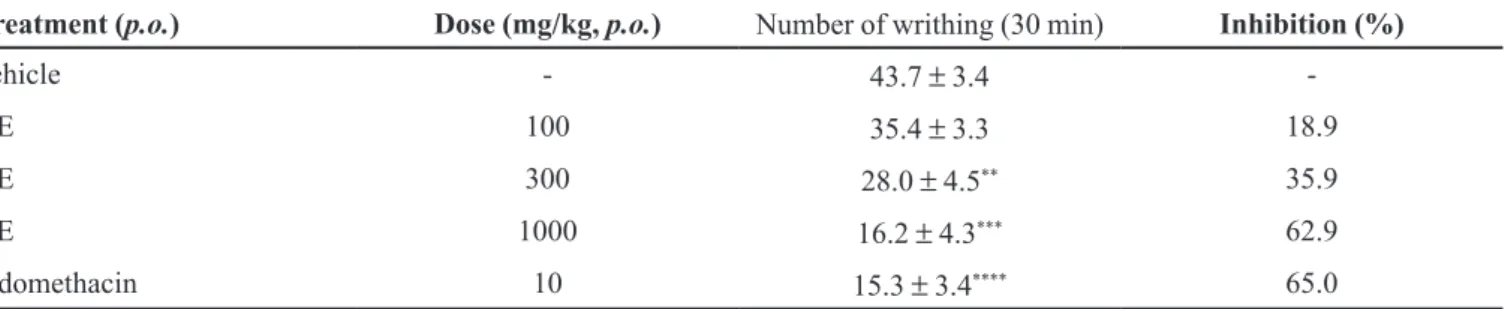
To evaluate the antinociceptive effect of the AE, we assessed its performance in the acetic acid-induced abdominal writhing model of analgesia. As can be seen in Table I, pre-treatment with the AE (0.1, 0.3 and 1.0 g/kg,
p.o.) produced a dose-related inhibition of acetic acid-in-duced abdominal writhing (18.9, 35.9, and 62.9%, respec-tively) compared to the control group (43.7 ± 3.4 number of writhings). The inhibitory dose calculated (ID50%) was 530.8 mg/kg, and pre-treatment with indomethacin also showed a decrease in accumulated abdominal writhing (15.3 ± 3.4 number of writhings).
In the hot-plate test,Figure 1 shows that the basal latency of the control group was 8.3 ± 0.8 sec, and the AE (1 g/kg, p.o.) did not alter the pain latency of the animals, even at a dose level high enough to induce maximal re-sponse in the acetic acid test. The positive control fentanyl increased the latency of heat stimulus 2.7-fold (30 min) and 1.9-fold (60 min).
FIGURE 1- Effect of the acetone extract (AE) of Anacardium
occidentale or fentanyl on the nociceptive response of mice in the hot-plate test. The symbols and vertical bars express means ± S.E.M. of the latency for the nociceptive behavior. **p < 0.01, ****p < 0.0001 when compared with the vehicle control group
(Two tail unpaired Student’s t test). n = 8.
TABLE I - Effect of AE from Anacardium occidentale on acetic acid-induced abdominal writhing in mice
Treatment (p.o.) Dose (mg/kg, p.o.) Number of writhing (30 min) Inhibition (%)
vehicle - 43.7 ± 3.4
-AE 100 35.4 ± 3.3 18.9
AE 300 28.0 ± 4.5** 35.9
AE 1000 16.2 ± 4.3*** 62.9
indomethacin 10 15.3 ± 3.4**** 65.0
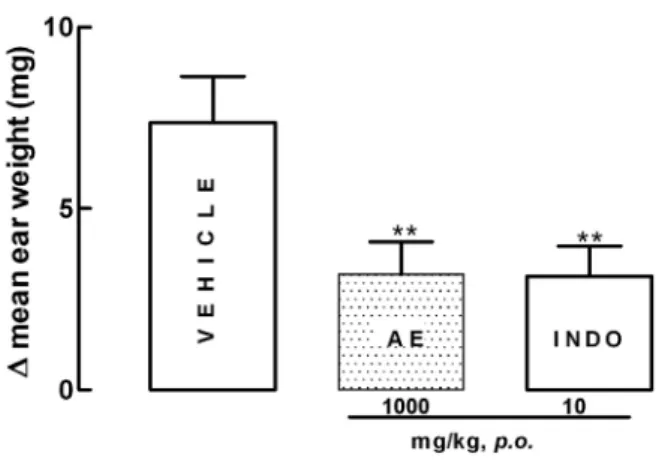
To assess the antiedematogenic effect of the AE, the croton oil-induced mice ear oedema method was used. Figure 2 shows that the difference of the right and left ear weight (Δ) obtained in the control group was 7.4 ± 1.2 mg, and that AE (1 g/kg) or indomethacin oral pre-treatment inhibited the edematogenic response after topical appli-cation of croton oil by 56.8 (Δ = 3.1 ± 0.9 mg) and 57.6% (Δ = 3.1 ± 0.8 mg), respectively.
To evaluate the influence of the oral administra-tion of the AE on leukocyte migraadministra-tion, we assessed its performance in the inlammatory model of carrageenan-induced peritonitis. As can be seen in Table II, compared to the group administered only with the vehicle (12.1 ± 1.0 leukocytes x 106/mL), the AE administered group
(0.1, 0.3 and 1 g/kg) exhibited a dose-related reduction of leukocyte migration by 24.8, 40.5 and 49.6%, respectively. The positive control, dexamethasone (2 mg/kg, s.c.), was also effective, inhibiting leukocyte migration by 66.9%.
DISCUSSION
The antinociceptive effect of the AE was tested in two models of analgesia: the acetic acid-induced ab-dominal writhing and the hot-plate test. The constrictions induced by acetic acid in mice result from an acute inlam-matory reaction related to the increase in the peritoneal fluid levels of PGE2 and PGF2α (Vinegar et al., 1976; Deraedt et al., 1976, 1980). Treatment with AE promoted a dose-related antinociceptive effect in the acetic acid-induced abdominal writhing model. Although this model could be commonly used as a screening method to iden-tify drugs with antinociceptive activity potential, several groups of drugs with different mechanisms of action can inhibit abdominal writhing (Koster et al., 1959; Hender-shot, Forsaith, 1959). Moreover, the involvement of dif-ferent mediators like prostaglandins (Deraedt et al., 1980), neurokininA (Julia, Bueno, 1997) and CGRP (Friese et al., 1997), for example, has been described in acid-induced abdominal writhing, which means that it is not possible to suggest any mechanism of the antinociceptive effect of the AE based only on this model. The fact that the AE was able to inhibit constrictions showed that this extract has a peripheral antinociceptive effect, interfering with the acute phase of the inlammatory process. This hypothesis was reinforced when the present results showed that the AE has no central action in the hot-plate test, commonly used to assess narcotic analgesics or other centrally acting drugs (Beirith et al., 1998). Also, antinociception is not related to nonspeciic central effects, since no detectable effect was observed in the rota-rod test (results not shown). Later, we tested this anti-inlammatory hypothesis in two other models that evaluate different aspects of the inlammatory process: edema formation and leukocyte migration. The AE signiicantly reduced croton oil-induced ear edema by 56.8%, and also reduced the total leukocyte migration to the peritoneum after carrageenan stimulation in a dose-related manner with a highest inhibition value of 49.6%.
The production of exudates in these models is related
TABLE II - Effect of AE from Anacardium occidentale on carrageenan-induced peritonitisin mice
Treatment Dose (mg/kg) Number of leukocytes
(x 106 / mL) Inhibition (%)
Vehicle (p.o.) - 12.1 ± 1.0
-AE (p.o.) 100 9.1 ± 1.3 24.8
AE (p.o.) 300 7.2 ± 0.3** 40.5
AE (p.o.) 1000 6.1 ± 0.2**** 49.6
Dexamethasone (s.c.) 2 4.0 ± 0.3**** 66.9
Values represent the mean ± S.E.M. of 10 mice. Signiicantly different from control group: **p < 0.005, ****p < 0.0001.
FIGURE 2 - Oral administration effect of vehicle (water), acetone
to a local release of vasoactive substances (histamine and kinins) and the synthesis of prostaglandins. The migration of leukocytes would not be directly related to cyclooxyge-nase products, but the process could be inhibited by some non-steroidal anti-inlammatory compounds, indicating that many mechanisms could be implicated in its control (Higgs et al., 1980; Mikami, Miyasaka, 1983; Brooks, Day, 1991). The A. occidentale stem bark acetone extract produced potent antinociceptive activity against the acetic acid-induced pain response without interfering with the hot-plate response, and also inhibited croton oil-induced ear edema formation and reduced leukocyte migration in the peritoneum after carrageenan stimulation. Our main hypothesis to explain these results is that compounds present in the AE can inhibit the cyclo-oxygenase and/or the lipoxygenase pathways of arachidonate metabolism, blockading the leukotriene mechanism, which is important to chemotaxis, and/or also blockading the prostaglandin mechanism, which is important to the genesis of the edema and pain (Morrow and Roberts II, 2001).
In conclusion, we herein report that the acetone extract from Anacardium occidentale produced antino-ciceptive, antiedematogenic and chemotaxis inhibitory activities, reinforcing the therapeutic potential of this traditional medicinal herb against pain and inlammatory diseases. A bioassay-guided fractioning of this extract is now in progress to identify the bioactive substance(s).
ACKNOWLEDGEMENTS
The authors thank the University Center of Barra Mansa and the National Council of Scientii c and Tech-National Council of Scientiic and Tech-nological Development (CNPq) for inancial support and the American Journal Experts for English review.
REFERENCES
BEIRITH, A.; SANTOS, A.R.S.; RODRIGUES, A.L.S. Spinal and supraspinal antinociceptive action of dipyrone in formalin, capsaicin and glutamate tests. Study of the mechanism of action. Eur. J. Pharmacol., v.345, p.33-245, 1998.
BROOKS, P.M.; DAY, R.O. Nonsteroidal anti-inlammatory drugs – differences and similarities. New Engl. J. Med., v.324, p.1716-1725, 1991.
CIOMS-Council for International Organization of Medical Sciences. International Guiding Principles for Biomedical Research Involving Animals, 1985. Avaiable at: <http:// http://www.cioms.ch/frame_1985_texts_of_guidelines. htm>. Accessed on: 26 jul. 2007.
CORRÊA, P.M. Dicionário das plantas úteis do Brasil. Rio de Janeiro: Imprensa Nacional, 1984. p.402.
D’AMOUR, F.E.; SMITH, D.L. A method for determining loss of pain sensation. J. Pharmacol. Exp. Therapeut., v.72, p.74-79, 1941.
DERAEDT, R.; JOUQUEY, S.; BENZONI, J.; PETERFALVI, M. Inhibition of prostaglandin biosynthesis by non-narcotic analgesic drugs. Arch. Int. Pharmacodyn. Ther., v.224, p.30-42, 1976.
DERAEDT, R.; JOUQUEY, S.; DELEVALÉE, F.; FLAHAUT, M.Release of prostaglandins-E and prostaglandins-F in an algogenic reaction and its inhibition. Eur. J. Pharmacol., v.61, p.17-24, 1980.
FERRÁNDIZ, M.L.; ALCARAZ, M.J. Anti-inflammatory activity and inhibition of arachidonic acid metabolism by lavonoids. Agents Actions, v.32, p.283-288, 1991.
FRIESE, N.; DIOP, L.; CHEVALIER, E.; ANGEL, F.; RIVIERE, P.J.; DAHL, S.G. Involvement of prostaglandins and CGRP-dependent sensory afferents in peritoneal irritation-induced visceral pain. Regul. Pept., v.70, p.1-7, 1997.
GOMES, F.E.S.; ANJOS, G.C.; DANTAS, T.N.C.; MACIEL, M.A.M.; ESTEVES, A.; ECHEVARRIA, A. Obtenção de nanoformulações do tipo microemulsão objetivando a biodisponibilização de Anacardium occidentale e sua eiciência como agente antioxidante. Rev. Fitos, v.2, p.82-88, 2006.
HENDERSHOT, L.C.; FORSAITH, J. Antagonism of the frequency of phenylquinone-induced writhing in the mouse by weak analgesic and nonanalgesics. J. Pharmacol. Exp. Therapeut., v.125, p.237-240, 1959.
HIGGS, G.A.; EAKINS, K.E.; MUGRIDGE, K.G.; MONCADA, S.; VANE, J.R. The effects on non-steroid anti-inflammatory drugs on leukocyte migration in carrageenin-induced inflammation. Eur. J. Pharmacol., v.66, p.81-86, 1980.
KONAN, N.A.; BACCHI, E.M. Antiulcerogenic effect and acute toxicity of a hydroethanolic extract from the cashew (Anacardium occidentale L.) leaves. J. Ethnopharmacol., v.112, p.237-242, 2007.
KOSTER, R.; ANDERSON, M.; DE BEER, E.J. Acetic acid for analgesic screening. Fed. Proc., v.18, p.412-416, 1959.
LOPES, V.S.; DANTAS, T.N.; MACIEL, M.A.M.; ASSIS, Z.M.S.; GALDINO, V.S.; ARAÚJO, I.S.; CAMACHO, C.L.; CHACON, D.P. Clinical evaluation of Anacardium occidentale. Rev. Bras. Ciênc. Farm., v.39, suppl.2, p.235-235, 2003.
MIKAMI, T.; MIYASAKA, K. Effects of several anti-inlammatory drugs on the various parameters involved in the inlammatory response in rat carrageenin-induced pleurisy. Eur. J. Pharmacol., v.95, p.1-12, 1983.
MORROW, J. D.; ROBERTS II, L. J. Lipid-derived autacoids: Eicosanoids and Platelet-Activating Factor. In: HARMAN J. G.; LIMBIRD L. E. (Eds.). Goodman & Gilman’s, The Pharmacological basis of therapeutics.10. ed. New York: McGraw Hill, 2001. p.669-685.
MOTA, M.L.; THOMAS, G.; BARBOSA FILHO, J.M. Anti-inflammatory actions of tannins isolated from the bark of Anacardium occidentale L. J. Ethnopharmacol., v.13, p.289-300, 1985.
OJEWOLE, J.A. Potentiation of the antiinlammatory effect of Anacardium occidentale (Linn) stem-bark aqueous extract by grapefruit juice. Meth. Find. Exp. Clin. Pharmacol., v.26, p.183-188,
OLAJIDE, O.A.; ADEROGBA, M.A.; ADEDAPO, A.D.; MAKINDE, J.M. Effects of Anacardium occidentale stem bark extract on in vivo inflammatory models. J. Ethnopharmacol., v.95, p.139-142, 2004.
TUBARO, A.; DRI, P.; MELATO, M.; MULAS, G.; BIANCHI, P.; DEL NEGRO, P.; DELLA LOGGIA, R. In the croton oil ear test the effects of non steroidal anti-inlammatory drug (NSAIDs) are dependent on the dose of the irritant. Agents Actions, v.19, p.371-373, 1986.
VINEGAR, R.; TRUAUX, J.F.; SELPH, J.L. Quantitative studies of pathways to acute carrageenan inlammation. Fed. Proc., v.35, p.2447-2456, 1976.
ZANINI JUNIOR, J.C.; MEDEIROS, Y.S.; CRUZ, A.B.; YUNES, R.A.; CALIXTO, J.B. Actions of compounds from Manderilla velutina on croton oil-induced ear edema in mice. A comparative study with steroidal and nonsteroidal antiinlammatory drugs. Phytother. Res., v.6, p.1-5, 1992.
ZIMMERMANN, M. Ethical considerations in relation to pain in animal experimentation. Acta Physiol. Scand. Suppl., v.554, p.221-233, 1986.
Received for publication on 17th March 2008