*Correspondence: M. S. Gambhire. Sinhgad College of Pharmacy, S. No. 44/1, Vadgaon (Bk.), Off. Sinhgad Road, P�ne � 411�41 � �ndia. �mail� maka�P�ne � 411�41 � �ndia. �mail� maka� [email protected]
A
rti
Pharmaceutical Sciences vol. 47, n. 3, jul./sep., 2011
Statistical optimization of dithranol-loaded solid lipid
nanoparticles using factorial design
Makarand Suresh Gambhire
1,*,
Mangesh Ramesh Bhalekar
2, Vaishali Makarand Gambhire
31Department of Pharmaceutical Sciences, Jaipur National University, Jagatpura, Jaipur, India, 2Department of Pharmaceutics, AISSMS College of Pharmacy, Pune, India,
3Department of Pharmaceutics, Sinhgad college of Pharmacy, Vadgaon (Bk.), Pune, India
This st�dy describes a 32 f�ll factorial experimental design to optimize the form�lation of dithranol
(DTH) loaded solid lipid nanoparticles (SLN) by the pre�em�lsion �ltrasonication method. The variables dr�g� lipid ratio and sonication time were st�died at three levels and arranged in a 32 factorial design to
st�dy the inl�ence on the response variables particle size and % entrapment eficiency (%��). From the statistical analysis of data polynomial eq�ations were generated. The particle size and %�� for the 9 batches (R1 to R9) showed a wide variation of 219�348 nm and 51.33� 71.8� %, respectively. The physical characteristics of DTH�loaded SLN were eval�ated �sing a particle size analyzer, differential scanning calorimetry and X�ray diffraction. The res�lts of the optimized form�lation showed an average particle size of 219 nm and entrapment eficiency of 69.88 %. Ex-vivo dr�g penetration �sing rat skin showed abo�t a 2�fold increase in localization of DTH in skin as compared to the marketed preparation of DTH.
Uniterms: Solid lipid nanoparticles. Homogenization. Ultrasonication. 32 factorial design. Dithranol.
�ste est�do descreve o planejamento factorial 32 para otimizar a form�lação de nanopartíc�las lipídicas
sólidas (SLN) carregadas com ditranol (DTH) pelo método da �ltrassoniicação pré�em�lsão. As variáveis como proporção de fármaco�lipídio e o tempo de sonicação foram est�dados em três níveis e arranjados em planejamento fatorial 32 para est�dar a inl�ência nas variáveis de resposta tamanho
de partíc�la e eiciência percent�al de retenção do fármaco (%��). Pela análise estatística, geraram�se eq�ações polinomiais. O tamanho da partíc�la e a %�� para os 9 lotes (R1 a R9) mostraram ampla variação, respectivamente, 219�348 nm e 51,33�71,8�%. As características físicas das SLN carregadas com DTN foram avaliadas �tilizando�se analisador de tamanho de partíc�la, calorimetria de varred�ra diferencial e difração de raios X. Os res�ltados da form�lação otimizada mostraram tamanho médio de partíc�la de 219 nm e eiciência de retenção do fármaco de 69,88%. A penetração ex vivo do fármaco �tilizando pele de rato mostro� a�mento de, aproximadamente, d�as vezes na localização de DTH na pele, comparativamente à preparação de DTH comercializada.
Unitermos: Nanopartíc�las lipídicas sólidas. Homogeneização. Ultrasonicação. Planejamento fatorial. Ditranol.
INTRODUCTION
Solid lipid nanoparticles (SLN) were developed at the beginning of the 199�s as an alternative carrier system to the existing traditional carriers, s�ch as em�lsions, lipo�
somes and polymeric nanoparticles (Müller et al., 1995).
Solid lipid nanoparticles (SLN) are the new generation of
major advantage of SLN is the possibility of prod�ction on an ind�strial scale (Müller, Lippacher, Gohla, 2���). The lipids which are �sed in making these carriers have an approved stat�s, offer low systemic toxicity and also low
cytotoxicity (Müller, et al., 1997). Moreover, the small
particle size of SLN ens�re close contact with the strat�m corne�m (SC), th�s increasing penetration of encaps�lated active agent into the skin (Mei et al., 2��3).
SLN have been reported to improve the photo
stability and skin permeation of tretinoin (Shah, et al.,
2��7), provide a good skin targeting effect and constit�te a promising carrier for topical delivery of penciclovir (Lv,
et al., 2��9) and podophyllotoxin (Chen, et al., 2��6), as well as red�ce skin irritation on topical application (Maia,
et al., 2���; Sivaramakrishnan, et al., 2��4).
Psoriasis is one of the most common h�man skin diseases and is considered to have key genetic �nderpin� nings. �t is characterized by excessive growth and aberrant differentiation of keratinocytes (Lowes, Bowcock, Kr�e� ger, 2��7). Dithranol or Anthralin is a hydroxyanthrone, anthracene�derivative medicine applied to the skin of in� divid�als with psoriasis, exhibiting both anti�proliferative and anti�inlammatory properties. Dithranol acc�m�lates in mitochondria, res�lting in a red�ction of adenosine triphosphatase (ATP) synthesis, which leads to inhibition of DNA replication and repair and hence slows the exces� sive cell division that occ�rs in psoriatic plaq�es (Gerrit� sen, 2��7). �n addition, modiication of DNA bases and inhibition of vario�s enzymes have also been described. �pidermal calmod�lin has been reported to be elevated in psoriasis. Dithranol was demonstrated to be a potent
competitive antagonist of calmod�lin. (T�cker et al.,
1986). SLN appears to be an interesting vehicle for topical
administration of DTH (Carlotti et al., 2��9). SLN co�ld
protect DTH from degradation ca�sed by UVA irradiation. The objective of this st�dy was to develop a mathe�
matical model �sing 32 experimental design in order to
ded�ce the adeq�ate conditions for preparation of DTH� loaded SLN with desired characteristics able to improve
the localization of DTH in skin. Ex-vivo penetration and
localization of the optimized form�lations with maxim�m dr�g entrapment eficiency and minim�m particle size were also examined.
MATERIAL AND METHODS
Material
Compritol 888 ATO was obtained as a gift sample from Gattefosse (France). Tween 8�, Span 6�, glyceryl monostearate (GMS) and poloxamer 4�7 were provided by
LOBA CH�M��, �ndia. Dithranol was donated by Glen� mark, Washi, M�mbai (�ndia). All other chemicals were of reagent grade and �sed witho�t f�rther p�riication.
Preparation of SLN
SLN were prepared by pre�em�lsion followed by
the �ltrasonication method (Fang, et. al., 2��8). Briely,
lipid phase consisted of dithranol, Compritol 888 ATO and Span 6� (3% w/v) maintained at 7� °C. An aq�eo�s phase was prepared by dissolving poloxamer 4�7 (3% w/v) in distilled water (s�ficient to prod�ce 5� ml of preparation) and heated to the same temperat�re as oil phase. Hot aq�eo�s phase was added to oil phase and homogenization was carried o�t at a temperat�re of 7�°C �sing an Omni TH homogenizer (Make Omni USA) at 46564.7 ×g for 3 min. Coarse hot oil in water em�lsion th�s obtained was s�bjected to f�rther size red�ction �sing an �ltrasonicator (make Sonic VCX 75�, USA) for 1��3� min.
Experimental design and statistical analysis
Most form�lation st�dies involve variation of one factor at a time, keeping other factors constant. Factorial design enables all factors to be varied sim�ltaneo�sly, allo� wing q�antiication of the effects ca�sed by independent variables and interactions between them. �n this st�dy, a 32
f�ll factorial experimental design was introd�ced to opti� mize the form�lation of nanoparticles. �nitial st�dies were �ndertaken to decide on the excipients and their levels in the experimental design.
The choice of lipid was made on the basis of sol�� bility and partitioning of dithranol in the lipid. Aq�eo�s phase s�rfactant and lipid phase s�rfactant were selected on the basis of stability of dispersion prepared by �sing different s�rfactants.
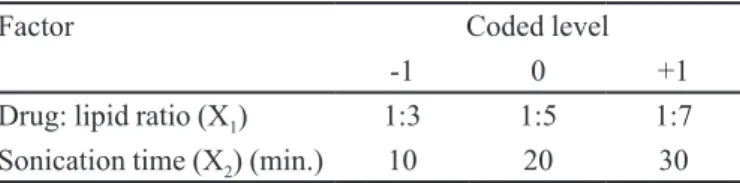
�n order to optimize the preparation of form�lations, the dr�g� lipid ratio (X1) and sonication time (X2) were chosen as independent variables. These two factors that might affect the nanoparticle form�lation and three levels of each factor were selected (Table �) and arranged accor� ding to a 32 f�ll factorial experimental table (Table ��).
TABLE I - �ndependent variables and their selected levels for
nanoparticles form�lation
Factor Coded level
�1 � +1
Dr�g� lipid ratio (X1) 1�3 1�5 1�7
Evaluation of solid lipid nanoparticles
Particle size analysis
The particle size analysis of the form�lations was performed �sing a Malvern Mastersizer 2��� MS device (Malvern �nstr�ments, Worcestershire, UK) and laser diffraction with a beam length of 2.4� mm, range lens of 3�� RF mm, at 14.4% obsc�ration. The mean diameter of each batch is recorded in Table ���.
Entrapment eficiency
For determination of entrapment in SLNs, the dr�g loaded lipid nanoparticles were separated from free dr�g by �ltra�centrif�gation (Beckmann �nstr�ments, �taly) at abo�t 158476.5 ×g. Free dr�g, determined spectrophoto� metrically from the added dr�g, remained �nentrapped in s�pernatant liq�id which was obtained after �ltra�centri� f�gation. The collected samples were added in chloroform and warmed to dissolve completely, and then extracted with dimethyl formamide (DMF) which dissolved only dithranol. The sol�tion was iltered, dil�ted with methanol and dithranol content determined spectrophotometrically.
�� was calc�lated according to the following eq�ation�
Amo�nt of entrapped dr�g in SLN
��% = ——————————————— × 1��
Amo�nt of entrapped dr�g in SLN
and free dr�g in dispersion
Differential Scanning Calorimetry (DSC) study
Differential Scanning Calorimetry (DSC) was per�
formed on a Mettler�Toledo DSC 821e (Col�mb�s, OH)
instr�ment, and an empty standard al�min�m pan was �sed as reference. DSC scans were recorded at a heating rate of 1� °C/min in a temperat�re range of 3��3�� °C. DSC mea� s�rements were carried o�t on p�re compritol 888 ATO and dithranol as b�lk material and SLN loaded with dithranol.
X-ray diffraction
X�ray scattering meas�rements were carried o�t with a Philips PAN analytical expert PRO X�ray diffractometer 178�. The samples were irradiated with mono�chromati� zed C�Ka radiation and analyzed between 2�8� ºC 2Ø. The patterns were collected with voltage of 3�kV and c�rrent of 3� mA, respectively. The scanning rate (2Ø/min) was set at 1� ºC/min.
Fourier Transmission Infrared Spectroscopy (FTIR) studies A Jasco FT�R spectrophotometer (Jasco FT�R� 4�1, Japan) was �sed for infrared analysis of samples. Abo�t 1�2 mg of sample was mixed with dry potassi�m bromide and the samples were examined at transmission mode over
a wave n�mber range of 4��� to 4��cm�1. FT�R st�dies
were carried o�t on p�re compritol 888 ATO and dithranol as b�lk material and SLN loaded with dithranol.
Ex-vivo skin penetration studies
Ointment containing DTH�loaded SLN was prepa� red with white soft parafin. Ointment containing plain DTH (marketed form�lation) was acq�ired from the ma�
rket. Ex-vivo skin penetration st�dies of DTH ointment
were performed with rat skin (Li�, et al., 2��7; Shah, et al., 2��7; Lv, et al., 2��9) �sing Franz diff�sion cell. Rat skin was taken from the abdominal region, after removing hair and s�bc�taneo�s fat tiss�e, by p�nching o�t a disc of ap�
proximately 2.5�cm2 in area. This slice was mo�nted on the
Franz diff�sion cell. Phosphate b�ffer (pH 7.4) served as receptor l�id. A small q�antity (�.1 g) of the ointment was applied to the skin s�rface. Serial sampling was performed at speciied time intervals (1,2,3,4,5,6,7,8,9,1�,12 ho�rs) by removing the contents of the receptor compartment and replacing it with fresh medi�m. The samples were analyzed �sing UV�V�S spectrophotometer (Shimadz� UV
18��) and mean c�m�lative amo�nt diff�sed Q (mg/cm2)
at each sampling time point was calc�lated. At the end of 12 ho�rs, the amo�nt of dr�g in the receptor compartment, the dr�g remaining on the skin, and the dr�g concentration in the skin was determined by extraction into a s�itable solvent followed by spectrophotometric analysis �sing an UV�V�S spectrophotometer.
RESULTS AND DISCUSSION
Experimental design and statistical analysis
The objective of this st�dy was to prepare solid li� pid nanoparticles of dithranol by pre�em�lsion �ltrasoni� cation method and to optimize the effects of form�lation variables on response parameters. Based on preliminary
TABLE II - A 32 F�ll factorial experimental design layo�t
Form�lation Code Coded Factor Level
Factor 1 Factor 2
R1 �1 �1
R2 � �1
R3 1 �1
R4 �1 �
R5 � �
R6 1 �
R7 �1 1
R8 � 1
st�dies, compritol 888 ATO, Span 6� and Poloxamer 4�7 were chosen as lipid, lipid phase s�rfactant and aq�eo�s phase s�rfactant respectively. Dr�g�lipid ratio and soni� cation time were selected as variables and entrapment eficiency and particle size as response parameters. A 32 f�ll factorial design was selected as it helps st�dy the
effect on response parameters by changing both variables sim�ltaneo�sly with a minim�m n�mber of experimental r�ns.
The particle size and �� for the 9 batches (R1 to R9) showed a wide variation 219�348 nm and 51.33� 71.�8%, respectively (Table ���). The data clearly indicated strong dependence of response variables on the selected inde� pendent variables.
�n order to q�antify the effect of form�lation varia� bles on the response parameters, it was necessary to cons� tr�ct a mathematical model which wo�ld help in predicting val�es of response parameters at any selected val�es of form�lation variables within the bo�ndaries of the design. �t may be the case that the levels of form�lation variables which are intermediate between the selected levels yield optim�m form�lation. Design �xpert 7.1 software was �sed to generate a mathematical model for each response parameter and the s�bseq�ent statistical analysis.
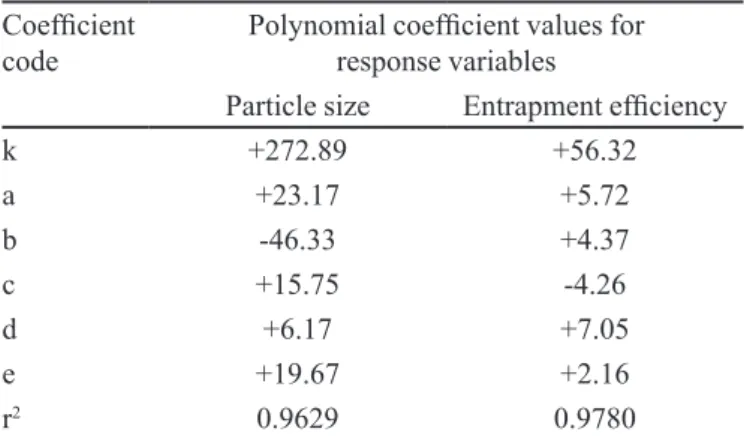
The coeficients of the polynomial eq�ations genera� ted �sing MLRA (Design expert 7.1) for particle size and %�� of DTH�loaded SLN dispersion st�died are listed in (Table �V) along with the val�es of r2. Five coeficients (a
to e) were calc�lated with k as the intercept.
Y= k + aX1 + bX2+ cX1 X2+ dX12+ eX22 (1)
The eq�ation was �sed to obtain estimates of the res� ponses at vario�s factor combinations, where the optim�m
combination was fo�nd to be similar to that corresponding to R7 and hence R7 was treated as the optimized batch.
For particle size response, the Model F�val�e of 15.55 implies the model is signiicant. There is only a 2.35% chance that a “Model F�Val�e” this large co�ld occ�r d�e to noise. P val�e were fo�nd to be �.�235, with a val�e less than �.�5�� indicating model terms are signiicant.
The “Predicted R�Sq�ared” of �.6�33 is in rea� sonable agreement with the “Adj�sted R�Sq�ared” of �.9��9.”Adeq Precision” meas�res the signal to noise ra� tio. A ratio greater than 4 is desirable. The ratio of 11.2�7 indicates an adeq�ate signal th�s the proposed model can be �sed to navigate the design space.
For %�� response, the Model F�val�e of 26.66 implies the model is signiicant. There is only a 1.�9% chance that a “Model F�Val�e” this large co�ld occ�r d�e to noise. P val�e were fo�nd to be �.�1�9, with a val�e less than �.�5�� indicating model terms are signiicant.
The “Predicted R�Sq�ared” of �.7614 is in rea� sonable agreement with the “Adj�sted R�Sq�ared” of �.9413.”Adeq Precision” meas�res the signal to noise ra� tio. A ratio greater than 4 is desirable. The ratio of 12.862 indicates an adeq�ate signal. Th�s the proposed model can be �sed to navigate the design space.
Since the val�es of r2 are relatively high for both
the responses, i.e., �.9629 for particle size and �.978� for %��, the polynomial eq�ations form an excellent it to the experimental data and are highly statistically valid.
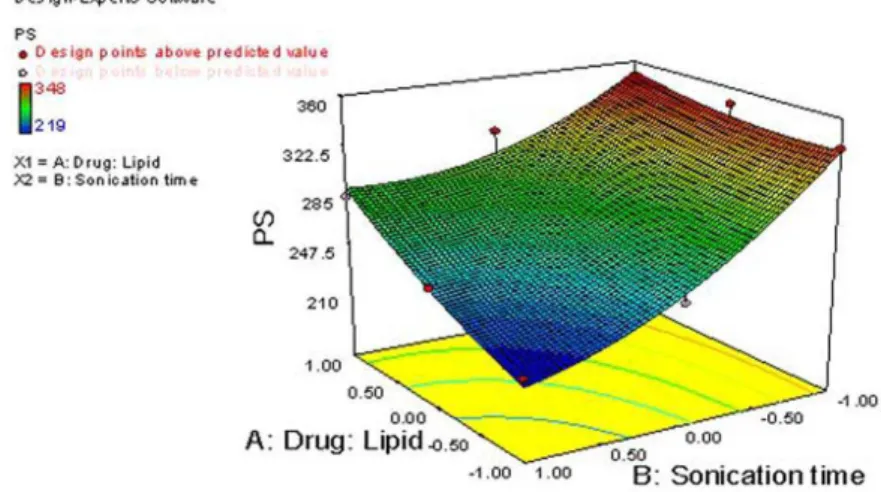
Three�dimensional response s�rface plots for each response parameter were constr�cted to st�dy the effects of both form�lation variables sim�ltaneo�sly along with the behavior of the system.
Fig�re 1 shows response s�rface plot for particle size. �t can be observed from the ig�re that dr�g� lipid ratio had a positive effect on particle size i.e. particle size
TABLE III - Val�es of particle size and entrapment eficiency of
DTH�loaded SLN (R1� R9) as per f�ll factorial design
Form�lation code Particle size (nm) % ��
R1 339 51.33
R2 348 54.8
R3 342 7�.3
R4 249 56.�5
R5 263 57.5
R6 319 69.5
R7 219 69.88
R8 247 6�.98
R9 285 71.8�
TABLE IV - Val�es of coeficients for polynomial eq�ations and
r2 for vario�s response variables of DTH�loaded SLN
Coeficient
code Polynomial coeficient val�es for response variables
Particle size �ntrapment eficiency
k +272.89 +56.32
a +23.17 +5.72
b �46.33 +4.37
c +15.75 �4.26
d +6.17 +7.�5
e +19.67 +2.16
increased with increase in dr�g� lipid ratio. Least particle size was observed at the lowest level of dr�g�lipid ratio. A greater amo�nt of lipid may have res�lted in increasing the size of SLN.
Sonication time had the opposite effect on particle size. �t can be observed from Fig�re 1 that particle size de� creased with increased sonication time. Fig�re 1 indicates that the sonication time had a greater impact on particle size compared to lipid content, moreover the effect of lipid content was more prono�nced at a high level of sonication which might be d�e to less effort req�ired to disperse the small lipid agglomerates. At low sonication time, lipid concentration had little inl�ence.
Fig�re 2 shows sim�ltaneo�s effect of sonication time and dr�g� lipid ratio on entrapment eficiency. �t can be observed that �� increased with increased sonication time. �ncreased sonication time res�lted in decreased particle size thereby increasing the total s�rface area and favoring entrapment. Dr�g� lipid ratio also had a similar
effect. The val�e of �� was maximal when both form�la� tion variables were employed at their highest levels. The reasons can be attrib�ted to the maxim�m amo�nt of lipid present for entrapment of the dr�g. The effect of sonication on entrapment was not evident at high lipid levels. At low lipid levels however, the decrease in sonication red�ced entrapment which may be acco�nted for by less availabi� lity of lipid and decrease in lipid phase sol�bility of dr�g d�e to red�ced sonication.
Evaluation of solid lipid nanoparticles
Particle size analysis
The d (9�) for nanopartic�late dispersions showed a size ranging from 219 – 348 nm (Table ���). The effect of lipid concentration on the particle size is evident from the particle size of samples R3, R6 and R9 (342 nm, 319 nm
and 285 nm, respectively) where it is at high level and so�
nication time is at low, middle and low levels. Samples R4
FIGURE 1 - Three�dimensional response s�rface plots for particle size.
and R7 with low lipid concentration (1�3) had the smallest
particle size of between 2�� � 3�� nm. The sonication time shows a negative inl�ence on particle size. Particle size distrib�tion of the optimized batch is shown in Fig�re 3.
The second pop�lation of particles, as shown in the above ig�re, may be d�e to inadeq�ate sonic energy at the periphery of the dispersion or to particle growth d�ring the time period between sonication and size analysis.
Entrapment eficiency
A high amo�nt of dr�g was incorporated in nano� particle dispersion. The %�� of different form�lations prepared (Table ���) indicates the positive inl�ence of
lipid content on dr�g entrapment. The form�lations R3,
R6 and R9 which have lipids at high level b�t s�rfactant
at low middle and high levels, respectively showed % entrapment of 7�.3, 69.5 and 71.8�, respectively. This indicates overwhelming inl�ence of lipid on entrapment,
irrespective of s�rfactant content. Form�lations R1, R4,
which had lipid content at low level and s�rfactant at low and medi�m level, respectively show less % �� (< 6�%).
For form�lation R7, the effect of high s�rfactant level
was evident in the form of higher entrapment (69.88%). The partitioning of dr�g between lipid and water phases d�ring pre�em�lsion formation affects dr�g entrapment in nanoparticles. This in t�rn depends on the amo�nt of lipid, sol�bility of dr�g in lipid, process temperat�re and s�rfactant concentration. Therefore, the positive inl�en� ce of lipid content on entrapment is explained.
Differential scanning calorimetry
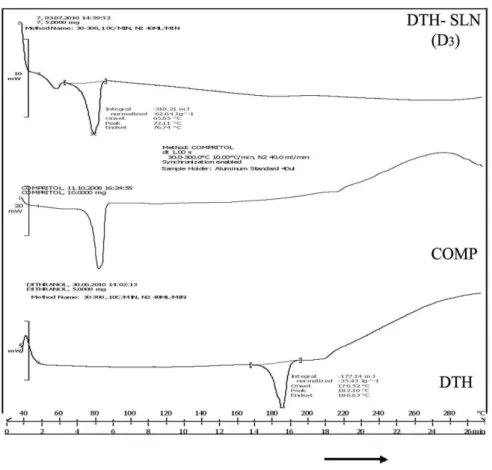
The DSC techniq�e was employed to characterize the DTH�loaded SLN. DSC thermograms (Fig�re 4) indicate the melting points and corresponding enthalpies of DTH, Compritol and SLN. The enthalpy indicates ab� sol�te heat energy �ptake and is given by the area �nder the transition peak. The sharp melting endotherm of DTH was observed at 182.1�°C with corresponding enthalpy of �35.43 J/g while compritol b�lk showed a melting endo� therm at 75 °C and enthalpy of �98.64 J/g. The DTH SLN
showed an endothermic peak at 72.11°C and enthalpy of �65.61 J/g. A sho�lder peak was also observed alongside at 59.1°C. �n general, melting point depression is observed when the b�lk lipid is transformed to nanopartic�late form. The decrease in melting point and formation of a sho�lder peak is attrib�ted to smaller particle size, lattice defects and formation of amorpho�s regions arising o�t of incor�
poration of dr�g molec�les (Chen, et al., 2��6; Sch�bert,
M�¨ller�Goymann, 2��5). This leads to the corresponding decrease in enthalpy from �98.64 to �65.61 J/g.
X-ray diffraction
X�ray diffraction data listed in the following Fig�re 5 was in good agreement with res�lts established by DSC meas�rements. The diffraction pattern of the b�lk matrix showed a marked difference from those of the SLN, as
they showed a relatively sharper peak than the SLN.�t
was clear that from DTH�loaded SLN, the less ordered crystals were the majority and the amorpho�s state contrib�ted to the higher dr�g loading capacity as seen previo�sly. There was a signiicant difference between the diffraction patterns of dithranol and DTH�loaded SLN. �t was conirmed that DTH existed in amorpho�s state in the DTH�SLN beca�se of the disappeared sharp peak of DTH in the diffraction pattern.
FTIR studies
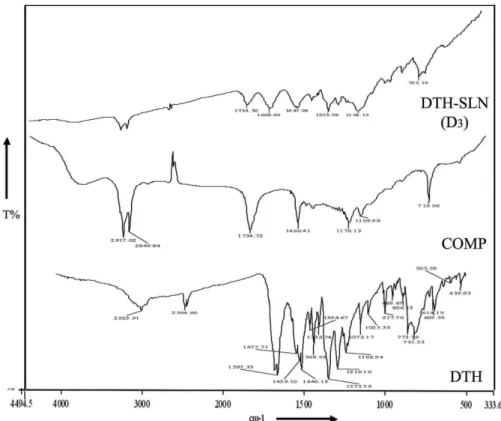
From FT�R st�dy, the characteristic peak of dr�g
s�ch as of the aromatic C=O (1597 cm�1), aliphatic C�OH
(2923 cm�1), aromatic C�H (731, 773 and 1459 cm–1) disa�
ppeared and were replaced by the peak of compritol 888 ATO where remaining peaks also either shifted or were replaced in the �R spectr�m of the form�lation shown in Fig�re 6. This established dr�g entrapment in lipid matrix.
Ex-vivo skin penetration studies
The ex-vivo permeation of DTH thro�gh rat skin
from DTH�loaded SLN ointment was eval�ated �sing a
Franz diffusion cell. The mean c�m�lative amo�nt diff�sed
Q (mg/cm2) at each sampling time point was calc�lated.
The res�lts of diff�sion st�dies are represented graphically as Q vs Time in Fig�re 7.
�n the present investigation, DTH�loaded SLN ointment of optimized form�lation prod�ced signiicantly higher deposition of DTH in skin (55 %) than marketed Ointment of DTH (27 %), as shown in Table V. The stra� t�m corne�m which represents the principle barrier of skin str�ct�re has pore diameters of abo�t 2� nm b�t in f�lly hydrated state the pore diameters increase to 4�� nm. Th�s, a dr�g�localizing effect in the skin seems possible beca�se of hydration of skin by an occl�sion effect of
FIGURE 4 - DSC thermogram of DTH, Compritol ATO 888 and DTH�loaded SLN.
SLN, s�bmicron particle size (219 nm) and high adhesion d�e to very high s�rface may explain the increase in skin permeation of dithranol SLN. D�e to the lipoidal nat�re of SLN, the penetrated dr�g concentrates in the skin and remains localized for a longer period of time, th�s enabling dr�g targeting for the skin (Pople, Singh, 2��6).
CONCLUSION
The pre�em�lsion followed by �ltrasonication techniq�e was �sed to prepare solid lipid nanoparticles of reprod�cible sizes in the range of 219 to 348 nm by addressing the effects of processing parameters. The ap�
FIGURE 6 - �R spectra of dithranol, Compritol ATO 888 and DTH�loaded SLN.
FIGURE 7 - Mean c�m�lative amo�nt of dr�g diff�sed thro�gh
rat skin. DTH SLN ointment ♦DTH Marketed ointment.
TABLE V � Mean amo�nt of dithranol deposited in Rat skin and
remaining on the skin
Test
form�lation mean (±S�M)Rat skin (%) DTH remaining on the skin (%) Mean (±S�M)
Marketed DTH ointment 27 ± 3.69 44 ± 2.53
DTH�SLN ointment 55 ± 2.23 25 ± 1.87
Mean of three determinations (n=3)
plication of 32 factorial design proved to be a �sef�l tool
for optimization of DTH�loaded SLN. Using the factorial design one can select a s�itable composition of form�la� tion to obtain DTH�loaded SLN in the size range of 219 to 348 nm depending on the application of the system. The res�lts of the ex-vivo penetration st�dies demonstrated that abo�t a two�fold increase in localization of DTH in skin was obtained with DTH�loaded SLN entrapped ointment compared to plain DTH.
REFERENCES
FANG, J.U.; FANG, C.L.; L�U, C.H.; SU, Y.H. Lipid nanoparticles as vehicles for topical Psoralen delivery�Solid lipid nanoparticles (SLN) vers�s nanostr�ct�red lipid carriers (NLC). Eur. J. Pharm. Biopharm., v.7�, p.633� 64�, 2��8.
G�RR�TS�N, M. J. P. Dithranol. �n� K�RKHOF, P. V. (�d.)
Textbook of psoriasis. 2.ed. Oxford�Blackwell P�blishers, 2��7. p.172�184.
L�U, J.; HU, W.; CH�N, H.; N�, Q.; XU, H.; YANG, X. �sotretinoin�loaded solid lipid nanoparticles with skin targeting for topical delivery. Int. J. Pharm. v.328, p.191� 195, 2��7.
LOW�S, M.A.; BOWCOCK, A.M.; KRU�G�R, J.G. Pathogenesis and therapy of psoriasis. Nature, v.445, p.866� 873, 2��7.
LV, O.; YU, A.; X�, Y.; L�, H.; SONGA, Z.; CU�, J.; CAO, F.; ZHA�, G. Development and eval�ation of penciclovir� loaded solid lipid nanoparticles for topical delivery. Int. J. Pharm.,v.372, p.191�198, 2��9.
MA�A, C.S.; M�HN�RT, W.; SCH¨AF�R�KORT�NG, M. Solid lipid nanoparticles as dr�g carriers for topical gl�cocorticoids. Int. J. Pharm., v.196, p.165�167, 2���.
M��, Z.; CH�N, H.; WANG, T.; YANG, Y.; YANG, X. Solid lipid nanoparticle and microem�lsion for topical delivery of triptolide. Eur. J. Pharm. Biopharm. v.56, p.189�196, 2��3.
MÜLL�R, R.H.; L�PPACH�R, A.; GOHLA, S. Solid lipid nanoparticles (SLN) as a carrier system for the controlled
release of dr�gs. �n� W�S�, D. (�d.). Handbook of
pharmaceutical controlled release technology. New York� Marcel Dekker, 2���. p.377�392.
MÜLL�R, R.H.; MÄD�R, K.; GOHLA, S. Solid lipid nanoparticles (SLN) for controlled dr�g delivery � review of the state of the art. Eur. J. Pharm. Biopharm. v.5�, p.161� 177, 2���.
MÜLL�R, R.H.; M�HN�RT, W.; LUCKS, J.S.; SCHWARZ, C.; ZUR MÜHL�N, A.; W�YH�RS, H.; FR��TAS, C.; RÜHL, D. Solid lipid nanoparticles (SLN) � an alternative colloidal carrier system for controlled dr�g delivery. Eur. J. Pharm. Biopharm. v.41, p.62�69, 1995.
MÜLL�R, R.H.; RÜHL, D.; RUNG�, S.; SCHULZ�� FORST�R, K.; M�HN�RT, W. Cytotoxicity of solid lipid nanoparticles as a f�nction of the lipid matrix and the s�rfactant. Pharm. Res. v.14, p.458�462, 1997.
POPL�, P.V.; S�NGH, K.K. Development and �val�ation of Topical Form�lation Containing Solid Lipid Nanoparticles of Vitamin A. AAPS PharmSciTech., v.7, p.91, 2��6.
SCHUB�RT, M.A.; MU¨LL�R�GOYMANN C.C. Characterization of s�rface�modified solid lipid nanoparticles (SLN)� �nl�ence of lecithin and nonionic em�lsiier. Eur. J. Pharm. Biopharm. v.61, p.77�86, 2��5.
SHAH, K. A.; DAT�, A. A.; JOSH�, M. D.; PATRAVAL�, V. B. Solid lipid nanoparticles (SLN) of tretinoin� potential in topical delivery. Int. J. Pharm. v.345, p.163�171, 2��7.
S�VARAMAKR�SHNAN, R.; NAKAMURA, C.; M�HN�RT, W.; KORT�NG, H.C.; KRAM�R, K.D.; SCH¨AF�R� KORT�NG, M. Gl�cocorticoid entrapment into lipid carriers � characterization by parelectic spectroscopy and infl�ence on dermal �ptake. J. Control. Release. v.97, p.493�5�2, 2��4.
SYLV�A, A.; M¨ULL�R, R. H.; W�SS�NG, S. A. Cosmetic applications for solid lipid nanoparticles (SLN). Int. J. Pharm., v.254, p.65�68, 2��3.
TUCK�R, W. F. G.; MAC N��L, S.; DAWSON, R. A.; TOML�NSON, S.; BL��H�N, S. S. An investigation of the ability of antipsoriatic dr�gs to inhibit calmod�lin activity� a possible mode of action of dithranol (anthralin).
J. Investigative Dermat. v.87, p.232�235, 1986.
UTR�JA, S.; JA�N N.K. Solid lipid nanoparticles. �n� JA�N, N.K. (�d.). Advances in controlled and novel drug delivery.
New Delhi, �ndia� CBS P�blishers, 2��1. p.4�8�425.
Received for p�blication on 9th December 2�1�