METRIC CONTRIBUTION IN THE ARCHIVAL
SCIENCE ON ARCHIVE ADMINISTRATION:
ARCHIVOMETRICS
Adilson Luiz Pinto (1), Sibele Fausto (2), Ana Paula Alves Soares (3), José Antonio Moreiro González (4)
(1) Federal University of the Santa Catarina, Department of Information Science, Campus Professor João David Ferrei-ra Lima – Trindade, CEP 88.040-900, Florianópolis (SC) – BFerrei-razil, E-mail: [email protected] (2) University of São Paulo, Integrated Library System, Rua da Praça do Relógio, 109, Bloco L - Térreo – Cidade Universitária, CEP 05508-050, São Paulo (SP) – Brazil, E-mail: [email protected] (3) Federal University of the Santa Catarina, Department of
Information Science, E-mail: [email protected] (4) Carlos III of the Madrid University, Faculty of Humanities, Communication and Documentation, Department of Library Science & Documentation, Calle Madrid, 126, Getafe,
28903, Madrid – Spain, E-mail: [email protected]
Abstract
This work covers the fundamentals of Archivometrics, a metric specialty that uses mathematics and statistics to study archives which evaluates the various aspects of the archive environment, such as the management of documents, the administrative management, the study of users, among others, using as methodology the literature review and characterized as an exploratory and descriptive study. It presents the studies that led to Archivometrics and others which underpin its applicability, describing the methods and techniques used,
also demonstrating the importance of this metric for the management of documents and archival resources, as well as contributing to their visibility and the satisfaction of its users. As a result, this work exposes the contribution of these stud-ies in theoretical, practical and methodological terms that shift to the consolidation and development of this metric specialty.
Keywords: Archives – documentation; Documentary analy-sis; Metrics studies; Archivometrics; Archival Administra-tion.
1 Introduction
Since the emergence of Bibliometrics, with its empiri-cal laws introducing the metric studies in the field of Information Science, new informational contexts came to light with new specialty metrics, such as Scientomet-rics, InformetScientomet-rics, WebometScientomet-rics, PatentometScientomet-rics, Alt-metrics and ArchivoAlt-metrics. The last one is defined by Gorbea-Portal (1994) as the application of mathematics and statistics to the analysis of archival records in order to identify the behavior of phenomena concerning the structure and organization of these documents and their funds.
This metric specialty is little discussed in the literature, although commonly applied in the archives. In this environment, the application thereof is observed, for example, on the physical space footage, quantification of the queries and loans, and on user studies. Also, it may be applied to assess the performance of document management activities, resource management, among other possibilities that can be explored with the appli-cation of metrics in the archives. There is undoubtedly
a great employment potential of the Archivometrics in archives.
Although only a few studies have been made, it is pos-sible to see the advantages of the application of Ar-chivometrics. Archivometrics is of paramount im-portance for the document management and archival services. Its application contributes to the optimization of archival activity, resource-saving, user satisfaction and for decision-making, among other activities. It is a tool that the archive manager can and should use to make a diagnosis of the archival resource, to structure and restructure its services and to establish priorities and goals.
the history and fundamentals of the Archivometrics, highlighting its importance and its contributions to Information Science, especially for Archival Science.
2 History of the information and
documentation incorporating metrics studies
With the end of the Second World War, the role of scientists gained a unique place, especially in initial scientific collaborations that were necessary in that scenario. At that time, a study was remarkable for the representation of this fact; the article "As We May Think," by Vannevar Bush (1945), reported the need for faster communication, manipulation of records, the growing volume of research, and new transmission methods. Practically, we would say that these facts were the emergence of what we now call Information Science.After that, with strong support from the scientific community, the Royal Empire Society Scientific Con-ference [1] was held in 1946, which initiated discus-sions about and directions for the information world stage. Prior to that, the whole process was flawed in matters of treatment, storage and use, because of the urgency in the demand for and composition of that context.
After the Royal Society’s event, the world began to question who were the information professionals. That is, who were responsible for the organization, control, and availability of the information. The importance attributed to some areas, such as Economics, Admin-istration and Management, and Mathematics and Engi-neering, was immediate, because of their ease in ob-serving the body of information and its representation. Under a belligerent thought, the world watched the emergence of a new science (Pinto, 2011).
Meanwhile, some sciences (e.g., Librarianship and Documentation) did not have equal relevance to the scientific community, something which was evident by its poor representation at conferences held at the Geor-gia Institute of Technology in October 1961 and April 1962. According to Shera (1968), members who gath-ered at these events were linguists, engineers, mathe-maticians and computer scientists.
This new science, based on information, is
[…] that discipline that investigates the properties and behavior of information, the forces governing the flow of information, and the means of processing information for optimum accessibility and usability. It is concerned with that body of knowledge relating to the origination, collec-tion, organizacollec-tion, storage, retrieval, interpretacollec-tion, transmission, transformation, and utilization of the infor-mation. This includes the investigation of information representations in both natural and artificial systems, the use of codes for efficient message transmission, and the study of information processing devices and techniques,
such as computers and their programming systems. It is an interdisciplinary science derived from and related to such fields as mathematics, logic, linguistics, psychology, computer technology, operations research, the graphic arts, communication, library science, management, and other similar fields. It has both a pure science component, which inquires into the subject without regard to its ap-plication, and an applied science component, which de-velops services and products (Borko, 1968, p. 3).
Based on the concepts described by Borko in defining a field of knowledge, we elucidate three key areas for the consolidation of information science that were denoted as essential only with the passage of time.
The first, Librarianship, was not originally considered part of information science due to the fact that it did not focus on the political economy of information. However, Librarianship gained relevance mainly through control of the record and its recovery and through structuring of the documentary language under the following basic disciplines: classification, catalog-ing, standardization, and the adequacy of information technology (Pinto, 2011, p. 60).
The second, Documentation, is linked to the emergence of the public library, due to the prominence and speci-ficity of its users and the expansion of the bibliography to become more aggregate (Otlet, 1934). Otlet was also responsible for other innovations in that area, such as the Universal Decimal Classification (UDC), the vision of a portable library in microforms—resurrected later by Bush in the project Memex in 1939 (Buckland, 1992, p. 284-285)—and application of Bibliometrics for informational control and documentation. However, in the case of Bibliometrics, Otlet has not had due recognition, because the scientific community adopted the concept of Bibliometrics as presented by Alan Pritchard in 1969 (Pinto, 2011, p. 60).
The third key area is Archival Science, as it applies to archival administration, “which emerged out of diplo-matics in the nineteenth century, (and) is a body of concepts and methods directed toward the study of records in terms of their documentary and functional relationships and the ways in which they are controlled and communicated” (Duranti & MacNeil, 1996, p. 47), and that are concerned with policies pertaining to doc-ument conservation and preservation.
In this sense, it is important to mention areas that are focused on visions of informational contexts (Cogni-tive Science, Commerce, Communication, Law, Librar-ianship, Archives, Museums, Government, Mathemat-ics, Philosophy, Public Policy, and Social Sciences) and on the documental scope (Documentation, Ar-chives, and Museum Studies).
adopted the Documentation with the same representa-tion, such as France, Spain, and Portugal (Ortega, 2009, p. 4), and likewise Informatics has been adopted by the Russians (Mikhailov, Chernyl, & Gilyarevskii, 1966).
Regardless of the structure underpinning Information Science, the following unique aspects were essential to its development: (i) the environment related to the processes of language and thematic representation (indexing and controlled vocabulary) and (ii) the pro-cess communication of scientific activity, with the later being responsible for the peculiarity of the dispersion, exponential growth, and obsolescence of this science, justifying the information metrics studies as one of the landmarks of substantiation of this new science.
In this discussion, it is relevant to mention how the world observes metrics studies and how the terminolo-gies that represent the areas and types of materials and information are assigned. Metrics studies are activities performed by subfields that represent areas within the various types of information and documentation, bas-ing themselves on Information Science and Documen-tation (Sengupta, 1992) derived of metrics from the bibliography, science, information unit (library and archives), information, cyberspace, and web.
In the worldwide conception, the subfields include Bibliometrics, Scientometrics, and Informetrics. These subfields were contextualized by McGrath (1989), who addressed the object of study of these metrics, how to work them through the statistics and mathematics, and on application methods to differentiate one study type from another, and the goal of their applicability.
Other studies have addressed the issue of metrics (Almind & Ingwersen, 1997; Nacke, 1979; Nalimov & Mul'chenko 1969; White & McCain, 1989), with the foundations already mentioned previously and new trends that were broken from the four main initial sub-fields, as Patentometrics (Guzman, 1999) and areas that do not have any relationship to those mentioned, such as Archivometrics (Gorbea-Portal, 1994; Pinto, 2011).
Related to the study of Archivometrics, we justify its existence and applicability in the coming sections.
3 Theoretical foundations of the subfield
Archivometrics
Archivometrics is "the application of methods and mathematical and statistical models in the behavior of the documents or manuscripts from archives, with the interest of identifying historical phenomena associated with the structure and organization of this type of fond and documents" (Gorbea-Portal, 2005, p. 94, our trans-lation).
This concept was established by Gorbea-Portal in 1994 in the article entitled "Principios teóricos y metodo-lógicos de los estudios métricos de la información”, published in the journal Investigación Bibliotecológica. In 2005, the same author back to discuss the subject in the book "Modelo teórico para el estudio métrico de la información documental" in which the author sets out the theoretical and methodological basis of morpho-metric studies in information and documentation, in-cluding a proposed theoretical model for the Archivo-metrics.
After almost 20 years the issue back to be addressed in the article entitled "Arquivometria" in which Pinto (2011) discusses the application of the metrics possibil-ities in the archives, and bringing a complement to the first definition of these metrics as "Archivometrics is any quantitative activity of the archives based on its simple or more complex applicability " (Pinto, 2011, p. 64).
The object of study is the documentary fond (Pinto, 2011) and its users (Duff et al, 2008; Yakel, 2010), related to the variables of the archive structure (Yakel & Tibbo, 2010) and circulation consultations (Davis, 2011), approaching methods and frequency distribution (Yakel & Tibbo, 2009), aiming to address the length of the shelves and file documents, as well as the cultural activity, personal and of the research itself (Yankel, 2011).
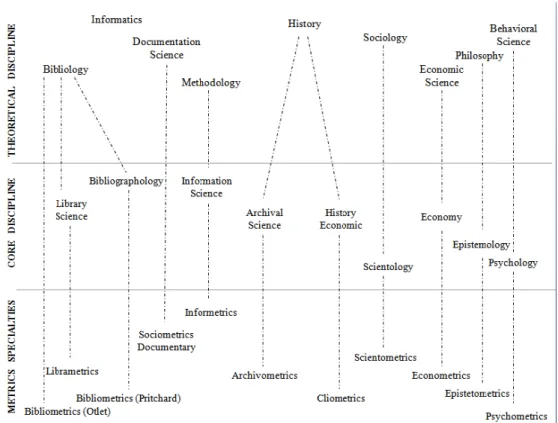
Figure 1: Mathematization of social knowledge on metrics studies
Source: Elias, Soares & Pinto (2015, p. 237), based in Gorbea-Portal (2005, p. 127) and adapted to this study
As can be noticed, Archivometrics scholarly disciplines and theory are focused on history, with Archivology as the core discipline and Archivometrics as the evalua-tion method (Gorbea-Portal, 2005, p. 127). This is unlike other metrics studies, which are based on com-puting, document theory, and book theory (Bibliomet-rics of Otlet, 1934), with such core disciplines as Librametrics (Ranganathan, 1969) and Bibliography (e.g. Bibliometrics of Pritchard, 1969).
On the other hand, some disciplines are derived from the Sociology of Science, which is based on metrics from Scientometrics, and others such as Information Science and its research methodology underpinning metrics from Informetrics (Pinto, 2011). Figure 2 shows a view of the relationship between these metrics studies.
The conception of Archivometrics is interesting, being mentioned as mere nomenclature by Gorbea-Portal (1994) with little applicability. For this reason, we intend to adapt techniques from other metrics studies to this subfield (Pinto, 2011).
Archivometrics works with indexes of action and man-agement, archive system manman-agement, recovery functions and access, document visibility, distribution pub-lic/private fonds where information contained therein seeks to facilitate conduct of activities and transparency requirements from the agency or entity. In this sense, the approach from theory to practice is based on exploring the size of the documentary piece, the circulation of pub-lic/private archive fonds and documental pieces, satisfac-tion demands for documental fonds or pieces, and overall efficiency of the documentary collection, treats about searches, organic quality, uniqueness, reliability, authen-ticity, accessibility, and probability of getting a document or documentary fond, document circulation assessment and search for document in online archives (visibility and impact) (Pinto, 2011, p. 64).
The author points out a range of possible explorations of the archives with the application of metrics, as sus-ceptible phenomena to be measured, evaluated. From these considerations the archive manager, or archivist, already has grants to apply Archivometrics on the ar-chives, even being them public or private ones.
4 Statistics of Documental Processes or
Archivometrics?
When we imagine an institution's archive, we see the image of bookcases, bookshelves, and file boxes that are sorted in a system defined by professionals working in this environment according to its temporality tables. However, if we look deeper, we identify that there is also a document management underpinning the ar-chive’s activities, which can be described as current, intermediate, permanent, and historical (Carbone & Gueze, 1971; Duboscq & Mabbs, 1974; Duchein, 1966).
According to Pinto, Elias & Vianna (2014, p. 140) different aspects of the archives can and should be measured. So, it is pertinent to ask (i) "archive only makes applications about quantification of docu-ments?"; or (ii) "archive develops statistics on the be-havior of documents or manuscripts, identifying histical phenomena associated with the structure and or-ganization of its fonds and documents? "
The authors comment that if the answer is the second, activities involving document management and its technical operations such as classification, arrange-ment, evaluation, conservation, digitization, among others, should be considered not just as statistics, but a new field of metric studies.
This question was also raised by Bibliometrics, when asked if it was applying statistics to the bibliography or
was incorporating bibliographic elements not related to the information units. So at that time Ranganathan suggested the term Librametrics to define the applica-tion of statistics, but this proposal had not many fans, perhaps due Bibliometrics be directed to the biblio-graphic production, which helps it to be studied by different areas of knowledge, not only by the manage-ment of libraries (Pinto, Elias & Vianna, 2014).
With respect to archives, it interests a way to mediate and to evaluate the different phenomena that occur in that environment. However, in view of its special fea-tures in the form of production, accumulation and man-agement of information, it becomes a challenge to adapt the methods of other metric studies and to devel-op a method capable of bringing to the analysis the peculiarities of the archives. In this context, Pinto, Elias and Vianna (2014) suggest an adaptation of the Ranganathan’s five laws on the archives:
(i) The documents are to be used, even if the archive is one document collection whose focus is to evaluate the collection, circulation, and its use in general. (ii) Each document has its user, which assesses the availability. (iii) Each document has its reader/researcher, which are different from ordinary users and whose focus is to eval-uate the dynamic role of the archive through their distri-bution services and reference, claiming, in some cases, the existence of such an information unit. (iv) Regarding the assessment of accessibility and response time, with a view to the generation process of this resource in an elec-tronic format, users and researchers’ time will be maxim-ized. (v) The archive is a living organism, such as an adaption proposal and change related to its users (Pinto, Elias & Vianna, 2014, p. 145).
These five points are justified by the fact that there are various types of public and private archives, linked to the actual need of the human in having the right to access public information.
The circulation of printed, photographic, audiovisual, phonographic, and tridimensional documents tends to grow and be contextualized in other supports, such as scanning/electronic. This is a vital process for informa-tional agility because the files are organisms that do not stop growing, independent of their nature.
This universe can and should be measured daily, week-ly, monthweek-ly, and annualweek-ly, targeting three basic purpos-es: (i) for space allocation of fonds and documentary material, (ii) for the demands distribution, and (iii) for the financial dynamics. Therefore, our vision has an existential point that alerts us to the question about if what is done in these archives’ processes is simply statistics applied to documentation or what we call Archivometrics?
identifying historical phenomena associated with the structure and organization of these fonds and docu-ments.
If the answer is directed to the second point, we can say that (i) the procedures (transfer, discard, and tech-nology used), (ii) the technical operations (sorting, cleaning, packaging, identification, digitalizing, and indexing), (iii) the permanent/historical documentary arrangements (arranged documents), (iv) the physical space (custody phases in linear feet and space servers), and (v) the time and informational accessibility are not simply only statistics, but again, they are what we call a new subfield of metrics studies.
The initial conception of bibliometrics also stems from a question, namely, whether that was done at that time was specifically statistics applied to the information units, or if could it incorporate more bibliographic elements not linked to information units, as we ques-tioned before. In dealing with this question, Ranga-nathan (1969) proposed the term Librametrics specifi-cally for the statistical activities in libraries but did not have many area followers. Perhaps the core scope of Bibliometrics, which is the study of statistics and mathematics from the bibliographic production, brings more concerns that not only relate to libraries, but also to the scientific literature as a whole. Thus, Bibliomet-rics ends up being studied by scientific areas in general and not necessarily solely for the management and activities of information units.
The reflection of this multidisciplinary approach can be seen by some people who developed Bibliometrics in the world, such as Lotka (Mathematician, Physic-Chemist), Zipf (Linguist), Price (Historian, Physic), Garfield (Lawyer), Leydesdorff (Sociologist), among others who used Bibliometrics techniques to analyze their scientific universes.
In contrast, in the archives unit we cannot apply Bibli-ometrics except in something more focused on their needs; therefore, we cannot resort of more diversified studies. In addition, we cannot simply apply Informet-rics, because the information in an archive is predomi-nantly focused only on the personal or private scope. Public institutions view this environment from a docu-mentary perspective. Thus, it is critical to have a study targeted to the archives (Pinto, Elias & Vianna, 2014).
4 Archivometrics in practice
For a better understanding of the applicability of met-rics in the archive, we address to the example of three practical studies with their approaches, methods and techniques used, summarizing their contributions which have different perspectives on the archives, demonstrating the application of Archivometrics in
various contexts, for example, specialized archives, as an Architecture and Engineering file.
Initially, is presented the study by Pinto (2011), in which the author besides bringing a complement in the definition of the Archivometrics, as previously men-tioned, also contributes to the development of the ric adaptation with the suggestion to add of other met-ric studies, including the following:
•Clapp-Jordan's model (1965) [2] adapted to the archives, with predominance of the number of historian or docu-mentalist (F), the number of undergraduates archived as users (E), the number of non-undergraduates (H), the number of the main materials for undergraduates (U), specialties that are offered to graduate students (Masters) (M), specialties that are offered to graduate students (Ph.D.) (D), and the volume of documents recommended by archive or by historians/documentalists as reliable sources to understand the documentary fond or important archive collections (V), what is represented as V = X + nF + nE + nU + nM + nD, where the number X is a con-stant, which represents a minimum volume feasible of document units for an archive collection. This model considers the optimization size to a collection in the ar-chive.
•For documentary circulation of collections and fonds, Clapp & Jordan describes the coefficient of the total number of documents consulted (Ta) with the total num-ber of documents in the collection, represented by (Tc): Qc = Ta ÷ Tc.
•The circulation model proposed by Clapp & Jordan based on document, which is represented by the number of times a document was consulted within an archive (Cv) and the time this document/documentary fond has been in the archive (t) since its incorporation, which is represent-ed by the following: Qd = Cv ÷ t.
•Satisfaction demand of historians and users in general can also be envisioned, incorporating the number of consulta-tions per year, answered or not (Cp), with the amount of requests per year (Cs), which is represented by the fol-lowing: Qm = Cp ÷ Cs.
•Comparison relations such as the Trueswell’s 80/20 rule (1969) [3], which is very challenged in Bibliometrics, can also be incorporated in Archivometrics to determine the relationship between queries and fond document or col-lection. This determines whether 80% of the queries in-volve 20% of any documentary fond or collection. How-ever, the position can also be applied to the relationship between historians and requests, providing information about whether 20% of historians hold 80% of the re-quests. Within the correlation coefficient, we have the composition of the document fond or collection, where we have, on the one hand, the circulation coefficient for a given collection (Qc) and, on other hand, the time of doc-ument entry acquired in your first query (dp), which is represented by Ec = Qc ÷ dp.
col-lection Pr(O) is multiplied by the probability of online availability of this document, given by Pr(B): Pr(A) = Pr(O) × Pr(B) (Pinto, 2011).
The second example is the study of Tovar-Alvarado, Pinto and Bahia (2012),with aproposal based on doc-ument management and basic tools of a metrics study
in archives. This study relies on simple visions but is effective in quantitative process management and ar-chival activities.
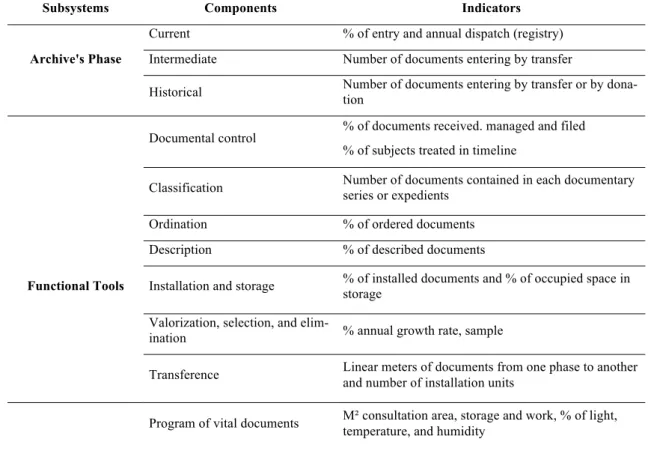
As an example, Table 1 shows specific considerations for addressing document management through metrics.
Subsystems Components Indicators
Current % of entry and annual dispatch (registry)
Archive's Phase Intermediate Number of documents entering by transfer
Historical Number of documents entering by transfer or by dona-tion
Documental control % of documents received. managed and filed % of subjects treated in timeline
Classification Number of documents contained in each documentary series or expedients
Ordination % of ordered documents
Description % of described documents
Functional Tools Installation and storage % of installed documents and % of occupied space in storage
Valorization, selection, and
elim-ination % annual growth rate, sample
Transference Linear meters of documents from one phase to another and number of installation units
Program of vital documents
M² consultation area, storage and work, % of light, temperature, and humidity
Table 1: Approach to the application of Archivometrics in document management (Tovar-Alvarado, Pinto & Bahia, 2012, p. 5-6)
Therefore, the authors present some possible applica-tions of metrics on archives with a proposal to use these indicators for the proper management of docu-ments. This also implies:
(i) to provide a quality archive service; (ii) to promote and enhance the image of the archive and its profession-als; (iii) to assist in the definition of archives and infor-mation services systems; (iv) to assist in accountability, administrative transparency and safeguard institutional memory, and (v) evaluate the archive services effective-ness and efficiency (Tovar-Alvarado, Pinto & Bahia, 2012, p. 2)
Finally, as a third example of the application of metrics to the archives we have the work by Fernandes et al (2013), related to both space in linear feet and the cost required to better manage the space in a map environ-ment. In this study, it is used a tubes shelf for full stor-age of plants, rather than a map collection. The map collection stores 250 plants, whereas a tubes shelf
holds 688 plants in the same physical space. A slightly larger space can store up to 9135 plants.
In this case, we can make a comparison to the calcula-tion of linear feet of the plant colleccalcula-tion in a line of reasoning that considers a shelf of 144 tubes or 16 × 9
as a reference, in four stages:
•The maximum ideal length of each tube was verified, given that the optimal number of plants per PVC pipe is 15 and taking into account the average size of 0.65 × 0.85
m (height × width) for each plant. The number of plants per linear meter of tubes, according to these parameters, is obtained by multiplying the number of Plants per Tube (PPT) and the Average Width of Plants (AWP) as fol-lows: PPT × AWP = MPT (Meters per Tube). Therefore, 15 × 0.85 = 12.75 linear meters of plants per tube.
•The Linear Meterage Occupied of the collections (LMO) was verified, which has five shelves with capacity for 688 tubes, of which only 609 were actually occupied. To ob-tain the LMO, we simply multiplied the number of Occu-pied Tubes (OT) by linear MPT, i.e., OT × MPT = LMO, or 609 × 12.75 = 7764.75 m of plants. Note that the same
calculation can be used to check the amount of Linear Meters Available (LMA) for storage of the collections plants, simply replacing the value of OT by Number of Empty Tubes (NET), i.e., NET × MPT = LMA. In con-clusion, it would be 79 × 12.75 = 1007.25 linear meters
of plants.
•The Total Storage Capacity (TSC) was verified, where the linear MPT was multiplied by Total Tubes of the col-lections (TT); thus, MPT × TT = TSC, or 12.75 × 688 =
8772 linear meters of plants.
We also analyzed the costs. A map collection had a mean value between US$800 and US$1300 with a capacity to store 250 plants. The cost of the shelf tubes was US$1180, whose storage capacity was 2160 plants in the same physical space (counting the purchase of tubes, timber shelves, and caps for the PVC pipes) (Fernandes et al, 2013).
Regarding the studies presented and their results, it is possible an analogy of their standpoints for different types of archives such as historical, of hospital, of university, among others, where it is clear that the methods and techniques presented here, generally may also be applied to other archive types, even requiring adaptation. Based on this assumption the exploration of possibilities with Archivometrics are not limited, con-sidering that much can be developed in theoretical an practical terms.
4 Final Remarks
In this work can be seen the foundations of Archivo-metrics, since the emergence of the term and its defini-tion, marking the beginning of the discussion about this subject in academia, to the subsequent development of other studies with their approaches, methods and tech-niques for the development and application of metrics in the archives.
In this context, we highlight the pioneering work of Gorbea-Portal (1994 and 2005) and Pinto (2011) for the conceptualization of this metric, defining its object of study and suggestions for its applicability, contrib-uting to its foundation, that is, its theoretical and meth-odological development.
In addition, should be emphasized the studies of Tovar-Alvarado, Pinto & Bahia (2012), Fernandes et al (2013), Pinto, Elias & Vianna (2014), Yakel (2010, 2011) e Yankel & Tibbo (2009, 2010). These studies contributed suggesting and introducing methods and techniques for the implementation of the Archivomet-rics and also pointing out the importance of its applica-tion on document management, management of
ar-chives resources, support decision-making and for user studies.
From the studies analyzed, one can verify the congru-ence of the proposals and the applicability of metrics in the archives, in order to understand how this new met-ric emerged and has developed to such metmet-rics special-ty.
For all these reasons, it is considered that this study contributes to the understanding and application of the Archivometrics. This becomes useful, therefore, for Information Science, but mainly for Archivology, where it helps archive managers in document manage-ment and services, supporting their decision-making, which is essential for proper management this infor-mation environment. In addition, it is expected that the study here presented may give rise to reflections and discussions between researchers and Archival Science professionals, so as to contribute to the development of future work, thereby promoting the advancement of research on the subject.
Notes
[1] The Royal Society Empire Scientific Conference, held by Royal Society on June–July 1946, in London, England. http://www.nature.com/nature/journal/v160/n4058/abs/16 0185c0.html.
[2] “Clapp-Jordan Model”, a mathematical model used in Librametrics studies to verify systems and information services regularities provided by the information unit. Verner W. Clapp and Robert T. Jordan (1965) claimed that the sufficiency of an academic library collection can be measured by the number of information units which it contains. They proposed a formula that can be used to as-sess the adequacy of academic collections. In this work we presents an adaptation of this model to the archive collection.
[3] "80/20 rule", principle devised by Richard W. Trueswell (1969), meaning that twenty percent of the information units that are moved out of an inventory (i.e. the set of it-ens available for circulation to library users) in circula-tion transaccircula-tions contain eighty percent of the infor-mation units in the inventory, in an approximated basis.
References
Almind, T. C.; Ingwersen, P. (1997). Informetric analyses on the world wide web: methodological approaches to “Webometrics”. // Journal of Documentation, 53:4 (1997) 404-426.
Björneborn, L; Ingwersen, P. (2004). Toward a basic framework for webometrics. // Journal of the American Society for Information Science and Technology, 55:14 (2004) 1216-1227.
Borko, H. (1968). Information Science: what is it?. // American Documentation, 19:1 (1968) 3-5.
Buckland, M. K. (1992). Emanuel Goldberg, electronic document retrieval, and Vannevar Bush´s Memex. // Journal of the Ameri-can Society for Information Science, 43:4 (1992) 284-294. Bush, V. (1945). As we may think. // Atlantic Monthly, 176:1 (1945)
Carbone, S.; Gueze, R. (1971). Projet de loi d´archives type: présen-tation et texte. Paris: Unesco, 1971. 243 p.
Clapp, V. W.; Jordan, R.T. (1965). Quantitative criteria for adequacy of academic Iibrary collections. // College and Research Librar-ies 26:5 (sept. 1965) 371-380.
Davis, D. (2011). Assessing Special Collections: Techniques and Benefits. 52nd Annual Rare Books and Manuscripts Section Preconference, Baton Rouge, LA, Jun. 21-24, 2011.
Duboscq, G.; Mabbs, A. W. (1974). Organisation du Préarchivage. Paris : Unesco, 1974. 78 p.
Duchein, M. (1966). Les bátiments et équipements d´archives. Paris: Conseil International des Archives, 1966. 312 p.
Duff, W. M.; Dryden, J.; Limikilde, C.; Cherry, J.; Bogomazova, E. (2008). Archivists Views of User-based Evaluation: Benefits, Barriers and Requirements. // American Archivist, 71:1 (2008) 144-166.
Duranti, L.; MacNeil, H. (1996). The Protection of the Integrity of Electronic Records: An Overview of the UBC-MAS Research Project. // Archivaria, 42 (1996) 46–67.
Elias, E.; Soares, A.; Pinto (2015). A.Aplicação da arquivometria no Arquivo Central da universidade Federal de Santa Catarina. // Ágora, 25:51 (2015) 234-254.
Fernandes, K.; Sousa, D. S. C.; Pinto, M. T.; Pinto, A. L. (2013). Estudo arquivométrico do acervo de plantas do DAL/DPAE, da Universidade Federal de Santa Catarina. Ágora, 23:46 (2013) 144-159.
Gorbea-Portal, S. (2005). Modelo teórico para el estudio métrico de la información documental. Madrid: Ediciones TREA, 2005. 176 p.
Gorbea-Portal, S. (1994). Principios teóricos y metodológicos de los estudios métricos de la información. // Investigación Biblioteco-lógica, 8:17 (1994).
Guzman, M. (1999). Patentometría: herramienta para el análisis de oportunidades tecnológicas. Universidad de la Habana: La Ha-bana, 1999.
McGrath, W. (1989). What bibliometricians, scientometricians and informetricians study; a typology for definition and classifica-tion; topics for discussion. 2nd International Conference on
Bib-liometrics, Scientometrics and Informetrics, Ontario, 1989. On-tario: The University of Western Ontario, 1989.
Mikhailov, A. I.; Chernyl, A. I.; Gilyarevskii, R. S. (1966). Informa-tika: novoe nazvanie teorii naučnoj informacii. // Naučno teh-ničeskaja informacija, 12 (1966) 35-39.
Nacke, O. (1979). Informetrie: ein neuer Name für eine neue Disziplin. // Nachrichten für Dokumentation, 30:6 (1979) 219-226.
Nalimov, V. V.; Mul’chenko, Z. M. (1969). Naukometriya: Izuche-nie Nauki kak Informatsionnogo Protsessa. Moscow: Nauka, 1969.
Ortega, C. D. (2009). Documentation as one of the origins of the Information Science and a fertile basis for its grounding. // Bra-zilian Journal of Information Science, 3:1 (2009) 33-34.
Otlet, P. (1934). Traité de Documentation: le livre sur Le livre: théorie et pratique. Bruxelles: Editiones Mundaneum – Palais Mondial, 1934.
Pinto, A. L. (2011). Arquivometria. // Ágora, 21:42 (2011) 59-69. Pritchard, A. (1969). Statistical Bibliography or Bibliometrics?. //
Journal of Documentation, 25:4 (1969) 348-349.
Ranganathan, S. R. (1969). Librametry and its scope. 7th DRTC
Seminar, paper DA. Bangalore: DRTC, 1969.
Sengupta, I. N. (1992). Bibliometrics, Informetrics, Scientometrics and Librametrics. // Libri, 42:2 (1992) 75-98.
Shera, J. H. (1968). Of librarianship, documentation and information Science. // Bulletin for Libraries, 22:2 (1968) 58-65
.
Tague-Sutcliffe, J. (1992). An introduction to informetrics. // Infor-mation Prossessing & Management, 28:1(1992) 1-3.
Tovar-Alvarado, A. V.; Pinto, A. L.; Bahia, M. E. S. (2012). Arqui-vometria: conceito e aplicações. 3º Encontro Brasileiro de Bibli-ometria e CientBibli-ometria, Gramado, RS, Ago. 27-29, 2012. Trueswell, R. L. (1969). Some behavioral patterns of library users:
the 80/20 rule. // Wilson Library Bulletin, 43:5(1969) 458–461. White, H. D.; McCain, K. W. (1989). Bibliometrics. // Annual
Re-view of Information Science and Technology 24 (1989) 119-186.
Yakel, E. (2010) Archival User Studies. Midwest Archives Confer-ence Fall Symposium, Dayton, OH, Oct.21-23, 2010.
Yakel, E. (2011) The Economic Impact of Archives: Moving beyond - a Survey of the Government Archives Users in Canada and the United States. Lexington: Best Practices Exchange, 2011. Yakel, E.; Tibbo, H. (2010) Standardized survey tools for
assess-ment in archives and special collections. Perf Meas Met 11:2 (2010) 211-222.
Yakel, E.; Tibbo, H. (2009) Flight Check Archival metrics Toolkits as User based Evaluations in Archives and Special Collections. Midwest Archives Conference, St Louis, MO, April 30 - May 2, 2009.
Copyright: © 2017. Pinto, et.al. This is an open-access article distributed under the terms of the Creative Commons CC Attribution-ShareAlike (CC BY-SA), which permits use, distribution, and reproduction in any medium, under the identical terms, and provided the original author and source are credited.