UNIVERSIDADE FEDERAL DE MINAS GERAIS
FREDERICO AMORIM CAVALCANTE
The topic unit in spontaneous American English a corpus-based study
FREDERICO AMORIM CAVALCANTE
The topic unit in spontaneous American English:
a corpus-based study
Dissertação apresentada ao Programa de Pós-Graduação em Estudos Linguísticos da Faculdade de Letras da Universidade Federal de Minas Gerais, como requisito parcial para a obtenção do título de Mestre em Linguística Teórica e Descritiva.
Área de Concentração: Linguística Teórica e Descritiva Linha de Pesquisa: Estudos Linguísticos Baseados em Corpora
Orientador: Prof. Dr. Tommaso Raso
Belo Horizonte Faculdade de Letras da UFMG
Ficha catalográfica elaborada pelos Bibliotecários da Biblioteca FALE/UFMG
Cavalcante, Frederico Amorim.
C376t The topic unit in spontaneos American English [manuscrito] : a corpus-based study / Frederico Amorim Cavalcante. – 2015.
183 f., enc. : il.,grafs, tabs. Orientador: Tommaso Raso.
Área de concentração: Linguística Teórica e Descritiva. Linha de Pesquisa: Estudos Linguísticos Baseados em Córpora. Inclui CD com 4 pastas contendo o total 158 arquivos de áudio em formato WAV.
Dissertação (mestrado) – Universidade Federal de Minas Gerais, Faculdade de Letras.
Bibliografia: f. 176 -183.
1. Linguística de corpus – Teses. 2. Atos de fala (Linguística) – Teses. 3. Língua inglesa – Análise prosódica (Linguística) – Teses. 4. Língua inglesa – Estudo e ensino – Teses. 5. Língua inglesa – Inglês falado – Brasil – Teses. I. Raso, Tommaso. II. Universidade Federal de Minas Gerais. Faculdade de Letras. III. Título.
Acknowledgements Prof. Tommaso Raso.
Prof. Heliana Mello.
Colleagues from the LEEL lab.
CAPES.
Polly, Lamita, Adriana, Giulia.
Luciana.
Dad.
Mom and sister.
Abstract
This thesis is dedicated to the analysis of the topic information unit in spontaneous American English speech as the unit is defined within the Language into Act Theory. In order for the study to be possible, a sample of the Santa Barbara Corpus of Spoken American English was
extracted. The sampling strategy adopted and the methodological steps followed in this phase were carefully chosen seeking to create an American English (AE) minicorpus with the same overall structure of the minicorpora of the C-ORAL projects for Italian and Brazilian Portuguese. Accordingly, the sample taken from the Santa Barbara Corpus was submitted to prosodic segmentation into tone units and utterances and to text-to-speech alignment at the utterance level. Following the alignment phase, the AE minicorpus received informational annotation based on the so-called Informational Patterning Hypothesis, which establishes a correspondence between the units of the prosodic pattern and those of the information pattern. The topic information unit — like all the units of the information pattern — is defined with respect to prosodic, distributional and functional criteria. Regarding the functional aspect, the topic is defined as the unit which supplies the domain of identification according to which the illocutionary force — carried by the comment — must be interpreted. After the phase of informational tagging, which involved the identification of all information units in the AE minicorpus, the analyses were carried. Both the transcription and the acoustic signal of utterances containing topic units were set apart for detailed examination. The transcriptions were saved in spreadsheets and the sound files organized into separate folders. The spreadsheets were used for the analysis of morphosyntactic features and semantic properties of the topics found, as well as for the counts provided in this thesis; the sound files were used for the prosodic analysis. In the prosodic analysis, the nuclear portion of the topics were identified, and their relevant acoustic parameters were assessed. The topic units were then classified with respect to the prosodic form through which they were realized. In this study, certain prosodic features that had never been found in topic units in other languages were found, which comprises one of the contributions of this thesis to a better understanding of the prosodic codification of the topic unit. Furthermore, the outcomes of this study yielded the proposition of a new account for the possible prosodic realizations of the topic unit. Finally, the AE minicorpus is offered as a contribution to researchers within the Language into Act Theory as well as for the general field of spontaneous speech studies.
Resumo
Esta dissertação dedica-se à análise da unidade informacional de tópico assim como ela é definida pela Teoria da Língua em Ato. Para que este estudo pudesse ser realizado, foi obtida uma amostra do Santa Barbara Corpus of Spoken American English. A estratégia de amostragem adotada e os passos metodológicos seguidos nessa fase foram criteriosamente escolhidos a fim de se criar um minicorpus do inglês americano com a mesma arquitetura geral dos minicorpora dos projetos C-ORAL para o Italiano e o Português Brasileiro. Com essa finalidade, a amostra obtida do Santa Barbara Corpus foi submetida à segmentação prosódica em unidades tonais e enunciados e ao alinhamento texto-som ao nível de enunciados. Após a fase de alinhamento, o assim chamado AE minicorpus recebeu anotação informacional com base na Informational Patterning Hypothesis, a qual estabelece uma correspondência entre as unidades do padrão prosódico e aquelas do padrão informacional. A unidade de tópico — assim como as demais unidades do padrão informacional — é definida em termos prosódicos, distribucionais e funcionais. Funcionalmente, o tópico é definido como a unidade que fornece o âmbito de aplicação da força ilocucionária, que, por sua vez, é veiculada pela comentário. Após a fase de etiquetagem informacional, a qual envolveu a identificação e anotação de todas as unidades informacionais no AE minicorpus, as análises foram conduzidas. Tanto a transcrição quanto o sinal acústico dos enunciados contendo tópicos foram separados para uma análise detalhada. As transcrições foram salvas em planilhas eletrônicas e os áudios dos enunciados foram dispostos em pastas separadas. As planilhas eletrônicas foram usadas para a análise das características morfossintáticas e das propriedades semânticas dos tópicos encontrados, bem como para a a geração das contagens apresentadas neste trabalho, ao passo que os áudios foram usados para a análise prosódica. Na análise prosódica, as porções nucleares dos tópicos foram identificadas e os parâmetros acústicos relevantes para a unidade foram avaliados. As unidades de tópico foram então classificadas quanto ao tipo de forma prosódica em que eram realizadas. Neste estudo, certos parâmetros prosódicos da unidade de tópico foram pela primeira revelados, os quais não haviam sido detectados nas outras línguas em que a unidade já havia sido estudada. Isso constitui uma novidade alcançada por meio do estudo. Além disso, os resultados aqui alcançados permitiram que se propusesse uma nova visão com relação às possíveis realizações prosódicas do tópico. Finalmente, o AE minicorpus é oferecido como uma contribuição aos pesquisadores trabalhando no âmbito da Teoria da Língua em Ato bem como ao campo dos estudos da fala espontânea em geral.
List of Illustrations
Figure 1: Oscillogram and f0 tracks of utterances apubmn01[91-92] 22 Figure 2: Oscillogram and f0 tracks of utterance afamdl02[99] 23 Figure 3: Oscillogram and f0 tracks of utterances afamdl03[7-8] 23 Figure 4: Oscillogram and f0 tracks of utterances afamdl02[183-185] 29 Figure 5: Oscillogram and f0 tracks of utterance afammn02[115] 31 Figure 6: Oscillogram and f0 tracks of utterance afammn01[5] 32 Figure 7: Oscillogram and f0 tracks of utterance afamdl02[53] 33 Figure 8: Oscillogram and f0 tracks of utterance afammn01[3] 33 Figure 9: Oscillogram and f0 tracks of utterance afamcv01[17] 34
Figure 10: Oscillogram and f0 tracks of afammn04[147] 35
Figure 11: Oscilaram and f0 tracks of afammn01[114] 39
Figure 12: Oscillogram and f0 tracks of afammn03[140] 40
Figure 13: Oscillogram and f0 tracks of the stanza afammn01[17] 41 Figure 14: Oscillogram and f0 tracks of type 1 topic unit (ifamdl14[40]) 47 Figure 15: Oscillogram and f0 tracks of type 2 topic unit (ifamcv01[370]) 48 Figure 16: Oscillogram and f0 tracks of type 3 topic unit (ifamdl16[220]) 49 Figure 17: Oscilaram and f0 tracks of type 4 topic unit (bfammn05[1]) 50 Figure 18: Schematic representation of prefix prosodic forms 51
Figure 19: Screenshot of WinPitch window. 105
Figure 20: Screenshot of Praat’s sound editor window 107
Figure 21: Manipulated and and original f0 movements of the topic in afammn04[142] 109
Figure 22: Type 1 prosodic form in AE — afamdl01[75] 143
Figure 23: Type 1 — screenshot of manipulation— afamdl01[75] 144
Figure 24: Type 1 — nucleus only — afamdl01[75] 144
Figure 25: Type 1 — entirely flattened — afamdl01[75] 145
Figure 26: Type 1 with coda — apubdl03[92] 146
Figure 27: Type 1 with coda edited and manipulated — apubdl03[92] 146 Figure 28: Acoustic measurements for the topic in Example (6.1) 146
Figure 29: Type 2 prosodic form in AE — afamdl01[95] 148
Figure 33: Type 2 with coda — afamcv04[16] 150 Figure 34: Type 2 form — flattened preparation — afamcv04[16] 151
Figure 35: Type 2 form — only the nucleus — afamcv04[16] 151
Figure 36: Acoustic measurements for the topic in Example (6.2) 153
Figure 37: Type 4 prosodic form in AE — afammn01[54] 153
Figure 38: Type 4 form — flattened and lowered initial f0 values — afammn01[54] 155 Figure 39: Type 4 form — “reason” […] “college” — afammn01[54] 155 Figure 40: F0 tracks of isolated semi-nuclei — topic in 6.5 156 Figure 41: F0 tracks of flattened second semi-nuclei — topic in 6.5 157
Figure 42: Type 4 topic with coda — afamcv04[135] 157
Figure 43: Acoustic measurements for the topic in Example (6.4) 158
Figure 44: Type 4 topic unit in Example 6.7 159
Figure 45: Disyllabic type 4 topic 160
Figure 46: Synthesized type 4 topic afamcv03[289] 160
Figure 47: Flat topic in Example (6.8) 161
Figure 48: Topic-appendix pattern — afamdl02[53] 163
Figure 49: afamdl02[53] — appendix removed 163
Figure 50: List of topic — afammn04[60] 164
Figure 51: List of topic — only the semi-nuclei — afammn04[60] 165
Figure 52: List of topic — apubmn01[254] 166
Figure 53: List of topic — only the nucleus — apubmn01[254] 166
Figure 54: List of topic —afamdl01[141] 167
Figure 55: List of topics — manipulation of the first unit — afamdl01[141] 167 Figure 56: Schematic representation of the prosodic contour of the type 3 prosodic form 168
Figure 57: Topic unit in ifamdl16[220] 169
Figure 58: Topic unit in ifamdl16[220] — edited 169
Figure 59: Topic unit in ifamdl16[220] — manipulated 170
Figure 60: Topic unit in bfammn06[11] 171
Figure 61: Topic unit in bfammn06[11] — edited 171
Figure 62: Topic unit in bfammn06[11] — edited and manipulated 172 Chart 1: The communicative situations in the C-ORAL family minicorpora 84
Chart 2: Communicative situations in the AE minicorpus. 90
Chart 4: Proportion of words uttered per age group 98 Chart 5: Proportion of words uttered per speakers’ schooling level 98
Chart 6: Example of header file 100
Chart 7: Distribution of verbal topics in the AE minicorpus 119 Chart 8: Distribution of nominal topics in the AE minicorpus 122 Chart 9: Distribution of morphosyntactic structure of topics in the AE minicorpus 124 Chart 10: Distribution of modal topics in the AE minicorpus 126 Chart 11: Distribution of semantic classes of referential topics in the AE minicorpus 127
List of Tables
Table 1: Relation between prosodic and information patterns 27
Table 2: IPO inventory of pitch movements 43
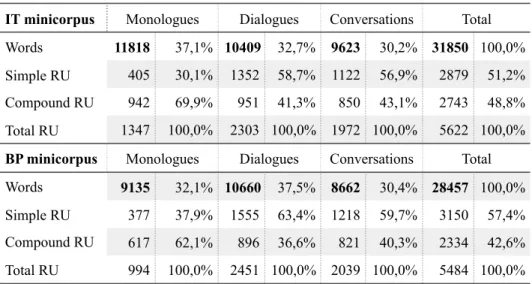
Table 3: Size of the IT and BP minicorpora 86
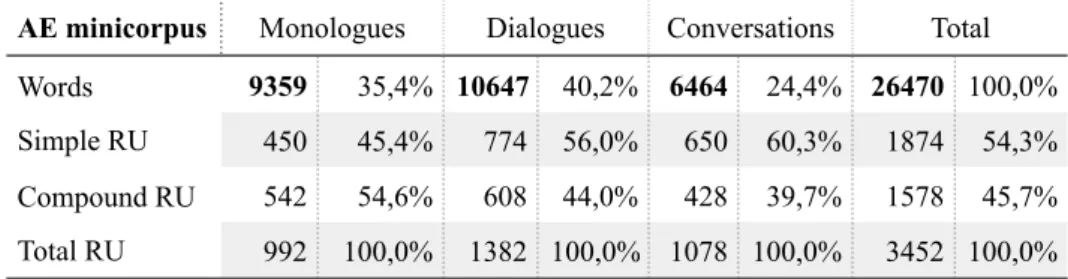
Table 4: Size of the AE minicorpus 89
Table 5: Prosodic annotation scheme used in the C-ORAL corpora 92
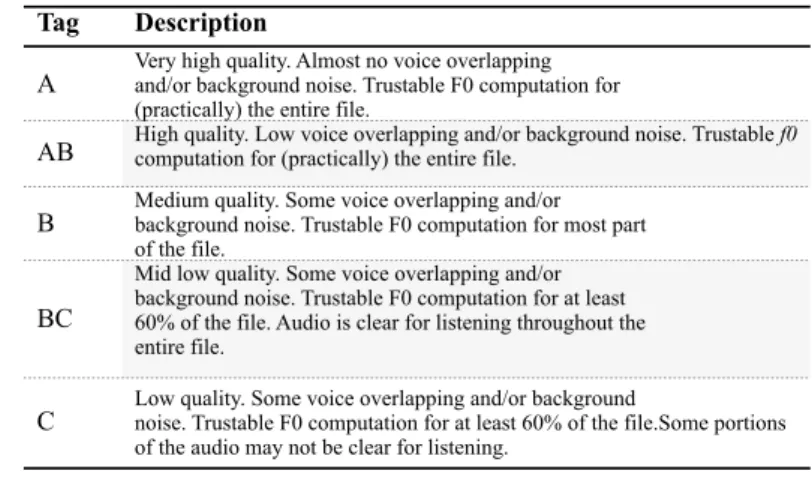
Table 6: Acoustic quality classification 93
Table 7: AE minicorpus acoustic quality 94
Table 8: Representation of non-linguistic phenomena 95
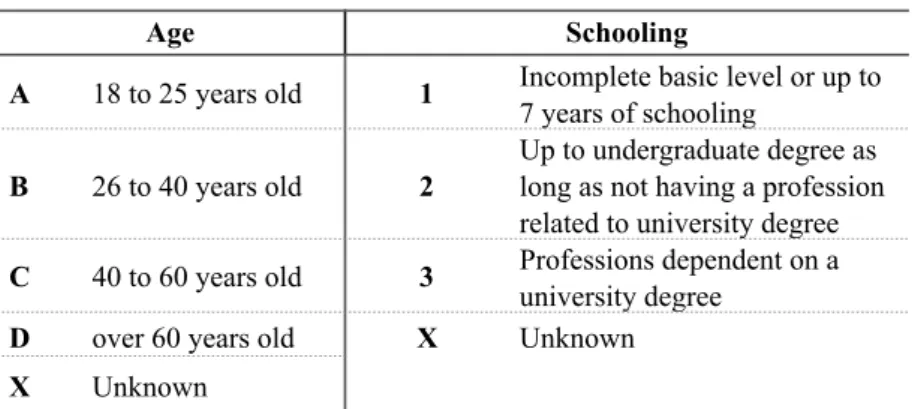
Table 9: Age groups and schooling levels 98
Table 10: Tagset used in the informational annotation 102
Table 11: Size of sound files 103
Table of Contents
1 Introduction 14
1.1 Goals and objectives 14
1.2 Organization of the text 15
2 The Language into Act Theory 17
2.1 Foundations of Language into Act Theory 18
2.2 The utterance as the reference unit for speech 18
2.3 The prosodic and information patterns 26
2.4 The units of the Information Pattern 28
2.4.1 Textual information units 28
2.4.1.1 The Comment 28
2.4.1.2 The Topic 30
2.4.1.3 The Appendix of comment and the Appendix of topic 32
2.4.1.4 The Parenthetic 33
2.4.1.5 The Locutive introducer 35
2.4.2 Dialogic information units 36
2.4.2.1 The Incipit 36
2.4.2.2 The Phatic 36
2.4.2.3 The Expressive 36
2.4.2.4 The Allocutive 37
2.4.2.5 The Conative 37
2.4.2.6 The Discourse Connector 37
2.4.3 The limits of the Isomorphism 37
2.4.3.1 Scanning units 38
2.4.3.2 Multiple Comments 39
2.4.3.3 Stanzas 40
2.5 The prosodic model adopted in L-AcT 42
2.6 The concept of prosodic forms in the L-AcT framework 45
2.7 Speech and Writing: some considerations 51
2.8 Summary 53
3 Literature Review: The notion of topic in other approaches 55
3.1 Halliday 56
3.2 Chafe 61
3.3 Li and Thompson 65
3.4 Lambrecht 67
3.5 Krifka 70
3.6 Pontes 73
3.7 Discussion 75
4 Materials and Methods 79
4.1 The Santa Barbara Corpus of Spoken American English 79
4.2 The Italian and Brazilian Portuguese minicorpora 81
4.3 The American English minicorpus 87
4.3.2 Communicative Situations 90
4.3.3 Prosodic annotation 91
4.3.4 Acoustic quality 93
4.3.5 Transcription criteria 94
4.3.6 Diastratic profile 97
4.3.7 Text-to-speech alignment 99
4.3.8 Informational annotation 101
4.3.9 Summary 103
4.4 Tools and Prosodic analysis 104
4.4.1 The analysis tools 104
4.4.2 The prosodic analysis of the topic unit 107
5 The topic unit in spontaneous American English 111
5.1 The distribution of simple and compound topics in the AE minicorpus 111 5.2 Morphosyntactic and semantic features of the topic unit in American English 116 5.2.1 Morphosyntactic make-up of topics in the AE minicorpus 116
5.2.1.1 The verbal topics 118
5.2.1.2 The nominal topics 120
5.2.1.3 Topics realized by AdvPs and PPs 123
5.2.2 Semantic properties of the topic unit 124
5.3 The compound topics in the AE minicorpus 132
5.3.1 The appendix of topic in the AE minicorpus 134
5.3.2 The list of topics in the AE minicorpus 136
5.4 Summary 138
6 The topic unit in the AE minicorpus — prosodic analysis 140
6.1 The prosodic forms of topics in the AE minicorpus 142
6.1.1 Type 1 prosodic form in the AE minicorpus 143
6.1.2 Type 2 prosodic form in the AE minicorpus 147
6.1.3 Type 4 prosodic form in the AE minicorpus 153
6.2 Compound topics in the AE minicorpus 162
6.2.1 The appendix of topic in the AE minicorpus 162
6.2.2 The list of topics in the AE minicorpus 164
6.3 The type 3 prosodic form — an alternative account 168
6.4 Conclusion 172
7. Conclusion 174
List of abbreviations
AdjP Adjectival phrase AdvP Adverbial phrase
AE American English
ALL Allocutive
APA Appendix
APC Appendix of Comment APT Appendix of Topic AUX Unspecified dialogic unit BP Brazilian Portuguese CMM Multiple Comment COB Bound Comment
COM Comment
CNT Conative
cv Conversation
dB Decibel
DCT Discourse Connector
dl Dialogue
EMP Unit without informational value
EP European Portuguese
EXP Expressive fam Private/familiar
f0 Fundamental frequency
Hz Hertz
i-[TAG] Interrupted information unit
INP Incipit
INT Locutive Introducer
IT Italian
mn Monologue
ms Milliseconds
NP Noun phrase
PAR Parenthetic
PB Brazilian Portuguese PE European Portugues PHA Phatic
pub Public
SCA Scanning unit TMT Time taking
TOP Topic
TPL List of topic
[TAG]_r Unit in Reported Speech UNC Unidentifiable information
unit
VP Verb phrase
List of symbols * Beginning of dialogic turn
[/n] Tone unit boundary with retracting / Non-terminal prosodic break // Terminal prosodic break + Utterance interruption
1 Introduction
This thesis deals with the organization of information structure in spontaneous American
English. The study was carried based on speech data collected from texts that make up the Santa Barbara Corpus of Spoken American English (DU BOIS et al. 2000-2005), which were carefully organized into a minicorpus comparable to the minicorpora of the C-ORAL projects for Italian and Brazilian Portuguese (CRESTI; RASO, 2012).
Following previous studies on Italian (FIRENZUOLI; SIGNORINI, 2003, SIGNORINI, 2005), Brazilian Portuguese (MITTMANN, 2012) and European Portuguese (ROCHA, 2012) carried within the framework of the Language into Act Theory (L-AcT), the topic information unit was chosen as the object of study for this thesis. The topic is an information unit present in nearly 40% of compound utterances — i.e. utterances made up of more than one tone/
information units — in spontaneous speech (CRESTI; MONEGLIA, 2010: 18).
One of the motivations underlining this work stems from the fact that the theoretical principles and the methodology of the L-AcT was yet to be taken beyond the realm of Romance languages. The theory, developed on the basis of extensive observation of
spontaneous speech collected in corpora, had not been applied to the description of languages other than Italian, French, Spanish, European Portuguese and Brazilian Portuguese, primarily because there was no linguistic resource — i.e. speech corpora — that allowed for research to be carried on languages other than those.
This thesis, therefore, brings about two main contributions. On the one hand, it deals with an information structure phenomenon that is widely present in spontaneous speech — namely, the topic — and on the other hand, if offers to the scientific community working within L-AcT approach a minicorpus that allows for the application of the principles and methodology
of the L-AcT to a language of vast academic reach and importance.
1.1 Goals and objectives
Goals:
guided the creation of the Brazilian Portuguese and Italian minicorpora of the C-ORAL family corpora;
II. To describe and analyze the topic information units found in the AE minicorpus.
The objectives associated to (I) above are as follows
a. To apply the transcription conventions and criteria (MELLO et al., 2012) to the texts selected from the Santa Barbara Corpus of Spoken American English to make up the
AE minicorpus;
b. To segment and annotate all the texts into tone units and utterances, following the principles of L-AcT (CRESTI, 2000).
c. To align all the selected texts to their corresponding acoustic source using the software WinPitch (MARTIN, 2005) — alignment at the utterance level;
d. To perform informational annotation on the AE minicorpus, following the so-called
Information Patterning Hypothesis (CRESTI; MONEGLIA, 2010).
The objectives associated to (II) are
a. To quantify topic units in the AE minicorpus;
b. To identify the prosodic features of topic units found;
c. To analyze the morphosyntactic and semantic features of the locutive content of the topic units found;
d. To compare the behavior and features of the topic unit in the AE minicorpus to the
same unit in Italian, Brazilian Portuguese and European Portugueses.
1.2 Organization of the text
This thesis is organized as follows. Chapter 2 provides an outline of the Language into Act Theory, which comprises the framework followed in the study. The theoretical constructs of
information pattern are introduced, and special focus is given to the topic information unit, which constitutes the very object of this study.
In Chapter 3, other approaches that have also dealt with the notion of topic are reviewed. It is shown that those approaches, in contrast to the L-AcT, do not draw a clear distinction between speech and writing, which results in theoretical elaborations that seem insufficient to account for the phenomenon of topic in spontaneous speech.
Chapter 4 is dedicated to the methodological procedures and resources that allowed for this study to be successfully conducted. The C-ORAL projects are briefly presented, as well as their corpora and minicorpora. The steps followed in the making of the AE minicorpus are shown, focusing on the measures taken in order to ensure comparability with the minicorpora of the C-ORAL projects. Finally, the methods employed in the analysis of the topic units
found in the AE minicorpus are shown.
Chapter 5 deals with the distribution, morphosyntactic features and semantic properties of the topic units in the AE minicorpus. The phenomenon of compound topics — i.e. iterated topics, topics integrated by an appendix unit and the so-called list of topics — are also dealt with.
Chapter 6 is dedicated to the prosodic analysis of the topic unit. The concept of prosodic form, as proposed in Firenzuoli (2003), comprises the guiding thread of the prosodic analysis. Finally, Chapter 7 summarizes the main achievements and outcomes of this thesis.
!
2 The Language into Act Theory
The Language into Act Theory (L-AcT) is a pragmatic framework for the study of spontaneous speech that provides a coherent methodology for compilation and annotation of speech corpora (CRESTI, 2000; MONEGLIA, 2005; CRESTI; RASO, 2012; MONEGLIA; RASO, 2014). The framework was developed at the Laboratorio Linguistico del Dipartimento di Italianistica dell'Università di Firenze (LABLITA), at the University of Florence, by Emanuela Cresti and collaborators, on the basis of extensive empirical observation of speech data collected in corpora. A corpus-driven theory, it was first formalized on the basis of Italian data from the LABLITA corpora, particularly the Corpus del parlato spontaneo adulto LABLITA1. Over the past few decades, the theory has been refined through a number of studies conducted on Brazilian and European Portuguese, Spanish, French, and, more recently, American English.
The L-AcT is based on an inductive methodology, and as Mittmann (2012) points out, constitutes an approach in which the corpus is not regarded as a mere repository of examples used to validate previously conceived assumptions. On the contrary, the theory was formalized on the basis of evidence found in corpora, after decades of extensive work with spoken data.
The L-AcT is an extension of Austin’s Speech Act Theory (AUSTIN, 1962). Therefore, speech is regarded as the result of pragmatic activities by the speaker (CRESTI, 2000). The utterance — the reference unit of speech behavior — is defined as the minimal stretch of speech featuring pragmatic autonomy and prosodic autonomy. The prosodic component of the theory (see Section 2.5) is drawn from the IPO methodology for the perceptual study of intonation, whose general principles are provided in ‘t Hart et al. (1990).
The C-ORAL-ROM (CRESTI; MONEGLIA, 2005) and C-ORAL-BRASIL (RASO; MELLO, 2012) corpora constitute the main achievements of the framework with respect to speech corpora compilation. The C-ORAL resources comprise multilingual comparable corpora that document spontaneous speech in accordance with the L-AcT framework. The
See http://lablita.dit.unifi.it/corpora/ for specific information about the LABLITA corpora.
ORAL corpora will be presented in Chapter 4. In what follows, an outline of the principles of the L-AcT framework will be provided.
2.1 Foundations of Language into Act Theory
Following Austin (1962), the L-AcT maintains that the speech act — i.e. the act that is performed by the speaker in making an utterance — consists of three levels, the so-called locutive, illocutive and perlocutive acts. The locutiveact, as the level corresponding to the act of saying something, consists of the linguistic make-up of what is uttered by the speaker, encompassing the phonological, semantic and syntactical strata.
The illocutive act, on the other hand, is regarded as the act performed in saying something. It is the action that the speaker performs in uttering a locutive content in a certain manner (e.g. Assertion, Polar Question, Order, Instruction, etc.). Both the locutive and illocutive acts comprise conventionalized levels in the structure of the speech act. In order for the locutive content of a speech act to make any sense, it must comply with the linguistic rules of a linguistic code, just as much as the illocutionary act must conform to rules of linguistic and cultural natures. As will soon be shown, prosody is what serve as the interface between the locutive and the illocutive levels of the utterance.
In Austin (1962), the perlocutive act is defined as the results achieved by the speech act upon the speaker’s audience. Therefore, the perlocutive act cannot be “predicted” and, consequently, this level of the speech act is not conventionalized. Cresti (2000), however, proposes that the perlocutive act corresponds to the affective base or the libido asset that drives the performance of the speech act. Despite the different definitions, the two approaches agree in that the perlocutive act is not conventionalized.
2.2 The utterance as the reference unit for speech
The utterance, as the result of pragmatic activities by the speaker (AUSTIN, 1962), is regarded as the linguistic counterpart of a speech act (CRESTI, 2000), i.e. it is the linguistic unit that accomplishes the speech act (CRESTI; MONEGLIA, 2010). This definition is based on the Illocutive principle (CRESTI, 2000), which proposes that every locutive act corresponds, in principle, to one illocutive act. The detection of utterances in the speech flow
is carried on the basis of pragmatic principles, which are crucially signaled by prosody. Hence, the definition of utterance as a linguistic unit featuring pragmatic and prosodic autonomy.
The completion of an utterance is necessarily signaled by a prosodic break perceived as terminal (2 conclusive in Crystal, 1975). A prosodic break is a perceptually salient variation of prosodic parameters such that it causes the parsing of the speech flow into discrete prosodic “envelopes”, called tone or prosodic units (‘t HART et al., 1990, MONEGLIA, 2005). Utterances may be prosodically segmented into more than one tone units, in which case prosodic breaks are perceived as non-conclusive, being called non-terminal breaks.
The methodology for the annotation of prosodic breaks determines that terminal breaks be indicated in transcriptions by a double-slash sign (“//”) and non-terminal breaks by a one-slash sign (“/”). Non-terminal prosodic breaks segment utterances into non-autonomous constitutive parts. The internal segmentation of utterances, as will be shown below, is also governed by pragmatic principles (CRESTI, 2000).
There are utterances that are made up of only one prosodic unit. Those utterances do not show
internal prosodic parsing and are called simple utterances, as they contain only the tone unit that specifies the illocutionary force (AUSTIN, 1962), which, at the informational level, is referred to as the comment unit (CRESTI; MONEGLIA, 2010). Accordingly, the comment unit (COM) is the only one that is necessary and sufficient for the performance of a speech act and, thus, for the realization of an utterance. The COM is always realized by a root prosodic unit (’t HART et al., 1990).
On the other hand, there are utterances with more than one tone units realized by a compound prosodic/information pattern; those are called compound utterances. Besides the root prosodic unit, compound utterances show other optional prosodic units, e.g. prefix and suffix units . (’t 3 HART et al., 1990). Each type of prosodic unit is devoted to the fulfillment of different functions at the informational level. Prosodic units of types other than root are signaled by
As pointed out in Moneglia (2005), traditional studies on prosody have consistently maintained that
2
utterances end in a terminal prosodic profile (see, for instance, Crystal (1975); Karcevsky (1931)).
See Section 2.5.
non-terminal prosodic breaks. The nature of the units of the prosodic and informational patterns, as well as the relation among them, will be further discussed in Section 2.3 below.
The utterance in (2.1) below , for example, is realized by two different prosodic units in a 4 prefix-root pattern. By listening to its tone units separately (see (2.1b) and (2.1c)), it can be verified that the prosodic break that segments the utterance into two prosodic envelopes — i.e. the break after “Jim” — is terminal; in other words, the break is perceived as non-conclusive and, therefore, the tone unit to the left of the break can not be pragmatically interpreted in isolation.
(2.1) afammn03[58] 5
(a) that’s why Marcia and Jim / could get up and move // (Audio 2.1a) (b) that’s why Marcia and Jim (Audio 2.1b)
(c) could get up and move (Audio 2.1c)
The identification of prosodic breaks on the basis of detection of perceptual salience of prosodic variations is a task to be performed by a speaker who is able to deal with the language in a natural and pragmatically adequate manner. Furthermore, the task does not involve either evaluation or assignment of any linguistic functions to the perceptually identified units (MONEGLIA, 2011). This method has proven to be highly reliable, showing an excellent degree of inter-rater agreement at a cross-linguistic level, especially for terminal breaks (see MONEGLIA et al., 2005, RASO; MITTMANN, 2009, MONEGLIA et al. 2010, MELLO et al. 2012).
The definition for utterance as the minimal stretch of speech featuring pragmatic and prosodic autonomy results independent from other traditionally accepted definitions based on syntactic and semantic criteria (CRESTI, 2000, CRESTI, 2001, CRESTI; GRAMIGNI, 2004). Consequently, the definition adopted within the L-AcT framework diverges from formal approaches that associate the concept of utterance with the syntactic realization of a
All the examples provided in this thesis, unless noted otherwise, are taken from the AE minicorpus,
4
which is presented in Chapter 4.
Texts from the AE minicorpus, like those from the C-ORAL family corpora, are identified through an
5
abbreviation of the language (a= American English), the context (fam= familiar/private; pub= public) and the interactional type (mn= monologue; dl= dialogue; cv= conversation). The first two digits identify the order of the texts in each interactional session of the minicorpus, while the digits between square brackets indicate the order of the utterance in the text from which it was extracted.
proposition and with semantic completeness. In those approaches, the concept of utterance is closely related to that of predication. However, empirical studies based on spoken Romance languages (MONEGLIA, 2005) and English (BIBER et al., 1999) show that about 30% of speech utterances do not contain a verb . Taking into account that almost one third of 6 utterances in spontaneous speech are verbless, it is clear that defining utterance on the basis of syntactic and semantic criteria is inaccurate.
The following example shows two contiguous utterances, (2.2a) and (2.2b), which have been identified solely on the basis of perceptually relevant prosodic cues. The utterances are first presented separately so that the prosodic break that marks the completion of each of them can be easily notices. This example is meant to show some evidence of the inadequacy of a syntax-based definition for the concept of utterance.
(2.2) apubmn01[91-92]
(a) but / they didn't feel that they had enough eggs // (Audio 2.2a) (b) to send over // (Audio 2.2b)
(c) but / they didn't feel that they had enough eggs // to send over // (Audio 2.2c)
The non-finite clause isolated in (2.2b), “to send over”, despite being a syntactically incomplete sequence, is in fact pragmatically autonomous, as Audio (2.2b) clearly shows. The mere transcription of the utterances in (2.2), without the acoustic source and the prosodic annotation, would probably induce the interpretation of (2.2a) and (2.2b) as comprising one
single utterance. However, if one listens to the their acoustic source — especially that in (2.2b) —, it becomes clear that “to send over” is realized autonomously: it can receive pragmatic interpretation, since it performs a speech act, just as is the case with the preceding utterance, which features a complete syntactic structure. Figure 1 below presents the f0 tracks of the utterances in (2.2).
The proportion of verbless utterances in the languages studied within the L-AcT approach is 38.1%
6
Figure 1: Oscillogram and f0 tracks of utterances apubmn01[91-92]
Another criterion that is often adopted for the definition of speech reference units is the one that associates the presence of a pause with completion of a coherent discourse unit . This 7 criterion, however, is problematic in at least two respects. On the one hand, pauses are oftentimes found separating integral parts of the same utterance — as it is defined in the L-AcT framework. The example below illustrates this first case.
(2.3) afammn02[99]
this incredible / film legend // (Audio 2.3)
By listening to Audio (2.3), it is possible to verify that the sequence “this incredible” cannot stand alone as a complete utterance, even though it is followed by a pause of 430 milliseconds (see Figure 2). Therefore, a pause-based criterion would yield the detection of two utterances where in fact there is just one. Nevertheless, this is not the only problem that such a criterion poses, for there are utterances in spontaneous speech that are not separated one from the other by pauses, like (2.4) below shows.
See Raso et al. (2015) for a comprehensive discussion about the role of pauses in the segmentation of
7
speech corpora.
22 Time (s)
0 3.783
Pi
tc
h (
H
z)
100 150 200 300
50 500
70
Figure 2: Oscillogram and f0 tracks of utterance afamdl02[99]
(2.4) afamdl03[7-8]
(a) so she's / all of 'em / are not short enough // (Audio 2.4a)
(b) she’s / these are the shorter one / and they're about two inches too long hhh // (Audio 2.4b)
(c) so she's / all of 'em / are not short enough // she's / these are the shorter one / and they're about two inches too long hhh // (Audio 2.4c)
The sequences reproduced above as (2.4a) and (2.4b) comprise two distinct utterances, as can be verified by listening to the respective sound files. However, as signaled in Figure 3 by the discontinuous vertical line closer to the center, the utterances are not separated by any interruption in the acoustic signal. The discontinuity observed in the f0 track is due to segmental features, since the final item in (2.4a) ends in a voiceless fricative, [f]. It is easy to verify that each sequence is fully pragmatically autonomous. And this autonomy is independent from there being a pause.
Figure 3: Oscillogram and f0 tracks of utterances afamdl03[7-8] Time (s)
0 2.792
Pi
tc
h (
H
z)
100 150 200 300 500
this incredible / [430 ms] film legend //
Time (s)
0 5.447
Pi
tc
h (
H
z)
100 150 200 300
50 500
70 700
As reported in Moneglia (2005), the French component of the C-ORAL-ROM was segmented and annotated based on two different and independent criteria: one based on the perception of terminal and non-terminal prosodic breaks and the other temporal based on the automatic detection of pauses of at least 200 milliseconds. The comparison of the two annotations showed that about 37% of terminal breaks were not followed by a pause; i.e. more than one third of those sequences would not have been detected should only the temporal criterion have been employed. This provides further empirical evidence for the inadequacy of the pause-based criterion for utterance detection.
It is important to highlight that, while prosodic features like pauses, boundary tones, f0 reset, sudden change in intensity, etc. may accompany prosodic breaks, none of such features are, per se, predictive. Whenever there is a pause, there is also a prosodic break. However, evaluating the break as terminal or non-terminal can only be done on a perceptual basis. The reliability of the detection of prosodic breaks is supported by a high degree of inter-rater agreement shown by studies carried out in a cross-linguistic perspective (MONEGLIA et al. 2005; MONEGLIA et al. 2010; RASO; MITTMANN 2009; MELLO et al. 2012).
The notion of dialogic turn, defined in terms of speaker alternation in the spoken exchange, has also proven inefficient as a means for detecting reference units in speech (CRESTI, 2000, CRESTI; GRAMIGNI, 2004). Dialogic turns, as (2.5) below shows, may range from one single word to a large argumentative stretch of speech, thus not showing the unity required for the identification of a linguistically relevant reference unit.
(2.5) apubmn01[79-101] (Audio 2.5) 8
*KIR: hhh and so that is the background information for the reason for quarantining &he with our other penguins &he we brought them over from Scotland and as it turned out in a quarantine period that they had that a &vi or I should say a fungus okay this Aspergillosis fungus had come to fruition and we had lost you know a good portion of penguins
*AMY: <wow>
*KIR: <so> okay now it’s time to consider replacing these penguins how do we want to go about doing that well hhh really didn't want to go through transporting
The three capital letters preceding each turn identify the speaker, “hhh” indicates paralinguistic noise
8
(e.g. laughter, cough, etc.), and angled brackets indicate overlapping speech. The other symbols used for the transcription of the AE minicorpus are presented in Chapter 4.
the birds didn't work last time a potential for bringing over diseases is obviously there so the thought was okay le’ts get some eggs &he Sea World San Diego has Gentus and apparently just not enough eggs to share if they had them they would gladly same situation with the Edinburgh Zoo they would gladly send us birds but they didn't feel that they had enough eggs to send over so we really didn't want to go the bird route and so that left us the choice of going down to Antarctica and collecting some &peng some penguin eggs ourselves hhh so they went to and I don't know if this is pronounced correctly Wiencke <Island>
*LOR: <yeah> that’s <where> a lot of seals are from as well *DON: <hum>
*KIR: okay *LOR: hum hum *KIR: cool
The extract presented above was taken from a monologic interaction recorded at a training meeting at an aquarium — the prosodic annotation was left out. The speaker identified as KIR is giving explanations about the work conducted at the aquarium. Her turns are intercalated with those of other speakers, which are considerably smaller and less complex. KIR’s turns are not only filled with hesitations, false starts and other fragmentation phenomena, but also show a degree of semantic and syntactic elaboration clearly absent in the other speakers’ turns. Those superficial differences should suffice to show that the concept of dialogic turn
cannot be satisfactorily equated with a linguistically relevant reference unit for speech analysis.
The use of prosodic cues for the detection of utterances in the speech flow has been successfully adopted as a heuristic method for the retrieval of reference units in the C-ORAL family corpora (see, for example, CRESTI; MONEGLIA, 2005, RASO; MELLO, 2012). As Moneglia (2005) points out, the strong acoustic salience that prosodic breaks show accounts for the reliability of the method. The acoustic salience of breaks, particularly in the case of terminal ones, makes their detection a relatively simple task, even for those individuals with little or no training.
their prosodic features. For this reason, studies conducted following the theoretical and methodological principles of the L-AcT framework rely not only on transcriptions, but also on their corresponding acoustic source. Hence, corpora compiled in accordance with the methodology proposed by L-AcT provide transcripts aligned to the acoustic source (see Chapter 4).
2.3 The prosodic and information patterns
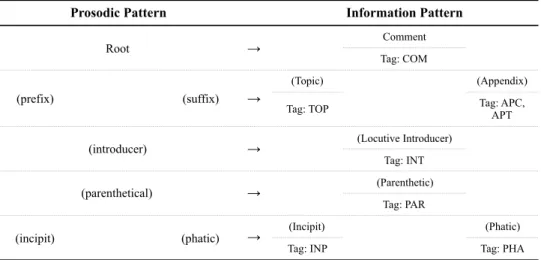
The organization of information in spoken language, as it is regarded in the L-AcT approach, is governed by pragmatic principles that are crucially mediated by prosody (CRESTI, 2000, CRESTI; MONEGLIA, 2010). Prosody is seen as the medium that, among other things, promotes the association between illocutionary value and locutive content, which together make up utterances. As previously mentioned, the core of an utterance is the rootprosodic unit, which specifies the illocution. Drawing on Halliday (1976), who first recognized a general relation between tone units and information units (MONEGLIA, 2005), a systematic correspondence is proposed between the prosodic pattern — i.e. the sequence of prosodic units that make up utterances — and the information pattern — i.e. the way in which information is encoded in speech. This assumption is formalized in the Information Patterning Hypothesis (CRESTI; MONEGLIA, 2010), which is outlined in the Table 1 below.
Each type of unit in the prosodic pattern (to the left of Table 1) corresponds to a specific type of unit in the information pattern (to the right of the Table), as the arrows in the table indicate. Prosodic units are defined as intonation profiles, which constitute configurations that result from the combination of one or more perceptually relevant pitch movements (FIRENZUOLI, 2003). The core prosodic unit, as previously mentioned, is the root, as it is capable of making up an utterance by itself. It is in relation to the root unit that the other types of prosodic units are distributed within the utterance. The root is obligatory in every utterance, while the others are not — this is indicated by the parentheses in Table 1.
In principle, each utterance realizes one illocution, and each of its possible tone units corresponds to one information unit (CRESTI, 2000; CRESTI; MONEGLIA, 2010). That comprises the basic assumption underlying the Illocutive principle (CRESTI, 2000). Every utterance necessarily has a tone unit of the root type (‘t HART et al., 1990), which at the
informational level corresponds to the comment unit (CRESTI, 2000). The comment unit is the one that carries the illocutionary force and the only information unit that is necessary and sufficient for the realization of a speech act (CRESTI, 2000). The cases in which the Illocutionary principle does not hold are dealt with in Section 2.4.3.
Among the optional information units, one that is central for the articulation of information in speech is the topic (CRESTI; MONEGLIA, 2010). The topic is realized by a prosodic unit of the prefix type (see Table 1). The function of the unit is to supply the field of application for the illocutionary force (CRESTI, 2000), thus making it possible for the illocutionary force to refer to domains of identification not necessarily present in the extralinguistic context. According to data reported in Cresti and Moneglia (2010), about 40% of compound utterances, i.e. utterances made up of more than one tone/information unit, are structure around a topic-comment relation.
Table 1: Relation between prosodic and information patterns
Information units can be of two types, depending on whether they participate in the syntactic and semantic construction of the utterance or, conversely, in the regulation of the interaction (CRESTI, 2000). In the former case, they are called textual information units; in the latter,
dialogic information units. Textual units make up (or refer to) the syntactic/ semantic dimension of utterances. Dialogic units, on the other hand, serve as interactional supports, as they address the interlocutor(s) and/or regulate the interaction.
Prosodic Pattern Information Pattern
Root →
Comment
Tag: COM
(prefix) (suffix) →
(Topic) (Appendix)
Tag: TOP Tag: APC,
APT
(introducer) → (Locutive Introducer)
Tag: INT
(parenthetical) → (Parenthetic)
Tag: PAR
(incipit) (phatic) → (Incipit) (Phatic)
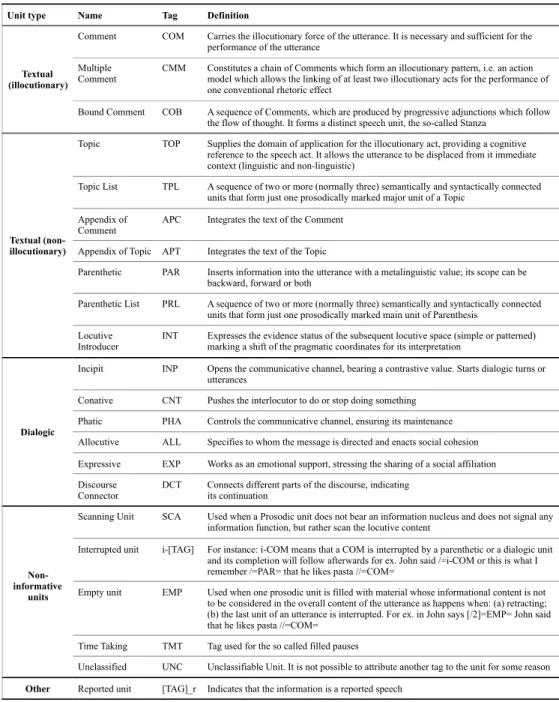
The textual information units are: the comment (COM) and the topic (TOP) — which were briefly presented above — the appendix of comment (APC) and the appendix of topic (APT), the parenthetic (PAR), and the locutive introducer (INT). The dialogic units are the incipit (INP), the conative (CNT), the phatic (PHA), the allocutive (ALL), the expressive (EXP) and the discourse connector (DCT).
In the next section, the units of the information pattern will be presented. The limits of the correspondence between information units and tone units, on the one hand, and between utterance and illocution — i.e. the limits of the Illocutive principle —, on the other, will also be discussed.
Before proceeding, it is important to stress that, similarly to the definition of utterances, the definition of information units is not based on their lexical, syntactic or semantic filling. Furthermore, the relation among units belonging to the same information pattern is a functional relation (CRESTI, 2000), with each unit, in principle, comprising a syntactic island delimited by prosodic breaks. As Cresti (2014: 604) puts it:
[B]asic syntactic/semantic relations such as scope of predication, regency, modification, quantification, subordination and coordination relations, and modal values fall inside the textual island. The final linguistic output of the utterance that we note is the combination of semantic/syntactic islands.
2.4 The units of the Information Pattern
The units of the information pattern are identified and described based on three different criteria: the function fulfilled by the unit within the information pattern, the prosodic features of the tone unit that realizes the information unit — including fundamental frequency (f0, in Hz), duration (in milliseconds) and intensity (in dB) —, and the position of the unit within the utterance in relation to the comment. In the next subsections, the units of the information pattern will be presented in accord with those three criteria.
2.4.1 Textual information units
2.4.1.1 The Comment
The comment is the information unit whose function is to carry the illocutionary force. Therefore, it is the information unit that is necessary and sufficient to realize a speech act; utterances may be made up of a comment only. The unit has no distributional constraint.
As already mentioned, the comment is realized through a root prosodic unit (see ‘t HART et al., 1990). It always carries a functional prosodic salience, called nucleus, which usually consists of some of the syllables that make up the locutive content of the unit. The nucleus of the comment carries the prosodic cues that specify the illocution. The root prosodic unit may show different forms, which vary depending on the type of illocution and the attitude with witch it is conveyed (see MELLO; RASO, 2011, RASO; ROCHA, 2015).
From a pragmatic standpoint (CRESTI, 2000), an utterance always performs a new, unpredictable act. Therefore, the illocutionary content of the comment is always new, even if it expresses referents that have been previously mentioned in the discourse. As Mittmann (2012) points out, the comment is the most informative unit in an utterance. The example below helps to clarify this point.
(2.6) afamdl02[183-185] (Audio 2.6)
*DAR: do what you want / with the time you have // learn / give / whatever // *PAM: love //=COM= %ill: directive (proposal)
*DAR: love //=COM %ill: expressive (irony)
*PAM: love //=COM= %ill: representative (conclusion)
Figure 4: Oscillogram and f0 tracks of utterances afamdl02[183-185]
Without the aid of prosodic cues, the three occurrences of the word “love” in the utterances above could be considered as a mere tautology. Nevertheless, “love” is realized as a different illocution every time it is uttered, as can be readily noticed by listening to the acoustic source.
Time (s)
0 2.615
P
it
c
h
(H
z
)
100 150 200 300
50 70
Therefore, from an illocutionary standpoint, all of them are informative (see RASO, MITTMANN, 2011).
2.4.1.2 The Topic
The function of the topic is to supply the the domain of application for the illocutionary force, which is in turn carried by the comment. The topic selects a domain of pragmatic relevance for the illocution (pragmatic aboutness), supplying the semantic and cognitive representations to which the comment is referred. Without a topic unit, the utterance necessarily refers to a contextually given domain. Therefore, the topic is more frequently found in monologues, in which utterances frequently refer to domains that are not necessarily present in the immediate context.
The topic is realized through a prefix prosodic unit (‘t HART et al., 1990). As the comment, it always carries a prosodic nucleus that signals its function. As a matter of fact, the topic and the comment are the only information units that have a functional prosodic nucleus. The prefix configuration can have different forms. Research carried on Brazilian Portuguese, European Portuguese and Italian (FIRENZUOLI; SIGNORINI, 2003, MITTMANN, 2012,
ROCHA, 2012) identified four different types of prefix units (see Section 2.6 below). 9
The topic always occupy a position to the left of the comment, although not necessarily in a contiguous “slot”. Its distribution, therefore, is constrained. It is possible to find more than one topic in an utterance, three being the largest number found up till now (MONEGLIA; RASO, 2014). Topic units can be either simple or compound, as it can be iterated, be integrated by an appendix (see Section 2.4.1.3) or participate in a list of topics. Compound topics will be taken up in Chapters 5 and 6, where the unit will be extensively discussed.
In order for a topic to be able to fulfill its function, it has to supply a semantic domain of identification (MONEGLIA; RASO, 2014). Therefore, the most frequent types of linguistic filling in topic units — in the languages studied up till now — are nouns and prepositional phrases. Verbal and adverbial phrases are also common; adjectival phrases, however, are rare.
Chapter 6 provides a discussion about each type of prefix and a new account for one of them is
9
therein proposed.
There are topic units that convey modal values, e.g. certain clauses, prepositional phrases and adverbials. Units of this kind, commonly referred to as “modal topics”, have also been identified by researchers working within other approaches (see CHAFE, 1994, MITHUN, forthcoming). Modal topics represent a theoretical problem within the L-AcT framework, for, as Moneglia and Raso (2014) point out, they infringe the adequacy of pragmatic aboutness, since they do not supply a domain of reference for the illocution. Likewise, modal topics infringe the requirement of non compositionally between units of the information pattern, since the semantic scope of their locutive content extends over the limits of the unit itself. Those theoretical issues have not been solved up till now, and they are still open to debate.
The following examples show two utterances structured around a TOP-COM relation. In the first one, the original audio was broken down into two, (2.7a) contains just the topic and (2.7b) just the comment. In this way, it is possible to verify that the topic cannot stand alone as a complete utterance, as it is not pragmatically interpretable in isolation. The comment, on the other hand, is perfectly interpretable in isolation. Audio (2.7c) contains the entire utterance. Example (2.8) shows a modal topic realized by a conditional clause.
(2.7) afammn02[115]
(a) this fellow LeRoy Neiman / (Audio 2.7a) (b) over here // (Audio 2.7b)
(c) this fellow LeRoy Neiman /=TOP= over here //=COM= (Audio 2.7c)
Figure 5: Oscillogram and f0 tracks of utterance afammn02[115]
this fellow LeRoy Neiman / [828ms] over here //
Time (s)
0 3.142
Pi
tc
h (
H
z)
100 150 200
30 300
50 500
(2.8) afammn01[5]
if you want to /=TOP= you can only take it for eight weeks //=COM= (Audio 2.8)
Figure 6: Oscillogram and f0 tracks of utterance afammn01[5]
Finally, the relation between the topic and the comment is a functional relation that is mediated by prosody. That entails that morphosyntactic features are not indicative of the function fulfilled by information units. Accordingly, only by examining the prosodic features of a certain unit is one able to determine the information function that it fulfills.
2.4.1.3 The Appendix of comment and the Appendix of topic
The appendix has the function of integrating the text of the comment or the topic. Therefore, it must follow the unit whose text it integrates, from which it may occasionally be separated by the interpolation of a dialogic information unit (see Section 2.4.2 below). The APC and APT are realized through a suffix prosodic unit (‘t HART et al., 1990) and have no functional nucleus.
The appendixes are realized with flat or falling prosodic movements, but the prosodic profile of the APT may reproduce that of the topic — although in a smaller scale and without the nucleus. Regarding the APC, it cannot be considered a postponed topic, for it does not supply an identification domain for the comment, a function that is fulfilled by topics only. Examples (2.9) and (2.10) below show an APT and an APC, respectively.
(2.9) afamdl02[53]
32
Time (s)
0 2.435
Pi
tc
h (
H
z)
150 200 300 500
the thing I know most /=TOP= about life and death /=APT= come from [/1] from my grandmother //COM (Audio 2.9)
Figure 7: Oscillogram and f0 tracks of utterance afamdl02[53]
(2.10) afammn01[3]
dad /=COM= you know /=AUX= has done some of it //=APC= (Audio 2.10)
Figure 8: Oscillogram and f0 tracks of utterance afammn01[3]
2.4.1.4 The Parenthetic
The parenthetic fulfills a metalinguistic function, as it provides instructions as to how the text of the utterance or part thereof should be interpreted, supplying explanations or pragmatic
APT
Time (s)
0 5.49
COM AUX APC
Time (s)
instructions (TUCCI, 2004, 2010). Accordingly, the parenthetic provides the addressee with information about the speaker’s attitude, aiding in the interpretation of the utterance.
The parenthetic commonly features modal expressions, such as modal or stance adverbials and parenthetical clauses. The unit is never found at the absolute beginning of an utterance, and, apart from this constraint, it is freely distributed within the utterance. Interestingly, parenthetics may even occur inside another textual unit, generating a type of momentary interruption that is eventually picked up, after the parenthetic has been realized. Moneglia and Raso (2014) report that parenthetics are more usually found interrupting topic and comment units.
Realized through a parenthetical prosodic unit, the parenthetic has no functional nucleus. It shows an overall flat prosodic profile, occasionally with minor and local movements. Its melodic contour is clearly distinct from that of the hosting utterance, featuring f0 values that are usually lower than the f0 values of the utterance. Parenthetics realized with particularly low f0 values are usually concluded in a rising movement. Additionally, the unit may show increased speech rates.
(2.11)
afamcv01[17]
<this is a town> /4 =EMP= there is a town right around here /=COB= that it still has a zocalo /=COB= it's built around a zocalo /=PAR= you were telling me <about that> //=COM= (Audio 2.11)
Figure 9: Oscillogram and f0 tracks of utterance afamcv01[17]
34
PAR
Time (s)
By listening to the example above, it is possible to verify that the parenthetic is not interpretable in isolation, a feature only presented by comment units.
2.4.1.5 The Locutive introducer
The primary function of the Locutive is to “bring in” meta-illocutions — more frequently Reported speech, but also List, Emblematic exemplification, Spoken thought, etc. The INT signals that its following unit(s) should be interpreted as pertaining to a hierarchical level different from that of enunciation. The other function that the INT may fulfill is to signal semantic salience, as Moneglia and Raso (2014) point out.
Locutive introducers always precede the information unit(s) of the meta-illocution that they bring in. They are realized through an introducer prosodic unit, which has no functional nucleus. The INT is characterized by a rapidly falling prosodic profile and high speech rate. Usually, the INT is clearly separated from the subsequent unit, which is in turn characterized by a salient f0 reset leading to a higher prosodic level. Thus, INTs are frequently concluded with f0 values that are lower than those of the introduced unit(s).
The example below shows a case of INT unit introducing a reported speech, which is signaled in the transcript by the “_r” symbol added to the information tags.
(2.12) afammn04[147]
and I keep telling him /=INT= get out of that relationship /=CMM _r= before you 10 have children //=CMM_r= (Audio 2.12)
Figure 10: Oscillogram and f0 tracks of afammn04[147]
Multiple comments (CMMs) are discussed in section 2.4.3 below.
10
INT
Time (s)
2.4.2 Dialogic information units
Dialogic information units address the interlocutor and function as a support for the interaction (CRESTI, 2000, FROSALI, 2008, RASO, 2014). They generally correspond to what is traditionally referred to as “discourse markers” (RASO, 2014). Not comprising a primary concern in this thesis, dialogic information units will be briefly presented below.
2.4.2.1 The Incipit
The INP signals the beginning of utterances or stanza sub-patterns . The unit may also 11 function as a turn-taking device. It marks an affective contrast — not a logical one — with what precedes it. The unit is found at the beginning utterances or stanzas sub-pattern. It can be realized through three different prosodic movements: (i) rising-falling, (ii) falling or (iii) rising, always reaching (or departing from) high f0 values. The possibility for different prosodic movements probably result from intrinsic segmental features of the unit (VIEIRA; RASO, 2015). The INP typically shows high f0-variation rate (Hz/ms), high intensity values and short duration.
2.4.2.2 The Phatic
The PHA has the function of signaling that the communicative channel is open. There is no distributional constraints for the PHA. It shows a flat or falling prosodic profile, short duration and very low intensity. The PHA frequently shows reduced phonetic realization — to the point that the unit might not even be hearable in isolation. When at final position in an utterance, the PHA usually shows higher intensity and, occasionally, rising prosodic profile.
2.4.2.3 The Expressive
The primary function of the EXP is to provide emotional support for the illocution, but this unit also plays a part in the sharing of social cohesion. Like the INP, it can also function as a turn-taking device, announcing, as it were, that the utterance “has begun”. However, the EXP does not mark affective contrast, as does the INP. The EXP has no distributional constraint, but it is frequently found at initial position. It is characterized by some prosodic variation —
! For stanzas, see Section 2.3.3.3 below. 11
which, according to Raso (2014: 708), probably results from the function of the EXP as a support for the illocution. More frequently, the EXP shows a modulated prosodic profile, but it can also be flat. It shows intermediate intensity and duration.
Both the PHA and EXP units call for more in-depth analysis, for it appears that those units actually comprise more than two information units. From a functional perspective, the EXP not only provides emotional support, but also participates in the utterance as a turn-taking strategy. This functional overlap suggests the existence of another type of dialogic unit.
2.4.2.4 The Allocutive
The function of the ALL is to identify the addressee and, especially, to mark social cohesion. It has no distributional constraint, but each language/culture seems to show different slot preferences (see RASO, 2014). Its prosodic profile is usually falling (occasionally flat), presenting low intensity and short duration. When at utterance-final position, the ALL may be lengthened.
2.4.2.5 The Conative
Functionally, the CNT pushes the interlocutor to do something or prevents him or her from doing it. It has no distributional constraint but is more frequently found either at the beginning or at the end of utterances. It shows a falling prosodic movement on the stressed syllable (VIEIRA; RASO, 2015), high intensity and short duration. When at the end of an utterance, the CNT is lengthened.
2.4.2.6 The Discourse Connector
The DCT signals that its subsequent sequence — either an utterance or a stanza sub-pattern — is in a relationship of continuation with the prior sequence — the previous utterance or sub-pattern. The DCT does not mark contrast and is always found at the beginning of utterances or stanza sub-patterns. It has a flat, slightly rising or falling prosodic profile, long duration, high intensity and low f0 variation rate.
In the preceding sections, the core units of the information pattern were presented. In what follows, some issues related to the non-correspondence between one utterance and one illocution, on the one hand, and one information unit and one tone unit, on the other, will be dealt with.
2.4.3.1 Scanning units
Cases are observed in which the one-to-one correspondence between the units of the prosodic and information patterns does not occur. In such cases, an information (always a textual one) is realized in more than one tone units. This phenomenon may result from different factors, such as performance inability on the part of the speaker, large syllabic size of the unit or even from issues related to emphasis (RASO, 2012). Regarding syllabic size, Martin (2009, 2014), among others, show that physiology places severe constraints on the syllabic size of tone units, which usually do not exceed seven syllables. Therefore, whenever the locutive content of a textual information unit surpasses this threshold, it is likely that the information unit be parsed into more than one tone units.
When a textual information unit is realized in more than one tone units, the tone unit(s) to the
left is called scanning unit (SCA). The informational function of a scanned unit is exclusively conveyed by the rightmost prosodic unit, as SCA units only carry part of the locutive content of the information unit, thus playing no direct informational role. Scanning units are always compositional from a syntactic-semantic standpoint.
Example (2.13) below shows a comment unit realized in three prosodic units. The two initial ones, as can be verified by listening to the audio file, simple carry part of the locutive content of the comment, thus playing a syntactic-semantic role rather than a functional one.
(2.13) afammn01[114]
we start out /=SCA=with /=SCA= dead horse hooves //=COM= (Audio 2.13)
Figure 11: Oscilaram and f0 tracks of afammn01[114]
2.4.3.2 Multiple Comments
There are cases in which one utterance carries more than one illocution, thus infringing the Illocutive principle, which states that every utterance performs one illocution. For instance, two or more comments may be jointly realized as a rhetoric pattern of illocutions, known as compositionalillocutionary pattern. The units carrying the illocutions in this type of pattern are called multiple comments (CMM).
Multiple comments show a highly conventionalized prosodic pattern and may be accompanied by other information units, either textual or dialogic ones. The illocutionary values carried by CMMs in a compositional pattern entail a global interpretation that exceeds, as it were, the interpretation of each CMM in isolation. The most common types of illocutionary patterns that CMMs realize are list, comparison, reinforcement, necessary
binding, functional recall and alternative questions (MONEGLIA; RASO, 2014).
The example below shows an illocutionary pattern of reinforcement. The two illocutions that make up the pattern can be heard separately in (2.14b) and (2.14c). Each CMM is interpretable in isolation, but, when heard in the illocutionary pattern that they form, their combined meaning becomes clear.
(2.14) afammn03[140]
SCA SCA COM
Time (s)
![Figure 4: Oscillogram and f0 tracks of utterances afamdl02[183-185]](https://thumb-eu.123doks.com/thumbv2/123dok_br/15798317.133374/30.892.190.737.732.960/figure-oscillogram-f-tracks-utterances-afamdl.webp)
![Figure 7: Oscillogram and f0 tracks of utterance afamdl02[53]](https://thumb-eu.123doks.com/thumbv2/123dok_br/15798317.133374/34.892.288.642.292.568/figure-oscillogram-f-tracks-utterance-afamdl.webp)
![Figure 9: Oscillogram and f0 tracks of utterance afamcv01[17]](https://thumb-eu.123doks.com/thumbv2/123dok_br/15798317.133374/35.892.289.642.806.1073/figure-oscillogram-f-tracks-utterance-afamcv.webp)
![Figure 12: Oscillogram and f0 tracks of afammn03[140]](https://thumb-eu.123doks.com/thumbv2/123dok_br/15798317.133374/41.892.290.640.343.605/figure-oscillogram-and-f-tracks-of-afammn.webp)