Neotropical Entomology
journal homepage: www.scielo.br/ne ISSN: 1519-566X
PEST MANAGEMENT
Induction of Insect Plant Resistance to the Spittlebug
Mahanarva fimbriolata
Stål (Hemiptera: Cercopidae) in Sugarcane by Silicon Application
AP Korndörfer, E Grisoto, JD Vendramim
Depto Entomologia e Acarologia, ESALQ/USP, Piracicaba, SP, Brasil
Keywords
Saccharum officinarum, sugarcane cultivar, silicon, pest
Correspondence
Ana P Korndörfer, Rua Fernando Costa, 177 apto 602, Bairro Maracanã, 38400-234, Uberlândia, MG, Brasil; korndorfer@hotmail. com
Edited by José R Salvadori – EMBRAPA
Received 26 March 2010 and accepted 17 December 2010
Abstract
Changes in the agroecosystem with the increase of green cane harvesting in Brazil affected the insect populations associated to this crop, and secondary pests like the spittlebug Mahanarva
fimbriolata Stål, became much more important. Many studies have demonstrated the active role played by silicon in plant defense against
herbivory. The objective of this study was to evaluate the effects of
silicon applications on the biology of the spittlebug reared on two resistant (SP79-1011 and SP80-1816) and one susceptible (SP81-3250) sugarcane cultivars. Sugarcane plants were grown under
greenhouse conditions and submitted to different treatments: with and without silicon fertilizer in two different soil type (sandy and
clay soil). The newly hatched nymphs were transferred to sugarcane roots and placed into boxes with lids, to keep a moistened and dark environment favoring their growth and maintenance of the root system, providing food access to the developing nymphs. After emergence, adult males and females were placed in cages for mating and oviposition. The silicon absorbed and accumulated in the plant caused an increase in nymphal mortality, and depending on the sugarcane cultivar tested this element also provided an increase in the duration of the nymphal stage and a decrease in the longevity of males and females. ‘SP79-1011’ presented the highest silicon content in leaves, and M. fimbriolata had the highest nymph mortality and
the shortest female longevity. The pre-oviposition period, fecundity
and egg viability were not affected by the silicon content in plants
or the cultivar used.
Introduction
The expansion of sugarcane plantings in Brazil and the gradual elimination of the burning practice before harvesting have contributed to the increase in population of the spittlebug Mahanarva fimbriolata (Stål). Consequently, this spittlebug, previously with no economic importance, has now became an important sugarcane pest (Dinardo-Miranda et al 2002). In addition to productivity losses,
M. fimbriolata attack directly impairs the photosynthesis
and other metabolic processes of the plant, affecting the
quality of raw materials for industrial processing, as well as its commercial value (Macedo et al 2003).
Neotrop Entomol 40(3): 387-392 © 2011 Sociedade Entomológica do Brasil use of resistant cultivars (Garcia 2006) are among the
most viable options. However, another technique can be the induction of insect resistance in plants, which can be obtained by the application of chemicals or mineral products. Recent evidence suggests that the deposition of silicon in plants is likely to build resistance to plants against some insect pests, due to physical, chemical and structural barriers (Korndörfer et al 2004).
Sugarcane draws silicon from the soil, favorably responding to silicon fertilization, particularly in soils in which this element is poorly available (Korndörfer
& Datnoff 1995). In addition to its important role as an
inducer of resistance to pests of economic importance,
silicon has several other beneficial functions in this crop,
such as improving photosynthetic capacity, tolerance to frost, plant architecture, tolerance to water stress, pest control, quality of raw materials and productivity (Savant et al 1999).
Despite the numerous studies showing the importance
of silicon as a beneficial element for sugarcane and as a
promoter of pest resistance in this crop (Keeping & Meyer 2002, Keeping et al 2004, Kvedaras & Keeping 2007, Kvedaras et al 2007), there are no studies involving silicon
application and its effect on resistance to the spittlebug.
Therefore, the objective of this study was to evaluate the
effect of silicon application to sugarcane cultivars on the
biology of the spittlebug M. fimbriolata.
Material and Methods
Sugarcane bud setts of the cultivars SP79-1011, SP80-1816 and SP81-3250 were planted in 500 ml containers using two types of soil (clay and sandy). As a initial source of nutrients for sugarcane growth, a 4-14-8 (N-P2O5-K2O) + micronutrients (1.5 g / kg substrate) formulation was used. For each cultivar in each type of soil, two other
treatments were established: with and without silicon. We used 800 kg/ha of Si (source: K2SiO3), corresponding
to 2.8 ml of fertilizer dissolved in 50 ml of distilled water for each container. Insects used in the experiments came from a laboratory colony maintained according to Garcia (2007), and experiments were conducted under controlled conditions (25±1ºC; 70 ± 10% RH; 14h photophase).
Each replicate consisted of 10 newly hatched nymphs, which were daily evaluated for mortality and adult emergence, from which we calculated the duration of the nymphal stage. Ten replicates were made for each treatment. Upon adult emergence, 10 couples (one male + one female) per replicate were formed and placed in separate cages with their respective plant per treatment for mating, breeding and feeding, and we assessed female fecundity and fertility and adult longevity (males and females).
Female fertility was determined by collecting all
eggs each female produced daily and placing them in
Petri dishes (6 cm x 2 cm high) lined with filter paper
moistened with distilled water, and the number of nymphs hatching eggs was assessed daily.
The Si content in leaves extracted from the plants in each treatment was determined at the end of the experiments according to Korndörfer (2004).
The data from the effects of Si on the development,
reproduction and longevity of the spittlebug were analyzed by a factorial 3 x 2 x 2 (three sugarcane cultivars, two doses of potassium silicate and two soil types). Means
were compared by the Tukey´s test at a significance level
of 5%.
Results and Discussion
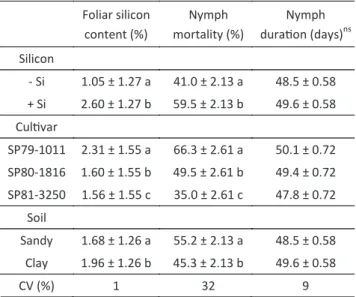
Plants treated with potassium silicate in the soil (+Si)
accumulated significantly higher amounts of silicon in
leaves (2.6%) than the untreated plants (-Si) (1.05%) (Table 1).
When comparing cultivars, silicon was absorbed in different quantities among cultivars. The highest absorption was recorded for cultivar SP79-1011, whose
value (2.31%) was significantly higher than that of
‘SP80-1816’ (1.60%) and ‘SP81-3250’ (1.56%) (Table 1). These results reinforce that sugarcane cultivars vary in their ability to accumulate this nutrient, as mentioned
Table 1 Mean (± SE) of foliar silicon content of sugarcane leaves of different cultivars treated (+Si) and untreated (-Si) with silicon grown in two types of soil and its effect on nymph mortality and nymph duration phase of the spittlebug Mahanarva fimbriolata. Temp.: 25 ± 1ºC, RH: 70%
and photophase: 14h.
Means followed by the same letter in column are not significantly different by the Tukey´s test (P > 0.05); nsNon significant.
Foliar silicon content (%)
Nymph mortality (%)
Nymph duration (days)ns
Silicon
- Si 1.05 ± 1.27 a 41.0 ± 2.13 a 48.5 ± 0.58 + Si 2.60 ± 1.27 b 59.5 ± 2.13 b 49.6 ± 0.58
Cultivar
SP79-1011 2.31 ± 1.55 a 66.3 ± 2.61 a 50.1 ± 0.72 SP80-1816 1.60 ± 1.55 b 49.5 ± 2.61 b 49.4 ± 0.72 SP81-3250 1.56 ± 1.55 c 35.0 ± 2.61 c 47.8 ± 0.72
Soil
Sandy 1.68 ± 1.26 a 55.2 ± 2.13 a 48.5 ± 0.58 Clay 1.96 ± 1.26 b 45.3 ± 2.13 b 49.6 ± 0.58
by Rossetto et al (2005).
Regarding the influence of the soil type in this
experiment, plants grown in clay soil had higher leaf Si content, unlike the value for plants grown in sandy soil (Table 1), as already reported by others (Raij & Campbell 1973). With a higher concentration of soluble Si in the soil, plants can absorb a greater quantity of this element from the substrate.
The 2.5 fold difference observed in the silicon content
of leaves from silicon-treated and untreated plants can be explained by the high solubility of the source (potassium silicate) and the high amount of silicon applied (800 kg/ha), and corroborates the sugarcane capacity to accumulate silicon (Ross et al 1974, Datnoff et al 2001), which may also constitute a defense strategy against this insect pest.
Analyses indicated that significant interaction was
only observed between cultivar and silicon treatment for the parameters nymph mortality, duration of nymphal stage and adult longevity (Table 2). Nymph mortality in untreated plants was higher on ‘SP79-1011’, while in Si-treated plants nymph mortality was also higher
on ‘SP79-1011’, but in this case not different from the
one observed on ‘SP80-1816’ (Table 2). Comparing Si-treated against unSi-treated plants, mortality on Si-Si-treated plants was always higher than on untreated plants.
Differences in nymph mortality between Si-treated and
untreated plants was near 75% on ‘SP80-1816’, 69% on ‘SP81-3250’, and 17% on ‘SP79-1011’ (Table 2). This smallest increase in nymph mortality observed on Si-treated ‘SP79-1011’ as compared to unSi-treated plants can be explained by the fact that leaves of this cultivar naturally carries relatively high values of Si, which is consistent with the fact that it is considered unsuitable to spittlebugs. However, induction of plant resistance due to Si treatment could be clearly observed when comparing nymph mortality on cultivar SP80-1816 to
that on SP81-3250. In this case, no differences in nymph
mortality were observed between these two cultivars on untreated plants, but silicon application to these cultivars
significantly increased nymph mortality on SP80-1816 to
a level similar to that observed in the resistant cultivar (SP79-1011) (Table 2).
Nymphs maintained in plants grown in sandy soil had higher mortality than those kept in plants grown in clay soil, regardless of silicon application or the plant cultivar (Table 1). The highest mortality observed in sandy soils might be related to environmental conditions such as
humidity and temperature, which are known to affect egg
diapause and hatching (Byers 1965). Besides, moisture is a very important factor in the development of this insect, especially for the immature stages, and the higher capacity of clay soils to retain water as compared to sandy soils may provide an environment with the adequate conditions to promote the development of the insect.
However, the soil type did not affect the spittlebug’s
nymph duration.
Silicon treatment also affected nymph development. While no difference in nymph development was observed
among the untreated cultivars, nymph development on Si-treated plants was prolonged on SP79-1011 as compared
to SP81-3250 (Table 3). This difference occurred because
‘SP79-1011’ Si-treated plants were the only ones to have
an effect on nymph development when exposed to silicon
(Table 3).
Male and female longevity in untreated or Si-treated plants was always lower on ‘SP79-1011’, although male
longevity on Si-treated SP80-1816 did not differ from
that observed for SP79-1011 (Table 4). Silicon treatment was able to reduce female longevity on SP79-1011 and SP80-1816 and male longevity only on SP80-1816. No
differences were observed for male of female longevity
between Si-treated and untreated SP81-3250 plants (Table 4). Once again, induction of plant resistance by silicon treatment could be observed on SP80-1816, as this was the only cultivar tested where male and female
longevity were affected by silicon treatment (Table 4).
There are evidences in the literature that susceptible
cultivars can benefit more than the resistant ones with
Table 2 Nymph mortality (%) (± SE) of the spittlebug
Mahanarva fimbriolata in three cultivars treated (+Si) and untreated (-Si) with silicon. Temp.: 25 ± 1ºC, RH: 70% and
photophase: 14h.
Means followed by the same letter, small in the column and capital in
the row, are not significantly different by the Tukey´s test (P > 0.05).
Cultivar Nymph mortality (%)
-Si +Si
SP81-3250 26.0 ± 3.69 aA 44.0 ± 3.69 aB SP80-1816 36.0 ± 3.69 aA 63.0 ± 3.69 bB SP79-1011 61.0 ± 3.69 bA 71.5 ± 3.69 bB
Cultivar Nymph development (days)
-Si +Si
SP79-1011 47.6 ± 1.01 aA 52.5 ± 1.01 bB SP80-1816 49.3 ± 1.01 aA 49.5 ± 1.01 abA SP81-3250 48.7 ± 1.01 aA 46.8 ± 1.01 aA
Mean 48.5 49.6
Table 3 Nymph development (± SE) of the spittlebug
Mahanarva fimbriolata in three cultivars treated (+Si) and untreated (-Si) with silicon. Temp.: 25 ± 1ºC, RH: 70% and
photophase: 14h.
Means followed by the same letter, small in the column and capital in
Neotrop Entomol 40(3): 387-392 © 2011 Sociedade Entomológica do Brasil pre-oviposition period, fecundity or fertility (Table 5).
The different cultivars tested affected several reproductive traits of M. fimbriolata (Table 5). The
pre-oviposition period was much longer on ‘SP81-3250’ than on ‘SP80-1816’ and ‘SP79-1011’ (Table 5). The lowest fecundity was observed for females from ‘SP79-1011’
(Table 5), although no difference was observed for female
fertility (egg viability ranged from 84.3% to 98.2%). The soil did not interfere in any of these three parameters.
The nutritional quality of the host plant, as well
as, the conditions for consumption, can affect female
fecundity. Aphids fed on low quality plants reabsorbed their embryos as a mechanism to extend their life span (Awmack & Leather 2002). In addition, malnourished aphids tend to die before producing their full expected
lifetime fecundity (Leather 1985). These effects were confirmed by more recent studies, in which only 33%
of Cinara atlantica (Wilson) females laid nymphs when exposed to high doses of silicon, in contrast to 46% of females feeding on plants with lower silicon doses (Campbell et al 2008).
Physical, morphological and/or chemical characteristics
Foliar silicon content (%) Pre-oviposition (days) Fecundity (no of eggs/female) Egg viability (%)ns Silicon
-Si 1.1 ± 1.27 a 3.9 ± 0.14 a 376.0 ± 18.42 a 88.2 ± 5.22
+Si 2.6 ± 1.27 b 3.7 ± 0.14 a 361.5 ± 18.42 a 77.0 ± 5.22
Cultivar
SP79-1011 2.3 ± 1.55 a 3.3 ± 0.17 a 242.4 ± 22.56 a 84.3 ± 7.02
SP80-1816 1.6 ± 1.55 b 3.7 ± 0.17 a 368.7 ± 22.56 b 89.0 ± 7.02
SP81-3250 1.6 ± 1.55 c 4.4 ± 0.17 b 495.1 ± 22.56 c 98.2 ± 7.02
Soil
Sandy 1.7 ± 1.26 a 4.0 ± 0.13 a 362.2 ± 18.42 a 87.6 ± 4.37
Clay 2.0 ± 1.26 b 3.6 ± 0.13 a 375.3 ± 18.42 a 89.6 ± 4.37
CV (%) 1 28 38 23
Means followed by the same letter in column are not significantly different by Tukey’s test (P > 0.05); nsNon significant.
Table 5 Foliar silicon content (± SE) of sugarcane leaves of different cultivars treated (+Si) and untreated (-Si) with silicon grown in two types of soil and its effect on pre-oviposition, oviposition and egg viability of the spittlebug Mahanarva
fimbriolata. Temp.: 25 ± 1ºC, RH: 70% and photophase: 14h.
Cultivar Female longevity (days) Male longevity (days)
-Si +Si -Si +Si
SP79-1011 12.1 ± 0.57 bA 9.9 ± 0.57 bB 11.9 ± 0.58 bA 10.9 ± 0.58 bA
SP80-1816 16.3 ± 0.57 aA 14.0 ± 0.57 aB 14.4 ± 0.58 aA 12.3 ± 0.58 bB
SP81-3250 17.0 ± 0.57 aA 15.5 ± 0.57 aA 15.3 ± 0.58 aA 14.1 ± 0.58 aA
Table 4 Male and female longevity (± SE) of M. fimbriolata in different cultivars treated (+Si) and untreated (-Si) with silicon.
Temp.: 25 ± 1ºC, RH: 70% and photophase: 14h.
Means followed by the same letter, small in the column and capital in the row, are not significantly different by Tukey’s test (P > 0.05).
silicon application (Keeping & Meyer 2002, Kvedaras et al 2007).
The lowest male and female longevity of M. fimbriolata
observed on cultivar SP79-1011 is in accordance to Garcia (2006), indicating the unsuitable traits of this cultivar to the spittlebug may be associated with its high Si absorption capacity.
On average, adults (males and females) fed on plants with high content of Si lived about two days shorter than on plants where there was no Si application. A two-day reduction in longevity for pests such as spittlebugs can
result in a significant reduction in the number of eggs laid
in the environment, as females can lay an average of 25 eggs/day, as reported in here (Table 5). The decrease in the number of eggs in the environment will decrease the future population of nymphs and, consequently, the damage caused to plants. A reduced longevity will also represent a decreased period of plant feeding, also resulting in a lower injection of the toxic saliva into the plant.
The soil type in which plants were grown did not
of the plants can alter insect behavior and interfere with
insect biology, leading to a reduced fitness and providing
protection to plants (Lara 1991, Goussain et al 2005). These characteristics may, therefore, be used in the selection of resistant cultivars. In the present study, regardless of the cultivar and soil where sugarcane was grown, the increase in silicon content of these plants after Si provisioning
affected the spittlebug nymph survivorship, and male and
female longevity, which are all important aspects of plant resistance to insects. However, the resistance of a plant to an insect pest may not be simply related to the total quantity of silicon, but where and how this element is distributed and organized in the plant. Miller et al (1960) showed that leaf sheaths of certain wheat and oat cultivars resistant to Phytophaga destructor (Say) exhibited a more complete distribution of silicon deposits on the surface than did susceptible cultivars. These authors suggest that the silicon deposition in susceptible plants may allow the larvae of P. destructor to feed between the rows of Si. In
sugarcane, the accumulation of silicon in the plant has proven to be an important factor of resistance against various insect pests (Keeping & Meyer 2002), increasing
the difficulty of penetration in the plant and exposing
the insects to natural enemies and abiotic conditions (Kvedaras & Keeping 2007), or decreasing pest survival and favoring a decrease in plant susceptibility to the pest with the increase of Si content (Keeping & Meyer 2002).
In this study, the increased resistance to spittlebug in the three cultivars due to silicon treatment suggests
that there may be differences among cultivars in the
assimilation/accumulation of silicon. Thus, the application of silicon in sugarcane growing areas, especially where susceptible cultivars are grown, may reduce the chances of the spittlebug population to reach the economic damage level. We can also conclude that SP79-1011 is the most unsuitable cultivar to M. fimbriolata, and that
SP81-3250 is the cultivar to better respond to resistance induction by silicon application.
Thus, the results obtained on the biological aspects of the spittlebug M. fimbriolata in three sugarcane cultivars
grown in two soil types with and without silicon, have
shown that different cultivars, as well as the presence of silicon and soil type influence the development of the
spittlebug. As the results of this study can collaborate with
integrated pest management practices in sugarcane fields,
further studies on the interactions of plant cultivars, soil
types and silicon application affecting the resistance of
plants to insects should be developed.
Acknowledgments
We thank Robson Thiago Xavier de Sousa for helping with the statistics. We also thank Ronald H Cherry and Alvin Wilson for helpful suggestions in reviewing this publication and the Coordenação de Aperfeiçoamento de
Pessoal de Nível Superior – Capes for providing financial
support to this work.
References
Awmack CS, Leather SR (2002) Host plant quality and fecundity in
herbivorous insects. Annu Rev Entomol 47:817-844.
Byers RA (1965)Biology and control of a spittlebug, Prosapia bicincta (Say), on coastal bermudagrass. Georgia Agricultural Experiment Stations. Georgia, Univ Ga Coll Agric Tech Bull, NS 42, 26p.
Datnoff LE, Seebold KW, Correa FJ (2001) The use of silicon for integrated disease management: reducing fungicide applications and enhancing host plant resistance, p.209-219. In Datnoff
LE, Snyder GH, Korndorfer GH (eds) Silicon in agriculture. Amsterdam, Elsevier Science, 403p.
Dinardo-Miranda LL, Garcia V, Parazzi EV (2002) Efeito de inseticidas no controle de Mahanarva fimbriolata (Stål)
(Hemiptera: Cercopidae) e de nematóides fitoparasitos na qualidade tecnológica e na produtividade da cana-de-açúcar.
NeotropEntomol 31: 609-614.
Garcia JF (2006) Bioecologia e manejo da cigarrinha das raízes, Mahanarva fimbriolata (Stal, 1854) (Hemiptera: Cercopidae), em cana de açúcar. Tese de Doutorado, Piracicaba, Escola Superior
de Agricultura Luiz de Queiroz, 99p.
Garcia JF, Botelho PSM, Parra JRP (2007) Laboratory rearing
technique of Mahanarva fimbriolata (Stål) (Hemiptera: Cercopidae). Sci Agric 64: 73-76.
Foliar silicon content (%)
Longevity (days)
Male Female
Silicon
- Si 1.1 ± 1.27 a 13.9 ± 0.34 a 15.2 ± 0.33 a + Si 2.6 ± 1.27 b 12.5 ± 0.34 b 13.2 ± 0.33 b
Cultivar
SP79-1011 2.3 ± 1.55 a 11.4 ± 0.41 b 11.0 ± 0.40 a SP80-1816 1.6 ± 1.55 b 13.4 ± 0.41 a 15.2 ± 0.40 b SP81-3250 1.6 ± 1.55 c 14.7 ± 0.41 a 16.3 ± 0.40 b
Soil
Sandy 1.7 ± 1.26 a 13.2 ± 0.33 a 14.1 ± 0.32 a Clay 2.0 ± 1.26 b 13.1 ± 0.33 a 14.2 ± 0.32 a
CV (%) 1 19 17
Table 6 Foliar silicon content (± SE) of sugarcane leaves of different cultivars treated (+Si) and untreated (-Si) with silicon and grown in two types of soil, and its effect on male and female longevity of the spittlebug Mahanarva fimbriolata. Temp.: 25 ± 1ºC, RH: 70% and photophase: 14h.
Neotrop Entomol 40(3): 387-392 © 2011 Sociedade Entomológica do Brasil Goussain MM, Prado E, Moraes JC (2005) Effect of silicon applied
to wheat plants on the biology and probing behaviour of the greenbug Shizaphis graminum (Rond.) (Hemiptera:Aphididae).
NeotropEntomol 34: 807-813.
Keeping MG, Meyer JH (2002) Calcium silicate enhances resistance
of sugarcane to the African stalk borer Eldana saccharina Walker
(Lepidoptera: Pyralidae). Agric For Entomol 4: 265-274. Korndörfer GH, Datnoff LE (1995) Adubação com silício: uma
alternativa no controle de doenças da cana-de-açúcar e do arroz. Info Agro 70: 1-3.
Korndörfer GH, Pereira HS, Nolla A (2004) Análise de silício: solo,
planta e fertilizante.Uberlândia, GPSi-ICIAG-UFU, 34p.
Kvedaras OL, Keeping MG (2007) Silicon impedes stalk penetration by the borer Eldana saccharina in sugarcane. Entomol Exp Appl
125: 103-110.
Kvedaras OL, Keeping MG, Goebel FR, Byrne MJ (2007) Water stress
augments silicon-mediated resistance of susceptible sugarcane cultivars to the stalk borer Eldana saccharina (Lepidoptera: Pyralidae). Bull Entomol Res 97: 175-183.
Lara FM (1991) Princípio de resistência de plantas a insetos.2. São Paulo, Ed.Ícone, 336p.
Leather SR (1985) Oviposition preferences in relation to larval growth rates and survival in the pine beauty moth, Panolis flammea. Ecol Entomol 10: 213-217.
Loureiro ES, Batista Filho A, Almeida JEM, Pessoa LGA (2005)
Seleção de isolados de Metarhizium anisopliae (Metsch.) Sorok.
contra a cigarrinha da raiz da cana-de-açúcar Mahanarva
fimbriolata (Stål) (Hemiptera: Cercopidae) em laboratório. Neotrop Entomol 34: 791-798.
Macedo D, Alves SB, Vieira SA (2006) Seleção de isolados de
Metarhizium anisopliae (Metch.) Sorok. a Mahanarva fimbriolata (Stal, 1854) (Hemiptera: Cercopidae). Semina, Ci Agr 27: 47-52.
Macedo N, Botelho PSM, Campos MBS (2003) Controle químico
de cigarrinha-da-raiz em cana-de-açúcar e impacto sobre a população de artrópodes. STAB 21: 30-33.
Miller BS, Robinson RJ, Johnson JA, Jones ET, Ponnaiya BWX (1960)
Studies on the relation between silica in wheat plants and
resistance to Hessian fly attack. J Econ Ent 53: 995-999.
Raij B van (1991) Fertilidade do solo e adubação. Piracicaba, Agronômica Ceres, Associação Brasileira para a Pesquisa da Potassa e do Fosfato, 343p.
Ross L, Nababsing P, Wong You Cheong Y (1974) Residual effect of
calcium silicate applied to sugarcane soils. In Int Congr Soc Sugar Cane Technol 15, Durban, Proc.15: 539-542.
Rossetto R, Lima Filho OF, Amorin HV, Tsai SM, Camargo M , Meloni
AB (2005) Silicon content in different sugarcane varieties. III
Silicon in agriculture conference. Uberlândia, UFU, 151p.
Savant NK, Korndorfer GH, Datnoff LE, Snyder GH (1999) Silicon
nutrition and sugarcane production: a review. J Plant Nutr 22: