484
https://doi.org/10.1590/0004-282X20170067
HISTORICAL NOTE
The art and neurology of Paul Richer
A arte e a neurologia de Paul Richer
Péricles Maranhão-Filho1
1Universidade Federal do Rio de Janeiro, Hospital Clementino Fraga Filho, Rio de Janeiro RJ, Brasil.
Correspondence: Péricles Maranhão-Filho; Av. Prefeito Dulcídio Cardoso, 1680 / 1802; 22620-311 Rio de Janeiro RJ, Brasil; E-mail: [email protected]
Conflict of interest: There is no conlict of interest to declare.
Received 12 January 2017; Received in inal form 06 March 2017; Accepted 14 March 2017.
ABSTRACT
In the 1890s, one of Charcot’s most important protégés, Dr. Paul Richer (1849–1933), drew and sculpted a series of representations of the main types of nerve pathology. That series included drawings of pleomorphic hysterical crises and sculptures depicting patients suffering from labio-glosso-laryngeal paralysis and myopathy, as well as Parkinson’s disease. Richer was a resident at La Salpêtrière and, in 1882, became head
of the Charcot museum. Early in his career, despite having no formal artistic training, he could represent masterfully, in drawings and sculptures, people’s tragic suffering from neurological diseases. Later on, with the same tools, he expressed the beauty of human movements in health.
Keywords: Paul Richer; drawings; sculpture; neurology; art.
RESUMO
Nos anos 1890, um dos mais importantes protegidos de Charcot, o doutor Paul Richer (1849-1933), desenhou e esculpiu uma série de representações igurativas dos principais tipos de patologia nervosa. Essa série incluiu desenhos de crises histéricas pleomóricas e esculturas de bustos representando pacientes que sofriam de doenças tais como: paralisia labio-glosso-laríngea, miopatia e doença de Parkinson. Richer foi residente de La Salpêtrière e, em 1882, foi nomeado chefe do museu de Charcot. Na primeira parte de sua carreira e
sem qualquer treinamento artístico formal, ele conseguiu representar, como ninguém, em desenhos e esculturas, o trágico sofrimento das doenças neurológicas. Mais adiante, com as mesmas ferramentas, ele concebeu a beleza do movimento humano na saúde.
Palavras-chave: Paul Richer; desenhos; escultura; neurologia; arte.
Paul Marie Louis Pierre Richer was born on February 17, 1849, to a family of linen and fabric merchants in Chartres – a region in Centre-Val de Loire, south-west of Paris. When he was young, every day on his way to school, Paul would go past the famous cathedral embellished with countless igures, which stimulated his imagination. Watching the stonema-sons repairing the structure, as he passed by, certainly con-tributed to Richer’s fondness for sculpture1.
he young medical student lacked any formal artistic training, but came to Jean-Martin Charcot’s attention in 1874, when Charcot chaired the committee for Henri Meillet’s thesis, entitled Permanent Deformations of the Hand from the Point of View of Medical Semiotics, and was captivated by the beauty of Paul Richer’s drawings. he master immediately proposed that Paul join him at La Salpêtrière to inish his house oicership1.
In the next year, Marc Sée published Research on the Anatomy and Physiology of the Heart, a 90-page book illustrated with 26
beautiful drawings by Richer, showing the heart from various angles2. It is worth mentioning that Richer was profoundly
dis-appointed to ind out that his name appeared nowhere. Encouraged by Bourneville and under Jean-Martin Charcot’s direction, Richer began working on his thesis,
which was defended in 1879, and served as the basis for the book entitled Clinical Studies on Hysteric-Epilepsy or Great Hysteria3, with 105 igures and nine engravings (Figure 1).
Richer used his drawings of Mlle. Blanche (Marie) Wittman to illustrate the great hysterical crises in diferent periods4.
Charcot claimed that Richer’s drawings were accu-rate enough for a doctor to diagnose the illnesses depicted. hat was the motivation for appointing him, in 1882, as head of the Musée Charcot at the Hôpital de la Salpêtrière5. Both Charcot
and Richer published a series of scientiic reviews on artworks that appeared in the Iconographie de la Salpêtrière, a journal published from 1888 to 1918, and coedited by Richer himself1.
Paul Richer was color blind, which explains why his work is solely composed of sketches and drawings and, later, engravings and sculptures, but never paintings.
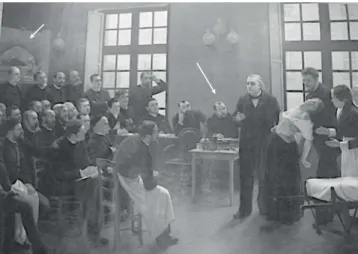
In the famous painting by Pierre Andre Brouillet, A Clinical Lesson at the Salpêtrière (1887)6, one may recognize many of his
485 Maranhão-Filho P. Paul Richer.
Richer was a member of the Academy of Medicine from 1898, and in 1903 assumed a chair in artistic anatomy at
l’Ecole des Beaux Arts. He mastered anatomy, physiology,
drawing and modeling with equal skills, and created mon -uments glorifying French medicine, such as his tributes to Alfred Vulpian (Figure 3).
In a studio attached to La Salpêtrière, Richer produced his drawings and began to create a collection of statues destined for teaching neurology. hree of these sculptures became very famous. According to Henry Meige7, these patient portraits
were thought to be perfectly objective, ‘like a photograph in three dimensions’.
In 1893, Richer portrayed a bust of a 26-year-old man called Henri ‘Bonn’. he bust of a Young Man Sufering from
Myopathy illustrates a study of suferers from amyotrophy, in which muscles waste away because the nerves supplying them are diseased (Figure 4A)5.
The Woman Suffering from Labio-Glosso-Laryngeal Paralysis (circa 1894), a life-size half-body plaster sculp -ture evokes extreme pathos (Figure 4B). The viewer’s focus is the figure’s finely-modeled face and hand, which reveal delicately-rendered veins underneath her skin, and her facial expression5.
Richer’s most well-known pathological sculpture por-trays a Woman Sufering from Parkinson’s Disease (Figure 4C). A patient called, simply, ‘Gell’ represents the almost-perfect clinical schema of Parkinson’s Disease. In that 47 cm high sculpture, you can see the typical suferer as having an expres-sionless visage, a head and torso inclined forward, a sunken chest, and lexed arms and legs: in a word, “the look of an old person who has been welded together”5.
In the golden age of Salpêtrière (1862–1893)6, four
peo-ple, Paul Richer, Albert Londe (1858–1917), Henry Meige (1866–1940), and Jean-Martin Charcot (1825–1893), who were all skilled in drawing themselves, had always been keenly interested in documenting images of diseases as an art form. Londe was an inluential French medical researcher and chronophotographer. In 1878, Jean-Martin Charcot hired Londe as a medical photographer at La Salpêtrière. In 1882,
Université Paris Descartes, Musée d’histoire de la médecine, Paris (author’s photograph).
Figure 2.Clinical Lesson at the Salpêtrière by Andre Brouillet
(1887). Screen of a woman in l’arc de cercle posture (short
arrow). Paul Richer (long arrow).
Figure 1. Paul Richer’s drawings. Top: Passionate attitude period – sad phase (left). Epileptiform period – phase of tonic immobility
or tetanism (right). Bottom: Contortion phase l’arc de cercle (left). Prodrome - agitation and partial contractures (middle). Period of
486 Arq Neuropsiquiatr 2017;75(7):484-487 Paris (author’s photograph).
Figure 3. Alfred Vulpian’s sculpture at the end of Rue Antoine Dubois, a short distance from the Faculty of Medicine.
(Extracted from: http://www.faoablog.com/blog/?p=10900. Accessed 2016 Nov 28). Figure 5. Richer working on his studio.
he devised a system — a 12-lens camera — to photograph the physical and muscular movements of patients, including individuals diagnosed with hysterical conditions and epilep-tic seizures. Meige was a physician, an exceptional anatomist, an excellent draftsman and a privileged illustrator. In 1924, he succeeded Paul Richer as a professor of anatomy at l’Ecole Nationale Supérieure de Beaux-Arts de Paris7.
Charcot and Richer made the claim that science and art were one and the same: “Science and art are nothing more than two manifestations of the same phenomenon, two faces of the same object”8. This art affinity resulted
in the publication of two books: Les Démoniaques dans l’Art (Paris, 1887)9 and Les Difformes et les Malades dans
l’Art (Paris, 1889)8, in which they diagnosed illnesses in
art-works of the past.
Paul Richer continued engraving, drawing and publishing for the rest of his life, but he shifted focus in the second half of his career from pathology to health. An interesting aspect: his book Introduction à L’étude de la Figure Humaine (1902)10,
despite the title, has no drawings whatsoever. Richer moved from the expression of what was conventionally consid-ered ugly to what was considconsid-ered beautiful. He exhibited his sculptures of anonymous athletes — runners, boxers, a shot putter — in the Parisian salons and even at the Universal Exposition of 1900.
Richer ended his career as the general inspector for draw-ing instruction. His retirement did not dampen his produc-tive energy (Figure 5). He continued to produce medals and statues. He passed away on December 17, 1933, at the age of 84 years old.
From: Nouv. Iconogr. de la Salpêtrière. Phototype Nég. A. Londe. (Accessed 2016 Nov). Figure 4. Sculptures by Paul Richer: Bust of a Young Man
Suffering from Myopathy (A). The Woman Suffering from Labio-Glosso-Laryngeal Paralysis (B). Attitude and Faces in Parkinson’s Disease (C).
A
B
487 Maranhão-Filho P. Paul Richer.
References
1. Bogousslavsky J. Following Charcot: a forgotten history of neurology and psychiatry. From Neurol Neurosci. 2011;29:71-90. https://doi.org/10.1159/isbn.978-3-8055-9557-5
2. Sée M. Recherches sur l’anatomie et la physiologie du coeur. 10a ed. Paris: G. Masson; 1883.
3. Richer P. Études cliniques sur l’hystero-épilepsie ou grande hysterie. Paris: Adrien Delahaye et Émile Lecrosnier ; 1881.
4. Signoret JL. [A cinical lesson at the Salpêtrière (1887) by André Brouillet]. Rev Neurol (Paris). 1983;139(12):687-701. French. 5. Ruiz-Gómez N. The ‘scientiic artworks’ of Doctor
Paul Richer. Med Humanit. 2013;39:4-10. https://doi.org/10.1136/medhum-2012-010279
6. Harris J. A clinical lesson at the Salpêtrière. Arch Gen Psychiatry. 2005;62(5):687-701.
7. Maranhão-Filho P. Henri Meige: a síndrome, o artista e o martelo. Rev Bras Neurol. 2013;49(2):80-1.
8. Charcot JM, Richer P. Les difformes et les malades dans l’Art. Paris: Lecrosnier et Babé; 1889.
9. Charcot J-M, Richer P. Les démoniaques dans l’art., Éditeurs. Paris: Adrien Delahaye et Émile Lecrosnier; 1887.
10. Richer P. Introduction à l’etude de la igure humaine. Paris : Gaultier Magnier & Cle ; 1902.