204
“The Conference is firmly convinced that if people in all walks of life, nongovernmental and voluntary organita- tions, governments, the World Health Organization, and all other bodies concerned join forces in introducing strategies for health promotion, in line with the moral and social values that form the basis of this Charter, Health for All by the Year 2000 will become a reality.”
.%une: World Health Organization, Health and Welfare Canada, and Canadian Public Health Associa- tion; Ottawa Charterfor Health Promotion, Ottawa, Canada, 1986.
A
JDSINMEXICO
As of 11 Febrmay 1987, about 32,000 cases of acquired immune de$ciency syndrome (AIDS) had been reported by the nations of the Americas to LYHO. Over nine-tenths of these had been detected in the UnitedStates, which hadreporteda totaZ of 29,536 cases. In temns of cases reported to I.PHO, Mem’co (with 249 reported cases) ranhed ffih, behind the United States, BraziG (1,012 cases), Canada (809 cases), and Haiti (785 cases). The foZZowing report deals with the 98 cases that were re- portedin Mexiio from the time of the first known case in 1980 untiZ 1 G April
1986.
At the present time Mexico’s General Epidemiology Bureau receives reports on AIDS patients diagnosed by hospi- tals belonging to the Health Ministry system, as well as those cared for in IMSS (Mexican Social Security Institute) and ISSSTE (Government Employ- ees Social Security and Services) hospitals. All records and data are updated as soon as new reports of AIDS are received.
The first known case of AIDS in Mex- ico (the case with the earliest onset) occurred in a Haitian student 27 years of age who was living in Mexico City and who began to experience his first symptoms in 1980. No cases were recorded in 1981, but four cases were re- corded in 1982, 13 in 1983, 12 in 1984, 49 in 1985, and 19 up to 16 April
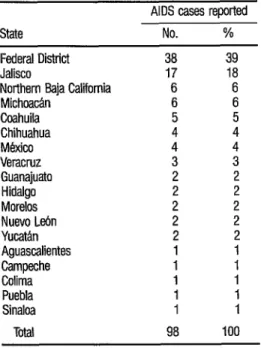
1986. These 98 cases were recorded in 17 states, the largest number being found in the Federal District (Table 1).
Regarding the patients’ sex and age (able 2) only four were females, the youngest being a girl 13 years of age who contracted the disease through a blood transfusion. There were no cases in the 15-19 group, 30 cases (31%) in the 20-29 group, 47 cases (48%) in the 30-39 group, and 11 (11%) in the 40-49 group. Only four cases were reported in people over 49 years old. Almost 80% of these reported cases occurred in patients between 20 and 39 years of age. (The ages of four pa- tients are unknown.)
TABLE 1. Classification of the 98 Mexkan AIDS cases reported up to 16 April 1986, by reporting state.
AIDS cases reported State No. % Federal District 38 39 Jalisco 17 18 Northern Baja California 6 6 Michoac& 6 6 Coahuila 5 5 Chihuahua 4 4 M&iW 4 4 Veracruz 3 3 Guanajuato 2 2 Hidaigo 2 2 Morelos 2 2 Nuevo L&n 2 2
Yuc&n 2
Aguascalientes 1 : Campeche 1 1 Colima 1 1 Puebla 1 1 Sinaloa 1 1 Total 98 100
Smces: lnstittio Meticano de Seguridad Social (IMSS); InstWo de Seguridad y Servicios Sociales para 10s Trabajadores del Estado (ISSSTE); Secmaria de Salud (SS).
TABLE 2. Classitication of the 98 Mexican AIDS cases studied, by sex and age group.
Age ww
(in years) Male Sex
Female
Cases reported No. % <I5
15-19 20-29 30-39 40-49 250 Unknown
Total
1
280 46 11 4 4 94
2 2
0 0
30 31 47 48 11 11
4 4
4 4
98 100
TABLE 3. Occupations of the 98 AIDS patients studiid.
206
Occupation Sex
No. of patients Student Hairdresser Clerk Flight attendant Lawyer Actor Dentist Housewife Dancer Cook Accountant Cosmetologist Draftsman Elementary schooiteacher Tourist manager Blue collar worker Pilot
Business manager Construction worker Architect Accountant’s assistant Varnish applier Driver Storekeeper Dietologist
Nuclear energy worker Engineer
Pastry cook Waiier
Machine operator Advanced student of
architecture Fisherman Advertising agent Retired
Public relations, Fisheries Department Psychologist Electrical technician Radiology technician Not investigated M F M M M M M M F i M M M M M M ii M M 1 M M M Fi F M M M i M M M M M 4 1 4 4 4 3 3 3 2 2” 2 2 2 2 2 2 2 1 1 1 1 ; 1 1 1 1 1 1 1 1 1 1 1 1 1 1 1 31 Soums:IMSS,ISSSTE,SS.
said they were bisexual. (In the Mexican social environment it is quite hard for someone to openly admit to being homosexual.) It was not possible to determine 11 male patients’ sexual preferences, but homosexuality was sus-
Only 25 of the 98 patients admitted to using drugs, and in most (14) cases the drug was marijuana. Use of intraven- ous drugs was reported in seven cases. Four patients said they had used ni- trites for their vasodilating and relaxing effects.
Another important consideration is whether AIDS patients lived or traveled outside the country and whether they had homosexual contacts with foreigners. Fifty-eight patients (78%) re- ported that they had lived or traveled outside of Mexico, primarily in the United States but also in some cases in Canada or Europe. This information was not requested in 24 cases, mostly those reported before 1984, because this variable’s importance had not been recognized. Sixteen of the 98 pa- tients said they had not traveled outside Mexico.
Regarding the occupation of AIDS pa- tients, occupational information was not obtained for 31 patients because the importance of this information was not initially recognized. As Table 3 indicates, the 67 patients from whom occupational data were collected showed a range of occupations that was quite extensive.
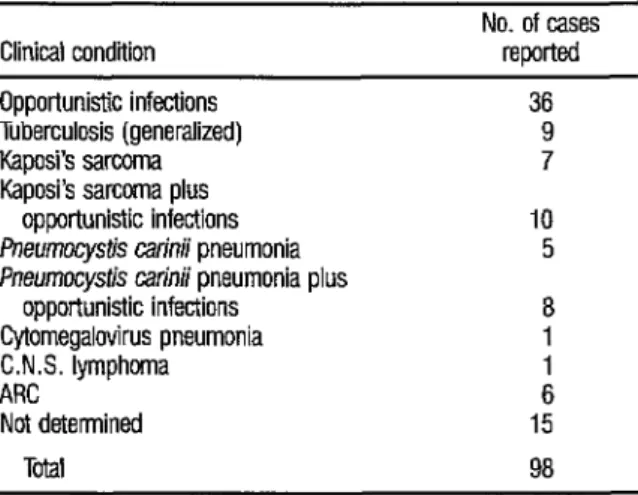
Table 4 lists the clinical conditions ex- hibited by the 98 patients when their cases were reported. An interesting finding that differed from the U.S. experience was that a significant number of these Mexican patients (nine of them) contracted tuberculosis, especially the generalized type, because of their deficient immunologic systems. The remaining 89 patients exhibited 36 cases of opportunistic infections alone, seven cases of Kaposi’s sarcoma alone, 10 cases of Kaposi’s sarcoma associated
TABLE 4. Cbssihtion of the 98 AIDS cases studied, by the pa- tient’s clinical condition.
Clinical condition
No. of cases reported Opportunistic infections
Tuberculosis (generalized) Kaposi’s sarcoma Kaposi’s sarcoma plus
opportunistic infections fneumocystis catinii pneumonia Pneumocysb carinii pneumonia plus
opportunistic infections Cytomegalovirus pneumonia C.N.S. lymphoma ARC
Not detemWd
36 9 7
10 5
8
1 6 15
Tota 98
Suum: IMSS, ISSSTE, SS.
208
with opportunistic infections, eight cases of Pnewzocystir curinii pneumonia associated with opportunistic infections, and five cases of Pnezlmocystis cuti& pneumonia alone. One patient had cytomegalovirus pneumonia, one had a central nervous system lymphoma, and six had AIDS-related complex (ARC). The clinical conditions of 15 patients could not be ascertained, al- though they are assumed to have had some opportunistic infections.
As of 16 April 1986, 51 of the 98 pa- tients were known to have died; 25 patients were in hospitals, under treat- ment at home, or considered under control; the status of 22 patients was unknown. Overall, the available data suggest that the death rate in Mexico as of 16 April 1986 was comparable to that reported for U.S. patients up to late 1985.
A review of the 51 reported deaths shows that the survival time from diagnosis to death was as follows: seven patients (14 % ) died in the first three months after being seen at a medical facility; 10 patients (20%) lived four to six months; 16 patients (32%) lived for seven to 12 months; seven patients (14 % ) lived for 13 to 18 months; three patients (6O/) survived for two years, and four patients (7 %) survived for more than two years. The length of survival of the four other deceased patients is uncertain.
Source: Alfonso Gonzalez GalvBn, Acquired immune deficiency syndrome in Mexico, Border Health 2(4):18-28, 1986.
HE
AUH, DRINKING-WATER, AND
SANITATION IN RURAL AREAS
While the association between water supply and sanitation programs and better health status is widely accepted among health professionals, in certain areas, especially rural ones, this rela- tionship is not well understood. Rural populations value water resources highly, and any number of examples can be cited that indicate the lengths to which rural communities will go and the amounts each will pay to obtain a more accessible water source or to enhance the utility of an existing supply- but water in this context and without accompanying sanitation measures will not necessarily improve the health status of rural communities.