Between-group diferences in
dental caries in the Xavante
Indians from Central Brazil
Rui Arantes
IRicardo Ventura Santos
II,IIIPaulo Frazão
IVI Fundação Oswaldo Cruz, Unidade Cerrado Pantanal
II Departamento de Endemias, Escola Nacional de Saúde Pública, Fundação
Oswaldo Cruz.
III Departamento de Antropologia, Museu Nacional, Universidade Federal do Rio
de Janeiro.
IV Departamento de Prática de Saúde Pública da Faculdade de Saúde Pública da
Universidade de São Paulo.
Correspondência: Rui Arantes FIOCRUZ – Unidade Cerrado Pantanal Av. Senador Filinto Muller, 1480 Vila Ipiranga - Campo Grande, MS CEP 79074-460 E-mail: [email protected]
Abstract
The aim of the study was to investigate caries experience levels in the Xavante Indi-ans, in the state of Mato Grosso, Brazil, with a focus on between-group differences. Oral health data were collected in 2004, following WHO guidelines in four of the seven Xavante reserves (Pimentel Barbosa, Sangradouro, Areões and Marechal Rondon). Data were collected in the largest village in each of the reserves, using the DMFS index. Statistical analyses included sex-speciic Poisson re-gressions to compare DMFS values among Xavante reserves. Prevalence ratios (PR) were used to measure the differences in caries experiences in the 6-to-34-year age group, whose losses varied between 26% and 30%. Xavante from the Pimentel Bar-bosa community were selected as reference group as they showed a lower prevalence of caries in all age groups. The major difference in DMFS was observed between Pimentel Barbosa and Sangradouro, both in males (PR 2.68, 95%CI 2.41-2.97) and in females (PR 2.03, 95%CI 1.85-2.23). The PRs of the illed component in Areões and Marechal Rondon (relative difference to Pimentel Barbosa) were lower, when compared to the total burden of disease observed in those reserves, indicating very low presence of re-storative services. It was concluded that the oral health transition among Xavante has not been homogeneous and the differences found in caries experiences can be associat-ed with the particularities of the interaction process between Indians and non-Indians. Local and regional determinants, including factors related to demography, speciic eco-nomic and socio-cultural characteristics, health care access and type of oral health services received might have inluenced the between-group differences in dental caries observed in the Xavante Indians.
Key Words: oral health, caries, DMFS
INTRODUCTION
The epidemiological picture of oral health in Indigenous populations from Brazil is little known. Nonetheless, there is evidence of inequalities between Indians and non-Indians in terms of access to oral health care services and regular preventive methods, thus causing indigenous popula-tions to be more vulnerable to caries and its complications,1,2,3,4. The risks of caries de-velopment in indigenous populations have increased due to their greater interaction with the surrounding Brazilian society1,2,5. Permanent contact with the non-indige-nous society has imposed changes in the forms of subsistence, socio-cultural systems and lifestyles of these peoples, usually with negative impacts on their health4,6. Changes in eating habits and the introduction of manufactured foods, especially those rich in sugar, are particularly important to deter-mine the current epidemiological picture of indigenous oral health5,7,8.
In 1999, health care of indigenous peo-ples became one of the responsibilities of Brazil’s Health Ministry, after the implemen-tation of the Indigenous Health Sub-System, and the creation of the – Special Indigenous Health Districts (DSEI) This process brought a greater amount of inancial and human resources9. However, Ferreira (2005)10 con-siders that oral health practices have not been implemented homogeneously in all Indigenous Health Districts. Whereas it is possible to perceive an increase in coverage in certain districts, there is a great dificulty in the implementation and organization of activities in others, often leaving a great part of the population without services.
While the presence of oral health in-equalities between indigenous and non-indigenous peoples has been dealt with in the literature, one question that has been little investigated is the occurrence of intra-ethnic differences, i.e. among sub-groups of the same ethnic group. Donelly et al. (1977)5 analyzed the differences in caries experi-ence of 210 Indians in three Yanomami villages with different levels of interaction
with the Brazilian society, situated on the border between Brazil and Venezuela. Less than one decayed tooth on average was observed in individuals aged between 20 and 43 years. In addition to lower caries experience than other indigenous popula-tions (North American groups), the authors found that communities with the presence of a religious mission showed higher caries index than others, which was interpreted as indicative of the inluence of Western eating habits on oral health5.
The Xavante Indians, whose lands are situated in the state of Mato Grosso, com-prise one of the most studied indigenous peoples in Brazil from the health perspec-tive. Investigations have evidenced how changes resulting from the interaction with the Brazilian society have interfered with their way of life and morbidity and mortality proile11,12. The Xavante is a good example of oral health transition. Very low levels of disease, observed in the first decades of permanent contact with non-indigenous society, contrast with the current situation, characterized by a high number of decayed teeth, several missing teeth, and infectious and pain episodes3,7,13.
The present study aimed to assess levels of dental caries experience in Xavante com-munities, situated in different Indigenous Reserves (IR), to investigate the presence of inequalities among sub-groups of one indigenous ethnic group. In addition, caries attack components (decayed, missing and illed surfaces – DMFS) were analyzed as an indication of the type of service received.
POPULATION AND METHODS
Study population
Through-out time, the Xavante of several IRs have followed distinct trajectories of interaction with the surrounding society, thus affecting disease-health proiles differently6,7,12,15,16.
In addition to the high mortality due to post-contact epidemics in the 1950s and 1960s, throughout time, the Xavante have experienced a reduction in their charac-teristic pattern of high mobility associated with the use of the environment. This led to a decrease in hunting and gathering ac-tivities and an increase in the importance of farming, associated with sedentarism and changes in eating habits, including the growing dependence on manufactured products6,7,12,15,16. The Xavante diet, which used to be based on the gathering of fruits and wild roots, hunting and horticulture, especially corn, began to have rice as staple food6,17,18,19. Data available from the 1960s have shown an increase in health problems associated with a diet that has become increasingly monotonous and poor in nu-trients, with a high prevalence of anemia in children, and obesity, diabetes and arte-rial hypertension in adults6,12,15,20. The new dietary pattern also had consequences on the oral health proile of the Xavantes, with a trend of increase in caries levels through-out time2,7,13.
In 2003, the DSEI Xavante included 144 villages, with a population of 11,227 individuals in seven Indigenous Reserves (Pimentel Barbosa , Marechal Rondon , Areões , Sangradouro , Parabubure , São Marcos and Marãwasede ). The largest Xavante area in extension is the Pimentel Barbosa IR (328 thousand hectares), which also has the lowest population density. The largest population is found in the Parabubu-re, with almost half of the total population of this ethnic group, the largest number of villages and the highest population density. The majority of Xavante villages (about 80%) have a population below 100 individuals, 16% between 100 and 300 individuals, and only 4% (six villages) between 300 and 500 individuals. The Xavante population is predominantly young, including more than 50% of individuals aged less than 15 years21. Aiming to achieve the main objective of this study, to investigate the occurrence of differences in caries experience among Xavante sub-groups, the strategy of selec-ting the largest village of each Indigenous Reserve investigated was adopted. In the case of Pimentel Barbosa, the investigation was conducted in the Etenheritipá village, with 511 individuals; in Sangradouro , in the Sangradouro village, with 379 indivi-duals; in Marechal Rondon, in the Batovi village, with 135 individuals; in Areões, in the Dois Galhos and Mutum villages, which totaled 193 individuals. It was not possible to research Parabubu , once there were conlicts between the local population and the governmental organization responsible for health care at the time of this study. São Marcos was not investigated either, as a re-sult of limitations related to resources and personnel for conducting ield work. In the case of Areões, the population is less dense than in the remaining IRs, so that data were collected in the two largest existing villages (Dois Galhos and Mutum).
In the villages investigated, all hou-seholds were visited and individuals aged more than two years who were present were evaluated, aiming to include the universe of the population in the studied communities.
Source: Coimbra Jr. et al., 2002.
The Xavante show high mobility associated not only with subsistence activities (going to gardens and hunting, ishing and gathe-ring activities), but also with visits to family members living in other communities. For this reason, population-based studies performed in this ethnic group frequently encounter dificulties due to losses, com-mon in the case of indigenous peoples, even in the case of prolonged stay of research teams in the communities. There were no refusals to participate in the study among the Xavante and losses corresponded to individuals who were absent at the time of the ield work. In the 6to34-year age group, from which the regression analysis was performed and prevalence ratio calculated, losses in the communities investigated va-ried between 26% and 30%.
Data collection procedures
Oral health evaluation was performed according to the criteria recommended by the World Health Organization22. Data were gathered by only one examiner (Arantes), helped by an indigenous resident of the respective village, who took notes. Clinical examinations were conducted in the homes and, in the case of school-age children, in the schools situated in the village, when these existed.
The survey, performed in 2004, included caries, periodontal conditions, occlusion and dentofacial anomalies (dental aesthetic index - DAI)3. For the purposes of this study, data on caries experience were analyzed. To achieve this, the DMFS index was used, whi-ch is comprised of the sum of three indica-tors related to different dimensions of caries experience in permanent teeth. Whereas the D-component refers to untreated decayed surfaces and its value can be interpreted as the current need for treatment, the M- and F-components refer to missing and illed surfaces, respectively, whose values can be interpreted as the past need for treatment. By admitting that the missing teeth had been extracted mostly due to caries and that the illed teeth showed a condition of
unequivocal caries lesion, the analysis of the component related to the number of missing surfaces and the number of illed surfaces can indicate the type of oral health service received. This service, in its turn, can depend on several aspects, among which are variations in treatment technology available for health care, dentists’ treatment philo-sophy, patients’ choices and the durability of restorative materials23. High dental loss and a low number of filled surfaces can indicate experience with irregular services, predominantly urgent and leading to dental mutilation. In the case of deciduous teeth, the dmfs index was calculated.
Kappa coefficient was used to assess the intra-examiner agreement during data collection. A total of 21 individuals were analyzed and subsequently re-analyzed, totaling 2,256 doubly examined dental sur-faces. Kappa coeficient showed a value of 0.94, thus indicating excellent agreement between exams.
Ethical aspects
The present study met the directives and norms established by Resolution 196/196 of the Brazilian Health Council24, which regulates the performance of re-search in human beings. It was approved by the National School of Public Health Research Ethics Committee and the Natio-nal Research Ethics Committee (Process 25000.083934/2003-51).
Data analysis
The database was developed using the EPI-Info software, version 6.04b, and the analysis was performed using Stata softwa-re, version 10.1. Caries index was calculated by age group, according to type of dentition. The following groups were used: 2 to 5 years (deciduous), 6 to 11 years (mixed) and 12 to 19 years, 20 to 34 years and 35 years and more (permanent).
composition, when compared to the D- and F-components. For each missing tooth, the DMFS increases four or five units (once anterior teeth have four surfaces and the posterior ones, ive), although the caries that led to dental loss had not reached all surfa-ces. To reduce this effect, some correction factors have been suggested in the literature. Wagg (1974)25 proposed an increase of 2.2 in the DMFS for each missing tooth, whereas the proposal by Abreu et al. (1998)26 was 3.5. An intermediate value corresponding to 3.0 was used in the present study. The reason for this was the need for the DMFS to be an integer number, so that the outcome was maintained as a discrete variable, a pre-requisite for the Poisson regression analysis used in this study.
For each age group, a chi-square test was performed to verify the existence of differences between sexes, according to the village. Means of DMFS and respective 95% conidence intervals were calculated for each age group and sex of each village. Although a universal sampling was con-ducted, the use of conidence intervals was adopted to minimize possible sources of uncertainty associated with non-response rate. Kruskal-Wallis test was used to test differences in age composition among villages.
The association between outcomes (DMFS and components) and independent variables (age and village) for each sex was estimated by the prevalence ratio (PR), calculated from the caries experience me-asured by the DMFS index, using Poisson regression. Poisson regression assumes that observations are independent and the logarithmic function of outcome changes linearly according to exposure variables27. This regression model was adopted because distributions were asymmetrical, with the majority of individuals having few decayed surfaces, contraindicating the use of linear regression methods. Differences in sex com-position among IRs were observed in indi-viduals aged 35 years and older and, for this reason, only data on permanent dentition of individuals aged between 6 and 34 years were analyzed. As the Pimentel Barbosa IR
showed the lowest level of caries, it became the reference category. Prevalence ratios between each Xavante village and reference category were calculated.
RESULTS
Data from 691 individuals were col-lected, of which 281 were from Pimentel Barbosa (59.2% of the Etenheritipá village population), 209 from Sangradouro (57.7% of the village population), 115 from Areões (62.8% of the two villages analyzed) and 86 from Marechal Rondon (66.2% of the Batovi village population). For the 6-to-34-year age group, used in the calculation of caries prevalence ratio among villages, similar percentages were obtained as regards the proportion of individuals analyzed. In Pi-mentel Barbosa , 74% of the individuals in this age group were included, in addition to 73% in Sangradouro, 70% in Areões and 74% in Marechal Rondon. The distribution of the population studied per age group and sex and according to is shown in Table 1. Signiicant differences among IRs in the composition per sex were only observed for the age group above 35 years (p<0.05).
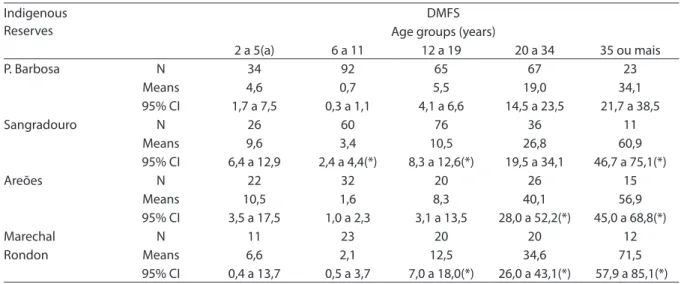
In the 2-to-5-year age group, Pimentel Barbosa showed the lowest value (4.6 surfa-ces of decayed, missing or illed deciduous dental surfaces), while Areões showed the highest value (10.5) (Table 2). There is an overlapping between conidence intervals, when Pimentel Barbosa is compared to the remaining IR, an indication that the differences were not statistically signiicant. For the 6-to-11-year age group, Pimentel Barbosa also showed the lowest mean va-lue, i.e. 0.7 (Table 2). The highest value was found in Sangradouro (3.4), with a statisti-cally signiicant difference, when compared to Pimentel Barbosa and Areões.
Table 1 - Age and sex composition of the study population, Xavante Indigenous Reserves, Mato Grosso, Brazil, 2004.
Age group (years)
Xavante Indigenous Reserves
Pimentel Barbosa Sangradouro Areoes Marechal Rondon
M (%) F (%) M (%) F (%) M (%) F (%) M (%) F (%) p-value* 2-5 21 (61,8) 13 (38,2) 16 (61,5) 10 (38,5) 13 (59,1) 09 (40,9) 08 (72,7) 03 (27,3) 0,893 6-11 41 (44,6) 51 (55,4) 29 (48,3) 31 (51,7) 18 (56,3) 14 (43,8) 10 (43,5) 13 (56,5) 0,690 12-19 38 (58,5) 27 (41,5) 42 (55,7) 34 (44,7) 10 (50,0) 10 (50,0) 12 (60,0) 08 (40,0) 0,899 20-34 32 (47,8) 35 (52,2) 22 (61,1) 14 (38,9) 11 (42,3) 15 (57,7) 06 (30,0) 14 (70,0) 0,144
35 e + 14
(60,9) 09 (39,1) 08 (72,7) 03 (27,2) 06 (40,0) 09 (60,0) 02 (16,7) 10 (83,3) 0,026 Total 146 (52,0) 135 (48,0) 117 (56,0) 92 (44,0) 58 (50,4) 57 (49,6) 38 (44,2) 48 (55,8)
* Teste de qui-quadrado / * Chi-square test
Table 2 - Mean values and conidence intervals (95% CI) of DMFS (decayed, missing and illed dental surface index), according to age groups and Xavante Indigenous Reserves, Mato Grosso, Brazil, 2004.
Indigenous Reserves
DMFS Age groups (years)
2 a 5(a) 6 a 11 12 a 19 20 a 34 35 ou mais
P. Barbosa N 34 92 65 67 23
Means 4,6 0,7 5,5 19,0 34,1
95% CI 1,7 a 7,5 0,3 a 1,1 4,1 a 6,6 14,5 a 23,5 21,7 a 38,5
Sangradouro N 26 60 76 36 11
Means 9,6 3,4 10,5 26,8 60,9
95% CI 6,4 a 12,9 2,4 a 4,4(*) 8,3 a 12,6(*) 19,5 a 34,1 46,7 a 75,1(*)
Areões N 22 32 20 26 15
Means 10,5 1,6 8,3 40,1 56,9
95% CI 3,5 a 17,5 1,0 a 2,3 3,1 a 13,5 28,0 a 52,2(*) 45,0 a 68,8(*)
Marechal N 11 23 20 20 12
Rondon Means 6,6 2,1 12,5 34,6 71,5
95% CI 0,4 a 13,7 0,5 a 3,7 7,0 a 18,0(*) 26,0 a 43,1(*) 57,9 a 85,1(*)
(a) The “dmfs” índex was used in this age group.
(*) statistically signiicant differences in relation to Pimentel Barbosa.
(20-to-34-year age group) (Table 2). In these three age groups, there were statistically significant differences when the IRs are compared to Pimentel Barbosa, particularly in the case of Marechal Rondon and in the 35-year-or-older age group.
Table 3 shows the descriptive statistics of DMFS components for the 6-to-34-year age group, according to IR and sex. First, the average values for age among IRs were compared, without statistically signiicant
Tabela 3 - Média, mediana e desvios-padrão das superfícies cariadas, perdidas e obturadas dos dentes permanentes na faixa etária entre 6 e 34 anos de idade, de acordo com as Terras Indígenas Xavante e sexos.
Table 3 - Mean, median and standard deviation of DMFS (decayed, missing and illed dental surface index) on permanent teeth in individuals aged from 6 to 34 years, according to sex and Xavante Indigenous Reserves, Mato Grosso, Brazil, 2004.
Indigenous reserves
Number of surfaces
Decayed Missing Filled
M F Both M F Both M F Both
Pimentel Barbosa
Mean 2,69 5,19 3,96 1,89 3,42 2,67 0,86 1,04 0,95
SD 5,93 10,27 8,48 4,82 6,36 5,69 2,75 2,83 2,78
Median 0,0 1,00 1,0 0,0 0,0 0,0 0,0 0,0 0,0
N 111 113 224 111 113 224 111 113 224
Sangradouro
Mean 6,09 6,56 6,30 3,68 4,06 3,85 1,17 1,38 1,27
SD 8,03 12,00 10,02 6,30 9,63 7,98 2,58 2,27 2,44
Median 4,00 4,00 4,00 0,0 0,0 0,0 0,0 0,0 0,0
N 93 79 172 93 79 172 93 79 172
Areões
Mean 7,26 13,49 10,37 2,85 8,46 5,65 0,33 0,0 0,17
SD 15,30 19,27 17,56 4,81 14,81 11,29 1,51 0,0 1,07
Median 2,00 5,00 3,00 0,0 0,0 0,0 0,0 0,0 0,0
N 39 39 78 39 39 78 39 39 78
Marechal Rondon
Mean 4,57 6,43 5,60 5,89 12,77 9,71 0,64 0,20 0,40
SD 4,95 9,83 8,03 9,40 18,54 15,45 2,87 1,02 2,05
Median 3,00 3,00 3,00 3,00 3,00 3,00 0,0 0,0 0,0
N 28 35 63 28 35 63 28 35 63
p-value (*) <0,00 <0,00 <0,00 0,02 0,03 <0,00 <0,00 <0,00 <0,00
* Teste de Kruskal Wallis entre as Terras Indígenas. / * Kruskal Wallis test among Indigenous Reserves.
When sexes were compared, the accu-mulated caries experience, mostly due to decayed and missing surfaces, was found to be more relevant in women (Table 3).
Considering the 6-to-34-year age group, table 4 shows the values of prevalence ratios (PR) between each IR and Pimentel Barbosa as reference for the several outcomes, using Poisson regression adjusted for age. Results were statistically signiicant for the majority of outcomes, both for women and men. Prevalence ratios of DMFS values indicate the magnitude of differences in burden of
disease accumulated in the 6-to-34-year age group between each village and the reference group.
Areões showed equivalent PRs. In the case of the illed component, differences were less evident. If the highest number of illed surfaces was found in Sangradouro, Areões and Marechal Rondon showed values wi-thout statistically signiicant association, when compared to Pimentel Barbosa. In other words, there were fewer restorative services received where they would be ex-pected, given the greater burden of disease in relation to the reference group.
Among women, burden of disease was greater in Sangradouro, Areões and Mare-chal Rondon, when compared to Pimentel Barbosa (Table 4). The worst condition in terms of caries experience was identiied in Sangradouro, while the best one was in Marechal Rondon. Missing teeth follow this pattern of inequality. However, it was
observed that Marechal Rondon does not differ from Pimentel Barbosa in terms of the number of untreated decayed teeth. In Marechal Rondon and Areões, there were either no illed teeth in women or a signii-cantly smaller number than in Pimentel Barbosa, whose burden of disease is lower, thus expressing low availability of restora-tive services.
DISCUSSION
Since the 1990s, there has been a gro-wing increase in the number of studies on health of indigenous peoples in Bra-zil11,13,28,29. One of the most signiicant di-ficulties in these studies is how to obtain representative samples from the point of view of the population. Indigenous
com-Tabela 4 - Razão de prevalência (RP) para o CPOS e componentes na população de estudo entre 6 e 34 anos entre as
Terras Indígenas e a referência (Pimentel Barbosa). Intervalos de coniança (95%) e valores estimados obtidos através de regressão de Poisson ajustados pela idade e de acordo com o sexo.
Table 4 - Prevalence ratio (PR) of the DMFS index and its components in men and women aged between 6 and 34 years living in Xavante Indigenous Reserves (Pimentel Barbosa as reference). 95% conidence intervals and estimated values were obtained through Poisson regression, adjusting for age. Mato Grosso, Brazil, 2004.
Outcome Men Women
Estimated parameters Estimated parameters
DMFS PR 95% CI SD p-value PR 95% CI SD p-value
Sangradouro/Ref 2,68 2,41 a 2,97 0,14 0,00 2,03 1,85 a 2,23 0,10 <0,00
Areões/Ref 1,62 1,52 a 1,73 0,05 0,00 1,46 1,39 a 1,53 0,03 <0,00
M. Rondon/Ref 1,33 1,27 a 1,39 0,03 0,00 1,17 1,13 a 1,21 0,02 <0,00
Cariado
Sangradouro/Ref 2,68 2,32 a 3,09 0,02 0,00 1,86 1,64 a 2,11 0,12 <0,00
Areões/Ref 1,88 1,73 a 2,04 0,08 0,00 1,56 1,47 a 1,65 0,05 <0,00
M. Rondon/Ref 1,23 1,15 a 1,31 0,04 0,00 1,01 0,96 a 1,06 0,03 0,66
Perdido
Sangradouro/Ref 3,15 2,62 a 3,79 0,30 0,00 2,35 2,00 a 2,77 0,19 <0,00
Areões/Ref 1,48 1,31 a 1,66 0,09 0,00 1,54 1,43 a 1,65 0,06 <0,00
M. Rondon/Ref 1,57 1,46 a 1,68 0,05 0,00 1,42 1,36 a 1,49 0,03 <0,00
Obturado
Sangradouro/Ref 2,01 1,50 a 2,69 0,30 0,00 2,11 1,60 a 2,79 0,30 <0,00
Areões/Ref 0,75 0,56 a 1,01 0,11 0,06 n.a. n.a. n.a. n.a.
M. Rondon/Ref 0,97 0,82 a 1,15 0,08 0,73 0,53 0,41 a 0,68 0,07 <0,00
n.a. - not applicable because there are no illed surfaces in this category DMFS – decayed, missing and illed surfaces
munities are not only frequently situated in areas of dificult access, but there is also the question of the small size of villages and the fact that, in truth, there are more than 200 distinct indigenous ethnic groups. In the sphere of research on indigenous health, one aspect that is practically unknown is the between-group differences, in terms of the disease-health process.
The present study, focused on the Xa-vante, one of the largest indigenous ethnic groups present in the country, with more than 10,000 individuals, aimed to investi-gate the occurrence of differences in oral health proile among Indigenous Reserves, with a focus on caries. This was the broadest investigation on oral health ever performed among the Xavante and one of the most far-reaching studies performed in an indi-genous people in Brazil. To achieve this, the largest villages of the Xavante Reserves were selected. Although this strategy of selection of communities enables between-ethnic group differences to be pointed out, it is important to emphasize the fact that these are not considered to be representative of the Indigenous Reserves under analysis. Villages with greater population density can show different socioeconomic and ecologi-cal characteristics than those with a smaller size, situated in the same Indigenous Reser-ve6. For the purposes of the present study, this is based on the principle that the largest villages of each Indigenous Reserve, consi-dering logistical possibilities, represent the best possible approximation to the diversity among reserves. As mentioned previously, the several Xavante Reserves, due to histo-rical and political questions resulting from contact with Brazilian society, show speciic socioeconomic characteristics.
Probably, the most important result of this study was the measurement of ine-qualities in the occurrence of caries among Xavante communities. In general, the caries experience was signiicantly higher in San-gradouro, Areões and Marechal Rondon, when compared to the reference group of Pimentel Barbosa. Untreated caries and missing teeth were the components
respon-sible for these differences, both in women and men.
Although the analysis of inter-gender differences in the Xavante was not a pur-pose of this study, indings showed grea-ter burden of disease in women. On the disparities in oral health between Xavante women and men, Arantes et al.13 performed a longitudinal study in Pimentel Barbosa, based on data collected in 1999 and 2004. In the 20-to-34-year age group, there was a risk of caries in women four times higher than that found in men. Authors argued that factors associated with social gender roles and differences in access to information, health services and education could explain the disparity observed.
that several Xavante communities show a signiicant diversity of oral health proiles, as revealed in the results of the present stu-dy. The differences in oral health patterns have parallels with those of other health conditions. Gugelmim & Santos (2001)15 found substantial differences in the occur-rence of overweight, obesity and diabetes between the villages of Pimentel Barbosa and Sangradouro
These authors highlighted important variations in the subsistence activities that predominate in each village, which is relec-ted in the diet and physical activity patterns. In the analysis of length of time spent on subsistence activities, the Xavante from Pimentel Barbosa used 94% of their time in activities associated with farming, hunting, ishing and gathering, and only 6% in paid activities. In contrast, in Sangradouro, paid activities totaled 39% of the time spent on subsistence. The most plausible explana-tion for this is the presence of a religious mission, which involves the creation of paid jobs to work in the missionary activities, such as teachers, cooks and cleaners thus requiring a lower level of physical activity and leading Indians to be more dependent on the regional market to obtain foods, with repercussions on their nutritional status.
It is worth emphasizing that the differen-ces in oral health conditions among several Xavante populations can be traced back many decades, not being a recent phenome-non. Niswander (1967)30 assessed oral health conditions of the Xavante group who lived in the Posto Indígena Simões Lopes (Simões Lopes Indigenous Post), from where the Xavante who currently live in the Marechal Rondon IR descend. It was observed that only 33% of individuals had no caries. This author refers to signiicant differences between the Simões Lopes and the São Domingos groups, from where the current Xavante of Pimentel Barbosa descend. Neel et al. (1964:107)31 mentioned ”the almost complete absence of disease” (caries) among the Xavante from São Domingos. This difference, or at least part of it, was attributed to the fact that, at that time, the Xavante from Simões Lopes
had incorporated the habit of sugar intake, in contrast to the group from São Domingos, who were still relatively isolated and with little change in their eating habits30. More recently, in the end of the 1980s, Pose (1993)32 showed different caries levels among the Xavante Reserves, based on secondary data obtained from the routine dental service at the Brazilian Indigenous Foundation(FUNAI – Fundação Nacional do Índio), the organiza-tion responsible for indigenous health care at that time. This author found patterns that were similar to those observed in this study, i.e. higher levels of caries in Marechal Ron-don, intermediate levels in Sangradouro and the lowest prevalences in Pimentel Barbosa.
The results from the present study not only point to important epidemiological differences among the Xavante villages, but also to the differences in received ser-vices that can be related to availability of oral health care services. The presence of dental services can be indirectly detected by the analysis of illed and missing DMFS components. The comparison of past need for treatment among groups with equiva-lent caries experience can be an indication of differences in the use of dental services and type of services provided (for example, a more mutilation-oriented proile where the M-component predominates or a more conservative proile where the F-compo-nent predominates . In this study, a strategy of analysis based on the calculation of the prevalence ratio was adopted, as a mea-sure of relative inequality, considering the group with lower burden of disease as the reference group. In this way, it was possible to comparatively assess the distribution of components of the DMFS index.
words, the relative difference for Pimentel Barbosa in relation to the number of de-cayed and missing surfaces is higher than the illed surfaces. Considering the fact that there is no documentation about self-dental extraction practices in Xavante villages, this pattern can be highly indicative of low avai-lability of restorative services and exposure to mutilating dental practices in these IRs.
Since 1999, indigenous health care has become part of the Brazilian Uniied Heal-th System(SUS-Sistema Único de Saúde), through the Health Care Sub-System for Indigenous Peoples(Subsistema de Atenção à Saúde dos Povos Indígenas) (Decree 3,156 of 8/27/1999). In the period of this study, the Brazilian Health Foundation(FUNASA – Fundação Nacional de Saúde) managed this sub-system, organized in Special Indi-genous Health Districts(Distritos Sanitários Especiais Indígenas - DSEI). The Xavante District was created in the sphere of this sub-system. The present study showed that, although oral health practices are included in the Xavante Disctrict activities, a signii-cant heterogeneity of availability of services persists in the Xavante Reserves. There are areas, such as Areões, which remain prac-tically without health care, observed by the absence of the illed component in women. Even in those where there is evidence of oral health care, the occurrence of dental resto-rative practices is very low. Results suggest that basic oral health care services provided by the Xavante District have been performed on an irregular basis and unequally distri-buted among the different communities.
Improvement of oral health care for the Xavante is a priority, especially when considering that there has been a trend of increase in the occurrence of caries and other diseases in this population, in the last decades6,7,13. Moreover, in contrast with the Brazilian population, in which a relevant trend of reduction in caries has been observed33,34,35, there is evidence that many indigenous populations, including the Xavante, are experiencing an opposite process of transition2. In Pimentel Barbosa, where data has been collected throughout
time, the mean DMFT increased from 1.16 in 1991 to 4.54 in 1997, in the 13-to-19-year age group7.
In this context of increase in the occur-rence of caries, analyses such as the ones performed in this study, which indicate differences among Xavante sub-groups, gain particular relevance, because they can subsidize the planning and implementation of health actions.
In conclusion, results provide evidence that the transition in oral health care among the Xavante is not homogeneous, depen-ding on the historical process of inclusion into and interaction with the non-indige-nous Brazilian society. This process has been developing in a heterogeneous way among the Xavante sub-groups and the differences can be associated with several aspects, such as speciic histories of interaction with non-Indians, socio-cultural aspects and access to health services. These are factors that have a local inluence and result in unique disease-health processes, with important epidemiological changes among the Xa-vante sub-groups. Knowledge about local determinants associated with epidemio-logical information is an important aspect to deine health policies that can help to structure more eficient health programs, with adequate allocation of resources and to establish the need for professionals or the creation of special programs, aimed at speciic segments of the population of each DSEI.
ACKNOWLEDGEMENTS
Authors would like to thank the Xavante for their interest in participating in this study. Resources for research were provided by Colgate and the Conselho Nacional de Desenvolvimento Cientíico e Tecnológico
1. Rigonatto DLL, Antunes JLF, Frazão P. Dental caries experience in Indians of the Upper Xingu, Brazil. Rev Inst Med Trop S Paulo 2001; 43(2): 93-8.
2. Arantes R. Saúde bucal dos Povos Indígenas do Brasil: panorama atual e perspectivas. In: Coimbra Jr CEA, Santos RV e Escobar AL.Epidemiologia e Saúde do Povos Indígenas no Brasil. Rio de Janeiro: Editora Fiocruz/ABRASCO; 2003. pp. 49-72.
3. Arantes R. Saúde Bucal dos Povos Indígenas do Brasil e o caso dos Xavante do Mato Grosso [Tese de Doutorado]. Rio de Janeiro: Escola Nacional de Saúde Pública Sérgio Arouca, Fiocruz; 2005.
4. Santos RV & Coimbra Jr. CEA. Cenários e tendências da saúde e da epidemiologia dos povos indígenas no Brasil. In: Coimbra Jr CEA, Santos RV e Escobar AL. Epidemiologia e Saúde do Povos Indígenas no Brasil. Rio de Janeiro: Editora Fiocruz/ABRASCO; 2003. pp. 13-47.
5. Donnelly CJ, Thomson LA , Stiles HM, Brewer C, Neel JV & Brunelle JA. Plaque, caries, periodontal diseases, and acculturation among Yanomami Indians, Venezuela. Community Dentistry and Oral Epidemiology 1977; 5:30-39.
6. Coimbra Jr. CEA, Flowers NM, Salzano FM & Santos RV. The Xavánte in Transition: Health, Ecology, and Bioanthropology in Central Brazil. Ann Arbor: University of Michigan Press; 2002.
7. Arantes R, Santos RV & Coimbra Jr. CEA. Saúde bucal na população indígena Xavánte de Pimentel Barbosa, Mato Grosso, Brasil. Cadernos de Saúde Pública 2001; 17: 375-384.
8. O’Sullivan DM, Champany R, Eberling S, Tetrev S & Tinanoff N.. Dental caries and treatment among Navajo preschool children. Journal of Public Health Dentistry 1994; 54:139-144.
9. Fundação Nacional de Saúde,. Política Nacional de Atenção à Saúde dos Povos Indígenas. Brasília: Funasa/ Ministério da Saúde, 2a Edição; 2002
10. Ferreira LB. O Processo de Inscrição das Ações de Saúde Bucal no Subsistema de Atenção à Saúde Indígena. [dissertação de mestrado]. Brasília: Coordenação de Aperfeiçoamento de Pessoal de Nível Superior, Universidade de Brasília; 2005.
11. Coimbra Jr CEA, Santos RV & Escobar AL. Epidemiologia e Saúde dos Povos Indígenas no Brasil. Rio de Janeiro: Fiocruz/Abrasco; 2003.
12. Leite MS, Gugelmin AS, Santos RV, Coimbra Jr CEA, 2003. Peris de saúde indígena, tendências nacionais e contextos locais: relexões a partir do caso Xavante, Mato Grosso. In: Coimbra Jr CEA, Santos RV e Escobar AL.Epidemiologia e Saúde do Povos Indígenas no Brasil. Rio de Janeiro: Editora Fiocruz/ABRASCO; 2003. p. 105-125.
REFERENCES
13. Arantes R, Santos RV, Frazão P, Coimbra Jr CEA . Caries, gender and socio-economic change in the Xavante Indians from Central Brazil. Annals of Human Biology 2009 36:162-175.
14. Lopes da Silva A. Dois séculos e meio de história Xavánte. In: Cunha MC. História dos Índios no Brasil. São Paulo: Companhia das Letras; 1992 p. 357-78.
15. Gugelmin SA & Santos RV. Ecologia humana e antropometria nutricional de adultos Xavante, Mato Grosso, Brasil. Cadernos de Saúde Pública 2001; 17:313-322.
16. Welch JR, Ferreira AA, Santos RV, Gugelmin SA, Werneck GL, Coimbra Jr CEA. Nutrition Transition, Socioeconomic Differentiation, and Gender Among Adult Xavante Indians, Brazilian Amazon. Human Ecology (New York) 2009; 37:13-26.
17. Flowers NM. Seasonal factors in subsistence, nutrition, and child growth in a central Brazilian Indian
community. In: HamesRB & VickersWH.Adaptive Response of Native Amazonians. New York: Academic Press; 1983. p. 357-390.
18. Giaccaria B & Heide A. Xavánte: Povo Autêntico. São Paulo: Editora Salesiana Dom Bosco; 1984.
19. Maybury-Lewis D. A Sociedade Xavánte. Rio de Janeiro: Francisco Alves Editora; 1984.
20. Vieira-Filho JPB.. Emergência do diabetes melito tipo II entre os Xavante e Bororo. Revista de Antropologia 1996; 24:37-440.
21. Souza LG, Santos RV, Coimbra Jr CEA. Estrutura Etária, Natalidade e Mortalidade do Povo Indígena Xavante de Mato Grosso, Amazônia, Brasil. Ciência & Saúde Coletiva 2008; 1609:1-7.
22. World Health Organization. Oral Health Surveys –
Basic Methods, 4th Edition. Geneve, 1997.
23. Brown LJ, Swango PA. Trends in Caries Experience in US Employed Adults from 1971-74 to 1985: Cross-sectional Comparisons. Adv Dent Res 1993; 7(1): 52-60.
24. Conselho Nacional de Saúde. Diretrizes e Normas Reguladoras de Pesquisa Envolvendo Seres Humanos. Resolução 196/96 e 304/00.
25. Wagg BJ. ECSI a new index for evaluating caries progression. Community Dentistry and Oral Epidemiology 1974; 2:219.
27. Barros AJ, Hirakata VN. Alternatives for logistic regression in cross-sectional studies: an empirical comparison of models that directly estimate the prevalence ratio. BMC Med Res Methodol 2003; 3: 21
28. Carneiro MCG, Santos RV, Garnelo L, Bessa MAR & Coimbra Jr CEA. Cárie dentária e necessidade de tratamento odontológico entre os índios Baniwa do Alto Rio Negro, Amazonas. Ciênc. saúde coletiva 2008; 13(6) p.1985-92.
29. Alves Filho P, Vettore MV & Santos RV. Saúde bucal dos índios Guaraní no Estado do Rio de Janeiro, Brasil. Cadernos de Saúde Pública 2009; (25):37-46,.
30. Niswander JD. Further studies on Xavánte Indians. VII. The oral status of the Xavántes of Simões Lopes. American Journal of Human Genetics1967; 19:543-533.
31. Neel JV, Salzano FM, Junqueira PC, Keiter F. & Maybury-Lewis D. Studies on the Xavánte Indians of the Brazilian Mato Grosso. American Journal of Human Genetics 1964; 16:52-140.
32. Pose SB. Avaliação das Condições de Saúde Oral dos Índios Xavánte, Brasil Central. [Dissertação de Mestrado]. Rio de Janeiro: Escola Nacional de Saúde Pública/ Fiocruz; 1993.
33. Ministério da Saúde. Projeto SB Brasil 2003, condições de saúde bucal da população brasileira 2002-2003, resultados principais. Brasília: Coordenação Nacional de Saúde Bucal, Ministério da Saúde; 2004.
34. World Health Organization.. The world oral health report. Continuous improvement of oral health in the 21st century-the approach of the WHO Global Oral
Health Programme. Geneva; 2003.