w w w. s b f g n o s i a . o r g . b r / r e v i s t a
Original
Article
HPLC-DAD-MS/MS
profiling
of
phenolics
from
Securigera
securidaca
flowers
and
its
anti-hyperglycemic
and
anti-hyperlipidemic
activities
Rana
M.
Ibrahim
a,
Ali
M.
El-Halawany
a,b,∗,
Dalia
O.
Saleh
c,
El
Moataz
Bellah
El
Naggar
d,
Abd
El-Rahman
O.
El-Shabrawy
a,
Seham
S.
El-Hawary
aaPharmacognosyDepartment,FacultyofPharmacy,CairoUniversity,Kasr-El-AinyStreet,Cairo11562,Egypt
bDepartmentofNaturalProducts,FacultyofPharmacy,KingAbdulazizUniversity,Jeddah21589,SaudiArabia
cPharmacologyDepartment,NationalResearchCentre,Dokki,12622Cairo,Egypt
dDepartmentofPharmacognosy,FacultyofPharmacy,DamanhourUniversity,DamanhourCity,Egypt
a
r
t
i
c
l
e
i
n
f
o
Articlehistory:
Received22December2014 Accepted21February2015 Availableonline23March2015
Keywords:
Securigerasecuridaca
Flowers HPLC-DAD-MS/MS Antidiabetic Anti-hyperlipidemic
a
b
s
t
r
a
c
t
Securigerasecuridaca(L.)Degen&Döefl.,Fabaceae,hasbeenwidelyusedintheIranian,Indianand Egyp-tianfolkmedicineasantidiabeticandanti-hyperlipidemicremedy.Phenolicprofilingoftheethanolic extract(90%)oftheflowersofS.securidacawasperformedviaHPLC-DAD-MS/MSanalysisinthepositive andnegativeionmodes.Thetotalpolyphenolsandflavonoidsintheflowersweredetermined colorimet-rically,andthequantificationoftheircomponentswascarriedoutusingHPLC-UV.Totalphenolicsand flavonoidsestimatedasgallicacidandrutinequivalentswere82.39±2.79mg/gand48.82±1.95mg/g
ofthedriedpowderedflowers,respectively.HPLC-DAD-MS/MS analysisoftheextractallowedthe identificationof39flavonoidsandeightphenolicacids.Quantitativeanalysisofsomeflavonoidsand phenolics(mg/100gpowderedflowers)revealedthepresenceofisoquercetrin(3340±2.1),hesperidin
(32.09±2.28),naringin(197.3±30.16),luteolin(10.247±0.594),chlorogenicacid(84.22±2.08),
cat-echin(3.94±0.57)andprotocatechuicacid(34.4±0.15),intheextract.Moreover,theacutetoxicity,
hypoglycemicandhypolipidemiceffectsoftheextractwereinvestigatedusingalloxaninduceddiabetes inratsinadoseof100,200,and400mg/kgbwt.Theethanolicextractwassafeuptoadoseof2000mg/kg. Alltesteddosesoftheflowerextractshowedmarkeddecreaseinbloodglucoselevelby31.78%,66.41% and63.8%at100,200and400mg/kgbwt,respectively,atp<0.05.Regardingtheanti-hyperlipidemic effect,adoseof400mg/kgoftheflowerextractshowedthehighestreductioninserumtriacylglycerides andtotalcholesterollevels(68.46%and51.50%,respectivelyatp<0.05).Thecurrentstudyprovedthe folkuseoftheflowersofS.securidacaasanti-diabeticandanti-hyperlipidemicagentwhichcouldbe attributedtoitshighphenoliccontent.
©2015SociedadeBrasileiradeFarmacognosia.PublishedbyElsevierEditoraLtda.Allrightsreserved.
Introduction
Diabetes mellitus is a complex disorder that characterized
by chronic hyperglycemia and disturbances of fat and protein
metabolismassociatedwithmalfunctionininsulinsecretionand/or
insulinaction.Theutilizationofimpairedcarbohydrateleadsto
acceleratedlipolysis,resultedinhyperlipidemia(Kimetal.,2006).
TheMiddleEastandNorthernAfricahasthehighestprevalenceof
diabetesasaworldregionwith34milliondiabeticpersons
accord-ingtointernationaldiabetesfederation(IDFDiabetesAtlas,2011).
∗ Correspondingauthorat:PharmacognosyDepartment,FacultyofPharmacy, CairoUniversity,Kasr-El-AinyStreet,Cairo11562,Egypt.
E-mail:[email protected](A.M.El-Halawany).
Inrecentyears,thereisgrowingevidencethatplantpolyphenols
includingflavonoidsareuniquenutraceuticalsandsupplementary
treatmentsforvariousaspectsoftype 2diabetesmellitus.Plant
polyphenols can modulate carbohydrate and lipid metabolism,
attenuatehyperglycemia,dyslipidemia,insulinresistance,
allevi-ateoxidative stressand preventthedevelopment oflong-term
diabeticcomplications(Bahadoranetal.,2013).Nowadays,there
isagrowinginterestintheanalysisandidentificationof
medici-nalplants’phenolicconstituentsaimingatfindingnewsourcesfor
thesecompoundsandtoestablishtheirstructureactivity
relation-ship.
Securigera securidaca(L.) Degen &Dörfl.,Fabaceae,hasbeen
widely used in the Iranian, Indian and Egyptian folk medicine
asantidiabeticandanti-hyperlipidemicremedy(Alietal.,1998;
Azarmiyetal.,2009;PorchezhianandAnsari,2001).Chloroformic
http://dx.doi.org/10.1016/j.bjp.2015.02.008
R.M.Ibrahimetal./RevistaBrasileiradeFarmacognosia25(2015)134–141
extract of S. securidaca decreased fasting serum glucose level,
increasedfoodconsumption,bodyweightandglycogencontent
oftheliverinrats(Zahedi-Asletal.,2005).Totalaqueousextractof
theseedsshowedsignificantdecreaseinbloodglucoselevel(−35%)
inglucoseloadedmice(Alietal.,1998).Inaddition,S.securidaca
seedsuspensionhasa protective effectagainstalloxan-induced
hyperglycemiaand oxidativestressin rats(Mahdiet al.,2011).
HydroalcoholicextractofS.securidacaseedsproducedasignificant
reductionintheleveloftriglyceride,LDLaswellasdecreasein
lipidperoxidation(Fathietal.,2010).Totalseedextractimproved
endotheliumdependentvasodilationinhighfatfedratsby
lower-inglipidformationaroundtheaortainhypercholesterolemicrats
anddecreasingatheroscleroticlesions(Azarmiyetal.,2009).The
hypoglycemiceffectoftheseedwasestimatedtoberelatedtoits
flavonoidcontent(Hosseinzadehetal.,2002).Concerningthe
flow-ersofS.securidaca,twoflavonoids,kaempferolandastragalinwere
isolatedfromitsaqueousextract(Alietal.,1998)butnoreports
werefoundregardingtheeffectoftheflowersonplasmaglucose
andlipidsindiabeticrats.
In the present study, the acute toxicity, anti-diabetic,
anti-hyperlipidemiceffectofthealcoholicextractofS.securidacaflowers
wereevaluatedinalloxaninduceddiabetesmodelinrats.Thetotal
polyphenolsandflavonoidsintheflowersweredeterminedandthe
phenoliccompositionoftheextractwasdescribedusingHPLC/DAD
(high-performanceliquidchromatographic/diodearraydetector)
coupledwithESI-MS(electrosprayionization/massspectrometry)
toidentifythemajorphenoliccompoundspresentintheextract.
Inaddition,HPLC-DADquantificationofmajorphenolicacidsand
flavonoidswascarriedout.
Materialandmethods
Chemicals
Reagents for spectrophotometric determination of
pheno-lic compounds, Folin–Ciocalteu’s reagent: was obtained from
Loba-Chemie (Mumbai, India), sodium carbonate and t-butyl
hydroquinonewereobtainedfromSigma,USA.
RegardingHPLCanalysisofphenolic compounds;acetonitrile
and methanol used were of HPLC grade, and were purchased
fromSigma–Aldrich(Steinheim,Germany).o-Phosphoricacidused
wasofanalyticalgradefromSdfineChemlimited(Mumbai,India)
and formic acidwaspurchased from E-Merck(Darmstadt,
Ger-many).DistilledwaterwasfurtherpurifiedusingaMilli-Qsystem
(Millipore, MA, USA). Acetonitrile and acidulated water were
filteredthrough a 0.45pmmembrane filter (PallGelman
Labo-ratory, USA) and degassed in anultrasonic bathprior toHPLC
analysis.Isoquercetrin,rutin,gallicacid,trans-cinnamicacid,
sal-icylic acid, naringin, protocatechuic acid, ellagic acid, luteolin,
quercetin,caffeic acid, hesperetin, p-coumaric acid, kaempferol
and hesperidin were purchased fromsigma Co. (St.Louis, MO,
USA).
Plantmaterial
SamplesofSecurigerasecuridaca(L.)Degen&Dörfl,Fabaceae,
werecollected duringthe years (2010–2013)from The
Experi-mentalStationofMedicinalandAromaticPlants,Pharmacognosy
Department,FacultyofPharmacy,CairoUniversity,Giza.Plantwas
kindlyauthenticatedbyBotanyspecialist,Dr.MohamedEl-Gebaly,
DepartmentofBotany,NationalResearchCenter(NRC),Giza,Egypt
andavoucherspecimenwaskeptattheHerbariumofthe
Depart-mentofPharmacognosy,FacultyofPharmacy,CairoUniversity(no.
11-6-2013-2).
Determinationoftotalphenolicsandflavonoidscontents
Quantificationof phenoliccompounds wascarried outusing
Folin–Ciocalteau’smethodasreportedbySigeretal.(2008).Briefly;
1gofdriedpowderedflowerswashomogenizedwith40mlof80%
methanolusinga pestle andmortar,filteredthroughWatmann
No.1filterpaperandtransferredintoavolumetricflask(100ml)
with80%methanol.0.2mlofthemethanolicextractwasplaced
in avolumetric flask(10ml)and0.5mlFolin–Ciocalteureagent
(2N)wasadded.After3min,saturatedsodiumcarbonate(1ml)
(20%indistilledwater)wasaddedandthevolumewascompleted
withdistilledwater.After1h,absorbanceofbluecolorwas
mea-suredatmax725nmagainstablank(distilledwater)usingUnicam
UV–visible Spectrometer.Gallic acidwas used to compute the
standardcalibrationcurve(20,40,60,80, 100mg/ml).
Determi-nationswerecarriedoutintriplicates;resultswererepresentedas
themeanvalues±standarddeviationsandexpressedasmggallic
acidequivalentspergramdryweight(mgGAE/gD.W.).
Total flavonoids wereextracted according tothe methodof
Hertogetal.(1992),1gofdriedpowderedflowerswas
homoge-nizedwith40mlof62.5%methanolwith0.1gt-butylhydroquinone
(w/v)and10mlof6Nhydrochloricacidwasaddedcarefullyand
the mixture refluxedat 90◦C for 2h. After cooling, the
super-natantwasfilteredandtransferredtoavolumetricflask(100ml)
with62.5% methanol.Sample (1ml), Folin–Ciocalteau’s reagent
(2N)(0.5ml) and Na2CO3 (200mg/ml) (3ml)were added,
vor-texedandthenallowedtostandfor15minatroomtemperature
ina darkplaceandabsorbancewasmeasuredat725nm.Rutin
wasusedasstandardandtheequivalents(w/w)weredetermined
froma standardconcentrationcurve(20,40,60,80,100mg/ml)
(Meenakshietal.,2009).Determinationswerecarriedoutin
trip-licates;resultswererepresented asthemeanvalues±standard
deviationsandexpressedasmgrutinequivalents(RE)pergramdry
weight.
Extractionprocedures
The air-dried powdered S. securidaca flowers (1.6kg) were
exhaustively extracted with 90% ethanol by cold maceration.
Thetotalalcoholicextract wascombinedandevaporatedunder
reducedpressureatatemperaturenotexceeding50◦C,yielding
250gofdryresidue.Forbiologicalstudytheextractdissolvedin
bi-distilledwaterbytheaidofanultrasonicbathjustpriortothe
investigation.
PreparationoftheextractforHPLC-DAD-MS/MSanalysis
Thepreviouslypreparedethanolicextractoftheflowers(20mg)
was dissolved in HPLC grade methanol (2ml). The methanolic
extractwasplacedinultrasonicbathfor5minandfilteredthrough
0.4mmembrane filter.Aliquot of 10lwasinjected into the
LC/DAD/MSanalysissystem.
HPLC-DAD-ESI–MSapparatus
The analysis was performed using a Hewlett-Packard 1100
(Waldbronn,Germany)composedofaquaternarypumpwithanon
linedegasser,athermostatedcolumncompartment,aphotodiode
arraydetector(DAD),anautosampler,and1100ChemStation
soft-ware,coupledwithelectrosprayionization(ESI)interfacedBruker
Daltonik Esquire-LC ion trapmass spectrometer (Bremen,
Ger-many) and an Agilent HP1100 HPLC system equipped withan
R.M.Ibrahimetal./RevistaBrasileiradeFarmacognosia25(2015)134–141
ConditionsforHPLC-DAD-MS/MSanalysisofflavonoids
TheHPLCseparationwasperformedonEclipseXDBC18column
(50mm×2.1mm,1.8m,AgilentCompany,USA).Mobilephase
consistedoftwosolvents,(A)methanoland(B)0.2%formicacid.
Separationofcompoundswascarriedout withgradientelution
profile:0min,A:B10:90;36min,A:B70:30;50min,A:B100:0;
60min.Chromatographywasperformedat30◦Cwithaflow-rate
of0.8ml/min.UVtracesweremeasuredat254,360andUVspectra
(DAD)wererecordedbetween190and900nm.
Massspectrophotometricconditions
Theionizationparameterswere asfollows:capillary voltage
4000V, end platevoltage−500V;nebulizinggasof nitrogenat
35.0p.s.i.;dryinggasof10l/minnitrogenat350◦C.Massanalyzer
scannedfrom50to1300.TheMS–MSspectrawererecordedin
auto-MS–MSmode.Thefragmentationamplitudewassetto1.0V.
Massspectraweresimultaneouslyacquiredusingelectrospray
ion-izationinthepositiveandnegativeionizationmodes.
QuantitativedeterminationofphenoliccompoundsbyHPLC
Quantitativedetermination ofphenolic compoundswas
per-formed using HPLC apparatus, Agilent Series 1200 apparatus
(Agilent, USA) equipped with autosampling injector, solvent
degasser, quaternary HP pump (series 1200) and ultraviolet
(UV)detector(set at280nmfor phenolic acidsand 330nm for
flavonoids).TheanalysiswasachievedonazobraxODSC18column
(particlesize5m,250mm×4.6mmØ).Columntemperaturewas
maintainedat35◦C.Flavonoidseparationwasdoneadoptingthe
methodofMattilaetal.(2000),usingamobilephaseconsisting
of50mMH3PO4,pH2.5(solutionA)andacetonitrile(solutionB)
aceticacid(40:60,v/v)inthefollowinggradient:isocraticelution
95%A:5%B,0–5min;lineargradientfrom95%A:5%Bto50%A:50%B,
5–55min;isocraticelution50%A:50%B,55–65min;lineargradient
from50%A:50%Bto95%A:5%B,65–67min.Theflowrateofthe
mobilephasewas0.7ml/min.Phenolicacidsseparationwasdone
adoptingthemethodofGoupyetal.(1999)withasolvent
sys-temconsistingofA(aqueousaceticacid2.5%),B(aqueousacetic
acid8%)andC(acetonitrile)inthefollowinggradient:at0min,5%
B;at20min,10%B;at50min,30%B;at55min,50%Bat60min,
100%B;at 100min,50%B and50% C; at110min,100% C until
120min.Thesolventflowratewas1ml/min.Theinjectionvolumes
were5l.Standardflavonoidsandphenolicacidswerepreparedas
10mg/50mlsolutionsinmethanolandtheyweredilutedtomake
concentrations(20–40g/ml)andinjectedintoHPLC.
Quantifica-tionofcompoundswasperformedbasedonpeakareacomputation
(externalstandardmethod).Theanalysiswasrunintriplicatesand
theconcentrationsoftheidentifiedcompoundswereexpressedas
(mg±SD/100gdryweight)andlistedinTable2.
Experimentalanimals
Adult Wister male albino rats, weighing 180–250g, were
obtainedfromtheAnimalHouseColonyoftheNationalResearch
Center(Dokki,Giza,Egypt),andwerehousedunderconventional
laboratoryconditionsthroughouttheperiodofexperimentation.
Theanimalswerefedastandardratpelletdietandallowedfree
accesstowater.
Drugsandkits
Alloxanmonohydratepowder(Sigma–Aldrich, St.Louis, MO,
USA),Gliclazide(Servier,Egypt)wereusedinthepresent
inves-tigation.Thebiochemicalkitsusedinthestudywereglucosekits
(Biodiagnostic,Egypt),cholesterolkits(Biodiagnostic,Egypt)and
triacylglycerideskits(Biodiagnostic,Egypt).
Acutetoxicity
AcuteoraltoxicityoftheethanolicextractoftheflowersofS.
securidacaL.wasperformedfollowingthemethodofLorke(1983).
Anti-hyperglycemicactivityandanti-hyperlipidemicactivity
Ratswereweighedandinjectedintraperitoneallywithalloxan
(150mg/kg)dissolvedindistilledwater.After48hbloodsamples
werewithdrawnfromtheretro-orbitalvenousplexusunderlight
etheranesthesiaandtheserumwasseparatedbycentrifugation
forthedeterminationofglucoselevel.Onlyratswithserumglucose
levelsmorethan250mg/dlwereselectedandconsideredas
hyper-glycemicanimalsaccordingtomethodofNeshwarietal.(2012).
Thehyperglycemicratswerethendividedintofivegroups(10rats
each).Thefirstgroupofdiabeticratsservedascontrol;thesecond
tofourthgroupsreceivedalcoholicextractoftheflowersatdoses
100,200and400mg/kgorallyfor10consecutivedays;andthefifth
groupofdiabeticratsreceivedGliclazide(antidiabeticstandard)at
doseof5mg/kgbwtorallyfor10consecutivedays.Theextractand
Gliclazidewerestarted48hafteralloxaninjectionatwhichtime
hyperglycemiawasconfirmed.Twenty-four hoursafterthelast
doseofeitherdrugtreatment,abloodsamplewaswithdrawnfrom
theretro-orbitalvenousplexusfrom18hfood-deprivedratsand
wascentrifugedat3000rpmfor10min.Theserumwasobtained
fordeterminationoftheserumglucoselevel,triacylglyceridesand
totalcholesterollevel.
Determinationofserumglucoselevel
Glucose level wasdetermined as quinineamine usinga test
reagent kit (Biodiagnostic, Egypt) according to the method of
Trinder(1969).Theabsorbancewasmeasuredat510nmandthe
resultswereexpressedasmg/dl.
Determinationofserumtriacylglyceridelevel
Triacylglycerideswereestimatedbyenzymaticmethodsusing
diagnostickit(Biodiagnostic,Egypt)accordingtothemethodof
Fossati and Prencipe (1982). The absorbance was measured at
510nmandtheresultswereexpressedasmg/dl.
Determinationofserumtotalcholesterollevel
Totalcholesterolwasestimatedbyenzymaticmethodsusing
diagnostickit(Biodiagnostic,Egypt)accordingtothemethodof
Allainetal.(1974).Theabsorbancewasmeasuredat500nmand
theresultswereexpressedasmg/dl.
Statisticalanalysis
Statisticalanalysiswascarriedoutbyonewayanalysisof
vari-ance (ANOVA)followedbyTukeytest. Resultsareexpressedas
means±SEM(n=10).
Resultsanddiscussion
TotalphenolsandflavonoidscontentsofS.securidacaflowers
wereinvestigated.Thevalueoftotalphenolicswas82.39±2.79mg
gallicacidequivalent(GAE)/g(D.W.)andthatofthetotalflavonoids
R.M.Ibrahimetal./RevistaBrasileiradeFarmacognosia25(2015)134–141
Table1
PeakassignmenetofmetabolitesinethanolicextractofS.securidacausingLC-DAD/MSinpositiveandnegativeionizationmodes.
No. RT [M−H]−m/z [M+H]+m/z Fragmentions Identifiedcompounds
1 0.9 147 – 147,62 trans-Cinnamicacid
2 1.2 – 139 137,93 Salicylicacid
3 1.5 – 216 170[(M+H)-HCOOH],125,97 Gallicacid
4 1.8 – 152 153,109 Protocatechuicacid
5 2.8 – 292 289,271,245,227,205,179,125 Catechin
6 11.1 447 – 327[(M−H)-120],285[(M−H)-162],284,255,227 Kaempferol-7-O-glucoside
7 11.7 448 – 447,357[(M−H)-90],327[(M−H)-120],
285[(M−H)-162]
Orientin
8 12.4 625 – 505[(M−H)-120],463[(M−H)-162],300,
301[(M−H)-162]
Quercetin-3,7-di-O-glucoside
9 12.7 447 – 327[(M−H)-120],284[(M−H)-H-162],255
[aglycone-2H-CO],243,241,217,213,199,175,149
Luteolin-3′-O-glucoside
10 12.8 447 – 327[(M−H)-120],285[(M−H)-162],284,
257[aglycone-CO],243,241,217,213,199,175,149
Luteolin-7-O-glucoside
11 13.2 593 – 503[(M−H)-90],473[(M−H)-120],431[(M−H)-162],
311[(M−H)-120–162],283
Isovitexin-4′-O-glucoside
12 13.6 609 – 489[(M−H)-120],447[(M−H)-162],
357[(M−H)-90–162],327[(M−H)-120–162]
Isoorientin-4′-O-glucoside
13 14.2 593 – 575[(M−H)-18],503[(M−H)-90],473[(M−H)-120],
383[(M−H)-90–120],353[(M−H)-120–120]
Apigenin6,8-di-C-glucoside (vicenin-2)
14 14.9 593 – 503[(M−H)-90],473[(M−H)-120],431,341,311
[(M−H)-120–162]
Isovitexin-7-O-glucoside (saponarin)
15 15 – 595 449,433,284
Kaempferol-O-neohesperidosideee
16 15.4 623 – 503[(M−H)-120],461[(M−H)-162],
341[(M−H)-120–162],315[(M−H)-146–162],297,
195,179,161,153,135
Isorhamnetin-3-O-glucoside-7-O-rhamnoside
17 15.9 448 – 447,429,357[(M−H)-90],327[(M−H)-120],
285[(M−H)-162]
Iso-orientin
18 15.9 564 – 545,503[(M−H)-60],473[(M−H)-90],
443[(M−H)-120],425,413,383,353[(M−H)-120–90],
Apigenin-6-C-pentoside–8-C-hexoside
19 16.1 639 – 639(M−H)-,519[(M−H)-120],477[(M−H)-162],459
[(M−H)-180],357[(M−H)-120–162],314,
315[(M−H)-162–162]
Isorhamnetin-O-sophoroside
20 16.3 593 – 503[(M−H)-90],473[(M−H)-120],447[(M−H)-146],
429[(M−H)-146-H2O],413,395,383,353,329,299
Isoorientin-2′′-O-rhamnoside
21 17.3 431 – 431,353,341[(M−H)-90],311[(M−H)-120],269 Isovitexin
22 17.6 577 – 577,413[(M−H)-146–18],457[(M−H)-120],341,311,
293[aglycone+41–18]-,173
Isovitexin-2′′-O-rhamnoside
23 17.7 – 580 579,459,271,235 Naringin
24 17.9 463 – 301[(M−H)-162],300,271,255,179,151 Isoquercetrin
25 18.1 – 303 301,258,143 Hesperetin
26 18.1 – 464 343,301,179,151 Hyperoside
27 18.2 – 303 257,229,185 Ellagicacid
28 18.9 578 – 431[(M−H)-146],308,285,269[(M−H)-162–146] Apigenin-7-O-rutinoside
29 19.2 608 – 301,281,237,326 Hesperidin
30 19.3 577 – 431[(M−H)-146],285[(M−H)-146–146] Kaempferol-3,7-dirhamnoside
(kaempferitrin)
31 19.5 – 609 301,464,179,151 Rutin
32 19.5 448 – 285[(M−H)-162],284,255,267,257,256,241,229,
213,163
Kaempferol-3-O-glucoside (astragalin)
33 19.5 607 – 608[(M−H)-H],463[(M−H)-146],447[(M−H)-162],
299[(M−H)-162–146]
Quercetin-3-O-glucoside-7-O-rhamnoside
34 19.7 – 287 287,285,217,241,175 Luteolin
35 19.7 593 – 593(M−H),447[(M−H)-146],285[(M−H)-146–162]
Kaempferol-3-O-glucoside-7-rhamnoside 36 19.9 477 – 357[(M−H)-120],315[(M−H)-162],314,286,285,271,
243,299
Isorhamnetin-3-O-glucoside
37 20.1 479 – 357[(M−H)-120],315[(M−H)-162],314,286,285,271,
299
Isorhamnetin-7-O-glucoside
38 23.3 479 – 477,301[(M−H)-176],273,257,179,193,151 Quercetin-3-glucuronide
39 24.9 625 – 449,461[(M−H)-162],447[(M−H)-176],337,287,
285[(M−H)-162–176]
Luteolin-7-O-glucuronide-3-O-glucoside
40 25.4 609 – 449[(M−H)-162],431[(M−H)-180],301,
287[(M−H)-162–162]
Luteolindi-O-glucoside
41 26.4 563 – 440[(M−H)-120],323,269[(M−H)-132–162] Apigenin-O-pentosyl-hexoside
42 33 – 301 301,151,179 Quercetin
43 34.3 – 286 285,257,151,169,241 Kaempferol
44 38.5 – 179 179,135,107 Caffeicacid
45 38.5 593 – 473[(M−H)-120],447[(M−H)-146],
301[(M−H)-146–146],299
Quercetin-3,7-dirhamnoside
46 38.8 – 353 353,191,190 Chlorogenicacid
R.M.Ibrahimetal./RevistaBrasileiradeFarmacognosia25(2015)134–141
0
0.0
6
4
2
0 0.5 1.0 2.0 1.5 2.5
0 5
A
= (–) BPC at 254B
= (–) BPC at 360 nmC
= (+) BPC at 230 nm 101 29
25
27 23
3134
42
43 44
46
47 5
4 3 2
24
67 10 12
13
16
18
19
15 26
303533 17 11 14
21
20
37 32
36
38 3939
41 45
28 22
9 8
BPC 50-1300 –AII MS
15 20 25 30 35 40 45 Time [min]
2 4 6 8 Intens x105
Intens x105
Intens x105
0 5 10
BPC 50-1300 –AII MS
15 20 25 30 35 40 45 Time [min]
0 5 10
BPC 300-400 +AII
15 20 25 30 35 40 45 Time [min]
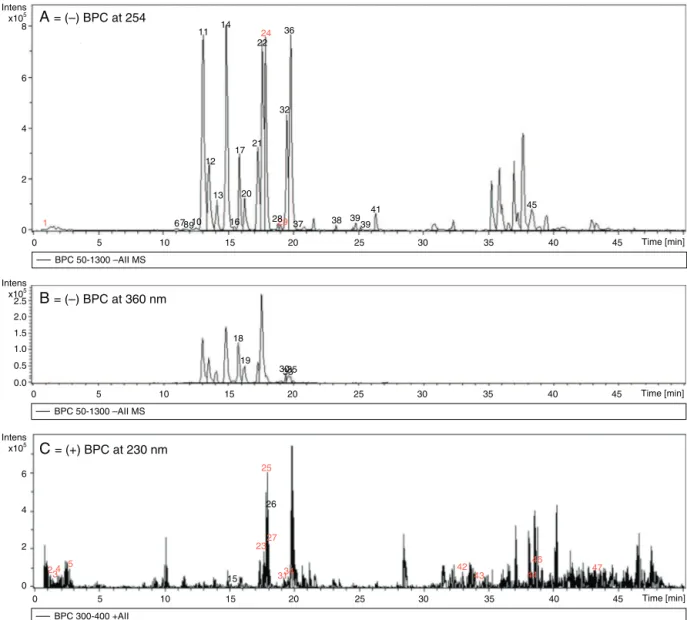
Fig.1.HPLC-ESI-MS/MSbasepeakchromatograms(BPC)ofthecrudeethanolicextractoftheflowersofS.securidacaL.recordedat254nm(A)and360nm(B),negativeion mode,andat230nm(C),positiveionmode.PeaknumbersfollowthoselistedinTable1.
HPLC-DAD-MS/MSanalysisofphenoliccompounds
TheHPLC-DAD-MS/MSanalysiswascarriedoutin both
neg-ative and positive ionizationmodes. The HPLC-DAD base peak
chromatograms(BPC)recordedat254nm(A),360nm(B)inthe
negativemodeandBPCinthepositivemodeobtainedat230nm
(C)areshowninFig.1.Theidentities,retentiontimesandobserved
molecularandfragmentionsforindividualcompoundsare
pre-sentedinTable1.
Atotalof47phenoliccompoundshavebeententatively
iden-tifiedbycomparingretentiontimesandMSdataofthedetected
peakswiththatreportedintheliteratureandbysearching
phyto-chemicaldictionaryofnaturalproductsdatabase(CRC).Identified
compoundsbelongedtovariousclasses(Table1)includingeight
phenolicacidsand39flavonoids.Thephenolicacidsincludedthree
hydroxybenzoicacids(salicylicacid,gallicacidandprotocatechuic
acid)andfourhydroxycinnamicacidderivatives(trans-cinnamic
acid,caffeicacid,chlorogenicacidandp-coumaricacid),inaddition
toellagicacid.Flavonoidswerepresentmostlyasflavones
(includ-ingbothO-andC-glycosideswithapigeninorluteolinasaglycone)
andflavonols(derivedfromtheaglycones;quercetin,kaempferol
andisorhamnetin),flavanones(naringeninandhesperitinandtheir
glycosides). While, only one flavan-3-ol (catechin) was
identi-fied.Sugar moieties consists of hexosides,deoxyhexosides and
pentosidesasdeducedfromthelossof162,146and132,
respectively.
Identificationofflavonoids
SeventeenflavoneswereidentifiedonthebasisoftheirMS/MS
fragmentation.Threecompoundsweremono-C-glycosylflavones
(peaks7,17and21)producingMSfragmentationpatterns
charac-teristictoC-glycosidesflavonoidsincludingdehydrationandcross
ringcleavageoftheglucosemoietythatproducing0,2crossring
cleavage [(M−H)-120]and 0, 3 cross ring cleavage[(M−H)-90]
(Figueirinhaetal.,2008).Compounds7,17and21showed
pseu-domolecularionsatm/z448,m/z448andm/z431,respectively,
andexhibitedtypicalfragmentationpatternsofC-glycosides,hence
theywereassignedasorientin,isoorientinandisovitexin,
respec-tively.
Peaks 13 and 18 were di-C-glycosyl flavones and showed
fragmentationpatternof[(M−H)-18],[(M−H)-90],[(M−H)-120],
[aglycone+113], and [aglycone+83] found in negative mode
R.M.Ibrahimetal./RevistaBrasileiradeFarmacognosia25(2015)134–141
pseudomolecularionatm/z593andcharacteristicfragmentions
at 575 [(M−H)-18], 503[(M−H)-90], 473[(M−H)-120], and 383
[(M−H)-90–120].
Compound18wasidentifiedasisochaftoside(6-C
-pentosyl-8-C-hexosylapigenin)(Figueirinhaetal.,2008;Zhangetal.,2011).
It showed a pseudomolecular ion at m/z 564 and a
fragmen-tation pattern typical of the asymmetric di-C-glycosides. MS2
datashowedfragmentsatm/z473[(M−H)-90]and443[(M−
H)-120], indicating the presence of a C-hexosyl unit. In the same
spectrumafragmentwasobservedatm/z503[(M−H)-60],
cor-respondingtothefragmentationofapentose.Thebasepeakat
m/z 473 [(M−H)-90] and the high abundance of the fragment
atm/z503[(M−H)-60]revealedthepresenceof a6-Cpentosyl
unit.Theionsatm/z353(aglycone+83)and383(aglycone+113)
supportedtheconclusionthatapigenin(MW270)wasthe
agly-cone.
SixcompoundswereidentifiedasO-glycosylflavones(peaks9,
10,28,39,40and41)andshowedfragmentationpatternbeginning
withthecleavageoftheO-sugarbond(Zhangetal.,2011).Five
com-poundswereidentifiedasO-,C-glycosylflavones(compounds11,
12,14,20and22)producingacharacteristicfragmentionsofO-,
C-glycosylflavonesat[(M−H)-120],[(M−H)-90]and[(M−H)-162]
or[(M−H)-146](Figueirinhaetal.,2008;Zhangetal.,2011).For
example,isoorientin-2′′-O-rhamnoside(20)hada
pseudomolecu-larionatm/z593thatrevealsaluteolinglycosidewithahexoseand
deoxyhexose.Fragmentsatm/z447[(M−H)-146],corresponding
tolossofonedeoxyhexoseandanotheratm/z429[(M−
H)-146-H2O]correspondingtothelossofrhamnose+H2Owereobserved.
In addition,the absenceof the aglyconeion is consistent with
anO-,C-diglycosidestructure(Figueirinhaetal.,2008).MS2data
alsoexhibitedfragmentsatm/z473[(M−H)-120](basepeak)and
a minor ion atm/z 503[(M−H)-90],which indicated the
pres-enceofaC-glucosylunit.Compound11(isovitexin-4′-O-glucoside)
exhibited apseudomolecular ion atm/z 593witha
fragmenta-tionpattern ofapigenindihexoside and characteristic fragment
ionsofO-,C-glycosylflavoneswiththelossofaO-hexosylmoiety
(−162).
Eighteen flavonols were identified in the ethanolic extract
ofthe flowersofS. securidaca.The identificationofthese
com-poundswasfacilitatedbytheanalysisoffragmentationpathways
of(M−H)−/(M+H)+ ionsin thenegativeandpositive ionmodes
and the observation of glycosidic residues (rhamnosyl (146)
and glucosyl (162)) werecleaved sequentiallyand generated
characteristicaglyconefragmentscompared totheavailable
lit-erature.Amongthesecompoundsfivecompoundswereidentified
askaempferolglycosides(6,15,30,32and35)and sevenwere
identifiedasglycosidesofquercetin(8,24,26,31,33,38and45).
Inaddition,fourisorhamnetinglycosides(16,19,36and37)were
identified.
Flavanonesusually occuras O-glycosyl derivatives,withthe
sugarmoietyboundtotheaglyconehydroxylgroupateitherC-7or
C-3.Amongthesecompounds,theO-diglycosidesareadominant
categoryandtheirstructuresareusuallycharacterizedbythe
link-ageofeitherneohesperidoseorrutinosetotheflavonoidskeleton.
Compound23wasfoundtobetheneohesperidosidenaringin.The
precursorandproductionsofthiscompoundwerem/z579and
271, respectively,indicating thelossofO-diglycoside(m/z308)
(Zhangetal.,2011)andcompound29wasfoundtobethe
ruti-nosidehesperidinwithprecursorandproductionsofm/z609and
299,respectively.
Oneflavan-3-olwasidentified,compound5,whichproduceda
protonatedmolecularionpeakatm/z(292)andyieldedfragment
ionsatm/z245,205,and179characteristicfor(+)-catechin.The
fragmention atm/z245,correspondingto[M+H-44]+,was
pro-ducedbythelossofa(CH)2OHgroupfromthecatechinmolecule
(Sunetal.,2007).
Identificationofphenolicacids
Eight phenolic acids belonged to various classes have been
identifiedbycomparingtheirretentiontimesandfragmentation
patternswiththatreported(Sánchez-Rabanedaetal.,2003;Sun
etal.,2007).Inthepositiveionmodehydroxybenzoicacids
pro-ducedaprotonated[M+H]+moleculeanda[M+H-44]+fragmention
vialossofaCO2groupfromthecarboxylicacidmoiety(Sunetal.,
2007).Threehydroxybenzoicacidshavebeenidentified;salicylic
acid,gallicacid,andprotocatechuicacid(2,3,and4).
Four hydroxycinnamic acids were identified; trans-cinnamic
acid,caffeicacid,chlorogenicacidandp-coumaricacid(1,44,46
and47).Caffeicandp-coumaricacidsproducedprotonated
molec-ularionsatm/z179and165,respectively,andMS2spectradueto
lossofCO2groupfromthecarboxylicacidfunction(fragmentions
atm/z135and119,respectively,[(M−H)-44])(Sunetal.,2007).
Chlorogenicacidshowedamolecularionpeakat(m/z353)anda
fragmentationionthatcorrespondingtothedeprotonatedquinic
acid(m/z191)(Sunetal.,2007).Compound27hadan[M+H]+ion
atm/z303whichyieldedamajorionatm/z301andminorionsat
m/z284,257,and229characteristicofellagicacidfragmentation
(SandhuandGu,2010).
QuantitativedeterminationofsomephenoliccompoundsinS. securidacaflowers
Absolute quantification of phenolics using the available
standardswascarriedout(Table2).Eightphenolicacidsi.e.trans
-cinnamicacid(2.36±0.98mg/100g),salicylicacid(15.54±1.91),
protocatechuicacid(34.4±0.155),ellagicacid(13.47±3.95),
caf-feicacid(5.4±1.43),chlorogenicacid(84.22±2.08),p-coumaric
acid(7.58±1.51)andgallicacid(9.5±0.14)weredetermined.In
additiontosevenflavonoidsi.e.isoquercetrin(3340±2.1),naringin
(19.73±3.016), hesperidin (32.098±2.28), luteolin (10.247±
0.594),quercetin(1.16±0.022),kaempferol (0.62±0.129),
cate-chin(39.44±5.73)andhesperetin(0.109±0.013).
Acutetoxicity
TheethanolicextractoftheflowersofS.securidacawasfound
tobesafeuptoadoseof2g/kgbwtwithnomortalityorsignsof
behavioralchangesortoxicityobservedwhichsuggestsitssafety
(Osweileretal.,1985).
Table2
QuantificationsofsomephenoliccompoundsidentifiedinS.securidacausingHPLC analysis.
Compound *Concentration(mg/100g)
trans-cinnamicacid 2.36±0.98
Salicylicacid 15.54±1.91
Protocatechuicacid 34.4±0.15
Naringin 19.73±3.01
Ellagicacid 13.47±3.95
Luteolin 10.24±0.59
Isoquercetrin 3340±2.1
Quercetin 1.16±0.02
Kaempferol 0.62±0.12
Caffeicacid 5.4±1.43
Catechin 39.44±5.73
Hesperidin 32.09±2.28
p-Coumaricacid 7.58±1.51
Hesperetin 0.10±0.01
Gallicacid 0.95±0.014
Chlorogenicacid 8.42±2.08
R.M.Ibrahimetal./RevistaBrasileiradeFarmacognosia25(2015)134–141
350
A
B
Anti-hyperglycemic activity
Anti-hyperlipidemic activity @
@ @
* *
* *
* *
* * *
Normal Diabetic Gliclazide (5 mg/kg)
Dose I (100 mg/kg)
Dose II (200 mg/kg)
Dose III (400 mg/kg)
Serum triacylglycerides (mg/dl) Serum cholesterol (mg/dl) *
* *
250
150
50
0
0
Nor mal
Diabetic
Gliclazide (5 mg/kg)Dose I (100 mg/kg)
Dose II (20
0 mg/kg)
Dos e III
(400 m g/kg) 50
100 200 250
150 100
Ser
um glucose le
vel (mg/dl)
Concentr
ation (mg/dl)
200 300
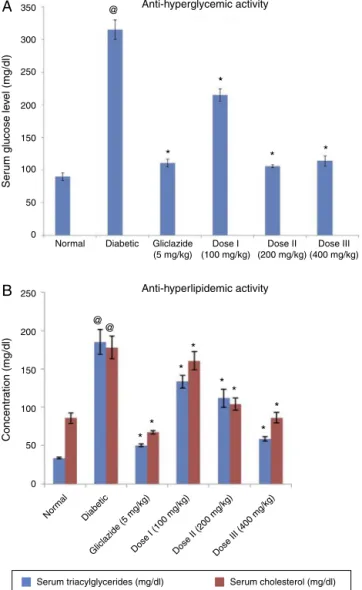
Fig.2. BiologicalactivitiesoftheethanolicextractoftheflowersofS.securidacaL. (A)Effectonserumglucoselevelinalloxan-inducedhyperglycemicrats.(B)Serum triacylglyceridesandcholesterollevelsinalloxan-inducedhyperglycemicrats. @Significantdifferencefromnormalratsp<0.05,*Significantdifferencefrom hyper-glycemicratsp<0.05.
Anti-hyperglycemicactivity
The ethanolic extract of the flowers showed marked anti-diabeticactivityonbloodglucoselevelsinalloxan-induceddiabetic ratsatalltesteddoses100,200and400mg/kgbwtwith poten-ciesof 31.78, 66.41and 63.8% respectively (Fig. 2A).The most
potentreductioninserumglucoselevelwasrecordedwithadose
of200mg/kgbwtcomparedtoGliclazideatadoseof5mg/kgbwt
(64.85%).
Anti-hyperlipidemicactivity
Theethanolicextractoftheflowersexhibitedpotent
hypolipi-demic effect on the elevated serum triacylglycerides and
cholesterollevelsinalloxaninducedhyperglycemicrats(Fig.2B)
with39.68%and41.46%decreasesinserumtriacylglyceridesand
cholesterollevelsatdose200mg/kg,68.46%and51.50%fordose
400mg/kg,comparedtogliclazideatdoseof5mg/kgbwt
show-ingreductioninserumtriacylglyceridesandcholesterollevelswith
73.01%and62.20%,respectively.
Diabetesmellitusisacomplexdisorderthatcharacterizedby
chronichyperglycemiaanddyslipidemia.Thediseasebecomesa
realproblemofpublichealthindevelopingcountries,whereits
prevalenceisincreasingsteadilyandadequatetreatmentisoften
expensiveorunavailable. Resultsof thepresent studyrevealed
thatalloxan-inducedhyperglycaemiaisassociatedwithmetabolic
changes.Alloxaninduceschemicaldiabetesinratsbydamaging
insulinsecretingpancreatic-cellsleadingtodecreaseininsulin
release(Kimetal.,2006).
Hyperlipidaemiaisamajorcharacteristicofdiabetes(Pushparaj
etal.,2000).DMinducedhyperlipidaemiaisattributabletoexcess
mobilizationoffatfromtheadiposetissueduetotheutilizationof
theglucose.Moreover,studiessuggestedthathyperlipidemiaisone
ofthemostcommonfeaturesinalloxan-inducedhyperglycaemia
inexperimentalrats(Krishnakumaretal.,2000).Inthisstudy,an
increaseinthelevelsoftotalcholesterolandtriglycerideshasbeen
observedinalloxan-inducedhyperglycaemicrats.Plantsusedin
traditionalmedicinetotreatdiabetesmellitusrepresenta
valu-ablealternativeforthecontrolofthisdisease(KumarandVerma,
2011).Inthepresentstudy,weevaluatetheacutetoxicity,
anti-hyperglycemicandhypolipidemiceffectsoftheethanolicextract
oftheflowersofS.securidacaL.Moreover,thephenoliccomposition
oftheextractwascharacterizedusingHPLC-DAD-ESI/MStechnique
tohelpinchemicalprofilingandstandardizationoftheextract.Oral
treatmentofhyperglycemicratswiththeethanolicextractofthe
flowers(100,200and400mg/kgbwt)significantlydecreasedthe
elevatedserumglucoselevelaswellasserumtotalcholesteroland
triglycerideslevelsindiabeticratswithpotenciescomparableto
gliclazide.Hence,wecouldsaythatextracthadbeneficialeffects
oncarbohydratemetabolisminhyperglycaemicrats.
HPLC-DAD-ESI/MSanalysisrevealedthattheethanolicextract
containscomplexmixtureofphenoliccompoundsincluding
differ-entclassesofphenolicacidsandflavonoids.Mostofthedetected
phenolic compoundswere reportedtohave anti-diabeticeffect
thoughdifferentmechanisms.Isovitexin,luteolin7-O-glucoside,
hyperoside and isorientin were reported to possess
antihyper-glycemicaction(Brahmachari,2011;delPilarNicasio-Torresetal.,
2012;Foladoretal.,2010).Vicenin-2wasreportedtobean
antiox-idantthatstronglyinhibited␣-glucosidaseandexhibitedpotent
anti-glycation properties (Islam et al.,2014). Isoquercetrin and
astragalinwerefoundtobeglycationinhibitorshavingcomparable
activitytothatofaminoguanidine(Brahmachari,2011).Rutinwas
reportedtopossesspotenthypoglycemicandhypolipidemic
activ-itiesbyenhancingperipheralglucoseutilizationbyskeletalmuscle
andstimulationof-cells(JadhavandPuchchakayala,2012).
The respective aglycones, quercetin and kaempferol were
found toimprove insulin-stimulated glucose uptake in mature
adipocytes(Figueirinhaetal.,2008).Isorhamnetin-3-O-glucoside
wasreportedtolowerserumglucoseconcentration,sorbitol
accu-mulationinthelenses,redbloodcellsbyexertingpotentinhibitory
activity against rat lens aldose reductase,leading to improved
diabeticcomplications(Brahmachari,2011).Rutinandhesperidin
were reportedto preventtheprogression of hyperglycemiaby
increasinghepaticglycolysis,glycogenconcentrationand
lower-inghepaticgluconeogenesis(Jungetal.,2004).Throughadocking
study,catechinshowedpotentialagonistcharacteristictoinsulin
receptor (insulin mimetic) (Pitchai and Manikkam, 2012).
Gal-licacidwasreportedtohavehypoglycemicandhypolipidaemic
effects against streptozotocin induced diabetic rats (Latha and
Daisy,2011),whilechlorogenicacidwasreportedtoexhibit
hypo-glycemic, hypolipidemic, and antioxidant properties (del Pilar
Nicasio-Torresetal.,2012).
Conclusion
In this workwe have evaluatedtheanti-hyperglycemic and
R.M.Ibrahimetal./RevistaBrasileiradeFarmacognosia25(2015)134–141
flower.Phenolicacidsandflavonoidsextractedwith90%ethanol
havebeenidentifiedandquantified.Theethanolicextractofthe
flowerswassafeuptodoseof2g/kg.Theextractshowedpotent
anti-diabeticandhypolipidemiceffectinalloxaninduced
hyper-glycemicinrats.Thecurrentresultsindicatethatthe
flavonoid-andphenolicacid-richextractofS.securidacaflowersisapromising
naturalpharmaceuticalforcombatingdiabetes.
Conflictsofinterest
Theauthorsdeclarethattheyhavenocompetinginterests.
Author’scontributions
RIwrotethemanuscript,carriedoutextractionproceduresand
analyzeddata.AMwrotethemanuscript,planedtheworkand
ana-lyzeddata.DScarriedoutbiologicalactivity.ENcarriedoutLCMS
analysisandinterpreteddata.AErevisedthemanuscriptand
super-visedwork.SEsuggestedthepointandrevisedthemanuscript.
References
Ali,A.A.,Mohamed,M.H.,Kamel,M.S.,Fouad,M.A.,Spring,O.,1998.Studies on Securigerasecuridacea(L.) Deg. et Dorfl. (Fabaceae) seeds an antidiabetic Egyp-tian folk medicine. Pharmazie 53, 710–715.
Allain,C.,Poon,L.,Chan,C.,Richmond,W.,Paul,C.,1974.Enzymatic determination of total serum cholesterol. Clin. Chem. 20, 470–475.
Azarmiy,Y.,Zakheri,A.,Alaf,A.,Fathiazad,F.,Fakhrjou,A.,Andalib,S.,Maaleki,D., Babaei,H.,Garjani,A.,2009.TheeffectoftotalextractofSecurigerasecuridacaL. seedonthoracicaortafunctioninhigh-fatfedrats.Pharm.Sci.15,83–92. Bahadoran, Z., Mirmiran, P., Azizi, F.,2013. Dietarypolyphenols as potential
nutraceuticalsinmanagementofdiabetes:areview.J.DiabetesMetab.Disord. 12,43.
Brahmachari,G.,2011.Bio-flavonoidswithpromisingantidiabeticpotentials:a criticalsurvey.In:Opportunity,ChallengeandScopeofNaturalProductsin MedicinalChemistry.ResSignpost,Trivandrum,Kerala,India,pp.187–221. delPilarNicasio-Torres,M.,Meckes-Fischer,M.,Aguilar-Santamaría,L.,
Gardu˜no-Ramírez,M.,Chávez-Ávila,V.,Cruz-Sosa,F.,2012.Productionofchlorogenic acidandisoorientinhypoglycemiccompoundsinCecropiaobtusifoliacalliand incellsuspensioncultureswithnitratedeficiency.ActaPhysiol. Plant.34, 307–316.
Fathi,A.F.,Alaf,A.N.,Zakheri,A.,Andalib,S.,MalekiDizaji,N.,GharahBaghian,A., Ghorbani,H.A.,Fakhrjou,A.,Garjani,A.,2010.Hypolipidemic and antioxidant effects of SecurigerasecuridacaL. seed in high fat fed rats. Pharm. Sci. 15, 293–301. Figueirinha, A., Paranhos, A., Pérez-Alonso, J., Santos-Buelga, C., Batista, M., 2008. Cymbopogon citratus leaves characterization of flavonoids by HPLC-PDA-ESI/MS/MS and an approach to their potential as a source of bioactive polyphenols. Food Chem. 110, 718–728.
Folador,P.,Cazarolli,L.,Gazola,A.,Reginatto,F.,Schenkel,E.,Silva,F.,2010.Potential insulin secretagogue effects of isovitexin and swertisin isolated from Wilbrandia ebracteataroots in non-diabetic rats. Fitoterapia 81, 1180–1187.
Fossati,P.,Prencipe,L.,1982.Serumtriglyceridesdeterminedcolorimetricallywith anenzymethatproduceshydrogenperoxide.Clin.Chem.28,2077–2080. Goupy,P.,Hugues,M.,Boivin,P.,Amiot,M.,1999.Antioxidantcompositionand
activityofbarley(Hordeumvulgare)andmaltextractsandofisolatedphenolic compounds.J.Sci.FoodAgric.79,1625–1634.
Hertog,M.,Hollman,P.,Katan,M.,1992.Contentofpotentiallyanticarcinogenic flavonoidsof28vegetablesand9fruitscommonlyconsumedintheNetherlands. J.Agric.FoodChem.40,2379–2383.
Hosseinzadeh,H.,Ramezani,M.,Danaei,A.R.,2002.Antihyperglycaemiceffectand acutetoxicityofSecurigeraSecuridacaL.seedextractsinmice.Phytother.Res. 16,745–747.
IDF,2011. DiabetesAtlas. 5th ed. InternationalDiabetes Federation, Brussels, Belgium.
Islam,M.N.,Ishita,I.J.,Jung,H.A.,Choi,J.S.,2014.Vicenin2isolatedfromArtemisia capillarisexhibitedpotentanti-glycationproperties.FoodChem.Toxicol.69, 55–62.
Jadhav,R.,Puchchakayala, G.,2012. Hypoglycemicand antidiabeticactivityof flavonoids:boswellic acid,ellagic acid,quercetin, rutinon streptozotocin-nicotinamideinducedtype2diabeticrats.Inter.J.PharmacyPharm.Sci.4, 251–256.
Jung,U.J.,Lee,M.K.,Jeong,K.S.,Choi,M.S.,2004.Thehypoglycemiceffectsof hes-peridinandnaringinarepartlymediatedbyhepaticglucose-regulatingenzymes in C57BL/KsJ-db/db mice. J. Nutr. 134, 2499–2503.
Kim,J.,Ju,B.,Choi,W.,Kim,S.,2006.Hypoglycemic and anti-hyperlipidemic effect of four Korean medicinal plants in alloxan induced diabetic rats. Am. J. Biochem. Biotechnol. 2, 154–160.
Krishnakumar,K.,Augusti,K.,Vijayammal,P.,2000.Anti-peroxidative and hypo-glycaemic activity of Salaciaoblongaextract in diabetic rats. Pharm. Biol. 38, 101–105.
Kumar,M.,Verma,D.,2011.Anti-diabetic and anti-hyperlipidemic effect of Morinda citrofoliaand Cocciniaindicain alloxan induced diabetic rats. Pharmacol. Online 2,307–311.
Latha, R., Daisy, P., 2011. Insulin-secretagogue antihyperlipidemic and other protectiveeffectsof gallicacid isolatedfrom Terminaliabellerica Roxb.in streptozotocin-induceddiabeticrats.Chem.Biol.Interact.189,112–118. Lorke,D.,1983.Anewapproachtopracticalacutetoxicitytesting.Arch.Toxicol.54,
275–287.
Mahdi,P.,Mohammad,E.,Ali-Akbar,M.,Karim,P.,2011.Tostudytheeffectsof Securigerasecuridaca(L.)seedagainstalloxan-inducedhyperglycemia.J.Med. PlantsRes.5,3188–3191.
Mattila,P.,Astola,J.,Kumpulainen,J.,2000.Determinationofflavonoidsinplant materialbyHPLCwithdiode-arrayandelectro-arraydetections.J.Agric.Food Chem.48,5834–5841.
Meenakshi,S.,Manicka,G.,Tamil,M.,Arumugam,M.,Balasubramanian,T.,2009. Total flavanoid and in vitro antioxidant activity of two seaweeds of Ramesh-waram coast. Glob. J. Pharmacol. 3, 59–62.
Neshwari,D.,Biren,S.,Singh,S.,Singh,C.,Lukesh,D.,Amitabh,D.,2012. Antihy-perglycemic effect of aqueous and ethanol extract of aerial part of Osbeckia nepalensishook in alloxan induced diabetic rats. Int. J. PharmTech Res. 4, 233–244.
Osweiler,G.,Carson,T.,Buck,W.,VanGelder,G.,1985.Clinical and Diagnostic Vet-erinary Toxicology. Kendall/Hunt Publishing Company.
Pitchai,D.,Manikkam,R.,2012.Hypoglycemic and insulin mimetic impact of cat-echinisolatedfromCassiafistula:asubstantiateinsilicoapproachthrough dockinganalysis.Med.Chem.Res.21,2238–2250.
Porchezhian,E.,Ansari,S.,2001.EffectofSecurigerasecuridacaonbloodglucose levelsofnormalandalloxan-induceddiabeticrats.Pharm.Biol.39,62–64. Pushparaj,P.,Tan,C.,Tan,B.,2000.EffectsofAverrhoabilimbileafextractonblood
glucoseandlipidsinstreptozotocin-diabeticrats.J.Ethnopharmacol.72,69–76. Sánchez-Rabaneda,F.,Jáuregui,O.,Casals,I.,Andrés-Lacueva,C.,Izquierdo-Pulido, M.,Lamuela-Raventós,R.M.,2003.Liquidchromatographic/electrospray ioniza-tiontandemmassspectrometricstudyofthephenoliccompositionofcocoa) Theobromacacao).J.MassSpectrom.38,35–42.
Sandhu,A.,Gu,L.,2010.Antioxidantcapacity,phenoliccontent,andprofilingof phenoliccompoundsintheseeds,skin,andpulpofVitisrotundifolia (musca-dinegrapes)asdeterminedbyHPLC-DAD-ESI-MSn.J.Agric.FoodChem.58, 4681–4692.
Siger,A.,Nogala-K,Lampart-Szczapa,E.,2008.The content and antioxidant activity of phenolic compounds in cold-pressed plant oils. J. Food Lipids. 15, 137–149. Sun,J.,Liang,F.,Bin,Y.,Li,P.,Duan,C.,2007.Screening non-colored phenolics in red
wines using liquid chromatography/ultraviolet and mass spectrometry/mass spectrometry libraries. Molecules 12, 679–693.
Trinder,P.,1969.Determination of blood glucose using 4-aminophenazone as oxy-gen acceptor. J. Clin. Pathol. 22, 246.
Zahedi-Asl,S.,Marahel,H.,Zaree,B.,2005.Study on the effects of chloroformic extractofSecurigerasecuridacaonserumglucoselevelandliverglycogen con-tentofmice.J.KermanUniv.Med.Sci.12,32–38.