Resumo
O objetivo do estudo foi analisar programas de atenção domiciliar na saúde suplementar do ponto de vista do direito à saúde, a partir de estudo de casos, de natureza qualitativa, desenvolvido em quatro operadoras de saúde no município de Belo Horizonte, Minas Gerais. Os dados empíricos foram obtidos de entrevistas com gestores de operadoras e prestadoras que ofertam programas de atenção domiciliar. Os resultados são discutidos a partir de três eixos analíticos: a oferta da atenção domiciliar e os desafios da universalização do direito à saúde; a relação da saúde suplementar com o sistema público de saúde e com as famílias; e a judicialização como caminho para se garantir o direito à saúde no cam-po da atenção domiciliar na saúde suplementar. A desregulamentação da atenção domiciliar na saúde suplementar foi revelada como um desafio para a garantia do direito à saúde, prevalecendo a oferta segundo os interesses das operadoras que adotam estratégias para evitar a judicialização, como, por exemplo, não divulgar o benefício. A suspensão da assistência por decisão unilateral da operadora e a transferência de responsabilidades para o sistema público de saúde e para as famílias afrontam o direi-to dos usuários de receber serviços na modalidade que melhor responda a determinadas situações de saúde. Conclui-se que a atenção domiciliar na saúde suplementar é permeada por tensões que eviden-ciam a urgência de maior regulamentação no campo. Palavras-chave: Cuidados domiciliares de saúde; Regulamentação governamental; Planos de pré--pagamento em saúde.
Kênia Lara Silva
PhD. in Nursing. Adjunct Professor of the School of Nursing, Federal University of Minas Gerais
Address: Rua Furtado Nunes, 131/101, Padre Eustáquio, CEP 30730-090, Belo Horizonte, MG, Brazil.
E-mail: [email protected]
Roseni Rosângela Sena
PhD. in Nursing. Professor Emeritus of the School of Nursing, Federal University of Minas Gerais
Address: Rua Palmira, 78/801, Serra, CEP 30220-110, Belo Horizonte, MG, Brazil.
E-mail: [email protected]
Laura Camargo Macruz Feuerwerker
PhD. in Public Health. Associate Professor of the School of Public He-alth, Department of Public Health Practice, University of Sao Paulo Address: Alameda Fernão Cardim, 317/71, CEP 01403-020, São Paulo, SP, Brazil.
E-mail: [email protected]
Caroline Gomes de Souza
B.S. in Management of Health Services, Federal University of Minas Gerais
Address: Rua Antônio José de Oliveira, 320/202, Parque São Pedro, CEP 31610-300, Belo Horizonte, MG, Brazil.
E-mail: [email protected]
Paloma Morais Silva
M.S. in Nursing, School of Nursing, Federal University of Minas Gerais. Researcher at NUPEPE.
Address: Rua David Maurílio Mourão, 213, Palmeiras, CEP 30575-340, Belo Horizonte, MG, Brazil.
E-mail: [email protected]
Andreza Trevenzoli Rodrigues
M.S. in Nursing, School of Nursing, Federal University of Minas Gerais. Researcher at the Center for Research, Teaching and Practice in Nursing, Federal University of Minas Gerais
Address: Rua Eufrásia Augusta de Jesus, 396, Santa Helena, CEP 32015-220, Contagem, MG, Brazil.
E-mail: [email protected]
1 Financial Institution: National Council for Scientific and Tech-nological Development (CNPq).
The right to health: challenges revealed by the
home care provision in supplementary health
services
1
Abstract
This study analyzes home care in supplementary he-alth programs from the right-to-hehe-alth perspective. A qualitative case study was conducted in four heal-th operationsoperators in heal-the municipality of Belo Horizonte, Minas Gerais State. Empirical data was collected via interviews with health operators and health providers offering home care services. The results were discussed according to three analytical criteria: provision of home care and challenges to the universal right to health; supplementary health relationship with the public health system and with families; and judicialization as a way of protecting the right to home care in supplementary health pro-grams. Home care deregulation in supplementary health programs was exposed as a challenge to the right to health because this service provision is un-derhealth operators’ control. These operators deve-lop ways to avoid judicialization, such as providing home care services as an undisclosed benefit. The service disruption caused by the private operators’ unilateral decisions and the transfer of responsibi-lity to the public health system and families affronts the user’s right to care that addresses specific health conditions. In conclusion, home care in supplemen-tary health programs is permeated by tensions that highlight the need for urgent regulation.
Keywords: Home Care; Government Regulation; Prepaid Health Plans.
Introduction
Regulation of health as a social right is relatively recent in Brazil. The promulgation of the Federal Constitution of 1988 was a milestone in national democracy; however, it raised other challenges to secure social rights. The creation and implementa-tion of the Unified Health System (UHS) still faces challenges, especially with regard to financial re-sources, assignment of responsibilities within the government sectors, and the relationship between public and private subsystems.
The private health subsystem, designated Sup-plementary Health (SH) services, comprises health services and activities provided by private health organizations. In Brazil, SH services began their expansion in the 1970s by selling services to pension plans. Its growth intensified starting with the crisis of the government-based healthcare model and by the consolidation of the corporate-based healthcare system (Andrade et al., 2009).
The private sector has the constitutional right to provide health services as a complement to the public system and in accordance with the guidelines and principles of UHS. By defining health services and activities as socially important, the Federal Constitution assigns to the state the responsibility for their regulation, supervision, and control. This applies to all services and activities, even if their implementation is not directly executed by the go-vernment, but through contracts or agreements of either individual or corporate entities (Brasil, 1988).
their relationships with healthcare providers and consumers, and contribute to the development of healthcare actions at the national level.
Regulatory activities in this sector have been marked by major disagreements. In public health, there is no consensus on the importance of bringing private healthcare services closer to NHS principles. In addition, there is a strong pressure for minimal market regulation, although internationally health-care is recognized as an inconsistent market, which requires regulation (Alves et al., 2009).
These factors explain the lethargy and inconsis-tencies of regulatory activities. As a consequence, SH operators are not reimbursed because of the unprofitable health procedures that are transferred to the public system. Moreover, there are neither established criteria nor cost-effective mechanisms to incorporate new technologies to the system. Re-garding the latter, we continue to be guided by the market with some regulatory intervention by the National Agency for Sanitary Surveillance (Agência Nacional de Vigilância Sanitária - ANVISA).
In the period 2005–2009, efforts to regulate the quality of SH were intensified through the Qualifi-cation Program for Supplementary Health (Brasil, 2012) by evaluating the extent of healthcare activi-ties and the quality of results obtained. However, usually the main focus on the effective regulation has been directed to mandatory health procedures, healthcare service charges, and more recently, the waiting time for healthcare services by healthcare providers.
As a result, we observe significant heterogeneity in quality standards of health service sectors; the-refore, beneficiaries have little access to relevant information and do not receive guidance on the subject. Among the shortcomings of the regulatory process, we highlight the lack of guidelines and actions in Home Care (HC).
Previous studies (Franco and Merhy, 2008; Mar-tins et al., 2009) have shown that, under the label of HC, health operators have included extended services that satisfy the extensive needs of benefi-ciaries who are not completely satisfied by the usual healthcare services, such as medical appointments, emergency care, and hospitalization. In general, high operating costs for the production of medical
and hospital procedures have triggered the provision of extended services.
Considering that HC services are neither part of the mandatory procedures nor regulated by ANS, health operators use this “umbrella,” electing crite-ria to include beneficiaries in HC programs, which are offered as added benefits. Healthcare operators who offer SH services are regulated only by ANVI-SA through Board Resolution No. 11/2006 (Brasil, 2006), which explains organizational aspects of HC, but does not establish either contracting criteria or regulatory mechanisms.
In SH services, as well as within the public sys-tem, healthcare service beneficiaries frequently file lawsuits for healthcare coverage, decrease in grace periods, unilateral termination of contracts, and unlimited hospitalization time. This is indicative of not only the health rights in dispute but also the limitations of health regulation and the absence of well-defined criteria for technological incorporation (Alves et al., 2009).
SH care models are known to be very diverse. Health operators’ regulation of contracting between beneficiaries and healthcare providers defines di-fferent formats for the establishment of healthcare. In this context, the structure of HC is based on the organization of SH services: responding to healthca-re needs but concomitantly being influenced by the economic and financial market (Franco et al., 2007). In this unpredictable territory characterized by the lack of specific regulations, rights in dispute (Souza et al., 2007), and healthcare needs not met by traditional healthcare models, we propose the study of HC practices in SH in Belo Horizonte in addition to that of the right to health.
Methods
characteristics: particularity (study of a particular phenomenon or situation), description (complete description of the investigated situations), heuristic (discovery or confirmation of previously existing meanings), and induction (construction of an in-ductive logic in understanding data) (André, 2005). To delineate the scope of the study, an initial ma-pping was conducted through a structured question-naire directed to health operators who were located or doing business in Belo Horizonte, Minas Gerais, to identify operators offering HC. In the second pha-se of the study, among the operators surveyed, four were selected for in-depth assessment: one operator was a self-management model, one was a medical cooperative, and the remaining two worked with group medicine. All of them provided prominent HC services within the institution and state capital.
Empirical data were obtained through inter-views with health operators and private healthcare providers, in addition to selected HC coordinators, allowing a detailed study of the event. We also inter-viewed health professionals and HC-eligible health operator beneficiaries.
The empirical material was subjected to an ade-quacy standard analytical strategy, which allows the comparison of a fundamentally empirical pattern with a prognostic-based pattern (Yin, 2005), and explored these findings using three axes: HC and the challenges for universal access to healthcare, rela-tionship with the public health system and families, and legalization to ensure the right to health in SH.
All ethical issues on research involving humans were observed. The project was approved by the Ethics Committee of the Universidade Federal de Minas Gerais, and all participants signed an infor-med consent form.
Results
The empirical findings allowed us to evaluate HC offered by health operators as well as the disa-greements generated by deregulation in the field, challenging the idea of HC as an added benefit, which only serves the interests of health operators, at the expense of the right of access and the needs of beneficiaries.
HC and the challenge of universal access to health The 2010 census reported a population of 2,375,151 inhabitants in Belo Horizonte (IBGE, 2013), of whi-ch approximately 1,237,111 were private healthcare beneficiaries (ANS, 2012).
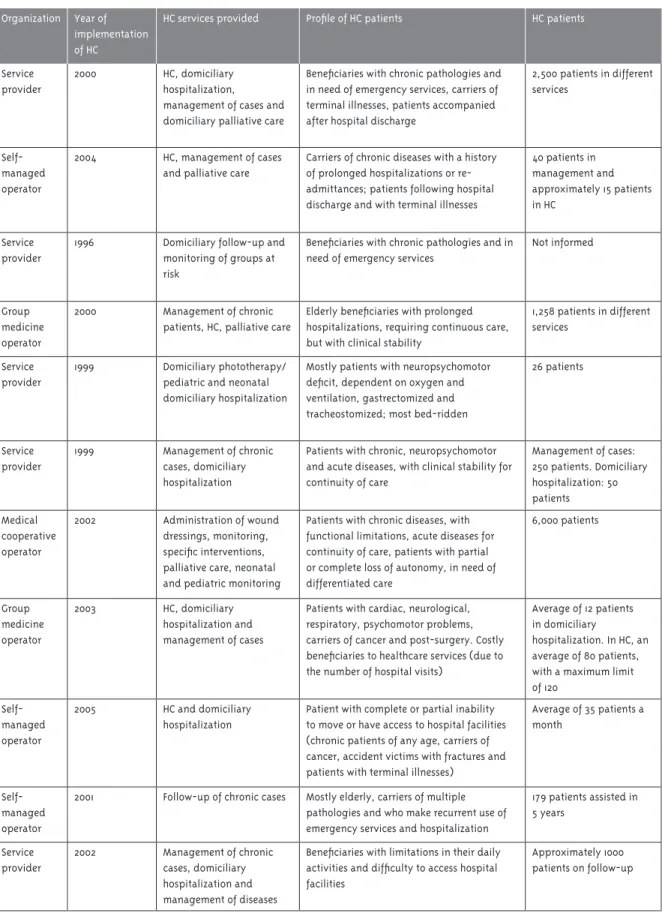
The initial mapping indicated the existence of 57 health operators and providers in Belo Horizonte, of which 38 were based in the city. Among these, 28 offered HC systematically. Of the 28, 12 answered the study questionnaire, allowing us to characterize HC as shown in Table 1. We found that approximately 11,269 patients are HC-assisted by the 12 operators/ providers who answered the questionnaire, which represented 0.62% of healthcare beneficiaries in Belo Horizonte.
Interviews with health operators and coordina-tors in HC have revealed that services are offered to the group who uses emergency and hospitalization services considerably. We identified the demands of this target population as well as the more appro-priate and economically viable solutions (in terms of reduced costs with procedures, hospitalizations, medication etc.), with an aim to extend the periods of clinical stability without complication.
The requirements for HC services vary with heal-thcare service programs. Thus, healheal-thcare operators determine the organization of HC according to di-fferent criteria, which implies distinct contracting criteria with health providers, suppliers, and benefi-ciaries. In this context, we find situations in HC that are as diverse as the monitoring and management of cases (e.g., through telephone follow-ups by the nursing staff) or regular HC by a multidisciplinary team who may transfer technological apparatus to the domicile.
In general, HC is designed preferably for patients with health problems and chronic diseases, mostly the elderly. These patients comprise carriers of chronic wounds, neuromuscular dystrophies, se-quels of cerebrovascular accident, multiple traumas, Alzheimer’s, chronic obstructive pulmonary disease, and cancer without therapeutic possibilities, among others.
Table 1 - Supply of Homecare Services, Belo Horizonte, 2011
Organization Year of implementation of HC
HC services provided Profile of HC patients HC patients
Service provider
2000 HC, domiciliary hospitalization, management of cases and domiciliary palliative care
Beneficiaries with chronic pathologies and in need of emergency services, carriers of terminal illnesses, patients accompanied after hospital discharge
2,500 patients in different services
Self-managed operator
2004 HC, management of cases and palliative care
Carriers of chronic diseases with a history of prolonged hospitalizations or re-admittances; patients following hospital discharge and with terminal illnesses
40 patients in management and approximately 15 patients in HC
Service provider
1996 Domiciliary follow-up and monitoring of groups at risk
Beneficiaries with chronic pathologies and in need of emergency services
Not informed
Group medicine operator
2000 Management of chronic patients, HC, palliative care
Elderly beneficiaries with prolonged hospitalizations, requiring continuous care, but with clinical stability
1,258 patients in different services
Service provider
1999 Domiciliary phototherapy/ pediatric and neonatal domiciliary hospitalization
Mostly patients with neuropsychomotor deficit, dependent on oxygen and ventilation, gastrectomized and tracheostomized; most bed-ridden
26 patients
Service provider
1999 Management of chronic cases, domiciliary hospitalization
Patients with chronic, neuropsychomotor and acute diseases, with clinical stability for continuity of care
Management of cases: 250 patients. Domiciliary hospitalization: 50 patients
Medical cooperative operator
2002 Administration of wound dressings, monitoring, specific interventions, palliative care, neonatal and pediatric monitoring
Patients with chronic diseases, with functional limitations, acute diseases for continuity of care, patients with partial or complete loss of autonomy, in need of differentiated care
6,000 patients
Group medicine operator
2003 HC, domiciliary hospitalization and management of cases
Patients with cardiac, neurological, respiratory, psychomotor problems, carriers of cancer and post-surgery. Costly beneficiaries to healthcare services (due to the number of hospital visits)
Average of 12 patients in domiciliary
hospitalization. In HC, an average of 80 patients, with a maximum limit of 120
Self-managed operator
2005 HC and domiciliary hospitalization
Patient with complete or partial inability to move or have access to hospital facilities (chronic patients of any age, carriers of cancer, accident victims with fractures and patients with terminal illnesses)
Average of 35 patients a month
Self-managed operator
2001 Follow-up of chronic cases Mostly elderly, carriers of multiple pathologies and who make recurrent use of emergency services and hospitalization
179 patients assisted in 5 years
Service provider
2002 Management of chronic cases, domiciliary hospitalization and management of diseases
Beneficiaries with limitations in their daily activities and difficulty to access hospital facilities
patient care, because HC is characterized by a more humane care and a closer relationship among staff, families, and patients.
Respondents from health operator #1 revealed that operator expansion, especially in the last 10 years, prompted the diversification of services in its portfolio, which has included HC as an added benefit since 1999. Initially, operators outsourced HC, but it was replaced by other options of care as it became more costly.
At the time of data collection, operator #1 offe-red six HC programs with distinct objectives and coverage, ranging from simple services such as administration of wound dressings in domiciles to intensive care programs involving the transfer of technological devices to the domicile. Thus, res-pondents have considered HC as a complement, and in some cases, a substitute for other modes of care.
In operator #2, HC was initiated in 2004 as an added benefit and comprised four categories (ma-nagement of chronic patients, HC, domiciliary hos-pitalization, and palliative care). This added benefit is emphasized to the families as follows:
We make it clear to families that this health service is an added benefit, which is not contemplated in the contract. As such, this benefit can be undone any time, and we make it clear to families in which situations this assistance can be undone. This agreement will be made in the form of a Term of Commitment, which should be signed by the bene-ficiaries, and we reiterate that this benefit can be undone any time… (Interview with employee from operator #2)
In this operator, HC was regarded as an alterna-tive to improve the quality of care while reducing costs, confirming the logic previously described in other HC studies (Silva et al., 2012, 2010; Cunha, 2007; Franco and Merhy, 2008; Rehem and Trad, 2005; Santos et al., 2011)
Operator #3 has been offering HC since 2004 as a structured program, which is part of their list of services. The implementation of the program was mainly motivated by the demands of families who might not adjust to situations demanding conti-nuous patient care after hospital discharge. Medical assistants were also concerned with the continuity of care, and reckoned HC as a viable alternative to
shorten hospitalization time of patients who still had some functional restrictions but did not need hospitalization. This implementation was also supported when they considered an increase in hospital re-admittance and emergency care. As in other operators, HC was highlighted as an added benefit, which was not contemplated in the contract:
At the time [of admittance in home care], we talked to him [caregiver] and explained that this is not a health coverage. Some people do not realize that even though this service is not covered in health plans, it is a benefit to health operators and pa-tients. (Interview with employee from operator #3)
HC is recognized as an alternative that is capable of qualifying care, but when offered as a benefit, it does not constitute a right ensured by the purchase of health insurance for all beneficiaries.
In operator #4, HC began in 2000 and was later expanded and modified to incorporate the current features. The creation of the program was motivated by demands from elderly patients with prolonged hospitalization, who required continuous care but had clinical stability. Health operators offered it as an added benefit and not as a contract service.
In general, operators establish eligibility criteria for the inclusion of beneficiaries in HC and restrict access to cases where the transfer of care to domici-les would allow a decrease in healthcare costs. Such delimitation of eligibility criteria for HC is a factor that deserves consideration, because it violates the principle of universal access.
The relationship between offer and demand in the right to health tends to be positive when we consider that it satisfies the health needs of specific groups. However, it is still essential to invest in other assistance modes that, in a large scale, could meet other real demands, such as the elderly population at a risk of falling sick, and groups that currently do not depend on care but are eligible for healthcare services in the operators studied, e.g., adults and younger adults at risk of diabetes and hypertension, among others.
also become a strategy for decentralization of health services, humanization of care, and coparticipation in care (Araújo et al., 2000).
Thus, HC services in SH can have a positive impact on health and quality of life for healthcare beneficiaries by incorporating new care-oriented technologies with a view of improving the current care model (Pereira et al., 2005). However, HC is a benefit and not a right ensured by a health plan, and beneficiaries are elected under operators’ criteria. The analyzed criteria are centered on operators’ economic interests rather than the protection of the beneficiaries’ needs. This condition makes families dependent on the benefit, which is not contractually legal.
Relationship with the public health system and families
Our results revealed several factors contributing to the decreased spending on HC, including deinstitu-tionalization, lesser reliance on hard technology, lower risk of complications such as nosocomial infections, and reduced demand for the multidis-ciplinary team. Moreover, two other elements are fundamental to cost reduction: sharing patient care with families by hiring caregivers and involving families in the acquisition of medication and other supplies. The latter is possible when we consider the noncontractual nature of HC and its lack of consumer protection mechanisms.
Interviewees have reported to involve families in healthcare costs particularly when dealing with cos-tly supplies and procedures, such as oxygen therapy. If not possible, operator auditors will evaluate the ac-tual need of these therapies; if needed, beneficiaries are encouraged to use the public health system. As a last resort, if auditors deliberate on these therapies but the families cannot afford, health operators may provide them, granted that they are indispensable for hospital discharge.
When the patient needs oxygen, the operator may not provide it, but we attempt to obtain it through UHS, after submitting the necessary protocols and forms. If the patient needs medication for Alzheimer’s, we acknowledge that the patient relies on it. There is a protocol for special medications that are distributed by the State Secretariat for
Health, and we fill other forms when requesting each medication. (Interview Manager Carrier 1)
The patient can be discharged from the hospital, but keeping the oxygen apparatus in the domicile is needed. We clarify this to the families, and if they cannot afford to rent the devices, auditors will as-sess the case. Some cases are forwarded to the State Secretariat for Health when treatment is within the context of pathology, and they may consent to supply the demanded oxygen. That is why, we make these assessments. (Interview Manager Carrier 4)
These findings indicate that resorting to the public health system is a key strategy for cost reduc-tion in HC. In hospitalizareduc-tion, health operators take responsibility for medical provisions, which impact healthcare costs the most (Andreazzi and Baptista, 2007), whereas in HC these provisions become the responsibility of the families or the public health system.
We do not offer equipment, but we may do so in some cases for the sake of the families. We may supply oxygen therapy to patients from 15 days to a month, during which the families submit the medical case to the State Secretariat for Health; this submission process may take a while. So while the families rent the necessary equipment for patient care, the medical case will be under evaluation. I think it is really important to guide the family, clarify their role in patient care, and assure them that HC is not as complex as they imagined. (Interview with a manager from health operator #3)
Usually when patients need intensive care, a nurse will make an overall assessment in the domicile and perform a few HC measures. Afterwards, the nurse will contact us, and we will determine the resources to be provided by us or the families. (Interview with a manager from health operator #2).
These findings corroborate previous studies indicating that one of the alternatives to reduce SH costs is the transfer of healthcare expenses to fami-lies (Martins et al., 2009; Cunha and Morais, 2007), including oral medication, enteral nutrition, and basic healthcare supplies, such as diapers (Franco and Merhy, 2008).
treat-ments, including limitless admissions to intensive care units, as to whether they should also pay for HC treatments, especially to foster patient recovery and decrease nosocomial infection risks. Such questio-ning also addresses the need to change the current SH model because, although it offers new service options, having HC as a large-scale and innovative option, SH does not seem to derive from a new con-ception of care, which is intended to be more humane and accountable for the needs of beneficiaries.
We also reiterate the deregulation problem, which limits access of beneficiaries to goods and services that should have been guaranteed by law.
Judicialization as a way to guarantee the right to health in HC
The results indicated that judicialization is a mecha-nism that ensures the inclusion and continuity of HC in SH, and provides the needed resources for HC:
We have injunctions requesting continuity of care, besides diapers, disposable cups etc. […] We ack-nowledge that we are dealing with a benefit, and not with health plan coverage… (Interview with manager from operator #1)
Besides offering HC as an added benefit, and using it as a precaution (since HC is not an acquired right), some operators adopt a “nonpublication” policy for the service as a strategy to prevent judi-cialization. Operator #1 avoids the term Domiciliary Hospitalization and operator #3 avoids the term Home Care, thus preventing healthcare operators from being formally responsible for all procedures and supplies, as it would be in Domiciliary Hospita-lization, and avoiding creating legally contracting conditions for HC:
When requested, [doctors belonging to the health-care network] they write “home health-care.” We already told them that this word is banned here, because we know that it has generated so many lawsuits on healthcare operators. (Interview with manager from operator #3)
And today we do not mean that HC is here because of the way we interpreted the term hospitalization. When we reach to the families and explain this term, they understand that Domiciliary
Hospitali-zation is the same as that available in the hospital. So we do not use the term hospitalization. We give them encouragement, intravenous medication, or oxygen therapy. (Interview with HC staff from operator #1)
Judicialization entails lack of compliance to so-cial rights, including the right to health. Espeso-cially in SH, this theme has been recurring, marked by disagreements between private interests, represen-ted by market-orienrepresen-ted health plans and health as a public asset. However, creating HC regulations that define the roles of state and industry could minimize these disagreements.
In democratic and contemporary contexts, ju-dicialization constitutes a route to file claims on contracting terms and ensure health rights signed into law, both nationally and internationally. It in-volves political, social, ethical, and health aspects that go beyond legal matters and public service management (Ventura et al., 2010). It is the search for rights by those who felt mistreated by the action or inaction of others (Asensi, 2010). In the case of ac-tions that provide health-related benefits, the state is acknowledged as an agent of omission.
The universal right to health requires the esta-blishment of accessible, transparent, and effective monitoring mechanisms, and accountability to pro-vide essential goods and services. Therefore, those who have duties related to the right to health are accountable for the practice of their functions, iden-tifying improvements and obstacles and warranting the necessary adjustments in health policy, along with other corrections (Hunt and Khosla, 2008).
In the case of UHS, where access of some to certain benefits undermines the access of others because of limited resources, the right to health will have positive outcomes when we face the ethical conflict between the protection of individual rights and the guarantee to collective rights (Lima et al., 2009). The conflict in SH is distinct from it and involves citizens’ right to universal access to heal-thcare, consumers’ right to assets, and enterprises’ right to profit.
recipients, according to distinctive criteria. Thus, the nonregulation of HC in SH represents a major challenge in protecting the rights of beneficiaries.
It is also clear that health operators may be playing an important role in the exponential growth of individualized judicial orders, beginning in the latter half of the 1990s, especially those related to diagnostic and therapeutic procedures, and health supplies, targeting the public health system itself (Ventura et al., 2010; Baptista et al., 2009).
Conclusion
The results of the study have highlighted that, in all cases studied, HC is an added benefit provided by healthcare operators to eligible beneficiaries and does not qualify as a right acquired when contrac-ting a healthcare service, considering that it is not included in the list of procedures defined by ANS.
With this legal and institutional status, benefi-ciaries are subject to the rules and constraints of the operators, who justify HC as a pursuit of economic and financial objectives, which may comply with the user’s needs with a more humane and relationship--based approach.
There is no publicity by the operators studied about the availability of HC, and users learn about this service only when considered eligible.
The lack of standardization in HC also influences the existence of different forms of organization of healthcare programs, which are designed to meet specific guidelines of each operator.
Therefore, we urgently need specific regulation capable of protecting beneficiaries and minimizing contract disagreements, and the incorporation of HC in the list of SH procedures, including health coverage parameters, payment, and minimum cri-teria to provide HC.
References
ALVES, D. C.; BAHIA, L.; BARROSO, A. F. O papel da justiça nos planos e seguros de saúde no Brasil.
Cadernos de Saúde Pública, Rio de Janeiro, v. 25, n. 2, p. 279-290, 2009.
ANDRADE, E. L. G. et al. Análise dos modelos assistenciais praticados pelas operadoras de planos de saúde em Minas Gerais. In. PEREIRA, R. C.; SILVESTRE, R. M. (Org.). Regulação e modelos assistenciais em saúde suplementar: produção científica da Rede de Centros Colaboradores da ANS. Brasília, DF: Organização Pan- Americana de Saúde, 2009. p. 87-118.
ANDRÉ, M. E. D. A. Estudo de caso em pesquisa e avaliação educacional. Brasília, DF: Liber Livro, 2005.
ANDREAZZI, M. F.; BAPTISTA, D. A. Reflexões sobre modelos de financiamento de assistência domiciliar em saúde e avaliação de custos. Rio de Janeiro: Universidade Federal do Rio de Janeiro, 2007. Disponível em: <http://www.medicina.ufrj. br/micropolitica/pesquisas/atencaodomiciliar/ textos/custos.pdf>. Acesso em: 06 jan. 2012.
ANS. AGÊNCIA NACIONAL DE SAÚDE.
Informações em saúde suplementar. Disponível em: <http://www.ans.gov.br/anstabnet/anstabnet/ tabcgi.exe?anstabnet/dados/TABNET_02.DEF>. Acesso em: 02 jan. 2012.
ARAÚJO, M. R. N. et al. Saúde da família: cuidado no domicílio. Revista Brasileira de Enfermagem, Brasília, DF, v. 53, p. 117-122, 2000. Número especial.
ASENSI, F. D. Judicialização ou juridicização: as instituições jurídicas e suas estratégias de saúde.
Physis: Revista de Saúde Coletiva, Rio de Janeiro, v. 1, n. 20, p. 33-55, 2010.
BAPTISTA, T. W. F.; MACHADO, C. V.; LIMA, L. D. Responsabilidade do Estado e direito à saúde no Brasil: um balanço da atuação dos poderes.
Ciência e Saúde Coletiva, Rio de Janeiro, v. 3, n. 14, p. 829-839, 2009.
BRASIL. Ministério da Saúde. Agência Nacional de Vigilância Sanitária. Resolução n. 11, de 26 de janeiro de 2006. Dispõe sobre o regulamento técnico de funcionamento de serviços que prestam atenção domiciliar. Diário Oficial [da] República Federativa do Brasil, Brasília, DF, 30 jan. 2006. Seção 1, p. 1-2. Suplemento.
BRASIL. Ministério da Saúde. Agência Nacional de Saúde Suplementar. Programa de qualificação da saúde suplementar. Rio de Janeiro, 2012. Disponível em: <http://www.ans.gov.br/index. php/aans/nossos-servicos/137-programa-de- qualificacao-da-saude-suplementar-qualificacao-das-operadoras> Acesso em: 2 jan. 2012.
CECCIM, R. B. et al. Imaginários sobre a perspectiva pública e privada do exercício profissional em saúde e a educação da saúde. In: PEREIRA, R. C.; SILVESTRE, R. M. (Org.).
Regulação e modelos assistenciais em saúde suplementar: produção científica da Rede de Centros Colaboradores da ANS. Brasília, DF: Organização Pan- Americana de Saúde, 2009. p. 199-233.
CUNHA, M. A. O.; MORAIS, H. M. M. A assistência domiciliar privada em saúde e suas estratégias: aparentes e ocultas. Ciência e Saúde Coletiva, Rio de Janeiro, v. 12, n. 6, p. 1651-1660, 2007.
FRANCO, T. B.; MERHY, E. E. Atenção
domiciliar na saúde suplementar: dispositivo de reestruturação produtiva. Ciência e Saúde Coletiva, Rio de Janeiro, v. 13, n. 5, p. 1511-1520, 2008.
FRANCO, T. B. et al. Assistência domiciliar na saúde complementar:revelando os processos de trabalho. Rio de Janeiro: Universidade Federal do Rio de Janeiro, 2007. Disponível em: < http:// www.medicina.ufrj.br/micropolitica/pesquisas/ implantacaoad/textos/ad_na_saude_suplementar_ revelando_os_processos_de_trabalho.pdf >. Acesso em: 24 nov. 2012.
HUNT, P.; KHOSLA, R. Acesso a medicamentos como um direito humano. Sur: Revista
Internacional de Direitos Humanos, São Paulo, v. 5, n. 8, p. 100-121, 2008.
IBGE – INSTITUTO BRASILEIRO DE GEOGRAFIA E ESTATÍSTICA. Atlas do censo demográfico 2010. Rio de Janeiro, 2013.
LIMA, R. C. G. S. et al. A construção do direito à saúde na Itália e no Brasil na perspectiva da bioética cotidiana.Saúde e Sociedade, São Paulo, v. 18, n. 1, p. 118-130, 2009.
LUDKE, M.; ANDRÉ, M. E. Pesquisa em educação: abordagens qualitativas. São Paulo: EPU, 1986.
MARTINS, A. A. et al. A produção do cuidado no programa de atenção domiciliar de uma cooperativa médica. Physis: Revista de Saúde Coletiva, Rio de Janeiro, v. 19, n. 2, p. 457-474, 2009.
PEREIRA, M. J. B. et al. A assistência domiciliar: conformando o modelo assistencial e compondo diferentes interesses/necessidades do setor saúde. Revista Latino-Americana de Enfermagem, Ribeirão Preto, v.13, n.6, p. 1001-1010, 2005.
REHEM, T. C. M. S. B.; TRAD, L. A. B. Assistência domiciliar em saúde: subsídios para um projeto de atenção básica brasileira. Ciência e Saúde Coletiva, Rio de Janeiro, v.10, p. 231-242. 2005. Suplemento 1.
SANTOS, L. R.; LEON, C. G. R. M. P.; FUNGHETTO, S. S. Princípios éticos como norteadores no cuidado domiciliar. Ciência e Saúde Coletiva, Rio de Janeiro, v.16, p. 855-863, 2011. Suplemento 1.
SENA, R. R. et al. Cuidado no domicílio: um desafio em construção. Cogitare Enfermagem, Curitiba, v. 4, n. 2, p. 58-62, 1999.
SENA, R. R. et al. O ser cuidador na internação domiciliar em Betim/MG. Revista Brasileira de Enfermagem, Brasília, DF, v. 53, n. 4, p. 544-554, 2000.
SILVA, K. L. et al. Atenção domiciliar como mudança do modelo tecnoassistencial. Revista de Saúde Pública, São Paulo, v. 44, n.1, p. 165-175, 2010.
SILVA, K. L. et al. Serviços de atenção domiciliar na saúde suplementar e a inserção da enfermagem em Belo Horizonte/MG. Acta Paulista de
SOUZA, M. H. S. C. et al. A intervenção do poder judiciário no setor de saúde suplementar: tutelas antecipadas como instrumento de garantia da assistência à saúde no Brasil. Revista Divulgação em Saúde para Debate, Rio de Janeiro, n. 37, p. 44-60, jan. 2007.
VENTURA, M. et al . Judicialização da saúde, acesso à justiça e a efetividade do direito à saúde.
Physis Revista de Saúde Coletiva, Rio de Janeiro, v. 1, n. 20, p. 77-100, 2010.
YIN, R. K. Estudo de caso: planejamento e métodos. 3. ed. Porto Alegre: Bookman, 2005.