IRIDOLOGIA: REVISÃO SISTEMÁTICA
IRIDOLOGÍA: REVISIÓN SISTÉMICA
Léia Fortes Salles1, Maria Júlia Paes da Silva2
RESUMEN
Este estudio es una revisión bibliográfica (ar-tículos) durante el periodo de 1970 al 2005 con relación a la Iridología/Iris-diagnóstico, el objetivo fue identificar la producción cien-tífica mundial en el área y conocer el pare-cer sobre el método. Fueron encontrados 25 artículos, de los cuales cuatro de autores brasileños. En cuanto a la categoría, 1 fue de revisión bibliográfica, 12 producto de inves-tigaciones y 12 sobre actualidad histórica y editorial. Los países que más contribuyeron con estudios fueron Brasil y Rusia. Con rela-ción al parecer son favorables al método 15 artículos y 10 están en contra. Concluyese que es necesario realizar estudios con rigor metodológico, pues la iridología brinda es-peranzas dentro del área preventiva.
DESCRIPTORES
Iridología.
Terapias alternativas. Enfermería.
ABSTRACT
This study is a literature review about Iridol-ogy/Irisdiagnose in the period from 1970 to 2005. The objective was to identify the worldwide scientific publications (articles) in this field and the opinions about the method. Twenty-five articles were found, four of them from Brazilian authors. About the category, 1 was literature review, 12 research studies and 12 updates, histori-cal reviews or editorials. The countries that have contributed more with the studies were Brazil and Russia. Fifteen of those are in favor of the method and 10 are against it. In conclusion, it is necessary to develop more studies inside the methodological rigor, once Iridology brings hope to preven-tive medicine.
KEY WORDS
Iridology.
Alternative therapies. Nursing.
Iridology:
A systematic review
RESUMO
Este estudo é uma revisão de literatura (ar-tigos) no período de 1970 a 2005 sobre Iridologia/ Irisdiagnose, com o objetivo de identificar o número da produção científi-ca mundial nesta área e as opiniões sobre o método. Foram encontrados 25 artigos, sendo quatro de autores brasileiros. Quan-to à categoria, 1 era revisão bibliográfica, 12 pesquisas e 12 atualizações, históricos ou editoriais. Os países que mais contribu-íram com os estudos foram Brasil e Rússia. Posicionam-se a favor do método 15 arti-gos e 10 contra. Conclui-se que é necessá-rio que sejam realizados estudos com pes-quisas dentro do rigor metodológico sobre essa prática, uma vez que a Iridologia traz esperança na área preventiva.
DESCRITORES
Iridologia.
Terapias alternativas. Enfermagem.
1 Nurse. Master in Nursing at School of Nursing, University of São Paulo. Expert in Iridology and Irisdiagnose at the Faculdade de Ciências de São Paulo e Instituto Brasileiro de Estudos Homeopáticos. São Paulo, SP, Brazil. [email protected] 2 Nurse. Full Professor at the Medical-Surgical Department at School
C
RITICAL
R
Rev Esc Enferm USP 2008; 42(3):585-9. www.ee.usp.br/reeusp/
586
Salles LF Silva MJPIridology: A systematic review
INTRODUCTION
The health panorama throughout the planet is alarm-ing. Traditional medicine and healthcare systems have not managed to fulfill the needs of the population. Healthcare systems in general are slow and lack financial, human and material resources. The most modern exams and the best drugs are difficult for most people to access.
Nowadays, people are constantly searching for al-ternatives to relieve their pain, without being too ex-pensive or causing too many side effects. They search for the holistic view, which traditional medicine does not provide anymore, since it became too fragmented due to its specialization areas. The latter may be shown due to the ever-increasing search for professionals with specializations in complementary therapies. The main reasons that motivate patients to search for these thera-pies are: the search for health promotion and disease prevention; because it is beneficial both for the emo-tional and spiritual health; because the effectiveness of conventional medicine is undetermined or generally associated to side effects and risks; and
when the available traditional resources for a certain pathological condition have not succeeded(1).
Several healthcare professionals are be-ginning to study some kind of complemen-tary therapy that may, together with their original area, improve the care provided to their patient. In order to meet this need, sev-eral universities have started offering courses in these areas.
One of the greatest problems faced by the healthcare professional who has a specialization in some comple-mentary therapy is the resistance of his colleagues, who often forget that it is healthy to respect the differences and that the duality stands on and, not on or. Those who
use complementary therapies defend that these should be used along with traditional medicine, not in substitu-tion to it.
Nurses seem to be flexible regarding this issue. They look forward to learning about such therapies, they recom-mend them, and even use them in their own healthcare(2).
Most of the young doctors acknowledge complementary therapies, but they have not agreed on whether to recom-mend them or not, since the Medicine Regional Committee does not acknowledge them. The only exceptions in this case stand for homeopathy and acupuncture, which have also been very criticized by the same doctors who are now trying to make it their only expertise(3).
In 1994, the use of complementary therapies by nurses was studied. This study came to the conclusion that the number of supporters was too small, which was related to the lack of a legislation to authorize nurses to
Those who use complementary therapies defend that these should be used along with traditional
medicine, not in substitution to it.
use them(4). In 1997, COFEN acknowledges nurses with
expertise in complementary health practices, through the Resolution 197, since they complied with the require-ments of the National Education Department for special-ization courses(5). In 2004, the City Hall of São Paulo posted
the implementation of Natural Therapies at the Munici-pal Health Department, such as Irisdiagnose, through the law no. 13.717, which reinforced the credibility of the method(6).
Nevertheless, there are still few nurses who dedicate themselves to these studies. This is a result of the type of training received during undergraduation, based on the biomedical healthcare model, as well as due to the finan-cial resources necessary for a solid qualification in these therapies(7).
Irisdiagnose is the science that reveals physical, emo-tional and mental aspects of an individual through his iris. The higher the number of nonconformities found in the soft tissue of one’s iris, the shorter the vitality and resistance, thus, the farther this person will be from his wellness. Irisdiagnose allows the propaedeutic, prophy-lactic and therapeutic approach and aims mainly at detecting disorders in progress and at their early intervention, so that such disorders may not evolve into a disease(8).
The greatest advantage of Irisdiagnose stands in the prevention of diseases, since even before the patient presents any symp-toms, the iridologist is able to detect sig-nals of any disorder and use the neces-sary means to keep the homeostasis of the organism, preventing it from getting ill(9).
The Nursing practice offers healthcare services that are oriented in order to provide care aimed at promoting, protecting, recovering and reestablishing health. The nurse searches for knowledge in several disciplines, and ab-sorbs the information needed for taking care of this pa-tient(10).
For the nurse who is an Iridisdiagnose specialist, the iris observation and analysis must be part of the clinical exam; In addition, its result must guide the nursing pro-cess, since it constitutes one more tool to get to know the patient/client(11).
There are Brazilian researchers who share this opin-ion(12). Despite of being a multidisciplinary and relatively
new science, Iridology does not provide a diagnosis, but contributes to the holistic view of the Being.
We are still taking the first steps, but everything indicates that, in association with the patient’s complaints and the physical exam, Iridology will exceptionally help Nursing to guide the patient approach more individually, thus improv-ing the quality of care(12).
Table 1 - Table 1 - Table 1 - Table 1 -
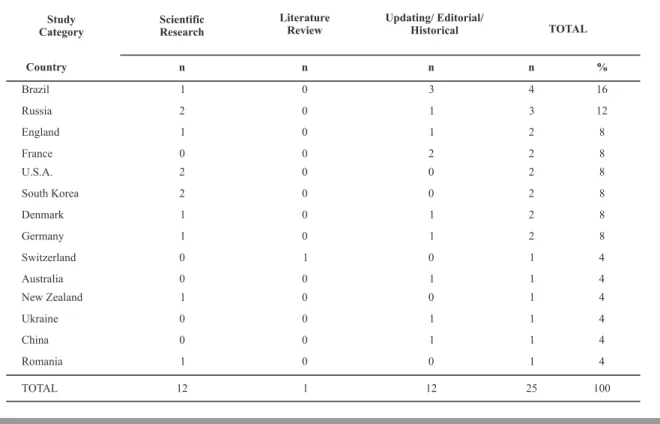
Table 1 - Distribution of articles about Iridology, according to the origin country and article category - São Paulo - 2006
habits generate health and this gained health will be trans-mitted from generation to generation(13). Prevention is the
medicine of the future, and the healthcare expenses will bring better results than those made towards the disease. It is exactly in the preventive medicine that lays the secret for good health, in all aspects, generating longevity and better conditionsand quality of life(13).
The main purpose of Iridology is the prevention. What happens is that the opinions about the method are di-vided. This article aims atgathering what has been writ-ten about Iridology/Irisdiagnose in scientific articles so far, and at describing the opinions about the method.
METHOD
This is a descriptive, exploratory study with a quanti-tative approach. It was carried out through a literature review, using the following databases: EMBASE, PubMed/ MEDLINE, LILACS, PeriEnf and the Bibliographical Database of USP - DEDALUS. The descriptors used for finding the references were Iridologia (DeCs), Iridology (MeSH).
The inclusion criteria for this analysis were:
•
Publication type: articles in journals.•
In any language, but with the abstract in English, Portuguese, Spanish or French.•
Publication year: period from 1970 to 2005.•
Articles with an abstract.Exclusion criteria were:
•
Articles without an abstract or with an abstract in any language other than English, Portuguese, Spanish or French.•
Articles that approached several complementary therapies, but not Iridology specifically.This last item was considered an exclusion criterion because the authors believe that when someone decides to analyze a subject, this person must know it well, and articles citing all kinds of complementary therapies are certainly not compatible with this thought.
RESULTS AND DISCUSSION
A total of 50 articles indexed with the words iridologia/ iridology were found in the databases. After the evalua-tion of the inclusion criteria - articles with an abstract and specifically about iridology - the study had only 25 articles, which will make up the results of this study.
As Table 1 illustrates, 25 publications were found in jour-nals. Only 1 was a systematic review out of this total; 12 were research studies and 12 were in editorial, updating or his-torical text categories. The countries that contributed with publications were Brazil, Russia, England, France, The United States of America, South Korea, Denmark, Germany, Switzer-land, Australia, New ZeaSwitzer-land, Ukraine, China and Romania.
Regarding the opinions, 10 articles were found to be against the method, and 15 were favorable, as it is ob-served on Table 2.
Study Category
Scientific Research
Literature Review
Updating/ Editorial/
Historical TOTAL
Country n n n n %
Brazil 1 0 3 4 16
Russia 2 0 1 3 12
England 1 0 1 2 8
France 0 0 2 2 8
U.S.A. 2 0 0 2 8
South Korea 2 0 0 2 8
Denmark 1 0 1 2 8
Germany 1 0 1 2 8
Switzerland 0 1 0 1 4
Australia 0 0 1 1 4
New Zealand 1 0 0 1 4
Ukraine 0 0 1 1 4
China 0 0 1 1 4
Romania 1 0 0 1 4
Rev Esc Enferm USP 2008; 42(3):585-9. www.ee.usp.br/reeusp/
588
Salles LF Silva MJPIridology: A systematic review
Table 2 - Table 2 - Table 2 -
Table 2 - Table 2 - Distribution of opinions (favorable/against) about the articles on Iridology, according to their category - São Paulo - 2006
The only systematic review article about Iridology was written in 1999, by Ernest E., from England. It has been the target of a discussion published by a French Ophthalmol-ogy journal, which tends to agree with the conclusions of the first article, even though it is difficult to evaluate the situation and come to conclusion, since there are few stud-ies about the subject. It also highlights that Iridology has been substantially growing and that new studies about the method are needed.
This review was based on only 4 literatures, even though the French article states that 67 articles about Iridology’s reliability had already been published by 1998. Most of them are favorable to the method, but there is one ques-tionable methodology and 4 articles against it, with an unobjectionable research in the methodological plan.
A Russian article shows the growing use of Iridology by nurses and ophthalmologists and the need for updating, in order to achieve a greater knowledge about the method.
Most of the articles whose opinions about the method were negative, state that Iridology has not been consid-ered capable of making a diagnosis. However, those who know the method also know that Iridology does not pro-vide diagnoses, but shows which organs are most weak-ened and more likely to fall ill. After this pre-diagnosis, the patient must still run exams in order to come to the conclusion of the diagnosis.
A larger amount of publications was observed from 2000 on, as illustrated on Table 3. This statement coin-cides with the world scenario of an increasing search for complementary therapies.
Table 3 - Table 3 - Table 3 -
Table 3 - Table 3 - Distribution of articles on Iridology according to the year they were published - São Paulo - 2006
Among the resources used, the Bibliographical Data-base at USP - DEDALUS and the PeriEnf dataData-base were the ones that mostly contributed for the search in the national literature, since national articles are not indexed at PubMed/MEDLINE and EMBASE.
Out of these four Brazilian articles, three were written by nurses and one by a physician. Three had been published on the Nursing Magazine – Brazilian edition, and indexed in the LILACS database, under the title Nursing (São Paulo); and one had been published on the Homeopathy Magazine, as Table 4 indicates.
Table 4 - Table 4 - Table 4 -
Table 4 - Table 4 - Distribution of Brazilian articles on Iridology, according to the source and publication period - São Paulo -2006
OPINION
Against Favorable TOTAL
n
6 6 12
%
50 50 100
n
3 9 12
%
25 75 100
n
10 15 25
%
40 60 100
CATEGORY Research Updating/historical/
editorial Total
Review
n
1 0 1
100 0 100
%
Opinion Against Favorable Total
Year no. % no. % no. %
2000-2005 5 50 7 47 12 48
1990-1999 2 20 5 33 7 28
1980-1989 2 20 3 20 5 20
1970-1979 1 10 0 0 1 4
TOTAL 10 100 15 100 25 100
Period 2000-2005 1990- 1999 1980 - 1989 Total
Source no. no. no. no. %
Nursing (São Paulo) 2 1 0 3 75
Homeopathy Magazine 0 0 1 1 25
REFERENCES
1. Eisenberg DM, Kessler RC, Foster C, Norlock FE, Calkins DR, Delbanco TL. Unconventional medicine in the United States: prevalence, costs, and patterns of use. N Engl J Med. 1993; 328(4):246-52.
2. Trovo MM, Silva MJP, Leão ER. Terapias alternativas/com-plementares no ensino público e privado: análise do conhecimento dos acadêmicos de Enfermagem. Rev Lat Am Enferm. 2003;11(4):483-9.
3. Akiyema K. Práticas não-convencionais em medicina no Município de São Paulo [tese]. São Paulo: Faculdade de Medicina, Universidade de São Paulo; 2004.
4. Barbosa MA. A utilização de terapias alternativas por enfermeiros brasileiros [tese]. São Paulo: Escola de Enfermagem, Universidade de São Paulo; 1994.
5. Conselho Regional de Enfermagem de São Paulo (COREn-SP). Documentos básicos de enfermagem. São Paulo; 2001. p.159-60.
6. São Paulo (Cidade). Lei 13.717, de 08 de Janeiro de 2004. Dispõe sobre a implantação das terapias naturais na Secretaria Municipal de Saúde [legislação na Internet]. São Paulo; 2004. [citado 2005 ago. 10]. Disponível em: http://www3.prefeitura.sp.gov.br/cadlem/secretarias/ negocios_juridicos/cadlem/pesqnumero.asp?t=L&n=13717 &a=&s=&var=0
7. Dobbro ERL. A música como terapia complementar no cuidado de mulheres com fibromialgia [tese]. São Pau-lo: Escola de Enfermagem, Universidade de São Paulo; 1998.
8. Batello CF. Iridologia e Irisdiagnose: o que os olhos podem revelar. São Paulo: Ground; 1999.
9. Salles LF. Epidemiologia dos anéis de tensão [monogra-fia]. São Paulo: Instituto Brasileiro de Estudos Homeo-páticos - IBEHE; 2003.
10. Fuerst EV, Wolff LV, Weitzel MH. Fundamentos de enfer-magem. 5ª ed. Rio de Janeiro: Interamericana; 1977.
11. Salles LF, Silva MJP. A incidência dos anéis de tensão na íris de pessoas que vivem em São Paulo. Nursing (São Paulo). 2004;8(81):86-90.
12. Reganin EC. A Iridologia como instrumento facilitador no processo de enfermagem. Nursing (São Paulo). 1999;2(12):8.
13. Beringhs L. Vida saudável pela Iridologia. São Paulo: Robe; 1997.
In Brazil, the only specialization course in Iridology and Irisdiagnose for healthcare professionals is provided by the Institute of Homeopathic Studies, in association to the University of Sciences of São Paulo.
It is evident that the Brazilian Nursing service is observ-ing new tendencies, as lecturers are invited to talk about Iridology in nursing universities and technical schools, con-ferences, journeys and seminars, not to mention the space offered recently by national nursing journals for the subject.
CONCLUSION
Therefore, this study evidences that the literature about the subject is scarce. Among the studies that were
found, only half of them were based on research studies, although not always with an appropriate methodology. The only review about the subject is based uniquely on four literatures. However, the subject is real, and divides opinions.
Iridology brings hope for the current healthcare scen-ery, and preventive medicine must be reinforced. Thus, new studies about the subject are needed – serious studies, which show whether the method is efficient or not.