The World Bank and the Brazilian National Health
System in the beginning of the 21
st
century
O Banco Mundial e o Sistema Único de Saúde brasileiro
no início do século XXI
Correspondence
Maria Lucia Frizon Rizzotto
Rua Visconde do Rio Branco, 1861, apto. 32. Cascavel, PR, Brasil. CEP 85802-190.
263
Abstract
This essay has the aim of updating discussions on the political perspective and the role played by the World Bank in the development of public health policies in Brazil, seeking to identify continuities and changes in the way this institution acts and suggest hypotheses about action strategies in this new century. To do this, we analyzed a 2007 and a 2013 document published by that institution, and gather data on projects funded by the World Bank from 2000 to 2015 in Brazil, with emphasis on the healthcare industry. We concluded that the traditional mechanisms of action have not changed from those used in the 1980s and 1990s, as well as the guiding principles; what we observed is that the World Bank’s actions have shifted from the national level to the state and municipal level. We indicate
the need for speciic studies of the agreements be -tween the Bank and subnational governments, since the Brazilian federative model and the national health system itself allow implementing decentral-ized management mechanisms that can alter the
setting of the Uniied Health System.
Keywords: Inter-American Development Bank;
Health Care Reform; Brazilian National Health System; Right to Health.
Maria Lucia Frizon Rizzotto
Universidade Estadual do Oeste do Paraná. Departamento de Saúde Coletiva. Cascavel, PR, Brazil.
E-mail: [email protected]
Gastão Wagner de Sousa Campos
Universidade Estadual de Campinas. School of Medicine. Campinas, SP, Brazil.
Resumo
Este ensaio tem o objetivo de atualizar as discus-sões sobre a perspectiva política e o papel desem-penhado pelo Banco Mundial na elaboração de políticas públicas de saúde no Brasil, procurando
identiicar continuidades e mudanças no modo de
agir dessa instituição e sugerir hipóteses sobre as estratégias de ação neste início de século. Para isso, analisam-se dois documentos, um de 2007 e outro de 2013, publicados por essa instituição, e
levantam-se dados sobre projetos inanciados pelo
Banco no período de 2000 a 2015 no Brasil, com
destaque para o setor de saúde. Conclui-se que os
mecanismos tradicionais de intervenção não se alteraram em relação aos utilizados nas décadas de 1980 e 1990, tampouco mudaram os princípios orientadores: o que se observa é um deslocamento das ações do Banco da esfera nacional para as esfe-ras estadual e municipal. Aponta-se a necessidade
de estudos especíicos dos contratos irmados entre
o Banco e os governos subnacionais, uma vez que o modelo federativo brasileiro e o próprio sistema nacional de saúde permitem implementar mecanis-mos de gestão descentralizados que podem alterar
a coniguração do Sistema Único de Saúde.
Palavras-chave: Banco Interamericano de Recons
-trução e Desenvolvimento; Reforma dos Serviços de Saúde; Sistema Único de Saúde; Direito à Saúde.
Introduction
Since the Brazilian National Health System (SUS) was created, in 1988, the World Bank has
shown interest in the Brazilian healthcare indus-try, especially regarding the responsibilities of the
State and public administration. This interest is
evidenced by the number of publications and loan agreements established with different areas of public administration aimed at interfering in the
dynamics of this industry (Rizzotto, 2012).
Three aspects deserve to be considered in the analysis of the World Bank’s relationship with
Bra-zilian healthcare ield: guarantee of the universal
right to health, how to manage this public policy, and the potential of this sector for the accumulation of capital. These are intrinsically correlated aspects, showing the dynamics of intervention by the Bank, as well as its intentions.
The universal right to health is not part of the liberal economic ideals and is also not mentioned in the philosophical principles of the World Bank. Liberal economic thought considers health care a commodity that should be offered by the mar-ket, which supposedly would better organize its
production, distribution and consumption. State
intervention should occur only to regulate the supply and ensure “essential minimums”, or-ganizing a reduced public apparatus to develop traditional public healthcare actions, control-ling epidemics and risks that tend to disrupt the market. The notion of essential minimums comes
from the Theory of Justice by John Rawls, a cur -rent of liberal economic thought that assigns to
(minimal) State the promotion of social justice
through policies aimed at reducing inequalities
and establishing some social equity (Rizzotto; Bortoloto, 2011). The World Bank (WB) updates
liberal economic ideals by incorporating concepts from the progressive field as the notion of equity, modifying them semantically and reducing to the possible economic liberalism historical projects of the health movement, as the case of universal coverage vs. universal system, which we will dis-cuss shortly ahead.
private health insurance supply, private manage-ment of public funds, and the full incorporation of science into capital in the medical-hospital-phar-maceutical complex, while examining the struggle of progressive governments in Latin America for the inclusion of health in the public sphere and as a universal right, considering the existing contra-dictions between accumulation and legitimation of the social order.
We can say health care has turned into a realm of political and ideological struggle. In this re-spect, the Brazilian health movement has accumu-lated losses in the legislative branch, in the dispute over public funds and in the very implementation of the organizational guidelines of the system
(Mendes, 2014). Some examples are the “saúde + 10” (health + 10) movement, which fought for 10% of Gross Current Revenue from federal resources
for health - but apparently only percentages of
the Net Current Revenue will be approved (PEC 01/2015) -; the approval of foreign capital inlows in the health care ield (Law 13097/2015); and the
incentive for the expansion of the group health
plan consumption (PEC 451/2014). However, de
-spite the dificulties and attacks, “SUS’ vocation to be a citizen’s right and a duty of the State is still alive” (Marques; Mendes, 2014, p. 290). The reason
is, to some extent, the right to health has been in-corporated into Brazilian society and subjectively the health movement remains alive and active in
defense of SUS.
The fact that Brazil has constitutionally
guar-anteed complete health care for all as a State re -sponsibility was strongly criticized by the World
Bank at the start of the SUS implementation (World Bank, 1991, 1995). The central issue has
never been whether Brazil could bear the costs of the system, but the opposition between liberal economic thought and the implementation of universal public health systems. For liberalism, jettisoning the market in any sector of social life, as the Brazilian health movement intended when
the SUS was created, is unacceptable. In 1990, the
World Bank defended the revision of the constitu-tional premise that assigns a complementary role to the private sector in the system and suggested that Brazil made reforms that favored a greater
participation of the private sector in the provision
of health services (Rizzotto, 2012). For the World
Bank, the public sector should be responsible for regulation, promotion and health education, in addition to funding; whereas services should be provided by any organization able to perform them more efficiently, since the private sector is more creative and efficient, besides offering better quality services and being “proven su-perior to public services” (World Bank, 1991, p.
119). These arguments are justified by the liberal program of government reinvention and State
re-engineering, which incorporates rules from the organizational culture of private companies into public institutions (Osborne; Gaebler, 1994;
Almeida, 1999).
In the late 1990s Brazil, the intervention of the World Bank in the healthcare industry took place systematically at the time the federal government adopted the neoliberal project, based on the
guide-lines of the Washington Consensus. Currently,
although less visible, the World Bank still offers “recommendations” to reform our health care sys-tem, guided by the same pro-market assumptions
(Rizzotto, 2012, 2014).
Decentralization, one of the SUS guidelines,
was initially supported by the World Bank, which associated it to the notion of privatization, the decentralized operation of the market and the shift of power from the central level to subna-tional authorities, which would result in greater managerial autonomy and in the possibility of
accountability for the managers in these levels.
Arretche (1997) discusses decentralization as a myth of the State reforms from this period, a
supposed mechanism for democratization and efficiency of public policies.
However, as the process of decentralization has
resulted in a municipalization of the system and
jettisoning of the federated states from SUS man -agement, the World Bank began having reservations on this aspect of Brazilian reform for an alleged mistake. It claimed decentralization was excessive, with little privatization of the provision of care and a tendency towards universalization of access, which supposedly was a huge overload, far beyond
This work has the aim of updating discussions on the political perspective and the role played by the World Bank in the development of public health policies in Brazil, seeking to identify continuities and changes in the way this institution acts and suggest hypotheses about action strategies in this new century.
To do this, first we analyze two documents from the World Bank on Brazilian health care: one from 2007, titled Governança no Sistema Único de Saúde (SUS) Brasileiro: fortalecendo a qualidade dos investimentos públicos e da gestão de recursos [Governance in Brazil’s
Uni-fied Health System (SUS): Raising The Quality of Public Spending and Resource Management], and
another from 2013, titled 20 anos de construção do sistema de saúde no Brasil: uma análise do Sistema Único de Saúde [Twenty Years of Health System Reform in Brazil: An Assessment of the Sistema Único de Saúde]. Next, we present data
on the projects cofunded by the World Bank, from 2000 to 2015, that show possible changes in its strategies to intervene in the dynamics of the Brazilian healthcare industry.
The World Bank’s assessment of the
Brazilian Uniied Health System in
this new century
One of the World Bank’s forms to act is
produc-ing and disseminatproduc-ing documents that relect its
vision on sectors of interest, with “recommenda-tions” generally aimed to redirect the sector to better suit the liberal market logic. In the early 1990s, the institution stated that its studies had the objectives of “contributing to deepen the knowledge about this national industry” and “making suggestions to face the challenges of the Brazilian health system over the coming
de-cades” (World Bank, 1991, p. 120). After more than
twenty years, the objectives remain almost the same, since the ones of the 2007 document are to research and describe how public resources are allocated; evaluate how the resources transferred to the states and municipalities are used; collect evidence of delays and slippages in budget
execu-tion; and “offer a set of policy recommendations
to improve eficiency in resource management and the quality of care in the SUS” (World Bank, 2007, p. 2, emphasis added). The 2013 document
seeks “to provide an objective assessment of the performance of the system and the challenges ahead” and “offers recommendations [...] based
on the diagnosis presented and the experiences of other countries in addressing similar reforms”
(Gragnolati; Lindelow; Couttolenc, 2013, p. 21-22, emphasis added).
Invariably, the World Bank’s interest revolves
around State administration, inancing and re -lationship with the market. The 2007 document focuses on “governance”, a way to administrate the
State arising from theories of business manage
-ment and State manage-ment, which emerged in the
last decades of the 20th century with the crises of
the welfare state and the growing social malaise resulting from the end of the Keynesian pact. For
Graña (2005), different approaches/interpreta -tions followed the resumption of the governance concept, in the 1980s and 1990s, nearly always suggesting it is horizontal decision-making result-ing from collective negotiations involvresult-ing
differ-ent (supposedly homogeneous) social actors, the
adoption of mechanisms that do not require the
authority and sanction of the State, and the end
of the boundaries between public and private. Ac-cording to this author, the discourse of good gov-ernance legitimized the World Bank’s intervention in economic and social policies of the countries that had taken loans and favored the
implemen-tation of neoliberal reforms of States during this
period, with refusal of income redistribution, privatization of public services and return of the cult of the market.
In the 2007 document, the World Bank adopts the term governance or accountability as a mechanism that “captures the responsibilities of actors and the consequences they face based
on performance” (World Bank, 2007, p. 1). With
sanctioned and good performance rewarded to promote quality and impact” (World Bank, 2007,
p. 1). For the Bank, the absence of accountability,
i.e., punishment of managers and professionals with poor performance, would lead to an unjust system that would compromise the quality and impact of health actions. The idea of local, decen-tralized governance transfers the responsibility for health care provided to the population to the realm of micropolitics, leaving intact any criti-cism to macropolitics, in which the allocation of public resources is defined, not least because the World Bank does not see the problem as lack of resources, but mismanagement.
Using a sample of six states, 17 municipalities, 49 hospitals and 40 primary health care units, the
World Bank (2007) says it made a “comprehensive”
diagnosis of the Brazilian health industry and presents a series of recommendations. Generally speaking, the diagnosis is negative on all aspects: the planning model adopted is too complex and centralized; the participation of the structures
of social control is insuficient, ineffective, and
potentially counterproductive; budgets are
sig-niicantly modiied during budgetary execution;
management of supplies and medicines is a source of resource mismanagement and waste;
manage-ment of equipmanage-ment and installations is ineficient
both in acquisition as in maintenance; staff
man-agement is hindered and distorted by inlexible
legislation, management practices, lack of manage-ment and complete lack of manager accountability; and management of production and quality is in its infancy; i.e., the management of the Brazilian health system is a failure.
Given this diagnosis, it recommends: (1)
synchronizing and coordinating the processes of planning, budgeting, execution, and informa-tion as well as guiding them to the performance;
(2) consolidating resource transfers in broader
categories and linking any increase in funding to performance improvement, rewarding good
performance and penalizing the inadequate; (3)
developing and introducing organizational ar-rangements that provide autonomy and authority for decision-making and resource management;
(4) strengthening and professionalizing the mana
-gerial capacity; and (5) applying mechanisms to
strengthen accountability such as management contracts that induce administrators to focus on
speciic objectives and measurable results (World Bank, 2007); i.e. for the Bank, the solution of this
industry’s problems would be in microspace and in the adoption of technical procedures, and never in macropolitical decisions.
The 2013 document (Gragnolati; Lindelow;
Couttolenc, 2013) features a diagnosis about the history of the SUS, a theme widely discussed by Brazilian researchers as Campos (2007), Paim et al. (2011), Santos, Santos and Borges (2013). Thus,
this work will stress what the World Bank consid-ers the challenges to achieve the goals defined
in the 1988 Federal Constitution. Its “recom -mendations”, in our understanding, go against
the SUS, for they distort principles and propose
measures that favor the interests of capital and not the construction of a universal public system.
This is no novelty, for since the SUS creation
the Bank has repeatedly shown to be against constitutional principles, as demonstrated in a
Ministry of Health Technical Opinion (Brasil, 1994), in studies on the World Bank (Almeida, 2002; Rizzotto, 2012; Lima, 2014), and by Carvalho (2013), who states:
It is paradoxical that these critical points are still, in fact, critical, to a large extent due to the opposi-tion that the World Bank has always posed to the
SUS [...] I must warn young readers that, since the
late 1980s, the World Bank has always been
detri-mental to Brazilian health (p. 1).
While it recognizes some advances, such as expan-sion of the primary care network, increase in access, decentralization of service provision, and reduction in regional disparities, the 2013 document focuses
on inancing and management of the system. It de -liberately left out human resources and pharmaceu-ticals, since these areas “featured less prominently
in the original SUS vision for reform and [...] have less impact on the inal outcomes of interest in the assessment” (Gragnolati; Lindelow; Couttolenc, 2013, p. 18). The topics considered central are unfolded in
gover-nance, eficiency, and public/private relationship in
the provision of health services in Brazil.
Right to health
According to the World Bank, the right to health in Brazil was operationalized by two principles: the legal guarantee that everyone has the right to be
treated free of charge in the SUS and the expansion of
the public network of health care units and services.
However, for the World Bank, “neither of these two
principles is a necessary condition to ensure the right to health care, since health services need not be free or provided within a public system to be accessible”
(Gragnolati; Lindelow; Couttolenc, 2013, p. 48). It
argues that “In several countries where the right to health care is considered to be guaranteed and universal, health services are not free (they are
sub-sidized) and are not necessarily provided by a public system” (Gragnolati; Lindelow; Couttolenc, 2013, p. 48). And it adds that, since a list of covered services was never deined, “(and therefore implicitly covering all services needed by a sick person), the SUS is more
generous, at least on paper, than the systems in most developed and rich countries, which have regulated
and deined a list of covered services and the condi -tions or circumstances under which they are covered”
(Gragnolati; Lindelow; Couttolenc, 2013, p. 48).
For the World Bank, countries like the United
Kingdom and Canada “limit or prioritize the coverage
of certain expensive procedures to cases in which the
patient is most likely to beneit from them (along a cost-effectiveness principle)” (Gragnolati; Lindelow; Couttolenc, 2013, p. 48). It analyses that an “open-ended beneits package is unlikely to be enforceable in a sustained manner” (Gragnolati; Lindelow; Cout
-tolenc, 2013, p. 48), which would have raised two legal conlicts in Brazil: patients obtaining medicines and
procedures by legal injunctions and private insurers
refusing to reimburse SUS for the costs of services
provided. The absence of a clear list of covered goods and services would have enabled providers to expand the supply and use of expensive new technologies,
resulting in a source of ineficiencies and unneces -sary costs, “as Brazil has been quick to adopt new
technologies and allocates them in an ineficient way” (Gragnolati; Lindelow; Couttolenc, 2013, p. 48).
This critique to the universal right and full ac-cess to health reiterates the World Bank’s opinion
that Brazil dared too much to create the SUS, and
points to solutions that restrict access and reduce the right. The defense of using cost-effectiveness as the parameter to allocate resources and of a limited supply of health services is combined with the idea of “universal coverage”, a concept adopted by
inter-national bodies like the World Health Organization (WHO), the Pan American Health Organization (PAHO) and the World Bank itself, according to news by the operations coordinator of the Human Devel -opment Department at the World Bank in Brazil: “In the area of health, there is a global movement to expand access to health care and achieve universal coverage. The World Bank is fully aligned with this movement” (Lindelow, 2013, p. 1, emphasis added).
Universal coverage is a United Nations (UN) pro -posal, expressed in its Post-2015 Development Agenda, that follows the Millennium Development Goals
(MDGs) and refers to ensuring a limited set of services
that can be offered by the market and purchased by
States. This proposal is absolutely distinct from uni
-versal systems as SUS, in which services are public and
access is equal, comprehensive and free for everyone. The idea of universal coverage has been heavily criti-cized and denounced by regional integration organi-zations, intellectual communities, social movements, organizations of the Brazilian and Latin American
health reform, and progressive governments (Cebes, 2014; Moreno; Nascimento, 2014; Lima, 2014).
On the right to health, the analysis of the Bank
(Gragnolati; Lindelow; Couttolenc, 2013, p. 58) is that
the principle of universality, the cornerstone of the
SUS, “is far from being fulilled” (Gragnolati; Lindelow; Couttolenc, 2013, p. 58), and that “more recent evidence suggests that reliance on the SUS increased over the last decade [...], but these differences may be due at least
in part to how the questions were asked” (Gragnolati;
Lindelow; Couttolenc, 2013, p. 58). In this case, research
methodological problems are supposedly “blurring” reality, as “other evidence suggests that individuals ‘pick and choose’ service providers, depending on the type of service and their circumstances” (Gragnolati;
Lindelow; Couttolenc, 2013, p. 58). It concludes that “even if most Brazilians use the SUS at some point,
system as their regular source of care is signiicant” (Gragnolati; Lindelow; Couttolenc, 2013, p. 58).
The supplemental private sector in Brazil has actually grown a lot over the last decades. This, however, does not mean that even users of private
plans do not use the SUS, especially when they need
high complexity care, which is rarely covered by the plans, since the ones with better coverage are almost impossible to be purchased and/or maintained by workers, who are excluded from their company’s health care plans when they retire and invariably return to the public system.
Governance
In this perspective that tends to think
decision-making (always a political process) as an act of management, neutralizing the inluence of political
dynamics and referring it to the quality of organi-zational and technical means (decentralization,
management, and evaluation), the notion of gover -nance is central, because it “induces and reproduces best practices, to ensure managers the
decision-making most adequate to SUS management and
constitutional principles” (Gragnolati; Lindelow;
Couttolenc, 2013, p. 4). Governance, in the Bank’s view, would also be related to: (1) the establishment of the right to health and its consequences; (2) the institutions for coordination and inancing at all levels of government; (3) the participation and inluence of society; (4) the relationship between
purchasers and providers of health services; i.e.,
governance is [...] concerned with the management
of relationships between various stakeholders in health, including individuals, households,
com-munities, irms, governments of different levels, nongovernmental organizations, private irms, and other entities with the responsibility to inance,
monitor, deliver, and use health services
(Gragno-lati; Lindelow; Couttolenc, 2013, p. 4).
This apparently more democratic notion of governance, takes away from governments and the
State itself the power and the duty to deine and
ensure social policies, and disregards antagonistic interests in a class society and the power of pressure
that each group exerts over State agents and over
the use of public funds. It is based on the principle
that the State is fundamentally the conductor of
negotiation processes and regulator of the supply of public services such as health, without necessar-ily being responsible for this supply and even by its full funding.
According to the World Bank, governance is a
crucial issue in the SUS at all government levels, due
to low local capacity to manage decentralized respon-sibilities, to lack of innovation in organizational and management models that correct current distortions, adopting methods of payment that offer incentives for providers to improve their performance, increas-ing effectiveness in the use of available resources
and improving SUS performance “in the context of a feasible and sustainable inancing system” (Gragno
-lati; Lindelow; Couttolenc, 2013, p. 12). For the Bank,
in the case of public providers,
payment reform would have to go hand-in-hand
with measures to strengthen the inancial and man -agerial autonomy of hospitals if payment-related incentives are to have an impact on performance
(Gragnolati; Lindelow; Couttolenc, 2013, p. 12).
The introduction in the public space of manage-rial administration, typical of capitalist companies, effected by management contracts, administrative
and inancial autonomy, based on meeting pre-de
-ined goals and rewarding achievements, is no news
in the World Bank’s recommendations. This notion was widely disseminated and enforced in reforms
of peripheral States amid structural adjustment agreements, e.g., the reform of the State apparatus carried out during the Fernando Henrique Cardoso administration in the 1990s (Pimenta, 1998; Riz
-zotto, 2012).
The 2013 document also resumes the defense of the privatization of the industry, highlighting that
“São Paulo has pioneered the contracting of hospi
-tal services from nonproit organizations” (p. 5) for the management of health facilities, and that “Rio
de Janeiro is using a similar approach for primary care, and many other states and municipalities are
following suit” (p. 108). It points out that other parts
with public-private partnerships, both in building as in management of public facilities. According to that document, “innovations in organizational models, provider payment, and contracting are
limited, but gaining momentum” through Nonproit Organizations (OS), Public-Private Partnerships (PPP) and Public Foundations (PF) (Gragnolati; Lindelow; Couttolenc, 2013, p. 5,10). Although these
management modes are not exclusive of subnation-al bodies, they are adopted more quickly in them, given their smaller media visibility and resistance from workers.
Eficiency
Eficiency and funding are two sides of the same coin, because eficiency is understood as
the ratio of inputs to outputs, i.e., expenditures
to results. For the WB, an eficient health sys -tem would be one that produces more with the
same expenditure. It recognizes the dificulty in determining system eficiency in a macro level; therefore, eficiency assessments tend to focus on speciic links in the chain, as allocative eficiency
(proper distribution of resources to programs or
interventions) and technical eficiency (greater
volume of services by inputs available) (Gragno
-lati; Lindelow; Couttolenc, 2013).
According to the WB, creating the SUS was ex
-pected to improve health system eficiency by inte -gration and coordination measures, focus on prima-ry health care, payment reform and strengthening of
governance and accountability. However, these re -forms would have been only partially implemented, with small gains, even with the expansion of primary care. The WB analyzes that countries like Brazil have achieved better results in health with com-parable or lower spending levels. The main factors
contributing to the ineficiency of our system would
be the absence of a clear list of goods and services covered, the small scale of operations, high use of human resources, low installed capacity utilization, in addition to the management model and payment
mechanisms (Gragnolati; Lindelow; Couttolenc, 2013). In other words, we would remain ineficient
because we failed to fully follow the “recommenda-tions” given in the 1990s: we did not legally limit
access and maintained the right to health; we could not organize the system on a decentralized basis; we failed to punish bad managers exemplarily; we did not create basic health care teams with workers of little educational attainment only; we did not in-troduce mechanisms of managerial administration as reward/punishment; and we did not implement
coinancing. For the Bank, despite constant pressure
from health care for more public funding, the central issue is whether this would be really necessary, since “the report has stated unequivocally” (Gragnolati;
Lindelow; Couttolenc, 2013, p. 110, emphasis added)
that the lack of resources and materials is not the deterrent factor for an improvement in access and quality. And while the debate about underfunding
was prior to the creation of the SUS, “there is no
clear and scientiic way to determine whether this
is the case” (Gragnolati; Lindelow; Couttolenc, 2013, p. 110, emphasis added).
For the WB, the Brazilian health system could produce more services and better health outcomes
with the same level of resources if it were more efi -cient, reduced waste, did not misuse funds, and made a better prioritization when allocating government
funds, offering more cost-eficient services. It con -cludes by saying that “There are no simple solutions for dealing with these issues, but there is a wealth of international experience on which to draw”
(Grag-nolati; Lindelow; Couttolenc, 2013, p. 13). However,
it admits that “government spending on health as a
share of GDP [...] is signiicantly lower than the level of spending in most Organisation for Economic Co-operation and Development (OECD) countries and
some middle-income peers” (Gragnolati; Lindelow;
Couttolenc, 2013, p. 13-14), but, before increasing the SUS funding, a priority of the health movement, we
should straighten everything out and explore the possibilities of management offered as “recommen-dations” for this national industry.
Public-private relationship
In the documents analyzed, differently from the fear of the early 1990s, when the possibility of imple-menting a public system in which the private sector
would have a complementary role to the SUS seemed
favorable to the private sector, particularly within the hospital and supplementary health care spheres. Data on increasing private insurance and plans, on the hegemony of private outpatient services, and on the predominance of private hospital beds seem to have reassured the institution. According to the WB, the role of the private sector was heavily debated
just before the new Brazilian Constitution was estab -lished, and in the end the complementary role of this
sector was deined. “Policy clearly favored expansion
of the public sector over contracting with private
providers” (Gragnolati; Lindelow; Couttolenc, 2013, p. 34), and “the importance of the private (‘supplemen
-tal’) health system was expected to decline steadily” (Gragnolati; Lindelow; Couttolenc, 2013). However,
after more than two decades, “this did not happen”
(Gragnolati; Lindelow; Couttolenc, 2013, p. 4). Cor -rectly concludes that access and quality problems are contributing to the continued demand for pri-vate health plans, which “is undermining the goals of universality and equity” (Gragnolati; Lindelow;
Couttolenc, 2013, p. 4, 122).
Although acknowledging that there is a
regula-tory framework provided by SUS, the WB says that
“coordination between the two sectors remains
very weak, and inconsistencies between SUS basic
legislation, which confers a marginal role on the private sector, and the existence of a strong dynamic private sector need to be reconciled”, and that it is “essential” to solve the lack of integration and
clear deinition of roles between the SUS and the private sector (Gragnolati; Lindelow; Couttolenc, 2013, p. 108).
In that regard, we must recognize that
post-SUS Brazilian governments have been generous
to the private sector and negligent toward the
SUS, facilitating the expansion of the former and
inducing the population to purchase low-coverage
health plans (Bahia, 2001, 2009). The private sector
has advanced beyond supplemental health care.
Serviços Auxiliares de Diagnóstico e Terapia (SADT - Ancillary Diagnostic or Therapeutic Services), es -pecially those of high technology incorporation, are mostly in the private sector, which in some cases
offers more than 90% of the services (Menicucci, 2007; Santos; Uga; Porto, 2008; Santos; Santos; Borges, 2013).
Old and new World Bank
intervention strategies in the
national health industry
It is well-known that, since the 1980s external debt crisis, the WB started to finance not only
speciic projects, but prioritized the broader Struc
-tural Adjustment Projects and Sector Projects, of
greater effects both in the redirecting of the eco-nomic development pattern as in sectoral reforms, which immediately gave greater visibility to and
politicized WB’s interventions (Melo; Costa, 1994; Pereira, 2014).
It is by this funding mechanism - sector proj-ects – and its conditions that the Bank will assume
a particular power of intervention in the deinition
of policies and national health systems in most pe-ripheral countries. And it will not be an imposition
from the outside in, but a conluence of interests
of governments, entrepreneurs, and researchers in those countries who share the same ideological perspective.
In the case of Brazil, with the intense process of decentralization that began with the Federal
Constitution, which transferred the decision-making power on the deinition and implementa -tion of policies to municipalities, the WB has also updated its action strategies, shifting the focus from the federal government to the states. This is evident in a recent manifestation of the World Bank’s representative in Brazil: “The World Bank has supported Brazil’s development for many years
and now inances projects in nearly every Brazilian state” (Lindelow, 2013, p. 1).
In the last 15 years (2000-2015), the World Bank
partially financed 211 projects in Brazil, consid-ering all contracts, regardless of type, require compensation from the providing institution.
Among the projects, 103 (48.81%) were contracts
with a federated state or the Federal District, 66
(31.27%) with the Federal Government, 24 (11.37%) with private foundations, and 17 (8.05%) with
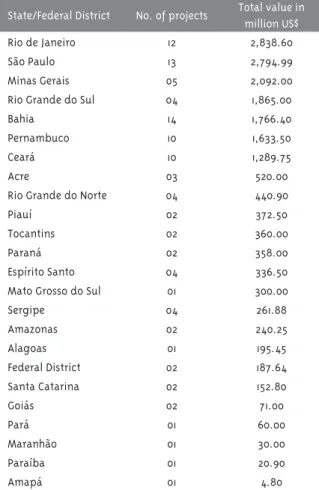
municipalities. As shown in table 1, 23 of the 26 Brazilian states and the Federal District have signed loan agreements with the World Bank from
were the only exceptions. Rio de Janeiro and São
Paulo were the ones who obtained the larger vol-ume of resources and Bahia the largest amount of projects approved. Although they had only five
and four projects approved, Minas Gerais and Rio Grande do Sul had a great volume of resources (Table 1) (World Bank, 2015).
Table 1 – Number and total value of the projects
inanced by the World Bank, according to federated
states and the Federal District. 2000-2015
State/Federal District No. of projects Total value in million US$
Rio de Janeiro 12 2,838.60
São Paulo 13 2,794.99
Minas Gerais 05 2,092.00
Rio Grande do Sul 04 1,865.00
Bahia 14 1,766.40
Pernambuco 10 1,633.50
Ceará 10 1,289.75
Acre 03 520.00
Rio Grande do Norte 04 440.90
Piauí 02 372.50
Tocantins 02 360.00
Paraná 02 358.00
Espírito Santo 04 336.50
Mato Grosso do Sul 01 300.00
Sergipe 04 261.88
Amazonas 02 240.25
Alagoas 01 195.45
Federal District 02 187.64
Santa Catarina 02 152.80
Goiás 02 71.00
Pará 01 60.00
Maranhão 01 30.00
Paraíba 01 20.90
Amapá 01 4.80
Source: World Bank (2015)
Just as an example, the government of the state of Paraná, as part of the signed loan agreement with the WB, created the Fundação Estatal de
At-enção em Saúde (FUNEAS-Paraná), transferring the management of the State Department of Health to a private State Foundation. The argument is
that the purpose is to “establish a new model of health care management” with the possibility of
“generating resources from non-State sources”
(Paraná, 2014, p. 1). In practice, the Foundation enables lexibilization of labor relations, intro -duces management contracts, management by performance goals, the professional governance system and, ultimately, the unaccountability of
the State towards population health.
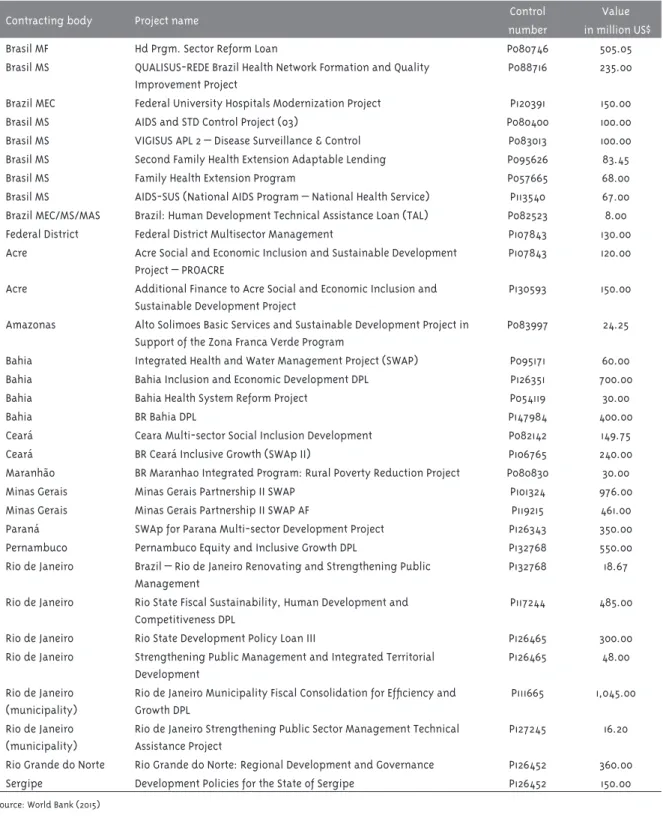
Among the 32 projects approved by the Bank for the Brazilian health care industry from 2000
to 2015 (table 2), only nine (28.2%) are from the Federal Government; the vast majority (71.87%) are
from subnational bodies, mostly federated states.
As noted, the WB has privileged SUS managers
who have decision-making power and autonomy to enter the mechanisms advocated by the WB in the system, initially regarding work manage-ment, but possibly expanding to the very notion of right to health. That is why we need studies that examine these state and municipal efforts more deeply, seeking to identify to what extent they are
contributing to disigure the SUS in its core, i.e.,
the possibility of being a universal public system for all Brazilians.
The WB’s choice of agreements with state gov-ernments may be due to the fact that reforms at this level of public management are less diluted than at municipal level, consequently more effective, and can be implemented with less resistance than at the national level.
Final remarks
The crises of accumulation have made capital expand into all areas of social life, transforming
them into spheres of capital appreciation. Health care represents a public ield with huge investment
potential, since it articulates several productive processes, forming the health industrial complex. The World Bank, as an instance of this new cycle of
inancial capitalism, reafirms the centrality of the market as a more eficient organizing and manag -ing mechanism of public policies, includ-ing those related to health.
The SUS is an experiment that, in the WB’s
Table 2 – Health care projects inanced by the World Bank, control number, and value, according to contract -ing body. 2000-2015
Contracting body Project name Control
number
Value in million US$
Brasil MF Hd Prgm. Sector Reform Loan P080746 505.05
Brasil MS QUALISUS-REDE Brazil Health Network Formation and Quality Improvement Project
P088716 235.00
Brazil MEC Federal University Hospitals Modernization Project P120391 150.00
Brasil MS AIDS and STD Control Project (03) P080400 100.00
Brasil MS VIGISUS APL 2 – Disease Surveillance & Control P083013 100.00 Brasil MS Second Family Health Extension Adaptable Lending P095626 83.45
Brasil MS Family Health Extension Program P057665 68.00
Brasil MS AIDS-SUS (National AIDS Program – National Health Service) P113540 67.00 Brazil MEC/MS/MAS Brazil: Human Development Technical Assistance Loan (TAL) P082523 8.00 Federal District Federal District Multisector Management P107843 130.00 Acre Acre Social and Economic Inclusion and Sustainable Development
Project – PROACRE
P107843 120.00
Acre Additional Finance to Acre Social and Economic Inclusion and Sustainable Development Project
P130593 150.00
Amazonas Alto Solimoes Basic Services and Sustainable Development Project in Support of the Zona Franca Verde Program
P083997 24.25
Bahia Integrated Health and Water Management Project (SWAP) P095171 60.00 Bahia Bahia Inclusion and Economic Development DPL P126351 700.00
Bahia Bahia Health System Reform Project P054119 30.00
Bahia BR Bahia DPL P147984 400.00
Ceará Ceara Multi-sector Social Inclusion Development P082142 149.75
Ceará BR Ceará Inclusive Growth (SWAp II) P106765 240.00
Maranhão BR Maranhao Integrated Program: Rural Poverty Reduction Project P080830 30.00
Minas Gerais Minas Gerais Partnership II SWAP P101324 976.00
Minas Gerais Minas Gerais Partnership II SWAP AF P119215 461.00
Paraná SWAp for Parana Multi-sector Development Project P126343 350.00 Pernambuco Pernambuco Equity and Inclusive Growth DPL P132768 550.00 Rio de Janeiro Brazil – Rio de Janeiro Renovating and Strengthening Public
Management
P132768 18.67
Rio de Janeiro Rio State Fiscal Sustainability, Human Development and Competitiveness DPL
P117244 485.00
Rio de Janeiro Rio State Development Policy Loan III P126465 300.00 Rio de Janeiro Strengthening Public Management and Integrated Territorial
Development
P126465 48.00
Rio de Janeiro (municipality)
Rio de Janeiro Municipality Fiscal Consolidation for Eficiency and
Growth DPL
P111665 1,045.00
Rio de Janeiro (municipality)
Rio de Janeiro Strengthening Public Sector Management Technical Assistance Project
P127245 16.20
Rio Grande do Norte Rio Grande do Norte: Regional Development and Governance P126452 360.00 Sergipe Development Policies for the State of Sergipe P126452 150.00
limited universal coverage, that give market in charge of supplying health services; governments that adopt business management mechanisms to
punish managers and workers; States that adopt
new public management as a form of management structures and public affairs, a micro-organiza-tional approach that turns planning into a purely technical action.
The critical view on the Brazilian health system, associated with state reforms put into practice us-ing loan agreements and with denial of the right to health, can feature a new liberal offensive against
the SUS and against any intention of establishing
universal public health systems. The goal of re-forming Brazilian health from its organization in federated states appears to be the WB’s immediate perspective. Its “help” is aimed at contributing to restore power to this level of government, which supposedly has more conditions to implement ac-countability and punishment mechanisms in public management, and the transfer of responsibilities to the market.
But inancing projects and the conditions they
come with are not the only ways the WB can
con-tribute to disigure the SUS. The liberal-private
ideology, defended by that institution, constitutes the world view of part of Brazilian society, many managers, workers, analysts, and researchers in-volved with the Brazilian health policy, who never
supported the SUS as a universal public system.
In our opinion, it is urgent that the movement
in defense of the SUS and of the right to health
both criticize projects aimed at ending the right to health and the organizational structure potentially able to implement this right, and work to create a common project for the defense of the
constitu-tional values that gave rise to the SUS, in addition
to measures necessary to correct distortions that have accumulated over these two and a half decades. We refer to the defense of funding compatible with
the needs of health care; the strong ight against
privatization by advancing a democratic reform of
the State that ends patrimonialism and consolidates
the mechanisms of social control of workers and society on the Executive power; the establishment of a staff policy common to the entire system; and, centrally, the advancement of quality social policies
on health, education, mobility and urban life, and public safety.
References
ALMEIDA, C. Reforma de sistemas de servicios de salud y equidad en América Latina y el Caribe:
algunas lecciones de los años 80 y 90.Cadernos de Saúde Pública, Rio de Janeiro, v. 18, n. 4, p.
905-925, ago. 2002.
ALMEIDA, C. M. Reforma do Estado e reforma de
sistemas de saúde: experiências internacionais e tendências de mudança.Ciência & saúde coletiva,
Rio de Janeiro, v. 4, n. 2, p. 263-286, 1999. ARRETCHE, M. O mito da descentralização como indutor de maior democratização e eiciência das políticas públicas. In: GERSCHMAN, S.; VIANA, M. L. W. (Org.) A miragem da pós-modernidade: democracia e políticas sociais no contexto da
globalização. Rio de Janeiro: Fiocruz, 1997, p. 127-152. BAHIA, L. O sistema de saúde brasileiro entre
normas e fatos: universalização mitigada e
estratiicação subsidiada. Ciência & Saúde Coletiva, Rio de Janeiro, v. 14, n. 3, p. 753-762,
2009.
BAHIA, L. Planos privados de saúde: luzes e
sombras no debate setorial dos anos 90.Ciência & Saúde Coletiva, São Paulo, v. 6, n. 2, p. 329-339,
2001.
BANCO MUNDIAL. A organização, prestação e inanciamento da saúde no Brasil: uma
agenda para os anos 90. Relatório nº 12655-BR. Washington, D.C. 1995.
BANCO MUNDIAL. Brasil: Governança no Sistema Único de Saúde (SUS) Brasileiro: fortalecendo a
qualidade dos investimentos públicos e da gestão
de recursos. Relatório nº 36601-BR. Documento
do Banco Mundial, 2007. Disponível em: <http://
www.aids.gov.br/sites/default/iles/Governanca_ SUS_-_Relatorio_banco_mundial.pdf> Acesso em:
25 maio 2015.
BANCO MUNDIAL. Brasil: novo desaio à saúde
do adulto. Washington, D.C.: [s.n.], 1991 (Série de Estudos do Banco Mundial sobre países).
BRASIL. Parecer Técnico sobre o relatório do Banco Mundial: The organization, delivery and
inancing of health care in Brazil – 1993. Brasília,
CAMPOS, G. W. de S. Reforma política e sanitária: a sustentabilidade do SUS em questão?Ciência & saúde coletiva, Rio de Janeiro, v. 12, n. 2, p.
301-306, abr. 2007.
CARVALHO, G. SUS: Subinanciamento ou ineiciência? Ou os dois? Ou mais um do que outro?. Campinas: Insituto de Direito Sanitário
Aplicado, 2013. Disponível em: <http://www.idisa.
org.br/site/documento_10663_0__2013---35---703---domingueira---relatorio-banco-mundial---15-12-2013.
html>. Acesso em: 23 maio 2015.
CEBES. Centro Brasileiro de Estudos de Saúde.
Porque defender o Sistema Único de Saúde?
Diferença entre direito universal e cobertura
universal de saúde. Rio de Janeiro: Cebes, 2014. GRAGNOLATI, M. G.; LINDELOW, M.;
COUTTOLENC, B. 20 anos de construção do sistema de saúde no Brasil: uma análise do
Sistema Único de Saúde. The World Bank. Washington, D.C. 2013. Disponível em: <http://
www.worldbank.org/pt/news/opinion/2013/12/20/
brazil-sus-uniied-public-healthcare-system-new-study>. Acesso em: 4 maio 2015.
GRAÑA, F. Todos contra el Estado: uso y abusos de
la ‘govenança’. Espacio Abierto, Zulia, v. 14, n. 4, p. 501-629, 2005.
LAURELL, A. C. Contradicciones en salud: sobre
acumulación y legitimidad en los gobiernos neoliberales y sociales de derecho en América Latina.Saúde em debate, Rio de Janeiro, v. 38,
n. 103, p. 853-871, dec. 2014.
LIMA, J. C. F. O Banco Mundial, a Organização Mundial de Saúde e o “novo universalismo” ou a “cobertura universal de saúde”. In: PEREIRA, J. M. M.; PRONKO, M. A demolição de direitos: um exame das políticas do Banco Mundial para
a educação e a saúde (1980-2013).Rio de Janeiro: Escola Politécnica de Saúde Joaquim Venâncio,
2014, p. 233-253.
LINDELOW, M. A marca do SUS. The World Bank,
20 dez. 2013. Notícias. Disponível em: <http://
www.worldbank.org/pt/news/opinion/2013/12/20/
brazil-sus-uniied-public-healthcare-system-new-study>. Acesso em: 13 jun. 2015.
MARQUES, R. M.; MENDES, A. O inanciamento do Sistema Único de Saúde e as diretrizes do Banco Mundial. In: PEREIRA, J. M. M.; PRONKO,
M. A demolição de direitos: um exame das políticas do Banco Mundial para a educação
e a saúde (1980-2013). Rio de Janeiro: Escola Politécnica de Saúde Joaquim Venâncio, 2014, p.
275-293.
MELO, M. A. B. C.; COSTA N. R. Desenvolvimento
sustentável, ajuste estrutural e política social: as
estratégias da OMS/OPS e do Banco Mundial para a
atenção à saúde. Planejamento e políticas públicas, Brasília, n. 1, p. 49-108, jun./dez.1994.
MENDES, Á. O fundo público e os impasses do
inanciamento da saúde universal brasileira.
Saúde e sociedade, v. 23, n. 4, p. 1183-1197, dez. 2014.
MENICUCCI, T. M. G. Público e privado na política de assistência ̀ saúde no Brasil: atores, processos
e trajetória. Rio de Janeiro: Fiocruz, 2007. MORENO, M.; NASCIMENTO, B. Organização Pan-Americana da Saúde inaliza consulta
pública sobre cobertura universal. Instituto Sul-Americano de Governo em Saúde, 12 set. 2014.
Notícias. Disponível em: <http://www.isags-unasur.org/it_materia.php?ev=348&lg=1>. Acesso
em: 14 jun. 2015.
OSBORNE, D.; GAEBLER, T. La reinvención del gobierno: la inluencia del espíritu empresarial en
el sector public. Buenos Aires: Paidós, 1994. PAIM, J.; et al. O sistema de saúde brasileiro:
história, avanços e desaios. Lancet, v. 377, n. 9779, p. 1778-1797, 21 maio 2011. Disponível em: <http://www.thelancet.com/journals/lancet/
article/PIIS0140-6736(11)60054-8/fulltext>. Acesso em: 25 out. 2015. (Série Brasil)
PARANÁ. Fundação Estatal de Atenção à Saúde do Paraná: Funeas. Cartilha – Perguntas e
respostas. Informações sobre o Projeto de Lei nº
726/13. Curitiba, 2014. Disponível em: <http:// www.saude.pr.gov.br/arquivos/File/PP_cartilha_ FUNDACAOESTATAL_18x21cm_web_FINAL.pdf>
Acesso em: 8 jun. 2015.
PEREIRA, J. M. M. Poder, política e dinheiro: a
trajetória do Banco Mundial entre 1980 e 2013.
In: PEREIRA, J. M. M.; PRONKO, M. A demolição de direitos: um exame das políticas do Banco
PIMENTA, C. C. A reforma gerencial do estado
brasileiro no contexto das grandes tendências mundiais. Revista de Administração pública, Rio
de Janeiro, n. 5, set./out. 1998.
RIZZOTTO, M. L. F. Capitalismo e saúde no Brasil nos anos 90: as propostas do Banco Mundial e o
desmontado SUS. São Paulo: Hucitec, 2012. RIZZOTTO, M. L. F. O Banco Mundial e o sistema nacional de saúde. In: PEREIRA, J. M. M.; PRONKO, M. A demolição de direitos: um exame das políticas do Banco Mundial para a
educação e a saúde (1980-2013).Rio de Janeiro: Escola Politécnica de Saúde Joaquim Venâncio,
2014.
RIZZOTTO, M. L. F.; BORTOLOTO, C. O conceito
de equidade no desenho de políticas sociais: pressupostos políticos e ideológicos da proposta
de desenvolvimento da CEPAL.Interface,
Botucatu, v. 15, n. 38, p. 793-804, set. 2011.
SANTOS, I. S.; SANTOS, M. A. B.; BORGES, D. C. L. Mix público-privado no sistema de saúde brasileiro: realidade e futuro do SUS. Fundação Oswaldo Cruz. A saúde no Brasil em 2030 –
prospecção estratégica do sistema de saúde
brasileiro: estrutura do inanciamento e do gasto setorial. Rio de Janeiro: Fiocruz, v. 4, p. 73-131,
2013. Disponível em: <http://books.scielo.org/
id/z9374/pdf/noronha-9788581100180-04.pdf>.
Acesso em: 13 jun. 2015.
SANTOS, I. S.; UGA, M. A. D.; PORTO, S. M. O mix público-privado no Sistema de Saúde Brasileiro: inanciamento, oferta e utilização de serviços de
saúde.Ciência & Saúde Coletiva, Rio de Janeiro, v.
13, n. 5, p. 1431-1440, out. 2008.
WORLD BANK. Projectos & Operaciones. Disponível em: <http://www.worldbank.org/
projects/search?lang=en&&searchTerm=&country code_exact=BR>. Acesso em: 10 jun. 2015.
Authors’ contribution
Both authors contributed equally in this essay.