* Extracted from the thesis “Adoecimento osteomuscular de trabalhadores portuários avulsos e o processamento do raciocínio clínico da enfermagem”, Programa de Pós-Graduação em Enfermagem, Universidade Federal do Rio Grande, 2015.
1 Universidade Federal do Rio Grande, Escola de Enfermagem, Rio Grande, RS, Brazil.
abstract
Objective: To identify scientiic evidence of occupational illness of dockworkers published in the literature. Method: systematic review of the literature, developed according to the Cochrane method. he databases searched were: Cochrane, LILACS, MEDLINE/ PubMed, CINAHL and SciELO. Studies from 1988 to 2014 were selected. he data were analyzed according to the level of evidence and Strengthening the Reporting of
Observational Studies in Epidemiology. Results: We included 14 studies, in which 11
(78.6%) were from international journals. he year of 2012 showed greater number of studies. All studies were classiied as: Level of Evidence 4, highlighting lung cancer, musculoskeletal and ischemic diseases, causal link in chemical risks. Conclusion: he development of preventive measures should especially include chemical exposure of workers applying the clinical reasoning of nurses’ environmental knowledge to care for illnesses.
descriPtOrs
Occupational Health; Occupational Risks; Occupational Health Nursing; Review.
Scientific evidence of dockworker illness
to nursing clinical reasoning*
Evidências científicas de adoecimento do trabalhador portuário para o raciocínio clínico da enfermagem
Evidencias científicas de enfermización del trabajador portuario para el razonamiento clínico de la enfermería
Marlise Capa Verde de Almeida1, Marta Regina Cezar-Vaz1
How to cite this article:
Almeida MCV, Cezar-Vaz MR. Scientific evidence of dockworker illness to nursing clinical reasoning. Rev Esc Enferm USP. 2016;50(2):341-349. DOI: http:// dx.doi.org/10.1590/S0080-623420160000200022
Received: 10/05/2015 Approved: 03/08/2016
reVieW article DOI: http://dx.doi.org/10.1590/S0080-623420160000200022
Corresponding author: Marlise Capa Verde de Almeida.
Scientific evidence of dockworker illness to nursing clinical reasoning
INTRODUCTION
Nursing clinical reasoning (CR) comprises cognitive pro-cesses used in the collection and processing of information on the health of the individual cared, from which hypotheses can be generated and assessed to meet the needs presented(1).
In occupational health, the occupational anamnesis is seen as one of the main tools of obtaining this information, en-compassing social and environmental conditions and those related to the organization and development of the work. However, there is also the possibility of obtaining health in-formation through technical and scientiic literature, identi-fying exposure to risk factors at work and the possible illness. hus, CR guide professionals to deine what social and envi-ronmental conditions contribute to the determination of the illness, developing, therefore, the causal link, understood as occupational, individual and collective risk factors that lead to occupational illness(2).
In the port working environment context in the southern of Brazil, health research identiied the prevalence of some diagnosed illnesses as musculoskeletal disorders(3),
hyperten-sion, low-back pain, lung disease and depressive episodes(4-5),
additionally, self-reported illnesses such as osteoarticular and mental disorders(6). hese results indicate the need to identify
whether all port realities lead to the same occupational ill-nesses, and how nursing can use these and other information in the CR processing, in order to mitigate and prevent them.
In Brazil, port activities are regulated by Article 40 of Law 12,815/2013(7) in six categories of workers: Wharfage,
stevedoring, freight conference, cargo repair, surveillance of ships and cargo. hese services are responsible for the move-ment of goods within the organized ports, in a manual and automated manner through lifting, conference, storage, among other actions performed on board the ships or in land, in the port docks, warehouses and silos(7). hese
profes-sional actions work as social and environmental constraints related to work organization and present diiculties of es-tablishing causal links since the jobs analyzed and the re-sponsibilities of each professional category are diferent. his exposes workers to diferent occupational risks, continuously and sometimes intermittently, given the rotational shiftwork, modifying the teams and their work actions for each port operation according to demand, which submit the worker to diferent conditions.
In order to identify the risks and illnesses that afect dockworkers, this systematic review presented, as a general objective, the identiication of scientiic evidence of occupa-tional illness of dockworkers published in the scientiic lit-erature, and as speciic objectives, the identiication of dock-worker illnesses published in the literature and to present the risks that indicate causal link to the illness of dockworkers.
METHOD
his is a systematic review of the literature, which is a secondary study that supports the development of clinical guidelines, providing information for decision-making and contributing to the development of plans for interventions/ clinical research. his review followed the steps recommend
by the Cochrane Handbook(8): formulation of the research
question; location and selection of studies; critical appraisal of studies; data extraction; analysis, presentation and inter-pretation of data; and improvement and update of the review. To determine the research question, we used the PICO strategy, which is an illustrative acronym of four essential ele-ments so that the research question support the bibliograph-ic search: Patient, Intervention, Comparison and Outcome(9).
In addition, we determined as Boolean operator (delimiter) AND. hus, the study questions were: What illnesses afect dockworkers? What are the risks that indicate causal link to the illness of dockworkers, according to the scientiic literature?
For location and selection of studies, electronic search-es were conducted in the following databassearch-es: Cochrane Library; Latin American and Caribbean Health Sciences (LILACS), Medical Literature Analysis and Retrieval System Online (MEDLINE/PubMed), Cumulative Index to Nursing and Allied Health Literature (CINAHL) and Scientiic Electronic Library Online (SciELO). he searches in the databases were not restricted to a health area and en-compassed all areas of knowledge, without speciication. he selected publication period was from 1988 to 2014, justiied by the establishment year of the Dock Regulations 1988(10),
with regard to international regulation of health, safety and welfare of port operations workers. Data collection was car-ried out between January and August 2014, using the fol-lowing strategies: “portuário”; “dockworker”; “dockworkers”, “dock” “and” “worker” and “dock” “and” “workers”. Databases that was indexed most of the studies were MEDLINE/ PubMed (n=97; 40.6%) and SciELO (n=71; 29.7%).
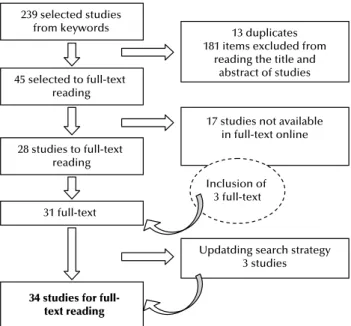
Scientiic productions were selected as shown in Figure 1.
239 selected studies from keywords
45 selected to full-text reading
13 duplicates 181 items excluded from
reading the title and abstract of studies
28 studies to full-text reading
17 studies not available in full-text online
Inclusion of 3 full-text 31 full-text
34 studies for full-text reading
Updatding search strategy 3 studies
Figure 1 – Flowchart distribution and selection of studies – Rio
Grande, RS, Brazil, 2015.
three full studies. From this selection, we obtained 31 studies to full-text reading and after search update, held in September 2014, three more studies were included, totaling 34 studies.
he inclusion criteria were: studies indexed in full in the databases listed and available online; meeting the objectives of the investigation; publication in the period between 1988 and 2014; abstract presentation for screening in Portuguese, English and Spanish. A protocol of analysis and synthesis of the studies was used, comprising aspects of study type, year of publication, number of dockworkers, type of illness and scientiic level of evidence assessed in the studies.
he analysis and interpretation of the data were carried out from the seven Evidence levels determined by the Rating System for the Hierarchy of Evidence(11), to quantify and
qualify the evidence from studies that identiied illnesses that afected dockworkers. he studies were further classiied ac-cording to the STROBE scale, which contains 22 items with recommendations to assess the adequacy of the description of all the steps of the observational studies. Each criterion received a score of zero to one, which was subsequently con-verted into a percentage, considering good quality studies the percentage higher than 40%.
hus, for the study of illnesses related to port work, we expanded the view at the occupational risks and their causal links, building three categories of analysis: Scientiic evidence of the illnesses that afect dockworkers; he illnesses related to dockworkers and Risks that indicate causal link with illnesses that afected dockworkers.
In order to respect ethical issues and authorship require-ments, the studies cited will be properly referenced through-out this study, according to Law No. 9,610, of February 19, 1998(12), which reports Author’s Copyright.
RESULTS
he search resulted in 239 studies, selected from the estab-lished inclusion criteria. he use of the term “dock” resulted in a greater number of publications, indicating an eicient search term, although not belonging to the Descriptors in Health Sciences (DeCS) or the Medical Subject Headings (MESH). From the application of the inclusion and exclusion criteria and from the level of evidence classiication and STROBE scale, 14 studies were obtained, of which 11 (78.6%) were published in English and three (21.4%) in Portuguese.
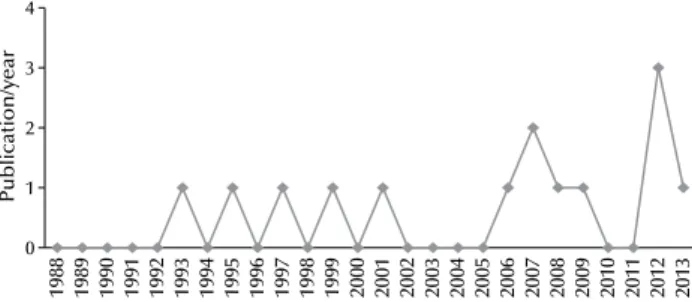
Of the 11 studies published in English, one (7.1%) was conducted in Brazil, while all the studies published in Portuguese were developed in the country. Within the 25 years search period, 15 studies did not publish scientiic stud-ies on the topic (Figure 2). Regarding the journals where the studies were published, 11 studies (78.6%) were published
in international journals, highlighting the Environmental Health Perspectives and the Occupational and Environmental Medicine. hree studies were published in national journals, two of the Nursing area: Acta Paulista de Enfermagem and
Revista Latino-Americana de Enfermagem; the third was pub-lished in Cadernos de Saúde Coletiva, from Rio de Janeiro.
0 1 2 3 4
2013
2012
2011
2010
2009
2008
2007
2006
2005
2004
2003
2002
2001
2000
1999
1998
1997
1996
1995
1994
1993
1992
1991
1990
1989
1988
Publication/y
ear
Figure 2 – Number of publications/per year considering the
study period – Rio Grande, RS, Brazil, 2015.
We highlight, among international journals, in addition to those already cited, those focusing on environmental is-sues such as the Indian Journal Occupational Environmental Medicine, the International Archives Occupational Environmental Health, the Scandinavian Journal of Work, and the Environment & Health. Regarding the indexing of studies, we observed an expressive variability of the de-scriptors used, especially “lung cancer” (n=4), “cumulative trauma disorder” (n=1) “ischemic heart disease” (n=1) and “mesothelioma” (n=3). In order to represent the risks, we highlight “asbestos” (n=3), “diesel exhaust” (n=3); “occupa-tional exposure” (n=3).
he number of dockworkers investigated in the studies ranged from 13 to 12,652 individuals, highlighting that in six studies, the worker’s health was indirectly investigated, using secondary data (databases and medical records).
ScientificevidenceoftheillneSSeSthataffect
dockworkerS
he irst category of analysis aimed at identifying the level of evidence of scientiic studies, highlighting the pre-ferred inclusion of randomized controlled trials, once they allow a more clear identiication of the efects of clinical actions in health(8). However, the search did not result in
studies with this methodological design, therefore, non-randomized studies that identiied scientiic evidence cov-ering the health of dockworkers and highlighting the gaps in health surveillance of these workers were included. hus, a total of 14 studies, all of Evidence Level 4 – cohort and case-control studies.
he illnesses and risks identiied in the studies are pre-sented in Table 1.
Table 1 – Characterization of studies by the title, year of publication, country, design/number of participants, type of illness and risk,
ordered by decreasing magnitude as quality score (STROBE) – Rio Grande, RS, Brazil, 2015.
title or references Year/ country
study design/number
of participants results: illness/risks
strobe score
Latency periods in asbestos-related
mesothelioma of the pleura(13) 1997Italy N=421Cohort Pleural mesothelioma/asbestos exposure due to repair and shipbuilding industries. 76.4%
Scientific evidence of dockworker illness to nursing clinical reasoning
theillneSSeSrelatedtoportwork
he studies explored the occurrence of work-related
can-cer(13-16,19-20,23-24). Some investigations were retrospective, with
the use of medical records and health service records(14-16,20).
One study(15) showed secondary data on cases of lung
cancer and ischemic diseases in an exposure ratio of work-ers to liqueied propane of trucks circulating in automotive stock areas. It did not show the speciic number of ports, but investigated stevedores and other categories of workers of a transport company, noting that those who worked driv-ing the machinery had a higher risk of developdriv-ing illnesses. It was also carried out research through health re-cords(16), identifying that 53 dockworkers who worked
un-der the efects of asbestos in shipbuilding, especially dur-ing the Second World War, they estimated higher risk for developing lung cancer.
Studies(15-16), also conducted from secondary data,
in-vestigated 5,710 dockworkers and 843 conferees at risk for developing lung cancer, given the exposure to diesel vehicles circulating in port terminals. he authors showed that, com-pared to diesel carcinogenicity, the composition of vehicle
fuels such as forklifts has been modiied, which mitigated the exposure for each category of workers.
he work in load transportation was analyzed and showed that it presents a risk for lung cancer by exposure to fuels and loads of grain or powder, such as cement, sand and grain(19). However, for 161 dockworkers and cargo handlers,
the results of the study did not show statistically signiicant risk estimates, but call for attention to the fact that these workers were exposed to gasoline and diesel emissions, which account for most carcinogenicity to humans.
In addition to lung cancer, malignant mesotheliomas were identiied(23-24) in histological samples with presence
of asbestos from the shipbuilding and the production of cement, these activities that were part of the port work in the past. In the irst study(23), 39 workers exerted port
ac-tivities, in the period between 1960 and 1998, they were exposed to large loading and unloading of asbestos, short-ening the disease latency time when compared with other workers investigated. In another study(24), it was identiied
that 17 of the 18 workers investigated had asbestos in lung tissues subjected to autopsy, and for 14 cases of the dis-ease, the latency period was on average, 36.3 years. Other
...continuation
title or references countryYear/ study design/number of participants results: illness/risks strobe score
Lung Cancer and Elemental Carbon
Exposure in Trucking Industry Workers(14) 2012USA N=58.326Cohort Lung cancer/exposure to vehicular carbon. 75%
Cause-Speciic Mortality in the Unionized
U.S. Trucking Industry(15) 2007USA Retrospective CohortN=54.319
High rates of lung cancer (SMR=1.10) and ischemic heart disease (SMR=1.32)/Vehicle
Fuel.
73.6%
Occupational exposure and lung cancer risk
in a coastal area of Northeastern Italy(16) 1993Italy Retrospective CohortN=174 Lung cancer/Asbestos exposure. 71.4%
Reducing AIDS risk among port workers in Santos, Brazil(17)
1999 Brazil
Intervention study
N=226. AIDS/risk behavior. 69.1%
Ischaemic heart disease mortality and years of work in trucking industry workers(18)
2013 USA
Cohort N=12.652
Ischemic heart disease/exposure to toxic combustion gases from vehicular emission
sources.
66.4%
Occupation and risk of lung cancer in Central and Eastern Europe: the IARC multi-center case–control study(19)
2007 Central and Eastern Europe Case-control study.
N=161 Lung cancer exposure to fuel and cargo grain/powder such as cement, sand, cereals. 65.9%
Lung Cancer and Vehicle Exhaust in Trucking Industry Workers(20)
2008 EUA
Cohort N=6.553
Lung cancer/exposure to diesel vehicle
(forklift). 61.4%
The prevalence of musculoskeletal diseases among casual dock workers(3)
2012 Brazil
Retrospective Cohort N=953
Low back pain, tendinitis and neck pain/ Risks involved in port work routine. 57.3%
Dock worker: proile of occupational
diseases diagnosed in an occupational health service(4)
2012 Brazil
Retrospective Cohort N=953
Prevalence of musculoskeletal cardiovascular and mental diseases/ Risks involved in port
work routine. 57.3%
A reestruturação produtiva nos portos e suas implicações sobre acidentes de trabalho em
estivadores do Espírito Santo(21)
2006
Brazil CohortN=13 Contusions, fractures, back pain and tight/ exposure to risks inherent to their work. 57.3%
Evaluation of the respiratory health of dock workers who load grain cargoes in British Columbia(22) 1995 British Columbia Case-control study N=118
Respiratory illness/exposure of workers to
grains (dust) in the loading and unloading. 48.2%
Malignant pleural mesothelioma in Italy(23) 2009
Italy
Cohort N=811
Malignant mesothelioma/asbestos exposure in
shipbuilding and production of iber cement. 42.7%
Asbestos Exposure in Malignant Mesothelioma of the Pleura: A Survey of 557 Cases(24)
2001 Italy
Cohort N=456
Malignant Mesothelioma/Asbestos exposure in
shipbuilding and repair. 40.9%
researchers,(13) speciically worked the latency period for the
occurrence of mesothelioma, also arising from asbestos in a sample with 11 dockworkers, identifying 35.4 years as the latency period for the disease.
Regarding the investigation of ischemic heart disease, a study presented as related risk, the working time exposed to mobile sources/vehicular toxic gas stations(18). According
to this study, at least 1 year of work in each functional posi-tion increased the risk of developing ischemic heart disease among 12,652 stevedores and other workers (long haul and delivery drivers) analyzed. he study inally suggested that the longer the exposure time, the greater the probability of developing ischemic diseases(21). Ischemic diseases were
also investigated in another study(15), which had, in addition
to ischemic heart disease, lung cancer, because of the high incidence rates related to exposure to vehicle exhaust.
Musculoskeletal disorders were presented by listing the illnesses diagnosed in a medical service port unit, which attended 953 workers(3) (low back pain, neck pain and
ten-dinitis) and musculoskeletal illnesses produced by accidents, causing contusions, fractures, back pain and crush(21).
A study analyzed the prevention of human immunode-iciency virus (HIV) among 226 dockworkers, based on risk behaviors that can lead to infection by the virus(17).
A study conducted in British Columbia(22) investigated
the damage to respiratory health (cough and sputum, for example) of longshoremen exposed to dust arising from grain in the loading and unloading processes. he authors recorded 118 dockworkers afected by respiratory illness.
From the survey of clinical diagnosis, one study(4)
identiied 527 types of illnesses which afected 953 dock-workers in a period of 10 years (2000-2009), highlighting, among them, hypertension, musculoskeletal, respiratory and mental illness.
riSkSthatindicatecauSallinkwithillneSSeSamong
dockworkerS
he causal relationships related to illnesses of the stud-ies presented, most rottenly, chemical hazards. hey were related to occupational exposure to vehicle fuel(14-15,18-20),
asbestos from the ship and shipbuilding activities(13,16,23-24)
and grain dust(19,22).
Although the causal relationship was related to the risks inherent to dock work routine, addressing them as literature and legislation on port work(3-4), and through
self-referral of workers(21). In addition, a study showed that
sexual behavior of dockworkers is a risk for the develop-ment of viral diseases(17).
DISCUSSION
Scholars of occupational dockworkers health perform Level 4 studies (cohort or case-control), which do not have the same strength of evidence of randomized/controlled studies(8). herefore, it shows a limitation to the
progres-sion of nursing clinical reasoning as it can hinder viewing of clinical possibilities of nursing care in this work con-text. However, these studies allow them to view worker
morbidity aspects and assist in the identiication of oc-cupational characteristics that support the creation of spe-ciic assistance strategies. Cohort studies allowed to pres-ent important illnesses that afect dockworkers and raised the clinical reasoning of the occurrence of each illness, such as lung cancer, cardiovascular and musculoskeletal diseases and work related disorders to the elements such as chemical exposure by cargo handled, by the working instruments used (machinery), and overall risk involved in the performance of port operations. Regarding case-control studies, they were not conclusive when trying to associate the illness and the dock work itself, but inserted variables to clinical reasoning consistent with the illness, working time, smoking and exposure to vehicle exhaust as interfering in illness.
Hence, we see that the CR regarding dockworkers’ health proved to be linked to environmental issues, which was conirmed both by the relations established in the studies and the scope of international journals in which the studies were published. he environmental issue was also seen in the use of indexing terms for studies, which high-lighted keywords and related descriptors such as “asbestos” and “occupational exposure”. his strengthens the environ-mental view of workers’ health that should be associated with the clinical perspective of nursing, highlighting this as an area which, in combination with clinical data submitted by workers, facilitate satisfaction of their needs, supporting the thinking and operation of professional CR(25).
In the dockworker context, understanding the illness meant to ascertain the possible investigated causal links, which represent both personal environmental constraints when it came to the age of the workers and habits such as smoking, as related to work organization, because they are associated to exposure and occupational hazards advised by the Brazilian Ministry of Health(2). he pulmonary
ill-ness was identiied as the most frequent occupational lung cancer and mesothelioma, whose causal links were mainly carried out with chemical risks as environmental agents – asbestos and carrier gases from cargo or the atmosphere of the port where dock workers perform activities.
Occupational cancer dates from 1775, when cases of the disease were identiied in the scrotum of chimney sweeps, as a result of exposure to soot(26). According to the
International Labour Organization (ILO), the concentra-tions of carcinogens substances are higher in workplaces than in other environments, which increases cancer mor-bidity related to work. he oncogenesis, then, is activated by environmental agents (exogenous) that work on speciic genes, triggering the decelerated growth of cells and pro-ducing tumors(26).
Exposure to asbestos among dockworkers has often been studied and especially retrospectively, that is, pres-ent in construction activities and ship repair carried out by dockworkers in the past, as in the period of World War II, when the material was widely used in vessels for its strength and its low cost(26). his example was brought in a study that
showed the Port of Trieste, Italy(23), in which there was also
Scientific evidence of dockworker illness to nursing clinical reasoning
harmful exposure of the worker. In the case of pleural meso-thelioma, the disease can be malignant or benign, and arises in the coating layer of the pleural, pericardial or peritoneal cavities. Its causal link with exposure to asbestos was estab-lished in 1960 and in the following decade, it was identiied also the possibility of domestic contamination, the workers’ clothes with the ibers of the substance(2,26). his is
essen-tially an occupational neoplasm, wherein from 70 to 95% of those who develop this disease have been occupationally exposed to asbestos, triggering the production of lung le-sions and other organs, with a latency period between 30 or 50 years(2,26).
Since 2009, the use of asbestos is prohibited, as required by ordinance 1644, however, the illness due to exposure can still be rising in the coming decades due to improved di-agnosis and the long latency time between exposure and disease(26-27). hus, we need to know the past history of
occu-pational workers and the substances they handled, in order to provide early detection of disease and the resources for action/assistance necessary already being provided and in-vested. Developing preventive measures against these agents is a complex task because of the constant change in the composition of these substances, which makes diicult the clariication of its carcinogenicity, helping to increase the incidence of the disease(26). In addition, it is emphasized that
the studies obtained focused on the continuous exposure of the dockworkers to asbestos is considered the main element of exposure and illness for occupational cancer.
In this context, studies show the nursing CR in inter-ventions for the provision of health information related to the disease, the symptoms at the start of oncological treat-ment and return the worker to routine(28-29). Besides that,
there are non-drug alternatives to assist in the return of work activities(30). It is noteworthy, however, that the nursing
studies have been developed on the basis of other causal re-lationships, such as cosmetics, agrochemicals, causing other cancers, such as colorectal and breast, diferent chemical ex-posure with respect to dockworkers.
In the exposure to vehicles exhaust, we highlight in the studies, diesel and organic and elemental carbon. Diesel has been, for many years, among the substances likely car-cinogens among humans, being only in 2012 considered carcinogenic by the International Agency for Research on Cancer (IARC)(26). Diesel’s exhaust is a complex mixture of
substances, whose gas phase include carbon monoxide and nitrogen oxides, gases that involve lung carcinogenesis(31).
his emission has been reported among older diesel vehicles(32) and, given the changes brought about by the
modernization of port facilities, they can count on more modern equipment, which have more controlled chemical composition of fuels. Still, port structures still have outdated equipment, which cannot provide such arrangements, keep-ing workers at risk, and it is necessary to emphasize the use of personal and collective protective equipment as one of the preventive measures, mainly because, in port working routine, there is a continuous and prolonged exposure to the recent emission of gases, in other words, the worker acts as the emission takes place.
In addition, the study demonstrates the multifunction-ality(4), where activities that require the same qualiication
can be carried out by skilled workers, regardless of the pro-fessional category to which they belong to, taking workers to operate diferent machines for diferent working hours and with various forms of exposure, making the health as-sessment and protection measures diicult. In this reality, a nursing study highlighted the multifunctionality in their own professional category, verifying that the diferentia-tion of the levels of qualiicadiferentia-tion of nurses and nursing staf itself, as well as the types of work and institutions where professionals work as risk factors associated with muscle disorders(33). his demonstrates that the multifunctionality
has already been included in the nursing CR processing in its own category, so, it is necessary to use this process to operate with dockworkers.
Another illness highlighted in the studies were ischemic diseases, which were not speciied in the selected studies, but, according to the Brazilian Ministry of Health, it can be acute myocardial infarction and angina(2). Risk factors for
the development of diseases in this group are multifactorial and may be related to lifestyle and health of individuals, such as food, alcohol intake, obesity, among others, hinder-ing the causal link. However, in relation to occupational exposure, carbon monoxide from cargo and vehicle emis-sions causes decreased blood capacity of oxygen transport and tissue oxygen release, which may contribute to ischemic diseases translated in the investigated studies(2). A nursing
study veriied the need for prevention of coronary disease programs in the workplace by identifying the age and the type of occupation as important predictors of these illnesses among bus and taxi drivers(34). Yet a Korean study showed
a reduction in risk for cardiovascular disease among male workers when they had better physical itness(35), showing
an alternative to address the prevention of cardiovascular illness in health programs.
he musculoskeletal disorders were represented by dis-eases such as low back pain, and changes/lesions in bone structures resulting from work accidents, represented by fractures and contusions. Overall, musculoskeletal illness is portrayed through the Repetitive Strain Injury (RSI) and Musculoskeletal Diseases related to work (MSDs), which constitute illnesses of diicult conceptualization, by its multifactorial nature, making the causal link with the work questioned and clariied over the years, even with the epi-demiological and ergonomic evidence(2). As the studies in
this review, a research that studied workers of the Port of Santos(36) also identiied the painful symptoms of the spine,
especially the lower back, which, together with mental dis-orders, caused sick leave of the subjects. Although this ill-ness has been identiied by less research methodologies of low evidence, from 34 existing ports in Brazil, this illness has been detected in three, which raises the investigation of other characteristics that can interfere with pathological involvement and the need for studies with workers from other ports.
for musculoskeletal care, also observed in nursing work-ers and other professional categories in which studied the painful symptomatology, gender and the age of the workers, the organization of work characteristics and smoking(37). It
was also checked by applying test and a surveillance tool(38);
the work shift and work dynamics(39), among others,
dem-onstrating that nursing has already promoted theoretical and methodological instrumentation for musculoskeletal diseases, and already points important elements for CR processing in the port environment.
It is believed that this review presents new research objects that progress in nursing CR process, contributing to the improvement of health care for the dockworkers and other professional categories. In addition to the ill-nesses, we detected the risks as important causal links for the processing of reasoning, which require knowledge of the work process, both retrospective as current, personal and environmental work for the instrumentalization of professional action.
CONCLUSION
Occupational lung cancer, ischemic disorders and mus-culoskeletal disorders were the most frequently researched diseases in dockworkers’ health. he causal links have been identiied through chemical risks, by previous exposure to asbestos, and by exposure to atmospheric gases from vehicle exhaust and own cargo handled. As for the causal links to other illnesses, there are general risks afecting dockworkers such as routine, functions, instruments and working hours.
From the study, it was observed that, for the construc-tion of the nursing CR, environmental and instrumental knowledge of port operations should be provided, requiring researchers to learn the elements that are part of daily life and directly inluence the illness and history of previous work, seeking information to prevent the development of diseases. Knowledge of environmental conditions must be constant, so that it minimizes the diiculty of establishing causal relationships and to facilitate the plans of nursing clinical actions.
resUMO
Objetivo: Identiicar evidências cientíicas de adoecimento ocupacional do trabalhador portuário publicadas na literatura. Método:
Revisão sistemática da literatura, construída conforme o método Cochrane. As bases de dados pesquisadas foram Cochrane, LILACS, MEDLINE/PubMed, CINAHL e SciELO. Foram selecionados artigos publicados de 1988 a 2014. Os dados foram analisados conforme o Nível de Evidência e Strengthening the Reporting of Observational Studies in Epidemiology. Resultados: Foram selecionadas 14 publicações, das quais 11 (78,6%) de revistas internacionais. O ano de 2012 reuniu maior número de publicações no período de estudo. Todas as publicações pertenciam ao Nível de Evidência 4, destacando o câncer pulmonar, doenças osteomusculares e isquêmicas, com nexo causal nos riscos químicos. Conclusão: A elaboração de medidas preventivas deve prever especialmente a exposição química do trabalhador, aplicando ao raciocínio clínico do enfermeiro um conhecimento ambiental para a assistência aos adoecimentos.
descritOres
Saúde do Trabalhador; Riscos Ocupacionais; Enfermagem do Trabalho; Revisão.
resUMen
Objetivo: Identiicar evidencias cientíicas de enfermización ocupacional del trabajador portuario publicadas en la literatura. Método:
Revisión sistemática de la literatura, planteada conforme al método Cochrane. Las bases de datos investigadas fueron Cochrane, LILACS, MEDLINE/PubMed, CINAHL y SciELO. Fueron seleccionados artículos publicados de 1998 a 2014. Los datos fueron analizados conforme al Nivel de Evidencia y Strengthening the Reporting of Observational Studies in Epidemiology. Resultados: Fueron seleccionadas 14 publicaciones, de las que 11 (78,6%) fueron de revistas internacionales. El año del 2012 reunió mayor número de publicaciones en el período de estudio. Todas las publicaciones pertenecían al Nivel de Evidencia 4, destacando el cáncer pulmonar, las enfermedades osteomusculares e isquémicas, con nexo causal en los riesgos químicos. Conclusión: La elaboración de medidas preventivas debe prever especialmente la exposición química del trabajador, aplicando al razonamiento clínico del enfermero un conocimiento ambiental para la asistencia a las enfermizaciones.
descriPtOres
Salud Laboral; Riesgos Laborales; Enfermería del Trabajo; Revisión.
REFERENCES
1. Carvalho EC, Cruz DA, Herdman TH. Contribuição das linguagens padronizadas para a produção do conhecimento, raciocínio clínico e prática clínica da Enfermagem. Rev Bras Enferm [Internet]. 2013 [citado 2015 nov. 3];66(n.esp):134-41. Disponível em: http://www.
scielo.br/pdf/reben/v66nspe/v66nspea17.pdf
2. Brasil. Ministério da Saúde; Organização Pan-Americana da Saúde. Doenças relacionadas ao trabalho: manual de procedimentos para
os Serviços de Saúde [Internet]. Brasília; 2001 [citado 2015 nov. 3]. Disponível em: http://bvsms.saude.gov.br/bvs/publicacoes/doencas_
relacionadas_trabalho1.pdf
3. Almeida MCV, Cezar-vaz MR, Soares JF, Silva MR. The prevalence of musculoskeletal diseases among casual dock workers. Rev Latino Am Enfermagem [Internet]. 2012 [cited 2015 Nov 3];20(2):243-50. Available from: http://www.scielo.br/pdf/rlae/v20n2/05.pdf
4. Almeida MCV, Cezar-vaz MR, Rocha LP, Cardoso LS. Dock worker: proile of occupational diseases diagnosed in an occupational
Scientific evidence of dockworker illness to nursing clinical reasoning
5. Cezar-Vaz MR, Almeida MCV, Bonow CA, Rocha LP, Borges AM, Piexak DR. Casual dock work: proile of diseases and injuries and perception of inluence on health. Int J Environ Res Public Health. 2014;11(2):2077-91.
6. Cezar-Vaz MR, Soares JFS, Almeida MC, Cardoso LS, Bonow CA. Doenças relacionadas ao trabalho autorreferidas por trabalhadores portuários avulsos. Ciênc Cuid Saúde. 2010;9(4):774-81.
7. Brasil. Lei n. 12.815, de 5 de junho de 2013. Dispõe sobre a exploração direta e indireta pela União de portos e instalações portuárias e sobre as atividades desempenhadas pelos operadores portuários; altera as Leis n. 5.025, de 10 de junho de 1966, n.10.233, de 5 de junho de 2001, n.10.683, de 28 de maio de 2003, n.9.719, de 27 de novembro de 1998, e 8.213, de 24 de julho de 1991; revoga as Leis n. 8.630, de 25 de fevereiro de 1993, e 11.610, de 12 de dezembro de 2007, e dispositivos das Leis n. 11.314, de 3 de julho de 2006 e
11.518, de 5 de setembro de 2007; e dá outras providências [Internet]. Brasília; 2013 [citado 2015 nov. 3]. Disponível em: http://www.
planalto.gov.br/ccivil_03/_ato2011-2014/2013/Lei/L12815.htm
8. Higgins JP, Green S, editors. Cochrane handbook for systematic reviews of interventions. Version 5.1.0 [Internet]. updated March 2011[cited 2015 Nov 4]; Available from: http://handbook.cochrane.org/
9. Stone PW. Popping the (PICO) question in research and evidence-based practice. Appl Nurs Res. 2002;15(3):197-8.
10. United Kingdom. The Docks Regulations 1988. Health and safety. Statutory Instruments 1988, n. 1655 [Internet]. Norwich; 1988 [cited 2015 Nov 4]. Available from: http://www.legislation.gov.uk/uksi/1988/1655/introduction/made
11. Stillwell SB, Fineout-Overholt E, Melnyk BM, Williamson KM. Searching for the evidence strategies to help you conduct a successful search. Am J Nurs. 2010;110(5):41-7.
12. Brasil. Lei n. 9.610, de 19 de fevereiro de 1998. Altera, atualiza e consolida a legislação sobre direitos autorais e dá outras providências
[Internet]. Brasília; 1998 [citado 2015 nov. 3]. Disponível em: http://www.planalto.gov.br/ccivil_03/leis/L9610.htm
13. Bianchi C, Giarelli L, Grandi G, Brollo A, Ramani L, Zuch C. Latency periods in asbestos-related mesothelioma of the pleura. Eur J Cancer Prev. 1997;6(2):162-6.
14. Garshick E, Laden F, Hart JE, Davis ME, Eisen EA, Smith TJ. Lung cancer and elemental carbon exposure in trucking industry workers. Environ Health Perspect. 2012;120(9):1301-6.
15. Laden F, Hart JE, Smith TJ, Davis ME, Garshick E. Cause-speciic mortality in the unionized U.S. trucking industry. Environ Health Perspect.
2007;115(8):1192-6.
16. Bovenzi M, Stanta G, Antiga G, Peruzzo P, Cavallieri F. Occupational exposure and lung cancer risk in a coastal area of Northeastern Italy. Int Arch Occup Environ Health. 1993;65(1):35-41.
17. Hearst N, Lacerda R, Gravato N, Hudes ES, Stall R. Reducing AIDS risk among port workers in Santos, Brazil. Am J Public Health. 1999;89(1):76-8.
18. Hart JE, Garshick E, Smith TJ, Davis ME, Laden F. Ischaemic heart disease mortality and years of work in trucking industry workers. Occup Environ Med. 2013;70(8):523-8.
19. Bardin-Mikolajczak A, Lissowska J, Zaridze D, Szeszenia-Dabrowska N, Rudnai P, Fabianova E, et al. Occupation and risk of lung cancer in Central and Eastern Europe: the IARC multi-center case-control study. Cancer Causes Control. 2007;18(6):645-54.
20. Garshick E, Laden F, Hart JE, Rosner B, Davis ME, Eisen EA, et al. Lung cancer and vehicle exhaust in trucking industry workers. Environ Health Perspect. 2008;116(10):1327-32.
21. Bourguignon DR, Borges LH. A reestruturação produtiva nos portos e suas implicações sobre acidentes de trabalho em estivadores do
Espírito Santo. Cad Saúde Colet. 2006;14(1):63-80.
22. Dimich-Ward HD, Kennedy SM, Dittrick MA, DyBuncio A, Chan-Yeung M. Evaluation of the respiratory health of dock workers who load grain cargoes in British Columbia. Occup Environ Med. 1995;52(4):273-8.
23. Bianchi C, Bianchi T. Malignant pleural mesothelioma in Italy. Indian J Occup Environ Med. 2009;13(2):80-3.
24. Bianchi C, Brollo A, Ramani L, Bianchi T, Giarelli L. Asbestos exposure in malignant mesothelioma of the pleura: a survey of 557 cases. Ind Health. 2001;39(2):161-7.
25. Oliveira DC, Vidal CR, Silveira LC, Silva LM. O processo de trabalho e a clínica na enfermagem: pensando novas possibilidades. Rev
Enferm UERJ. 2009;17(4):521-6.
26. Instituto Nacional de Câncer José Alencar Gomes da Silva (INCA). Diretrizes para a vigilância do câncer relacionado ao trabalho [Internet].
Rio de Janeiro: INCA; 2012 [citado 2015 nov. 3]. Disponível em: http://bvsms.saude.gov.br/bvs/publicacoes/inca/diretrizes_vigilancia_
cancer_trabalho.pdf
27. Brasil. Ministério da Saúde. Portaria n. 1.644, de 20 de julho de 2009. Veda, ao Ministério da Saúde e aos seus órgãos vinculados, a utilização e a aquisição de quaisquer produtos e subprodutos que contenham asbestos/amianto em sua composição, e disciplina
demais providências [Internet]. Brasília; 2009 [citado 2015 nov. 3]. Disponível em: http://bvsms.saude.gov.br/bvs/saudelegis/gm/2009/
prt1644_20_07_2009.html
28. Bains M, Munir F, Yarker J, Steward W, Thomas A. Return-to-work guidance and support for colorectal cancer patients: a feasibility study. Cancer Nurs. 2011;34(6):E1-12.
29. Jefford M, Loti-Jam K, Baravelli C, Grogan S, Rogers M, Krishnasamy M, et al. Development and pilot testing of a nurse-led posttreatment
support package for bowel cancer survivors. Cancer Nurs. 2011;34(3):E1-10.
30. Mourgues C, Gerbaud L, Leger S, Auclair C, Peyrol F, Blanquet M, et al. Positive and cost-effectiveness effect of spa therapy on the resumption of occupational and non-occupational activities in women in breast cancer remission: a French multicentre randomised controlled trial. Eur J Oncol Nurs. 2014;18(5):505-11.
32. Ueda AC, Tomaz E. Inventário de emissão de fontes veiculares da região metropolitana de campinas, São Paulo. Quim Nova. 2011;34(9):1496-500.
33. Simmons B. Clinical reasoning: concept analysis. J Adv Nurs. 2010;66(5):1151-8.
34. Park K, Hwang SY. 10-year risk for cardiovascular disease among male workers in small-sized industries. J Cardiovasc Nurs. 2015;30(3):267-73.
35. Ka SS, Kim JS, Lee MY, Kim SH, Jeong HC, Lee MK, et al. The link between health-related physical itness level and cardiovascular
disease-related risk factors. Korean J Occup Health Nurs. 2014;23(2):97-105.
36. Alencar MC, Biz RA. Relações entre condições e organização do trabalho e os afastamentos de trabalhadores portuários de transporte. Rev Ter Ocup Univ São Paulo. 2012;23(3):208-15.
37. Magnago TS, Lisboa MT, Griep RH, Kirchhof AL, Camponogara S, Nonnenmacher CQ, et al. Condições de trabalho, características sociodemográicas e distúrbios musculoesqueléticos em trabalhadores de enfermagem. Acta Paul Enferm. 2010;23(2):187-93.
38. Petersen RS, Marziale MH. Low back pain characterized by muscle resistance and occupational factors associated with nursing. Rev Latino Am Enfermagem. 2014;22(3):386-93.