Spam Filtering by Quantitative Profiles
Marian Grend´ar1, Jana ˇSkutov´a2 and Vladim´ır ˇSpitalsk´y3
1
Slovanet, a.s.
Z´ahradn´ıcka 151, 821 08 Bratislava, Slovakia
2
Slovanet, a.s.
Z´ahradn´ıcka 151, 821 08 Bratislava, Slovakia
3
Slovanet, a.s.
Z´ahradn´ıcka 151, 821 08 Bratislava, Slovakia
Abstract
Instead of the “bag-of-words” representation, in the quantitative profile approach to spam filtering and email categorization, an email is represented by an m -dimensional vector of numbers, withmfixed in advance. Inspired by email shape analysis proposed recently by Sroufe et al., two instances of quantitative profiles are considered: line profile and character profile. Perfor-mance of these profiles is studied on the TREC 2007, CEAS 2008 and a private corpuses. At low computa-tional costs, the two quantitative profiles achieve perfor-mance that is at least comparable to that of heuristic rules and naive Bayes.
Keywords: Email Categorization, Spam Filtering, Quantitative Profile, Character Profile, Line Profile, Random Forest
1. Introduction
Spam is an unsolicited email message. From the re-ceiver’s perspective, spam is an annoyance and thus it is necessary to block its delivery, for instance, by filtering it out.
Traditional approach to spam filtering and email catego-rization (cf., e.g. [2-4], [9], [12-14], [16], [22]) that is based on heuristic rules, naive Bayes filtering and/or text-mining suffers from several deficiencies. Among short-comings of the traditional approach there are high com-putational costs, language dependence (cf., e.g. [1]), ne-cessity to update the heuristic rules, high number of rules, and vulnerability.
Instead of the “bag-of-words” representation, employed in text-mining and naive Bayes filtering, in the quanti-tative profile (QP) approach that we propose, an email
is represented by anm-dimensional vector of numbers withmfixed in advance. Inspired by Sroufe, Phithakkit-nukoon, Dantu, and Cangussu [21], two instances ofQPs
are considered: line profile (LP) and character profile
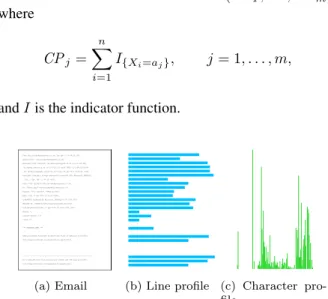
(CP). Informally put, the line profile of an email is a
vec-tor of lengths of the firstmlines. The character profile is a histogram of characters. Of course, many otherQPs
are conceivable.
The main advantages of the two considered quantitative profiles arei)sound performance,ii)simple computabil-ity,iii)language-independence,iv)robustness to outly-ing emails, v) high scalability and vi)low vulnerabil-ity.
The considered two instances of the quantitative profile approach perform comparably to the naive Bayes filtering and heuristics-based approaches and perform very well also in a multi-language, non-English communication. Furthermore, the satisfactory performance is attained by means of a small set of easily computable quantitative features. A performance study was done on the TREC 2007, CEAS 2008 and a private corpuses. To demon-strate the power of the consideredQPs, the profiles are
obtained from raw emails, without any preprocessing. Consequently, we intentionally ignore the structure of emails and character encoding.
On the twoQPs, the Random Forest algorithm
with extreme-valued profiles as well as high scalabil-ity.
In our view, classification and email categorization byLP
(orCP) should have low vulnerability. For, the lines the
lengths of which differentiates between spam and ham, change from corpus to corpus. For instance, in the CEAS 2008 corpus, the most important for deciding between spam and ham are the lengths of the (10, 17, 15, 14, 16)-th lines, whilst in 16)-the TREC 2007 corpus 16)-they are 16)-the (5, 13, 6, 15, 7)-th lines. As the training corpus is usually not available to a spammer, it should be not easy to evade theLP(orCP) filter.
As a by-product of a performance study ofCPandLP,
we note that in the TREC 2007 and CEAS 2008 corpuses the number of header lines is capable of discriminating between spam and ham, at a rate that is, in our view, too high. Consequently, the corpuses lead to overly opti-mistic performance of spam filtering methods.
The paper is organized as follows. In the next section we formally introduce theQPs mentioned above. Then,
in Section 3, we describe the three email corpuses used for assessment of the QPs’ performance. In Section 4
we describe measures used for performance evaluation. The results are summarized in Section 5. In the con-cluding section some directions for future research are briefly discussed. All the computations were performed with R [15]. To make the results reproducible, a supple-mentary material including the source code was prepared, cf. [8].
2. Quantitative profiles
The quantitative profile (QP) of an email is an m
-dimensional vector of real numbers that represents the email. The dimensionmof the profile is set in advance, and it is the same for all emails. In this paper we con-sider two particularQPs – the line profile and the
charac-ter profile. These profiles can be introduced by means of a simple probabilistic model.
An email is represented as a realization of a vector ran-dom variable, that is generated by a hierarchical data gen-erating process. The lengthnof an email is an integer-valued random variable, with the probability distribu-tion Fn. Given the length, the email is represented by
a random vectorXn
1 = (X1, . . . , Xn)from the
proba-bility distributionFXn
1|nwith the support inA
n, where A = {a1, . . . , am} is a finite set (alphabet) of size
m=|A|.
Then, the character profile (CP) of an email is an m -dimensional random vector CP = (CP1, . . . ,CPm),
where
CPj= n
X
i=1
I{Xi=aj}, j= 1, . . . , m,
andIis the indicator function.
http://www.theinsider.org/news/emails/unsubscribe/ To be removed from this mailing list please use the form provided: −−−−−−−−−−−−−−−−−−−−−−−−−−−−−−−−−−−−−−−−−−−−−−−−−−−−−−−−−−−−−−−−−−−−−−−− http://www.theinsider.org/news/article.asp?id=2476 American gunman massacres students and staff at American university *** BREAKING NEWS *** Lines: 10 Content−Length: 336 Status: O X−OriginalArrivalTime: 17 Apr 2007 10:44:10.0734 (UTC) Message−ID: <COSMIC200uYDlrjbudz00002c2e@cosmic200> X−MimeOLE: Produced By Microsoft MimeOLE V6.00.3790.3959 Date: Tue, 17 Apr 2007 11:44:10 +0100 Subject: "The Insider" − News Bulletin To: "Subscriber" <[email protected]> From: "The Insider" <[email protected]> Tue, 17 Apr 2007 11:44:10 +0100 Received: from mail pickup service by cosmic200 with Microsoft SMTPSVC; for <[email protected]>; Tue, 17 Apr 2007 06:44:26 −0400 by speedy.uwaterloo.ca (8.12.8/8.12.5) with ESMTP id l3HAiP0I026448 Received: from cosmic200 (windows.globalgold.co.uk [194.1.150.45]) Return−Path: <[email protected]> From [email protected] Tue Apr 17 06:44:26 2007
(a) Email (b) Line profile (c) Character pro-file
Fig. 1: Graphical representation of the line and char-acter profiles of an email
In order to introduce the otherQP, it is necessary to
se-lect a special character (or a subset of characters) from the alphabet. Letkbe the number of occurrences of the special character in an email and letTj (j = 1, . . . , k)
be the index of thej-th occurrence of the special char-acter; put T0 = 0. Then the binary profile (BP) of
an email is defined as a k˜-dimensional random vector
BP= (BP1, . . . ,BP˜k), where
BPj =Tj−Tj−1−1, j = 1, . . . ,˜k.
There,˜kis the maximum allowable number of the occur-rences of the special character and it is set in advance. Hence, ifk >k˜, the rest of the email is ignored. And if an email hask <k˜,BPj = 0forj > k.
In this work, an email is understood as a stream of bytes without any preprocessing, so thatAis taken to be the ASCII character set. The end-of-line is taken for the spe-cial character. Consequently, the binary profile becomes theline profile(LP) sinceBPj is the length of thej-th
line of an email in bytes. We fix the maximal number˜k of considered lines to100.
3. Data sets
available TREC 2007 and CEAS 2008 corpuses, and a private corpus.
The TREC 2007 corpus [7] comprises over 75 000 emails (25 220 hams and 50 199 spams), of which approxi-mately 67% is spam, and the rest are ham emails. For the training phase we used the first 50 000 emails. The rest forms the test set. The ratio of spam to ham in the training and test sets is approximately 2:1.
The other publicly available corpus, used for the perfor-mance analysis ofQPs, is CEAS 2008 [6]. It consists of
137 705 emails (27 126 hams and 110 579 spams). The corpus was hand labeled [18]. To form the training set, we used the first 90 000 emails. The test set comprises the remaining emails. The ratio of spam to ham in the training and test sets is approximately 4:1.
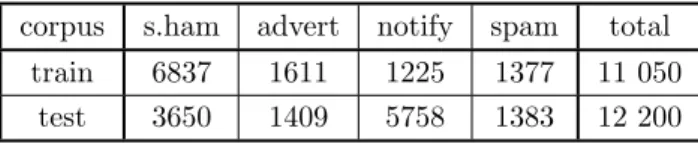
Performance of spam filtering algorithms is typically as-sessed on English language corpuses, such as the above mentioned TREC and CEAS. When applied to non-English emails, their performance may be different. Due to the support from a Slovak internet services provider, we enjoyed the opportunity of access to a private cor-pus created in 2010, that comprises mainly non-English emails. Structure of the corpus is summarized in Table 1. The training set we used consists of 11 050 emails and the test set consists of 12 200 emails.
Table 1: Composition of the private corpus
corpus s.ham advert notify spam total
train 6837 1611 1225 1377 11 050
test 3650 1409 5758 1383 12 200
The private corpus was hand labeled. Emails were placed into one of the two groups: ham and spam. More-over, ham was divided into advert, solicited ham (de-noted s.ham) and notify. Based on the language of the major part of an email, the emails were placed into one of the four language groups: Slovak/Czech, English, Ger-man, and other. The corpus comprises 64% of the Slo-vak/Czech ham in the training set and 38% in the test set.
4. Classification algorithm
and performance measures
Quantitative profiles serve as an input to a classifica-tion algorithm. In this work we use the Random For-est classifier, introduced by Breiman [5] and ported
to R by Liaw and Wiener [11], with the default set-tings. We have employed also LDA, logistic regression, LASSO and SVM [10], but these methods performed much worse.
To evaluate QPs’ performance, we calculate the false
positive ratefpr =F P/(T N+F P)and the false nega-tive ratefnr =F N/(T P +F N), whereTP(TN) stands
for the number of true positive (true negative) emails, i.e. the correctly recognized spam (ham) emails; andFP
(FN) stands for the number of false positive (false
neg-ative) emails, i.e. the incorrectly recognized ham (spam) emails, respectively. We also present the receiver operat-ing characteristic (ROC) curve [19], i.e. the graph of the
true positive rate vs. the false positive rate, obtained as functions of the decision threshold. The areaAUCunder
theROCcurve is also reported.
5. Results
In this section we summarize performance of the basic
QPs on the three corpuses mentioned above.
5.1 Comparison of quantitative profiles
with SpamAssassin and Bogofilter
For the sake of comparison, we report also results for SpamAssassin (SA) [20], version 3.3.1, off-line and
with-out the Bayes filter, and Bogofilter (BF) [17], version
1.2.2 with the default configuration. On the private cor-pus, the output fromSAwas processed by the Random
Forest classification algorithm, as it attains much better performance thanSAwith the default weights. In
addi-tion to much better performance, it allows for email cat-egorization, which is impossible with the defaultSA. On
the public corpuses, however, the defaultSA
classifica-tion performs better. Bogofilter allows a binary classifi-cation only.BFwas learnt in the batch mode.
0.00 0.02 0.04 0.06 0.08 0.10
0.80
0.85
0.90
0.95
False positive rate
T
rue positiv
e r
ate
AUC LP = 0.96395 AUC CP = 0.95982 AUC SA = 0.95682 AUC BF = 0.96131
(a) private corpus
0.00 0.01 0.02 0.03 0.04 0.05
0.90
0.92
0.94
0.96
0.98
1.00
False positive rate
T
rue positiv
e r
ate
AUC LP = 0.99986 AUC CP = 0.9993 AUC SA = 0.94216 AUC BF = 0.99959
(b) TREC 2007 corpus
Table 2: fnr (%) at fixedfpr = 0.5% orfpr = 1%
private TREC07 CEAS08
filter at 0.5% at 1% at 0.5% at 1% at 0.5% at 1%
CP 14.39 11.64 2.53 0.49 4.38 4.25
LP 21.33 20.10 0.30 0.13 0.39 0.27
SA 12.68 10.10 35.87 30.51 76.14 69.92
BF 13.05 7.38 0.40 0.06 0.47 0.36
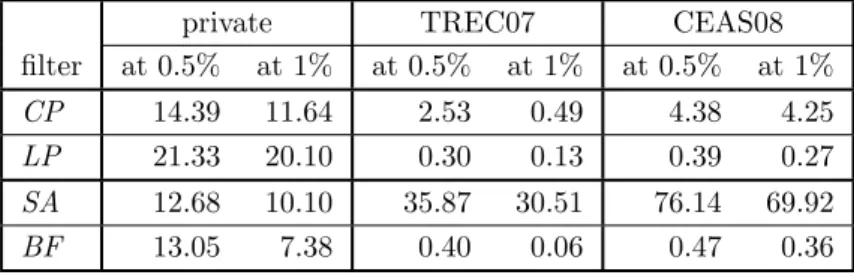
On the private corpus, for fpr = 0.5% the best per-formance is attained by SA and BF, and CP performs
only slightly worse, cf. Table 2 and Figure 2. LP is
slightly less effective, and it attains fnr around21% at
fpr= 0.5%.
With the exception ofSA, on the public corpuses all the
studied filters attain much better performance than on the private corpus, see also Section 5.6. The twoQPs
per-form much better thanSAas Table 2 as well as Figure 2b
indicates. The line profile attains better performance (smallerfnr) thanBFat the0.5%level offpr.
5.2 Email categorization
for the private corpus
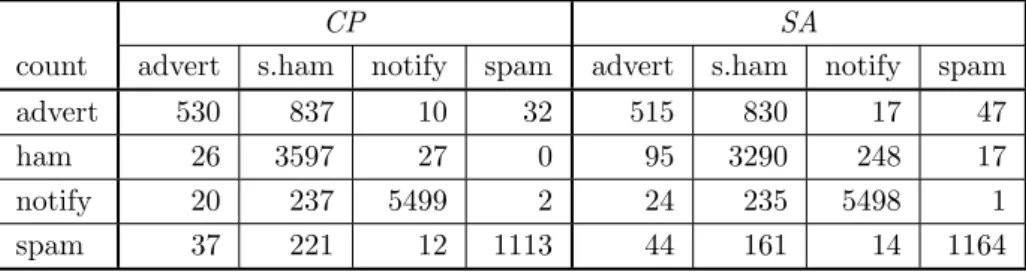
On the private corpus, performance ofCPand especially LPin spam filtering (i.e. binary categorization) is worse
than that of SAand BF. However, in categorization of
emails into one of the four categories, bothCPandLP
perform much better in the most interesting category of solicited ham. Misclassification table forCPandSAis in
Table 3.
5.3 Comparison with email shape analysis
Sroufe et al. [21] suggest to filter spam by means of its shape, which the authors define (using our terminology) as a smoothed line profile of email body, where smooth-ing is performed by the kernel smoother. Sroufe et al. also report the total error of30%, based on a preliminary study on the TREC corpus. Further, the authors find the performance very good, ’considering that no content or context was even referenced’, cf. [21], p. 26. The line profile, that is inspired by the email shape analysis, at-tains on the TREC corpusfpr= 4.23%afnr = 17.00%, when the threshold is not optimized and email headers are intentionally not taken into account, cf. Section 5.6. This gives the total error around 12.29% and indicates that smoothing is unnecessary.
5.4 Choice of LP dimension
The dimension˜kof the line profile is a free parameter. In order to choose the value of˜k it is necessary to ex-plore the dependence of theLPfilter’s performance on˜k. Figure 3 depictsfnrfor different values of˜kand the two values0.5%and1%offpr, for the private corpus. Asfnr
stabilizes at its lowest values fork˜ ≈ 40, the choice of ˜
k= 100is justified on the ’safe bet’ ground.
0 20 40 60 80 100
0.0
0.4
0.8
Dimension k~ of LP
fnr
0 20 40 60 80 100
0.0
0.4
0.8
fpr = 0.5% fpr = 1.0%
Fig. 3: Dependence offnr on the dimension ˜kofLP, for fpr = 0.5% (solid line) and 1% (dashed line); private corpus
5.5 Reduction of the feature space
It is also important to know to what extent the dimen-sion of theQPfeature space can be reduced without
sub-stantive reduction of the classifier’s performance. To this end the top 20 and the top 50 features were considered, where the ranking of features was provided by the Ran-dom Forest’s measure of the mean decrease of accuracy. The study was done on the private corpus and solely the email body was considered.
In the binary classification the top 20 features of the line profile attain essentially the same performance as the en-tire line profile of the length 100. In the case ofCP, to
Table 3: CP andSAconfusion tables for categorization, private corpus
CP SA
count advert s.ham notify spam advert s.ham notify spam
advert 530 837 10 32 515 830 17 47
ham 26 3597 27 0 95 3290 248 17
notify 20 237 5499 2 24 235 5498 1
spam 37 221 12 1113 44 161 14 1164
of 256 are needed. The same holds forSA. However, in
the case of the email categorization it is not possible to reduce the dimension ofSAfeatures without substantive
decrease in accuracy.
5.6 Why are TREC and CEAS
misleading?
All the considered email filters except ofSAattain much
better performance on the public corpuses than on the pri-vate one; cf. Table 2. In search for explanation we have noted that in the public corpuses, unlike to the private corpus, the number of header lines contains information that is substantive for spam filtering. Figure 4 depicts the distribution of the number of lines in header, for spam and ham, in the TREC corpus.
Number of header lines
Density
0.00 0.05 0.10
20 40 60
ham 0.00
0.05 0.10 spam
Fig. 4: Distribution of emails with respect to the number of header lines, for spam and ham, in the TREC 2007 corpus
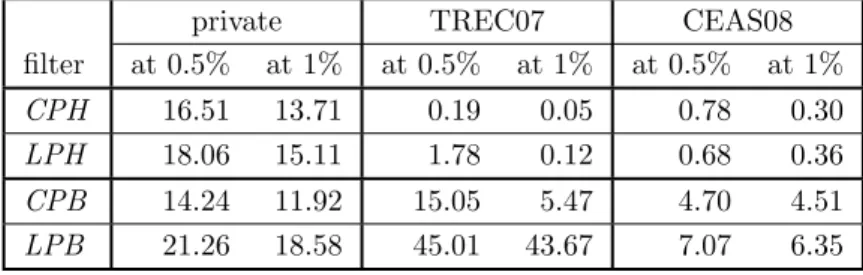
Once the email header is not taken into account, and solely the email body is processed, performance of LP
andCPworsens and becomes comparable to that on the
private corpus; cf. Table 4. In Table 4,LPH(CPH)
de-notes the line (character) profile of email header andLPB
(CPB) denotes the line (character) profile of email body,
respectively.
The decline of performance ofCPandLPcaused by
ex-clusion of email headers supports the hypothesis that in
the TREC 2007 and CEAS 2008 corpuses the profiles of headers carry a substantive information for discriminat-ing between spam and ham.
5.7 Summary of the performance study
The empirical study implies that the simple and easily ob-tainable line and character profiles attain at least compa-rable performance as the optimally tuned SpamAssassin, which is based on hundreds of fixed rules, and the perfor-mance of character profiles is close to that of Bogofilter. Particularly, on the public corpusesLPis better thanBF
andSA. On the private corpusCPattains comparable
per-formance asBFandSA, andLPis slightly worse.
6. Conclusions
Motivated by Sroufe et al. [21], we have proposed the quantitative profile approach to email classification. In this communication we explored two quantitative files, the line profile and the character profile. The pro-files are obtained from raw emails, without any prepro-cessing. The computational costs of the two profiles are minimal. Performance of the profiles was studied on the TREC 2007, CEAS 2008 corpuses and a private, multi-lingual corpus. The two quantitative profiles attained at least comparable performance as the optimally tuned SpamAssassin and the batch-mode learnt Bogofilter. Be-sides the good performance, the two quantitative profiles are language independent and the resulting filter is robust to outlying emails, highly scalable and has low vulnera-bility.
As a by-product, we have noted that the number of header lines in the TREC 2007 and CEAS 2008 corpuses contain rather strong information on the email class. The cor-puses thus lead to overly optimistic performance of spam filters.
dy-Table 4: fnr (%) at fixedfpr = 0.5% orfpr = 1%
private TREC07 CEAS08
filter at 0.5% at 1% at 0.5% at 1% at 0.5% at 1%
CPH 16.51 13.71 0.19 0.05 0.78 0.30
LPH 18.06 15.11 1.78 0.12 0.68 0.36
CPB 14.24 11.92 15.05 5.47 4.70 4.51
LPB 21.26 18.58 45.01 43.67 7.07 6.35
namics, and another instances of the binary profile. Also, the profiles are worth employing in a semi-supervised email categorization.
Acknowledgments
Stimulating feedback from Peter Farkaš, Ján Gallo, Peter Koˇcík, Erik Lehotský, Dušan Slivoˇn and Stanislav Záriš is gratefully acknowledged. This paper was prepared as a part of the project “SPAMIA”, MŠ SR - 3709/2010-11, supported by the Ministry of Education, Science, Re-search and Sport of the Slovak Republic, under the head-ing of the state budget support for research and develop-ment.
References
[1] T. A. Almeida, and A. Yamakami, "Content-based spam filtering", in Proceedings of the 23rd IEEE Interna-tional Joint Conference on Neural Networks (IJCNN’10), Barcelona, Spain, 2010.
[2] T. A. Almeida, and A. Yamakami, "Advances in spam filtering techniques", in Computational Intelligence for Privacy and Security. Book Series: Studies in Computa-tional Intelligence, Springer, Berlin/Heidelberg, 2012, to appear.
[3] I. Androutsopoulos, G. Paliouras, and E. Michelakis, "Learning to filter unsolicited commercial e-mail", Na-tional Centre for Scientific Research "Demokritos", Athens, Greece, Tech. Rep. 2004/2, (2004).
[4] P. S. Bogawar, and K. K. Bhoyar, "Email mining: a re-view", IJCSI International Journal of Computer Science Issues, Vol. 9, No. 1, 2012.
[5] L. Breiman, "Random forests", Machine Learning, Vol. 45, No. 1, 2001, pp. 5-32.
[6] G. V. Cormack, and T. R. Lynam, "CEAS 2008 cor-pus", 2008.
❤tt♣✿✴✴♣❧❣✳✉✇❛t❡r❧♦♦✳❝❛✴⑦❣✈❝♦r♠❛❝✴❝❡❛s❝♦r♣✉s
[7] G. V. Cormack, and T. R. Lynam, "TREC 2007 cor-pus", 2007.
❤tt♣✿✴✴♣❧❣✳✉✇❛t❡r❧♦♦✳❝❛✴⑦❣✈❝♦r♠❛❝✴tr❡❝❝♦r♣✉s✵✼✴ ❛❜♦✉t✳❤t♠❧
[8] M. Grendár, J. Škutová, and V. Špitalský, "Supple-ment to “Spam filtering by quantitative profiles”", 2011.
❤tt♣✿✴✴✇✇✇✳s❛✈❜❜✳s❦✴⑦❣r❡♥❞❛r✴s♣❛♠✴ ❙✉♣♣❧❡♠❡♥t❚♦◗✉❛♥t✐t❛t✐✈❡Pr♦❢✐❧❡s✳♣❞❢
[9] T. Guzella, and W. Caminhas, "A review of ma-chine learning approaches to spam filtering", Expert Sys-tems with Applications, Vol. 36, 2009, pp. 10206-10222.
[10] T. Hastie, R. Tibshirani, and J. Friedman, The Elements of Statistical Learning, Springer, New York, 2009.
[11] A. Liaw, and M. Wiener, "Classification and regres-sion by randomForest", R News, Vol. 2, No. 3, 2002, pp. 18-22.
[12] T. M. Mahmoud, and A. M. Mahfouz, "SMS spam filtering techniqu based on artificial immune system", IJCSI International Journal of Computer Science Issues, Vol. 9, No. 1, 2012.
[13] A. N. Pathak, M. Seghal, and D. Christopher, "A study of selective data mining algorithms", IJCSI Inter-national Journal of Computer Science Issues, Vol. 8, No. 2, 2011.
[14] J. Pruthi, and E. Kumar, "Anti-trust rank: fighting web spam", IJCSI International Journal of Computer Sci-ence Issues, Vol. 8, No. 1, 2011.
[15] R Development Core Team, "R: A language and en-vironment for statistical computing", R Foundation for Statistical Computing, Vienna, Austria. ISBN 3-900051-07-0, (2010).
[16] M. Rafi, S. Hassan, and M. S. Shaikh, "Content-based text categorization using Wikitology", IJCSI Inter-national Journal of Computer Science Issues, Vol. 9, No. 4, 2012.
[17] E. S. Raymond, D. Relson, M. Andree, and G. Louis, "Bogofilter", (2004).
❤tt♣✿✴✴❇♦❣♦❢✐❧t❡r✳s♦✉r❝❡❢♦r❣❡✳♥❡t
[18] R. Segal, A. Bratko, and G. Cormack, "CEAS 2008 Spam Filter Challenge", conference talk, 2008.
❤tt♣✿✴✴✇✇✇✳❝❡❛s✳❝❝✴✷✵✵✽✴❝❤❛❧❧❡♥❣❡✴r❡s✉❧ts✳ ♣❞❢
[19] T. Sing, O. Sander, N. Beerenwinkel, and T. Lengauer, "ROCR: Visualizing the performance of scoring classifiers", R package version 1.0-4., 2009.
❤tt♣✿✴✴❈❘❆◆✳❘✲♣r♦❥❡❝t✳♦r❣✴♣❛❝❦❛❣❡❂ ❘❖❈❘
[20] SpamAssassin.
❤tt♣✿✴✴s♣❛♠❛ss❛ss✐♥✳❛♣❛❝❤❡✳♦r❣
[21] P. Sroufe, S. Phithakkitnukoon, R. Dantu, and J. Cangussu, "Email shape analysis", in Distributed Com-puting and Networking, K. Kant, S. V. Pemmaraju, K. M. Sivalingam, J. Wu (Eds.), Lecture Notes in Computer Science 5935/2010, Springer, New York, 2010, pp. 18-29.