Characterization of the third SERK gene in pineapple (
Ananas comosus
)
and analysis of its expression and autophosphorylation activity
in vitro
Jun Ma
1,2, Yehua He
1, Zhongyi Hu
1, Wentian Xu
1, Jingxian Xia
1, Cuihong Guo
1, Shunquan Lin
1,
Chengjie Chen
1, Chenghou Wu
1and Junli Zhang
21
Horticultural Biotechnology College, South China Agricultural University, Guangzhou, China.
2
College of Landscape Architecture, Sichuan Agricultural University, Chengdu, China.
Abstract
Two somatic embryogenesis receptor-like kinase genes (identified asAcSERK1 and AcSERK2) have previously
been characterized from pineapple (Ananas comosus). In this work, we describe the characterization of a third gene (AcSERK3) in this family. AcSERK3 had all the characteristic domains and shared extensive sequence homology with other plantSERKs. AcSERK3 expression was studied by in situ hybridization and quantitative real-time PCR to analyze its function. Intensein situ hybridization signals were observed only in single competent cells and competent cell clusters; no hybridization signal was detected in the subsequent stages of somatic embryogenesis.AcSERK3 was highly expressed in embryogenic callus compared to other organs,e.g., 20-80 fold more than in anther but simi-lar to that of non-embryogenic callus, which was 20-50 fold that of anther.AcSERK3 expression in root was 80 fold higher than in anther and the highest amongst all organs tested. These results indicate thatAcSERK3 plays an im-portant role in callus proliferation and root development. His-tagged AcSERK3 protein was successfully expressed and the luminescence of His6-AcSERK3 protein was only ~5% of that of inactivated AcSERK3 protein and reaction buffer without protein, and 11.3% of that of an extract of hostEscherichia coli pET-30a. This finding confirmed that the AcSERK3 fusion protein had autophosphorylation activity.
Keywords: AcSERK3, autophosphorylation activity, expression analysis, prokaryotic expression, somatic embryogenesis.
Received: January 13, 2014; Accepted: April 15, 2014.
Introduction
Somatic embryogenesis (SE) is the process whereby somatic cells can develop into plants via characteristic mor-phological stages (Shahet al., 2002) and is a notable exam-ple of plant totipotency. Somatic embryogenesis can be used for rapid propagation of valuable clones and also for gene transfer and regeneration of genetically modified plants (Schellenbaumet al., 2008). The use of SE-based transformation systems may overcome the problem of chi-mera formation (Sanjeevet al., 2008). Pineapple is a vege-tative propagated crop that depends on suckers because it is self-sterile. Somatic embryogenesis is a highly efficient means of propagating pineapples and can be induced in this species by exposure to 2,4-dichlorophenoxyacetic acid (2,4-D), with the frequency of somatic embryo induction reaching 95%; the number of somatic embryos per callus (3x3x3 mm) after 40 days (d) of culture is ~48 (Heet al., 2007). The origin of SE in pineapple is unicellular (Heet al., 2010; Maet al., 2012a,b). Somatic embryogenesis thus provides a good way to genetically transform pineapple.
The genetic and biochemical mechanisms leading to SE are not well understood (Nolan et al., 2003; Pérez-Núnezet al., 2009). The screening of differentially and spe-cifically expressed genes in carrot embryogenic cell cul-tures resulted in the isolation ofDcSERK(Daucus carota
somatic embryogenesis receptor-like kinase).DcSERKwas found to be a marker for single somatic cells capable of forming embryos and its expression continued up to the early globular stage but was absent in later stages of embry-onic development (Schmidtet al., 1997). A study in maize suggested that SERK protein may be involved in signal transduction and the induction of embryonic development since cells without SERK expression show no such re-sponse (Baudino et al., 2001). AtSERK1, which is ex-pressed during ovule development and early embryoge-nesis, is a component of the embryogenesis-signaling pathway (Hechtet al., 2001) and a positive regulator that enhances embryogenesis after ectopic expression (Schel-lenbaum et al., 2008). Studies of plant species such as
Arabidopsis, maize and Medicago truncatula have sug-gested that some SERKs play pivotal roles in conferring embryonic potential to cells (Itoet al., 2005). The absence of detectableLsSERKgene transcripts reduces the ability of plants to form somatic embryonic structures in vitro Send correspondence to Ye-hua He. Horticultural Biotechnology
(Santoset al., 2009).SERKsare involved in the acquisition of embryogenic competence in plant cells (Schellenbaum
et al., 2008). The expression patterns ofZmSERK1 (Bau-dinoet al., 2001) andStSERK1(Sharmaet al., 2008) sug-gested thatSERKsmay be involved in plant development, disease resistance or other procedures (Alamet al., 2010; Huang et al., 2010; Yang et al., 2011). In many plants, SERKs form a gene family with several members (Baudino
et al., 2001; Hechtet al., 2001; Huet al., 2005; Nolanet al., 2003; Thomas et al., 2004) that have variable roles in embryogenesis and other developmental processes (Sanjeevet al., 2008; Songet al., 2008; Alamet al., 2010). For example, the five SERKs inArabidopsisare involved in several independent pathways (Albrechtet al., 2008), while the twoZmSERKs(Baudinoet al., 2001) and three
VvSERKs (Schellenbaumet al., 2008) have different ex-pression patterns in maize (Zea mays) and grapevine (Vitis vinifera), respectively. We have previously shown that in pineapple (Ananas comosus)AcSERK1plays an important role in the induction and development of SE (Ma et al., 2012b), and that AcSERK2 is highly expressed only in embryogenic cells before the pro-embryonic stage (Maet al., 2012a). The characterization of other SERKs from pineapple and analysis of their expression and function in SE and other developmental processes should improve our understanding of the biological roles of the SERK gene family.
The perception and transduction of external stimuli frequently involves the interaction of membrane-associated receptor proteins with extracellular ligands and the subse-quent transmission of information through kinase domains of the receptor that in turn leads to the phosphorylation of target proteins (Ullrich and Schlessinger, 1990; Posadaet al., 1993). Plant receptor-like kinases (RLKs) can auto-phosphorylate serine and/or threonine residues and play an important role in the perception and transmission of exter-nal sigexter-nals (Shiu and Bleecker, 2001; Torii, 2004). The dephosphorylation of transmembrane receptor kinases cat-alyzed by phosphatases is an essential regulatory mecha-nism in receptor-mediated signaling (Shah et al., 2002). Protein kinases play important roles in cellular signaling and metabolic regulation in plants (Shahet al., 2001b). The autophosphorylation activities of five AtSERKs have been compared and their phosphorylation sites identified (Kar-lovaet al., 2009). Intramolecular autophosphorylation is required for AtSERK1 activation, although most of the re-ceptors are in a non-phosphorylated state (Shah et al., 2001b, 2002). In vitro, this phosphorylation can be achieved through the action of a minor population of cata-lytically active AtSERK1 molecules, whilein vivoit can be obtained via ligand-induced conformational changes. The analysis of phosphorylation is thus an important tool for es-tablishing the function of SERKs.
We have previously shown thatAcSERK1 is effec-tively induced by 2,4-D during SE and can be used as a
marker for embryogenically competent cells (Ma et al., 2012b).AcSERK2expression was synergistically increased when 2,4-D was supplied in the culture medium but was not specifically associated with SE and may play a broader role in morphogenesis (Maet al., 2012a). In the present work, we analyzed the expression ofAcSERK3based onin situ
hybridization and quantitative real-time PCR (qRT-PCR).
AcSERK3was expressed at high levels only in competent cells during SE and there was no apparent difference in the expression level between embryogenic and non-embryo-genic callus. The highest expression was detected in roots. The His-tagged AcSERK3 fusion protein was expressed in
E. coliand autophosphorylation was detected.
Material and Methods
Plant material
Calluses derived from the leaf-base of Ananas comosus. cv.Shenwan cultured in 2,4-D-free medium were randomly allocated to one of two groups. One group was transferred to 2,4-D-containing medium for SE induction while the other was maintained on 2,4-D-free medium for proliferation of non-embryogenic calluses. Batches of embryogenic calluses were periodically used to extract to-tal RNA every 5 d after incubation on 2,4-D containing me-dium. Non-embryogenic control samples were obtained at 0, 15, 25, 35 and 45 days. Samples of organs (root, stem, leaf, calyx, bract, petal and anther) were also used to isolate RNA for qRT-PCR. The ovules and ovaries were periodi-cally collected at relevant stages (a week before flower blooming, at flower blooming, a week after flower bloom-ing, two weeks after flower blooming and four weeks after flower blooming) to studyAcSERK3expression during the development of these organs. All of the tissue samples were immediately snap-frozen in liquid nitrogen and stored at -80 °C until RNA extraction. Embryogenic calluses in-duced with 2,4-D were fixed in formalin acetic acid (FAA) forin situhybridization.
RNA/DNA extraction and cDNA synthesis
RNA was extracted using TRIzol reagent (Takara) based on the manufacturers recommendations. Each RNA sample was digested with DNase (Takara) to remove any remaining DNA. The first strand cDNA was synthesized using M-MLV reverse transcriptase (Invitrogen). Genomic DNA was extracted from calluses culturedin vitroby treat-ing with cetyltrimethylammonium bromide (CTAB) as de-scribed by Murray and Thompson (1980) and treated with RNase A to eliminate RNA.
Isolation ofAcSERK3
The primers used to isolate AcSERK3 are shown in Supplementary Table S1. The 5’ and 3’ end sequences of
5’-Full RACE Core Set v.2.0 kit (Takara), according to the manufacturer’s instructions. Sequences were edited, aligned and analyzed using DNAMAN and CLUSTAL software tools. Specific primers designed based on the re-sults of RACE were used to amplify the full-length cDNA sequence and genomic sequence.
Bioinformatics analysis
The isolated sequence was blasted against sequences deposited in GenBank sequences. The open reading frame (ORF) was predicted with the ORF Finder program. The protein parameters of the protein were computed by the Protparam tool of ExPASy. The signal peptide (SP) was predicted with the SignalP 3.0 Server tool and the trans-membrane region (TM) was predicted by the TMpred tool. The structure and function of the protein were assessed us-ing the ScanProsite software (Zdobnov and Apweiler, 2001). The SWISS-MODEL program was used to predict the tertiary structure (Arnold et al., 2006) and phospho-rylation sites were predicted by the KinasePhos tool. Multi-ple sequence alignment was done with DNAMAN software and phylogenetic trees were constructed using MEGA4 software.
Quantitative real-time PCR (qRT-PCR)
The relative expression ofAcSERK3was assessed us-ing a Thunderbird SYBR qPCR mix (Toyobo) accordus-ing to the manufacturer’s instructions. The assays were done us-ing an iQ5 real-time PCR system (BioRad). qRT-PCR was done using gene-specific primers forAcSERK3(Table S1). A gene encoding pineappleb-actin was used as an internal (housekeeping gene) control. Triplicate quantitative PCR experiments were run for each sample and for each tissue and time point three biological replicates assayed. The re-sults were analyzed using iQ5 system software. To prevent the amplification of any contaminating genomic DNA, RNA preparations were treated with DNaseI and the probe primers were designed over an exon/intron boundary in the cDNA sequence. The specificity of the amplifications was verified by electrophoresis and at the end of the PCR run by melting curve analysis.
RNAin situhybridization and detection
RNAin situhybridization was done using the proce-dures described in the Roche manual forin situ hybridiza-tion to chromosomes, cells and tissue sechybridiza-tions. The samples were fixed, embedded, sectioned and hybridized as de-scribed elsewhere (Maet al., 2012a). The sense and anti-sense probes were transcribed with cDNA fragments cloned in the pSPT 19 vector (Roche) and were labeled with digoxigenin-UTP using an SP6 or T7 RNA polymer-asein vitrotranscription kit (Roche) according to the tech-nical manual. Detection was done with anti-digoxigenin-AP and NBT/BCIP ready-to-use tablets (Roche) and the
hybridization signal was observed by microscopy (Olym-pus).
Prokaryotic expression ofAcSERK3
After digestion with two restriction enzymes (EcoRI andHindIII), full-lengthAcSERK3without the signal pep-tide was sub-cloned into the pET-30a vector. The recombi-nant plasmid (pET-AcSERK3) was then introduced intoE. coliBL21 (DE) pLysS competent cells and sequenced from both sides. A single colony ofE. colistrain BL21 (DE) har-boring the pET-30a-AcSERK3 plasmid was cultured at 37 °C overnight in Luria-Bertani liquid medium containing kanamycin (50mg/mL). Subsequently, 1mL of the cultured cells was transferred to 200mL of fresh medium and shaken at 150 rpm for about 4 h until the optical density (OD600)
reached 0.5. The cultures were then induced by adding isopropyl-b-D-thiogalactoside (IPTG) to a final concentra-tion of 1 mM and shaken for another 20 h at 18 °C. Bacteria were harvested by centrifugation (4000 rpm, 5 min), resus-pended in 2 mL of splitting buffer and ultrasonicated at 4 °C. The ultrasonicated product was centrifuged (12,000 rpm, 10 min, 4 °C) and 50mL of the precipitate and supernatant were assessed by sodium dodecyl sulfate-polyacrylamide gel electrophoresis (SDS-PAGE) on 12% gels. The protein bands were visualized after being stained with pre-cooled 0.1 M KCl solution. The target protein was obtained by His column chromatography. An empty pET-30a vector inE. coliBL21 (DE) was used as a control.
Western blot analysis of AcSERK3
Purified soluble recombinant proteins were separated by 12% SDS-PAGE and transferred to a nitrocellulose membrane (Roche) using a Mini Trans-Blot apparatus (Bio-Rad) according to the manufacturer’s instructions. The membrane was incubated in a blocking solution con-taining 5% skimmed milk overnight at 4 °C and then treated with anti-His polyclonal antibody (Amersham) at 37 °C for 2 h. After three washes in PBS, the membrane was incu-bated with a rabbit anti-goat IgG conjugated secondary an-tibody (Promega) at 37 °C for 1 h. After a further three washes in PBS, the membrane was treated with BeyoECL Plus (Beyotime) and the blots were exposed to X-ray film (Kodak).
Autophosphorylation assay
Purified fusion protein was coupled togATP (50mM, Promega) in a solid white 96-well plate and incubated for 60 min at room temperature in a volume of 50mL of kinase reaction buffer (20 mM Tris, pH 7.5, 0.5 M NaCl, 0.1 M MgCl2and 0.1 M DTT). After incubation withgATP, an
luminescent signal correlated with the amount of ATP pres-ent and was inversely related to the amount of kinase activ-ity. The prokaryotic expression and purification of the fusion protein was performed three times, and the auto-phosphorylation of each sample was assessed in triplicate.
Results
Cloning ofAcSERK3
SERKscomprise a small gene family in many plants (Sharmaet al., 2008). The question arises as to whether there are other SERK genes inA. comosusthat are closely related toAtSERK1. Based on the isolation ofAcSERK1
andAcSERK2(Maet al., 2012a,b) using the primers listed in Supplementary Table S1, the full-length DNA and cDNA sequences ofAcSERK3 were amplified. The full-length mRNA sequence of AcSERK3 contained 2045 bp (GenBank accession number HM236377) and the full-length genomic DNA sequence contained 5299 bp (GenBank accession number JN672683).
Sequence analysis
The mRNA sequence of AcSERK3 contained an 1890-bp open reading frame (ORF) that encoded 629 amino acids, with a calculated molecular mass of 69.6 kDa and a predicted pI of 5.55. The total number of negatively charged residues (Asp+Glu) was 71 and the total number of positively charged residues (Arg+Lys) was 60; the general formula was C3092H4889N853O921S24. The extinction
coeffi-cient at 280 nm was 78,880 and the instability index (II) was 45.55, which classified the protein as unstable. The aliphatic index was 91.91 and the grand average of hydro-pathicity (GRAVY) was -0.220, indicating that AcSERK3 was a hydrophobin.
TheAcSERK3mRNA sequence showed the highest identity withAcSERK2 (A. comosus, HM236376, 82%),
CnSERK (Cocos nucifera, AAV58833.2, 82%) and
AcSERK1(A. comosus, HM236375, 79%) at the nucleotide level, and the predicted amino acid similarity of these se-quences was 88% (Supplementary Figure S1). AcSERK3 aligned closely with some SERKs from other species and contained all the conserved domains present in these SERKs. A high similarity of AcSERK3 to other SERKs was observed in the leucine zipper region and kinase do-mains, while weak similarity was observed in the signal peptide and the serine-proline-proline (SPP) region. The SP sequence was detected using the SignalP3.0 program which predicted that the first 28 N-terminus amino acids of AcSERK3
(MAISTRQAVAPWFLWLLLLFNPVARVLR) formed a signal peptide, with a putative signal peptide cleavage site between residues 28 and 29 (Supplementary Figure S2A). The signal peptide of AcSERK3 has one amino acid less than that of AcSERK1 and five amino acids more than that of AcSERK2. This signal peptide was followed by a
leucine-rich domain containing the ZIP motif. As in other SERKs, there were five leucine-rich repeat (LRR) consen-sus sequences with the typical 24 residues that are essential for correct localization of the AtSERK1 protein (Shahet al., 2001a). The ZIP motif was followed by a proline-rich domain containing the SPP motif, an alanine-rich hydro-phobic transmembrane domain (Supplementary Figu-re S2B), and a serine/thFigu-reonine kinase domain comprising 11 sub-domains located at positions 305-592 (Supplemen-tary Figure S2C). The 29 amino acid residue activation loop (A-loop) was also present in subdomains VII and VIII, which was defined as the active site of AtSERK1 (Shahet al., 2001c). A protein kinase ATP-binding region was pres-ent at positions 311-333 and a serine/threonine protein kinase active site was present at positions 428-440 in subdomain VI with an active site at position 432, which in-dicated the function of AcSERK3 as a serine/threonine kinase (Singlaet al., 2008). The kinase region was followed by a leucine-rich C-terminal domain, as described by Schmidtet al.(1997) that was conserved among the three AcSERKs. The tertiary structure of AcSERK3 protein was predicted with SWISS-MODEL program (Supplementary Figure S2D). There were 13 serine phosphorylated sites, five threonine phosphorylated sits and four tyrosine phos-phorylated sites in the AcSERK3 protein (Supplementary Figure S2E).
A comparative alignment of the predicted AcSERK3 coding regions with the corresponding genomic sequence revealed that AcSERK3 consisted of 11 exons and 10 introns (Supplementary Figure S3). This exon/intron struc-ture was quite similar to that ofAcSERK1,AcSERK2(Maet al., 2012a,b) and otherSERKs(Sharmaet al., 2008; Stone
et al., 2001). The mRNA coding regions ofAcSERK1, 2, 3
were 1890, 1875 and 1890 bp long, respectively, while the corresponding full-length DNA sequences were 4845, 5707 and 5155 bp long, indicating that were important dif-ferences in the lengths of the intron sequences (Supplemen-tary Figure S3). Alignment of the sequences of the corresponding introns indicated marked differences in their base pair composition (data not shown).
associ-ated with AcSERK2 and CnSERK (Pérez-Núnez et al., 2009), while AcSERK1, which was closest to HvSERK and then to OsSERK1 and ZmSERK1, formed a separate cluster. All of these were grouped closer to AtSERKs 1 and 2 and DcSERK rather than to AtSERKs 3-5. AtSERK1 and DcSERK have been directly implicated in somatic embryogenesis and can be used as markers of competent cells (Schmidtet al., 1997; Nolanet al., 2003). AtSERKs 3-5 were distantly related to other SERKs because they showed very weak similarity in the SPP region, a unique feature of SERK proteins (Sharmaet al., 2008).
AcSERK3expression during somatic embryogenesis
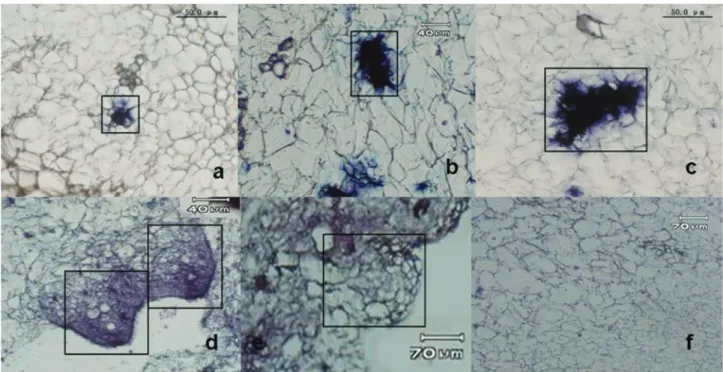
Our previous study confirmed that treatment with 2,4-D was important for the formation of embryogenic cells in activated pineapple calluses (Heet al., 2007). The pres-ence of 2,4-D stimulates the formation of competent cells and a transition towards embryogenic cells.In situ hybrid-ization was done with sections of 2,4-D-treated calluses to detect the expression pattern ofAcSERK3. Intense expres-sion signals were observed in a few of the small cyto-plasm-rich cells (Figure 1A) and small clusters of these cytoplasm-rich cells (Figure 1B,C). The large vacuolated cells surrounding these small cytoplasm-rich cells were non-proliferating remnants of the callus. TheseAcSERK3 -expressing cells were small, isodiametric, non-vacuolated, cytoplasm-rich and proliferating, indicating their high met-abolic activity. We have confirmed that some of these
cyto-plasm-rich small cells are embryogenic cells and that they can form somatic embryos (Heet al., 2010). This finding indicated that theseAcSERK3-expressing cells were com-petent cells that were involved in the formation of early stage pro-embryo through cell division (Figure 1D) in which the expression ofAcSERK3 apparently decreased. No hybridization signal was detected in the early stage of the globular embryo (Figure 1E).AcSERK3showed an es-sentially similar expression profile to that ofAcSERK2 dur-ing the early stage of pro-embryo formation (Maet al., 2012a), but different from that ofAcSERK1which showed a high level of expression in the transition from single com-petent cells to the globular embryo (Ma et al., 2012b). When the sense probe for hybridization was tested alone, no signal was detected in any region of the callus (Figu-re 1F).
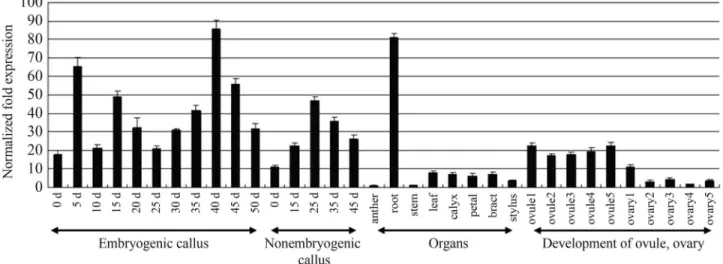
To determine the abundance of AcSERK3 during embryogenesis, qRT-PCR was done with RNA isolated from calluses cultured in the absence and presence of 2,4-D. The level of expression could be upregulated by short-term treatment (5 d) with 2,4-D and then maintained in a relatively low level. After culture with 2,4-D for 40 d, the expression ofAcSERK3reached the highest level but then apparently decreased. In non-embryogenic calluses that were used as controls, the expression of AcSERK3
gradually increased in the initial 25 d of culture and then de-creased. Overall, except for the high level of expression on days 5 and 40 of the treatment with 2,4-D, there was no sig-nificant difference between the expression ofAcSERK3in
embryogenic and non-embryogenic calluses (Figure 2). The expression level in calluses was 5-10 times of that in other organs except root. This expression pattern indicated thatAcSERK3may play a role in the proliferation of cal-luses beyond SE.
AcSERK3expression in various organs
Since the expression ofAcSERK3in anther was the lowest amongst all of the organs screened, all other levels of expression were expressed as the fold change relative to that of anther. Root had the highest expression (80 fold that of anther), which suggested thatAcSERK3played an im-portant role in this organ.AcSERK3expression in leaf, ca-lyx, bract and petal was 6-8 fold that of anther, with stem having a low expression similar to anther.AcSERK3 ex-pression during ovule development was stable and rela-tively high (~20 fold that of anther), perhaps because this protein has a role in the development of the zygotic embryo. The level of expression during ovary development was rel-atively low (~3 fold that of anther and similar to other or-gans, except root).
Prokaryotic expression, purification and western blot analysis of AcSERK3
The mRNA sequence ofAcSERK3without the signal peptide was inserted into the pET-30a expression vector and transformed intoE. coliBL21 (DE) Plys to express the N-terminally His6-tagged protein. SDS-PAGE of the fu-sion protein showed that AcSERK3 was expressed and mi-grated as a single band with the predicted molecular mass. The protein was detected in both supernatant and precipi-tate (Figure 3A). This result showed that the prokaryo-tically expressed ~68 kDa His6-AcSERK3 was a soluble protein. The soluble fraction of the fusion protein was puri-fied by nickel-affinity column. The puripuri-fied product was
separated by SDS-PAGE and stained with Coomassie Bril-liant Blue. The molecular mass of the purified protein
Figure 2-AcSERK3expression assessed by qRT-PCR. The results are shown as the fold-change compared to the expression levels in anther and were normalized relative to the housekeeping gene AcACTIN in callus.Embryogenic callus- callus cultured in medium containing 2,4-D.Non-embryogenic callus- callus cultured in 2,4-D-free medium. For callus tissue, the time intervals are in days (d). The columns represent the mean±SD of X determina-tions.
Figure 3- Prokaryotic expression and western blot results of AcSERK3. (A) SDS-PAGE analysis of the expression product of pET-30a-AcSERK3 inE. coli.Lanes: M - low molecular mass marker, 1 - supernatant of cells carrying the pET30a vector, 2 - supernatant of non-induced cells carrying the pET30a-AcSERK3vector, 3 - supernatant of induced cells carrying the pET30a-AcSERK3vector, 4 - precipitate of induced cells carrying the pET30a vector, 5-precipitate of non-induced cells carrying the AcSERK3 vector, 6 - precipitate of induced cells carrying the pET30a-AcSERK3 vector. (B) Purification of expressed pET30a-AcSERK3 pro-tein. Lanes: M - low molecular mass marker, 1 - soluble fraction of in-duced cells containing pET30a-AcSERK3, 2 - pET30a-AcSERK3 flow-through, 3 - wash buffer, 4-7 - first, second, third and fourth washes with elution buffer. (C) Western blot of His6-AcSERK3 fusion protein. Lanes:
(~68 kDa) (Figure 3B) agreed well with the calculated mo-lecular mass for AcSERK3. The identity of the His-tagged AcSERK3 protein was further confirmed by western blot analysis using anti-His antibody (Figure 3C).
Analysis ofAcSERK3autophosphorylation
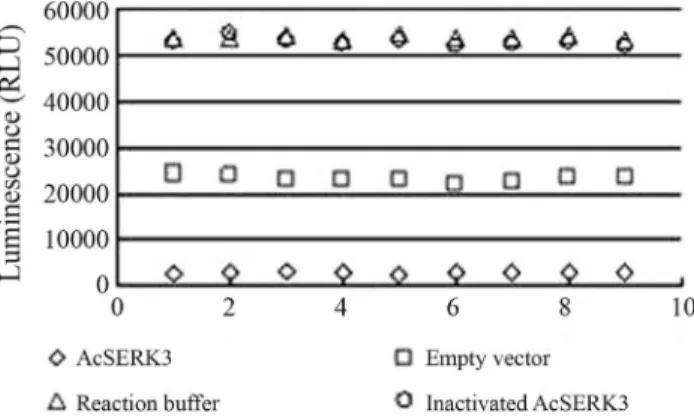
Protein phosphorylation is a critical part of signal transduction events that allow cells to respond to external stimuli. This is achieved by protein kinases that catalyze the transfer of theg-phosphate from ATP to a target protein (Langeret al., 2004). AtSERKs have been shown to have autophosphorylation activity and AtSERK1 was the most active kinase, with 24 autophosphorylated residues (Karlo-vaet al., 2009). Anin vitrophosphorylation assay was used to assess autophosphorylation by incubating His6-AcSERK3 protein withgATP. The reaction products were then detected with a Kinase-Glo luminescent kinase assay kit (Promega). This method allows the measurement of kinase activity by quantifying the decrease in ATP levels at the end of the incubation. After incubation with purified His6-AcSERK3 protein, the luminescence decreased to 4.84% of that seen with inactivated AcSERK3 protein, 4.92% that of reaction buffer without protein, and 11.28% that of an extract of host E. coli cells containing empty pET-30a vector (Figure 4). The decrease in luminescence indicated that most of thegATP was consumed after incu-bation with AcSERK3 protein. This finding confirmed that AcSERK3 protein can catalyze the transfer ofg-phosphate from ATP to the phosphorylation sites of AcSERK3.
Discussion
AcSERK3is a member of a small family of RLKs, all of which have a predicted signal peptide, five leucine-rich regions, a typical serine-proline rich juxtamembrane re-gion, and a C-terminal kinase domain that is also conserved
in all of the 11 subdomains, as described for serine/threo-nine protein kinases (Shahet al., 2001a). The similarity of the deduced amino acid sequence of AcSERK3 with AtSERK1 (85%) suggested that the corresponding regions in AcSERK3 may play a similar role to AtSERK1. Align-ment of the three AcSERKs showed that most of the diver-gent amino acids were located in the signal peptide, the SPP domain and the C-terminal region. The C-terminal regions showed less sequence conservation and is believed to gen-erate docking sites for specific kinase substrates for auto-phosphorylation rather than a more general response to kinase activation (Pawson, 2004; Wanget al., 2005). The difference in signal peptide of the three AcSERKs may af-fect the expression patterns and subcellular localization of AcSERKs. All three AcSERKs contained 11 exons and 10 introns; the highly conserved exons and exon/intron structure suggest that there is some functional significance for such organization in this gene family (Sharmaet al., 2008). However, the sequence length and base composition of the introns were quite different in the threeAcSERKsand otherSERKs (Stoneet al., 2001; Sharmaet al., 2008; Maet al., 2012a,b). Introns may play a role in mediating gene ex-pression (Tosi, 1998; Gregoise and Romeo, 1999). Phylo-genetic analysis showed that AcSERK3 grouped closely with AcSERK2 and, to a lesser extent, with CnSERK, whereas AcSERK1 was more closely associated with HvSERK, OsSERK1 and ZmSERK1 in a separate cluster. These relationships suggested thatAcSERK3may be closer toAcSERK2in expression and function than toAcSERK1. The 22 phosphorylated sites predicted in AcSERK3 indi-cated that it was likely to have autophosphorylation activ-ity.
There are important gaps in our knowledge of the ini-tial events involved in the transition of somatic cells to embryogenic cells. In our studies, we have focused our attention on a possible role of SERK in pineapple embryo-genesis becauseSERKsseemed to play key roles in the ini-tiation of embryogenesis. In previous work, we demon-strated that 2,4-D was effective in initiating SE in pineapple callus (Heet al., 2007) and therefore used calluses cultured in the presence of 2,4-D as a means of obtaining embryo-genic calluses. We have also shown that some of the small cytoplasm-rich cells undergo asymmetrical division and subsequently progress to form the embryo (Heet al., 2010).
One of the goals of the present work was to determine the relationship betweenAcSERK3expression and the initi-ation of SE. Thein situhybridization results showed that
AcSERK3was highly expressed in single competent cells and small competent cell clusters. These AcSERK3 -ex-pressing cells were small, isodiametric, non-vacuolated and rich in cytoplasm. Not all of these small cytoplasm-rich cells were competent cells and only a few of them ex-pressed AcSERK3. The morphological characteristics of
AcSERK3-expressing cells were similar to those of the cells observed to form embryos in calluses (Heet al., 2010). In a Figure 4- Autophosphorylation of AcSERK3 fusion protein. The
lumi-nescence was inversely correlated with the amount of kinase activity.
AcSERK3- purified His6-AcSERK3 fusion protein,empty vector- puri-fied product ofE. colicells containing the pET-30a vector,reaction buffer
manner similar to that observed here,DcSERKwas also ex-pressed in a few single cells and small clusters of 2-8 cells; the frequency of competent cells in enlarged cells of carrot was only 0.56% andDcSERKwas expressed in single cells that were competent to regenerate through SE (Schmidtet al., 1997).
There is not much difference in the expression pro-files ofAcSERKsin single competent cells. The expression ofAcSERK3decreased in the early stage of pro-embryos, when only a very weak hybridization signal was detected. This expression pattern was similar to that ofAcSERK2, whereasAcSERK1was expressed at a high level from the competent single cell stage to the globular embryo stage (Maet al., 2012b). This expression pattern agreed with the phylogenetic analysis. There was an increase inAcSERK3
expression after 5 d of induction with 2,4-D, as shown byin situhybridization in competent cells. The results presented here, together with cytological observations (He et al., 2010), demonstrate thatAcSERK3may play a role in the transition of somatic to competent cells. This expression profile was similar to that ofAcSERK2, but the fold in-crease inAcSERK3was only half that ofAcSERK2(Maet al., 2012a).
Studies withArabidopsissuggest that members of the SERK family have partially redundant functions, can act as co-receptors with different main receptors, and individual members can act in different signaling pathways (Karlova
et al., 2009). In contrast toAcSERK1andAcSERK2, the ex-pression of which was very low in non-embryogenic callus,
AcSERK3showed relatively high expression in this tissue.
ZmSERKfrom maize (Baudinoet al., 2001) andOsSERK
from rice (Ito et al., 2005) were also expressed in non-embryogenic and non-embryogenic cells. This expression pat-tern suggested thatAcSERK3may play a role in the prolif-eration and differentiation of somatic cells in the callus. Studies ofSERKin other species have also suggested that their function is not limited to embryogenesis (Baudinoet al., 2001; Nolanet al., 2003; Colcombetet al., 2005; Itoet al., 2005; Singlaet al., 2008). As withArabidopsisSERKs that can act in different signaling pathways (Karlovaet al., 2009), the threeAcSERKsmay play different roles in SE and plant development.
SERK is a member of the diverse family of serine/threonine receptor kinases in plants. Expression of plant RLKs inE. colicells yields proteins that are suitable for biochemical studies (Shahet al., 2001b). As shown for the SERK family, the kinase domains of various plant re-ceptor kinases are highly conserved, although their phos-phorylation properties vary considerably (Karlova et al., 2009). The molecular mass of prokaryotically expressed His6-AcSERK3 protein agreed well with the calculated molecular mass of AcSERK3 and the identity of the fusion protein was confirmed by western blot analysis using anti-His antibody. AcSERK3 was predicted to have 22 phos-phorylation sites. In agreement with this, the
autophos-phorylation assay showed that purified His6-AcSERK3 was able to catalyze the transfer ofg-phosphate from ATP to the phosphorylation sites of AcSERK3, indicating that this protein was indeed a protein kinase. The autophos-phorylation activity of AtSERK1 has been demonstrated and the catalytic site and phosphorylated sites have been identified (Shahet al., 2001b; Karlovaet al., 2009).
In conclusion, the results of this study show that the
AcSERK3 sequence amplified from pineapple could be used to generate a His-tagged AcSERK3 fusion protein in
E. colicells and that the prokaryotically expressed protein had autophosphorylation activity. Further elucidation of the biochemical properties of AcSERK3 and identification of the role of this protein in intracellular signaling could provide valuable insights into the process of plant embryo-genesis.
Acknowledgments
This research was supported by the Natural Science Foundation of China (grant no. 30971984), Project 948 of the Ministry of Agriculture (grant no. 2010-G2-11), Com-monweal Industry Scientific Research Project of the Minis-try of Agriculture (grant no. nyhyzx201203021), and the Open Found Project of the Key Laboratory of Utilization of Tropical Crop Germplasm Resources, Ministry of Agricul-ture (grant no. KFKT-2010-07).
References
Alam MM, Sharmin S, Nabi Z, Mondal SI, Islam MS, Nayeem SB, Shoyaib M and Khan H (2010) A putatuve leucine-rich repeat receptor-like kinase of jute involved in stress re-sponse. Plant Mol Biol Rep 28:394-402.
Albrecht C, Russinova E, Kemmerling B, Kwaaitaal M, de Vries SC (2008) Arabidopsis somatic embryogenesis receptor kinase proteins serve brassinosteroid-dependent and-inde-pendent signaling pathways. Plant Physiol 148:611-619. Arnold K, Bordoli L, Kopp J and Schwede T (2006) The
SWISS-MODEL workspace: A web-based environment for protein structure homology modelling. Bioinformatics 22:195-201. Baudino S, Hansen S, Brettschneider R, Hecht Valérie FG, Dres-selhaus T, Lorz H, Dumas C and Rogowsky PM (2001) Mo-lecular characterisation of two novel maize LRR recep-tor-like kinases, which belong to the SERK gene family. Planta 213:1-10.
Colcombet J, Boisson-Dernier A, Ros-Palau R, Vera CE and Schroeder JI (2005)Arabidopsissomatic embryogenesis re-ceptor kinases 1 and 2 are essential for tapetum development and microspore maturation. Plant Cell 17:3350-3361. Gregoise JM and Romeo pH (1999) T-cell expression of the
hu-manGATA-3gene is regulated by a non-lineage-specific si-lencer. J Biol Chem 274:6567-6578.
He YH, Fang SQ, Ma J, Hu ZY, Lu M and Peng B (2010) Histocytology observation on the somatic embryogenesis in
He YH, Luo J, Wu HT, Wang RX and Gao AP (2007) Somatic embryogenesis from leaf base callus ofAnanas comosus. J Fruit Sci 24:59-63 (in Chinese).
Hecht V, Vielle-Calzada JP, Hartog MV, Schmidt DL, Boutilier K, Grossniklaus U and de Vries SC (2001) TheArabidopsis
somatic embryogenesis receptor kinase 1 gene is expressed in developing ovules and embryos and enhances embryo-genic competence in culture. Plant Physiol 127:803-816. Hu H, Xiong L, Ynag Y (2005) Rice SERK1 gene positively
regu-lates somatic embryogenesis of cultured cell and host de-fense response against fungal infection. Planta 222:107-117. Huang X, Lu XY, Zhao JT, Chen JK, Dai XM, Xiao W, Chen YP, Chen YF and Huang XL (2010)MaSERK1gene expression associated with somatic embryogenic competence and dis-ease resistance response in banana (Musaspp.). Plant Mol Biol Rep 28:309-316.
Ito Y, Takaya K and Kurata N (2005) Expression of SERK family receptor-like protein kinase genes in rice. Biochim Biophys Acta 1730:253-258.
Karlova R, Boeren S, van Dongen W, Kwaaitaal M, Aker J, Vervoort J and de Vries S (2009) Identification ofin vitro
phosphorylation sites in theArabidopsis thalianasomatic embryogenesis receptor-like kinases. Proteomics 9:368-379.
Langer T, Vogther M, Elshorst B, Betz M, Schieborr U, Saxena K and Schwalbe H (2004) NMR backbone assignment of a protein kinase catalytic domain by a combination of several approaches: Application to the catalytic subunit of cAMP-dependent protein kinase. Chembiochem 5:1508-1516. Ma J, He YH, Hu ZY, Xu WT, Xia JX, Guo CH, Lin SQ, Cao L,
Chen CJ, et al. (2012a) Characterization and expression analysis of AcSERK2, a somatic embryogenesis and stress resistance related gene in pineapple. Gene 500:115-123. Ma J, He YH, Wu CH, Liu HP, Hu ZY and Shun GM (2012b)
Cloning and molecular characterization of a SERK gene transcriptionally induced during somatic embryogenesis in
Ananas comosus. cv. Shenwan. Plant Mol Biol Rep 30:195-203.
Nolan KE, Irwanto RR and Rose RJ (2003) Auxin up-regulates
MtSERK1 expression in both Medicago truncatula root-forming and embryogenic cultures. Plant Physiol 133:218-230.
Pawson T (2004) Specificity in signal transduction: From phos-photyrosine-SH2 domain interactions to complex cellular systems. Cell 116:191-203.
Pérez-Núnez MT, Souza R, Sáenz L, Chan JL, Zúniga-Aguilar JJ and Oropeza C (2009) Detection of aSERK-like gene in co-conut and analysis of its expression during the formation of embryogenic callus and somatic embryos. Plant Cell Rep 28:11-19.
Posada J, Yew N, Ahn NG, Vande Woude GF and Cooper JA (1993) Mos stimulates MAP kinase inXenopusoocytes and activates a MAP kinase. In Vitro Mol Cell Biol 13:2546-2553.
Sanjeev KS, Steve M, Ingo H and Glenn JB (2008) Cloning and molecular characterisation of a potato SERK gene trans-criptionally induced during initiation of somatic embryo-genesis. Planta 228:319-330.
Santos MO, Romano E, Vieira LS, Baldoni AB and Aragão FJL (2009) Suppression ofSERKgene expression affects fungus
tolerance and somatic embryogenesis in transgenic lettuce. Plant Biol 11:83-89.
Schellenbaum P, Jacques A, Mailot P, Bertsch C, Mazet F, Farine S and Walter B (2008) Characterization of VvSERK1, VvSERK2, VvSERK3 and VvL1L genes and their expres-sion during somatic embryogenesis of grapevine (Vitis viniferaL.). Plant Cell Rep 27:1799-1809.
Schmidt ED, Guzzo F, Toonen MA and de Vries SC (1997) A leucine-rich repeat containing receptor-like kinase marks somatic plant cells competent to form embryos. Develop-ment 124:2049-2062.
Shah K, Gadella Jr TWJ, van Erp H, Hecht V and de Vries SC (2001a) Subcellular localization and oligomerization of the
Arabidopsis thaliana somatic embryogenesis receptor kinase 1 protein. J Mol Biol 309:641-655.
Shah K, Vervoort J and de Vries SC (2001b) Role of threonines in
Arabidopsis thaliana somatic embryogenesis receptor kinase 1 activation loop in phosphorylation. J Biol Chem 276:41263-41269.
Shah K, Schmidt ED, Vlak JM and de Vries SC (2001c) Expres-sion of theDaucus carotasomatic embryogenesis receptor kinase (DcSERK) protein in insect cells. Biochimie 83:415-421.
Shah K, Russinova E, Gadela Jr TWJ, Willemse J and de Vries SC (2002) TheArabidopsiskinase-associated protein phospha-tase controls internalization of the somatic embryogenesis receptor kinase 1. Gene Dev 16:1707-1720.
Sharma SK, Millam S, Hein I and Bryan GJ (2008) Cloning and molecular characterization of a potato SERK gene trans-criptionally induced during initiation of somatic embryo-genesis. Planta 228:319-330.
Shiu SH and Bleecker AB (2001) Receptor-like kinases from
Arabidopsisform a monophyletic gene family related to ani-mal receptor kinases. Proc Natl Acad Sci USA 98:10763-10768.
Singla B, Khurana JP and Khurana P (2008) Characterization of three somatic embryogenesis genes from wheat, Triticum aestivum. Plant Cell Rep 27:833-843.
Song DH, Li GJ, Song FM and Zheng Z (2008) Molecular charac-terization and expression analysis ofOsBISERK1, a gene en-coding a leucine-rich repeat receptor-like kinase, during dis-ease resistance responses in rice. Mol Biol Rep 35:275-283. Stone SL, Kwong LW, Yee KM, Pelletier J, Lepiniec L, Fischer
RL, Goldberg RB and Harada JJ (2001)
LEAFYCOTYLEDON2encodes a B3 domain transcription factor that induces embryo development. Proc Natl Acad Sci USA 98:11806-11811.
Thomas C, Meyer D, Himber C and Steinmetz A (2004) Spatial expression of a sunflower SERK gene during induction of somatic embryogenesis and shoot organogenesis. Plant Physiol Bioch 42:35-42.
Torii KU (2004) Leucine-rich repeat receptor kinase in plants: Structure, function, and signal transduction pathways. Int Rev Cytol 234:1-46.
Tosi M (1998) Molecular genetics of C1 inhibitor. Immuno-biology 199:358-365.
Ullrich A and Schlessinger J (1990) Signal transduction by recep-tors with tyrosine kinase activity. Cell 61:103-212. Wang X, Goshe MB, Soderblom EJ, Phinney BS, Kuchar JA, Li J,
sites of theArabidopsisbrassinosteroid-insensitive 1 recep-tor kinase. Plant Cell 17:1685-1703.
Yang C, Zhao TJ, Yu DY and Gai JY (2011) Isolation and func-tional characterization of a SERK gene from soybean (Glycine max(L.) Merr.). Plant Mol Biol Rep 29:334-344.
Internet Resources
ORF Finder program,
http://www.ncbi.nlm.nih.gov/gorf/gorf.html (accessed June 20, 2013).
Protparam program for computation of protein parameters, http://web.expasy.org/protparam/ (accessed June 20, 2013).
SignalP 3.0 Server tool for signal peptide prediction,
http://www.cbs.dtu.dk/servicesSignalP/ (accessed June 20, 2013).
TMpred software for transmembrane region prediction, http://www.ch.embnet.org/software/TMPRED_form.html (accessed June 20, 2013).
Zdobnov and Apweiler (2001) ScanProsite program for assess-ment of protein structure and function,
http://us.expasy.org/prosite/ (accessed June 20, 2013).
Arnoldet al.(2006) SWISS-MODEL program for prediction of tertiary structure, http://swissmodel.expasy.org/ (accessed June 20, 2013).
KinasePhos program for prediction of phosphorylation sites, http://kinasephos.mbc.nctu.edu.tw/ (accessed June 20, 2013).
Supplementary Material
The following online material is available for this article: Table S1 - Details of the primers used in this study.
Figure S1 - Multiple sequence alignment of SERK family protein kinases.
Figure S2 - Sequence analysis of AcSERK3. Figure S3 - Exon/intron structure ofAcSERK3. Figure S4 - Phylogenetic tree of SERK family proteins.
This material is available as part of the online article from http://www.scielo.br/gmb.
Associate Editor: Marcia Pinheiro Margis