Carum copticum
and
Thymus vulgaris
oils inhibit virulence
in
Trichophyton rubrum
and
Aspergillus
spp
Mohd Sajjad Ahmad Khan
1,2, Iqbal Ahmad
1, Swaranjit Singh Cameotra
21
Department of Agricultural Microbiology, Aligarh Muslim University, Aligarh, India. 2
Institute of Microbial Technology, Chandigarh, India.
Submitted: August 17, 2012; Approved: September 9, 2013.
Abstract
Emergence of drug-resistant strains has demanded for alternative means of combating fungal infec-tions. Oils ofCarum copticumandThymus vulgarishave long been used in ethnomedicine for ail-ments of various fungal infections. Since their activity has not been reported in particular against drug-resistant fungi, this study was aimed to evaluate the effects of oils ofC. copticumandT. vulgaris
on the growth and virulence of drug-resistant strains ofAspergillusspp. andTrichophyton rubrum. The gas chromatography-mass spectrometry analysis revealed thymol constituting 44.71% and 22.82% ofT. vulgarisandC. copticum, respectively. Inhibition of mycelial growth by essential oils was recorded in the order of thymol >T. vulgaris>C. copticumagainst the tested strains. RBC lysis assay showed no tested oils to be toxic even up to concentration two folds higher than their respective MFCs. Thymol exhibited highest synergy in combination with fluconazole against Aspergillus fumigatusMTCC2550 (FICI value 0.187) andT. rubrumIOA9 (0.156) as determined by checker-board method. Thymol andT. vulgarisessential oil were equally effective against both the macro and arthroconidia growth (MIC 72mg/mL). A > 80% reduction in elastase activity was recorded forA. fumigatusMTCC2550 byC. copticum,T. vulgarisoils and thymol. The effectiveness of these oils against arthroconidia and synergistic interaction of thymol andT. vulgariswith fluconazole can be exploited to potentiate the antifungal effects of fluconazole against drug-resistant strains of T. rubrumandAspergillusspp.
Key words:anti-elastase activity, arthroconidia, synergy, thymol, virulence.
Introduction
Fungal infections caused by various pathogenic and opportunistic strains are on the rise in the different parts of the world. This is primarily due to growing number of high risk patients particularly immunocompromised. Filamen-tous fungi includingAspergillus fumigatus and dermato-phytes are common reported pathogens (Vermountet al., 2008; Dagenais and Keller, 2009). Invasive aspergillosis caused byAspergillusspp. in immunocompromised hosts may cause morbidity and mortality in a range from 40 to 90% in high risk populations (Dagenais and Keller, 2009). Whereas, increased incidence of dermatophytoses, infec-tions of hair, skin and nails, caused byTrichophytonspp., have been reported in recent years especially in the tropical countries (Vazquez, 2003). Such infections are not
life-threatening; however, both immunocompetent and immunosuppressed persons are affected. Such infections have increased considerably among pediatric and geriatric populations (Monod, 2008) and can become serious in immunocompromised patients resulting in invasive infec-tions (Sokovic et al., 2008). Hence, the management of these fungal infections would be a definite challenge to mankind.
In spite of introduction of newer antifungal drugs, such fungal infections have been threatened by the devel-opment of drug resistant strains, host toxicity and variable drug bioavailability (Barker and Rogers, 2006). Also, these drugs are costly and not affordable to a larger section of hu-man population across the globe (Barker and Rogers, 2006; Baddley and Pappas, 2007; Ahmadet al., 2010). Therefore,
alternative strategies have to be explored and exploited. One of the approaches is to search for novel broad spectrum antifungal compounds from natural products including me-dicinal plants which can be used alone or in combiantion with known antifungal drugs. Combination therapy has po-tential advantages over monotherapy in terms of reducing dose related toxicity and emergence of drug resistance (Baddley and Pappas, 2007). However, in addition to kill-ing fungi, attenuation of virulence factors has been consid-ered as novel antifungal drug action. Targeting virulence attributes is an attracting attention to develop antifungal agent based on anti-pathogenic drug principle (Gauwerky
et al., 2009). Establishment of infection by fungi depends on the host cell interaction with complex interplay of secre-tion of virulence factors mainly proteinases including elas-tinases, keraelas-tinases, gelatinases and lipases such as esteras-es and phospholipasesteras-es. Thesteras-ese extracellular enzymesteras-es have been identified as putative virulence factors inAspergillus
spp. andTrichophytonspp. by assisting these organisms to degrade structural barrier and immune cells, and to obtain nutrient and in establishing infections (Voltanet al., 2008). In addition, arthroconidia are considered as the primary cause of infection and pathogenesis by dermatophytes and often produced underin vivocondition (Yazdanparast and Barton, 2006). Arthroconidia are dormant fungal conidia that are metabolically active cells enriched with lipid-con-taining vacuoles and intracellular organelles and are highly resistant to some antifungal agents and adverse environ-mental conditions (Yazdanparast and Barton, 2006; Barros
et al., 2007). This variation in drug sensitivity due to vege-tative or arthroconidial form inT. rubrumis the main rea-son for failure of dermatophytosis treatment in clinical practice.
Plant products traditionally being used in ethnome-dicine have been expected to deliver newer antifungal com-pounds. In particular, oils ofC. copticumandT. vulgaris
have been well documented for ethnomedicinal values in traditional medicine (Pina-Vazet al., 2004; Bairwaet al., 2012). Antifungal activities of these essential oils against
Aspergillusspp. andTrichophytonspp. have been reported by several workers (Zacchinoet al., 1999; Cavaleiroet al., 2006; Tullioet al., 2007; Bajpai et al., 2009; Khan and Ahmad, 2011). But interaction of these oils with antifungal drugs has not been explored. Moreover, the influence of these oils on fungal virulence factors synthesis and activity are also not yet explored or poorly known.
In lieu of this, the present study was aimed to deter-mine in vitro growth inhibition of T. rubrum and
Aspergillusspp. by the oils ofC. copticumandT. vulgaris
and their major component thymol. These agents were also assessed for their synergistic interaction with antifungal drug fluconazole. Further, to explore anti-pathogenic drug principle of these oils, inhibition of elastase and keratinase enzymes was examined.
Materials and Methods
Plant essential oils and drugs
Essential oils (C. copticum; ajowan andT. vulgaris; thyme) were purchased from Aroma Sales Corporation, New Delhi. Thymol (98% purity) was obtained from Hi-media Ltd., Mumbai. The drug powder of fluconazole was purchased from Pfizer, Mumbai, India. Stock solution of fluconazole was prepared in dimethyl sulphoxide (DMSO) at a concentration of 25 mg/mL and stored at -20 °C until used. The purity of oils and active compounds was deter-mined by physico-chemical analyses such as specific grav-ity, refractive index, optical rotation and solubility in alcohol at Fragrance and Flavour Development Centre, Kannauj, India. The suspensions of essential oils were pre-pared by diluting ten times in 1% DMSO and used in assays at concentrations ranging from 4.5 to 2304mg/mL.
Fungal strains
Aspergillus fumigatus MTCC2550 was purchased from Microbial Type Culture Collection, India;A. niger
IOA3 andT. rubrumIOA9 were collected from Jawaharlal Nehru Medical College and Hospital, AMU, Aligarh, India and are maintained at the departmental culture collection. These fungal strains were resistant to azoles including fluconazole and itraconazole (Khan and Ahmad, 2011).
Gas chromatography and gas
chromatography-mass spectrometry analysis
The percentage composition of oils ofC. copticum
andT. vulgariswas determined by GC-FID and the com-pounds were identified by GC-MS. GC analysis was car-ried out on a Shimadzu 2010 Gas Chromatograph equipped with an FID and 25 m x 0.25 mm x 0.25mm WCOT column coated with diethylene glycol (AB-Innowax, 7031428, Ja-pan). Injector temperature was set at 270 °C and detector at 280 °C. Nitrogen was used as a carrier gas at a flow rate of 3.0 mL/min at a column pressure of 74.9 kPa. 0.2mL of sample were injected into column with a split ratio of 90.0. The linear temperature program of 60 °C to 230 °C set at a rate of 3 ºC/min with hold time at 230 °C for 10 min. The samples were than analyzed on the same Shimadzu instru-ment fitted with the same column and following the same temperature program as above. MS parameters used were: ionisation voltage (EI) 70eV, peak width 2 s, mass range 40-600 amu and detector voltage 1.5 V. Results were based on GC-FID. Peak identification was carried out by compar-ison of the mass spectra with database of NIST05 and Wiley8 libraries. Identification of compounds was con-firmed by comparison of their relative retention indices with literature values (Davies, 1990).
Assays for determination of antifungal activity Antifungal effect of essential oils was determined in terms of MIC and inhibition of biomass in liquid medium and mycelial radial growth on solid medium as described below.
Determination of minimum inhibitory concentration
The minimum inhibitory concentration of oils ofC. copticum,T. vulgaris, thymol and fluconazole was deter-mined as described elsewhere (Khan and Ahmad, 2011).
Inhibition of mycelial biomass production
Method of Shafiqueet al.(2011) with slight modifi-cation was used to assess the effect of essential oils and drugs on the production of mycelial biomass by tested fungi. Briefly, 50 mL Sabouraud dextrose broth (SDB) containing different concentrations of essential oils was in-oculated with 500mL of freshly prepared conidial suspen-sion (~1.5x10⁶cfu/mL). In the corresponding control an equal amount of distilled water was added. The flasks were incubated at 28±2 °C for 5 days. Thereafter, mycelial bio-mass from triplicate samples for each treatment was col-lected on pre-weighed Whatman filter paper No.1. Myce-lial yield was determined after drying the myceMyce-lial mat at 80 °C for 24 h. The experiments were performed three times and mean percent loss in mycelial dry weight was cal-culated over untreated control.
Inhibition of mycelial radial growth
Inhibition of mycelial radial growth by tested oils and drugs was determined by the method of Quiroga et al.
(2004) with little modification. Briefly, a 5 mm diameter disc of inoculum of the tested fungi was cut from the pe-riphery of an actively growing culture and placed onto the SDA Petri plates amended with oils and thymol. The SDA plates without oils and thymol and served as untreated con-trols. All the inoculated plates were incubated at 28±2 °C for 5 days. Three replicates for each combination of tested fungi and oils/thymol concentrations were used. The exper-iment was performed three times and the mean diameter of the radial growth of the fungi was recorded at the end of the incubation period and percent growth inhibition was calcu-lated in comparison with untreated controls.
RBC lysis assay
The toxicity of essential oils or active compounds was evaluated by the red blood cell (RBC) lysis assay as adapted by Luizeet al.(2005) with some modifications. The freshly obtained RBCs of sheep blood were washed with 1 mL of PBS (pH 7.0) and 4 mL was added to 5% (w/v) glucose solution to obtain 4% RBC suspension. 750mL of PBS containing the desired concentration of test agent was mixed with 750mL of RBC suspension in Eppen-dorf tubes and incubated at 37 °C for 2 h. Triton X-100 (0.1% (v/v) in PBS) was used as a positive control whereas 1% DMSO and PBS were used as negative controls. Tubes were centrifuged at 2000 rpm for 10 min and the absor-bances of supernatant were read at 540 nm. Percent haemo-lysis was calculated as: [{(A-B)/(C-B)} X 100]. Where A and B are the absorbance values of supernatant from the test
sample and PBS (solvent control) respectively and C is the absorbance value of supernatant from the sample after 100% lysis. Each experiment was performed three times in triplicate and the mean values were considered for calcula-tion of percent haemolysis.
Interaction of essential oils with fluconazole
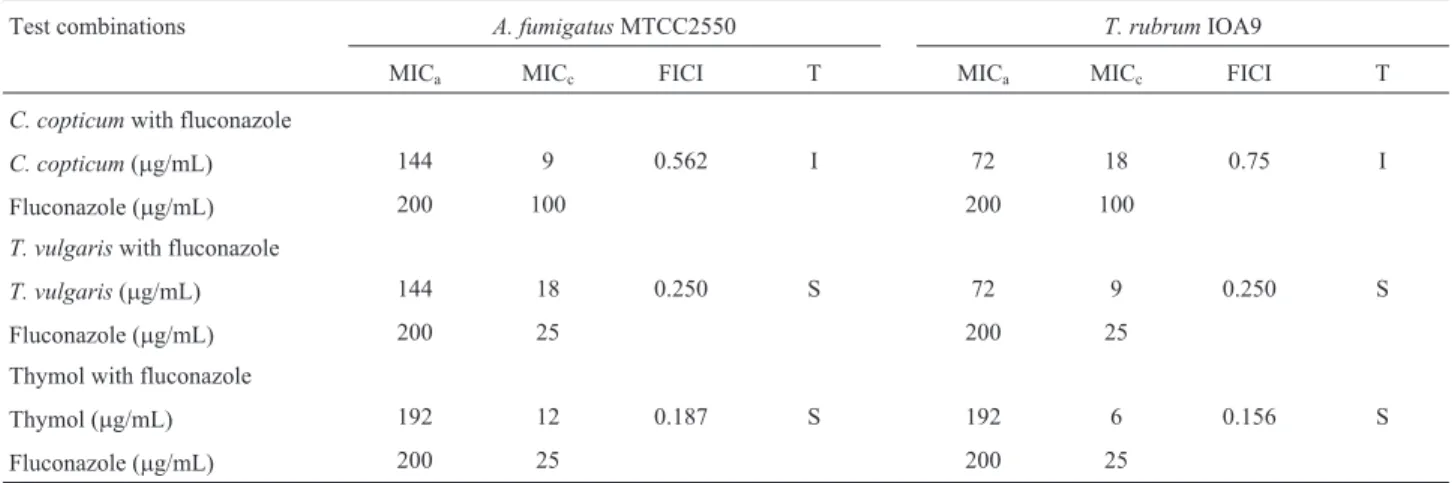
A checkerboard microtiter test was performed to evaluate the interaction ofC. copticum,T. vulgarisoils and thymol with fluconazole againstA. fumigatusMTCC2550 andT. rubrumIOA9.The series of two-fold dilutions, in eight numbers, of each agent were made in SDB to obtain four times the final concentration being achieved in the microtiter well. Furthermore, 50 mL of each dilution of oils/compounds was added to the 96 well microtiter plates in the vertical direction, while 50mL of each dilution of fluconazole was added in the horizontal direction, so that various combinations of essential oils or active compounds and fluconazole could be achieved. Also, 100mL of coni-dial suspension were added to each well and plates were in-cubated at 30 °C for 2 days. The nature of interaction was defined quantitatively by means of fractional inhibitory concentrations (FIC) that were calculated as the MIC of the combination of essential oil or active compound with fluco-nazole divided by the MIC of essential oil or active com-pound or fluconazole alone. An FIC index (FICI) was obtained by adding both FICs. The combination result was interpreted as follows: FICI£0.5, synergistic; > 0.5-4.0, no interaction; > 4.0, antagonistic as described by Odds (Odds, 2003).
MIC Determination against macroconidia and arthroconidia inT. rubrum
diluted (2 x) macroconidial or arthroconidial suspensions. Microtitre plates were incubated at 28 °C and MICs were recorded after 5 days of incubation. MIC was defined as the lowest concentration resulting in total inhibition of visible growth. All the tests were performed three times in tripli-cates and mean values were considered for calculation of MICs.
Assays for determination of anti-virulence activity
Detection and inhibition of elastase activity
The method of Kotharyet al.(1984) was adapted to detect the production of elastase among tested isolates; the elastase activity was determined by colorimetric assay of Sacharet al.(1955) with some modifications employing elastin congo red (Sigma) as a substrate. Briefly, 250mL each of 50 mM sodium borate buffer (pH 8.5) and elastin congo red (20 mg/mL in 50 mM sodium borate buffer, pH 8.5) was mixed and vortexed at room temperature for 5 min. Next, 250mL of each fungus was added and incu-bated at 37 °C for 3 h at 180 rpm. Test sample was replaced by 250mL of buffer as control. After incubation, 750mL of 10% trichloro acetic acid was added to stop the reaction and kept for 30 min on ice. Insoluble material in the assay mix-ture was removed by centrifugation at 5,000 rpm, 30 min and the absorbance was read at 495 nm using a double beam uv-vis spectrophotometer (UV5704SS, India).
Inhibition of elastase activity by fungal agents (oils at 1:10 dilution) was evaluated using the modified method of Okumuraet al.(2007). The known inhibitors of proteinases namely, ethylene diamine tetra acetic acid (EDTA), 5 mM; and metal ion Mg2+(MgSO4), 1 mM; were also used in the study. In the assay, 200mL of test sample was mixed with 50 mL of inhibitor solution and incubated at 37 °C for 45 min before adding to elastin congo red substrate mix-ture. Further, procedure was followed as performed for elastase activity. Test sample without exposure to inhibitor was run as control. All the experiments were done three times in triplicate and the mean test absorbance value was subtracted from the mean untreated control absorbance value to obtain the percent reduction in elastase activity.
Detection and inhibition of keratinase activity
Estimation of keratinase activity in tested fungi was performed using the modified method of Muhsin and Aubaid (2000). Briefly, 500mL of cell free supernatant was mixed with 50 mg of guinea pig hair in 5 mL of 0.03 M phosphate buffer (pH 7.8) and incubated at 37 °C for 3 h, 150 rpm. Test sample was replaced by buffer to run the con-trol. Reaction mixture was stopped by adding 5 mL of 10% TCA and kept on ice for 30 min and centrifuged at 5,000 rpm for 30 min. The hair was removed by filtration and the absorbance was read at 280 nm using a double beam uv-vis spectrophotometer (UVS504SS, India).
Inhibitory effect of test agents was evaluated by the method of Okumuraet al.(2007) with some modifications, and employing known inhibitors of proteinases as used in elastase inhibition assays. In the assay, 400mL of test sam-ple was mixed with 100mL of inhibitor solution and incu-bated at 37 °C for 45 min. The control was run without inhibitors. Each experiment was performed three times in triplicate and inhibition of keratinase activity was calcu-lated in terms of percent reduction in mean absorbance value of test sample compared with untreated control.
Statistical analysis
All the experiments were performed three times with three replicates per experiment and data are expressed as mean± standard deviation. Statistical significance of the differences was determined by the one way ANOVA test using Minitab (V.11.0 for Windows). % reduction in elastase and keratinase activity in test strains in the pres-ence of oils/inhibitors was compared to untreated control by one way ANOVA using Duncan’s method. P-values of £ 0.05 were considered as statist±ally significant.
Results
GC-GC/MS analysis
GC and GC-MS analysis of essential oils revealed the presence of various major and minor compounds. MainC. copticumoil components werer-cymene (33.67%), thymol (22.82%) andg-terpinene (21.61%). Thymol was the main constituent (44.71%) ofT. vulgarisfollowed byg-terpinene (26.01%) anda-cymene (21.22%).
Antifungal activity
MIC of fluconazole was found to be 200 mg/mL against A. fumigatus MTCC2550 and A. niger IOA3 whereas 800 mg/mL against T. rubrum IOA9. Both the tested oils exhibited MIC of 72 mg/mL and 144 mg/mL againstT. rubrumIOA9 andA. fumigatusMTCC2550, re-spectively. MICs of T. vulgaris and C. copticum were 288mg/mL and 576mg/mL againstA. nigerIOA3, respec-tively. Thymol exhibited MIC of 192mg/mL against the strains A. fumigatus MTCC2550 and T. rubrum IOA3 whereas 384mg/mL againstA. nigerIOA3.
Furthermore, tested oils exerted concentration de-pendent inhibitory effects on the production of fungal bio-mass (Table 1) and mycelial radial growth (Table 2). Thymol was the most inhibitory resulting in reduction in the biomass as well as radial growth from 94.07% to 99.75% in tested strains at 72 mg/mL. Reference drug fluconazole also exhibited concentration dependent inhibi-tion in biomass and radial growth of tested fungi up to 84.89% and 87.08%, respectively at 200mg/mL.
activity
of
essential
oils
527
Table 2- Concentration dependent inhibition of mycelial radial growth inA. fumigatusMTCC2550,A. nigerIOA3 andT. rubrumIOA9 by essential oils/active compounds in comparison with fluconazole.
Conc.(mg/mL) Percent inhibition in radial growth over untreated control
C. copticum T. vulgaris Thymol Conc.
(mg/mL)
Fluconazole
AF AN TR AF AN TR AF AN TR AF AN TR
4.5 12.56±1.53 19.23±2.03 20.45±3.39 11.56±1.73 14.34±1.45 17.251.39 20.73±1.15 21.44±2.43 13.04±1.37 1.25 10.56±1.81 12.34±1.47 12.34±2.69
9 21.89±1.42 28.67±3.13 35.45±2.66 25.89±1.42 22.38±2.34 30.251.66 30.70±2.57 32.34±3.23 23.89±1.34 2.5 17.251.27 19.35±1.81 19.92±3.41
18 30.46±2.12 40.13±3.91 50.12±6.32 40.46±2.12 39.23±2.45 45.12±4.22 41.79±2.20 42.23±320 37.70±2.33 5 23.04±2.86 25.23±2.86 29.03±4.93
36 59.32±5.49 55.34±5.23 79.15±5.23 59.02±5.39 55.35±4.45 68.15±4.23 59.42±4.38 68.34±5.35 63.70±4.10 25 36.39±2.92 35.44±3.24 53.384.58
72 67.27±3.10 69.33±5.39 98.46±5.13 73.27±3.10 71.89±3.91 95.13±3.15 97.26±2.94 96.34±6.56 94.07±3.64 50 66.47±4.53 67.44±5.45 61.87±6.18
144 96.70±4.42 95.33±5.13 - 98.20±6.32 95.34±5.34 - - - - 100 71.04±3.57 75.45±4.67 70.67±5.60
288 - - - 200 87.08±2.98 89.49±5.36 86.00±4.64
AF-A. fumigatusMTCC2550; AN-A. nigerIOA3; TR-T. rubrumIOA9. -; indicates no biomass.
Conc.(mg/mL) Percent inhibition in dry biomass over untreated control
C. copticum T. vulgaris Thymol Conc.
(mg/mL)
Fluconazole
AF AN TR AF AN TR AF AN TR AF AN TR
4.5 21.34±2.45 22.64±1.91 19.90±1.86 24.51±2.45 22.11±1.45 17.90±1.27 19.56±1.73 22.23±3.45 19.251.09 1.25 12.32±1.81 11.41±3.24 11.41±3.24
9 30.79±2.19 32.99±3.34 30.5±3.45 35.88±2.19 33.12±2.64 33.55±3.36 33.89±1.22 30.34±3.18 3.251.66 2.5 21.29±2.56 21.26±1.41 21.26±1.41
18 41.67±2.34 46.37±3.13 57.44±4.16 47.54±2.08 41.23±3.34 54.44±4.28 44.96±2.72 47.23±4.35 49.12±4.42 5 30.90±2.54 44.54±2.81 44.54±2.81
36 52.56±3.45 59.77±2.47 66.02±4.78 59.37±4.68 55.23±3.91 69.02±5.50 68.02±5.39 72.33±6.56 64.95±4.04 25 54.31±6.13 53.33±3.41 53.33±3.41
72 61.45±1.66 64.55±2.69 80.27±2.45 71.79±2.29 70.12±2.39 82.27±2.02 95.50±6.92 94.38±5.23 99.753.25 50 66.62±3.47 65.70±1.81 65.70±1.81
144 76.34±3.40 79.81±4.22 100 86.02±1.40 81.24±4.56 100 - - - 100 77.63±1.90 77.71±4.16 77.71±4.16
288 90.67±3.40 93.33±3.30 - 98.42±1.40 95.34±5.65 - - - - 200 85.32±0.47 84.89±3.19 84.89±3.19
Cellular toxicity assay
Tested agents showed no haemolysisin vitroat their respective MFCs. Only at a concentration two to four times higher of MFCs (2304 mg/mL) partial haemolysis (10-25%) was observed. Complete haemolysis was shown at 0.1% (v/v) Triton X-100 (positive control) and no haemo-lysis was observed by 1% DMSO and PBS (solvent con-trols) (Table 3).
Synergy of essential oils with fluconazole
T. vulgarisand thymol showed significant levels of synergistic interaction with fluconazole againstT. rubrum
IOA9 andA. fumigatusMTCC2550, whereas,C. copticum
interacted indifferently with fluconazole against the tested fungi (Table 4). Thymol exhibited the highest synergy with FICI values of 0.187 and 0.156 against A. fumigatus
MTCC2550 andT. rubrumIOA9, respectively.
Susceptibility of macroconidia and arthroconidia
As shown in Table 5, the MICs of eugenol andT. vulgariswere found to be 72mg/mL against both macro and arthroconidia and MICs ofC. copticum was only 2-fold higher against arthroconidia, in comparison with
macro-conidia. Control drug fluconazole was not much effective, as MIC against arthroconidia was 8-fold higher compared with macroconidia.
Inhibition of elastase and keratinase activity
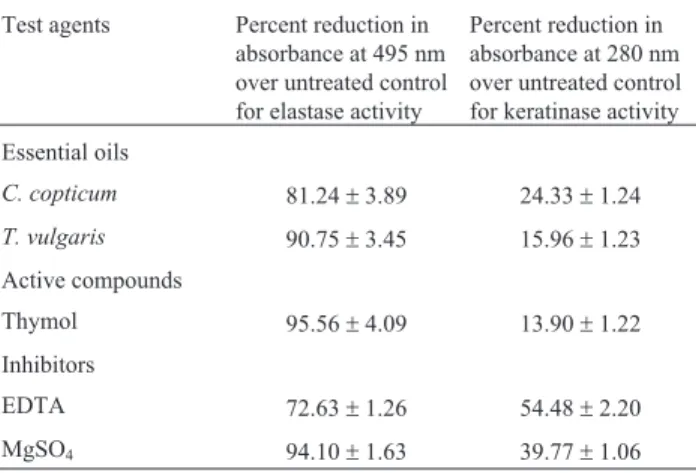
SinceA. nigerIOA3 andT. rubrumIOA9 showed rel-atively higher production of elastase and keratinase, re-spectively, the essential oils were only tested for their anti-elastase and anti-keratinase activity against these two strains. As shown in Table 6, thymol showed the highest
re-528 Khanet al.
Table 3- Haemolytic properties ofC. copticum,T. vulgarisoils and thymol.
Test agents Percent haemolysis of RBC (Mean±SD)
Concentration of essential oils/active compounds (mg/mL)
18 36 72 144 288 576 2304
Essential oils
C. copticum 1.48±0.14 1.84±0.14 2.44±0.19 3.51±0.07 4.27±0.17 4.62±0.27 21.03±0.30 T. vulgaris 1.38±0.14 1.84±0.14 2.74±0.19 3.21±0.07 4.09±0.17 4.92±0.27 19.11±0.40 Active compounds
Thymol 1.64±0.19 2.59±0.07 3.45±0.12 3.99±0.05 4.68±0.17 5.66±0.20 16.34±0.23
Table 4- FIC and FICI for combination of essential oils or active compounds with fluconazole againstA. fumigatusMTCC2550 andT. rubrumIOA9.
Test combinations A. fumigatusMTCC2550 T. rubrumIOA9
MICa MICc FICI T MICa MICc FICI T
C. copticumwith fluconazole
C. copticum(mg/mL) 144 9 0.562 I 72 18 0.75 I
Fluconazole (mg/mL) 200 100 200 100
T. vulgariswith fluconazole
T. vulgaris(mg/mL) 144 18 0.250 S 72 9 0.250 S
Fluconazole (mg/mL) 200 25 200 25
Thymol with fluconazole
Thymol (mg/mL) 192 12 0.187 S 192 6 0.156 S
Fluconazole (mg/mL) 200 25 200 25
MICa, MIC of one agent alone; MICc, MIC of agent in most effective combination; I- indifferent; S- synergy.
Table 5- Effect of essential oils and active compounds in terms of MIC against arthroconidia compared to macroconidia inT. rubrumIOA9.
Test agents MIC (mg/mL)
Macroconidia Arthroconidia Essential oils
Carum copticum 72 144
Thymus vulgaris 72 72
Active compounds
Thymol 72 72
Antifungal drugs
duction (95.56%) in comparison with untreated controls in elastase activity followed byT. vulgaris(90.75%) andC. copticum(81.24%). On the contrary, tested oils were less effective in reducing the keratinase activity.
Discussion
The presentin vitrostudy explored efficacy of oils of
C. copticumandT. vulgarisand their major active constitu-ent thymol in inhibiting growth and virulence against the azole-resistant strains ofAspergillusspp. andT. rubrum. Tested oils/compound exerted concentration dependent in-hibitory effects on the production of fungal biomass and mycelial radial growth. Thymol was the major active ingre-dient of both the oils as revealed by GC/GC-MS analysis. This indicates that inhibitory activity of the oils of C. copticumandT. vulgarismay be due to the thymol. How-ever, minor constituents may also play a key role in the bio-logical activities of these oils. Further, oils ofC. copticum,
T. vulgarisand thymol were tested for their toxicities to sheep erythrocytes. An alternative approach to combat drug-resistant strains is the use of antifungal agents in com-bination to reduce host toxicity and emergence of resis-tance. The promisingin vitroantifungal activity of tested agents along with their non-toxicity to RBCs, prompted us to investigatein vitrocombinations of these essential oils and thymol with fluconazole to increase efficacy of this drug against the azole-resistant strains. To our knowledge, no investigation for these combinations has been carried out before.
T. vulgarisand thymol showed significant levels of synergistic interaction with fluconazole against tested fungi, whereas, C. copticum interacted indifferently. Thymol exhibited highest synergy with fluconazole against
A. fumigatus MTCC2550 (FICI values of 0.187) and T. rubrumIOA9 (0.156), respectively. Level of synergy ofT. vulgariswith fluconazole was comparatively lesser, with the FICI value of 0.250. This is probably due to the
pres-ence ofa-cymene (21.22%) andg-terpinene (26.01%) that has diluted the synergistic effect of thymol (44.71%) com-pared to pure compound. The amount of thymol in C. copticumis 22.82% that is almost two fold lesser compared to amount present inT. vulgarisand it could have probably further reduced the synergistic effect of thymol and re-sulted in indifference type of interaction with fluconazole. Thymol reduced the MIC of fluconazole up to 4-fold and its MIC decreased up to 16- and 32-folds againstA. fumigatus
MTCC2550 andT. rubrumIOA9, respectively. Treatment of fungal infections caused by the drug-resistant fungi may require higher doses in monotherapy and if fluconazole is used in higher concentration it can lead to adverse side ef-fects such as hepatotoxicity (Grollet al., 1998). In these perspectives, these data suggests that thymol could be quite effectively used in combating dose-related toxicity and drug-resistance against fluconazole in the treatment of these fungi.
Infections caused by filamentous fungi are character-ized by the presence of hyphal elements in host tissues, however, formation of arthroconidia constitute the primary mode of transmitting dermatophytic infections such as ony-chomycosis in humans and animals (Malten and Thiele, 1973; Guptaet al., 2003). Arthroconidia are more resistant to antifungals and may be one of the causes of therapeutic failure, mainly in patients whose lesions contain abundant arthroconidia (Miyazi and Nishimura, 1971). Generally,in vitro testing evaluates the responses of microconidia, macroconidia or hyphae (Arreseet al., 2001; Yazdanparast and Barton, 2006) but underin vivoconditions infectious entity is mostly found to be arthroconidia (Yazdanparast and Barton, 2006). Hence, there is a need of susceptibility testing for antifungal agents against arthroconidia in order to determine their effectiveness at infection sites. There-fore, we compared MIC of tested oils and fluconazole against macroconidia and arthroconidia in T. rubrum
IOA9. Tested oils/compounds showed inhibitory activity against arthroconidia at par compared with fluconazole. Arthroconidia and macroconidia ofT. rubrumIOA9 were equally susceptible toT. vulgaris and thymol. However, arthroconidia was found to be more tolerant to fluconazole in comparison with macroconidia. These data account for the effectiveness of thymol and oil ofT. vulgariscontaining higher amount of thymol (44.71%) in treating dermato-phytic infections. In our knowledge, efficacy of these oils and compounds against arthroconidia has not been reported before.
The systematic development of active pharmaceuti-cal ingredients addressing virulence factors as a prime tar-get could provide entirely novel therapeutic options for the treatment and/or prevention of localized or systemic fungal disease. Targeting virulence factors is now gaining interest as an alternative strategy to develop new anti-infective agents. The increasing trend of screening of plant products for their anti-virulent activity against fungi prompted us to
Table 6- Effect of essential oils and active compounds on elastase and keratinase activities inA. nigerIOA3 andT. rubrumIOA9, respectively.
Test agents Percent reduction in absorbance at 495 nm over untreated control for elastase activity
Percent reduction in absorbance at 280 nm over untreated control for keratinase activity Essential oils
C. copticum 81.24±3.89 24.33±1.24 T. vulgaris 90.75±3.45 15.96±1.23 Active compounds
Thymol 95.56±4.09 13.90±1.22
Inhibitors
EDTA 72.63±1.26 54.48±2.20
evaluate some of these oils for their anti-pathogenic effi-cacy. Production of elastases and keratinases are reported to aid in the pathogenesis of Aspergillus spp. and
Trichophytonspp. (Okumuraet al., 2007, Vermoutet al., 2008) and, therefore inhibition of elastase and keratinase activities inA. fumigatusandT. rubrumwas determined by these oils. Tested oils showed > 80% reduction in the elastase activity of A. fumigates MTCC2550. However, these oils appeared to be less effective in reducing the keratinase activity. Since proteinases contribute to fungal virulence by destroying host tissues and digesting immuno-logically important proteins such as antibodies and comple-ment factors (Santoset al., 2007), the inhibition of these enzyme activities in particular elastase and anti-arthro-conidial activity may effectively reduce the pathogenesis of
A. fumigatus.
Conclusions
In our study, the novel anti-proteinase activity of the tested oils in addition to mycelial growth inhibition, and ef-fectiveness against drug tolerant arthroconidia are indica-tive of their efficacy as potential antifungal drugs. The data obtained have highlighted theT. vulgarisas more inhibi-tory compared withC. copticumand this activity appeared to be correlated to the presence of high amount of thymol in theT. vulgarisoil. Moreover thymol andT. vulgaris con-taining higher amount of thymol also exhibited strong syn-ergistic interactions with fluconazole against the tested fungi. This could highlight the potential exploitation of thymol in combination therapy for treatment of drug-resistant strains ofA. fumigatusandT. rubrum. The current studies draw attention for developing new compounds es-pecially thymol as antifungal agents in the management of aspergillosis and dermatophytosis. However,in vivo evalu-ations are needed to unfold the therapeutic potential of these agents in combating such fungal diseases.
Acknowledgement
We are grateful to Advanced Instrumentation and Re-search Facility at Jawaharlal Nehru University, New Delhi for helping in GC/GC-MS analysis. We are also thankful to Indian Council of Medical Research, New Delhi, for finan-cial assistance in the form of senior research fellowship to MSAK.
Conflict of interest
Authors declare no conflict of interest.
References
Ahmad I, Khan MSA, Zahin M, Owais M, Shahid M, Mehmood Z, Pant AB (2010) Combinational antifungal therapy and re-cent trends in drug discovery. In:Ahmad, I.; Owais, M.; Shahid, M.; Aqil, F. (eds). Combating Fungal Infections:
Problems and Remedy, Springer-Verlag, Berlin Heidelberg, Germany, pp 213-240.
Arrese JE, Pierard-Franchimont C, Pierard GE (2001) A plea to bridge the gap between antifungals and the management of onychomycosis. Am J Clin Dermatol 2:281-284.
Baddley JW, Pappas PG (2007) Combination antifungal therapy for the treatment of invasive yeast and mold infections. Curr Infect Dis Rep 9:448-456.
Bairwa R, Sodha RS, Rajawat BS (2012)Trachyspermum ammi. Pharmacogn Rev 6:56-60.
Bajpai VK, Yoon JI, Kang SC (2009) Antifungal potential of es-sential oil and various organic extracts of Nandina
domesticaThunb against skin infectious fungal pathogens.
Appl Microbiol Biotechnol 83:1127-1133.
Barker KS, Rogers PD (2006) Recent insights into the mecha-nisms of antifungal resistance. Curr Infect Dis Rep 8:2816-2823.
Barros MES, Santos DA, Hamdan JS (2007) Evaluation of sus-ceptibility of Trichophyton mentagrophytes and
Trichophyton rubrumclinical isolates to antifungal drugs
using a modified CLSI microdilution method (M38-A). J Med Microbiol 56:514-518.
Cavaleiro C, Pinto E, Goncalves MJ, Salgueiro L (2006) Anti-fungal activity ofJuniperusessential oils against dermato-phyte, Aspergillusand Candidastrains. J Appl Microbiol 100:1333-1338.
Dagenais TRT, Keller NP (2009) Pathogenesis of Aspergillus
fumigatus in invasive aspergillosis. Clin Microbiol Rev
22:447-465.
Davies NW (1990) Gas chromatographic retention indices of monoterpenes and sesquiterpenes on methyl silicone and carbowax 20 M phases. J Chromatogr A 503:1-24. Gauwerky K, Borelli C, Korting HC (2009) Targeting virulence: a
new paradigm for antifungals. Drug Discov Today 14:214-222.
Groll AH, Piscitelle SC, Walsh TJ (1998) Clinical pharmacology of systemic antifungal agents: a comprehensive review of agents in clinical use, current investigational compounds, and putative targets for antifungal drug development. Adv Pharmacol 44:343-500.
Gupta AK, Ahmad I, Porretta M, Summerbell RC (2003) Arthro-conidial formation inTrichophyton raubitschekii. Mycoses 46:304-310.
Khan MSA, Ahmad I (2011) Antifungal activity of essential oils and their synergy with fluconazole against drug resistant strains ofAspergillus fumigatusandTrichophyton rubrum. Appl Microbiol Biotechnol 90:1083-1094.
Kothary MH, Chase TJr, Macmillan JD (1984) Correlation of elastase production by some strains ofAspergillus fumigatus
with ability to cause pulmonary invasive aspergillosis in mice. Infect Immun 43:320-325.
Luize PS, Tiuman TS, Morello LG, Maza PK, Ueda-Nakamura T, Filho BPD, Cortez DAG, de Mello JCP, Nakamura CV (2005) Effects of medicinal plant extracts on growth of
Leishmania(L.)amazonensisandTrypanosoma cruzi. Braz
J Pharm Sci 41:1-10.
Malten KE, Thiele FA (1973) Evaluation of skin damage. II. Wa-ter loss and carbon-dioxide release measurements related to skin resistance measurements. Braz J Dermatol 89:565-569. Miyazi M, Nishimura K (1971) Studies on arthrospores of
Trichophyton rubrum.II. Relationship between the types of
eruption and the parasitic forms of Trichophyton rubrum. Jpn J Med Mycol 12:81-85.
Monod M (2008) Secreted proteases from dermatophytes. Mycopathologia 166:285-294.
Muhsin TM, Aubaid AH (2000) Partial purification and some bio-chemical characteristics of exocellular keratinase from
Trichophyton mentagrophytes var. erinacei.
Mycopatho-logia 150:121-125.
Odds FC (2003) Synergy, antagonism, and what the chequerboard puts between them.J Antimicrob Chemother 52:1. Okumura Y, Ogawa K, Uchgiya K, Nikai T (2007)
Characteriza-tion and primary structure of elastase inhibitor, AFLEI from
Aspergillus flavus. Jpn J Med Mycol 18:13-18.
Pina-Vaz C, Rodrigues AG, Pinto E, Costa-de-Oliveira S, Tavares C, Salgueiro L, Cavaleiro C, Goncalves MJ, Martinez-de-Oliveira J (2004) Antifungal activity ofThymusoils and their major compounds. Eur Acad Dermatol Venereol 18:73-78.
Quiroga EN, Sampietro AR, Vattuone MA (2004)In vitro fungi-toxic activity ofLarrea divaricatacav. extracts. Lett Appl Microbiol 39:7-12.
Sachar LA, Winter KK, Sicher N, Frankel S (1955) Photometric method for estimation of elastase activity. Proc Soc Exp Biol Med 90:323-326.
Santos ALS, Palmeira VF, Rozental S, Kneipp LF, Nimrichter L, Alviano DS, Rodrigues ML, Alviano CS (2007) Biology and pathogenesis of Fonsecaeaa pedrosoi, the major etiologic agent of Chromoblastomycosis. FEMS Microbiol Rev 31:570-591.
Shafique S, Shafique S, Bajwa R, Akhtar N, Hanif S (2011) Fungitoxic activity of aqueous and organic solvent extracts
ofTagetes erectuson phytopathogenic fungus-Ascochyta
rabiei. Pak J Bot 43:59-64.
Sokovic M, Glamoclija J, Ciric A, Kataranovski D, Marin PD, Vukojevic J, Brkic D (2008) Antifungal activity of the es-sential oil ofThymus vulgarisL. and thymol on experimen-tally induced dermatomycoses. Drug Dev Ind Pharm 34:1388-1393.
Tullio V, Nostro A, Mandras N, Dugo P, Banche G, Cannatelli MA, Cuffini AM, Alonzo V, Carlone NA (2007) Antifungal activity of essential oils against filamentous fungi deter-mined by broth microdilution and vapour contact methods. J Appl Microbiol 102:1544-1550.
Vazquez JA (2003) Combination antifungal therapy against
Candidaspecies: the new frontier - are we there yet? Med
Mycol 41:355-368.
Venkatesan G, Singh AJAR, Murugesan AG, Janaki C, Shankar SG (2007)Trichophyton rubrum- the predominant etiologi-cal agent in human dermatophytoses in Chennai, India. Afr J Microbiol Res 1:9-12.
Vermout S, Tabart J, Baldo A, Mathy A, Losson B, Nignon B (2008) Pathogenesis of dermatophytosis. Mycopathologia 166:267-275.
Voltan AR, Donofrio F, Miranda ET, Moraes RA, Mendes-Gian-nini MJS (2008) Induction and secretion of elastinolytic and proteolytic activity in cultures of Paracoccidioides
brasiliensis.J Basic Appl Pharm Scie 29:97-106.
Yazdanparast SA, Barton RC (2006) Arthroconidia production in
Trichophyton rubrumand a new ex vivo model of
onycho-mycosis. J Med Microbiol 55:1577-1581.
Zacchino S, Lopez S, Pezzenati G, Furlan R, Santecchia C, Munoz L, Gianni F, Rodriguez A, Enriz R (1999)In vitro
evaluation of antifungal properties of phenylpropanoids and related compounds acting against dermatophytes. J Nat Prod 63:1353-1357.