E
xaminingwayfinding bEhavior in a parking lothttp://dx.doi.org/10.1590/1984-0292/1310
Rodrigo Mora
I, H,
José Manuel Allard
II,
Carola Zurob
II I Universidad Diego Portales, Santiago, Chile II Pontiicia Universidad Catòlica, Santiago, Chilea
bstractThis article examines wayinding behavior in an extended parking lot belonging to one of the largest shopping malls in Santiago, Chile. About 500 people were followed while going to the mall and returning from it, and their trajectories were mapped and analyzed. The results indicate that inbound paths were, in average, 10% shorter that outbound paths, and that people stopped three times more frequently when leaving the mall than when accessing it. It is argued that these results are in line with previous research on the subject, which stress the importance of environmental information in shaping people`s behavior.
keywords: wayinding; parking lot; inbound and outbound paths.
1.- i
ntroductionShopping malls are one of the most ubiquitous spaces of modern capitalist cities. It is calculated that in the United States alone, more than 2,000 shopping malls exist, accounting for nearly 75% of all non-automotive sales in this country.
Unlike traditional street centers that accommodate both locals and visitors using different transportation modes, shopping malls, especially those located out-side downtown areas, rely heavily on private locomotion. This means that users typically arrive in their own cars and park them in (mostly) large parking lots that belong to and are managed by the mall itself. It is often the case that these spaces lack a clearly legible architecture and/or are poorly lit, making it dificult for users to navigate in the environment. In addition, the fact that parking lots are dynamic (cars come and go at any time, changing the overall coniguration of the setting), and have few reference points that might help people to orient themselves, does not facilitate either the task of inding a mall entrance or inding one´s car once leaving the premises. How do people ind their way in those circumstances?
This article aims to better understand this problem. It studies how people move when entering the mall after parking their cars and reaching their vehicles once their shopping is complete.
H Dirección: Universidad Diego Portales, Facultad de Arquitectura, Arte y Diseño, Avenida República 180, Santiago, Chile. Correo electrónico: [email protected], [email protected],
2.-P
reviousWorkIn their inluential work Wayinding: people, signs, and architecture, Ar-thur and Passini (1992) deine wayinding as “the process of reaching a destina -tion, whether in a familiar or unfamiliar environment. Wayinding is best deined as spatial problem solving” (ARTHUR; PASSINI, 1992, p. 26). According to the authors, wayinding behavior is composed of two interrelated phases: the devel -opment of action plans, in which individuals mentally deine a series of actions in order to reach a particular destination; and an execution phase, in which indi-viduals transform these action plans into effective behaviors in space. However, Arthur and Passini argue that, because environmental conditions are not static but intrinsically dynamic, wayinding behavior also comprises a third dimension, the information processing phase, in which individuals monitor and assess environ-mental conditions in order to adjust their action plans.
Although it can be said that, more often than not, environmental conditions are intrinsically dynamic, there are important differences in terms of how much they change in different scenarios. For example, a supermarket´s layout does not change on a daily basis but on speciic, relatively rare occasions, whereas a de -partment store is likely to change part of its layout in a systematic manner in order to encourage exploration on the part of its customers. An especially inter-esting case in that regard is that of parking lots. Like department stores and other commercial buildings, parking lots are spatial entities where wayinding searches have to take place (people park their cars in order to reach a given destination), but where the spatial structure is deined, to a great extent, by the parked cars, which change all the time in a rather unpredictable way. Thus, despite their rela-tive simplicity in terms of spatial arrangement, parking lots impose on users some challenges in terms of wayinding.
Until now, parking lot navigation has been rarely investigated in litera-ture. This seems to be at odds with the ubiquity of this kind of infrastructure and the fact that, in rapidly developing countries like China, shopping malls are being constructed at a pace not seen in decades.1 Further, although some graphic projects on parking lots have received much acclaim in the academic and practi-tioners´ spheres, it is still unclear how people move in parking lots, which in turn makes it dificult to assess these interventions’ effectiveness. The result is that there is not much clarity about the principles that might guide the design of park-ing lots either from the architecture or graphic perspective in order to facilitate wayinding behavior in people.
main entrance to the parking lot, that is, when they were still driving their cars, and then when people had to ind the mall´s entrance, once they had parked their vehicles. For the outbound task, Venemans argued, the main dificulty arose from the fact that often people forgot the places (or sometimes level) where they had parked their cars, making the search for the vehicles sometimes a stressful task.
The main limitation of Venemans’ argument is that it is not supported by real-world, empirical evidence, which makes it dificult to conirm that there are differences in people’s navigation patterns when going to the mall as opposed to returning from it. To some extent, this shortcoming applies to much of the research on human navigation thus far, which historically has focused on labo-ratory-centred studies rather than on exploring real-world navigation. This work aims to modestly contribute to overcoming this gap. Presented here is an in-depth analysis of a large data set of people’s movement patterns in an extended shop -ping mall in the city of Santiago.
Figure 1: a recent picture of the mall
3.- a
nalyzingWayfindingbehaviorinalargemall’
sParkinglotUnlike public buildings such as hospitals or university campuses, which have preoccupied many scholars in the ields of architecture and spatial cognition since the eighties, little research has been carried out on wayinding behavior in parking lots. This is in spite of the fact that malls have become a common place for inhabitants of cities either in the developed or in the developing worlds.
The case in point to be reviewed here is the Parque Arauco shopping mall in the eastern area of Santiago, Chile. Inaugurated in 1982, it was the irst shop -ping mall built in the capital, attracting thousands of visitors since the very irst day. Today the mall attracts nearly 400,000 visitors each day.
The history of Parque Arauco has had many changes. In 1982, when it opened for business, it epitomized the arrival of a new economic era imposed by an authoritarian regime (1973-1990). This was characterized by open, laisez-faire capitalism that aimed to overcome what was hitherto perceived as a socialist tendency in the Chilean economy. The mall was received as a novelty by many Chileans, being the only player in the country for more than ten years.
The irst plan of the mall consisted only of a large corridor with two anchor stores at its ends. In 1992, ten years after its inauguration, a new section was built, comprising a food court, a large hall and another anchor store. In 2003 a large outdoor space called Boulevard Parquet Arauco was built. It comprised several restaurants, a theatre, various cinemas, and a large curvilinear outdoor space with many stores and restaurants. These improvements have permitted the mall to re-tain its customer base and expand it to night-goers during the weekend. Figure 1 shows a recent photograph of Parque Arauco.
Due to these changes, the mall constructed a series of parking lots in the East and West parts of the site. The East wing consisted of three decks below the ground loor (-1, -2, -3), totaling 2,394 parking spaces in an area of 68,300 sqm. The West wing, on the other hand, consisted of 9 decks, starting from -3 and in -ishing at +5. This area involved 55,000 sqm and accommodated 1,458 parking spaces. Figure 2 shows the ifteen loors of the mall.
All loors have more than one entrance to the mall. Some loors have six entrances, while others have only two. Overlapped decks are, in most cases, al-most identical in their layouts, meaning that both the distribution of entrances and the parking space arrangements have few differences.
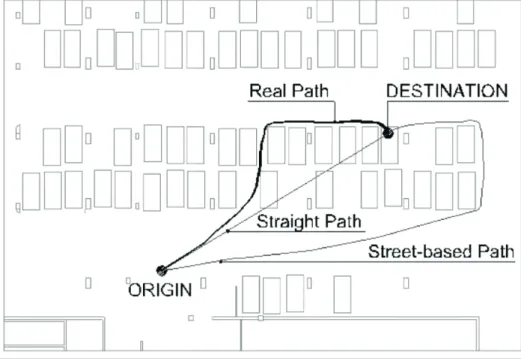
Figure 3: the three kinds of paths distance examined in this paper
4.- m
ethod4.1.-Participants and method
The experiment consisted of discreetly following people while they moved through the parking lot in order to reach any of the entrances to the mall (in-bound task) or leaving the mall in order to reach their cars (out-(in-bound task). A to-tal of 586 individuals were observed, corresponding to 287 for the inbound task, and 299 for the outbound task. The observation took place on ive consecutive weekly days of the month in June 2012 (winter in the southern hemisphere).
The procedure consisted of mapping people´s trajectories on a printed map of each loor of the parking as precisely as possible. Each trajectory’s starting and ending time was also carefully registered. In addition to trajectories, people´s detentions (deined as pauses involving head movements or signage reading) were mapped as well as each person´s gender and inferred age (four categories were deined for this: below 16; 16–30; 31–60; older than 60). Finally, groups involving two or more than two persons were registered. Figures 3a and 3b show people´s inbound and outbound paths on two loors of the setting (2 and 1), cor -responding to the East and West wings.
5.- r
esults5.1.- Descriptive analysis
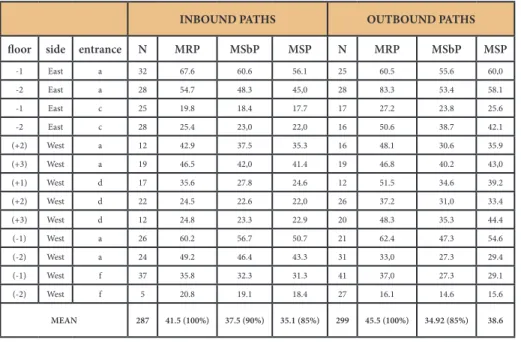
In order to be able to compare how much each person walked on the park-ing lot loors, either when enterpark-ing the buildpark-ing or leavpark-ing it, an exercise was undertaken. This consisted of distinguishing the major entrances/exits on each loor and measuring their corresponding trajectories and stops. For example, the irst two rows of table 1 characterize people’s movement on loor 1 (East Wing). As can be seen, there were two entrances on this loor, A and C. Entrance A was used by 32 people to access the mall, while entrance C was used by 28 people.
First, it was investigated whether males, females, and groups (either male-only, female-only, or mixed-gender groups) behaved differently while mov-ing into the mall. A one-way between-groups analysis of variance (ANOVA) was conducted to test this. No statistical difference was found at the p>.05 level in path length for the three groups. Despite not reaching a statistical difference, mean distances walked by men were 28 percent longer than those traveled by females and groups (being 224 m for the irst group, 174 m for the second group, and 173 m for the last group).
forced not to move freely on the loors but to walk along the existing streets in the parking lot. This measure was meant to represent one´s movement when no parking spaces are available (as in the case of Christmas time, when the shop-ping mall´s parking area are full), and there is little or no room to move between vehicles. Finally, the last measure to be examined here is the Mean Straight Path (MSP), which corresponds to a straight line linking A to B. In addition to these measures, the number of stops made by each individual was registered and mapped, which resulted in a mean number of stops per entrance.
Table 1 shows all these measures for each of the entrances of the parking lot, both in the inbound and outbound trajectories. As can be seen, the MRP of each entrance in the inbound task moved from a minimum of 19.8 m to a maxi-mum of 67.6 m and from 16.1 m to 83.9 m in the outbound task. Were trajectories made by people coming to the mall larger than those made when returning to their cars? In 10 out of the 13 cases examined, this was the case, ranging from 103 to 195 percent. In only three cases did people actually walk less when returning to their vehicles than when entering the mall.
The cautious reader might have noted that since the analysis does not studied the same people but on different persons, there is no way to afirm for certain that people effectively navigated the parking lot in different manners according to the direction of travel. However, here we argue that the size of both samples (about 300 people in each direction) might neutralize any effects related to personal differences.
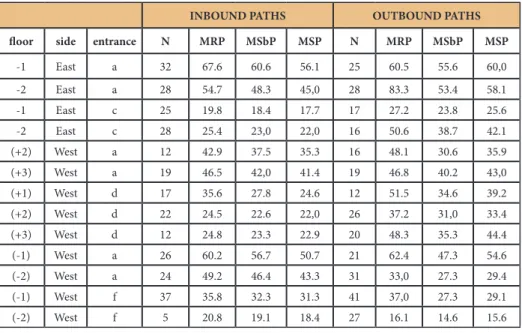
Table 2 shows people´s paths in each loor according to the MRP (Mean Real Path), MSbP (Mean Street-based Path) and MSP (Mean Straight Path). For the sake of simplicity, main values are displayed in igure 5. As can be seen, in the inbound scenario, MRP is, on average, 10 percent more extended than MSbP and 15 percent longer than MSP. Therefore, people walked, on average, 15 per-cent more meters than the minimum possible straight line between the origin and destination, and 10 percent more than the shortest possible path. In the case of out-bound paths, the situation seems to be slightly different; here the distances people effectively walked (or MRP trajectories) were 23 percent longer than MSP and 15 percent more extended than MSbP paths. That is to say, people seemed to be less “effective” in their trips when getting out of the mall than when accessing it.
Table 3 shows the number of stops made by users while navigating in the mall, both in the inbound and outbound scenarios. As can be seen, the average number of stops made by each person in the inbound scenario was 0.08, whereas this value reached 0.29 in the outbound scenario. This trend is conirmed by the ifth and seventh columns of table 3, which illustrate the percentage of people who stopped at least once while moving in the parking lot. In inbound trajecto-ries, this value moved from 0 to 23 percent of people, depending on the entrance (with three entrances showing no people stopping in order to reach them), while in outbound paths, these values ranged from 4 to 61 percent. In other words, peo-ple seemed to be much more likely to stop while navigating when returning to their cars than when heading for the mall.
Table 1: Mean Real Path of Inbound and Outbound trajectories in the parking lot of the shopping mall
INBOUND PATHS OUTBOUND PATHS
loor side entrance N MRP MSbP MSP N MRP MSbP MSP
-1 East a 32 67.6 60.6 56.1 25 60.5 55.6 60,0
-2 East a 28 54.7 48.3 45,0 28 83.3 53.4 58.1
-1 East c 25 19.8 18.4 17.7 17 27.2 23.8 25.6
-2 East c 28 25.4 23,0 22,0 16 50.6 38.7 42.1
(+2) West a 12 42.9 37.5 35.3 16 48.1 30.6 35.9
(+3) West a 19 46.5 42,0 41.4 19 46.8 40.2 43,0
(+1) West d 17 35.6 27.8 24.6 12 51.5 34.6 39.2
(+2) West d 22 24.5 22.6 22,0 26 37.2 31,0 33.4
(+3) West d 12 24.8 23.3 22.9 20 48.3 35.3 44.4
(-1) West a 26 60.2 56.7 50.7 21 62.4 47.3 54.6
(-2) West a 24 49.2 46.4 43.3 31 33,0 27.3 29.4
(-1) West f 37 35.8 32.3 31.3 41 37,0 27.3 29.1
(-2) West f 5 20.8 19.1 18.4 27 16.1 14.6 15.6
Table 2: MRP, MSbP and MSP paths in the Inbound and Outbound scenarios
INBOUND PATHS OUTBOUND PATHS
loor side entrance N MRP MSbP MSP N MRP MSbP MSP
-1 East a 32 67.6 60.6 56.1 25 60.5 55.6 60,0
-2 East a 28 54.7 48.3 45,0 28 83.3 53.4 58.1
-1 East c 25 19.8 18.4 17.7 17 27.2 23.8 25.6
-2 East c 28 25.4 23,0 22,0 16 50.6 38.7 42.1
(+2) West a 12 42.9 37.5 35.3 16 48.1 30.6 35.9
(+3) West a 19 46.5 42,0 41.4 19 46.8 40.2 43,0
(+1) West d 17 35.6 27.8 24.6 12 51.5 34.6 39.2
(+2) West d 22 24.5 22.6 22,0 26 37.2 31,0 33.4
(+3) West d 12 24.8 23.3 22.9 20 48.3 35.3 44.4
(-1) West a 26 60.2 56.7 50.7 21 62.4 47.3 54.6
(-2) West a 24 49.2 46.4 43.3 31 33,0 27.3 29.4
(-1) West f 37 35.8 32.3 31.3 41 37,0 27.3 29.1
(-2) West f 5 20.8 19.1 18.4 27 16.1 14.6 15.6
6- d
iscussionThe irst and perhaps most-obvious conclusion derived from this research is that parking lots, despite their apparent simplicity, are not necessarily uncom-plicated spaces to move through but rather complex settings in which users are required (whether consciously or not) to adopt different strategies in order to reach their destinations. The inding that return trips were longer, included more stops, and were less “effective” than incoming trips (as users deviate more from a straight line between origin and destination when returning to their cars) could be explained by the fact that parking lots tend to be unremarkable spaces with poor or non-existent distinctive points (landmarks) to orient people. As a result, to remember one´s car location is often a dificult task, one that could demand an extended (and not necessarily pleasant) search in a frequently hostile, from a wayinding point of view, setting to navigate. It is, therefore, reasonable that, from a practical point of view, malls should pay more attention to the wayinding problem faced by users not only in the indoor realm but also in the outdoor. Fur-ther, since inding one´s car tends to be the last part of a visit to a shopping mall, to what degree having dificulties in this task could affect the entire experience of the journey should be a concern. The results here indicate that there is room for improvement in this matter.
From a theoretical point of view, these indings are in accordance with related research (GOLLEDGE, 1995; MORA, 2010) that has shown that, all oth-er things being equal, inbound and outbound trajectories tend to diffoth-er, and that environmental factors play an important role in shaping them. However, unlike these works, the predominant factor behind this difference might be not related to the way in which people perceive distance (and therefore act) accordingly, as proposed by Conroy-Dalton (2003) and Bailenson, Shum and Uttal (2000), but to the fact that people seem to have problems in recalling the location of their vehicles due to the homogeneous and featureless nature of parking lots.
The perceived dificulty experienced by people when returning to their cars might have prompted them to adopt two different navigational attitudes, one internally driven (the inbound one), in which persons minimize real distance in order to get to their destinations rapidly (which in turn demanded them to pass by many parked vehicles), and another more externally-focused and more cautious, in which people are more willing to move along the internal layout of the parking lot in order to reach their cars. Seeing it this way, these results are also in line with previous research that has shown that people have the ability to switch between different strategies in a recursive manner during navigation (STECK; MALLOT, 2000). Future research should explore this topic, as well as exploring the role of visual properties of space that deine people´s spatial behavior.
n
oter
eferencesARTHUR, P.; PASSINI, R. Wayinding: people, signs, and architecture. New York: McGraw-Hill, 1992.
BARBOZA, D. China, new land of shoppers, builds malls on gigantic scale.
The New York Times, [online], 25 May 2005. Available in: <http://www.nytimes.
com/2005/05/25/business/worldbusiness/25mall.html?pagewanted=all&_r=0>. Accessed on: 21 May 2014.
BAILENSON, J.; SHUM, M.; UTTAL, D. The initial segment strategy: a heuristic for route selection. Memory and Cognition, v. 28, n. 2, p. 306-319, 2000.
CONROY-DALTON, R. The secret is to follow your nose. Route path selection and angularity. Environment and Behavior, v. 35, n. 1, p. 107-131, 2003
GOLLEDGE, R. G. Path selection and human preference in human navigation: a progress report. In: CONFERENCE ON INFORMATION THEORY, COSIT, 2., 1995, Semmering, Austria. Proceedings... Lecture Notes in Computer Science, [S.l.], v. 988, p. 207-222, 1995.
MORA, R. Acerca de la racionalidad e irracionalidad de nuestras decisiones.
Fractal: Revista de Psicologia, v. 23, n. 2, p 425-428, 2011.
STECK, S.; MALLOT, H. The role of local and global landmarks in virtual environment navigation. Presence, [S.l.], v. 9, n. 1, p. 69-83, 2000
VENEMANS, P. Redesign of a car park: the application of wayinding principles. In: ZWAGA, H. J. G.; BOERSEMA, T.; HOONHOUT, H. C. M. (Ed.). Visual
information for everyday use: design and research perspectives. London: Taylor & Francis, 1999. p. 275-282.