15ª Conferência da Associação Portuguesa de Sistemas de Informação (CAPSI 2015) 02 e 03 de Outubro de 2015, Lisboa, Portugal
ISSN 2183-489X
DOI http://dx.doi.org/10.18803/capsi.v15.125-141
125
A Study on Massive Open Online Courses in Higher Education
Carolina Costa, Department of Economics, Management and Industrial Engineering, University of Aveiro, Portugal, [email protected]
Leonor Teixeira, IEETA - Institute of Electronics and Telematics Engineering of Aveiro, Department of Economics, Management and Industrial Engineering, University of Aveiro,
Portugal, [email protected]
Helena Alvelos, CIDMA - Center for Research and Development in Mathematics and Applications, Department of Economics, Management and Industrial Engineering, University of
Aveiro, Portugal, [email protected]
Abstract
In this paper the current usage of active Massive Open Line Courses (MOCC) is analysed. First a systematic literature revision is performed, in order to identify and classify the published works and the existing developments in this area, being the most used MOOCs platforms also found out. Afterwards, a content analysis of the two most popular MOOCs’ platforms – Coursera and EdX – and a comparison between them is performed. This analysis takes into account, among others, the number and areas of knowledge of the accessible courses, the Higher Education Institutions (HEI) that offer courses using the platforms, the length of the courses and the expected workload for a student to successfully complete the MOOCs. The main findings were that the use of MOOCs has been growing in the last years and that Coursera and EdX are the two main platforms used by HEIs in order to make MOCCs available.
Keywords: MOOCs, Higher Education, Coursera, EdX
1.
I
NTRODUCTIONHigher Education Institutions (HEIs) are becoming more receptive to integrate in their teaching and learning processes, new technologies, being the Massive Open Online Courses (MOOCs) platforms, one of the most recent.
MOOC is a concept associated to e-learning [Fini 2009] that offers world-class education to an
unlimited number of participants (massive) around the globe with Internet access (online) for low or no fees [Aboshady et al. 2015] and [Glance et al. 2013]. MOOCs make use of some traditional courses’ materials such as videos, short videos combined with formative quizzes, texts and problem sets, using tools for interaction, in order to build a community for students and lecturers [Ahlberg 2014]. In these courses, it is also possible to implement formative quizzes, automated assessment, peer and self-assessment and online forums for support and discussion [Glance et al. 2013]. Therefore, they can offer educational benefits to HEIs, professors, and students [Aboshady
Costa, Texeira e Avelo /A Study on Massive Open Online Courses in Higher Education
15ª Conferência da Associação Portuguesa de Sistemas de Informação (CAPSI 2015) 126
et al. 2015], providing opportunities for thousands of learners to participate in free online courses
[Ahlberg 2014] and [Yousef et al. 2015].
Hew and Cheung [2014, p.51] refer three main differences between MOOCs and traditional classroom’ courses: "the large and diverse student enrolment in MOOCs, the high dropout rate of MOOCs compared to that of traditional courses, and the relatively lack of instructor presence or support in MOOCs compared to traditional courses". Concerning the comparison between MOOCs and the traditional e-learning courses, it is recognized that MOOCs involve more self-directed learning than the other e-learning courses, and that the central role of the mediator is more recognised in the traditional e-learning courses than in MOOCs [Nyoni 2013].
The MOOCs’ underlying technology is recent, the first MOOC having been launched in 2008 [Ahlberg 2014] and [Fini 2009]. In 2011 there was a 'wave of offers' of MOOCs platforms [Tschofen and Mackness 2012], and, at the present, HEIs are offering a growing variety of MOOCs [Yousef et al. 2015], using different platforms, being Coursera and EdX the most widely used ones [Kim 2015].
This paper aims to analyse the current usage of MOOCs platforms and courses by HEIs as well as its future trends. This analysis was performed in two phases: the first one consisted in literature review, identifying and classifying the published works and the existing developments in this area, and the second one was based on the content analysis about MOOCs offered by some of the most recognized HEIs around the world.
The paper is organized in four sections. The MOOC concept was outlined in this introductory section. The methodology used in this study is described in the second section and in the third section the results and their discussion are addressed. Finally, in the fourth section, some conclusions and future trends are presented.
2.
M
ETHODOLOGYThe methodology followed in this study was a systematic literature review complemented with content analysis about MOOCs’ platforms available from some selected HEI.
Since a systematic study of the published literature between 2008 and 2012 has already been published by Liyanagunawardena et al. [2013], this paper aims to complement this analysis, extend it to the years of 2013 to 2015 and, when possible, compare the results of the two studies in order to identify the trends on MOOCs’ usage.
In order to gather data about the systematic review of published MOOC literature, firstly, there were selected the more common scientific databases in the areas of Information and Communication
Costa, Texeira e Avelo /A Study on Massive Open Online Courses in Higher Education
15ª Conferência da Associação Portuguesa de Sistemas de Informação (CAPSI 2015) 127
Technologies (ICT) and Education, which were (i) ISI Web of Knowledge; (ii) Scopus and (iii) IEEE Xplorer.
The selected search terms were: (i) MOOC; (ii) massive open online course; (iii) higher education; (iv) university and (v) universities.
The time period considered was from 2008 until 2015, since the first MOOC appeared in 2008 [Ahlberg 2014] and [Fini 2009].
From the study just mentioned, resulted 156 relevant articles (article or review document types), that were analysed in order to identify the more referred MOOCs platforms.Finally, the two most referred MOOCs platforms were subjected to content analysis based on the information of the sites of some of the most recognized HEIs around the world, which also allowed the comparison of those platforms.
In the next section, the results of this study are presented.
3.
R
ESULTS ANDD
ISCUSSIONIn this section the results of the systematic literature revision are presented (section 3.1), followed by brief characterization of the articles considered relevant (section 3.2). The main objective of section 3.3 is to identify the more referred MOOCs’ platforms in the identified articles. Finally, and taking into account the results of the study made in 3.3, in section 3.4 a detailed content analysis of the two most popular MOOCs’ platforms and a comparison between them are performed.
3.1.
Results from the systematic search
An overview of the documents identified based on the criteria referred in the Methodology section, is presented in Table 1. The first column identifies the database used in each search; the 2nd column presents the resulting number of documents (article, book, conference paper, editorial, news, patent, review) and, in the 3rd column, the resulting number of articles (article or review document types).
Database Number of documents Number of articles Date
ISI Web of Knowledge 136 74 24/03/2015
Scopus 281 137 24/03/2015
IEEE Xplorer 102 4 19/05/2015
Costa, Texeira e Avelo /A Study on Massive Open Online Courses in Higher Education
15ª Conferência da Associação Portuguesa de Sistemas de Informação (CAPSI 2015) 128
Note that the articles are part of the documents and so their number is included in the number of documents. The last column of the table refers to the date of the search performed.
Comparing the results presented in Table 1 with those from the work of Liyanagunawardena et al. [2013], where they referred that by the end of 2012 there were 5 documents in ISI Web of Knowledge, 39 in Scopus, and one in IEEE Xplorer, it can be noticed that in the last 2 years and 3 months the number of documents published in this area in the most relevant scientific databases increased considerably.
Taking into account only the type of documents “articles” (which includes articles and reviews), it should be taken into account that some of them are present in more than one database, as can be seen in Figure 1.
Figure 1 – Number of articles in academic databases
The data collection resulted thus in 156 articles, 17 only from ISI Web of Knowledge, 80 only from Scopus, 55 from ISI Web of Knowledge and Scopus, 2 from ISI Web of Knowledge and IEEE Xplorer, and 2 from Scopus and IEEE Xplorer.
3.2.
Characterisation of the selected articles
The articles identified in the previous section were afterwards analysed according to the year of publication, the journals where they were published and the respective authors.
Figure 2 presents the number of articles published on MOOCs in the databases analysed, per year from January 2012 until March 2015, and it can be seen that this number have been increasing consistently through this period of time.
Costa, Texeira e Avelo /A Study on Massive Open Online Courses in Higher Education
15ª Conferência da Associação Portuguesa de Sistemas de Informação (CAPSI 2015) 129
Figure 2 – Number of articles by publication year
The numbers reported in the study by Liyanagunawardena et al. [2013] on MOOCs’ articles in journals, indicated one in 2008, one in 2009, two in 2010, four in 2011, and nine in 2012. These numbers reflect a fact already expected. As the first MOOC appeared in 2008, it was not possible to report on MOOCs before that. The apparent contradiction between the results from the two studies in the year 2012 (9 vs 4), is due to the fact that Liyanagunawardena et al. [2013] reported the results for more databases than the three used in the present work (including, for example, Google Scholar).
Concerning the number of journals publishing in this area, by March 2015 there were 92 scientific journals of the 3 selected databases that published articles about MOOCs. From those, 72 had published only one article. Among the other 20, it should be emphasized the International Review
of Research in Open and Distance Learning, that published 16 articles on this theme.
Comparing these numbers with those of the work by Liyanagunawardena et al. [2013] (6 journals with more than one article on MOOCs in 2012 vs 20 in 2015 and 6 articles published by
International Review of Research in Open and Distance Learning in 2012 vs 16 in 2015), it can be
confirmed the growing interest in this area also by the scientific magazines.
An analysis of the number of articles by authors has also been made. Meneses and Vazquez- Cano has the highest number of publications (three), while the other authors have two or one articles. According to Lopez-Meneses et al. [2015], Forsey and Glance are the most cited authors. In this analysis, these two authors have two articles each.
3.3.
Identification of MOOCs platforms
The selected 156 articles were analysed in order to identify which MOOCs’ platforms were most mentioned in the scientific literature. In Table 2 the list of the platforms that are referred in more than four articles is presented, as well as the references of the articles themselves.
15ª Conferência da Associação Portuguesa de Sistemas de Informação (CAPSI 2015) 130 Refer ence C o u se ra E d X U da ci ty F u tu re L ea rn O p en u p E d U de m y O p en2 S tud y Mi ri ada X C an v as K h an A ca d emy Ive rs it y
[Aboshady et al. 2015], [Ahlberg 2014], [Atenas 2015], [Burch and
Harris 2014] and [Clarke 2013]
● ● ● ●
[Amemado 2014], [Ayala et al. 2014], [Baggaley 2013, 2014], [Bonvillian and Singer 2013], [Bulfin et al. 2014], [Carr 2012], [Comeau and Cheng 2013], [Cusumano 2014], [DeBoer et al. 2014], [Egerstedt 2013], [Glance et al. 2013], [Guzdial and Adams 2014], [Jordan 2014], [Kellogg 2013], [King et al. 2014], [Knox 2014], [Liyanagunawardena et al. 2013], [Longstaff 2014], [Lopez-Meneses et al. 2015], [Martin 2012], [Perna et al. 2014], [Skiba 2012], [Toven- Lindsey et al. 2015], [Vallaeys 2014], [Wellen 2013], [Wright 2013] and [Xu and Yang 2015]
● ● ●
[Audsley et al. 2013] ● ● ●
[Barnes 2013] ● ● ● ● ● ●
[Canessa et al. 2013], [Fox, 2013], [Monedero-Moya et al. 2015],
[Moodie 2014], [Najafi et al. 2014] and [Reilly et al. 2014]
●
[Comer et al. 2014], [Fisher 2014], [Fowler and Smith 2013], [Jiang
et al. 2014], [Murray 2014], [Kustritz 2014], [Sadhasivam 2014], [Sidorenko 2014], [Spada 2014], [Tucker et al. 2014] and [Vazquez- Cano 2013]
●
[Costa-Jussà et al. 2014]
●
[Cervone 2015], [Daniel et al. 2015], [Dillahunt et al. 2014], [Friedman and Friedman 2013], [Gillani and Eynon 2014], [Hollands
2014], [Laplante, 2013] [Mackness et al. 2013], [Marshall 2014], [Searls 2014] and [Subhi et al. 2014]
● ●
[Daza et al. 2013] ● ● ● ●
[Langen and Bosch 2013] and [Manouselis et al. 2013] ● ●
[Estevez-Ayres et al. 2013] ● ● ● ●
[Firmin et al. 2014] ●
[Galán 2014] ● ● ● ●
[Hew and Cheung 2014] ● ● ● ● ●
[Hollands and Tirthali 2014] ● ●
[Jobe and Hansson 2014] ● ● ● ●
[Kern 2014] ● ● ● ●
[Kim 2015] ● ● ● ● ● ●
[Leito et al. 2015] ● ● ●
[Liyanagunawardena and Williams 2014] ● ● ● ● ● ● ● ● ● ●
[Macleod et al. 2014] ● ● ●
[Martín-Monje el al. 2014] ● ● ● ● ● ●
[Medina-Salguero and Aguaded 2014] ● ● ● ●
[Mehta et al. 2013] ● ● ● ●
[Nkuyubwatsi 2014] ● ● ● ● ● ● ●
15ª Conferência da Associação Portuguesa de Sistemas de Informação (CAPSI 2015) 131 Table 2 – Number of articles by MOOCs platforms
According to Table 2, the most referenced platforms are Coursera and EdX. A detailed content analysis of those MOOCs’ platforms and a comparison between them are performed in the next section.
3.4.
Characterisation and Comparison of Coursera and EdX platforms
The Coursera and EdX platforms were analysed considering the following criteria: (i) number and areas of knowledge of the courses accessible through each platform; (ii) number of HEIs that offer courses using the referred platforms; (iii) number of MOOCs made available by the HEIs that offer more than three courses; (iv) percentage of courses that present an introductory video, summarizing the objectives and main contents of the course, as well as the number of instructors involved; (v) descriptive statistics of the duration of the courses and (vi) descriptive statistics of the expected workload for a student to successfully complete the MOOCs. Regarding the universities using Coursera, it was found that on 19/05/2015 there were 102 universities that offered 1036 courses [Coursera 2015]; while on 02/11/2012 there were 36 universities presenting 198 courses [Audsley et al. 2013]. Concerning EdX, on 19/05/2015, there were 39 universities that offered 516 courses [EdX 2015]; while on 02/11/2012 there were only three universities presented 9 courses [Audsley et al. 2013]. Taking into account the current figures, it can be seen that the relationship between the number of courses and number of universities offering the courses (NCourses/NUniversities) is higher in the case of EdX (about 13) than in the case of Coursera (about 10).
[O'Connor 2014] ● ● ● ● ● ● ●
[Oyo and Kalema 2014] ● ● ● ●
[Pantò and Comas-Quinn 2013] ● ● ● ●
[Parkinson 2014] ● ● ● ●
[Paton 2014] ● ● ●
[Pujar and Bansode 2014] ● ● ● ● ●
[Rhoads et al. 2013] ● ●
[Ros et al. 2014] ●
[Sanchez-Vera et al. 2015] ● ● ●
[Vargas 2014] ● ● ● ● ●
[Vázquez-Cano and Meneses 2014] ● ● ● ●
[Vila et al. 2014] ● ● ● ● ● [Wu 2013] ● ● ● ● ● [⛥ ソ⯕ and Jun 2014] ● ● ● ● ● ● ● Number of articles 89 82 63 14 9 8 7 7 5 5 5
15ª Conferência da Associação Portuguesa de Sistemas de Informação (CAPSI 2015) 132
On the date of this study (19/05/2015), it was found that more than 13 million students have signed up courses using Coursera [Coursera 2015]. The same information from EdX was not available, but it was possible to notice that 0.4 million students obtained certificates from EdX courses [EdX 2015]. Actually, the number of students that use MOOCs in these platforms has increased substantially, since on March 2013, 2.8 million people learned through Coursera, and about 1.3 million people used EdX [Kim 2015], and by November 2014, more than 10 million students have signed up for Coursera's courses [Coursera in Kim 2015], and more than 1.7 million students have signed up for EdX's courses [Kim 2015].
Concerning the knowledge areas of the MOOCs, in Coursera platform they are classified in 25 different categories while in EdX the correspondent number is 28.
Table 3 presents the knowledge areas considered in each of the platforms being studied, and the number and percentage of courses classified in each one. Note that some courses are classified in more than one area.
15ª Conferência da Associação Portuguesa de Sistemas de Informação (CAPSI 2015) 133 Table 3 – Areas of knowledge of courses and number of courses in Coursera [2015] and EdX [2015]
Many of the areas are common to both platforms. In Coursera, the areas where there are more courses are: Computer Science (229; 10.0%), Humanities (188; 8.2%), Social Sciences (177;
15ª Conferência da Associação Portuguesa de Sistemas de Informação (CAPSI 2015) 134
7.7%), Business & Management (170; 7.4%) and Health & Society (155; 6.7%). In EdX the corresponding areas are: Humanities (99; 8.4%), Computer Science (96; 8.1%), Engineering (94; 8.0%), Science (86; 7.3%) and Social Sciences (81; 6.9%).
On 22/05/2015, Coursera had 107 available courses from 54 HEIs, while EdX had, on 26/05/2015, 115 available courses from 39 HEIs. In Figure 3 it can be seen that 4 of those HEIs (Berklee College of Music, École Polytechnique Fédérale de Lausanne, Peking University, and Rice University) offered courses in both platforms simultaneously.
Figure 3 – Number of universities offering courses in MOOCs platforms
Although by May 2015 there were 102 HEIs that used Coursera, only 54 of them had available courses on that date, while concerning EDX, all the 39 HEIs had available courses. Table 4 presents the universities offering 4 or more available courses.
Number of courses
University Coursera EdX Total
Berklee College of Music 4 2 6
Cornell 0 4 4
Harvard University 0 26 26
Johns Hopkins University 4 0 4
MIT 0 12 12
Peking University 9 6 15
Rice University 3 1 4
Stanford University 4 0 4
Tsinghua University 0 10 10
Universitat Autònoma de Barcelona 4 0 4
University of Copenhagen 5 0 5
University of Pennsylvania 7 0 7
Universitat Politècnica de València 0 9 9
The University of Queensland, Australia 0 4 4
15ª Conferência da Associação Portuguesa de Sistemas de Informação (CAPSI 2015) 135
Harvard University, Peking University and MIT are the universities with more available MOOCs in both studied platforms. Note that Harvard University and MIT only have courses in EdX platform, which confirms a higher variety of courses per HEI in EdX than in Coursera.
With respect to the introductory video which presents in an easy and fast way to provide a first contact with the course content and the professor [Audsley et al. 2013], it can be observed that it is included in 93.5% of the courses found in Coursera [Coursera 2015] and in 88.7% of the courses found in EdX [EdX 2015]. Most of the courses have only one (Coursera – 59%; EdX –36.5%) or two instructors (Coursera – 21.5%; EdX – 29.6%) [Coursera 2015] and [EdX 2015].
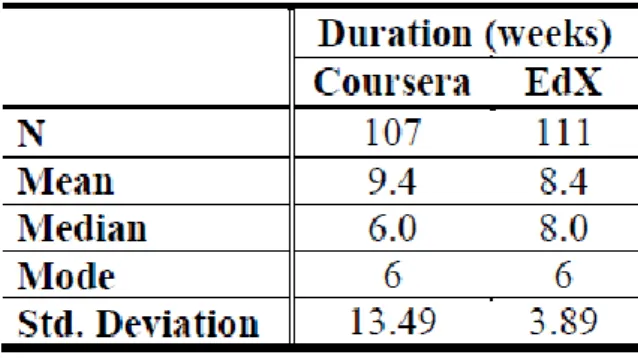
Finally, some information regarding the duration of the courses and the expected workload for a student to successfully complete the MOOCs (with the exception of the time of attending the “lessons”), are presented.Tables 5 and 6 show the descriptive statistics (number of courses (N), mean, median, mode and standard deviation) of the duration of the courses (in number of weeks) and the courses’ workload (in hours) for both platforms, respectively. Note that there were some courses in EdX that did not have the referred information accessible.
Table 5 – Descriptive statistics of the duration of courses (number of weeks) in both platforms
On average, the duration of the courses in Coursera is 9.4 (s=13.49) weeks, and 8.4 (s=3.89) in EdX. According Haggard (2013 in Atenas, 2015), the MOOCs courses are normally between 4 and 10 weeks long.
15ª Conferência da Associação Portuguesa de Sistemas de Informação (CAPSI 2015) 136 Table 6 – Descriptive statistics of courses’ workload (in hours) in both platforms
On average, the minimum of hours per week of workload, is 3.93 (s=1.912) hours, and the maximum is 6.10 (s=2.595) hours in Coursera platform. In EdX, on average, the minimum of hours per week of workload is 4.14 (s=2.059) hours, and the maximum is 5.07 (s=2.267) hours.
Comparing the values presented in Table 6 for courses available on both platforms, it can be observed that there are no considerable differences in the workload required to successfully complete the courses, since the intervals defined by the minimum and maximum values of workload are overlapped.
4.
C
ONCLUSIONSA systematic literature review about MOOCs in higher education was carried out to identify and classify the published works in order to understand MOOCs based research. The ISI Web of Knowledge, Scopus and IEEE Xplorer databases were used in order to search work published since 2008. The analysis resulted in 156 articles. With this work it was verified that the number of studies published in this area in the most relevant scientific databases increased considerably in the last two years.
As Coursera and EdX platforms were the most mentioned in the referred articles, a characterization and comparison of these platforms has been made, using a content analysis of the information available in the platforms’ sites.
On May 2015 there were 102 universities that offered 1036 courses in the Coursera platform, while regarding EdX, there were 39 universities that offered 516 courses. Thus, it can be concluded that the relationship between the number of courses and number of universities offering the courses is higher in the case of EdX than in the case of Coursera.
The average duration of the courses in Coursera is 9.4 weeks, and in EdX is 8.4 weeks. The average course in Coursera requires 3.93 to 6.10 hours of work per week, and in EdX requires
15ª Conferência da Associação Portuguesa de Sistemas de Informação (CAPSI 2015) 137
4.14 to 5.07 hours per week. The values from the workload required do not differ considerably between both platforms.
It could be noted that EdX is more interdisciplinary than Coursera because it covers a higher number of knowledge areas. Architecture, Communication, Ethics, History, Literature, Philosophy & Ethics, and Science are examples of areas present in EdX and not included in Coursera.
For future work, it is intended to complement the characterization of the two studied platforms based on the categories of courses and on their demand. It is also intended to proceed with the comparison between them. Additionally, it is planned to continue to study the evolution of MOCCs concept and its supporting platforms, and analyse other platforms that can arise in this context.
R
EFERENCESAboshady, O. A., Radwan, A. E., Eltaweel, A. R., Azzam, A., Aboelnaga, A. A., Hashem, H. A., . . . Hassouna, A. “Perception and use of massive open online courses among medical students in a developing country: multicentre cross-sectional study”. Bmj Open, 5, 1 (2015), 1-9.
Ahlberg, C. “MOOCs at Karolinska institutet university library”. Insights, 27, 2 (2014), 160-165.
Amemado, D. “Integrating technologies in higher education: The issue of recommended educational features still making headline news”. Open Learning, 29, 1 (2014), 15-30.
Atenas, J. “Model for democratisation of the contents hosted in MOOCs”. RUSC Universities and Knowledge Society Journal, 12, 1 (2015), 3-14.
Audsley, S., Fernando, K., Maxson, B., Robinson, B., and Varney, A. K. “An Examination of Coursera as an information environment: Does Coursera fulfill its mission to provide open education to all?” Serials Librarian, 65, 2 (2013), 136-166.
Ayala, C., Dick, G., and Treadway, J. “The MOOCs are coming! Revolution or fad in the business school?” Communications of the Association for Information Systems, 35 (2014), 225-243.
Baggaley, J. “MOOC rampant”. Distance Education, 34, 3 (2013), 368-378.
Baggaley, J. “Online learning: a New Testament”. Distance Education, 35, 1 (2014), 133-140. Barnes, C. “MOOCs: The Challenges for Academic Librarians”. Australian Academic & Research Libraries, 44, 3 (2013), 163-175.
Bonvillian, W. B., and Singer, S. R. “The online challenge to higher education”. Issues in Science and Technology, 29, 4 (2013), 23-30.
Bulfin, S., Pangrazio, L., and Selwyn, N. “Making 'MOOCs': The Construction of a New Digital Higher Education within News Media Discourse”. International Review of Research in Open and Distance Learning, 15, 5 (2014), 290-305.
Burch, S. L., and Harris, S. E. “A Massive Open Online Course on climate change: the social construction of a global problem using new tools for connectedness”. Wiley Interdisciplinary Reviews-Climate Change, 5, 5 (2014), 577-585.
Canessa, E., Tenze, L., and Salvatori, E. “Attendance to massive open on-line courses: Towards a solution to track on-line recorded lectures viewing”. Bulletin of the Technical Committee on Learning Technology, 15, 1 (2013), 36-39.
Carr, N. “The crisis in higher education”. Technology Review, 115, 6 (2012), 32-36.
Clarke, T. “The advance of the MOOCs (massive open online courses): The impending globalisation of business education?” Education and Training, 55, 4 (2013), 403-413.
15ª Conferência da Associação Portuguesa de Sistemas de Informação (CAPSI 2015) 138
Comeau, J. D., and Cheng, T. L. “Digital "tsunami" in higher education: Democratisation Movement towards Open and Free Education”. Turkish Online Journal of Distance Education, 14, 3 (2013), 198-224. Comer, D. K., Clark, C. R., and Canelas, D. A. “Writing to Learn and Learning to Write across the Disciplines:
Peer-to-Peer Writing in Introductory-Level MOOCs”. International Review of Research in Open and Distance Learning, 15, 5 (2014), 26-82.
Costa-Jussà, M. R., Formiga, L., Petit, J., and Fonollosa, J. A. R. “Detailed description of the development of a MOOC in the topic of statistical machine translation” Lecture Notes in Computer Science (including subseries Lecture Notes in Artificial Intelligence and Lecture Notes in Bioinformatics), 8856, (2014), 92-98.
Coursera. https://www.coursera.org (19/05/2015), 2015.
Cusumano, M. A. “Technology strategy and management: Mocs revisited, with some policy suggestions”.
Communications of the ACM, 57, 4 (2014), 24-26.
Daniel, J., Cano, E. V., and Gisbert Cervera, M. “The future of MOOCs: Adaptive learning or business model?” RUSC Universities and Knowledge Society Journal, 12, 1 (2015), 64-73.
Daza, V., Makriyannis, N., and Rovira Riera, C. “MOOC attack: Closing the gap between pre- university and university mathematics”. Open Learning, 28, 3 (2013), 227-238.
DeBoer, J., Ho, A. D., Stump, G. S., and Breslow, L. “Changing "Course": Reconceptualizing Educational Variables for Massive Open Online Courses”. Educational Researcher, 43, 2 (2014), 74-84.
Dillahunt, T., Wang, Z., and Teasley, S. D. “Democratizing Higher Education: Exploring MOOC Use Among Those Who Cannot Afford a Formal Education”. International Review of Research in Open and Distance Learning, 15, 5 (2014), 177-196.
EdX. https://www.edx.org (19/05/2015), 2015.
Egerstedt, M. “Controls for the masses [focus on education]”. IEEE Control Systems, 33, 4 (2013), 40-44. Estevez-Ayres, I., Crespo-Garcia, R. M., Fisteus, J. A., and Delgado Kloos, C. “An Algorithm for Peer Review
Matching in Massive Courses for Minimising Students' Frustration”. Journal of Universal Computer Science, 19, 15 (2013), 2173-2197.
Fini, A. “The Technological Dimension of a Massive Open Online Course: The Case of the CCK08 Course Tools”. The International Review of Research in Open and Distance Learning, 10, 5 (2009).
Firmin, R., Schiorring, E., Whitmer, J., Willett, T., Collins, E. D., and Sujitparapitaya, S. “Case study: using MOOCs for conventional college coursework”. Distance Education, 35, 2 (2014), 178-201.
Fisher, D. H. “Leveraging AI teaching in the cloud for AI teaching on campus”. AI Magazine,35, 3 (2014), 98-100.
Fowler, L., and Smith, K. “Drawing the blueprint as we build: Setting up a library-based copyright and permissions service for MOOCs”. D-Lib Magazine, 19, (2013), 7-8.
Fox, A. “From MOOCs to SPOCs”. Communications of the ACM, 56, 12 (2013), 38-40.
Frank Cervone, H. “Three trends in higher education and their potential impact on information agencies”. OCLC Systems and Services, 31, 1 (2015), 7-10.
Friedman, L. W., and Friedman, H. H. “Using social media technologies to enhance online learning”. Journal of Educators Online, 10, 1 (2013), 1-22.
Galán, J. G. “The mooc phenomenon and universality of culture: The news boundaries of higher education”. Profesorado, 18, 1 (2014), 73-91.
Gillani, N., and Eynon, R. “Communication patterns in massively open online courses”. Internet and Higher Education, 23, (2014), 18-26.
Glance, D. G., Forsey, M., and Riley, M. “The pedagogical foundations of massive open online courses”. First Monday, 18, 5 (2013).
Guzdial, M., and Adams, J. C. “MOCs need more work; so do CS graduates”. Communications of the ACM, 5, 1 (2014), 18-19.
Hew, K. F., and Cheung, W. S. “Students' and instructors' use of massive open online courses (MOOCs): Motivations and challenges”. Educational Research Review, 12, (2014), 45-58.
15ª Conferência da Associação Portuguesa de Sistemas de Informação (CAPSI 2015) 139
Hollands, F. M. “Why do institutions offer MOOCs?” Journal of Asynchronous Learning Network, 18, 3 (2014), 1-19.
Hollands, F. M., and Tirthali, D. “Resource Requirements and Costs of Developing and Delivering MOOCs”. International Review of Research in Open and Distance Learning,15, 5 (2014), 113-133.
Jiang, S., Williams, A. E., Warschauer, M., He, W., and O'Dowd, D. K. “Influence of Incentives on Performance in a Pre-College Biology MOOC”. International Review of Research in Open and Distance Learning, 15, 5 (2014), 99-112.
Jobe, W., and Hansson, P. O. “Putting a MOOC for human rights in the hands of Kenyans: The Haki Zangu case for non-formal learning. Electronic Journal of Information Systems in Developing Countries, 65, 1 (2014), 1-17.
Jordan, K. “Initial Trends in Enrolment and Completion of Massive Open Online Courses”. International Review of Research in Open and Distance Learning, 15, 1 (2014), 133-159.
Kellogg, S. “Online learning: how to make a MOOC”. Nature, 499, 7458 (2013), 369-371.
Kern, V. “Actions speaking louder than words: Building a successful tutorials program at the University of Washington Libraries”. Fontes Artis Musicae, 60, 3 (2014), 155-162.
Kim, J. I. “A study on the K-MOOC platform standardization measures”. International Journal of Software Engineering and its Applications, 9, 1 (2015), 221-236.
King, C., Kelder, J. A., Doherty, K., Phillips, R., McInerney, F., Walls, J., . . . Vickers, J. “Designing for quality: The understanding dementia MOOC”. Electronic Journal of e- Learning, 12, 2 (2014), 161-171. Knox, J. “Digital culture clash: "massive" education in the E-learning and Digital Cultures MOOC”. Distance
Education, 35, 2 (2014), 164-177.
Kustritz, M. V. R. “Canine theriogenology for dog enthusiasts: teaching methodology and outcomes in a massive open online course (MOOC)”. Journal of veterinary medical education, 41, 1 (2014), 9-18. Langen, F., and Bosch, van den H. Massive Open Online Courses: Disruptive innovations or disturbing
inventions? Open Learning, 28, 3 (2013), 216-226.
Laplante, P. A. “Courses for the masses?” IT Professional, 15, 2 (2013), 57-59.
Leito, I., Helm, I., and Jalukse, L. “Using MOOCs for teaching analytical chemistry: experience at University of Tartu”. Analytical and Bioanalytical Chemistry, 407, 5 (2015), 1277-1281.
Liyanagunawardena, T. R., Adams, A. A., and Williams, S. A. “MOOCs: A Systematic Study of the Published Literature 2008-2012”. International Review of Research in Open and Distance Learning, 14, 3 (2013), 202-227.
Liyanagunawardena, T. R., and Williams, S. A. “Massive Open Online Courses on Health and Medicine: Review”. Journal of Medical Internet Research, 16, 8 (2014).
Longstaff, E. “The Prehistory of MOOCs: Inclusive and Exclusive Access in the Cyclical Evolution of Higher Education”. Journal of Organisational Transformation and Social Change, 11, 3 (2014), 164-184. Lopez-Meneses, E., Vazquez-Cano, E., and Roman, P. “Analysis and Implications of the Impact of MOOC
Movement in the Scientific Community: JCR and Scopus (2010-13)”. Comunicar , 44 (2015), 73-80. Mackness, J., Waite, M., Roberts, G., and Lovegrove, E. “Learning in a Small, Task-Oriented, Connectivist
MOOC: Pedagogical Issues and Implications for Higher Education”. International Review of Research in Open and Distance Learning, 14, 4 (2013), 140-159.
Macleod, H., Haywood, J., Woodgate, A., and Alkhatnai, M. “Emerging patterns in MOOCs: Learners, course designs and directions.” TechTrends, 59, 1 (2014), 56-63.
Manouselis, N., Thanopoulos, C., Vignare, K., and Geith, C. “An open and scalable learning infrastructure for food safety”. Journal of Asynchronous Learning Network, 17, 2 (2013), 119-132.
Marshall, S. “Exploring the ethical implications of MOOCs”. Distance Education, 35, 2 (2014), 250-262. Martin, F. G. “Education will massive open online courses change how we teach”. Communications of the
ACM, 55, 8 (2012), 26-28.
Martín-Monje, E., Bárcena, E., and Read, T. “Peer-to-peer interaction and linguistic feedback in foreign language MOOCs”. Profesorado, 18, 1 (2014), 167-183.
15ª Conferência da Associação Portuguesa de Sistemas de Informação (CAPSI 2015) 140
Medina-Salguero, R., and Aguaded, I. “The MOOC in the educational platform MiriadaX”. Profesorado, 18, 1 (2014), 137-153.
Mehta, N. B., Hull, A. L., Young, J. B., & Stoller, J. K. “Just Imagine: New Paradigms for Medical Education”. Academic Medicine, 88, 10 (2013), 1418-1423.
Monedero-Moya, J.-J., Cebrian-Robles, D., and Desenne, P. “Usability and Satisfaction in Multimedia Annotation Tools for MOOCs”. Comunicar, , 44 (2015), 55-62.
Moodie, G. “Gutenberg's effects on universities”. History of Education, 43, 4 (2014), 450-467. Murray, D. J. A. “Participants' perceptions of a MOOC”. Insights, 27, 2 (2014), 154-159.
Najafi, H., Evans, R., and Federico, C. “MOOC Integration into Secondary School Courses”. International Review of Research in Open and Distance Learning, 15, 5 (2014), 306-322.
Nkuyubwatsi, B. “A cross-modal analysis of learning experience from a learner's perspective”. Electronic Journal of e-Learning, 12, 2 (2014), 195-205.
Nyoni, J. “The viral nature of massive open online courses (MOOCs) in open and distance learning: Discourses of quality, mediation and control”. Mediterranean Journal of Social Sciences, 4, 3 (2013), 665-672. O'Connor, K. “MOOCs, institutional policy and change dynamics in higher education”. Higher Education, 68,
5 (2014), 623-635.
Oyo, B., and Kalema, B. M. “Massive Open Online Courses for Africa by Africa”. International Review of Research in Open and Distance Learning, 15, 6 (2014), 1-13.
Pantò, E., and Comas-Quinn, A. “The challenge of open education”. Journal of E-Learning and Knowledge Society, 9, 1 (2013), 11-22.
Parkinson, D. “Implications of a new form of online education”. Nursing times, 110, 13 (2014), 15-17. Paton, C. “Massive open online course for health informatics education”. Healthcare informatics research, 20,
2 (2014), 81-87.
Perna, L. W., Ruby, A., Boruch, R. F., Wang, N., Scull, J., Ahmad, S., and Evans, C. “Moving Through MOOCs: Understanding the Progression of Users in Massive Open Online Courses”. Educational Researcher, 43, 9 (2014), 421-432.
Pujar, S. M., and Bansode, S. Y. “MOOCs and LIS education: A massive opportunity or challenge”. Annals of Library and Information Studies, 61, 1 (2014), 74-78.
Reilly, E. D., Stafford, R. E., Williams, K. M., and Corliss, S. B. “Evaluating the validity and applicability of automated essay scoring in two massive open online courses.” International Review of Research in Open and Distance Learning, 15, 5 (2014), 83-98.
Rhoads, R. A., Berdan, J., and Toven-Lindsey, B. “The Open Courseware Movement in Higher Education: Unmasking Power and Raising Questions about the Movement's Democratic Potential”. Educational Theory, 63, 1 (2013), 87-110.
Ros, S., Hernandez, R., Read, T., Rodriguez Artacho, M., Pastor, R., and Diaz Orueta, G. “UNED OER Experience: From OCW to Open UNED”. Ieee Transactions on Education, 57,4 (2014), 248-254. Sadhasivam, J. 2Educational paradigm shift: Are we ready to adopt MOOC?” International Journal of
Emerging Technologies in Learning, 9,4 (2014), 50-55.
Sanchez-Vera, M.-d.-M., Leon-Urrutia, M., and Davis, H. “Challenges in the Creation, Development and Implementation of MOOCs: Web Science Course at the University of Southampton”. Comunicar, , 44 (2015), 37-44.
Searls, D. B. “A New Online Computational Biology Curriculum”. Plos Computational Biology, 10, 6 (2014), 1-3.
Selwyn, N., Bulfin, S., and Pangrazio, L. “Massive open online change? Exploring the discursive construction of the 'MOOC' in newspapers”. Higher Education Quarterly, 69, 2 (2015), 175-192.
Sidorenko, T. V. “Open educational resources as a tool to improve language education effectiveness in the Russian higher education institutions”. International Journal of Emerging Technologies in Learning, 9,5 (2014), 67-70.
15ª Conferência da Associação Portuguesa de Sistemas de Informação (CAPSI 2015) 141
Skiba, D. J. “Disruption in higher education: massively open online courses (MOOCs)”. Nursing education perspectives, 33, 6 (2012), 416-417.
Spada, K. “Higher Education in the Digital Age”. Ieee Transactions on Professional Communication, 57, 2 (2014), 150-153.
Subhi, Y., Andresen, K., Bojsen, S. R., Nilsson, P. M., & Konge, L. “Massive open online courses are relevant for postgraduate medical training”. Danish Medical Journal, 61, 10 (2014), 1-5.
Toven-Lindsey, B., Rhoads, R. A., and Lozano, J. B. “Virtually unlimited classrooms: Pedagogical practices in massive open online courses”. Internet and Higher Education, 24, (2015), 1-12.
Tschofen, C., and Mackness, J. “Connectivism and dimensions of individual experience”. The International Review of Research in Open and Distance Learning, 13, 1 (2012), 124-143.
Tucker, C., Pursel, B. K., and Divinsky, A. “Mining student-generated textual data in MOOCs and quantifying their effects on student performance and learning outcomes”. Computers in Education Journal, 5, 4 (2014), 84-95.
Vallaeys, F. “University Social Responsibility: a new university model against commodification”. Revista iberoamericana de educación superior, 5, 12 (2014), 105-117.
Vargas, J. S. “Programmed instruction’s lessons for xMOOC designers”. Revista Mexicana de Analisis de la Conducta, 40, 2 (2014), 7-19.
Vazquez-Cano, E. “The Videoarticle: New Reporting Format in Scientific Journals and its Integration in MOOCs”. Comunicar, , 41 (2013), 83-90.
Vázquez-Cano, E., and Meneses, E. L. “MOOCs and higher education: The knowledge expansion”. Profesorado, 18, 1 (2014), 3-12.
Vila, R. R., Mengual-Andrés, S., and Guerrero, C. S. “Assessment the pedagogical quality of the MOOC”. Profesorado, 18, 1 (2014), 27-41.
Wellen, R. “Open access, Megajournals, And moocs: On the political economy of academic unbundling”. SAGE Open, 3, 4 (2013), 1-16.
Wright, F. “What do librarians need to know about moocs?” D-Lib Magazine, 19, (2013), 3-4.
Wu, K. “Academic libraries in the age of MOOCs”. Reference Services Review, 41, 3 (2013), 576-587. Xu, B., and Yang, D. “Study Partners Recommendation for xMOOCs learners”. Computational intelligence
and neuroscience, (2015), 832093-832093.
Yousef, A. M. F., Chatti, M. A., Wosnitza, M., and Schroeder, U. “A cluster analysis of MOOC stakeholder perspectives.” RUSC Universities and Knowledge Society Journal, 12, 1 (2015), 74-90.
⛥ソ⯕, and Jun, W. “A Study on Analysis of Current Status and Improvement Suggestions for Massive Open Online Courses”. Journal of the Korea Institute Of Information and Communication Engineering, 18, 12 (2014), 3005-3012.