UNIVERSIDADE DO ALGARVE
Developing and transmitting a
Portuguese-American identity
Neuza Carla do Sacramento Alves Baptista e Costa
Dissertação
Doutoramento em Comunicação, Cultura e Artes
Trabalho efetuado sob a orientação de:
Prof. Doutora Maria Cabral
(Professora Catedrática da Faculdade de Ciências Humanas e Sociais da
Universidade do Algarve)
e
Prof. Doutora Mirian Tavares
(Professora Associada da Faculdade de Ciências Humanas e Sociais da
Universidade do Algarve)
Developing and transmitting a
Portuguese-American identity
Declaro ser a autora deste trabalho, que é original e inédito. Autores e trabalhos consultados estão devidamente citados no texto e constam da listagem de referências incluída.
Copyright: Neuza Carla do Sacramento Alves Baptista e Costa
A Universidade do Algarve tem o direito, perpétuo e sem limites geográficos, de arquivar e publicitar este trabalho através de exemplares impressos reproduzidos em papel ou de forma digital, ou por qualquer outro meio conhecido ou que venha a ser inventado, de o divulgar através de repositórios científicos e de admitir a sua cópia e distribuição com objetivos educacionais ou de investigação, não comerciais, desde que seja dado crédito ao autor e editor.”
Abstract
This study, an exploratory qualitative multi-case case study, is particularly interested in the possible development of a bi-cultural, transnational identity of the Portuguese citizens who emigrated to the United States during the second half of the twentieth century, as well as that of their descendants. Auretta (20 11) suggests that, “to tell a story is to retell the world. To retell the world is to renew the world, or at least to renew a world” (p. 3) and in following Auretta’s train of thought this study retells the stories of immigration and adaptation to a new wo rld in order to understand the processes of acculturation and assimilation that are involved. In order to do so during an initial phase of the study, participants who identified themselves as Portuguese-Americans who were at the time living in the United States, were asked to answer a survey created for this purpose, the
Portuguese-American Identity Survey. During a second phase, a sub-sample of the population
was selected for the multi-case case study and individual, semi-structured interviews were conducted, allowing for the collection of participants’ life stories, as well as any recollections of their immigration experiences or those of their family. In doing so, the study analyzed participants’ perceptions of cultural identity, language use and acquisition of English and/or Portuguese, as well as their participation or lack of, in a bicultural and bilingual community. Conclusions led to a greater understanding of the endurance and transmission of a transnational, bicultural and bilingual identity, the Portuguese-American identity, specifically how it has come to exist, what it is comprised of, and what its implications in the lives of the participants are. In addition, the results reveal the need for further discussion amongst community members, researchers and language experts to ensure that the Portuguese language and culture survives in the future Portuguese -American generations.
The key words:
Immigration, transnational identity, first/second/third generation, cultural identity, identity constructions, cultural heritage
Resumo
O presente estudo, um estudo exploratório qualitativo do tipo multi-caso, incide no desenvolvimento da identidade bi-cultural e transnacional dos cidadãos Portugueses que emigraram para os Estados Unidos durante a segunda metade do século vinte, bem como a dos seus descendentes. Auretta (2011) sugeriu que, “contar uma história é recontar o mundo. Recontar o mundo é renovar o mundo, ou pelo menos renovar um mundo” (p. 3) e, no seguimento do pensamento de Auretta, este estudo conta as histórias de imigração e da adaptação a um novo mundo, a fim de compreender os processos de aculturação e assimilação que nela estão envolvidos. Para que tal fosse possível, durante uma fase inicial do estudo, foi solicitado aos participantes que se identificam como Luso-Americanos e que vivem nos Estados Unidos, que respondessem a um questionário criado para este efeito, o Portuguese-American Identity Survey. Durante uma segunda fase, uma subamostra da população foi selecionada para o estudo multi-caso e foram realizadas entrevistas individuais, semi-estruturadas, que permitiram a recolha das histórias de vida dos participantes, bem como quaisquer lembranças das suas experiências de imigração ou das dos seus familiares. Assim, o estudo analisou a percepção da identidade cultural dos participantes, o uso da linguagem e a aquisição do inglês e / ou do português, bem como a sua participação, ou a falta dela, numa comunidade bi-cultural e bilíngue. As conclusões levaram a uma maior compreensão da resistência e da transmissão de uma identidade transnacional, bi-cultural e bilingue, a identidade Luso-Americana, demonstrando, especificamente, como esta se desenvolveu, em que consiste e quais as suas implicações nas vidas dos participantes. Os resultados revelam ainda que há necessidade de uma maior discussão entre os membros da comunidade, pesquisadores e especialistas em linguagem para garantir que a língua e a cultura portuguesa sobrevivam nas futuras gerações luso-americanas.
Termos chave:
Imigração, identidade transnacional, primeira/segunda/terceira geração, identidade cultural, construções de identidade, herança cultural
Acknowledgements
During the time I have been working on this study, I have received endless support and encouragement from mentors, my family, my friends and my co-workers.
I would like to give a very special thank you to Prof. Doutora Maria Cabral who has also been a notable friend but also my longtime mentor. I am extremely grateful for your continuous readiness to read my work, your thought provoking questions, and your statistical and technical help. I would also like to express my gratitude to my second mentor and friend, Prof. Doutora Mirian Tavares for allowing me to dream of this study, for the encouraging words that allowed me to get started. I am sincerely grateful for your endless, insightful comments and suggestions throughout the entire process. I am eternally grateful and indebted to you both.
I am also forever grateful to the twelve individuals that volunteered their time and trusted me with their personal stories during the interview phase of the study, without their kind help this study would not have been feasible. I will forever treasure your words. Thank you so much Alice, Andrea, Daniel, Danny, Sr. Fernando, Jenn, Jesse, Liz, Maria, Rosemary, Sandra and Victor.
I would like to especially thank my dad and my mom for always supporting and encouraging me. Pete, thank you for continuously asking if I was working and if was done yet. Vanda, thank you, for having the talk with me that got it all started and for checking in on a regular basis. Tia Marilia, obrigada por tudo. Thank you all for your patience and support. I love you all.
TABLE OF CONTENTS
CHAPTERS PAGE
IINTRODUCTION
1.1 THE RESEARCH PROBLEM 13
1.2 THE RESEARCH QUESTIONS AND OBJECTIVES 16
1.3 THE THESIS STRUCTURE 17
IIREVIEW OF THE LITERATURE
2.1 IMMIGRATION:AN HISTORICAL OVERVIEW 19
2.2 IMMIGRATION TODAY 23
2.3 PORTUGAL:EMIGRATION AND IMMIGRATION, AN HISTORICAL
PERSPECTIVE
35 2.4 IDENTITY AND LANGUAGE ISSUES IN IMMIGRANT SOCIETIES 50
2.4.1 IDENTITY 50
2.4.2 LANGUAGE ACQUISITION,LANGUAGE LOSS,BILINGUALISM AND
MULTILINGUALISM 55
2.5 SUMMARY 68
III METHODOLOGY
3.1 THE STUDY 69
3.2 DESCRIPTION OF THE STUDY AND JUSTIFICATION OF THE RESEARCH DESIGN
CHOSEN 70
3.3 THE PARTICIPANTS OF THE STUDY 72
3.3.1 THE SURVEY PARTICIPANTS 72
3.3.2 SAMPLING AND SELECTION OF CASES (MULTI-CASE STUDY) 73
3.4 THE RESEARCH INSTRUMENTS 76
3.4.1 THE SURVEY 76
3.4.1.1 TRIANGULATION AND VALIDATION OF THE SURVEY 84
3.4.2 THE INTERVIEW 88
3.5 THE RESEARCH PROCEDURES 96
3.5.1 SURVEY:DATA COLLECTION AND DATA PROCESSING 96 3.5.2 THE INTERVIEWS:DATA COLLECTION AND DATA PROCESSING 99 IV RESULTS
4.1 QUESTION 1:WHO ARE THE DESCENDANTS OF THE PORTUGUESE IMMIGRANTS IN THE UNITED STATES OF AMERICA WHO SELF-IDENTIFY AS PORTUGUESE
-AMERICANS? 105
4.2 QUESTION 2:WHAT ARE THE SUBJECTS’ REPRESENTATIONS OF THE ENGLISH
AND/OR PORTUGUESE LANGUAGE? 122
4.3 QUESTION 3:HOW DO THE SUBJECTS IDENTIFY THEMSELVES AMERICAN
AND/OR PORTUGUESE?WHY?IN WHAT CONTEXT(S)? 136 4.4 QUESTION 4:HAS THE PORTUGUESE LANGUAGE AND CULTURE BEEN
TRANSMITTED TO YOUNGER GENERATIONS? IF SO, HOW AND WHY? 154
4.5 CLOSING SECTION OF THE SURVEY 158
4.6 THE INTERVIEWS / CASE STUDY 159
4.6.1 PART I:IDENTIFICATION OF RESPONDENT AND FAMILY EMIGRATION HISTORY 167 4.6.2 PART II:LANGUAGE AND EDUCATION (WHAT WAS THE PARTICIPANTS’
L1/L2?WHAT WAS THE LANGUAGE LEARNING PROCESS LIKE?IN WHAT CONTEXTS ARE ENGLISH AND PORTUGUESE USED?WHAT ARE THE ACADEMIC QUALIFICATIONS OF THE PARTICIPANTS?DID PARTIPANT (OR CHILDREN)
ATTEND PORTUGUESE SCHOOL?)
185
4.6.3 PART III:CULTURAL IDENTITY (HOW DO YOU IDENTIFY YOURSELF?WHAT IS A PORTUGUESE-AMERICAN?DOES YOUR INDENTITY CHANGE DEPENDING ON WHO YOU ARE WITH OR WHERE YORE ARE?)
202 4.6.4 PART IV:CULTURAL TRANSMISSION (IS THE CULTURE BEING MAINTAINED
ALINE?IS CONTACT WIT PORTUGAL BEING KEPT?WHAT KIND OF CONTACT IS
BEING KEPT?WHY?WHAT IS THE FREQUENCY OF THE CONTACT?
4.6.5 PART IV:SOCIETY AND EDUCATION 238
4.6.6 PART VI:FINAL COMMENTS AND THANK YOU 242
VDISCUSSION AND CONCLUSIONS
5.1 INTRODUCTION 243
5.2 DISCUSSION OF FINDINGS OF THE SURVEY 244
5.3 DISCUSSION OF FINDINGS OF THE INTERVIEWS 246
5.4 CONCLUSIONS 249
5.5 IMPLICATIONS FOR EDUCATIONAL PRACTICE 252
5.6 LIMITATIONS OF THE STUDY AND SUGGESTIONS FOR FUTURE RESEARCH 253
REFERENCES 254
APPENDIX A -RESEARCH INSTRUMENTS –SURVEY 263
APPENDIX B-RESEARCH INSTRUMENTS –INTERVIEW GUIDE 275
APPENDIX C -INTERVIEW DATA TRANSCRIPTIONS 279
APPENDIX D -NVIVO WORD FREQUENCY QUERY TREATMENT 388 APPENDIXE–WORD TREE FIGURES (FROM FIGURE 4.34 TO 4.54) IN CHAPTER 4 CD
LIST OF TABLES
TABLES PAGE
2.1 The United States as a Country of Destination, 1960-2013 29 2.2 Portugal as a Country of Destination, 1960-2013 29 2.3 Foreign Population Residing in Portugal in 2013 37
2.4 European Union Nationals Resident in Portugal in 2008 38
2.5 Evolution of the Foreign Population in National Territory,
1980-2014 40
2.6 Number of People Who Left Portugal to Live Elsewhere 42
2.7 Population of Portuguese Ancestry Group by Region: 2009 45
3.1 Participants Willing to Participate in an Interview According to State of Residence
75
3.2 Correspondence Between the Survey Questions and the Research
Goals 79
3.3 Interview Information 100
3.4 Research Dimension – Participants’ Understanding of Culture 101 3.5 Research Dimension – Participants’ Views on Education 102 3.6 Research Dimension – Participants’ Representations of their Identity 102 3.7 Research Dimension – Participants’ Representations of Immigration 102 3.8 Research Dimension – Participants’ Representations of the
Portuguese and the English Languages
102
4.1 Interviewees’ Identification 184
4.2 Interviewees’ Current Use of Language English and Portuguese 195 4.3 Interviewees’ Perception of the Value of Education Throughout the
Generations
196
4.4 Interviewees’ Definition of Culture 204
4.5 Interviewees’ Definition of Portuguese-American 209 4.6 Interviewees’ Perception of Whether the Label of
Portuguese-American Ever Changes
214
4.7 Interviewees’ Description of the Portuguese-American Household and Whether it has Changed
229
LIST OF FIGURES
FIGURES PAGE
2.1 Emigrant populations from Portugal, mid-2013 Estimates 25 2.2 Immigrant populations in Portugal, mid-2013 Estimates 26 2.3 International Migrant Population by Country of Destination, 1960 27
2.4 Map of world migrations since 1500 31
3.1 Number of survey respondents interested in participating in an interview
74
4.1 Participants’ Gender 106
4.2 Number of Respondents per Age Group 107
4.3 Place of Birth of Participants’ Grandparent 108
4.4 Participants’ Place of Birth 109
4.5 Participants’ Nationality 109
4.6 Participants’ State of Residence. 111
4.7 Participants’ Place of Origin in Portugal (in or out of the mainland)
112
4.8 Participants’ Member of the Family to First Emigrate to the United States of America
113
4.9 Approximate Date of Emigration of Participant or Ancestors 115
4.10 Reasons for Emigration 116
4.11 Participants’ Level of Education 117
4.12 Where Participants Received a Formal Education 118
4.13 Participants’ Job Descriptions 121
4.14 Language Participants Use Most Often 122
4.15 Language Participants Feel Most Fluent 123
4.16 Language in Which Participants Read Most Often 124 4.17 Language in Which Participants Read Most Fluently 125 4.18 Language in Which Participants Write Most Often 125 4.19 Language in Which Participants Write Most Fluently 126 4.20 Participants’ Self-rating of Portuguese Proficiency Level in
Writing, Reading, Listening and Speaking
127
4.21 Participants’ Self-rating of English Proficiency Level in Writing, Reading, Listening and Speaking
129
4.22 Language(s) Spoken by Participants at Different Places and with Different People
131
4.23 Participants’ Frequency of Use of the Portuguese Language 133 4.24 Participants’ Frequency of Use of the English Language 135 4.25 Participants’ Definition of Their Cultural Origin 137 4.26 How Important Participants Feel Their Cultural Identity Is 137 4.27 Participants’ Evaluation of the Above Statements in Regards to
Their Cultural Identity
Figures Page
4.28 The Three Words That First Come to Mind When Participants Think of What it Means to be Portuguese
140
4.29 The Three Words That First Come to Mind When Participants Think of What it Means to be American
147
4.30 Frequency With Which Participants’ Participate in Activities in the Portuguese-American Community
154
4.31 How Frequently Participants Travel to Portugal 155 4.32 Participants’ Reasons for Traveling to Portugal 156
4.33 Yes or No? 158
CHAPTER I INTRODUCTION
1.1 The Research Problem
Taking into account the past, present and probable future trends and numbers in emigration from Portugal, it is the intent of this research to study the effects and characteristics of the transmission of the Portuguese cultural and linguistic identity from the individuals who emigrated from Portugal to the United States of America to their descendants, who may or may not have developed, fostered and nurtured a Portuguese-American bicultural and bilingual identity.
Initially the main question guiding this study was what it meant to be Portuguese-American, especially what it meant in terms of a cultural identity. Having been raised in the United States of America from the age of 5, I consider myself Portuguese-American despite the fact that I only have Portuguese nationality. When people ask, “What are you?” I often feel the need to break down that question into its indefinite possibilities. Does the question ask, where I was born, where my ancestors came from, where my passport is from, where my national identity card says I am from, or does it ask, where I feel most at home, culturally and linguistically? The awkwardness of this question is that it is often only partially answered by truth, for it is extremely difficult, if not nearly impossible to answer the question, “what are you?” unless I give my long-winded, very confusing answer. First of all, I am Angolan by birth, as I was born in Luanda to Portuguese parents who were raised from a very early age in Angola. I am also the descendant of Portuguese emigrants to the United States of America who found that for economic reasons, post-revolution Portugal was not an option for their family and thus opted to follow in the footsteps of my paternal great-grandfather, who was adventurous enough to explore the Western United States in
the late 18th century and early 19th century. Thus, at some point, I became a New Yorker, and consequently, an American, at least at heart. New York is where I am most at home. It is where I know the language, where I understand the jokes, the sarcasm and the rules of engagement. This however, does not help me to fit in at a hundred percent. My first name for instance, in a land of such a vast variety of names, still makes the reader of a list come to a full stop, usually urging the reader to call me by my last name, automatically bypassing my first name. Today, not surprisingly, amongst my non-Portuguese group of friends I am often simply “Costa” (pronounced Kosta).
On the other hand, I am Portuguese. I understand, speak, read and write the language at a near native level. Nevertheless, the fact that my family is Portuguese and that I can physically trace my genealogical roots to mainland Portugal, is what most makes me Portuguese. However, my linguistic and cultural ability does not make me fit in at a hundred percent all of the time. I frequently fail to understand the jokes and even some of the rules of social engagement, which often leads to social retreat. Furthermore, after living in Portugal and working at a Portuguese university for the past ten years, I still at times have difficulty following formal academic lectures and the intertwining question and answer sessions that usually follow.
The reality is that both Portugal and the United States of America are embedded into the person that I have become. Nevertheless, they divide me. Despite the fact that I am functional in both countries, the degree of functionality is not the same. Fundamentally, I am both, and I probably could not be who I am if it were not for both of my “nationalities”, my Portuguese side and my American side. Nevertheless, this trans-nationality, this duality between countries, languages and cultures makes me, more often than I would like to, question who I am.
My suspicion is that in this increasingly global society, there are immigrants and their descendants, who also linger in this transnational world, between a bicultural and/or bilingual identity. Ideally, I would like to have a more noble understanding of how a dual, transnational identity develops, how it comes to exists within immigrant societies and whether it contributes to the survival of
such societies. Thus, in contemplating this study, the questions regarding the existence and survival of a bicultural, bilingual identity became increasingly pertinent, both on an individual and on a community level.
As the design of this research project began evolving, I sought to explore the stories and experiences of the Portuguese immigrants residing in the United States of America. Initially the focus was on the Portuguese immigrants residing in the state of New York and their descendants, specifically those who had emigrated on or after 1950. The decision to focus on New York State was because despite the fact that I have not lived there for ten years, I still feel an enormous connection to this location and its people and thus believed this would facilitate the process of reaching the target population. In addition, I felt the need to limit the study to a state since the numbers of Portuguese immigrants and their descendants are quite high across the United States of America. However, early on in the data collection phase, it became evident that it would be best to expand the study to include all Portuguese immigrants and their ancestors, living in the United States of America who would be willing to participate, to ensure that the sample would be significant enough.
As I read the autobiographies of Portuguese immigrants and the existing studies on Portuguese-Americans, I become curious about the steps taken to develop such an identity. Furthermore, I became curious about the language acquisition process of the individuals and the balance, or lack of, between the first language and second language. As a group, I wondered whether this community lives a balanced life, both socially and linguistically between the Portuguese speaking community and the English speaking community. I wondered about their identity. Is it strictly an American, a Portuguese identity, or a combination of the two? In the cases where there is a blending of the two identities, I became curious about the details. For instance, what in the lives and identities of these individuals is Portuguese and what is American? Additionally, does language alone make individuals identify as Portuguese-Americans? Ultimately, I wondered whether there were differences and, or similarities that constitute the identity of such a community and its individuals, and how these were affected by a number of external factors such as: age, level of education, place of residence, type of
employment, language(s) spoken, etc. These questions eventually led to a more detailed structure of this study and its foundation.
1.2 The Research Questions and Objectives
My suspicion is that, similarly to what has occurred with other immigrant groups, over time with the adoption of and adaptation to a new culture and a new language, Portuguese immigrants and their descendants that are living in the United States of America have undergone significant alterations to their cultural and linguistic identity. Hence, the investigation questions guiding this study, seek to provide additional information about the cultural and linguistic identity of the participants. These questions are:
1. Who are the descendants of the Portuguese immigrants in the United States of America who self-identify as Portuguese-Americans?
2. What are the subjects’ representations of the English and/or Portuguese language?
3. How do the subjects identify themselves American and/or Portuguese? Why? In what context(s)?
4. Has the Portuguese language and culture been transmitted to younger generations? If so, how and why?
5. What is, if any, the personal, societal and educational impact of the subjects’ experiences?
6. What are, if any, the lessons to be learned from the subjects’ experiences?
The research objectives pursued in this study in order to answer the above stated research questions are:
1. To characterize the participants’ representations identity and language preferences of the Portuguese-Americans living throughout the United States of America.
2. To understand how the Portuguese culture and language have been transmitted to younger generations.
3. To examine the personal, societal and educational impact of the subjects’ experiences.
Finally, this study also aims to contribute to a wider comprehension of the nature and struggles of immigrant families and their descendants and the social implications of their incorporation or lack of into the mainstream society, while attempting to maintain their language and culture alive. As memories of a time long gone fade, as a language becomes replaced in a rapidly changing world, what can the newer generations do to maintain to maintain the cultural and linguistic links alive, however small they may be?
1.3 The Thesis Structure
This dissertation is consequently organized into five chapters, besides this introductory chapter. The first part of Chapter II provides the reader with a brief historical overview of immigration based on the existing literature, bringing the reader to the second part of the chapter which reviews the existing literature on Portugal’s history as both a country of emigration and immigration, focusing on a more detailed perspective of the immigration literature published by and about Portuguese-Americans. The chapter concludes with a brief discussion of the issues of connected to immigration including language acquisition (most often a second language, but not necessarily), language loss, bilingualism, multilingualism and identity. Chapter III describes the methodology employed, including the reasoning behind the research questions guiding this study, identifies the participants and the instruments designed to conduct the research. Chapter IV discusses the data treatment, both of the survey and the interviews, and reports results of the qualitative and quantitative analysis. Chapter V interprets and presents the author’s findings as well as conclusions and suggestions for change both in the integration of new immigrants and for the cultural and linguistic maintenance of future generations of Portuguese-Americans in the United States of America. Pertinent information that supports and validates the findings of the research such as the sample questionnaires and interview guide, graphs, maps and transcripts of interviews has also been included in Appendices (A, B, C and D).
CHAPTER II
REVIEW OF THE LITERATURE
The immigrant’s heart marches to the beat of two quiet different drums, one from the old homeland and the other from the new. The immigrant has to bridge these two worlds, living comfortably in the new and bringing the best of his or her ancient identity and heritage to bear on life in an adapted homeland. He becomes a transmitter of his own culture and a contributor to the deepening of the culture in his new homeland. His children live with intertwined identities …
(Irish President McAleese, remarks at St. Michael’s Irish Centre, Liverpool, Wednesday, 4 June, 2008)
2.1 Immigration: An Historical Overview
As President McAleese suggests, many men and women have indeed created bridges between their “worlds” and they continue to do so, for the movement of human beings from one corner of the world to another is neither a new nor a recent phenomenon. In Böhning’s words (1978, p.11), “the history of mankind is the history of migration” (as cited in Rystad, 1992, p. 1172). Despite its vast history various experts and people that have shown interested in this area and its history, including but not limited to historians, anthropologists, politicians and even the media have given this worldwide movement different labels. Whether they have labeled it emigration, immigration or migration, whether, this movement is national or international, or even legal or illegal, what seems to be relevant is that as a worldwide phenomenon it has always involved a significant number of
people from all races, creeds, colors, backgrounds and corners of the world. The 20th century alone saw significant alterations in numbers. Data published by the Organization for Economic Co-operation and Development (OECD) indicates that the number of people, the so called migrants moving around the world, has significantly increased from an estimated 77 million individuals in 1960 to 214 million in 2010 (2012, p. 3). Messina for instance emphasizes that post-WWII there were three distinct migratory phases especially to Western Europe: 1945-79, 1973-2007 and 1989-2007 (2007, p.19), which would definitely corroborate the numbers reported by the OECD, at least within Europe.
Besides the importance of its vast history, the human phenomenon of migration, is now and has always been the result of an array of circumstances and these circumstances are just are crucial to the history of mankind. In fact, the
World Migration Report 2013 - Migrant well-being and development, published
by the International Organization for Migration (IOM) states that,
Throughout the history of mankind, human beings have migrated in search of greater opportunities and a better life. While migration is driven by many complex factors, most migrants want to earn a better living, to live in a more agreeable environment or to join family or friends abroad. Many, however, do not move of their own free will but are forced to do so – refugees escaping persecution, for instance; people devastated by conflict or natural disasters; or victims of trafficking. But those who willingly choose to migrate are largely driven by the desire for greater happiness, prosperity and well-being. (2013, p23)
The above description of migration focuses on two key aspects of the migration process, it not only describes the forces pushing many individuals towards a voluntary move, it also reminds the reader of the numerous men, women and children who face an involuntary move. Nevertheless, it is a description that focuses on the so called desire to improve one’s life, regardless of whether this
desire to leave is a direct consequence of one’s voluntary wishes or a direct
consequence of external circumstances that in fact push or force one out of his/her own country. Interestingly, whereas the online Oxford English dictionary offers a more one-sided definition of immigration as an, “action of coming to live
permanently in a foreign country”, the IOM’s Glossary on Migration offers a definition that does not restrict immigration to a permanent action of settlement but includes a broader, less time-specific definition, in which immigration is, “a process by which non-nationals move into a country for the purpose of settlement” (2013, p. 49), a more restrictive definition than the one given in the above mentioned World Migration Report 2013 - Migrant well-being and development. Nevertheless, regardless of the length of stay, temporary or permanent, immigration has historically been linked to the already discussed an array of reasons including but not limited to those of a political, religious and/or economic nature. Ignatiev for instance, reminds the reader about how the Irish Famine period of 1815, an event that is neither political, nor religious, nor economic, but which led to a mass exodus of the Irish towards the United States of America (2009, p. 45). Lick recounts the Azorean immigration as the final consequence of an assortment of factors including those related to natural causes, “In addition to the economic and political factors that spurred many Azoreans to emigrate in the late 1800s and early 1900s earthquakes and volcanic eruptions destroyed entire villages and sent their residents fleeing to America” (1998, pp. 40-41). Gardaphé (1996) compares literature that recounts the lives of southern Italian peasants who emigrated to the United States of America in search of a better life but essentially a better control over their own lives. They emigrated between the late 19th century and the early 20th century, most were illiterate because literacy was a way for those in power, the politicians and the Church, to keep them under control (1996, pp. 26-27). On the other hand, Teixeira and Da Rosa point out that the Portuguese who emigrated to Canada around the middle of the 20th century did so because Canada needed laborers and so it endorsed the immigration of, “agricultural and railway construction workers” (2009, p.6). These are some of the numerous examples available in the immigrant literature that has been published, more of which will be discussed in detail later on in this chapter. However, these examples illustrate just how some of the unexpected factors have throughout the history of mankind pushed or pulled emigrants into what to them were unknown territories, something that continues to occur today. An example being the uncontrollable number of refugee and/or migrant men, women and children who have already arrived upon the shores of Greece in 2015, both terms, refugee and migrant are used on purpose here because there seems to be a worldwide disagreement over which to use.
Not surprisingly, when it comes to present day discussions about worldwide migration issues, Perruchoud and Redpath-Cross alert for a need of a worldwide discussion regarding the definitions as they, “are often vague, controversial or contradictory. There is an absence of universally accepted definitions, which stems partially from the fact that migration is something which has traditionally only been addressed at the national level … may vary according to a given perspective or approach” (2011, p. 5). Yet, despite the numerous attempts to define the concepts within the field of migration, whether emigration or immigration, the truth is that these define an intricate and constant worldwide movement of people. The reality is that an imperative difference between these concepts is rooted in the point of view as Perruchoud and Redpath-Cross (2011) point out. Thus, if one focuses on the point of departure, then one refers to emigration, but one focuses on the point of arrival, then one refers to immigration. Furthermore, as Rystad explains,
Migration is a remarkably broad and multifaceted field embracing a multitude of issues, even when limited to international migration. Seasonal and temporary migration as well as migration with the intent of permanent residence all figure in this phenomenon, as do forced migration of various kinds, the expulsion of entire ethnic groups and the deportation of certain individuals. Flight triggered by political persecution, by civil war, by famine, by environmental disasters, etc. also falls under the general category of migration. (1992, p. 1168)
In fact, scholars as well as non-scholars, from a variety of fields have studied the phenomenon of migration for various purposes (political, economic, legal, etc.) and from various perspectives. Martin and Widgren (2002) note that migration became a topic of interest amongst anthropologists around the middle of the twentieth century and has continued to be of interest until today, especially because by 1990 there were believed to be 120 million people living outside their country of origin, a number which a decade later had already risen to 160 million (as cited in Bretell, 2003, p. ix -x). Furthermore, data published by the Organization for Economic Co-operation and Development (OECD) indicate that the number of people, the so called migrants moving around the world has
significantly increased from an estimated 77 million individuals in 1960 to 214 million in 2010 (2012, p. 3). Bretell goes on to explain that anthropologists have not only focused their interest on, “the impact of out-migration on sending communities, they have also increasingly turned their attention to the study of immigrant populations in the United States” (2003, p. x). While some of the studies conducted have focused on the emigrant, defined by IOM’s Glossary on Migration as, “a person undertaking an emigration” (2011, p. 32), and emigration as, “the act of departing or exiting from one State with a view to settling in another” (2011, p. 32); others, have focused on the immigrant, defined by IOM’s Glossary on Migration as, “a person undertaking an immigration”, being that
immigration is defined as, “a process by which non-nationals move into a country
for the purpose of settlement” (2011, p. 49). Even worldwide organizations such as the United Stations, through the Organization for Economic Co-operation and Development (OECD) and the United Nations Department of Economic and Social Affairs (UNDESA) have studied the effects of international migration on the world’s development (World Migration in Figures © OECD-UNDESA October
20131) in an attempt to improve policy making strategies, which contribute to a
better informed worldwide population and eliminate or at least diminish the myths pertaining to immigrants and migration in general. While it is clear that a worldwide consensus on definitions may be a necessity, for the purposes of this research I will follow the IOM’s definitions for emigrant and immigrant.
2.2 Immigration Today
Today’s global events, including a growing global economy and the increasing ease of travel, continue to contribute to an on-going flow of international migration. Mota (2010) in Pires et al., describes the 21st century as the “century of people in motion” (2010, p. 14). In fact, the World Migration in
1 World Migration in Figures © OECD-UNDESA October 2013 – A joint contribution by
UN-DESA and the OECD to the United Nations High-Level Dialogue on Migration and Development, 3-4 October 2013. Retrieved from: http://www.oecd.org/els/mig/World-Migration-in-Figures.pdf
Figures2 report released in October 2013 places the number of worldwide international migrants at about 232 million, a number which when further analyzed according to place of settlement in a developed or in a developing part of the world, or even the broader analysis by continent of settlement, indicate an overall increase in international migrations, especially between 1900 and 2013, despite the fact that this increase occurred at a lower rate after 2010. More specific quantitative data of the on-going movement of human beings from one country to another is depicted in an interactive map entitled, International Migrant
Populations by Country of Origin and Destination, mid-2013 Estimates. The map
published on the website of the Migration Policy Institute (MPI), shows how Portugal is no stranger to the worldwide trend of international migration. Based on mid-2013 estimates from the UN Population Division, the first map (see Figure 1.1) illustrates the migrant population originating from Portugal, as well as the worldwide present day settlement of the Portuguese. As per data depicted in this map, in mid-2013 there were an estimated 175,000 migrants in the United States of America from Portugal, as compared to a mere 6,444 migrants in France and a substantial 203,000 migrants in Switzerland, just to name a few of the countries to where those who were either born in Portugal or who have legal citizenship, have chosen to emigrate to. This information is further corroborated by the work of Machado et al. (which states that if one looks at emigration from Portugal there were two main waves or cycles of emigration. The first between 1855 and 1935 a transatlantic migration when almost 2 million people left Portugal for various parts of the world, being that Brazil was the most popular destination for the Portuguese during this time. The second wave of Portuguese emigration, between 1931 and 1975 was intra-European, and it was during this time that the number of Portuguese emigrants increased, being that the main destination was France (Machado et al., 2010, p. 22). Nevertheless, the Portuguese still left for the Americas during this latter wave of emigration.
2 World Migration in Figures © OECD-UNDESA October 2013 – A joint contribution by
UN-DESA and the OECD to the United Nations High-Level Dialogue on Migration and Development, 3-4 October 2013. Retrieved from: http://www.oecd.org/els/mig/World-Migration-in-Figures.pdf
Figure 2.1 Emigrant populations from Portugal, mid-2013 Estimates3
When compared to the number of migrants that have come into Portugal during the same period of time, the number of migrants that left Portugal is much higher (see Figure 1.2). The following data is available for migrants that have emigrated to Portugal: there are 7,000 migrants from the US in Portugal, 94,000 from France and 17,000 from Switzerland, numbers, data which shows the lack of balance between those leaving and those coming into Portugal.
3 Source:
http://www.migrationpolicy.org/programs/data-hub/maps-immigrants-and-emigrants-around-world
Migration Policy Institute tabulation of data from the United Nations, Department of Economic and Social Affairs (2013). Trends in International Migrant Stock: Migrants by Origin and Destination, 2013 Revision (United Nations database, POP/DB/MIG/Stock/Rev.2013). Available here: http://esa.un.org/unmigration/TIMSO2013/migrantstocks2013.htm.
Figure 2.2 Immigrant populations in Portugal, mid-2013 Estimates4
A closer look at the approximate time period with which this study is concerned leads us to yet another MPI map entitled, The International Migrant
Population by Country of Destination, which allows the viewer to look at the years
between 1960 and 2013, while specifically depicting the international migrant movement per decade (see Figure 2.3) focusing on the countries that have hosted 20,000 or more international migrants.
4 Source:
http://www.migrationpolicy.org/programs/data-hub/maps-immigrants-and-emigrants-around-world
Migration Policy Institute tabulation of data from the United Nations, Department of Economic and Social Affairs (2013). Trends in International Migrant Stock: Migrants by Origin and Destination, 2013 Revision (United Nations database, POP/DB/MIG/Stock/Rev.2013). Available here: http://esa.un.org/unmigration/TIMSO2013/migrantstocks2013.htm.
Figure 2.3 International Migrant Population by Country of Destination, 19605 A quick analysis of the graphic shows that each one of the colored circles drawn on the map represents a percentage of the migrant population as compared to the total amount of population within a country. For instance, the total population in the United States in 1960 equaled 186,326,000 people, out of which 10,826,000 were international migrants, meaning the migrant share of the population was 5.8%. More specifically, the total male population at the time in the US was 92,215,000; out of which 5,293,000 were male migrants, which means that 5,7% of the total male population the was made up of male migrants. In contrast, the total female population in 1960 in the USA was 94,111,000; out of which 5,533,000 were female migrants, which means that 5.9% of the total female population the was made up of female migrants. A slightly higher number when compared to the total male migrants. In the same year, in 1960, in Portugal the
5 Source:
http://www.migrationpolicy.org/programs/data-hub/maps-immigrants-and-emigrants-around-world
Migration Policy Institute tabulations of the United Nations, Department of Economic and Social Affairs (2013). Trends in International Migrant Stock: The 2013 revision (United Nations database, POP/DB/MIG/Stock/Rev.2013). Available here: http://esa.un.org/unmigration/migrantstocks2013.htm?mtotals
total population equaled 8,858,000, out of which 39,000 were migrants, a 0.4% of the population. Interestingly, the statistics for male migrants for this year are not depicted, meaning that the number must have been below the 20,000 mark. However, the total female population was 4,619,000; 23,000 were female migrants, making the female migrant share of the total female population 0.5%. It would be interesting to further research this difference in a subsequent study, my initial suspicion is that the high number of women that entered the country could be due to domestic help brought from the colonies and/or the family reunification laws of the time.
As shown in Table 2.1 The United States as a Country of Destination,
1960 – 2013 and in Table 2.2 Portugal as a Country of Destination, 1960 – 2013,
the number of migrants in the United States and in Portugal increased significantly between 1960 and 2013, nevertheless it is crucial to advert the reader to two of MPI’s notes on this data and the fact that the statistics represented in these graphs6 can be slightly altered or dependent on several factors7, including:
• the different ways which countries use to collect data;
• the actual definition of “migrants” that countries may or may not use, an issue that is also discussed in Leite (1987);
6 Source:
http://www.migrationpolicy.org/programs/data-hub/maps-immigrants-and-emigrants-around-world
7 “1) Because governments collect statistics on international migrants residing within their
countries' boundaries in varying ways, there is no consistent cross-country definition of this population. The UN Population Division provides the mid-year estimate of international migrants based on official statistics on the foreign born, i.e., people born outside of the country of current residence. However, for countries that do not collect data on place of birth but have data on citizenship, the estimated number of noncitizens is used instead. In both cases, migrant stock also includes refugees, some of whom may not be foreign born. Most of the data were obtained from population censuses; population registers and nationally representative surveys were also used for information on the number and composition of international migrants. For more information on the UN Population Division’s methodology to estimate the size of international migrants, click here: http://esa.un.org/unmigration/migrantstocks2013.htm?mdocs
2) Changes in countries' geographic and political boundaries over time affect the size of the total and international migrant populations as well as countries' rankings in the chart above. For example, part of the increase in the world international migrant stock observed between 1980 and 2000 was due to the break-up of the former Soviet Union into 15 independent countries. Because of the changed political boundaries, about 27 million persons were "added" to the 2000 world total international migrant stock. Thus, a person born in the Soviet Republic of Ukraine but residing in Russia was counted as an "internal migrant" during the Soviet Union time and as an "international migrant" after the Soviet Union's dissolution.”
• the UN’s Population Division estimates, which depend on the data provided by the countries depicted, “foreign born people”, “non-citizen” data and refugee data
• data from national censuses or surveys
• the fact that some of the countries depicted have undergone changes in boundaries (geographic and political)
Table 2.1
The United States as a Country of Destination, 1960 - 2013
Total population Migrants Migrant share of the total population 1960 186,326,000 10,826,000 5.8% 1970 209,464,000 11,974,000 5.7% 1980 229,469,000 16,364,000 7.1% 1990 254,507,000 23,251,000 9.1% 2000 284,594,000 34,814,000 12.2% 2010 312,247,000 44,184,000 14.2% 2013 320,051,000 45,785,000 14.3%
Note: Adapted from Migration Policy Institute tabulations of the United Nations, Department of
Economic and Social Affairs (2013). Trends in International Migrant Stock: The 2013 revision (United Nations database, POP/DB/MIG/Stock/Rev.2013). Available here: http://esa.un.org/unmigration/migrantstocks2013.htm?mtotals.
Table 2.2
Portugal as a Country of Destination, 1960 - 2013
Total population Migrants Migrant share of the total population 1960 8,858,000 39,000 0.4% 1970 8,680,000 102,000 1.2% 1980 9,766,000 266,000 2.7% 1990 9,899,000 436,000 4.4% 2000 10,306,000 635,000 6.2% 2010 10,590,000 854,000 8.1% 2013 10,608,000 894,000 8.4%
Note. Migration Policy Institute tabulations of the United Nations, Department of Economic and Social Affairs (2013). Trends in International Migrant Stock: The 2013 revision (United Nations database, POP/DB/MIG/Stock/Rev.2013).
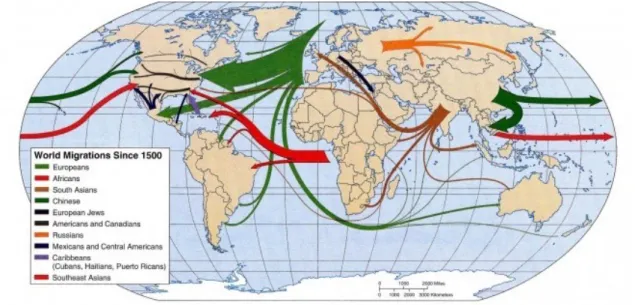
A map published on the website itsallaboutculture.com (see figure 2.4) shows patterns of human migration around the world since the 1500s. In fact, the patterns outline a transnational movement of people, which has gone in a multitude of directions. The most evident pattern being the one depicted by the green arrows showing a migratory pattern from Europe to the New World, more specifically the continents of North and South America, Australia (possibly due to colonization) and towards Asia (possibly due to the discoveries period). A second significant migratory pattern is illustrated by the red arrows leaving the western coast of Africa in the direction of the again, the New World, which most likely depicts the history of slave trade as well as later moves due to emigration from Africa to America. A third migratory pattern, depicted by the burgundy arrows, is that of the South Asians towards Australia, the United Kingdom, South Africa, the US and Canada. This latter pattern could be explained by the historical political and economic connection, which these countries have with the East India Trading Company and later, the British Commonwealth. Additional patterns include the move of the Chinese, the Southeast Asians and the Russians towards the east; the European Jews’ move towards the south most likely caused by their persecution during WWII; the move of Central Americans, Mexicans and Caribbeans towards North America; and finally, the move west of Americans and Canadians within their own countries. These migratory patterns are probably best known as historical migrations but the question is whether these are still happening today. If in fact they are, have they remained the same or have they been altered? In what ways?
Figure 2.4 Map of world migrations since 15008
To answer this question, one can refer to data which the World Bank published in 2010 and which the IOM while working alongside the company Locus
Insight has used to develop an interactive application called Where We’re From9,
an application that allows the user to trace and visualize the movement of people from one country to another. It is extraordinary to visually witness the comings and goings of people around the world. Upon consultation of this interactive application the user can choose a specific country by clicking on the map and literally visualize the numbers for “outward migration”, people leaving the country, or for “inward migration” people coming into a chosen country. The symbols used are colored circles each representing up to 20,000 migrants, which as the “move” occurs cluster into a country or spread out across the world. For instance, after clicking on inward migration and on the USA, a quick reading of the graph shows that according to the data presented by the IOM there are 176,694 emigrants from Portugal, 11,635,995 emigrants from Mexico and 6,150 from the Republic of Congo. On the other hand, once I clicked on outward migration and on Portugal the circles that emerged to represent Portuguese emigration spread out across a number of countries, including: Canada, the United States of America,
8 Source: http://itsallaboutculture.com/great-migrations-lecture-and-maps/
Mexico, Belize, Guatemala, Honduras, Nicaragua, Costa Rica, Panama, Venezuela, Ecuador, Peru, Brazil, Chile, Bolivia, Paraguay, Uruguay, Guinea Bissau, Guinea, Republic-of-the-Congo, Angola, Mozambique, Spain, France, Ireland, the United Kingdom, Belgium, Luxembourg, Germany, Netherlands, Switzerland, Italy, Norway, Sweden, Denmark, Check Republic, Austria, Hungary, Ukraine, Poland, Romania, Greece, Turkey, Cyprus, Lithuania, India, Japan, Thailand, Philippines, Australia and New Zealand. This illustration appears to confirm the old saying that the Portuguese are in all corners of the world.
Nevertheless, what the graph also shows is that the worldwide movement of people is not limited to Portugal or the United States of America. As Rystad argued, “One could reasonably claim that mankind’s entire history has been a history of migration.” (1992, p. 1169). Throughout history, the movement of people from one part of the world to another has been constant, whether due to wars, religions, including religious persecution, and last but not least weak and unpredictable economies. Nevertheless, it is relevant to point out as Rystad (1992) did Charles Tilly’s (1978, p. 62) list of the most influential causes of “long-distance migration” since the 1500s:
“1) the changing demographic distribution of employment opportunities; (2) demographic imbalances, alterations of regional differentials in natural increase; and,
(3) actions and policies of nation states; i.e., making war, expelling or relocating specific ethnic groups, controlling migration.”
(1992, p. 1169)
Regardless of the driving reasons and the worldwide migration of people has caused numerous alterations to national and transnational cultures and the languages spoken throughout the world, going as far as contributing, at times, to the linguistic death of some languages. For example, Crystal alerts the reader to the fact that one of the issues causing language loss, otherwise known as language death, is in fact “cultural assimilation” (2000, p.77). In other words an overbearing linguistic, cultural, economic or even military influence of a more dominant group over a weaker group. The worldwide push of English as a lingua franca can be an example, but so can the United States’ English as a second language programs which for many years were considered superior and more beneficial than bilingual
programs. Crystal (2000) points to yet another example, colonialism and its fatal impact on both Australian and North American indigenous languages.
Regardless of the impact, positive or negative, today’s events all over the world continue to contribute greatly to a continuous flow of migration. Confirmation of this is the data published by the Organisation for Economic
Co-operation and Development, otherwise known as the OECD, in conjunction with
the Agence Française de Développement (AFD) in Connecting with emigrants –a
global profile of diasporas, which states that, “International migration has risen
significantly in recent decades, from 77 million persons in 1960 to 214 million in 2010 – an increase of 177%” (2012, p.16). The OECD´s report also goes on to explain that part of the reason for this increase is that when compared to the not so distant past, there is a greater ease in migrating today due to the fact that a globalized world and further advances in technology, including new methods of communicating (2012, p.16) have diminished the price of immigration, both the economic cost of emigrating and the individual cost.
Nevertheless the patterns of emigration have undergone significant modifications. Whereas, the United States of America was for many years since the beginning of its colonization the sole country of choice for many emigrants, especially due to its promise to be the land of dreams and possibilities, today it is no longer an exclusive choice and definitely not the first for many who wish to emigrate. Furthermore, there are reports of Americans looking to settle elsewhere. Wood (2014)10 indicated that out of the 7.6 million Americans who in 2014 were thought to be residing outside of the US, nearly ¾ of them were contemplating on whether or not to give up their American citizenship. Hence, it is not a surprise when studies such as Kelo and Watcher’s (2004) suggest that there are alternatives to the less traditional options for those seeking to emigrate. Countries that were once the providers of emigrants have become those where immigrants now choose to settle. Portugal is one of these countries, especially for people looking to leave eastern European countries such as the Ukraine, as well as other parts of the world,
10
like China for example. This newer pattern may be best explained by Kelo and Wachter’s remarks, “Globalization is, as already its name suggests, a development affecting the whole world. It is also viewed as being driven in the main by economic forces. Next to globalization, regional integration is perceived as a major factor in migration. The prime example is the European Union …” (2004, p. 6). Remarks which can potential explain not only new migratory trends but also the underlying reasons for such trends.
Kelo and Wachter focus on a more recent phenomenon, the migration into the original European countries, an older European Union, within which the authors place Portugal. It is crucial to note the various types of migration described by Kelo and Wachter and the differences between them:
First of all, there is the differentiation into “forced” and “voluntary migration”. Refugees, seeking asylum or at least temporary shelter in another country as a consequence of armed conflicts, persecution or serious discrimination in their country of origin, are a typical case of “forced migrants”. “Labour market migration”, i.e. mobility for the purpose of employment, is one frequent form of voluntary migration. Second, there is the distinction between “permanent” and “temporary” migration. A foreign student would be a classical case of a temporary migrant, whereas a husband joining his wife (or vice versa) is expected to stay in the destination country and therefore thought to be permanent. There are, however, groups (growing in size) who do not clearly fall into either category: cross border commuters, for example, who continue to (formally) reside in their home country, but work in another. Seasonal workers are hard to classify, too. This is why some researchers have suggested the introduction of an intermediate category, that of “incomplete migration”. Third, there is the categorization into “legal” and “illegal immigration”. (2004, p. 15)
In fact, their study describes an international migration within the EU entailing all of the types of migration described above. However, this movement has suffered some modifications and consequently it has since the 1990s, with the entrance of additional countries into the European Union, been a movement of people from East to West.
As is evident from the above data migrant paths and the consequent numbers are relevant worldwide, it is for this reason and because immigration is something that is personal to me, that I have decided to embark on this study in an attempt to develop a deeper understanding of those who were courageous enough, desperate enough or simply forced to leave, and consequently leapt into the unknown certainties of a new place, a new culture and a new language. In doing so, I hope to gain an understanding of the development a bicultural, bilingual, transnational identity of the immigrant and his/her descendants, especially those who left Portugal for the United States of America during the second half of the 20th century. In order to do so, I will first look at how this phenomenon has played
out in two countries, the United States of America and Portugal and consequently, its effects on the people involved, their language (Portuguese and English) and their culture, one I will refer to as the Portuguese-American culture.
2.3 Portugal: Emigration and Immigration, an Historical Perspective
Portugal is not an outsider in the migratory cycle. In fact, Warrin and Gomes emphasize that, “for most of the past millennium the history of the Portuguese people has been intimately connected with migration … an early Portuguese diaspora that stretched virtually from one end of the globe to the other with well-established emigration patterns” (2013, p. 1 - 2). Likewise, Newitt (2015) describes the migrations of the Portuguese from the 15th century to the 21st century stating that, “over the centuries the idea of emigration has become deeply embedded in Portuguese culture” (2015, p.10). Yet, Feldman-Bianco narrates the migration of the Portuguese as follows, “ Ever since the era of seafaring exploration in the 15th and 16th centuries, the world – rather than the nation-state – has been the spatial unit for the Portuguese. Starting with the voyages of discovery and the colonizing of new lands and later (since the 19th century) continuing with labor migration, the movement of people across the globe has been constitutive of the Portuguese experience” (2009, p. 51).
The Portuguese have made the world their “home” and they are no strangers to recent migratory trends, in recent years much like other “old” European Union countries, Portugal has become a welcoming country, opening its doors to immigrant families from a variety of socio-cultural, linguistic and ethnic backgrounds. To clarify Portugal’s current situation within the realm of present day European migrations Kelo and Watcher pointed out that, “In the 1980s and 1990s, migration balances turned, for the first time, positive also in Finland, Ireland, and the United Kingdom (UK), followed by Greece, Italy, Portugal and Spain. Apart from the UK, these had all been traditionally emigration countries.” (2004, p. 33) Such migration patterns are not the traditional patterns many Portuguese were a part of during the 1800s and the early 1900s, when Portuguese emigration laws were characterized as being limiting and most definitely not encouraging (Leite, 1997). In fact, Maria Baganha recounts the years between 1975 and 1920 as years of increasing Portuguese governmental legal control (as cited in Newitt, 2005, p. 191). As Machado (2011) points out, despite the fact that Portugal went from being a country where emigration numbers dominated, to a country with increasing immigration numbers, emigration from Portugal never ceased. Subsequently, the Portuguese government saw the need to review and revise the laws that controlled all the migratory movement of the Portuguese and the foreigners, in other words entrances and exists, as well as those that regulated the residency and citizenship of foreigners.
In fact, there have been numerous social, linguistic and political changes in Portugal. For instance, in 2014 Migrant Integration Policy Index, a worldwide evaluation of integration policies of immigrants, ranked Portugal, second out of 38 countries, in the categories that analyze migrant labor market mobility and the reunification of migrant families. In its role as the host country, Portugal has become a country which opens its doors to welcome immigrants, regardless of whether these immigrants are looking for a temporary or a permanent home or whether they have come to Portugal voluntarily or involuntarily depending on the specific situation in their country of origin. Baganha and Góis (as cited in Machado, 2011) pointed to 1981 as the turning point in Portuguese immigration due to significant legal alterations, namely law 264-B/81, which made Portuguese legislation more similar to that of other EEC (European Economic Community)
countries, followed by further legal changes in 1998, 2001, 2003, 2004, 2007 (Machado, 2011). Such legal alterations, according to Baganha and Gois allowed Portugal to become more European and move away from the dictatorship State it had been. As Baganha and Marques explain it was only after the 1974 Revolution and the decolonization process that followed it that the number of foreigners living in Portugal increased to a annual average of about 12.7%, of which by 1980 out of the 58,000 foreign residents living in Portugal, 48% were from Africa, 31% were from Europe and 11% from were from South America (2001, p. 15).
Consequently, as the years have passed as a host country Portugal has seen the number of foreign residents increase. According to data published by Portugal´s Borders and Immigration Service (SEF), there were 332,137 authorizations for residency issued in 2006, a number which highly contrasts to that of 1980 when a mere 50,750 authorizations were issued. More recently, in 2013 the number of residency approvals approved rose yet again to 398,268 (see Table 2.3).
Table 2.3
Foreign Population Residing in Portugal in 2013
Distritos Total TRs VLDs H M Total Nacional 401.320 398.268 3.052 195.544 205.776 Aveiro 12.566 12.489 77 6.067 6.499 Beja 6.781 6.777 4 3.858 2.923 Braga 9.280 9.124 156 4.392 4.888 Bragança 2.282 2.266 16 1.163 1.119 Castelo Branco 3.009 2.959 50 1.530 1.479 Coimbra 11.387 11.082 305 5.622 5.765 Évora 3.702 3.679 23 1.897 1.805 Faro 58.839 58.743 96 29.264 29.575 Guarda 1.794 1.788 6 916 878 Leiria 15.076 15.054 22 7.559 7.517 Lisboa 176.963 175.509 1.454 85.472 91.491 Portalegre 2.715 2.713 2 1.333 1.382 Porto 23.701 23.428 273 11.044 12.657 Santarém 12.509 12.496 13 6.265 6.244 Setúbal 41.711 41.518 193 19.563 22.148 Viana do Castelo 2.994 2.988 6 1.509 1.485 Vila Real 2.140 2.138 2 1.015 1.125 Viseu 4.428 4.427 1 2.333 2.095 Açores 3.614 3.289 325 1.845 1.769 Madeira 5.829 5.801 28 2.897 2.932
Note: Adapted from http://sefstat.sef.pt/distritos.aspx (February 27, 2015); TRs ares residency titles; VLDs are long term visas; H = men; M = Women
Furthermore, the data presented by SEF (Borders and Immigration Service) and corroborated by Machado et al. (2010) for the years between 1980 and 2008 show an increase in immigration to Portugal. More specifically by 1980 a significant number of European Union nationals were residing in Portugal as seen in Table 2.4, the largest group originating from Romania with 27,410 individuals, while the smallest originated from Cyprus with a mere 8 individuals (Machado et al., 2010, p. 54).
Table 2.4
European Union Nationals Resident in Portugal in 2008
Foreigners (total) 443,102 Europe (total) 168,203 EU-27 84,727 Austria 422 Belgium 1,560 Bulgaria 6,456 Cyprus 8 Czech Republic 203 Denmark 432 Estonia 79 Finland 354 France 4,576 Germany 8,187 Greece 139 Hungary 333 Ireland 616 Italy 3,915 Latvia 240 Lithuania 505 Luxembourg 124 Malta 17 Poland 925 Romania 27,410 Slovakia 173 Slovenia 44 Spain 7,220 Sweden 1,058 The Netherlands 4,360 United Kingdom 15,371
Note: Adapted from INE (Statistics Portugal) and SEF (Borders and Immigration Service) as cited in Machado et al., 2010, p. 54.