(Annals of the Brazilian Academy of Sciences) ISSN 0001-3765
www.scielo.br/aabc
Interdisciplinary paleovegetation study in the Fernando de Noronha Island
(Pernambuco State), northeastern Brazil
LUIZ C.R. PESSENDA1, SUSY E.M. GOUVEIA1, MARIE-PIERRE LEDRU2, RAMON ARAVENA3, FRESIA S. RICARDI-BRANCO4, JOSÉ A. BENDASSOLLI5, ADAUTO DE S. RIBEIRO6,
SORAYA E.M.G. SAIA1, ABDELFETTAH SIFEDDINE2, ELDEMAR DE A. MENOR7, SÔNIA M.B. DE OLIVEIRA8, RENATO C. CORDEIRO9, ÂNGELA M. DE M. FREITAS10,
RENÉ BOULET8, HELOISA F. FILIZOLA11
1Laboratório de Carbono 14, CENA/USP, Av. Centenário, 303, Caixa Postal 96, 13400-970 Piracicaba, SP, Brasil 2Institut de Recherche pour le Développement, 32 avenue Henri-Varagnat, F-93143 Bondy Cedex, France
3Department of Earth and Environmental Sciences, University of Waterloo, 200 University Avenue
Waterloo, Ontario, Canada N2L 3G1
4Departamento de Geologia e Recursos Naturais, Instituto de Geociências, UNICAMP
Caixa Postal 6152, 13083-970 Campinas, SP, Brasil
5Laboratório de Isótopos Estáveis, CENA/USP, Av. Centenário, 303, Caixa Postal 96, 13400-970 Piracicaba, SP, Brasil 6Universidade Federal de Sergipe, Centro de Ciências Biológicas e da Saúde, São Cristóvão, 49100-000 Aracaju, SE, Brasil
7Universidade Federal de Pernambuco, Departamento de Geologia, Avenida Ramos s/n, 50749-530 Recife, PE, Brasil 8Instituto de Geociências, USP, Rua do Lago, 562, 05508-080 São Paulo, SP, Brasil
9Universidade Federal Fluminense, Departamento de Geoquímica, Morro do Valonguinho
Outeiro São João Batista, 24020-007 Niterói, RJ, Brasil
10Universidade Federal Rural de Pernambuco, Rua Dom Manoel de Medeiros s/n, Dois Irmãos, 52171-900 Recife, PE, Brasil 11Embrapa Meio Ambiente, Rodovia SP 340, km 127,5, Caixa Postal 69, 13820-000 Jaguariúna, SP, Brasil
Manuscript received on December 3, 2007; accepted for publication on April 4, 2008; presented byKENITIROSUGUIO*
ABSTRACT
The aim of this research was to reconstruct vegetation changes (with climate inferences) that occurred during the Holocene in the Fernando de Noronha Island, Pernambuco State, northeastern Brazil. The research approach included the use of geochemical (mineralogy, elemental), carbon isotopes (δ13C,14C) and pollen analyses in soil organic matter (SOM) and sediments collected in Lagoa da Viração and Manguezal do Sueste. The carbon isotopes data of SOM indicated that there was no significant vegetation changes during the last 7400 BP, suggesting that the climate was not the determinant factor for the vegetation dynamics. The pollen analysis of the sediment of a core collected in the Lagoa da Viração showed the absence of Quaternary material in the period between 720 BP and 90 BP. The mineralogical analysis of deeper layer showed the presence of diopside indicating this material was developed “in situ”. Only in
the shallow part of the core were found pollen of similar plant species of the modern vegetation. The geochemistry and isotope results, in association with the sediment type and pollen analyses of sediment samples of Manguezal do Sueste, indicated variations in the vegetation and in its location since the middle Holocene. Such variations can be associated with climatic events and sea level oscillations and also with anthropogenic events considering the last five hundred years.
Key words:pollen, carbon isotopes, paleovegetation, Fernando de Noronha, Holocene.
*Member Academia Brasileira de Ciências Correspondence to: Luiz Carlos Ruiz Pessenda E-mail: [email protected]
INTRODUCTION
sta-ble and perennial lakes and the aridity of the climate. However, the few studies that were carried out in conti-nental areas in this region have shown important changes in vegetation and climate during the late Quaternary. The most common research tools used in these studies in-clude pollen, carbon isotopes and geochemical analyses (De Oliveira et al. 1999, Ledru et al. 2001, Sifedddine et al. 2003, Pessenda et al. 2004, 2005a, b). Sometimes such climatic variations were also linked with sea level dynamics (Suguio et al. 1985), as observed in the stud-ies on emerged shorelines and superbly preserved coastal deposits along the Rio Grande do Norte State (Bezerra et al. 2003).
This paper describes a study aiming to reconstruct the vegetation and climate changes that eventually oc-curred during the Holocene in Fernando de Noronha Is-land, Pernambuco State, northeastern Brazil. The paleo-enviromental changes were reconstructed based on pol-len (sediments only), geochemical and isotope analysis in soils collected in various locations representative of the different vegetation communities and sediments col-lected in a lake (Lagoa da Viração) and in a mangrove (Manguezal do Sueste).
STUDY AREA
The Archipelago of Fernando de Noronha is formed by 21 islands and islets, with a total area of 11,270 ha, being Fernando de Noronha the main island (IBAMA 2005) (Fig. 1). In the Table I are showed the sampling points and respective geographic coordinates.
The climate of the area is tropical (Awi of Köppen classification system) influenced by the Atlantic Ocean. The annual average temperature is around 25◦C and the total annual precipitation is around 1400 mm with great inter annual variability. There are two seasons well-marked, being the humid period from March to July and drier from August to January. In relation to the relative air humidity, there is great uniformity during the whole year, with values oscillating around 85% in the rainy and 81% in the dry period (M. Batistella, unpublished data). The flora, characteristic of island environments is poor in species. This pattern is caused by the isolation of the near continent due to the winds and currents dynam-ics, relative geomorphologic homogeneity and semi-arid climate (M. Batistella, unpublished data). The
coloniza-tion of the vegetacoloniza-tion probably begun in the Pleistocene, since the volcanism that created the archipelago would have finished about 1,8 Ma approximately (Teixeira et al. 2003).
The Lagoa da Viração, enclosed for native vegeta-tion and covered by aquatic plant (Pistia stratiotes) is located between the Praia do Leão and Ponta da Sapata about 20 m above the mean sea level (Fig. 1, Table I). The water column is around 1.50 m in the central part of the lake.
The plain is limited by a cliff of approximately 100 m, formed by basalt sills intercalated by layers of piroclastic materials (ashes and volcanic blocks), practi-cally establishing a complete isolation of the area. The dense vegetation and the geological setting are responsi-ble for a natural geomorphologic protection and preser-vation of the lake. The terrestrial input is reduced, due to the predominance of a diffuse pluvial drainage system that permeates through a relatively dense surrounding vegetation (A.S. Moraes, unpublished data).
An important climatic factor that influences the vegetation covering of the Archipelago is the constant wind. The trade winds with direction ESE reach mainly the windward face, where it is located the Sueste bay (Fig. 1) and Manguezal do Sueste (Table I).
The vegetation of Manguezal do Sueste is only com-posed byLagunculariasp. and it represents one of the only places of the occurrence of this species in oceanic islands of the South Atlantic Ocean. The trees are 7 m tall on average. During the Holocene they occupied a larger area, being considered today as a relic of earlier periods (M. Batistella, unpublished data).
Concerning the hydrology, the Maceió River is the main water body of the island that was feeding be-fore the Manguezal do Sueste. At present, the river ends in the Xaréu reservoir. The remaining bodies of water are of moderate dimensions, being all intermittent ones, drying quickly at the end of the rainy season.
MATERIALS AND METHODS
VEGETATION
Fig. 1 – Archipelago of Fernando de Noronha showing the location of Lagoa da Viração (modified from Ulbrich et al. 2004). The Manguezal do Sueste is located in the Baía do Sueste. The geographic coordinates of soil sampling points are shown in the Table I.
height of the chest) is larger than 20 cm. Four structural parameters were analyzed for the characterization of the vegetation: CAP, height of the fork, total height of the trees and the distance among the closest trees. A botan-ical identification of the dominant species was also made around the Lagoa da Viração.
SOILS
The soil is shallow with great amount of stones on the surface soil and is classified as Haplic Cambisol. The soil sampling was performed in a trench and by a hand auger. Information about the sampling sites is found in Table I.
For the14C dating of the soil organic matter (SOM), samples of approximately 5 kg were collected each 10 cm from a 300 cm deep trench. Soil samples for isotopic determination (δ13C) were collected by drilling,
dried at 60◦C up to constant weight and sieved to 0.210 mm before analyses.
Grain size analyses were carried out at the Soil Sci-ence Department of the Escola Superior de Agricultura “Luiz de Queiroz” (Piracicaba, Brazil) using the den-simeter method (Kiehl 1979) and the results are reported as clay percentage.
The mineralogical composition of the soil from the trench at Morro da Quixaba was qualitatively determined by X-ray diffraction. An estimate of the relative amounts of the present minerals was made by comparison of the height of the characteristic picks of the minerals. The equipment used was a Siemmens D5000 of the X-Rays Diffraction Laboratory of the Geosciences Institute, Uni-versity of São Paulo (São Paulo State).
The total organic C and13C analyses were carried out at the Stable Isotopes Laboratory of CENA (Piraci-caba, Brazil). The results are expressed in percentage of dry weight and “δ” units (◦/◦◦), respectively. Theδ
TABLE I
Study sites in Fernando de Noronha. Sampling
Region Geografic Altitude Collected
points coordinates (m) material
Trench Morro 3
◦52’01.0”S
170 Soil
da Quixaba 32◦26’57.4”W and plant
LV Lagoa 3
◦52’13.5”S
23 Sediment da Viração 32◦26’53.5”W and plant
Sancho (1) 3
◦51’38.8”S
60–70 Soil
32◦27’8.3”W
Sancho (2) 40 m upstream ∗ 60–70 Soil
of Sancho (1)
Sancho (3) 30 m downstream ∗ 60–70 Soil
of Sancho (1)
Ilha Rata 3◦49’10.2”S 30 Soil
32◦23’31.7”W
Atalaia 3◦51’32.4”S Sea level Soil
32◦24’44.7”W
Praia do Leão * Sea level Soil
MPO Mata da 3
◦52’33.5”S
100 Soil
Ponta Oeste 31◦27’22.8”W
SE Mangue do 3
◦51’56.4”S
Sea level Sediment Sueste 32◦25’31.8”W
∗not collected.
PDB, with analytical precision of±0.2◦/◦◦ (Pessenda et
al. 2004, 2005a).
For 14C dating, the soil humin fraction was iso-lated by physical and chemical pre-treatments (Pessenda et al. 1996) and the14C dating carried out at the Isotrace Laboratory in Toronto, Canada, through AMS (Accel-erator Mass Spectrometry). The14C ages are presented in years BP (before present) normalized to a δ13C of −25◦/◦◦ PDB and in cal yr BP (Stuiver et al. 1998). The
14C dating in years BP will be use for the presentation and discussion of the results.
SEDIMENTSAMPLES
A 72 cm sediment core was sampled in the central re-gion of Lagoa da Viração and a 220 cm sediment core in the Manguezal do Sueste using a vibracorer (Martin and Flexor 1989) and a 3-inch diameter aluminum tube. After opening and macroscopic description of the sedi-mentary deposits at the Geochemistry Laboratory of Federal Fluminense University (Niterói, Brazil), samples were collected in plastic cubes of 2 cm3in 2 cm intervals
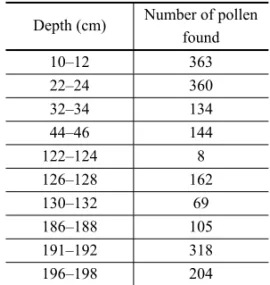
for pollen, geochemistry and mineralogical analyses. The chemical treatment of the samples followed the methodology of Faegri and Iversen (1989), with identification using a microscope Carl Zeiss Axioskop 40 and comparison with reference pollen atlas and with pollen collection done for this study. From fifteen sam-ples of Manguezal do Sueste, were studied those cor-responding to the striped intervals in the Table II, since they presented larger possibility to contain palinomorphs after the chemical preparation.
About 100 mg of chemically pre-treated (HCl 4%) sediments samples were sent to the Environmental Iso-topes Laboratory of the University of Waterloo, Canada, for elementary (C, N) and isotopic (δ13C) determinations
that were performed in a Carlo Erba analyzer coupled to a mass spectrometer Optima. The results are expressed in percentage of dry weight and in the relative “δ” unit
(◦/
◦◦), determined in relation to the international
stan-dard PDB for13C.
TABLE II
Studied intervals×number of pollen found.
Depth (cm) Number of pollen found
10–12 363
22–24 360
32–34 134
44–46 144
122–124 8
126–128 162
130–132 69
186–188 105
191–192 318
196–198 204
remains, etc.) and treated later with HCl 4% for 5 h at 80◦C. After successive washes (up to pH 5) with deion-ised water and drying to 60◦C for 48 h, the samples were combusted and the purified CO2sent to the Isotrace Lab-oratory, University of Toronto, Canada, for AMS dating. The mineralogical composition of the sediments was determined at the X-Ray Diffraction Laboratory at the Institute of Geoscience of USP (São Paulo, Brazil) using the equipment Siemmens D 5000.
RESULTS AND DISCUSSIONS
VEGETATION
Four physiognomic units of vegetation were observed in the area of Lagoa da Viração: (i) cliff vegetation, which was defined by the distribution of windward species, with the dominance of C4 grassPaspalum paniculatum – Poaceae; (ii) coastal area vegetation represented by the presence of insular Cactus, (iii) interior areas vege-tation characterized by the presence of species arboreal-shrubs (3 to 5 m of height) and a thin herbaceous substra-tum with little regeneration and Cactus dominance and (iv) quite altered forested areas, formed by tree strata. The lake is covered completely by Pistia stratiodes (Araceae) giving its green coloration, while in their mar-gins the vegetation reaches up to 25 m height. The dif-ficult access to the area seems to preserve the forest for-mations (Gouveia et al. 2005).
The riparian vegetation of the lake extend up to
∼40 m of their margins, presenting an arboreal
gradi-ent with dossal, sub-dossal and thin herbaceous stratum with little regeneration. The dossal was characterized by the dominance ofTabebuia roseoalba (Bignoniaceae), representing 53.6% of sampled trees in 16 quadrants of 25 m2. The
Erythrina velutina (Fabaceae) represents 17.9% of the trees and the abundance in the area was of 22.3%, while the Capparis cynophallophora (Cap-paraceae), with 14.3% of the total of the dossal trees, occurred in 18.7% of the quadrants. The arboreal stra-tum presented the medium height of 12.5±5.0 m, with
variance of 24.5 m for the trees (Gouveia et al. 2005). In the herbaceous-shrub stratum of the forest it was observed the predominance ofCapparis leafy (frondosa) – Capparaceae (87.5%), while the frequency ofC. cyno-phallophorawas estimated in 25%. These two species are present in all forests of the island and now they serve as forage for the cattle. The presence ofPistia stratiodes in 18.8% of the sampled area indicates that the level of the water is variable, maintaining the quite humid mar-gins, making possible the survival of that species. The arboreal speciesErythrina velutinaandTabebuia roseo-albapresented regeneration in 31.2% and 12.5% of the sampled area, indicating an important dispersion of these species (Gouveia et al. 2005).
Lagunculariawas the only tree of the Manguezal do Sueste. In the immediate surroundings the follow-ing trees have been identified: Senna(Caesalpiniaceae), Capparis cynophallophora (Capparidaceae), Sapium (Euphorbiaceae),Canavalia(Fabaceae),Leucaena (Mi-mosaceae) and harbaceous plantsMitra(Rubiaceae), Es-tactafeta(Verbenaceae),Desmodium(Fabaceae), Ama-ranthaceae and some ruderals of the family of the Eu-phorbiaceae and Turneraceae (Pessenda et al. 2005b).
SOILS
The soils presented clay content higher than 50% and the general tendency is a decreasing of the carbon con-centration with increasing depth, varying from 1 to 3% in the surface to values around 0.3% at about 300 cm (Gouveia et al. 2005).
the soil profile and at the surface the smectite disappears, probably transformed in kaolinite (Oliveira et al. 2005). The 14C dating of soil samples showed ages of 7380±80 BP at the 220–210 cm depth interval and
5730 ±70 BP at 130–120 cm depth interval (Fig. 2
and Table III). Similar 14C dates were obtained for the humin fraction at similar soil depths in distinct soils and locations in Brazil (Gouveia et al. 2002, Pessenda et al. 2001, 2004, 2005a).
The isotopic (δ13C) values of SOM of the shallow
layers characterized the vegetation cover of each study site (Fig. 2). In the locations, Sancho, Ilha Rata and MPO and in the trench at Morro da Quixaba (Table I), the data between –25◦/
◦◦ and –25.8◦/◦◦ indicate the
presence of an open arboreal vegetation dominated by C3 plant type, while in the Praia do Leão and Atalaia, the δ13C values of∼–19◦/◦◦ indicates a mixture of C4
and C3 plants. No significant δ13C changes were ob-served with depth in the locations currently colonized by C3plants, excepting at sites Sancho 3 and Ilha Rata where enriched values as –23% were observed in part of their13C record (Fig. 2). This pattern suggests that C4 plants started to colonize these locations probably during a drier period. The sites represented by a mix-ture of C3 and C4 plants, with the exception of a value of –16.5◦/
◦◦ in the deepest sample at Atalaia site, do
not show also significant changes with depth (Fig. 2) in-dicating the vegetation communities have not changed in the period of the last 300 years represented by the record.
Despite that significant vegetation changes have not been observed in the Fernando de Noronha archipelago, evidence for climate changes in the northeastern region of Brazil have been documented in studies carried out in continental areas. In a peat bog in the Icatu River valley in the semi-arid region of Bahia State, it was documented vegetation and climate changes during the last 11 ka BP (De Oliveira et al. 1999), with a humid period during the early Holocene, becoming progressively drier during the Holocene. In the northernmost region, the vegetation is scarce and open at the beginning of the Holocene, chang-ing progressively toward a woody savanna (Behlchang-ing et al. 2000, Ledru et al. 2001). At Lagoa do Caçó, Maranhão State, a dry period until 7000 cal BP (c. 6 ka BP) was observed despite the gradual increase in lake water level
inferred from sedimentological and geochemical analy-sis (Sifeddine et al. 2003). In the same region, Pessenda et al. (2005a) attested that carbon isotopes were good indicators for regional paleonvironmental reconstruc-tions and show a similar overall pattern of changes to the pollen records, as a drier early/mid Holocene period than the late Pleistocene period, and a consequent woody savanna vegetation expansion in the region.
LACUSTRINEMATERIAL OFLAGOA DAVIRAÇÃO
The14C dating indicated that the core material repres-ents the last 750 years. The 14C dates obtained were 720±60 BP for layer 72–70 cm, 390 ±50 BP for
52–50 cm and 90±50 BP for 32–30 cm (Fig. 3 and
Table III).
The pollen content generally reflect the local veg-etation. The main tree species that grow in this area, CapparisandErythrina, are represented on the diagram (Fig. 4). However, Bignoniaceae Tabebuia roseoalba very abundant as a plant (53%) is never represented in the pollen spectra. One explanation could be the ento-mophilous dispersion of the pollen grains but the same characteristic is also observed for Capparis and Ery-thrinawhich are identified in the pollen content. At the moment we do not have any argument to explain this result.
Based on differences in pollen spectra, two pollen zones could be distinguished (Fig. 4). One at the bot-tom of the record, between 60 and 28 cm depth and the second one at the top of the record, between 18 and 0 cm depth.
Fig. 2 – Isotopic values (δ13C) in relation to soil depth collected in distinct locations at Fernando de
Noronha and respective14C ages of charcoal fragments(∗)and humin fraction(∗∗).
TABLE III
14C dating of charcoal fragment, soil organic matter and sediment samples from Lagoa da Viração e Manguezal do Sueste.
Sample Location Depth (cm) 14C Age 14C Age (BP) (cal BP) Charcoal fragment Atalaia 50–60 290±50 280–490
SOM (Humin) Morro 120–130 5730±70 6390–6680 da Quixaba 210–220 7380±80 8030–8360
Lagoa 30–32 90±50 10–150
Sediment
da Viração 50–52 390±50 420–510 70–72 720±60 620–740
Sediment
28 Modern 1958*
46 Modern 1959*
Manguezal 132–134 440±50 430–540 do Sueste 138–140 710±50 630–730 191–192 1930±50 1770–1990 214–216 4240±60 4780–4970
70 60 50 40 30 20 10 0
0 10 20 8 12 16 -30 -25 -20
gray clay with green stains gray clay
dark organic clay
Age (
14 C
yrB P)
720 ± 60 390 ± 50 90 ± 50
TOC (%)
Dep th(c
m) δ13
C (‰) C/N
Sed ime
ntLo g
10 20 30 40 50 60 70
-35 -30 -25 -20 -15 -10
δ
1
3 C
(‰
)
Lacustrine Algae C
3Land Plants
C
4Land Plants
C/N
Fig. 3 – Sediment log,14C dating, (a) total organic carbon, (b) C/N ratio, (c)δ13C and (d) C/N×δ13C diagram
(modified from Sifeddine et al. 2004) of sediment samples of Lagoa da Viração.
sediment deposition with capacity for a good pollen pre-servation. The pollen of the Pontederiaceae Pistia is generally destroyed by the chemical treatment when sep-arating pollen from the sediment and therefore could not be observed in this record.
re-Fig. 4 – Pollen percentage diagram of Lagoa da Viração showing selected taxa. The pollen sum includes arboreal and non-arboreal pollen taxa. Values smaller than 1% are represented by the “+” sign.
lation to the mineralogy of the soil from the trench lo-cated upslope, mainly for the layer (70–32 cm), indicate that probably this material is a rock alteration material produced in relatively confined environment (Oliveira et al. 2005).
The total C results showed very low values between 0.32% and 0.63% in the deeper layer (70–32 cm) and an increase in the carbon content reaching values as high as ∼ 17% is observed in the shallow layer (Fig. 3a).
The values of the C/N ratio varied from 10.7 at the deeper layer to∼8 at 32–30 cm, characterizing a
pre-dominance of aquatic plants, probably algae in the or-ganic matter of the sediment. Then, a trend to higher values reaching 16.3 is observed in the shallow part of the sediments (Fig. 3b). This gradual increase from∼8
to∼16% and the increase in carbon content is probably
due to a more significant contribution of organic mate-rial from C3 plants (Pistia stratiotes) in the sedimenta-tion of the lake during the recent history of the lake. The contribution of a more recent organic carbon source to the sediments is also observed in theδ13C profile. The δ13C data (Fig. 3c) are characterized by values around
–22.1◦/
◦◦ in the interval 70 to 32 cm, and then a trend
toward more depletedδ13C is observed in the shallow
part of the profile reaching values of∼–27.6◦/◦◦ in the
shallow layer, which is very similar to the δ13C value
found for thePistiaaquatic plant (–28.5◦/◦◦). The
re-lationship among C/N ratio andδ13C values also
indi-cates a mixture of aquatic plants, algae and C3 plants (Meyers 2003) in the composition of the sedimentary organic matter of the lake core (Fig. 3d). The low or-ganic carbon and the poor preservation of the pollen ob-served in the lake core indicated the lake was dry dur-ing the dry season allowdur-ing the oxidation of the organic matter. The recent history is controlled by the influ-ence of Pistia stratiotes, a specie probably introduced by man in the study area.
MANGUEZAL DOSUESTE
Sediment type,14C dating, pollen data and mineralogy
The sediment stratigraphy as well as the AMS14C data are presented in the Figure 5 and Table III. The sedi-ments are composed of sand mixed with shells in the deeper part of the profile, changing to mainly sand in the interval 170 and 45 cm. Then, a change to organic-rich clay is observed in the shallow part of the profile. This pattern is indicative of depositional changes from a high energy to a low energy environment. 14C ages of 4240±60 BP and∼ 2000±50 BP were obtained in
the base of the core (at 216–214 cm) and in the depth of 192–191 cm. The14C ages obtained for the layers 140– 138 cm and 132–130 cm (organic sandy material) were 710 ±50 BP and 440 ±50 BP, respectively. These
Fig. 5 – Sediment log,14C dating, (a) total organic carbon, (b) C/N ratio and (c)δ13C values of
Three levels, 191–192 cm, 22–24 cm and 10–12 cm, presented sufficient amount of pollen (>250) for more
detailed pollen analysis (Table II, Fig. 6).
In addition to the identified pollen taxa, well-pre-served and abundant fragments of cuticles, spores of fungi, algae, some dinoflagellates cysts were found. Folded and fragmented pollens, probably evidencing transport were also found and in the interval 122– 124 cm; an organic foraminifer test was also identified. A total of 52 pollen types belonging to 21 angiosperms families and one gymnosperm (Ephedraceae) were iden-tified (F. Ricardi-Branco, personal communication, Pes-senda et al. 2005b).
In spite of the shortage of pollen in most of the studied levels, it was possible to have a general idea about the dynamics of the vegetation. The studied sam-ples were divided in two time intervals:∼2000–440 BP
and 440 BP to the present. In the interval 222 cm (4240 BP) up to 194 cm (>2000 BP) the sediment material
was constituted of thick and medium sand with shells, probably indicating that the current place of the man-grove was a beach. In such case, the sea level probably was above the present level and the mangrove located more into the interior of the island. A significant in-crease in the sea level reached a maximum at∼5460 cal
BP in the central Brazilian coast (Suguio 1993) and a rel-atively rapid sea level rise occurred at∼5000 cal BP to ∼4 m and induced an overall coastal retreat in the
re-gion of Rio Grande do Norte State, northeasthern Brazil. Sea level fell immediately and eventually rose again about 2100-1100 cal BP, resulting in a second coastal retreat in the Holocene (Bezerra et al. 2003). These events can be connected with the dynamic observed for the Manguezal do Sueste around 4240 BP (4780–4970 cal BP) and 1930 BP (1770–1990 cal BP).
Interval ∼2000–440 BP. Pollen of the families
Alis-mataceae, Cyperaceae, Amaranthaceae, Amaranthaceae/ Chenopodiaceae and Araceae were found in the inter-val 198-196 cm representing an age>2000 BP. These
pollen can be considered as belonging to the vegeta-tion that inhabited the surroundings of the mangrove. It was also identified pollens of Convolvulaceae (Evolvus andIpomea), Euphorbiaceae (SapiumandEuphorbia), Moraceae (Ficus), and Combretaceae (Laguncularia), associated to modern vegetation found in Noronha, not
introduced with the colonization, and indicating the presence of the mangrove in the same place on that time. In the following interval (192–191 cm) it was found the same families than the previous interval and the first reg-istration of Arecaceae and Ephedaraceae, possibly trans-ported by the wind or by the Maceió River.
In the interval 186–180 cm, a decreasing in the number of pollen taxa was observed, being registered the families Alismataceae, Amaranthaceae/Chenopodia-ceae, CyperaAmaranthaceae/Chenopodia-ceae, Poaceae and the absence of pollens of Laguncularia, possibly due to the diminishing of man-grove area, probably associated with the sea-level rise observed in the Rio Grande do Norte coast during the period 2100–1100 cal BP (Bezerra et al. 2003), al-though were registered for the first time pollen of the familiesBombacaceaeandFabaceae(Erythrina).
Interval 440 BP–Present. Pollen of Amaranthaceae/ Chenopodiaceae, Araceae, Convolvulaceae (Ipomea), Cyperaceae, Moraceae (Ficus) and Poaceae were found in the interval 132–130 cm. Pollen of Amaranthaceae/ Chenopodiaceae, Araceae, Convolvulaceae (Ipomea), Cyperaceae, Euphorbiaceae (Euphorbia), Moraceae ( Fi-cus) and Poaceae and the first appearance of Cappa-raceae (Cleome), Rubiaceae, Malvaceae and the genus Jatropa(Euphorbiaceae) were found in the interval 128– 126 cm. As in the previous level, pollen of Laguncu-laria were not registered. In the sample collected in the interval 124–122 cm were found only 8 pollens of Poaceae. In the intervals 46–44 cm, 34–32 cm and 24– 22 cm (modern history) were found the families regis-tered in the previous layers, the reappearance of Lagun-culariaand for the first time registered pollens of Cas-sia (Caessalpinaceae), Tabebuia (Bignoniaceae), Leu-caenaand Desmonthus(Mimosaceae), Ludwigia (On-agraceae), Cupania (Sapindaceae), Walteria (Stercula-ceae), Solanaceae,Nyctagina (Nyctaginaceae), Malva-ceae,Jasminum(Oleaceae), Verbenaceae and of the gen-era Desmodium, Crotalaria and Andiroba (Fabaceae) andCapparis(Capparaceae). Considering the presence of these pollens, it is possible to deduce that the man-grove was located in its current position.
age in most of the studied layers can be explained by the influence of several factors such as: direction of the winds, reduced area of the island, poor flora and oscilla-tions in the dimensions of the mangrove, connected with variations in the sea level, probably associated to more arid phases. During these dry periods, the Maceió River is the main source of pollen transportation from the is-land flora for the mangrove, it might have dried. How-ever, an additional cause of the lower pollen is related to the high energy of deposition linked to the Maceió River, which was the main source of water to the mangrove for most part of his history.
Isotopic and geochemistry data
For most of the record, the organic carbon content (Fig. 5a) is very low with values less than 1%. A similar pattern is observed in the C/N ratios (Fig. 5b), that is character-ized by values lower than 10. Theδ13C profile (Fig. 5c)
also showed most of theδ13C values are around –22◦/◦◦.
There are some exceptions below 45 cm where the C and C/N ratios tend to increase and theδ13C values tend
to decrease. For example, in the depth interval 138– 136 cm (∼ 600 BP) to 134–132 cm (∼ 400 cm), there
is an increasing in the concentration of total organic C (1.14% to 2.43%), in the C/N ratio (9.4 to 13.5) and an isotopic depletion (–22.7◦/
◦◦ to –24.8◦/◦◦ ),
proba-bly indicating a significant input of organic material of C3plant origin probably from an external source. Con-sidering the small number of pollens (Table II) and the identified species in the layer 132–130 cm, for this pe-riod there is no indication of the presence of a mangrove at the site. The greater changes are observed on the more recent part of the profile where a significant increase in the carbon content and C/N ratios and a depletion of theδ13C values from –23.5◦/◦◦ to –27.8◦/◦◦ are
docu-mented. These patterns are accompanied by a change in the lithology from high energy sediments (sand) to low energy sediments (dark organic clay). The pollen anal-yses in the recent sediments correspond to the modern mangrove vegetation at the site (Table II). The trend of increasing C/N and decreasingδ13C values indicates an
input of organic matter of different origin probably from the mangrove trees that are C3type plants (Meyers 2003). The variations observed in the different proxies used in the study probably are associated with climatic
events and considering the last hundreds of years, with anthropogenic aspects, in addition to sea level oscilla-tions. The influence of the sea level changes is observed in the sediments rich in shells deposited at the site at least 4500 years ago. The presence of the sand units re-flect the influence of the river and the organic rich clay are linked to the construction of a river dam that reduced the input of water from the river watershed. The lack of pollen in most of the record could be also related to oxidation during the river low flow condition during the dry season.
CONCLUSIONS
Based on results obtained in the soils of Fernando de Noronha and in the record of Lagoa da Viração and Manguezal do Sueste it was concluded that:
1. The climate changes that occurred during the Holo-cene in the northeastern region of Brazil did not affect significantly the vegetation cover in distinct locations in the Fernando de Noronha Island during the Holocene. This pattern could be associated to the moderate effect of the ocean on the climate of the island.
2. The material of the lower part (72–60 cm) of the sediment core collected at Lagoa da Viração is prob-ably a rock alteration product in a relatively confined environment. The material of the lower part (72– 32 cm) of the sediments in the Lagoa da Viração was exposed to the air due to evaporation during the dry season. In the upper part (from ∼18 cm
to the surface) it was observed the presence of pol-len associated with modern plant species located around the lake regularly deposited and well pre-served in the sediment due to the presence of the Pistia stratiotes, a C3plant that colonized the lake during the last decades due to reduced evaporation during the dry season.
3. The lithology of the sediment collected in the Manguezal do Sueste showed the presence of sand rich in shells associated to sea level changes dur-ing the middle and late Holocene (∼4200 BP and ∼2000 BP). The sand and clay deposits represent
deposition of the organic clays is clearly linked to the construction of a dam in the river watershed during the last decades.
4. Well-preserved pollen representing the present wa-tershed and mangrove vegetation were only found in the recent part of the sediments record. Similarly to the Lagoa da Viração, the poor preservation of the pollen was probably due to oxidation during the dry season.
5. The δ13C and C/N patterns at both sites showed
the input of modern organic matter in the recent part of their history, associated to the presence of Pistia stratiotes in case of Lagoa da Viração, and input from the mangrove vegetation, in case of the Manguezal do Sueste.
ACKNOWLEDGMENTS
To Fundação de Amparo à Pesquisa do Estado de São Paulo (FAPESP) (01/13262-6, 01/10828-9) for financial support, to IBAMA for administrative support and to M.V.L. Cruz from the14C Laboratory of Centro de Ener-gia Nuclear/Universidade de São Paulo (CENA/USP) for support during the analyses.
RESUMO
Esta pesquisa teve o objetivo de reconstruir trocas de vege-tação (com referências climáticas) que ocorreram durante o Holoceno na ilha de Fernando de Noronha, Estado de Pernam-buco, nordeste do Brasil. Para o desenvolvimento da pesquisa utilizou-se de análises geoquímicas (minerais, elementar), isó-topos do carbono (δ13C, 14C) e análises polínicas em solos
e sedimentos coletados na Lagoa da Viração e no manguezal do Sueste. Os isótopos do carbono dos solos indicaram que não houve trocas significativas de vegetação durante os últi-mos 7400 anos AP, sugerindo que o clima não foi um fator determinante para a dinâmica da vegetação. A análise polínica dos sedimentos da Lagoa da Viração mostrou ausência de ele-mentos quaternários no período entre 720 AP e 90 AP. A análise mineralógica das camadas mais profundas mostrou a presen-ça de diopsídeo, indicando que este material foi desenvolvido “in situ”. Somente na parte superficial do testemunho foram encontrados palinomorfos de plantas similares à vegetação moderna. Os resultados geoquímicos e isotópicos, em asso-ciação com o tipo de sedimento e as análises polínicas das
amostras de sedimento do Manguezal do Sueste, indicaram variações na vegetação e na sua localização desde o Holo-ceno médio. Tais variações podem estar associadas a eventos climáticos e oscilações do nível do mar e também a eventos antrópicos considerando os últimos quinhentos anos.
Palavras-chave:pólen, isótopos do carbono, paleovegetação, Fernando de Noronha, Holoceno.
REFERENCES
BEHLINGH, ARZ HW, PÄTZOLDJ ANDWEFERG. 2000. Late Quaternary vegetation and climate dynamics in northeastern Brazil. Inferences from marine core GeoB 3104-1. Quat Sci Rev 19: 981–994.
BEZERRA FHR, BARRETO AMF ANDSUGUIO K. 2003. Holocene sea-level history on the Rio Grande do Norte State coast, Brazil. Mar Geol 196: 73–89.
BROWER JE AND ZAR JH. 1984. Field and laboratory
methods for general ecology, 2nded., Dubuque: W.M.C. Brown Publishers, 226 p.
DEOLIVEIRAPE, BARRETOAMFANDSUGUIOK. 1999. Late Pleistocene/Holocene climatic and vegetational his-tory of the Brazilian caatinga: the fossil dunes of the middle São Francisco River. Paleogeogr Paleoclimatol Paleoecol 152: 319–337.
FAEGRIKANDIVERSENJ. 1989. Textbook of pollen
analy-sis, 4thed., J. Wiley & Sons, Chichester.
GOUVEIA SEM, PESSENDA LCR, ARAVENAR, BOULET
R, SCHEEL-YBERT R, BENDASSOLIJA, RIBEIROAS
AND FREITASHA. 2002. Carbon isotopes in charcoal and soils in studies of paleovegetation and climate changes during the late Pleistocene and the Holocene in the south-east and centerwest regions of Brazil. Glob Planet Change 33: 95–106.
GOUVEIASEMET AL. 2005. Estudo multi/interdisciplinar
em Fernando de Noronha (PE). In: X CONGRESSO DA
ASSOCIAÇÃOBRASILEIRA DEESTUDOS DOQUATER
-NÁRIO. Qual a chave para o futuro? Guarapari. IBAMA. 2005. Disponível na internet no endereço:
http://www2.ibama.gov.br/unidades/parques/reuc/31.htm. KIEHLEJ. 1979. Manual de edafologia; relações solo/planta.
São Paulo: Ceres.
LEDRUMP, CORDEIRO RC, DOMINGUEZ JML, MARTIN
MARTINL ANDFLEXOR JM. 1989. Vibro-testemunhador leve: construção, utilização e possibilidades. In: II CON
-GRESSO DA ASSOCIAÇÃO BRASILEIRA DE ESTUDOS DO QUATERNÁRIO, 2, RIO DE JANEIRO. São Paulo ABEQUA (Publicação Especial, 1).
MEYERSPA. 2003. Applications of organic geochemistry to
paleolimnological reconstructions: a summary of exam-ples from the Laurentian Great Lakes. Org Geochem 34: 261–289.
OLIVEIRASMB, FAVARODIT, PESSENDALCR, GOUVEIA
SEM, SIFEDDINE A, MENORE ANDCORDEIRORC. 2005. O material de preenchimento da Lagoa da Vi-ração em Fernando de Noronha. In: X CONGRESSO
BRASILEIRO DEGEOQUÍMICA. Porto de Galinhas, PE,
Brasil.
PESSENDALCR, ARAVENAR, MELFIAJANDBOULETR.
1996. The use of carbon isotopes (C–13, C–14) in soil to evaluate vegetation changes during the Holocene in central Brazil. Radiocarbon 38: 191–201.
PESSENDALCR, GOUVEIASEMANDARAVENAR. 2001. Radiocarbon dating of soil organic matter and humin frac-tion and its comparison with14C ages of fossil charcoal.
Radiocarbon 43(2B): 595–601.
PESSENDALCR, RIBEIROAS, GOUVEIASEM, ARAVENA
R, BOULETRANDBENDASSOLIJA. 2004. Vegetation
dynamics during the Late Pleistocene in the Barreirinhas region, Maranhão state, northeastern Brazil, based on car-bon isotopes in soil organic matter. Quat Res 62: 183–193. PESSENDALCR, LEDRUMP, GOUVEIASEM, ARAVENA
R, RIBEIRO AS, BENDASSOLI JA AND BOULET R. 2005a. Holocene palaeoenvironmental reconstruction in northeastern Brazil inferred from pollen, charcoal and carbon isotope records. Holocene 15: 814–822.
PESSENDA LCR ET AL. 2005b. Dinâmica vegetacional
e espacial do Mangue do Sueste, Fernando de Noronha (PE), desde o Holoceno médio. In: X CONGRESSO DA
ASSOCIAÇÃOBRASILEIRA DEESTUDOS DOQUATER
-NÁRIO. Qual a chave para o futuro? Guarapari.
SIFEDDINEAET AL. 2003. A 21000 cal years paleoclimatic record from Caçó Lake, northern Brazil: evidence from sedimentary and pollen analyses. Paleogeogr Paleoclima-tol Paleoecol 189: 25–34.
SIFEDDINE A, WIRRMANN D, ALBUQUERQUE ALS, TURCQB, CORDEIRORC, GURGELMHCANDABRÃO
JJ. 2004. Bulk composition of sedimentary organic mat-ter used in palaeoenvironmental reconstructions: exam-ples from the tropical belt of South America and Africa. Paleogeogr Paleoclimatol Paleoecol 214: 41–53. SUGUIOK. 1993. Holocene relative sea-level changes along
the Central Brazilian and Japanese coasts: possible sig-nificance of their similarities and differences. An Acad Bras Cienc 65: 271–278.
SUGUIOK, MARTINL, BITTENCOURTACSP, DOMINGUEZ
JML, FLEXORJMANDAZEVEDOAEG. 1985.
Flutua-ções do nível relativo do mar durante o Quaternário supe-rior ao longo do litoral brasileiro e sua implicações na sedimentação costeira. Rev Bras Geocienc 15(4): 273– 286.
STUIVERM, REIMERPANDBRAZIUMASTF. 1998. High-precision radiocarbon age calibration for terrestrial and marine samples. Radiocarbon 40: 1127–1151.
TEIXEIRAW, CORDANIUG, MENOREA, TEIXEIRAMG ANDLINSKER R. 2003. Arquipélago de Fernando de
Noronha. O paraíso do Vulcão. Tempos do Brasil. São Paulo: Terra Virgem Editora, 167 p.
ULBRICHMNC, MARQUESLSANDLOPESRP. 2004. As ilhas vulcânicas brasileiras: Fernando de Noronha e Trin-dade. In: GEOLOGIA DOCONTINENTE SUL-AMERI