Quantification and classification of the main environmental impacts on a
Halodule wrightii
seagrass meadow on a tropical island in northeastern Brazil
MARIA ELISA PITANGA1, MANUEL J.F. MONTES1, KARINE M. MAGALHÃES2 and THIAGO N.V. REIS1 1Universidade Federal de Pernambuco/ UFPE, Departamento de Oceanografia,
Rua da Arquitetura, s/n, Cidade Universitária, 50670-901 Recife, PE, Brasil 2Universidade Federal Rural de Pernambuco/ UFRPE, Departamento de Biologia,
Rua Dom Manoel de Medeiros, s/n, Dois Irmãos, 52171-900 Recife, PE, Brasil
Manuscript received on March 29, 2010; accepted for publication on February 9, 2011
ABSTRACT
Multiple stress mechanisms have caused a worldwide decrease in seagrasses, which are vulnerable to environmental and/or anthropogenic pressure. The loss of seagrass meadows of Halodule wrightii is
reported for the littoral of Itamaracá Island (Northeastern Brazil). The present study identified the main anthropogenic factors that negatively influenced over the abundance and distribution of seagrass meadows
between July and September 2007 at the Jaguaribe and Pilar Beaches, Eastern littoral of Itamaracá.
Anthropogenic impact included the discharge of untreated sewage through fluvial channels, urban and
commercial development along the coast, the anchoring of motorized and non-motorized boats, diverse
fishing techniques and the dumping of solid waste. The data indicates that the Pilar is an environment with
a higher impact index (71.43%) when compared with the Jaguaribe (57.14%), standing out the number of
boats with a central motor, the total number of boats, the presence of shellfish gatherers and coastal urban development. The present study reinforces the need for defining management and conservation measures
for this ecosystem, which has high ecological and economic value. Key words: conservation, ecological value, habitat loss, marine habitat.
Printed version ISSN 0001-3765 / Online version ISSN 1678-2690
www.scielo.br/aabc
Correspondence to: Maria Elisa Pitanga E-mail: [email protected]
INTRODUCTION
The increase of the environmental pressure results
in the degradation of estuaries and coastal areas,
which causes changes in habitats and affects the
distribution of species (Lotze et al. 2006). Seagrass
meadows are among the most affected ecosystems,
with reductions in their coverage area being reported
worldwide (Ceccherelli et al. 2007, Creed and Amado
Filho 1999, Duarte et al. 2004, Francour et al. 1999,
Huang et al. 2006, Kirkman 1997, Schaffelke et al.
2005, Short et al. 2006, Short and Wyllie-Echeverria
1996, Walker et al. 1989, Walker and McComb 1992).
These reductions are related to a variety of direct and
indirect human activities (Baden et al. 2003, Hastings
et al. 1995, Hemminga and Duarte 2000, Huang et al.
2006, Walker et al. 1989), as well as to global climate
changes (Short et al. 2006).
frequency with which such loss has occurred suggests
that the increase of human population has become
an important cause of disturbance to these habitats
around the world (Short and Wyllie-Echeverria 1996,
Hemminga and Duarte 2000). The rate of decline
of seagrass meadows has accelerated in the past
decades (Waycott et al. 2009), and these sensitive
habitats can act as early indicators of degradation
(Freeman et al. 2008).
The ecosystems formed by these plants are
valuable in terms of ecological services provided
to the environment. Seagrass meadows also
represent about 11.5% of the dollar value of the
total annual flow of services provided by terrestrial
and aquatic ecosystems worldwide (Constanza et
al. 1997). The loss of seagrass habitats decreases
primary production, carbon sequestration and
cycling nutrients in the coastal zone (Worm 2006).
Considering the energy these plants provide to other
ecosystems, such as adjacent coral reefs or distant
deep-sea bottoms, the continued loss of seagrass
meadows also leads to a decrease in their net
secondary productivity (Heck et al. 2008).
In Brazil, information on the environmental
impact on seagrass meadows is scarce (Creed and
Amado Filho 1999, Magalhães and Alves 2002,
Magalhães et al. 2003, Magalhães and
Eskinazi-Leça 2000, Short et al. 2006). Field observations
and reports from local fishermen (Magalhães and
Alves 2002) indicate the loss of seagrass coverage
on Itamaracá Island, which is considered the
most important estuarine complex in the state of
Pernambuco (northeastern Brazil). The seagrass
meadows of Itamaracá Island are the densest of all
meadows in the country and also have the greatest
biomass values (K.M. Magalhães, unpublished
data).
Halodule wrightii
is the most abundant and
well-distributed seagrass on the coast of the state
of Pernambuco, including Itamaracá Island. This
species is found in shallow waters and sheltered
locations, with soft bottoms in estuaries and lagoons
formed by coral reefs (Kempf 1970).
The aim of the present study was to identify
anthropogenic factors that may have a negative
influence over the abundance and distribution of
Halodule wrightii
seagrass meadows on Itamaracá
Island, and generate data for the drafting of an
effective conservation program for this ecosystem.
MATERIALS AND METHODS
STUDY AREA
The Jaguaribe and Pilar sites are located in the eastern
littoral zone of Itamaracá Island, Pernambuco State,
northeastern Brazil (7º43’46.9”S, 34º49'32.5"W
and 7º45'12.7"S, 34º49'25.6"W, respectively)
(Figure 1). The climate is defined by two distinct
seasonal periods: a dry season from September to
February and a rainy season from March to August.
Mean precipitation and temperature for the region are
1763 mm/year and 26° C, respectively (Andrade and
Lins 2005). The area is characterized by quartz and
bio-detritus calcareous sand sediments (Kempf 1970).
IMPACT MEASURES AND FIELD SURVEY
An interaction matrix for the field surveys (Tommasi
1994) was constructed with the anthropogenic
impact variables that direct or indirectly affect
seagrass coverage worldwide, as reported in the
literature (scientific papers, technical documents,
specialized books and field observations). With this
matrix, six surveys were carried out at the Jaguaribe
and Pilar sites between July and September 2007.
The length traversed for each site ranged from 1 to
1.2 km at Jaguaribe and Pilar, respectively. Each
survey was conducted in several 10-meter transects
parallel to the coastline and above the high-tide
mark. The different forms of impact at each site
were quantified, classified and photo documented.
Solid waste and containment structure were not
Figure 1. Study area – Jaguaribe and Pilar sites, Itamaracá Island, Pernambuco, Brazil.
DATA ANALYSIS
The importance of different forms of impact with
regard to the effects on
H. wrightii
meadows was
established based on the numerical scale proposed
by Singer (1985). Thus, the forms of impact were
assessed in four levels: no effect (
0
); negligible
to moderate effect (
1
); significant effect (
2
) and
extreme effect (
3
). The impact importance index
at each site was determined from the sum of the
numeric values attributed to each form of impact.
Order and state criteria were used to describe the
different forms of impact on
H. wrightii
meadows,
as suggested by Feuerschutte (1993). Order was
described as
direct
(impact resulting directly from
action) or
indirect
(unexpected action or caused by
a secondary impact). State criteria were described
as
temporary
(effect with particular duration),
permanent
(effect remaining for a known period
of time after the action has ceased) or
cyclic
(effect appearing in known periods of time). The
Statistica 8 program (StatSoft Inc.) was used to
perform the analysis of variance (ANOVA).
One-way ANOVA was used to determine significant
differences in impact between sites. Tukey’s test
was used to identify specific differences. The level
of significance was set at
p
=
0.05.
RESULTS
DESCRIPTION OF FORMS OF IMPACT
At both sites, different anthropogenic forms of impact
involved the discharge of untreated sewage through
pluvial channels, urban and commercial development
along the coast, the anchoring of motorized and
non-motorized boats, fishing techniques and the dumping
of solid waste. These different forms of impact are
described below.
are used to discharge untreated sewage directly onto
the beach, as the area does not have a proper sewage
collection and treatment system (SNIS 2010).
The sites are frequently used for recreational
activities, and a total of 46 vending kiosks and 114
houses were recorded in the study area. Jaguaribe
was more frequently used for tourism and had 78%
of the kiosks, but only 34% of the total number
of houses. All buildings at the Jaguaribe site were
located in the supralittoral zone, exceeding the
mean maximal high tide level in some cases. Pilar
had a greater number of houses (66%) and 22% of
the total number of kiosks. Most constructions at
the Pilar site were built on the shoreline at the high
tide limit, causing erosion and resulting in the need
for containment structures made of brick. At the
Jaguaribe site, these structures were generally built
with coconut palm stems.
The total number of boats ranged from 52 to 123
at the Jaguaribe site, and 37 to 60 at the Pilar site.
There was a significantly greater number of boats
at Jaguaribe (F = 14.44; p = 0.003). The number of
anchored boats ranged from 16 to 43 at Jaguaribe,
and 12 to 23 at Pilar, with no significant difference
between sites (F = 3.56; p = 0.088). The number of
boats with a central motor was significantly different
between sites (F = 96.29; p < 0.001) (Figure 2). The
impact of boat maintenance was also observed at
both sites. Local fishermen use seagrass meadows
for cleaning and waterproofing hulls. Both processes
involve the use of brush, sea water, pitch (melted
and/or dissolved in solvent), gas burners or lime and
castor bean oil. In both techniques, the residue is
discarded at the site.
As the population of Itamaracá Island depends
heavily on a variety of aquatic organisms in the
coastal ecosystem, different fishing techniques are
practiced. Most techniques are handmade, consisting
of crab, lobster and fish traps, trawl and casting
nets, fishing sticks, harpoons and manual shellfish
gathering. The use of trawl-net fishing predominated
significantly (58%) over other techniques (42%) at
the Jaguaribe site (F = 11.90; p = 0.006). At Pilar,
shellfish gathering demonstrated an important direct
impact on the seagrass meadows, accounting for
94% of all fishing techniques (F = 15.15; p = 0.003).
Gatherers may spend over four hours per day
collecting shellfish and causing significant damage
to the seagrass meadows.
Solid waste was observed at the shoreline and
in the channels, consisting of plastic packaging,
pieces of fishing nets, rope, nylon fishing line,
steel and aluminum cans, paper, polystyrene and
pieces of wood.
INTERPRETATION OF IMPACT
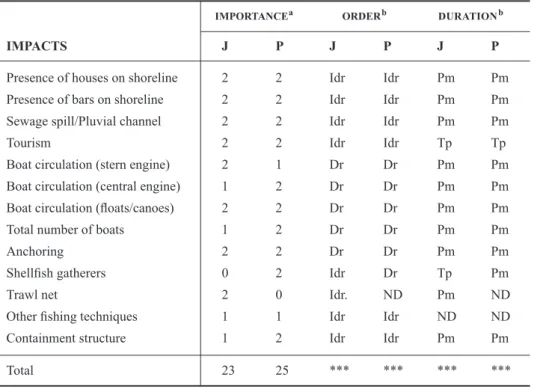
The total impact score from the checklist applied to
the Jaguaribe and Pilar sites was 23 and 25 points,
respectively (Table I). The degree of importance of
specific forms of impact differed between sites. For
example, the number of boats with a stern motor and
trawl-net activities were determined to be
significant
at Jaguaribe, whereas at Pilar the effect of boats with
a stern motor was determined to be
negligible to
moderate
and trawl-net activities to have not affected
the ecosystem (
no effect
). There was a greater
proportion of forms of impact classified as
significant
at Pilar (71.43%) regarding the 57.14% determined
for Jaguaribe (Table I). The significant forms of
impact were the number of boats with a central motor,
boats, anchoring, disruptive fishing techniques and
the discharge of untreated sewage.
The direct effect of the discharge of
untreated sewage on seagrass coverage was
observed at both study sites. Information from
the local government confirms the lack of a
sewage collection and treatment system in the
area. Island residents are responsible for sewage
disposal and are instructed to build septic pits,
but there is no supervision to enforce the building
of such pits or monitor the final destination of the
waste. The coastal environment is exposed to a
large number of nutrients from human activities.
These nutrients have harmful effects on the structure
and function of the seagrass ecosystem (Lee and
Dunton 2000). The input of organic matter causes
an increase in the biomass of phytoplankton (Walker
and McComb 1992, McMahon et al. 1997) and
epiphytic algae, which reduces both light penetration
and the concentration of dissolved oxygen (Huang et
Table I.Importance and qualification of impact on H. wrightii meadows at the Jaguaribe (J) and Pilar (P) sites from July to September 2007; Itamaracá Island, Pernambuco State, Brazil.
Font: aModified from Singer (1985); bAdapted from Feuerschutte (1993).
Presence of houses on shoreline 2 2 Idr Idr Pm Pm Presence of bars on shoreline 2 2 Idr Idr Pm Pm
Sewage spill/Pluvial channel 2 2 Idr Idr Pm Pm
Tourism 2 2 Idr Idr Tp Tp
Boat circulation (stern engine) 2 1 Dr Dr Pm Pm
Boat circulation (central engine) 1 2 Dr Dr Pm Pm
Boat circulation (floats/canoes) 2 2 Dr Dr Pm Pm
Total number of boats 1 2 Dr Dr Pm Pm
Anchoring 2 2 Dr Dr Pm Pm
Shellfish gatherers 0 2 Idr Dr Tp Pm
Trawl net 2 0 Idr. ND Pm ND
Other fishing techniques 1 1 Idr Idr ND ND
Containment structure 1 2 Idr Idr Pm Pm
Total 23 25 *** *** *** ***
IMPACTS J P J P J P
IMPORTANCEa
ORDERb DURATIONb
ND – No data; 0 – no effect; 1 – negligible
to moderate;
2 – significant; 3 – extreme;
Dr – Direct; Idr – Indirect; Tp – Temporary; Pm – Permanent; Cc – Cyclic.
gatherers and containment structures. No significant
differences between sites were detected with regard
to the qualification of the different forms of impact
based on
order
and
duration
.
DISCUSSION
al. 2006). Increased nutrient loads are considered the
major cause of decline or lack of recovery of seagrass
meadows (Hemminga and Duarte 2000). According
to Giesen et al. (1990), an increasing degree of
eutrophication is related to an increase in turbidity.
The Brazilian Institute of Geography and Statistics
(IBGE 2008) reports that Itamaracá has a population
of 18,412 inhabitants. Based on the calculation
used by Jürgensen (1995) to estimate the level of
nutrients entering an environment, Itamaracá Island
receives an input of 220.944
g/N
T/day/inhabitant and
883,776g/P
T/day/inhabitant.
Construction in the supralittoral zone, as
observed at the study sites, diminishes the supply
and/or interrupts the transport of sediments, resulting
in erosion and sedimentation in seagrass meadows
(Short and Wyllie-Echeverria 1996). These processes
have an indirect impact on the meadows, such as
light attenuation and the covering of leaves, with a
consequent reduction in the photosynthetic activity.
Such effects, together with eutrophication, are
reported to be the major causes of the decline in
seagrass coverage worldwide (Kirkman 1997).
During the monitoring at Pilar beach in 2002,
a sediment wave was recorded crossing a seagrass
meadow, which caused the total disappearance
of the meadow and the subsequent appearance of
meadow fragments (K.M. Magalhães, unpublished
data). Containment structures on the shoreline may
cause sediment imbalances in seagrass meadows
by changing the wave energy pattern, which can
increase sedimentation and/or erosion and, thus,
lead to the fragmentation of seagrass meadows
(Walker and McComb 1992).
The intensive circulation and anchoring of
motorized and non-motorized boats, as seen at
both sites, have been characterized as a serious
threat to the conservation of seagrass meadows
worldwide (Walker et al. 1989, Kirkman 1997,
Creed and Amado Filho 1999). According to
Ceccherelli et al. (2007), the impact of anchoring
activities, regardless of boat size, causes the
small-scale degradation of these ecosystems. The impact
of these activities depends on the stage of the
anchoring cycle and the kind of anchor employed
(Ceccherelli et al. 2007, Creed and Amado Filho
1999, Francour et al. 1999, Milazzo et al. 2004).
At Itamaracá, both sites have been used as boat
ports for many decades, and Pilar is also a fishing
center for the Island. Boat anchoring may also
cause a short-term reduction in
H. wrightii
meadow
density in tropical regions (Creed and Amado Filho
1999). According to Walker et al. (1989), the scars
created by moorings in the seagrass canopy affect
the physical integrity of the meadow. In addition
to the impact of the presence of boats, oil leakage
from boat motors is an additional local stressor that
affects seagrass meadows (Baden et al. 2003).
Diverse fishing techniques were observed in
the study area, but two of these fishing modalities
out-ranked the others in terms of the disturbance of
seagrass meadows: trawl-net fishing at Jaguaribe
and manual shellfish gathering at Pilar. The lack of
trawling at Pilar may be related to the difference
in the number of boats between the two sites as
Pilar has a greater number of boats, which could
make trawling difficult. According to Huang et al.
(2006), trawling pulls out seagrass by the roots,
thereby destroying the meadows. Some fishing
techniques may disturb the sediment dynamics,
which can result in a severe reduction in meadows
(Hemminga and Duarte 2000, Short and
Wyllie-Echeverria 1996) as observed at Itamaracá Island.
The low number of reports on shellfish
gatherers at Jaguaribe may be related to the lower
abundance and distribution of
Halodule
in this
area in comparison to Pilar (field observation).
The number of shellfish gatherers increases
considerably at the Pilar site at low tide. A large
number of individuals, including children, gather
shellfish on the island, and this activity is a source
of income for locals. The act of digging up shellfish
covers the meadows with sediment, which affects
seagrass growth (Huang et al. 2006).
Solid waste on beaches and in coastal ecosystems
is regularly observed (Araújo and Costa 2004).
Despite the presence of solid waste in the meadows
of Itamaracá, the effects on seagrass have not yet
been reported. However, there are reports on the
consumption of this waste by animals that depend on
the meadows, which results in drowning, deformation
and death (Beck and Barros 1991, Bjorndal et al.
1994, Bugoni et al. 2001).
Based on the results of the present study, the
authors suggest a permanent monitoring program
for the assessment of the effects of these different
forms of impact on
H. wrightii
meadows, identifying
possible variations in certain seagrass parameters
(meadow density and coverage, leaf growth and
rhizomes per year) related to the health of the meadow
(UNEP 2007). According to Nyqvist et al. (2009),
monitoring and management must consider meadows
an important ecosystem and establish measures for
the preservation of both the seagrass and its habitat,
thereby protecting other organisms associated to these
meadows. The management of seagrass meadows
requires an integrated approach (Borum et al. 2004),
including efforts toward assessing water quality, the
diversity and biomass of epiphytes, sedimentation
rate and the intensity of different forms of impact.
RESUMO
Múltiplos mecanismos estressores têm causado em todo mundo declínio das angiospermas marinhas, que são vulneráveis a pressões ambientais e/ou antrópicas. A perda de prados de Halodule wrightii tem sido relatada para o litoral da Ilha de Itamaracá (Nordeste
do Brasil). O presente estudo identificou os principais fatores antrópicos que influenciaram negativamente na
abundância e distribuição desses prados entre Julho e Setembro de 2007 nas praias de Jaguaribe e do Pilar,
litoral leste de Itamaracá. O impacto antropogênico incluiu despejo de efluentes in natura nos canais fluviais, desenvolvimento urbano e comercial na linha
de costa, ancoragem de embarcações motorizadas e
não-motorizadas, técnicas diversas de pesca e disposição de
resíduos sólidos. Os dados obtidos indicam que Pilar é
um ambiente com maior índice de impacto (71,43%) quando comparada à Jaguaribe (57,14%), destacando-se número de embarcações com motor de centro, número total de embarcações, presença de grupos de
marisqueiros e desenvolvimento urbano costeiro. O presente estudo reforça a necessidade de se definir
políticas de manejo e conservação deste ecossistema, que possui elevado valor ecológico e econômico.
Palavras-chave: conservação, valor ecológico, perda de habitat, habitat marinho.
REFERENCES
ANDRADE GO AND LINS RC. 2005. Os climas do Nordeste. In:
Vasconcelos Sobrinho J, As regiões naturais do Nordeste,
o meio e a civilização, Recife: CONDEPE, p. 95-18.
ARAÚJO MCB AND COSTA M. 2004. Quali-quantitative analysis of the solid wastes at Tamandaré Bay,
Pernambuco-Brasil. Trop Ocean 32(2): 159-170.
BADEN S, GULLSTRÖM M, LUNDÉN B, PIHL L AND
ROSENBERG R. 2003. Vanishing Seagrass (Zostera marina, L.) in Swedish Coastal Waters. J Hum Environ 32(5): 374-377.
BECK CA AND BARROS NB. 1991. The impact of debris on the
Florida manatee. Mar Pollut Bull 22(10): 508-510. BJORNDAL KA, BOLTEN AB AND LAUGUEUX CJ. 1994.
Ingestion of marine debris by juvenile sea turtles in coastal Florida habitats. Mar Pollut Bull 28(3): 154-158. BORUM J,DUARTE CM, KRAUSE-JENSEN D AND GREVE TM.
2004. What can be done to prevent seagrass loss? In: Borum J et al. (Eds), European seagrasses: an introduction to monitoring and management, Ed. The M&MS project, p. 67-71.
BUGONI L,KRAUSE L AND PETRY MV. 2001. Marine debris and human impacts on sea turtles in Southern Brazil. Mar Pollut Bull 42(12): 1330-1334.
BURKHOLDER JM,TOMASKO DA AND TOUCHETTE BW. 2007. Seagrasses and eutrophication. J Exp Mar Biol Ecol 350: 46–72.
CECCHERELLI G,CAMPO D AND MILAZZO M. 2007. Short-term
response of the slow growing seagrass Posidonia oceanica to simulated anchor impact. Mar Environ Res 63: 341-349. COSTANZA R ET AL. 1997. The value of the world´s ecosystem
services and natural capital. Nature 387: 253–260.
CREED JC AND AMADO FILHO GM. 1999. Disturbance and
of the macroflora of a seagrass (Halodule wrightii
Ascherson) meadow in the Abrolhos Marine National Park, Brazil: an experimental evaluation of anchor damage. J Exp Mar Biol Ecol 235: 285-306.
DUARTE CM, MARBÁ N AND SANTOS R. 2004. What may cause
ERFTEMEIJER PLA AND LEWIS RRR. 2006. Environmental of dredging on seagrasses: A review. Mar Pollut Bull 52: 1553–1572.
FEUERSCHUTTE RC. 1993. Política e legislação de proteção
ambiental no Brasil. In: Avaliação de impactos ambientais, MAIA, 2ª ed., Curitiba, PR:IAP/GTZ.
FRANCOUR P, GANTEAUME A AND POULAIN M. 1999. Effects of boat anchoring in Posidonia oceanica seagrass beds in the Port-Cros National Park (north-western Mediterranean Sea). Aquatic Conserv 9: 391-400.
FREEMAN AS,SHORT FT,ISNAIN I, RAZAK FA AND COLES RG.
2008. Seagrass on the edge: Land-use practices threaten coastal seagrass communities in Sabah, Malaysia. Biol Cons 141: 2993-3005.
GIESEN WBJT,VAN KATWIJK MM AND DEN HARTOG C. 1990
Eelgrass condition and turbidity in the Dutch Wadden Sea. Aquatic Bot 37: 71-85.
HASTINGS K,HESP P AND KENDRICK GA. 1995. Seagrass loss
associated with boat mooringas at Rottnest Island, Western
Australia. Ocean Coast Manage 26(3): 225-246.
HECK KL, CARRUTHERS TJB, DUARTE CM, HUGHES AR,
KENDRICK G,ORTH RJ AND WILLIAMS SW. 2008. Trophic
Transfers from Seagrass Meadows Subsidize Diverse Marine and Terrestrial Consumers. Ecosystems 11(7): 1198–1210.
HEMMINGA MA AND DUARTE CM. 2000. Seagrass Ecology,
Cambridge University Press, 298 p.
HUANG X, HUANG L, LI Y, XU Z, FONG CW, HUANG D,
HAN Q, HUANG H, TAN Y AND LIU S. 2006. Main
seagrass beds and threats to their habitats in the coastal sea of South China. Chin Sci Bull 51(Supp. II): 136-142. IBGE - INSTITUTO BRASILEIRO DE GEOGRAFIA E ESTATÍSTICA.
2008. http://www.ibge.gov.br/ (accessed June 27, 2008).
JÜRGENSEN C. 1995. Modelling of nutrient release from the
sediment in a tidal inlet, kertingenor. Funen. Heldingor.
Ophelia, Heldingor 42: 163-178.
KEMPF M. 1970. Nota preliminar sobre os fundos costeiros da região de Itamaracá (Norte do Estado de Pernambuco,
Brasil). Trab Oceanog Univ Fed PE 9/11: 95-110.
KIRKMAN H. 1997. Seagrasses of Australia. Australia: State
of the Environment Technical Paper Series (Estuaries and the Sea), Department of the Environment, Canberra, 36 p.
LEE KS AND DUNTON KH. 2000. Effects of nitrogen enrichment
on biomass allocation, growth, and leaf morphology of the seagrass Thalassia testudinum. Mar Ecol Prog Ser 196: 39-48. LEE KS,SHORT FT AND BURDICK DM. 2004. Development of a nutrient pollution indicator using the seagrass, Zostera marina, along nutrient gradients in three New England estuaries. Aquatic Bot 78: 197-216.
LOTZE HK, LENIHAN HS, BOURQUE BJ, BRADBURY RH, COOKE RG, KAY MC, KIDWELL SM, KIRBY MX, PETERSON CH AND JACKSON JBC. 2006. Depletion, degradation, and recovery potential of estuaries and coastal seas. Science 312: 1806-1809.
MAGALHÃES KM AND ALVES MS. 2002. Fanerógamas
mari-nhas do litoral do estado de Pernambuco. In: Diagnóstico da Biodiversidade de Pernambuco ed. Recife: Secretaria de Ciências, Tecnologia e Meio Ambiente, Editora Massangana 1: 173-181.
MAGALHÃES KM, COCENTINO ALM, ESKINAZI-LEÇA E,
FERNANDES MLB, REIS TNV, GUIMARÃES NCL AND
RODRIGUES HS. 2003. Seagrass meadows at the Suape Port area, Pernambuco, Brazil. In: Claudio-Sales V, Tonini IM and Dantas EWC. Anais de trabalhos completos do VI Congresso de Ecologia do Brasil, Editora da Universidade Federal do Ceará, p. 334-335.
MAGALHÃES KM AND ESKINAZI-LEÇA E. 2000. Os prados de
fanerógamas marinhas. In: Barros HM, Leça EE, Macedo
SJ and Lima T (Orgs), Gerenciamento participativo de
estuários e manguezais. Recife: Editora Universitária da UFPE, p. 37-49.
MCMAHON K, YOUNG E, MONTGOMERY S, COSGROVE
J, WILSHAW J AND WALKER DI.1997. Status of a shallow
seagrass system, Geographe Bay, south-western Australia. J R Soc Wes Aust 80: 255-262.
MILAZZO M, BADALAMENTI F, CECCHERELLI G AND
CHEMELLO R. 2004. Boat anchoring on Posidonia oceanica beds in a marine protected area (Italy, western Mediterranean): effect of anchor types in different anchoring stages. J Exp Mar Biol Ecol 299: 51-62. NYQVIST A,ANDRÉ C,GULLSTRÖM M,BADEN SP AND ABERG
P. 2009. Dynamics of Seagrass Meadows on the Swedish Skagerrak Coast. Ambio 38(2): 85-88.
SCHAFFELKE B,MELLORS J AND DUKE NC. 2005. Water quality
in the Great Barrier Reef region: responses of mangrove, seagrass and macroalgal communities. Mar Pollut Bull 51: 279-296.
SHORT FT, KOCH EW, CREED JC, MAGALHAES KM,
FERNANDEZ E AND GAECKLE JF. 2006. SeagrassNet
monitoring across the Americas: case studies of seagrass decline. Mar Ecol 27(4): 277-289.
SHORT FT AND WYLLIE-ECHEVERRIA S. 1996. Natural and human-induced disturbance of seagrasses. Environ Conserv 23: 17-27.
SINGER EM. 1985. Metodologia para avaliação dos impactos
ambientais da mineração. Encontro Técnico (27/06/85) – Mineração e Meio Ambiente no Estado de São Paulo, 1ª ed., São Paulo, ABGE, p. 10-20.
SNIS-SISTEMA NACIONAL DE INFORMAÇÕES SOBRE
SANEAMENTO. 2010. http://www.snis.gov.br/ (acessed December, 2010).
TOMMASI LR. 1994. Estudo de impacto ambiental. São Paulo: Terragraph Artes e Informática, 354 p.
UNEP - UNITED NATIONS ENVIRONMENT PROGRAME. 2007. Guidelines for impact assessment on seagrass meadows. United Nations Environment Programe. Mediterranean Action Plan, 44 p.
WALKER DJ, LUKATELICH G, BASTYAN G AND MCCOMB
AJ. 1989. Effect of boat moorings on seagrass beds near Perth, Western Australia. Aquatic Bot 36: 69-77.
WALKER DJ AND MCCOMB AJ.1992. Seagrass degradation in
Australian coastal waters. Mar Pollut Bull 25: 191-195. WAYCOTT M ET AL. 2009. Accelerating loss of seagrasses across
the globe threatens coastal ecosystems. PNAS 106(30): 12377-12381.