722
Revista da Sociedade Brasileira de Medicina Tropical 44(6):722-724, nov-dez, 2011
INTRODUCTION
Article/Artigo
1. Departamento de Patologia, Universidade Federal do Maranhão, São Luis, MA. 2. Curso de Medicina, Universidade Estadual do Maranhão. Caxias, MA. 3. Curso de Medicina, Centro Universitário do Maranhão, São Luís, MA.
Address to: Profa. Graça Maria de Castro Viana. Rua Nova, quadra H, casa 2, Sítio Leal, 65041-140
São Luís, MA, Brasil. Phone: 55 98 3223-1314 e-mail: [email protected]
Received in 28/12/2010
Accepted in 28/07/2011
Relationship between rainfall and temperature: observations on the cases
of visceral leishmaniasis in São Luis Island, State of Maranhão, Brazil
Relações entre pluviometria e temperatura: observações sobre a ocorrência de casos de
leishmaniose visceral na Ilha de São Luis, Estado do Maranhão, Brasil
Graça Maria de Castro Viana
1, Maria do Desterro Soares Brandão Nascimento
1,2, Érica Milena Fernandes Rabelo
1,
João Arnaud Diniz Neto
1, José Roberto Binda Júnior
3, Carolina de Souza Galvão
1, Alessandro Carvalho dos Santos
1,
Onildo Martins Santos Júnior
1,
Rodrigo Artur Souza de Oliveira
1and Rafael Silva Guimarães
1ABSTACT
Introduction: Visceral leishmaniasis is a serious public health problem that requires global control strategies, especially with respect to factors that may intervene in reducing the incidence of endemicity. In this work, rainfall density and temperature were correlated with the incidence
of human cases in an area endemic for leishmaniasis in São Luis do Maranhão, Northeastern
Brazil. Methods: Notiication of human cases by the National Health Foundation/Regional
Coordination of Maranhão (FUNASA/COREMA) from 2002 to 2010 was used. Ecological data (mean temperature and rainfall density) were provided by the Meteorological Oice of
State. Results: A signiicant association was veriied between the number of VL cases and
rainfall rate but not in the analysis concerning mean temperatures. Conclusions: hese data
suggest that the control actions in visceral leishmaniasis should be performed during rainy season in the State of Maranhão, which is in the irst half of the year.
Keywords: Visceral leishmaniasis. Ecoepidemiology. Temperature. Rainfall density.
RESUMO
Introdução: A leishmaniose visceral por ser um importante problema de saúde pública mundial requer estratégias de controle, notadamente em relação a fatores que possam intervir na redução da incidência dessa endemia. A densidade pluviométrica e a temperatura são aqui correlacionadas com a incidência de casos humanos em uma área endêmica de calazar na Ilha
de São Luis do Maranhão, nordeste brasileiro. Métodos: Utilizou-se notiicações dos casos
humanos pela Fundação Nacional de Saúde/Coordenação Regional do Maranhão (FUNASA/ COREMA) durante o período de 2002 a 2010. Os dados ecológicos (temperatura e densidade
pluviométrica) foram cedidos pela Universidade Estadual do Maranhão. Resultados:
Associação signiicante foi veriicada entre o número de casos e a pluviometria, o que não
foi veriicado com a temperatura média. Conclusões: Esses dados sugerem que as ações de
controle na leishmaniose visceral devem ser executadas durante o período chuvoso em nosso Estado, ou seja, no primeiro semestre do ano.
Palavras-chaves: Leishmaniose visceral. Ecoepidemiologia. Temperatura. Densidade pluviométrica.
Visceral leishmaniasis (VL) or kala-azar is a disease of serious public health concern, especially in tropical and subtropical areas of the world. It presents a worldwide incidence of 500,000 cases per year1. he forms of the disease are related to parasite species, but they difer in epidemiology, geographical distribution, hosts, vectors involved, and incidence and mortality rates2.
In Latin America, the disease has been reported in at least 12 countries, but 90% of the cases occur in Brazil3. Currently, VL occurs in 19 of the 27 states of Brazil, with approximately 1,600 municipalities presenting autochthonous transmission, and has shown an endemic-epidemic character, maintaining an annual mean of between 3,000 and 4,000 new cases4.
Relevant alterations have been observed in the epidemiological features of VL over time. Initially, the profile was rural, involving peridomicile transmission; however, this proile progressively changed and acquired periurban characteristics, and it currently shows full urbanization, with a strong presence in very urbanized districts of large cities, including Rio de Janeiro/RJ, Teresina/PI, São Luis/ MA, Belo Horizonte, and Montes Claros/MG2,5.
Recent control strategies for this endemicity have focused on the environment, notably vector control, especially in regions like the Indian subcontinent where transmission occurs between humans6.
Macedo et al.7 demonstrated that sandflies present seasonal distribution associated with rainfall and humidity indices, with increased density in the rainy season.
723
METHODSRESULTS
DISCUSSION
Viana GMC et al - Relationship between rainfall and temperature
VL is expanding to other cities in the State of Maranhão. his problem is highlighted by the number of reported cases occurring in 50.2% (109 municipalities) of the 217 existing municipalities8.
he present study aimed to correlate the ecological factors, temperature and rainfall density, with the reported human cases. his is important for determining the best time to intervene in the epidemiological chain, while permiting the provision of duly applied resources tailored to the realities in each region.
A cross-sectional study was conducted involving 834 subjects from an area endemic for VL (island of São Luis do Maranhão, Brazil). Case notiications were collected between 2002 and 2010 by the National Health Foundation/Regional Coordination of Maranhão (Fundação Nacional de Saúde/Coordenação Regional de Maranhão - FUNASA/ COREMA). Ecological data for rainfall and temperature in the region studied were obtained from the Meteorological Oice of the state.
Statistical analysis
A database for the data obtained was constructed using the Excel 2007 application. ANOVA was used for statistical analysis, and the signiicance level was set at p<0.05.
Ethical considerations
he investigative process was conducted in accordance with the ethical guidelines established by Resolution 196/96 of the Brazilian National Health Council and the Helsinki Declaration of 1964, revised in 2000. his research was approved by the Research Ethics Commitee of the University Hospital of the Federal University of Maranhão.
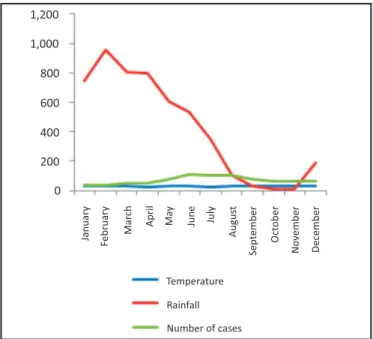
Of the 834 cases of human VL reported between 2002 and 2010, a greater number of cases occurred at the end of the rainy season ( June, July, and August).
he regional rainfall data were analyzed according to the months of the year between 2002 and 2010. Figure 1 shows that a relation can
FIGURE 1-Correlation between the number of human visceral leishmaniasis cases and rainfall (mm) and mean temperature (°C) between 2002 and 2010.
be inferred between the number of cases and rainfall, as the increase in rainfall was positively associated with an increased number of VL cases (p<0.001).
he mean temperature in the region between 2002 and 2010 was also analyzed according to the months of the year. High mean temperatures were observed in all months of the year. Figure 1 also shows that the relation between the number of cases and the average temperature was not signiicant based on the results of the ANOVA (p=0.9216).
he island of São Luis do Maranhão is the result of land invasion. Disorderly setlement began in 1960, and severe deforestation and intense migration followed. These factors caused an ecological imbalance in the region, having displaced mosquitoes from their natural ecotope, resulting in an epidemic of human VL in 1993. From this year onward, emphasis was placed on preventive actions and epidemiological studies in the area. As it is an invaded territory, patients constantly change addresses, causing one of the greatest diiculties of the study.
It was found that at the end of the rainy season ( June, July, and August), a greater number of cases of human VL were reported in this location. Interestingly, this fact is associated with increased rainfall during these months. One of the possible factors responsible for this relation is the occurrence of a greater peridomicile invasion of sandlies in search of blood meal on humans during the rainy season9,10.
Regarding the mean temperature during the years under study, observations showed that while higher temperatures occurred in all months of the years, this did not result in increased rainfall or cause a greater number of VL cases. Diferences between the mean temperatures during the analysis period were probably not suicient to alter the paterns of rainfall.
It is known that at elevated temperatures, sandly presents a life cycle that shows more rapid maturation11. In another study conducted in an endemic area of Maranhão12, it was found that the frequency of phlebotomine is signiicantly higher in the rainy season (January-July), particularly in the second quarter. However, the relationship between the outbreak of sandlies and the temperature was not the purpose of this study. Given the small diference in the mean temperatures, this factor did not interfere in the patern of the occurrence of VL cases. hese data reinforce the idea that a higher incidence of the disease occurs during the rainy season ( January-July) that is not associated with a rise in temperature, which is in contrast to the State of Ceará, where more cases are reported in the period from June to August9.
he indings of this study lead to a beter elucidation of the environmental factors in relation to the emergence of cases of leishmaniasis, already evidenced in the literature13, thereby enabling appropriate intervention in the transmission chain, more efective control of the disease, and the consequent reduction in morbimortality.
ACKNOWLEDGMENTS
he authors would like to thank the Institutional Program for Scientific Initiation Grants (Programa Institucional de Bolsas de Iniciação Cientíica, PIBIC) for its inancial support. Rafael Guimarães Silva was awarded a grant under this program.
1,200 1,000 800 600 400 Temperature Rainfall Number of cases
724
Rev Soc Bras Med Trop 44(6):722-724, nov-dez, 2011
he authors declare that there is no conlict of interest. CONFLICT OF INTEREST
REFERENCES
1. Gontijo CMF, Melo MN. Leishmaniose Visceral no Brasil: Quadro Atual, Desaios e Perspectivas. Rev Bras Epidemiol 2004; 7:338-349.
2. Marzochi MCA. Epidemiologia das Leishmanioses no Brasil.Rev Patol Trop 1994; 23:82-84.
3. Camargo-Neves VLF, Santucci SG. Leishmaniose Visceral Americana. São Paulo: Superintendência de Controle de Endemias – SUCEN. Coordenadoria de Controle de Doenças. Secretaria de Estado de Saúde de São Paulo; 2001. 4. Ministério da Saúde. Secretaria de Vigilância em Saúde. Departamento de
Vigilância Epidemiológica. Manual de vigilância e controle de leishmaniose visceral. Brasília: Ministério da Saúde; 2004.
5. Tesh RB. Control of zoonotic Leishmaniasis: is it time to change strategies? Am J Trop Med Hyg 1995; 52:287-292.
6. Clements MF, Gidwani K, Kumar R, Hostomska J, Dinesh SD, Kumar V, et al. Measurement of Recent Exposure to Phlebotomus argentipes, the Vector of Indian Visceral Leishmaniasis, by Using Human Antibody Responses to Sand Fly Saliva. Am J Trop Med Hyg2010; 82:801-807.
7. Macedo ITF, Bevilaqua CML, Morais NB, Sousa LC, Linhares FE, Amóra SSA, et al. Sazonalidade de lebotomíneos em área endêmica de Leishmaniose visceral no município de Sobral, Ceará, Brasil. Ciência Animal2008; 18:67-74. 8. Caldas AJM. Marcadores de eficácia terapêutica na leishmaniose visceral
humana em crianças e adultos [PhD hesis]. [Salvador]: Faculdade de Medicina. Universidade Federal da Bahia. Centro de Pesquisa Gonçalo Muniz; 2004. 103p. 9. Alencar JE. Expansão do calazar no Brasil. Ceará Médico 1983; 5:86-102. 10. Monteiro EM, Silva JCF, Costa RT, Costa DC. Leishmaniose visceral: estudo de
lebotomíneos e infecção canina em Montes Claros, Minas Gerais. Rev Soc Bras Med Trop2005; 38:147-152.
11. Almeida K. Controle Biológico da Leishmaniose: Descoberto Parasita do Inseto Transmissor da Doença. Minas Faz Ciência 2003;13:10-13.
12. Rebêlo JMM, Leonardo FS, Costa JML, Pereira YNO, Silva FS. Flebotomíneos (Dipitera, Psychodidae) de área endêmica de leishmaniose na região dos cerrados, Estado do Maranhão, Brasil. Cad Saúde Pública 1999; 15:623-630.