ISSN: 1809-4430 (on-line)
_________________________
1 Engº Agrícola, Prof. Doutor, Universidade Estadual de Mato Grosso do Sul, Unidade de Cassilândia, UEMS-UUC/Cassilândia-MS, Fone: (67) 3596-7600, [email protected]
2 Engº Agrônomo, Mestre, Universidade Estadual de Mato Grosso do Sul, Unidade de Aquidauana, UEMS-UUA/Aquidauana-MS, [email protected]
3 Engª Agrônoma, Mestre, Universidade Estadual de Mato Grosso do Sul, Unidade de Aquidauana, UEMS-UUA/Aquidauana-MS, [email protected]
4 Engº Agrônomo, Prof. Doutor, Universidade Estadual de Mato Grosso do Sul, Unidade de Aquidauana, UEMS-UUA/Aquidauana-MS, [email protected]
5 Bióloga, Profa. Doutora, Universidade Federal de Mato Grosso do Sul, Unidade de Aquidauana, UFMS/Aquidauana-MS,
SOURSOP SEEDLINGS: EMERGENCE AND DEVELOPMENT UNDER DIFFERENT
CULTIVATION ENVIRONMENTS AND SUBSTRATES – PART I
Doi:http://dx.doi.org/10.1590/1809-4430-Eng.Agric.v36n2p 217-228/2016
EDÍLSON COSTA1, ADRIANO R. SASSAQUI2, ANNE K. DA SILVA3, NORTON H. REGO4, BRUNA G. FINA5
ABSTRACT: Seedling quality is crucial to obtain vigorous plants in the field. This study aims to evaluate the emergence and development of soursop seedlings in different substrates in protected environments. The experiment was conducted at the Mato Grosso do Sul State University and carried out using five protected environments: greenhouse, greenhouse with thermo-reflective screen, nursery with monofilament screen, nursery with thermo-reflective screen, and nursery with palm thatch. The substrates (S) consisted of cattle manure (M), humus (H), cassava branches (C), and vermiculite (V) as in the following ratios: S1 = H + V (1:3), S2 = H + V (1:1), S3 = H + V (3:1), S4 = H + C (1:3), S5 = H + C (1:1), S6 = H + C (3:1), S7 = M + V (1:3), S8 = M + V (1:1), S9 = M + V (3:1), S10 = M + C (1:3), S11 = M + C (1:1), S12 = M + C (3:1), S13 = H + M + V (1:1:1), S14 = H + M + C (1:1:1), and S15 = H + M + V + C (1:1:1:1). For the statistical analysis, each of those environments was considered as an experiment in which was used the completely randomized design; subsequently, it was performed a combined analysis of them. In summary, the greenhouse with thermo-reflective screen and combined substrates with “M + V” promote greater development of the seedlings. High concentrations of “V” or “C” cause no beneficial effect on soursop seedlings.
KEYWORDS: Annona muricata; cattle manure; cassava branches; vegetable ambience.
MUDAS DE GRAVIOLEIRA: EMERGÊNCIA E DESENVOLVIMENTO SOB
DIFERENTES AMBIENTES DE CULTIVO E SUBSTRATOS – PARTE I
RESUMO: A qualidade da muda é fundamental para obtenção de plantas vigorosas no campo. Desta forma, o presente trabalho teve como objetivo avaliar a emergência e o desenvolvimento de mudas de gravioleira, em diferentes substratos, no interior de ambientes protegidos. O experimento foi conduzido na Universidade Estadual de Mato Grosso do Sul, onde foram empregados cinco ambientes protegidos: estufa agrícola; estufa agrícola com tela termorrefletora sob o filme; viveiro agrícola coberto com tela de monofilamento; viveiro agrícola coberto com tela termorrefletora e viveiro coberto com palha. Os substratos foram constituídos por esterco bovino (E), húmus (H), ramas de mandioca (M) e vermiculita (V), nas seguintes proporções: S1 = H + V (1:3); S2 = H + V (1:1); S3 = H + V (3:1); S4 = H + M (1:3); S5 = H + M (1:1); S6 = H + M (3:1); S7 = E + V (1:3); S8 = E + V (1:1); S9 = E + V (3:1); S10 = E + M (1:3); S11 = E + M (1:1); S12 = E + M (3:1); S13 = H + E + V (1:1:1); S14 = H + E + M (1:1:1); e S15 = H + E + V + M (1:1:1:1). Cada ambiente foi considerado um experimento, sendo adotado o delineamento inteiramente casualizado e, posteriormente, análise conjunta dos mesmos. Em síntese, a estufa agrícola com tela termorrefletora sob filme e os substratos combinados com “E + V” promovem maior desenvolvimento de mudas. Altas concentrações de “V” ou “M” provocam efeito não benéfico às mudas de gravioleira.
INTRODUCTION
The soursop (Annona muricata L.) belongs to the Annonaceae family and has been showing
great economic potential in the Brazilian fruit scenario, especially in Northeast Brazil. Its fruits are destined for consumption in natura and mostly for the agro-industry due to low-technology
orchards (COSTA et al., 2005).
Similarly to the increasing fruit demand is the formation of orchards. In this case, the production of quality seedlings is an adopted practice to the production of soursop since seedlings with aggregate qualities reflect on growth and survival in the field, especially under adverse conditions, in addition to provide better performance and productivity (BARBOSA et al., 2003).
The propagation of fruit seedlings in protected environments is widely used as it promotes benefits related to the protection and internal microclimate. However, these environments may have different configurations, directly influencing the quality of seedlings (COSTA et al., 2010). When comparing different protected environments for jatoba, COSTA et al. (2011c) observed that the greenhouse with low-density polyethylene (LDPE) has provided more vigorous seedlings than those produced in environments covered with black or thermal-reflective screen, both with 50% shading. For passion fruit, COSTA et al. (2009) observed that environments with monofilament or thermal-reflective screens, both with 50% shading, promoted better seedlings when compared to those produced in greenhouse with LDPE. For araticum, CAVALCANTE et al. (2008) observed that the full sun environment provided larger seedlings than that produced in greenhouse with LDPE.
The substrate is another factor that influences seedlings; physical characteristics, such as porosity, moisture retention and density, as well as chemical characteristics, such as nutrient content, pH and cation exchange capacity, are important parameters for its choice (SILVA & FARNEZI, 2009). Thus, the choice of the elements that compose the substrates is a crucial factor for the formation of soursop seedlings. According to LIMA et al. (2009), soursop seedlings cultivated in substrate composed of soil, humus and carbonized rice husk (2:1:1) present greater vigor when compared with those cultivated in substrates with a mixture of soil, carbonized rice husk, and coconut shell powder. OKUMURA et al. (2008) describe that organic components fertilized with mineral components improve the development of grafted seedlings of soursop. OLIVEIRA et al. (2009b) shows that the isolated green husk powder causes depressive effect on soursop seedlings.
Considering that in the literature there is a lack of research about the influence of protected environments and substrates for the formation of soursop seedlings, studies should be conducted in this area. Thus, this study aimed to evaluate the effect of protected environments and substrates on the seedlings production of Annona muricata L. in Aquidauana, MS, Brazil.
MATERIAL AND METHODS
The experiments for the formation of soursop seedlings were conducted in the experimental area of the Mato Grosso do Sul State University (UEMS), campus Aquidauana, MS, Brazil
(geographical coordinates: 20°20’ S and 55°48’ W; average altitude: 174 m), from January to April,
2012. The regional climate is classified as tropical warm sub-humid with rainy summers and dry winters, with mean annual precipitation of 1200 mm and temperature of 29 °C.
closures in the front and side in 45º with black monofilament screen with 50% shading (Sombrite®); (E4) a screened nursery with galvanized steel structure, 8 m wide, 18 m length, and 3.5 m of ceiling height, coverage and closures in the front and side in 45º with aluminized thermal-reflective screen with 50% shading (Aluminet®); and (E5) a nursery with a wooden structure, 3 m wide, 1.2 m length, and 1.8 m of ceiling height, covered with a native palm thatch regionally known as bacuri, and without front and side closures.
The soursop fruits were collected from trees in the region of Aquidauana, MS, Brazil from November to December, 2011. The seeds were separated from the fruit pulp, washed in running water, and shade dried for three days. In order to release seed dormancy, the seeds were immersed in water at 25 °C for 24 hours. The cassava branches were triturated in a hammer mill (model TRF 650, TRAPP, Jaraguá do Sul, SC, Brazil) using an 8-mm mesh sieve; subsequently, it was placed in open-air on a canvas for composting during 60 days, being wet daily and turned completely inside out and upside down each 2 days. In addition, it was used vermiculite with medium texture, and both cattle manure (composted during 30 days) and earthworm humus were obtained in the region of Aquidauna and Dois Irmãos do Buriti, MS, respectively.
The sowing was carried out on January 6, 2012 in polyethylene bags in which were placed three seeds per container in the depth of 1–3 cm. After 42 days after sowing (DAS), it was performed the polish out when the seedlings presented two definitive leaves, keeping one plant per container.
Inside the protected environments, the plants were placed in polyethylene bags (15.0 × 21.5 cm) with 1.6 liter capacity and filled with substrates derived from combinations of earthworm humus (H), cattle manure (M), vermiculite (V) and cassava branches (C) (Table 1). The respective chemical analyses and density of the substrates (1970) are shown, respectively, in Tables 2 and 3.
TABLE 1. Substrates (S) derived from different mixture ratios of humus (H), cattle manure (M), vermiculite (V) and cassava branches (C).
Humus (H) + Vermiculite (V) Humus (H) + Cassava Branches (C) S1 = 25% H + 75% V;
S2 = 50% H + 50% V; S3 = 75% H + 25% V.
S4 = 25% H + 75% C; S5 = 50% H + 50% C; S6 = 75% H + 25% C.
Cattle Manure (M) + Vermiculite (V) Cattle Manure (M) + Cassava Branches (C) S7 = 25% M + 75% V;
S8 = 50% M + 50% V; S9 = 75% M + 25% V.
S10 = 25% M + 75% C; S11 = 50% M + 50% C; S12 = 75% M + 25% C. Humus (H) + Cattle Manure (M) + Vermiculite (V)
S13 = 33.3% H + 33.3% M + 33.3% V
Humus (H) + Cattle Manure (M) + Cassava Branches (C) S14 = 33.3% H + 33.3% M + 33.3% C
Humus (H) + Cattle Manure (M) + Vermiculite (V) + Cassava Branches (C) S15 = 25% H + 25% M + 25% de V + 25% C
TABLE 2. Chemical analysis of the substrates organic materials used in the treatments.
--- g kg-1 ---
* N P K Ca Mg S C OM
M 10.60 3.66 1.00 9.80 1.65 1.81 96.50 166.00 H 14.80 4.46 1.00 26.70 12.50 3.53 163.00 281.00 C 19.50 2.89 7.00 18.80 6.15 2.42 376.00 647.00
- - - ---mg kg-1 ---
pH U C/N Cu Zn Fe Mn B
TABLE 3. Wet and dry densities of the substrates.
Density (kg.m-3)
S1 S2 S3 S4 S5 S6 S7 S8
W 791.11 958.74 1104.50 931.50 1146.17 1229.06 648.14 741.17 D 279.83 479.71 500.62 273.65 502.11 648.20 209.47 270.36
S9 S10 S11 S12 S13 S14 S15 -
W 838.14 652.16 700.27 816.03 956.67 766.94 988.09 - D 399.47 216.58 244.08 376.33 442.97 289.88 457.02 - W = wet density; D = dry density; S1 = 25% H + 75% V; S2 = 50% H + 50% V; S3 = 75% H + 25% V; S4 = 25% H + 75% C; S5 = 50% H + 50% C; S6 = 75% H + 25% C; S7 = 25% M + 75% V; S8 = 50% M + 50% V; S9 = 75% M + 25% V; S10 = 25% M + 75% C; S11 = 50% M + 50% C; S12 = 75% M + 25% C; S13 = 33,3% H + 33,3% M + 33,3% V; S14 = 33,3% H + 33,3% M + 33,3% C; S15 = 25% H + 25% M + 25% V + 25% C.
Each cultivation environment was considered as an experiment because there was no repetition of them. In each environment was adopted a completely randomized design with six replications of five plants each. Initially, the data were submitted to the analysis of individual variances of the substrate; then the evaluation of the mean square error and the combined analysis of the experiments were performed (BANZATTO & KRONKA, 2006). Statistical calculation was carried out by using the software Sisvar 5.3 (FERREIRA, 2010) and the averages submitted to the F-test and compared by the Scott-Knott test at 5% probability.
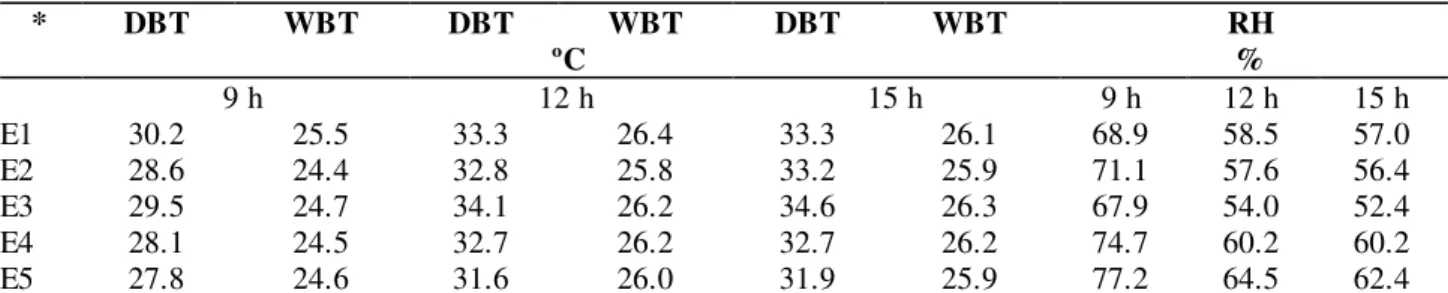
After sowing and the beginning of seedling emergence, it was evaluated the emergence speed index (ESI) and the mean germination time (MGT). The data were collected daily from 29 January, 2012 (23 DAS) to 26 February, 2012 (51 DAS) and subsequently transformed according to the equation x0.5. Seedling height was measured by using a millimetric ruler every fifteen days from the polish out; the number of leaves was evaluated at 55, 70, 85 and 100 DAS. In addition, the temperatures of dry and wet bulb were measured daily at 9:00, 12:00 and 15:00 h in each cultivation environment during all the experiment time, and the relative humidity was determined with the software Psychrometric Function Demo (Table 4).
TABLE 4. Average temperature (°C) and relative humidity (%) at 9:00, 12:00 and 15:00 h for each cultivation environment (E) during the experiment, from January 7 to April 4, 2012.
* DBT WBT DBT WBT DBT WBT RH
ºC %
9 h 12 h 15 h 9 h 12 h 15 h
E1 30.2 25.5 33.3 26.4 33.3 26.1 68.9 58.5 57.0 E2 28.6 24.4 32.8 25.8 33.2 25.9 71.1 57.6 56.4 E3 29.5 24.7 34.1 26.2 34.6 26.3 67.9 54.0 52.4 E4 28.1 24.5 32.7 26.2 32.7 26.2 74.7 60.2 60.2 E5 27.8 24.6 31.6 26.0 31.9 25.9 77.2 64.5 62.4 *DBT = dry bulb temperature (ºC); WBT = wet bulb temperature (ºC); RH = relative humidity (%); E1 = greenhouse covered with a low-density polyethylene (LDPE) film; E2 = greenhouse covered with a LDPE and aluminized thermal-reflective screen with 50% shading under the film; E3 = screened nursery covered with black monofilament screen with 50% shading; E4 = screened nursery covered with aluminized thermal-reflective screen with 50% shading; E5 = cultivation environment covered with a native palm thatch regionally known as bacuri.
RESULTS AND DISCUSSION
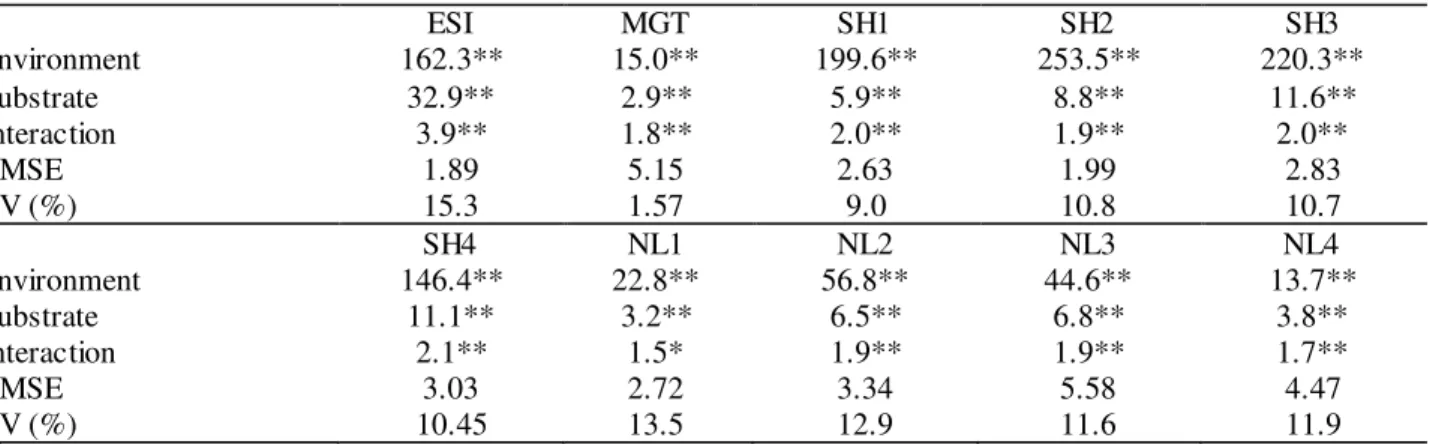
TABLE 5. Analysis of variance with calculated F, coefficient of variation, and the relation between the minimum and maximum mean square error for the emergence speed index (ESI), mean germination time (MGT), seedling height (SH) and number of leaves (NL) at 55 (SH1; NL1), 70 (SH2; NL2), 85 (SH3; NL3) and 100 (SH4; NL4) days after the soursop sowing.
ESI MGT SH1 SH2 SH3
Environment 162.3** 15.0** 199.6** 253.5** 220.3** Substrate 32.9** 2.9** 5.9** 8.8** 11.6** Interaction 3.9** 1.8** 2.0** 1.9** 2.0**
RMSE 1.89 5.15 2.63 1.99 2.83
CV (%) 15.3 1.57 9.0 10.8 10.7
SH4 NL1 NL2 NL3 NL4
Environment 146.4** 22.8** 56.8** 44.6** 13.7** Substrate 11.1** 3.2** 6.5** 6.8** 3.8** Interaction 2.1** 1.5* 1.9** 1.9** 1.7**
RMSE 3.03 2.72 3.34 5.58 4.47
CV (%) 10.45 13.5 12.9 11.6 11.9
NS = Not significant; * = Significant at 5%; ** = Significant at 1%; CV = Coefficient of variation; RMSE = Relation between the minimum and maximum mean square error of the different cultivation environment.
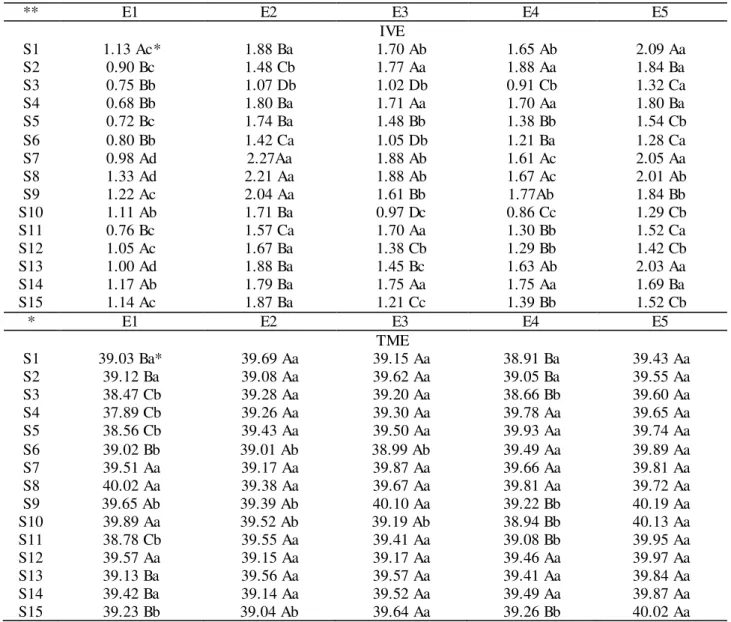
It was observed interaction between the environments and substrates for all variables by means of the F test (Table 5). In the interaction between substrates within the environments for ESI, the substrates that showed higher performance were those that contained at least 50% of vermiculite in their composition (S1, S7 and S8), promoting greater ESI in all cultivation environments (Table 6). Although the seedlings of the substrate S1 have showed higher ESI, in most of the measurements the plants exhibited the lowest heights (Tables 9 and 10).
It is possible that the substrates S1 and S7 may have contributed to the increasing ESI by promoting better physicochemical conditions and less resistance to emergence due to their weight since they were constituted with large proportions of vermiculite (75%). In fact, FERREIRA et al. (2010) referred to vermiculite as the responsible for the greater ESI observed in Rollinia mucosa
due to the greater balance between moisture and aeration of the substrate. In this sense, SILVA et al. (2009) showed that lightweight materials, such as carbonized rice husk, provided greater ESI in mangabeira. The proportion of vermiculite present in the substrate S2 (50%) also provided appropriate physical conditions for the soursop emergence, as well as the substrate S9 with a high percentage of cattle manure (75%) since the organic matter has the property of promoting greater water adsorption.
Among the environments, the greenhouse without thermal-reflective screen (E1) provided low ESI for all substrates (Table 6), which differs from the results obtained by SASSAQUI et al. (2013) in tamarind seedlings. On the other hand, the greenhouse with thermal-reflective screen (E2) promoted higher ESI (Table 6). SANTOS et al. (2011) compared a greenhouse with thermal-reflective screen (50% shading) under the polyethylene film (I) and a screened nursery with monofilament screen with 50% shading (II), and observed a higher ESI in the environment I to
Hymenaea stigonocarpa Mart. The environment E2 led to lower temperatures and higher relative
humidity when compared to the environment E1 (Table 2); these conditions favored the emergence of soursop in the environment E2 as observed by OLIVEIRA et al. (2009a) in seedlings of
Copernicia hospita Martius, reporting also that the greater seedling emergences may be related to
TABLE 6. Interaction between environments and substrates (E × S) for the emergence speed index (ESI) and mean germination time (MGT) of soursop.
** E1 E2 E3 E4 E5
IVE
S1 1.13 Ac* 1.88 Ba 1.70 Ab 1.65 Ab 2.09 Aa S2 0.90 Bc 1.48 Cb 1.77 Aa 1.88 Aa 1.84 Ba S3 0.75 Bb 1.07 Db 1.02 Db 0.91 Cb 1.32 Ca S4 0.68 Bb 1.80 Ba 1.71 Aa 1.70 Aa 1.80 Ba S5 0.72 Bc 1.74 Ba 1.48 Bb 1.38 Bb 1.54 Cb S6 0.80 Bb 1.42 Ca 1.05 Db 1.21 Ba 1.28 Ca S7 0.98 Ad 2.27Aa 1.88 Ab 1.61 Ac 2.05 Aa S8 1.33 Ad 2.21 Aa 1.88 Ab 1.67 Ac 2.01 Ab S9 1.22 Ac 2.04 Aa 1.61 Bb 1.77Ab 1.84 Bb S10 1.11 Ab 1.71 Ba 0.97 Dc 0.86 Cc 1.29 Cb S11 0.76 Bc 1.57 Ca 1.70 Aa 1.30 Bb 1.52 Ca S12 1.05 Ac 1.67 Ba 1.38 Cb 1.29 Bb 1.42 Cb S13 1.00 Ad 1.88 Ba 1.45 Bc 1.63 Ab 2.03 Aa S14 1.17 Ab 1.79 Ba 1.75 Aa 1.75 Aa 1.69 Ba S15 1.14 Ac 1.87 Ba 1.21 Cc 1.39 Bb 1.52 Cb
* E1 E2 E3 E4 E5
TME
S1 39.03 Ba* 39.69 Aa 39.15 Aa 38.91 Ba 39.43 Aa S2 39.12 Ba 39.08 Aa 39.62 Aa 39.05 Ba 39.55 Aa S3 38.47 Cb 39.28 Aa 39.20 Aa 38.66 Bb 39.60 Aa S4 37.89 Cb 39.26 Aa 39.30 Aa 39.78 Aa 39.65 Aa S5 38.56 Cb 39.43 Aa 39.50 Aa 39.93 Aa 39.74 Aa S6 39.02 Bb 39.01 Ab 38.99 Ab 39.49 Aa 39.89 Aa S7 39.51 Aa 39.17 Aa 39.87 Aa 39.66 Aa 39.81 Aa S8 40.02 Aa 39.38 Aa 39.67 Aa 39.81 Aa 39.72 Aa S9 39.65 Ab 39.39 Ab 40.10 Aa 39.22 Bb 40.19 Aa S10 39.89 Aa 39.52 Ab 39.19 Ab 38.94 Bb 40.13 Aa S11 38.78 Cb 39.55 Aa 39.41 Aa 39.08 Bb 39.95 Aa S12 39.57 Aa 39.15 Aa 39.17 Aa 39.46 Aa 39.97 Aa S13 39.13 Ba 39.56 Aa 39.57 Aa 39.41 Aa 39.84 Aa S14 39.42 Ba 39.14 Aa 39.52 Aa 39.49 Aa 39.87 Aa S15 39.23 Bb 39.04 Ab 39.64 Aa 39.26 Bb 40.02 Aa *Means followed by the same uppercase letters on columns and lowercase letters on rows do not differ by the Scott-Knott test at 5% probability; **E1 = greenhouse; E2 = greenhouse with a thermal-reflective screen under the film; E3 = screened nursery with monofilament screen; E4 = screened nursery with thermal-reflective screen; E5 = cultivation environment with native palm thatch. S1 = 25% H + 75% V; S2 = 50% H + 50% V; S3 = 75% H + 25% V; S4 = 25% H + 75% C; S5 = 50% H + 50% C; S6 = 75% H + 25% C; S7 = 25% M + 75% V; S8 = 50% M + 50% V; S9 = 75% M + 25% V; S10 = 25% M + 75% C; S11 = 50% M + 50% C; S12 = 75% M + 25% C; S13 = 33,3% H + 33,3% M + 33,3% V; S14 = 33,3% H + 33,3% M + 33,3% C; S15 = 25% H + 25% M + 25% V + 25% C.
The ESI varied from 37.89 (environment E1, substrate S4) to 40.19 days (environment E5, substrate S9), with an overall average of 39.42 days, showing small difference between substrates and environments. OLIVEIRA et al. (2005) observed that the temperature causes effect both on the percentage of germination and germination speed index in Annona montana; also, the optimum
Perhaps the low percentage of cassava branches (33.3% and 25%) in the substrates S14 and S15 has not interfered with the availability of nutrients for the seedlings, particularly potassium, which can be found in the concentration of 7 g kg−1 in cassava branches (Table 2). According to Barbosa et al. (2003), potassium is one of the nutrients required in higher proportio n to the aerial part of soursop seedlings up to 195 days after the polish out.
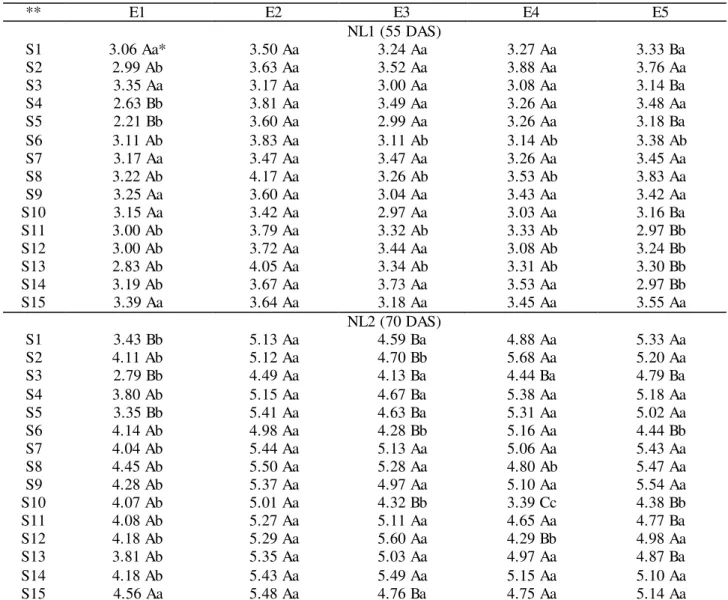
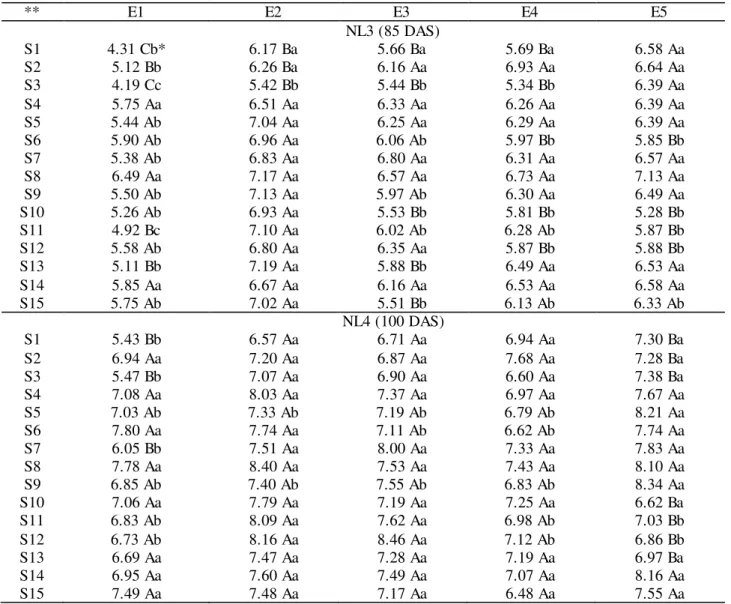
For the nursery with palm thatch (E5), the substrates S1, S2 and S3 promoted the lowest average number of leaves at 100 DAS (NL4) (Table 8). Combinations of cassava branches and cattle manure (S10, S11 and S12) provided a negative effect since, in general, seedlings cultivated in these substrates had lower average number of leaves for the four countings (Tables 7 and 8).
TABLE 7. Interaction between environments and substrates (E × S) for the number of leaves (NL) of soursop at 55 and 70 DAS.
** E1 E2 E3 E4 E5
NL1 (55 DAS)
S1 3.06 Aa* 3.50 Aa 3.24 Aa 3.27 Aa 3.33 Ba S2 2.99 Ab 3.63 Aa 3.52 Aa 3.88 Aa 3.76 Aa S3 3.35 Aa 3.17 Aa 3.00 Aa 3.08 Aa 3.14 Ba S4 2.63 Bb 3.81 Aa 3.49 Aa 3.26 Aa 3.48 Aa S5 2.21 Bb 3.60 Aa 2.99 Aa 3.26 Aa 3.18 Ba S6 3.11 Ab 3.83 Aa 3.11 Ab 3.14 Ab 3.38 Ab S7 3.17 Aa 3.47 Aa 3.47 Aa 3.26 Aa 3.45 Aa S8 3.22 Ab 4.17 Aa 3.26 Ab 3.53 Ab 3.83 Aa S9 3.25 Aa 3.60 Aa 3.04 Aa 3.43 Aa 3.42 Aa S10 3.15 Aa 3.42 Aa 2.97 Aa 3.03 Aa 3.16 Ba S11 3.00 Ab 3.79 Aa 3.32 Ab 3.33 Ab 2.97 Bb S12 3.00 Ab 3.72 Aa 3.44 Aa 3.08 Ab 3.24 Bb S13 2.83 Ab 4.05 Aa 3.34 Ab 3.31 Ab 3.30 Bb S14 3.19 Ab 3.67 Aa 3.73 Aa 3.53 Aa 2.97 Bb S15 3.39 Aa 3.64 Aa 3.18 Aa 3.45 Aa 3.55 Aa
NL2 (70 DAS)
S1 3.43 Bb 5.13 Aa 4.59 Ba 4.88 Aa 5.33 Aa S2 4.11 Ab 5.12 Aa 4.70 Bb 5.68 Aa 5.20 Aa S3 2.79 Bb 4.49 Aa 4.13 Ba 4.44 Ba 4.79 Ba S4 3.80 Ab 5.15 Aa 4.67 Ba 5.38 Aa 5.18 Aa S5 3.35 Bb 5.41 Aa 4.63 Ba 5.31 Aa 5.02 Aa S6 4.14 Ab 4.98 Aa 4.28 Bb 5.16 Aa 4.44 Bb S7 4.04 Ab 5.44 Aa 5.13 Aa 5.06 Aa 5.43 Aa S8 4.45 Ab 5.50 Aa 5.28 Aa 4.80 Ab 5.47 Aa S9 4.28 Ab 5.37 Aa 4.97 Aa 5.10 Aa 5.54 Aa S10 4.07 Ab 5.01 Aa 4.32 Bb 3.39 Cc 4.38 Bb S11 4.08 Ab 5.27 Aa 5.11 Aa 4.65 Aa 4.77 Ba S12 4.18 Ab 5.29 Aa 5.60 Aa 4.29 Bb 4.98 Aa S13 3.81 Ab 5.35 Aa 5.03 Aa 4.97 Aa 4.87 Ba S14 4.18 Ab 5.43 Aa 5.49 Aa 5.15 Aa 5.10 Aa S15 4.56 Aa 5.48 Aa 4.76 Ba 4.75 Aa 5.14 Aa *Means followed by the same uppercase letters on columns and lowercase letters on rows do not differ by the Scott-Knott test at 5% probability; **E1 = greenhouse; E2 = greenhouse with a thermal-reflective screen under the film; E3 = screened nursery with monofilament screen; E4 = screened nursery with thermal-reflective screen; E5 = cultivation environment with native palm thatch. S1 = 25% H + 75% V; S2 = 50% H + 50% V; S3 = 75% H + 25% V; S4 = 25% H + 75% C; S5 = 50% H + 50% C; S6 = 75% H + 25% C; S7 = 25% M + 75% V; S8 = 50% M + 50% V; S9 = 75% M + 25% V; S10 = 25% M + 75% C; S11 = 50% M + 50% C; S12 = 75% M + 25% C; S13 = 33,3% H + 33,3% M + 33,3% V; S14 = 33,3% H + 33,3% M + 33,3% C; S15 = 25% H + 25% M + 25% V + 25% C.
Considering the environments within the substrates, there was no difference for the substrates S1, S3, S7, S9, S10 and S15 at 55 DAS, S15 at 70 DAS, S4, S8 and S14 at 85 DAS and S2, S4, S8, S10, S13, S14 and S15 at 100 DAS (Tables 7 and 8). In the other substrates, the greenhouse with thermal-reflective screen under the polyethylene film (E2) promoted plants with higher number of leaves in the four samples (55, 70, 85 and 100 DAS). The greenhouse without the thermal-reflective screen under the polyethylene film (E1) did not favor leaves production and in generally promoted the lowest counts in the four samples. The seedlings cultivated in the nurseries E3, E4 and E5 showed similar results to that found for the environment E2 (Tables 7 and 8).
It is possible that the different responses to the number of leaves are due to changes in physiological processes, respiration and photosynthesis, which are due to changes in the microclimate of the environment caused by variations in the configuration of their coverage (Costa et al., 2011b).
TABLE 8. Interaction between environments and substrates (E × S) for the number of leaves (NL) of soursop at 85 and 100 DAS.
** E1 E2 E3 E4 E5
NL3 (85 DAS)
S1 4.31 Cb* 6.17 Ba 5.66 Ba 5.69 Ba 6.58 Aa S2 5.12 Bb 6.26 Ba 6.16 Aa 6.93 Aa 6.64 Aa S3 4.19 Cc 5.42 Bb 5.44 Bb 5.34 Bb 6.39 Aa S4 5.75 Aa 6.51 Aa 6.33 Aa 6.26 Aa 6.39 Aa S5 5.44 Ab 7.04 Aa 6.25 Aa 6.29 Aa 6.39 Aa S6 5.90 Ab 6.96 Aa 6.06 Ab 5.97 Bb 5.85 Bb S7 5.38 Ab 6.83 Aa 6.80 Aa 6.31 Aa 6.57 Aa S8 6.49 Aa 7.17 Aa 6.57 Aa 6.73 Aa 7.13 Aa S9 5.50 Ab 7.13 Aa 5.97 Ab 6.30 Aa 6.49 Aa S10 5.26 Ab 6.93 Aa 5.53 Bb 5.81 Bb 5.28 Bb S11 4.92 Bc 7.10 Aa 6.02 Ab 6.28 Ab 5.87 Bb S12 5.58 Ab 6.80 Aa 6.35 Aa 5.87 Bb 5.88 Bb S13 5.11 Bb 7.19 Aa 5.88 Bb 6.49 Aa 6.53 Aa S14 5.85 Aa 6.67 Aa 6.16 Aa 6.53 Aa 6.58 Aa S15 5.75 Ab 7.02 Aa 5.51 Bb 6.13 Ab 6.33 Ab
NL4 (100 DAS)
S1 5.43 Bb 6.57 Aa 6.71 Aa 6.94 Aa 7.30 Ba S2 6.94 Aa 7.20 Aa 6.87 Aa 7.68 Aa 7.28 Ba S3 5.47 Bb 7.07 Aa 6.90 Aa 6.60 Aa 7.38 Ba S4 7.08 Aa 8.03 Aa 7.37 Aa 6.97 Aa 7.67 Aa S5 7.03 Ab 7.33 Ab 7.19 Ab 6.79 Ab 8.21 Aa S6 7.80 Aa 7.74 Aa 7.11 Ab 6.62 Ab 7.74 Aa S7 6.05 Bb 7.51 Aa 8.00 Aa 7.33 Aa 7.83 Aa S8 7.78 Aa 8.40 Aa 7.53 Aa 7.43 Aa 8.10 Aa S9 6.85 Ab 7.40 Ab 7.55 Ab 6.83 Ab 8.34 Aa S10 7.06 Aa 7.79 Aa 7.19 Aa 7.25 Aa 6.62 Ba S11 6.83 Ab 8.09 Aa 7.62 Aa 6.98 Ab 7.03 Bb S12 6.73 Ab 8.16 Aa 8.46 Aa 7.12 Ab 6.86 Bb S13 6.69 Aa 7.47 Aa 7.28 Aa 7.19 Aa 6.97 Ba S14 6.95 Aa 7.60 Aa 7.49 Aa 7.07 Aa 8.16 Aa S15 7.49 Aa 7.48 Aa 7.17 Aa 6.48 Aa 7.55 Aa *Means followed by the same uppercase letters on columns and lowercase letters on rows do not differ by the Scott-Knott test at 5% probability; **E1 = greenhouse; E2 = greenhouse with a thermal-reflective screen under the film; E3 = screened nursery with monofilament screen; E4 = screened nursery with thermal-reflective screen; E5 = cultivation environment with native palm thatch. S1 = 25% H + 75% V; S2 = 50% H + 50% V; S3 = 75% H + 25% V; S4 = 25% H + 75% C; S5 = 50% H + 50% C; S6 = 75% H + 25% C; S7 = 25% M + 75% V; S8 = 50% M + 50% V; S9 = 75% M + 25% V; S10 = 25% M + 75% C; S11 = 50% M + 50% C; S12 = 75% M + 25% C; S13 = 33,3% H + 33,3% M + 33,3% V; S14 = 33,3% H + 33,3% M + 33,3% C; S15 = 25% H + 25% M + 25% V + 25% C.
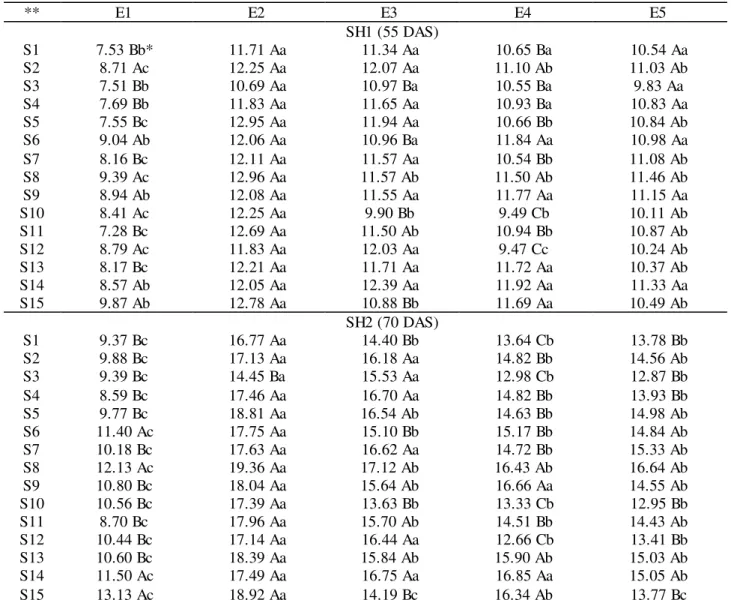
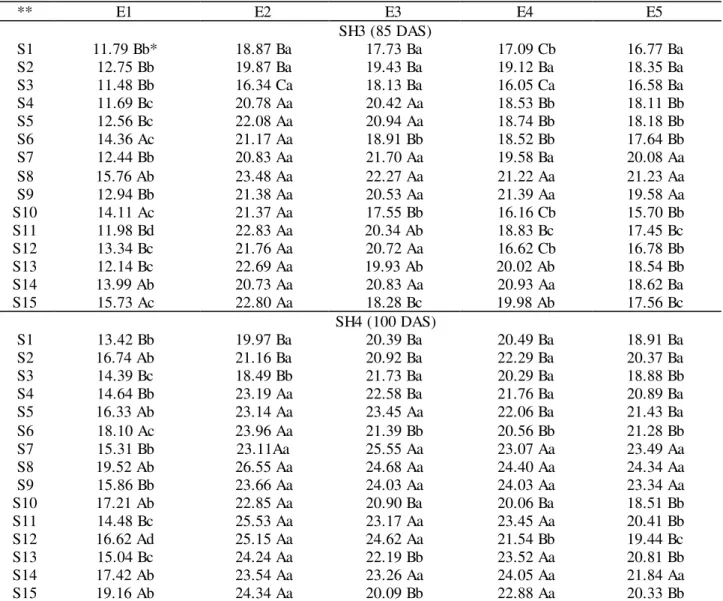
average at 55, 70, 85 and 100 DAS within the environment E1. In the environment E2, in general, only the combinations of humus and vermiculite (S1, S2 and S3) provided lower average height (Tables 9 and 10).
The lower heights due to the substrates S1, S4 and S7 may be associated with nutritional insufficiency caused by high concentration of vermiculite (S1 and S7) and cassava branches (S7), all with the proportion of 75%. COSTA et al. (2005) observed that the substrates containing vermiculite or vermiculite + carbonized rice husk provided soursop rootstock with low development since it is likely that these components are exempt from appropriate nutritional content for the plant development.
In the environments E3 and E4, the substrates formulated with cattle manure (from S7 to S15), in general, promoted higher average plant height, indicating that this material may be suitable for the formation of seedlings. Soursop propagated in substrates with cattle manure and vermiculite (S7, S8 and S9) presented higher average height in the environment E5 (Tables 9 and 10).
TABLE 9. Interaction between environments and substrates (E × S) for the seedling height (SH) of soursop at 55 and 70 DAS.
** E1 E2 E3 E4 E5
SH1 (55 DAS)
S1 7.53 Bb* 11.71 Aa 11.34 Aa 10.65 Ba 10.54 Aa S2 8.71 Ac 12.25 Aa 12.07 Aa 11.10 Ab 11.03 Ab S3 7.51 Bb 10.69 Aa 10.97 Ba 10.55 Ba 9.83 Aa S4 7.69 Bb 11.83 Aa 11.65 Aa 10.93 Ba 10.83 Aa S5 7.55 Bc 12.95 Aa 11.94 Aa 10.66 Bb 10.84 Ab S6 9.04 Ab 12.06 Aa 10.96 Ba 11.84 Aa 10.98 Aa S7 8.16 Bc 12.11 Aa 11.57 Aa 10.54 Bb 11.08 Ab S8 9.39 Ac 12.96 Aa 11.57 Ab 11.50 Ab 11.46 Ab S9 8.94 Ab 12.08 Aa 11.55 Aa 11.77 Aa 11.15 Aa S10 8.41 Ac 12.25 Aa 9.90 Bb 9.49 Cb 10.11 Ab S11 7.28 Bc 12.69 Aa 11.50 Ab 10.94 Bb 10.87 Ab S12 8.79 Ac 11.83 Aa 12.03 Aa 9.47 Cc 10.24 Ab S13 8.17 Bc 12.21 Aa 11.71 Aa 11.72 Aa 10.37 Ab S14 8.57 Ab 12.05 Aa 12.39 Aa 11.92 Aa 11.33 Aa S15 9.87 Ab 12.78 Aa 10.88 Bb 11.69 Aa 10.49 Ab
SH2 (70 DAS)
The high concentration of cassava branches (75%) in the substrates S4 and S10 may have reduced the moisture retention capacity due to the higher percentage of macropores, causing low size seedlings. The increase of macropores may be related to the particle size of the branches; in fact, COSTA et al. (2011a) observed that more than 50% of milled cassava branches were retained in sieves with mesh of 2 mm.
According to BARBOSA et al. (2003), the soursop has low initial growth, with average fortnightly growth rates of 3.3 cm. In this study, from the beginning of the biweekly height measurements (55 DAS), the average increase of the seedlings were similar to those described by BARBOSA et al. (2003) in the substrates S6 and S15, with 3.02 and 3.09 cm in the environment E1. The substrate S8 provided average increase above 4.00 cm in the environments E2, E3, E4 and E5.
TABLE 10. Interaction between environments and substrates (E × S) for the seedling height (SH) of soursop at 85 and 100 DAS.
** E1 E2 E3 E4 E5
SH3 (85 DAS)
S1 11.79 Bb* 18.87 Ba 17.73 Ba 17.09 Cb 16.77 Ba S2 12.75 Bb 19.87 Ba 19.43 Ba 19.12 Ba 18.35 Ba S3 11.48 Bb 16.34 Ca 18.13 Ba 16.05 Ca 16.58 Ba S4 11.69 Bc 20.78 Aa 20.42 Aa 18.53 Bb 18.11 Bb S5 12.56 Bc 22.08 Aa 20.94 Aa 18.74 Bb 18.18 Bb S6 14.36 Ac 21.17 Aa 18.91 Bb 18.52 Bb 17.64 Bb S7 12.44 Bb 20.83 Aa 21.70 Aa 19.58 Ba 20.08 Aa S8 15.76 Ab 23.48 Aa 22.27 Aa 21.22 Aa 21.23 Aa S9 12.94 Bb 21.38 Aa 20.53 Aa 21.39 Aa 19.58 Aa S10 14.11 Ac 21.37 Aa 17.55 Bb 16.16 Cb 15.70 Bb S11 11.98 Bd 22.83 Aa 20.34 Ab 18.83 Bc 17.45 Bc S12 13.34 Bc 21.76 Aa 20.72 Aa 16.62 Cb 16.78 Bb S13 12.14 Bc 22.69 Aa 19.93 Ab 20.02 Ab 18.54 Bb S14 13.99 Ab 20.73 Aa 20.83 Aa 20.93 Aa 18.62 Ba S15 15.73 Ac 22.80 Aa 18.28 Bc 19.98 Ab 17.56 Bc
SH4 (100 DAS)
S1 13.42 Bb 19.97 Ba 20.39 Ba 20.49 Ba 18.91 Ba S2 16.74 Ab 21.16 Ba 20.92 Ba 22.29 Ba 20.37 Ba S3 14.39 Bc 18.49 Bb 21.73 Ba 20.29 Ba 18.88 Bb S4 14.64 Bb 23.19 Aa 22.58 Ba 21.76 Ba 20.89 Ba S5 16.33 Ab 23.14 Aa 23.45 Aa 22.06 Ba 21.43 Ba S6 18.10 Ac 23.96 Aa 21.39 Bb 20.56 Bb 21.28 Bb S7 15.31 Bb 23.11Aa 25.55 Aa 23.07 Aa 23.49 Aa S8 19.52 Ab 26.55 Aa 24.68 Aa 24.40 Aa 24.34 Aa S9 15.86 Bb 23.66 Aa 24.03 Aa 24.03 Aa 23.34 Aa S10 17.21 Ab 22.85 Aa 20.90 Ba 20.06 Ba 18.51 Bb S11 14.48 Bc 25.53 Aa 23.17 Aa 23.45 Aa 20.41 Bb S12 16.62 Ad 25.15 Aa 24.62 Aa 21.54 Bb 19.44 Bc S13 15.04 Bc 24.24 Aa 22.19 Bb 23.52 Aa 20.81 Bb S14 17.42 Ab 23.54 Aa 23.26 Aa 24.05 Aa 21.84 Aa S15 19.16 Ab 24.34 Aa 20.09 Bb 22.88 Aa 20.33 Bb *Means followed by the same uppercase letters on columns and lowercase letters on rows do not differ by the Scott-Knott test at 5% probability; **E1 = greenhouse; E2 = greenhouse with a thermal-reflective screen under the film; E3 = screened nursery with monofilament screen; E4 = screened nursery with thermal-reflective screen; E5 = cultivation environment with native palm thatch. S1 = 25% H + 75% V; S2 = 50% H + 50% V; S3 = 75% H + 25% V; S4 = 25% H + 75% C; S5 = 50% H + 50% C; S6 = 75% H + 25% C; S7 = 25% M + 75% V; S8 = 50% M + 50% V; S9 = 75% M + 25% V; S10 = 25% M + 75% C; S11 = 50% M + 50% C; S12 = 75% M + 25% C; S13 = 33,3% H + 33,3% M + 33,3% V; S14 = 33,3% H + 33,3% M + 33,3% C; S15 = 25% H + 25% M + 25% V + 25% C.
screen (E3) provided results similar to those observed in the environment E2 at 100 DAS (SH4). The greenhouse without thermal-reflective screen (E1) promoted lower height within all substrates in all measurements (Tables 9 and 10).
Seedlings cultivated in environments which provided greater shading (E2, E3, E4 and E5) presented, in general, greater height when compared to those cultivated in the environment covered only with polyethylene (E1). The attenuation of light stimulates adaptive mechanisms and causes increased growth of the seedlings.
It is possible that the low average in the height of seedlings observed in the greenhouse covered only with polyethylene film (E1) is associated with fewer leaves and consequently lower leaf area and lower photosynthetic activity. As observed by CAMPOS et al. (2008), soursop plants containing more leaves showed greater height probably caused by more intense photosynthetic activity.
CONCLUSIONS
The greenhouse with thermal-reflective screen under the film provides proper development to the seedlings and it is the most appropriate for soursop.
Combinations of cattle manure and vermiculite favor the development of soursop seedlings. High concentrations of vermiculite and cassava branches are not indicated for the development of soursop seedlings.
ACKNOWLEDGEMENTS
The authors want to thank for scholarship on Research Produtivity granted by CNPq(proc. nº 300829/2012-4); and by FUNDECT (proc. nº 23/200.647/2012 - Call Notice FUNDECT/ CNPq No. 05/2011 - Program of First Projects - PPP); as well as CAPES for Master scholarships granted to the second and third authors.
REFERENCES
BANZATTO, D.A.; KRONKA, S.N. Experimentação agrícola. 3. ed. Jaboticabal: Funep, 2006. 247 p.
BARBOSA, Z.; SOARES, I.; CRISÓSTOMO, L.A. Crescimento e absorção de nutrientes por mudas de gravioleira. Revista Brasileira de Fruticultura, Jaboticabal, v.25, n.3, p.519-522, dez. 2003.
CAMPOS, M.C.C.; MARQUES, F.J.; LIMA, A.G.; MENDONÇA, R.M.N. Crescimento de porta-enxerto de gravioleira (Annona muricata, L.) em substrato contendo doses crescentes de rejeitos de
caulim. Revista de Biologia e Ciências da Terra, Campina Grande, v.8, n.1, p.61-66, 2008.
CAVALCANTE, T.R.M.; NAVES, R.V.; SERAPHIN, J.C.; CARVALHO, G. D. Diferentes ambientes e substratos na formação de mudas de araticum. Revista Brasileira de Fruticultura,
Jaboticabal, v.30, n.1, p.235-240, mar. 2008.
COSTA, A.M.G.; COSTA, J.T.A.; CAVALCANTI JUNIOR, A. T.; CORREIA D.; MEDEIROS FILHO, S. Influência de diferentes combinações de substratos na formação de porta-enxertos de gravioleira (Annona muricata L.). Revista Ciência Agronômica, Fortaleza, v.36, n.3, p.299-305,
2005.
COSTA, E.; DURANTE, L.G.Y.; NAGEL, P.L.; FERREIRA, C. R.; SANTOS, A. Qualidade de mudas de berinjela submetida a diferentes métodos de produção. Revista Ciência Agronômica, Fortaleza, v.42, n.4, p.1017-1025, out-dez. 2011a.
COSTA, E.; LEAL, P.A.M.; REGO, N.H.; BENATTI, J. Desenvolvimento inicial de mudas de jatobazeiro do cerrado em Aquidauana-MS. Revista Brasileira de Fruticultura, Jaboticabal, v. 33, n.1, p.215-226, mar. 2011c.
COSTA, E.; LEAL, P.A.M.; SASSAQUI, A.R.; GOMES, V.A. Doses de composto orgânico comercial na composição de substratos para a produção de mudas de maracujazeiro em diferentes tipos de cultivo protegido. Engenharia Agrícola, Jaboticabal, v.30, n.5, p.776-787, set./out. 2010.
COSTA, E. RODRIGUES, E.T.; ALVES, V.B.; SANTOS, L.C.R.; VIEIRA, L.C.R. Efeitos da ambiência, recipientes e substratos no desenvolvimento de mudas de maracujazeiro-amarelo em Aquidauana-MS. Revista Brasileira de Fruticultura, Jaboticabal, v.31, n.1, p.236-244, mar. 2009. FERREIRA, D.F. SISVAR - Sistema de análise de variância. Versão 5.3. Lavras: UFLA, 2010. FERREIRA, M.G.R.; SANTOS, M.R.A.; SILVA, E.O.; GONÇALVES, E.P.; ALVES, E.U.;
BRUMO, R. L. A. Emergência e crescimento inicial de plântulas de biribá (Rollinia mucosa (Jacq.)
Baill) (Annonaceae) em diferentes substratos. Semina: Ciências Agrárias, Londrina, v.31, n.2, p.373-380, abr./jun. 2010.
LIMA, R.L.S.; WEBER, O.B.; PEREIRA, W.E.; CORREIA, D.; SOFIATTI, V.; BRANDÃO, Z.N.; FERREIRA, G.B. Crescimento e teores de nutrientes em mudas de gravioleira cultivadas em seis substratos. Engenharia Ambiental, Espirito Santo do Pinhal, v.6, n.3, p.594-606, set./dez. 2009.
OKUMURA, H.H.; CAVALCANTE JÚNIOR, A.T.; COSTA, J.T. A.; CORREA, D. Fertilizantes minerais e orgânicos na formação de mudas enxertadas de gravioleira. Revista Ciência Agronômica, Fortaleza, v.39, n.4, p.590-596, out./dez. 2008.
OLIVEIRA, I.V.M.; ANDRADE, R.A.; MARTINS, A.B.G. Influência da temperatura na germinação de sementes de Annona montana. Revista Brasileira de Fruticultura, Jaboticabal,
v.27, n.2, p.344-345, ago. 2005.
OLIVEIRA, A.B.; MEDEIROS FILHO, S.; BEZERRA, A.M.E.; BRUNO, R.L.A. Emergência de plântulas de Copernicia hospita Martius em função do tamanho da semente, do substrato e
ambiente. Revista Brasileira de Sementes, Londrina, v.31, n.1, p.281-287, 2009a.
OLIVEIRA, L.C.; TAVARES, J.C.; RODRIGUES, G.S.O.; MARACAJÁ, P.B.; SILVA, M.L. Efeito de diferentes substratos na germinação de sementes e formação inicial de plântulas de graviola. Revista Verde, Mossoró, v.4, n.1, p.90-97, jan./mar. 2009b.
SANTOS, L.C.R.; COSTA, E.; LEAL, P.A.M.; NARDELLI, E.M.V.; SOUZA, G.S.A. Ambientes protegidos e substratos com doses de composto orgânico comercial e solo na formação de mudas de jatobazeiro em Aquidauana-MS. Engenharia Agrícola, Jaboticabal, v.31, n.2, p.249-259, mar./abr. 2011.
SASSAQUI, A.R.; TERENA, T.F.S.; COSTA, E. Protected environments and substrates for production of genipap seedlings. Acta Amazonica, Manaus, v.43, n.2, p.143-152, 2013.
SILVA, E.A.; MARUYAMA, W.I.; OLIVEIRA, A.C.; BARDIVIESSO, D.M. Efeito de diferentes substratos na produção de mudas de mangabeira (Hancornia speciosa). Revista Brasileira de Fruticultura, Jaboticabal, v.31, n.3, p.925-929, set. 2009.