_________________________
1 Engº Agrícola, Prof. Doutor, Universidade Estadual de Mato Grosso do Sul, Unidade de Cassilân dia, UEMS-UUC/Cassilândia-MS, Fone: (67) 3596-7600, [email protected]
2 Engº Agrônomo, Mestre, Universidade Estadual de Mato Grosso do Sul, Unidade de Aquidauana, UEMS-UUA/Aquidauana-MS, [email protected]
3
SOURSOP SEEDLINGS: BIOMASSES AND BIOMETRIC RELATIONS IN DIFFERENT FARMING ENVIRONMENTS AND SUBSTRATES – PART II
Doi:http://dx.doi.org/10.1590/1809-4430-Eng.Agric.v36n2p 229-241/2016
EDÍLSON COSTA1, ADRIANO R. SASSAQUI2, ANNE K. DA SILVA3, NORTON H. REGO4, BRUNA G. FINA5
ABSTTRACT: The quality of seedling is critical to obtain vigorous plants in the field. The present study aimed to assess biomasses and biometric relations of soursop seedlings. We used different substrates in protected environments. The experiment was performed at the Universidade Estadual do Mato Grosso do Sul (UFMS) (State University of Mato Grosso do Sul). Five farming
environments were developed in greenhouses: one covered with low-density polyethylene film (LDPE), another with with polyethylene and heat-reflective cloth under film under 50% shading in aluminized color, monofilament cloth under 50% shading in black, thermo-reflective cloth under 50% shading in aluminized color, and an environment covered with bacuri coconut straw. Substrates were made of manure, humus, cassava branches and vermiculite at different proportions. Each of them varying from 25%, 33.3%, 50% and 75% in mixture combination. Each environme nt was considered an experiment. A completely randomized design was adopted and later a joint analysis of them. Agricultural greenhouse covered with LDPE and thermo-reflective cloths under 50% of shading, proportionated seedlings with greater biomass. Substrates containing manure are the most suitable for soursop seedlings. High percentages of earthworm humus produce low quality soursop seedlings. Soursop seedlings had a Dickson’s quality index around 0.335. The greenhouse covered only with LDPE film did not produce high quality seedlings.
KEYWORDS:Annona muricata, manure, cassava branches.
MUDAS DE GRAVIOLEIRA: BIOMASSAS E RELAÇÕES BIOMÉTRICAS SOB DIFERENTES AMBIENTES DE CULTIVO E SUBSTRATOS - PARTE II
RESUMO: A qualidade da muda é fundamental para obtenção de plantas vigorosas no campo. Desta forma, o presente trabalho teve como objetivo avaliar as biomassas e as relações biométricas de mudas de gravioleira, em diferentes substratos, no interior de ambientes protegidos. O experimento foi conduzido na Universidade Estadual de Mato Grosso do Sul, onde foram empregados cinco ambientes de cultivo: estufa agrícola coberta com filme de polietileno de baixa densidade (PEBD); estufa agrícola coberta com PEBD e tela termorrefletora sob o filme de 50% de sombreamento na cor aluminizada; telado de tela de monofilamento de 50% de sombreamento na cor preta; telado de tela termorrefletora de 50% de sombreamento na cor aluminizada; e ambiente coberto com palha de coqueiro-bacuri. Os substratos foram constituídos por esterco bovino, húmus, ramas de mandioca e vermiculita em diferentes proporções, variando de 25%, 33,3%, 50% e 75% cada um deles, na combinação da mistura. Cada ambiente foi considerado um experimento, sendo adotado o delineamento inteiramente casualizado e, posteriormente, a análise conjunta dos mesmos. A estufa agrícola coberta com PEBD, com tela termorrefletora de 50% de sombreamento sob o filme propiciou mudas com maiores biomassas. Os substratos contendo esterco bovino são os mais indicados para mudas de gravioleira. Altas porcentagens de húmus de minhoca produzem mudas de gravioleira com baixa qualidade. Mudas de gravioleira apresenta m índice de qualidade de Dickson em torno de 0,335. A estufa agrícola coberta apenas com filme de polietileno de baixa densidade não promoveu mudas de alta qualidade.
INTRODUCTION
Annonaceae family includes approximately 75 genera and 600 species. The most
economically important genera are Anonna and Rollinia. Soursop (Annona muricata L.) spreads
along tropical and subtropical areas. It is originally from Central America and North of South America (BRAGA SOBRINHO, 2014). These fruits are designated for consume in natura and for
agroindustry (COSTA et al., 2005).
According to COSTA et al. (2005), the increased demand for soursop has driven the expansion of new cultivated areas. It determines the need for technological studies in all productive segments (OLIVEIRA et al., 2009). Quality of seedlings is an important factor within the production phases. It influences the settlement of orchards, and intervene in production costs, survival, development and production (BARBOSA et al., 2003).
In this context, high quality seedling production requires alternative elements for substrate composition that meet the requirements of soursop seedlings (OKUMURA et al., 2008). According to LIMA et al. (2009) and OKUMURA et al. (2008), nutritional balance of substrates is critical for development of soursop seedlings.
Chemical properties (organic matter, macro and micronutrients, carbon/nitrogen ratio, pH and electrical conductivity) and physical properties (macro, micro and total porosity, density and water retention) can be dramatically changed depending on the concentration and the element used in substrate (GUERRINI & TRIGUEIRO, 2004). NEGREIROS et al. (2004) affirm that soursop rootstock respond positively on substrates made from cattle manure, soil, sand and vermiculite (2:1:1:1 v/v). It happens because of better balance of the chemical and physical characteristics of the substrate.
Another important requirement in seedling formation are configuration variations of growing environments. According to GUISELINI et al. (2010), protected environments can promote increased production and health of plants, allowing production in the off-season. COSTA et al. (2011a), however, reveal that the different materials used in environments may change biometric characteristics of seedlings. COSTA et al. (2010) show that the indoor environment with light diffuser polyethylene film promoted greater height, shoot and root dry mass. Compared with environments covered with monofilament film and aluminized cloth, COSTA et al. (2009) found that black cloth 50% shading showed larger passion fruit seedlings than the plastic greenhouse did. COSTA et al. (2015) observed larger Baru trees with higher biomass in greenhouses with black cloth on the roof and on the sides. They were compared to greenhouses with aluminized cloth on the roof and black cloth on the side. The last one did not show results as great as the first o ne. In jatoba, seedlings grown under shade of 0.30 and 50% were observed higher levels of chlorophyll in plants at 30% and less photosynthesis at 0% shading (PIEREZAN et al., 2012). Greenhouse covered with low-density polyethylene and nursery with black shade cloth formed the best genipap seedlings, compared to the nursery covered with buriti straw (SASSAQUI et al., 2013).
Given the above, this study aimed to evaluate the effect of protected environments and substrates on biomass, as well as biometric relations of soursop seedlings.
MATERIAL AND METHODS
Soursop seedlings (Annona muricata L.) were formed in a nursery located at the Universidade Estadual do Mato Grosso do Sul (UEMS) (State University of Matro Grosso do Sul), campus in
Aquiduana (altitude of 174 m, 20º 20' S latitude and 55º 48' W longitude). The area lies on the interface area between Cerrado and Pantanal biomes. The experiment was carried between January and April of 2012. The climate is sub-humid, tropical and warm, with rainy seasons in summer and dry seasons in winter. Rainfall of 1.200 mm and average annual temperature of 29º C.
under 50% shading, with arched ceiling format, having width of 8.0 m and length of 18.00 m, with ceiling height of 4.00 m; (A2) a greenhouse on galvanized structure, with ridge zenithal opening, covered with low-density polyethylene film (LDPE) of 15 µm and light diffuser; with front and side locks with monofilament black cloth under 50% shading, with arched ceiling format, having width of 8.0 m and length of 18.00 m, with ceiling height of 4.00 m, containing below the LDPE a heat-reflective cloth under 50% shading; (A3) roof farm nursery on galvanized structure with dimensions of 8.0 m wide, 18.00 m long and 3.50 m ceilings, covered, front and side closures in 45º angle, monofilament black cloth in 50% shading (Sombrite®); (A4) agricultural nursery on galvanized structure with dimensions of 8.0 m wide, 18.00 m long and 3.50 m ceilings, covered, front and side closures in 45º angle of heat-reflecting cloth on aluminized color, 50% shading (Aluminet®) and (A5) wooden structure nursery farm with dimensions of 3.00 m long, 1.20 m wide and 1.80 ceilings, covered with palm straw native in the area, popularly known as bacuri, side and front had no locks.
Soursop seeds were collected from trees in areas of Aquidauana city, State of Mato Grosso do Sul (MS), in November and December. We pulped the fruits and the seeds were separated. They were washed in water and dried in the shade for three days. To break dormancy, seeds were immersed in water at 25 ºC for 24 hours.
The branches of cassava were crushed in hammer mill (brand TRAPP, FRR 650 model) using 8 mm sieves. Later the sieves were placed in the open on canvas for composting during 60 days. They were wet daily and crimped every two days. After this procedure, we determined the geometric average particle diameter of 1.81 mm and 50.76% of particles were retained on a 2.0 mm sieve. We used commercial vermiculite of medium texture. The manure obtained in the region of Aquidauana city, MS State, was composted for 30 days. The earthworm humus was obtained from the company based in the city of Dois Irmãos do Buriti, MS State.
Sowing was held on January 6, 2012 in polyethylene bags, in which were placed three seeds per container at a depth of 2 cm. Forty-two days after sowing (DAS) we performed the thinning when seedlings presented two definitive leaves, leaving one plant per container.
Seeds were planted in polyethylene bags (15.0 x 21.5 cm) with 1.6 L capacity a nd filled with different substrates obtained from mixtures: earthworm humus (H), bovine manure (M), vermiculite (V) and cassava branches (C), as described in Table 1, and their respective chemical analysis (Table 2) and densities of substrates (Table 3).
TABLE 1. Substrates (S) derived from mixtures at various proportions: humus (H), manure (M), vermiculite (V) and cassava branches (C). Aquidauana - MS 2012.
Humus (H) + Vermiculite (V) Humus (H) + Cassava Branches (C)
S1 = 25% of H + 75% of V; S2 = 50% of H + 50% of V; S3 = 75% of H + 25% of V.
S4 = 25% of H + 75% of C; S5 = 50% of H + 50% of C; S6 = 75% of H + 25% of C.
Manure (M) + Vermiculite (V) Manure (M) + Cassava Branches (C)
S7 = 25% of M + 75% of V; S8 = 50% of M + 50% of V; S9 = 75% of M + 25% of V.
S10 = 25% of M + 75% of C; S11 = 50% of M + 50% of C; S12 = 75% of M + 25% of C. Humus (H) + Manure (M) + Vermiculite (V)
S13 = 33.3% of H + 33.3% of M + 33.3% of V Humus (H) + Manure (M) + Cassava Branches (C)
S14 = 33.3% of H + 33.3% of M + 33.3% of C
TABLE 2. Chemical analysis of organic materials of substrates used in treatments. Aquidauana - MS, 2012.
--- g kg-1 ---
* N P K Ca Mg S C OM
M 10.60 3.66 1.00 9.80 1.65 1.81 96.50 166.00
H 14.80 4.46 1.00 26.70 12.50 3.53 163.00 281.00
C 19.50 2.89 7.00 18.80 6.15 2.42 376.00 647.00
- - - ---mg kg-1 ---
pH RH C/N Cu Zn Fe Mn B
M 6.50 2.86 9.10 17.50 75.00 7800.00 310.00 11.47
H 6.90 13.46 11.01 30.00 130.00 14800.00 370.00 14.40
C 7.20 11.23 19.28 20.50 87.50 3440.00 520.00 20.70
* Solanalise, Laboratory of soil analysis in Cascavel, Paraná State, Brazil. OM = organic matter; RH = % humidity at 65º C; M = manure; H = earthworm humus; C = cassava branches; C/N = carbon and nitrogen ratio.
TABLE 3. Humid and dry substrate density. Aquidauana - MS, 2012. Density(kg.m-3)
S1** S2 S3 S4 S5 S6 S7 S8
Hd* 791.11 958.74 1104.50 931.50 1146.17 1229.06 648.14 741.17
Dd 279.83 479.71 500.62 273.65 502.11 648.20 209.47 270.36
S9 S10 S11 S12 S13 S14 S15 -
Hd 838.14 652.16 700.27 816.03 956.67 766.94 988.09 -
Dd 399.47 216.58 244.08 376.33 442.97 289.88 457.02 -
*Hd = Humid density; Dd = Dry density **S1 = 25% H + 75% V; S2 = 50% H + 50% V; S3 = 75% H + 25% V; S4 = 25% H + 75% C; S5 = 50% H + 50% C; S6 = 75% H + 25% C ; S7 = 25% M + 75% V; S8 = 50% M + 50% V; S9 = 75% M + 25% V; S10 = 25% M + 75% C; S11 = 50% M + 50% C; S12 = 75% M + 25% C; S13 = 33.3% H + 33.3% M + 33.3% V; S14 = 33.3% H + 33.3% M + 33.3% C; S15 = 25% H + 25% M + 25% V + 25% C.
Because there is no repetition of cultivation environments, each one was considered an experiment. In each environment, a completely randomized design was adopted with six repetitions of five seedlings each. Initially, data were submitted to analysis of individual variance of the substrate. Then performing the evaluation of the medium squares of residues and joint analysis of experiments (BANZATTO & KRONKA, 2013). We used the statistical program Sisvar 5.3 (FERREIRA, 2011), and the averages referred to the F test and compared by Scott-Knott test at 5% probability.
At 100 DAS were measured plant height (PH) and stem diameter (SD), shoot and root dry matter (SDM and RDM, respectively) and percentage of survival (S%). The masses were measured in an analytical balance after being dried in a greenhouse with forced air circulation, at the average temperature of 65º C until a consistent mass is obtained.
From the SDM and RDM, we obtained weight total dry matter (TDM). We determined height/ stem diameter ratio (H/ D), shoot/ root dry matter ratio (S/Rdm) and Dickson’s quality index
(DQI).
)
(
)
(
)
(
)
(
)
(
g
RDM
g
SDM
mm
SD
cm
PH
g
TDM
DQI
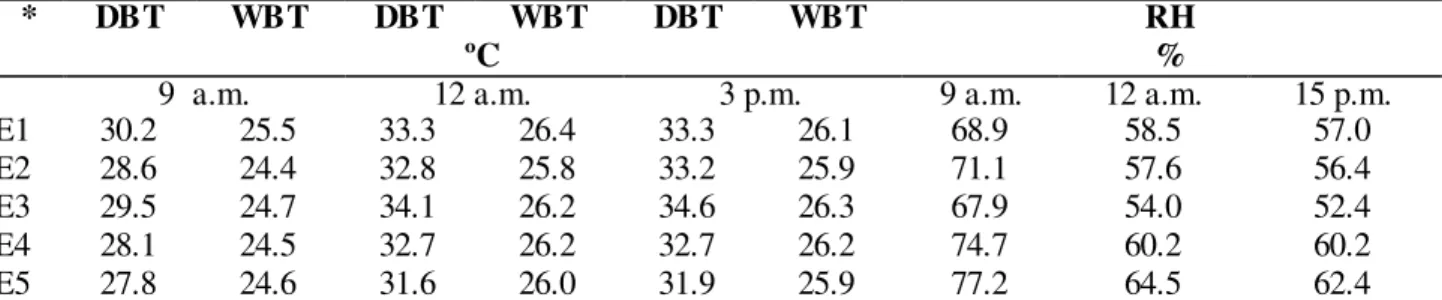
TABLE 4. Temperature (º C) and average relative humidity (%) at 9 a.m., 12 a.m., 3 p.m. for each environment (E), during the experiment. Aquidauana, from 01/07 to 04/13/2012.
* DBT WBT DBT WBT DBT WBT RH
ºC %
9 a.m. 12 a.m. 3 p.m. 9 a.m. 12 a.m. 15 p.m.
E1 30.2 25.5 33.3 26.4 33.3 26.1 68.9 58.5 57.0
E2 28.6 24.4 32.8 25.8 33.2 25.9 71.1 57.6 56.4
E3 29.5 24.7 34.1 26.2 34.6 26.3 67.9 54.0 52.4
E4 28.1 24.5 32.7 26.2 32.7 26.2 74.7 60.2 60.2
E5 27.8 24.6 31.6 26.0 31.9 25.9 77.2 64.5 62.4
* DBT = dry-bulb temperature (º C); WBT = wet-bulb temperature (º C); RH = relative humidity (%); (E1) greenhouse covered with low-density polyethylene film (LDPE); (E2) greenhouse covered with low-density polyethylene film and thermo-reflective cloth under 50% film shading in aluminized color; (E3) greenhouse monofilament cloth 50% shading in black color; (E4) cloth greenhouse heat-reflecting 50% shading in aluminized color; (E5) environment covered with bacuri coconut straw.
RESULTS AND DISCUSSION
To proceed with the joint analysis of experiments and comparison of cultivation environments, the division between the highest and the lowest average square of residues from individual variance analysis (substrates) within the enviro nments cannot exceed the approximate ratio of 7:1 (BANZATTO & KRONKA, 2013). In this study, the relations between average residue squares were lower than 7:1, which allows the implementation of joint analysis of the experiments and comparisons of environments (table 5).
TABLE 5. Analysis of variance with F calculated, coefficient of variation and ration between the highest and lowest average square for dry weight of shoot (RDM), total dry mass (TDM), percentage of survival (S %), height and diameter ratio (H/ D), shoot and root dry mass ratio (S/Rdm) and Dickson’s quality index (DQI) of soursop seedlings.
Aquidauana - MS, 2012.
SDM RDM TDM S % H/ D S/Rdm DQI
Environment 147.0** 122.0** 142.1** 59.6** 97.9** 122.3** 94.3**
Substrate 11.2** 8.9** 8.7** 18.9** 7.4** 17.0** 5.5**
Interaction 2.6** 2.4** 2.3** 3.8** 3.3** 4.3** 2.1**
RSMW 1.77 1.69 1.59 2.17 1.53 5.36 1.27
CV (%) 17.9 20.1 17.5 20.0 7.7 15.9 20.0
NS = Non-significant; * significant at 5%, ** significant at 1%; CV = Coefficient of variation; RSMW = Ratio of the average squares of maximum and minimum waste of different environmental conditions.
According to T test (table 5), we observed interaction between environments and substrates for all variables. Thus, we turned out interest to the developments and the responses of interactions.
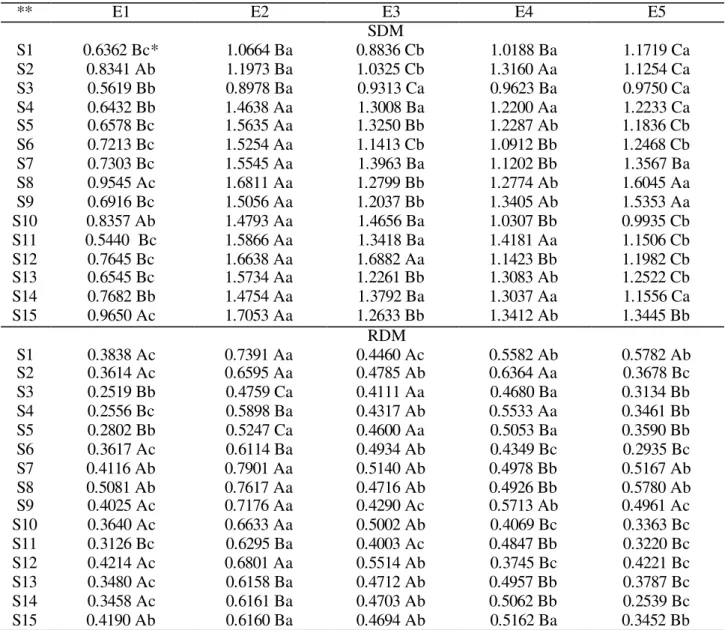
TABLE 6. Interaction between environments and substrates (E x S) for dry matter of the shoot (SDM) and the root system (RDM) of soursop seedlings at 100 DAS. Aquidauana - MS, 2012.
** E1 E2 E3 E4 E5
SDM
S1 0.6362 Bc* 1.0664 Ba 0.8836 Cb 1.0188 Ba 1.1719 Ca
S2 0.8341 Ab 1.1973 Ba 1.0325 Cb 1.3160 Aa 1.1254 Ca
S3 0.5619 Bb 0.8978 Ba 0.9313 Ca 0.9623 Ba 0.9750 Ca
S4 0.6432 Bb 1.4638 Aa 1.3008 Ba 1.2200 Aa 1.2233 Ca
S5 0.6578 Bc 1.5635 Aa 1.3250 Bb 1.2287 Ab 1.1836 Cb
S6 0.7213 Bc 1.5254 Aa 1.1413 Cb 1.0912 Bb 1.2468 Cb
S7 0.7303 Bc 1.5545 Aa 1.3963 Ba 1.1202 Bb 1.3567 Ba
S8 0.9545 Ac 1.6811 Aa 1.2799 Bb 1.2774 Ab 1.6045 Aa
S9 0.6916 Bc 1.5056 Aa 1.2037 Bb 1.3405 Ab 1.5353 Aa
S10 0.8357 Ab 1.4793 Aa 1.4656 Ba 1.0307 Bb 0.9935 Cb
S11 0.5440 Bc 1.5866 Aa 1.3418 Ba 1.4181 Aa 1.1506 Cb
S12 0.7645 Bc 1.6638 Aa 1.6882 Aa 1.1423 Bb 1.1982 Cb
S13 0.6545 Bc 1.5734 Aa 1.2261 Bb 1.3083 Ab 1.2522 Cb
S14 0.7682 Bb 1.4754 Aa 1.3792 Ba 1.3037 Aa 1.1556 Ca
S15 0.9650 Ac 1.7053 Aa 1.2633 Bb 1.3412 Ab 1.3445 Bb
RDM
S1 0.3838 Ac 0.7391 Aa 0.4460 Ac 0.5582 Ab 0.5782 Ab
S2 0.3614 Ac 0.6595 Aa 0.4785 Ab 0.6364 Aa 0.3678 Bc
S3 0.2519 Bb 0.4759 Ca 0.4111 Aa 0.4680 Ba 0.3134 Bb
S4 0.2556 Bc 0.5898 Ba 0.4317 Ab 0.5533 Aa 0.3461 Bb
S5 0.2802 Bb 0.5247 Ca 0.4600 Aa 0.5053 Ba 0.3590 Bb
S6 0.3617 Ac 0.6114 Ba 0.4934 Ab 0.4349 Bc 0.2935 Bc
S7 0.4116 Ab 0.7901 Aa 0.5140 Ab 0.4978 Bb 0.5167 Ab
S8 0.5081 Ab 0.7617 Aa 0.4716 Ab 0.4926 Bb 0.5780 Ab
S9 0.4025 Ac 0.7176 Aa 0.4290 Ac 0.5713 Ab 0.4961 Ac
S10 0.3640 Ac 0.6633 Aa 0.5002 Ab 0.4069 Bc 0.3363 Bc
S11 0.3126 Bc 0.6295 Ba 0.4003 Ac 0.4847 Bb 0.3220 Bc
S12 0.4214 Ac 0.6801 Aa 0.5514 Ab 0.3745 Bc 0.4221 Bc
S13 0.3480 Ac 0.6158 Ba 0.4712 Ab 0.4957 Bb 0.3787 Bc
S14 0.3458 Ac 0.6161 Ba 0.4703 Ab 0.5062 Bb 0.2539 Bc
S15 0.4190 Ab 0.6160 Ba 0.4694 Ab 0.5162 Ba 0.3452 Bb
* Uppercase letters in the same columns and lower lines for each parameter do not differ from each other by the Scott-Knott’s test at 5% probability; ** (E1) a greenhouse covered with low-density polyethylene film (LDPE); (E2) covered agricultural greenhouse and LDPE thermo-reflective cloth and 50% shading film in aluminized color; (E3) greenhouse monofilament cloth 50% shading in black color; (E4) cloth greenhouse heat-reflecting 50% shading in aluminized color; (E5) environment covered in bacuri coconut straw. S1 = 25% H + 75% V; S2 = 50% H + 50% V; S3 = 75% H + 25% V; S4 = 25% H + 75% C; S5 = 50% H + 50% C; S6 = 75% H + 25% C; S7 = 25% M + 75% V; S8 = 50% M + 50% V; S9 = 75% M + 25% V; S10 = 25% M + 75% C; S11 = 50% M + 50% C; S12 = 75% M + 25% C; S13 = 33.3% H + 33.3% M + 33.3% V; S14 = 33.3% H + 33.3% M + 33.3% C; S15 = 25% H + 25% M + 25% V + 25% C.
In general, high concentration of cassava raw substrate in S4, S5 and S10 may have interfered in low accumulation of SDM of plants. Because branches showed higher pH (7.2) (Table 2), and they did not provide nutrients for plants. PAIVA SOBRINHO et al. (2010) had higher biomass production for mangabeira in substrate containing lower pH (6.9). The values of nutrients of cassava branches available in Table 2 did not mean that they were available to seedlings. Because the average diameter of this material particles was 1.81 mm. This means the material was not completely mineralized.
Among cultivation environments, seedlings grown in a greenhouse with thermo-reflective cloth (E2) showed higher SDM than seedlings propagated in a greenhouse without heat-reflective cloth (E1) (Table 6). Because the cloth in the film led to lower temperatures and higher relative humidity (Table 2). This means better environmental conditions for development of soursop.
Possibly environmental settings in E2 environment, zenithal opening and 150-µm polyethylene film coverage associated with heat-reflecting cloth under 50% shading film, reduced solar radiation transmitted into the environment. Especially in higher intensity periods favoring SDM (COSTA et al., 2011a). According to GUISELINI et al. (2010), environment with low-density polyethylene diffuser film associated with thermo-reflective shade cloth enhances the attenuation of solar radiation inside environments.
Overall, environments E3, E4 and E5, all with shade cloth, had higher SDM than environment E1, which was covered only with low-density polyethylene film. Possibly the greatest attenuation of light in these environments allow better environmental conditions to plants and promote more growth, with greater accumulation of SDM.
For RDM variable, the substrates S3, S5 and S6 provided plants with low RDM (Table 6). Analyzing Table 3, we see that substrates S3 (500.6 kg.m-3), S5 (502.1 kg.m-3) and S6 (648.2 kg.m -3) presented high density, probably caused by high content of earthworm content (75%, 50% e 75%
respectively). According to ZORZETO et al. (2014) substrates with low porosity, that is, higher density must be used with caution. Because it brings problems allied to high water retention capacity and lack of oxygen for root development, for the movement of water and for drainage. Humus, besides having high contents of Zn and Fe, can ca use reduction of substrate aeration capacity, once macropore ratio also decreases and, consequently, RDM reduces. GUERRINI & TRIGUEIRO (2004) found higher density and smaller column of macropores on substrates with high doses of biosolid.
Substrates with vermiculite (S1, S2, S7, S8 e S9) caused increase of RDM in all environments (Table 6). Vermiculite may have favored chemical and physical conditions, as this mineral (clay type 2:1) is characterized by promoting greater exchange of cations and lower density of substrate. It happens as lower density allows greater radicular development with better nutrient absorption available with less restriction.
Analyzing biomass of soursop seedlings (RDM) by comparing the cultivation environments, we observe the largest accumulations of biomass in plants grown in E2 environment. For S2, S3, S4, S5 e S15 substrates, root biomass of plants in E2 environment did not differ from the ones in E4 environment (Table 6). Both environments (E2 and E4) had the heat-reflecting cloth that was very important for root development of soursop seedlings. Especially in the environment where the cloth was associated with polyethylene (E2). Overall, seedlings in environment covered only with polyethylene film (E1) and the ones in environment covered with straw (E5) showed low accumulation of RDM. Conditions of both environments (E1 and E5) were less favorable to the soursop development. Because in E5 environment, that did not have lateral cloth, plants were exposed to direct winds; and in environment E1, that had no shading cloth with the film, temperatures were more elevated and attenuation of solar radiation was smaller. It reflects lower root biomass accumulation.
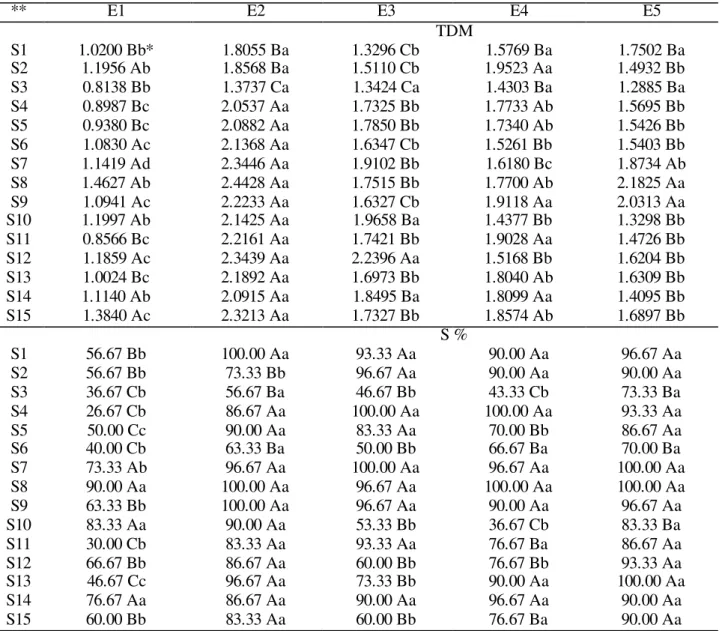
In TDM, substrates formulated with humus and vermiculite (S1, S2 and S3) resulted in plants with lower accumulation of total biomass (Table 7). Humus had great contents of Zn and Fe, besides other elements (Table 2). They could be causing phytotoxicity to soursop seedlings and, as consequence, providing lower biomass accumulation (Table 7).
Subtracts containing manure provided seedlings with high accumulation of total biomass (Table 7), and it is in accordance with NEGREIROS et al. (2004). They showed that, in general, for soursop seedlings, substrates containing manure provided the best seedlings, including biomass accumulation and root system formation.
Analyzing environments inside substrates, plants cultivated in E2 environment were among the ones that accumulated the highest TDM in all substrates (Table 7). The seedlings produced in A1 environment, however, showed lower absolute values of TDM. As previously reported, E2 environment promoted better environmental conditions than E1 environment, as well as greater accumulation of total biomass in soursop seedlings. Forty-five days after transplanting, equivalent to 105 days after the emergence, BARBOSA et al. (2003) verified in soursop seedlings the total biomass of 1.10 g. These results are inferior to the ones obtained in the best substrates and cultivation environments, 100 days after sowing, in the present study.
For variable survival percentage (S %), substrates containing 75% of earthworm humus (S3 and S6) promoted inferior results in all the environments (Table 7). These results can be related to two factors: high density of both substrates (Table 3) causing lower development capacity of roots and root aeration (GUERRINI & TRIGUEIRO, 2004) and high zinc content in earthworm humus (Table 2) providing toxicity and nutritional imbalance (SILVA & FARNEZI, 2009).
TABLE 7. Interaction between environments and substrates (E x S) total dry mass (TDM) and survival percentage (S %) of soursop at 100 DAS. Aquidauana - MS, 2012.
** E1 E2 E3 E4 E5
TDM
S1 1.0200 Bb* 1.8055 Ba 1.3296 Cb 1.5769 Ba 1.7502 Ba
S2 1.1956 Ab 1.8568 Ba 1.5110 Cb 1.9523 Aa 1.4932 Bb
S3 0.8138 Bb 1.3737 Ca 1.3424 Ca 1.4303 Ba 1.2885 Ba
S4 0.8987 Bc 2.0537 Aa 1.7325 Bb 1.7733 Ab 1.5695 Bb
S5 0.9380 Bc 2.0882 Aa 1.7850 Bb 1.7340 Ab 1.5426 Bb
S6 1.0830 Ac 2.1368 Aa 1.6347 Cb 1.5261 Bb 1.5403 Bb
S7 1.1419 Ad 2.3446 Aa 1.9102 Bb 1.6180 Bc 1.8734 Ab
S8 1.4627 Ab 2.4428 Aa 1.7515 Bb 1.7700 Ab 2.1825 Aa
S9 1.0941 Ac 2.2233 Aa 1.6327 Cb 1.9118 Aa 2.0313 Aa
S10 1.1997 Ab 2.1425 Aa 1.9658 Ba 1.4377 Bb 1.3298 Bb
S11 0.8566 Bc 2.2161 Aa 1.7421 Bb 1.9028 Aa 1.4726 Bb
S12 1.1859 Ac 2.3439 Aa 2.2396 Aa 1.5168 Bb 1.6204 Bb
S13 1.0024 Bc 2.1892 Aa 1.6973 Bb 1.8040 Ab 1.6309 Bb
S14 1.1140 Ab 2.0915 Aa 1.8495 Ba 1.8099 Aa 1.4095 Bb
S15 1.3840 Ac 2.3213 Aa 1.7327 Bb 1.8574 Ab 1.6897 Bb
S %
S1 56.67 Bb 100.00 Aa 93.33 Aa 90.00 Aa 96.67 Aa
S2 56.67 Bb 73.33 Bb 96.67 Aa 90.00 Aa 90.00 Aa
S3 36.67 Cb 56.67 Ba 46.67 Bb 43.33 Cb 73.33 Ba
S4 26.67 Cb 86.67 Aa 100.00 Aa 100.00 Aa 93.33 Aa
S5 50.00 Cc 90.00 Aa 83.33 Aa 70.00 Bb 86.67 Aa
S6 40.00 Cb 63.33 Ba 50.00 Bb 66.67 Ba 70.00 Ba
S7 73.33 Ab 96.67 Aa 100.00 Aa 96.67 Aa 100.00 Aa
S8 90.00 Aa 100.00 Aa 96.67 Aa 100.00 Aa 100.00 Aa
S9 63.33 Bb 100.00 Aa 96.67 Aa 90.00 Aa 96.67 Aa
S10 83.33 Aa 90.00 Aa 53.33 Bb 36.67 Cb 83.33 Ba
S11 30.00 Cb 83.33 Aa 93.33 Aa 76.67 Ba 86.67 Aa
S12 66.67 Bb 86.67 Aa 60.00 Bb 76.67 Bb 93.33 Aa
S13 46.67 Cc 96.67 Aa 73.33 Bb 90.00 Aa 100.00 Aa
S14 76.67 Aa 86.67 Aa 90.00 Aa 96.67 Aa 90.00 Aa
S15 60.00 Bb 83.33 Aa 60.00 Bb 76.67 Ba 90.00 Aa
* Uppercase letters in the same columns, and lower lines for each parameter, do not differ according to the Scott-Knott’s test at 5% probability; ** (E1) a greenhouse covered with low-density polyethylene film (LDPE); (E2) greenhouse covered with LDPE and thermo-reflective cloth and 50% shading film in aluminized color; (E3) greenhouse monofilament cloth 50% shading in aluminized color; (E5) environment covered with bacuri coconut straw; S1 = 25% H + 75% V; S2 = 50% H + 50% V; S3 = 75% H + 25% V; S4 = 25% H + 75% C; S5 = 50% H + 50% C; S6 = 75% H + 25% C; S7 = 25% M + 75% V; S8 = 50% M + 50% V; S9 = 75% M + 25% V; S10 = 25% M + 75% C; S11 = 50% M + 50% C; S12 = 75% M + 25% C; S13 = 33.3% H + 33.3% M + 33.3% V; S14 = 33.3% H + 33.3% M + 33.3% C; S15 = 25% H + 25% M + 25% V + 25% C.
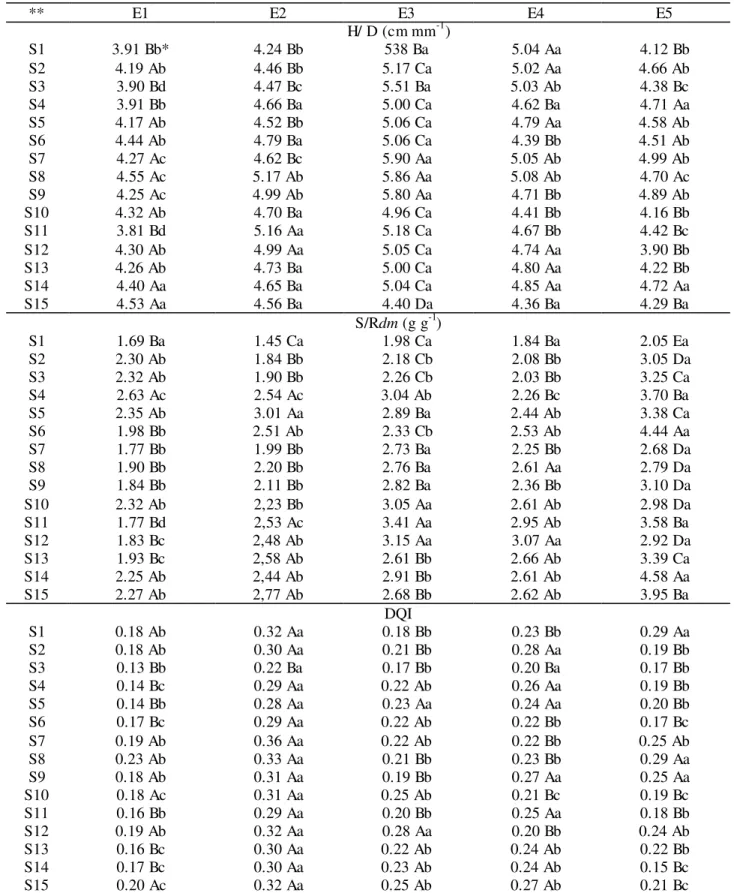
TABLE 8. Interaction between environments and substrates (E x S) for height/ diameter ratio (H/ D), shoot/root dry mass ratio (S/Rdm) and Dickson’s quality index (DQI) of soursop
seedlings at 100 DAS. Aquidauana - MS, 2012.
** E1 E2 E3 E4 E5
H/ D (cm mm-1)
S1 3.91 Bb* 4.24 Bb 538 Ba 5.04 Aa 4.12 Bb
S2 4.19 Ab 4.46 Bb 5.17 Ca 5.02 Aa 4.66 Ab
S3 3.90 Bd 4.47 Bc 5.51 Ba 5.03 Ab 4.38 Bc
S4 3.91 Bb 4.66 Ba 5.00 Ca 4.62 Ba 4.71 Aa
S5 4.17 Ab 4.52 Bb 5.06 Ca 4.79 Aa 4.58 Ab
S6 4.44 Ab 4.79 Ba 5.06 Ca 4.39 Bb 4.51 Ab
S7 4.27 Ac 4.62 Bc 5.90 Aa 5.05 Ab 4.99 Ab
S8 4.55 Ac 5.17 Ab 5.86 Aa 5.08 Ab 4.70 Ac
S9 4.25 Ac 4.99 Ab 5.80 Aa 4.71 Bb 4.89 Ab
S10 4.32 Ab 4.70 Ba 4.96 Ca 4.41 Bb 4.16 Bb
S11 3.81 Bd 5.16 Aa 5.18 Ca 4.67 Bb 4.42 Bc
S12 4.30 Ab 4.99 Aa 5.05 Ca 4.74 Aa 3.90 Bb
S13 4.26 Ab 4.73 Ba 5.00 Ca 4.80 Aa 4.22 Bb
S14 4.40 Aa 4.65 Ba 5.04 Ca 4.85 Aa 4.72 Aa
S15 4.53 Aa 4.56 Ba 4.40 Da 4.36 Ba 4.29 Ba
S/Rdm (g g-1)
S1 1.69 Ba 1.45 Ca 1.98 Ca 1.84 Ba 2.05 Ea
S2 2.30 Ab 1.84 Bb 2.18 Cb 2.08 Bb 3.05 Da
S3 2.32 Ab 1.90 Bb 2.26 Cb 2.03 Bb 3.25 Ca
S4 2.63 Ac 2.54 Ac 3.04 Ab 2.26 Bc 3.70 Ba
S5 2.35 Ab 3.01 Aa 2.89 Ba 2.44 Ab 3.38 Ca
S6 1.98 Bb 2.51 Ab 2.33 Cb 2.53 Ab 4.44 Aa
S7 1.77 Bb 1.99 Bb 2.73 Ba 2.25 Bb 2.68 Da
S8 1.90 Bb 2.20 Bb 2.76 Ba 2.61 Aa 2.79 Da
S9 1.84 Bb 2.11 Bb 2.82 Ba 2.36 Bb 3.10 Da
S10 2.32 Ab 2,23 Bb 3.05 Aa 2.61 Ab 2.98 Da
S11 1.77 Bd 2,53 Ac 3.41 Aa 2.95 Ab 3.58 Ba
S12 1.83 Bc 2,48 Ab 3.15 Aa 3.07 Aa 2.92 Da
S13 1.93 Bc 2,58 Ab 2.61 Bb 2.66 Ab 3.39 Ca
S14 2.25 Ab 2,44 Ab 2.91 Bb 2.61 Ab 4.58 Aa
S15 2.27 Ab 2,77 Ab 2.68 Bb 2.62 Ab 3.95 Ba
DQI
S1 0.18 Ab 0.32 Aa 0.18 Bb 0.23 Bb 0.29 Aa
S2 0.18 Ab 0.30 Aa 0.21 Bb 0.28 Aa 0.19 Bb
S3 0.13 Bb 0.22 Ba 0.17 Bb 0.20 Ba 0.17 Bb
S4 0.14 Bc 0.29 Aa 0.22 Ab 0.26 Aa 0.19 Bb
S5 0.14 Bb 0.28 Aa 0.23 Aa 0.24 Aa 0.20 Bb
S6 0.17 Bc 0.29 Aa 0.22 Ab 0.22 Bb 0.17 Bc
S7 0.19 Ab 0.36 Aa 0.22 Ab 0.22 Bb 0.25 Ab
S8 0.23 Ab 0.33 Aa 0.21 Bb 0.23 Bb 0.29 Aa
S9 0.18 Ab 0.31 Aa 0.19 Bb 0.27 Aa 0.25 Aa
S10 0.18 Ac 0.31 Aa 0.25 Ab 0.21 Bc 0.19 Bc
S11 0.16 Bb 0.29 Aa 0.20 Bb 0.25 Aa 0.18 Bb
S12 0.19 Ab 0.32 Aa 0.28 Aa 0.20 Bb 0.24 Ab
S13 0.16 Bc 0.30 Aa 0.22 Ab 0.24 Ab 0.22 Bb
S14 0.17 Bc 0.30 Aa 0.23 Ab 0.24 Ab 0.15 Bc
S15 0.20 Ac 0.32 Aa 0.25 Ab 0.27 Ab 0.21 Bc
Overall, A3 environment showed the greatest H/ D, it does not differ from other environments for other substrates. The shading of this environment, provided by black cloth under 50% shading, presented height growth of soursop seedlings that was not followed by the stretching and thickness of stem. Seedlings produced in A3 environment, however, may promote the bedding plant when transplanted in the field.
For ratio between dry matter mass of shoot and dry matter mass of root (S/Rdm), the quotient
obtained may indicate quality seedlings, ranging from one to three to obtain quality seedlings. Results higher than three for S/Rdm were observed in the indoor environment with monofilament
cloth (E3) associated with substrates containing cassava branches (S4, S10, S11 and S12), and in the environment with straw (E5) associated with substrates S2, S4, S5, S6, S9, S11, S13, S14 e S15 (Table 8), which were all composed by humus, except S9 and S11.
According to PEREIRA et al. (2010), the formula proposed by Dickson (DQI) is an important variable for evaluation of seedlings, because it considers SDM, RDM, AP and SD variables in a single variable. According to the authors, these variables combined into a single variable (DQI) show a balanced equation of phytomass distribution and seedling growth. The higher the value of DQI the greater the seedling quality. COSTA et al. (2011b) verified that DQI worked as quality indicator for jatoba seedlings. Substrates S7, S9 and S15 containing manure and vermiculite produced seedlings with high DQI (Table 8), showing high quality seedlings. Subtract composed by 75% humus and 25% vermiculite (S3), however, provided seedlings with lower DQI within all environments.
Seedling from E2 environment showed the highest values of DQI, when compared to other environments (Table 8). It indicates that high quality soursop seedlings can present DQI values of 0.30.
CONCLUSIONS
Greenhouse covered with LDPE, with thermo-reflective cloth 50% shading on the film provided seedlings with greater biomasses.
Substrates containing manure are the most suitable for soursop seedlings. High percentages of earthworm humus produce low quality soursop seedlings. Soursop seedlings have Dickson’s quality index around 0.335.
Greenhouse covered only with low-density polyethylene film did not produce high quality seedlings.
ACKNOWLEDGEMENTS
The authors want to thank for scholarship on Research Produtivity granted by CNPq(proc. nº 300829/2012-4); and by FUNDECT (proc. nº 23/200.647/2012 - Call Notice FUNDECT/ CNPq No. 05/2011 - Program of First Projects - PPP); as well as CAPES for Master scholarships granted to the second and third authors.
REFERENCES
BANZATTO, D.A.; KRONKA, S.N. Expe rimentação agrícola. 4. ed. Jaboticabal-SP: Funep, 2013. 237 p.
BARBOSA, Z.; SOARES, I.; CRISÓSTOMO, L.A. Crescimento e absorção de nutrientes por mudas de gravioleira. Revista Brasileira de Fruticultura, Jaboticabal, v.25, n.3, p.519-522, dez. 2003. doi: 10.1590/S0100-29452003000300039
COSTA, A.M.G.; COSTA, J.T.A.; CAVALCANTI JUNIOR, A. T.; CORREIA D.; MEDEIROS FILHO, S. Influência de diferentes combinações de substratos na formação de porta-enxertos de gravioleira (Annonamuricata L.). Revista Ciência Agronômica, Fortaleza, v.36, n.3, p.299-305,
2005. doi: 10.1590/S1413-70542004000300007
COSTA, E.; DIAS, J.G.; LOPES, K.G.; BINOTTI, F.F.S.; CARDOSO, E.D. Telas de
sombreamento e substratos na produção de mudas de Dipteryx alata Vog. Floresta e Ambiente,
Rio de Janeiro, v.22, n.3, p.416-425, 2015. doi: 0.1590/2179-8087.071714
COSTA, E.; LEAL, P.A.M.; QUEIROZ, C.A. Effects of protected environments on plant biometrics parameters. In: MATOVIC, D. (Org.). Biomass: detection, production and usage. Croatia: Intech, 2011a. v.1, p.305-320. Disponível em:
<http://www.intechopen.com/books/biomass-detection-production-and-usage/effects-of-protected-environments-on-plant-biometrics-parameters>. Acesso em: 20 set. 2015. doi: 10.5772/18043 COSTA, E.; LEAL, P.A.M.; REGO, N.H.; BENATTI, J. Desenvolvimento inicial de mudas de jatobazeiro do cerrado em Aquidauana-MS. Revista Brasileira de Fruticultura, Jaboticabal, v.33, n.1, p.215-226, mar. 2011b. doi: 10.1590/S0100-29452011005000035
COSTA, E.; LEAL, P.A.M.; SASSAQUI, A.R.; GOMES, V.A. Doses de composto orgânico comercial na composição de substratos para a produção de mudas de maracujazeiro em diferentes tipos de cultivo protegido. Engenharia Agrícola, Jaboticabal, v.30, n.5, p.776-787, set./out. 2010.
doi: 10.1590/S0100-69162010000500001
COSTA, E.; RODRIGUES E.T.; ALVES V.B.; SANTOS, L.C.R.; VIEIRA L.C. R. Efeitos da ambiência, recipientes e substratos no desenvolvimento de mudas de maracujazeiro-amarelo em Aquidauana – MS. Revista Brasileira de Fruticultura, Jaboticabal, v.31, n.1, p.236-244, 2009. doi: 10.1590/S0100-29452009000100033
COSTA, E.; SANTOS, L.C.R.; CARVALHO, C.; LEAL, P.A.M.; GOMES, V A. Volumes de substratos comerciais, solo e composto orgânico afetando a formação de mudas de maracujazeiro-amarelo em diferentes ambientes de cultivo. Revista Ceres, Viçosa, v.58, n.2, p.216-222, mar./abr. 2011c. doi: 10.1590/S0034-737X2011000200013
FERREIRA, D.F. Sisvar: a computer statistical analysis system. Ciência e Agrotecnologia, v.35, n.6, p.1039-1042, 2011. doi: 10.1590/S1413-70542011000600001
GUERRINI, I.A.; TRIGUEIRO, R.M. Atributos físicos e químicos de substratos compostos por biossólidos e casca de arroz carbonizada. Revista Brasileira de Ciência do Solo, Viçosa, v.28, n.6, p.1069-1076, 2004. doi: 10.1590/S0100-06832004000600016
GUISELINI, C.; SENTELHAS, P.C.; PANDORFI, H.; HOLCMAN, E. Manejo da cobertura de ambientes protegidos: Radiação solar e seus efeitos na produção de gérbera. Revista Brasileira de Engenharia Agrícola e Ambiental, Campina Grande, v.14, n.6, p.645-652, 2010. doi:
10.1590/S1415-43662010000600011
LIMA, R.L.S.; WEBER, O.B.; PEREIRA, W.E.; CORREIA, D.; SOFIATTI, V.; BRANDÃO, Z.N.; FERREIRA, G.B. Crescimento e teores de nutrientes em mudas de gravioleira cultivadas em seis substratos. Engenharia Florestal, Espírito Santo do Pinhal, v.6, n.3, p.594-606, set/dez. 2009. MARQUES, M.C.; NASCIMENTO, C.W.A. Tolerância de mamona a zinco avaliada por
fluorescência de clorofila e nutrição das plantas. Revista Brasileira de Ciência do Solo, Viçosa, v.38, n.3, p.850-857, maio/jun. 2014. doi: 10.1590/S0100-06832014000300016.
NEGREIROS, J.R.S.; BRAGA, L.R.; ÁLVARES, V.S.; BRUCKNER, C.H. Influência de substratos na formação de porta-enxerto de gravioleira (Annona muricata L.). Ciência e
Agrotecnologia, Lavras, v.28, n.3, p.530-536, maio/jun. 2004. doi:
OKUMURA, H.H.; CAVALCANTE JÚNIOR, A.T.; COSTA, J.T.A.; CORREA, D. Fertilizantes minerais e orgânicos na formação de mudas enxertadas de gravioleira. Revista Ciência
Agronômica, Fortaleza, v.39, n.4, p.590-596, out./dez. 2008.
OLIVEIRA, L. C.; TAVARES, J. C.; RODRIGUES, G. S. O.; MARACAJÁ, P. B.; SILVA, M. L. Efeitos de diferentes substratos na germinação de sementes e formação inicial de plântulas de graviola. Revista Verde, Pombal, v.4, n.1, p.90-97, jan./mar. 2009.
PAIVA SOBRINHO, S.; LUZ, P.B.; SILVEIRA, T.L.S.; RAMOS, D.T.; NEVES, L.G.; BARELLI, M.A.A. Substratos na produção de mudas de três espécies arbóreas do cerrado. Revista Brasileira de Ciências Agrárias, Recife, v.5, n.2, p.238-243, 2010. doi: 10.5039/agraria.v5i2a741
PEREIRA, P.C.; MELO, B.; FREITAS, R.S.; TOMAZ, M.A.; TEIXEIRA, I.R. Tamanho de recipientes e tipos de substrato na qualidade de mudas de tamarindeiro. Revista Verde, Pombal, v.5, n.3, p.136-142, jun./set. 2010.
PIEREZAN, L.; SCALON, S.P.Q.; PEREIRA, Z.V. Emergência de plântulas e crescimento de mudas de jatobá com uso de bioestimulante e sombreamento. Cerne, Lavras, v.18, n.1, p.127-133, 2012. doi: 10.1590/S0104-77602012000100015
SASSAQUI, A.R.; TERENA, T.F.S.; COSTA, E. Protected environments and substrates for production of genipap seedlings. Acta Amazonica, Manaus, v.43, n.2, p.143-152, 2013. doi: 10.1590/S0044-59672013000200003
SILVA, E.B.; FARNEZI, M.M.M. Limitações nutricionais para o crescimento de mudas de graviola em casa de vegetação em Latossolo vermelho distrófico do norte de Minas Gerais. Bioscience Journal, Uberlândia, v.25, n.6, p.52-58, nov./dez. 2009.
ZORZETO. T.Q.; DECHEN, S.C.F.; ABREU, M.F.; FERNANDES JÚNIOR, F. Caracterização física de substratos para plantas. Bragantia, Campinas, v.73, n.3, p.300-311, 2014. doi: