(Annals of the Brazilian Academy of Sciences) ISSN 0001-3765
www.scielo.br/aabc
Development of the banana plants ‘Prata Anã’ and ‘FHIA-01’ under
the effect of paclobutrazol applied on the soil
EMANUEL MAIA1, DALMO L. SIQUEIRA1, LUIZ C.C. SALOMÃO1, LUIZ A. PETERNELLI2, MARÍLIA C. VENTRELLA3 and RITHIELY P.Q. CAVATTE3
1Departamento de Fitotecnia, Setor de Fruticultura, Universidade Federal de Viçosa (UFV) Av. P.H. Rolfs s/n, Centro, 36570-000 Viçosa, MG, Brasil
2Departamento de Informática, Setor de Estatística, UFV, Av. P.H. Rolfs s/n, Centro, 36570-000 Viçosa, MG, Brasil 3Departamento de Biologia Vegetal, UFV, Av. P.H. Rolfs s/n, Centro, 36570-000 Viçosa, MG, Brasil
Manuscript received on April 3, 2008; accepted for publication on September 9, 2008; presented byELIBIOL. RECH
ABSTRACT
Under some cultivation conditions, excessive growth of the pseudostem of banana plants can be considered a limiting factor, and thus, the use of growth regulators can constitute a valid alternative. This work aimed to evaluate the action of paclobutrazol on the growth of the pseudostem of banana plants and other characteristics of their development. An experiment was installed with five paclobutrazol doses (0; 0.5; 1.0; 1.5; and 2.0 g of a.i. plant–1) combined with two banana plant cultivars (‘Prata Anã’ and ‘FHIA-01’). Paclobutrazol did not affect the number of days from planting to flowering, total leaf area and leaf emission rate. However, it increased leaf permanence on the plants and sucker number, reduced the foliar area of the leaves emitted after its application and provided an average reduction in pseudostem height of 26%.
Key words:foliar area, growth analysis, growth regulator,Musaspp., suckers.
INTRODUCTION
Brazilian banana plant cultivation has undergone changes in the past years mainly related to seedling production due to two strong reasons: the advance of pest and disease into free areas and the formation of large export-oriented orchards. This scenario led to the production of a large amount of seedlings with high phy-tosanitary standard within a short period of time, made possible by the use of micro-propagation techniques (Leonel et al. 2004). For these seedlings to be pro-duced, the matrix plants must be healthy and maintained under conditions that minimize the possibility of
con-Correspondence to: Emanuel Maia
Present address: Departamento de Agronomia, Universidade Federal de Rondônia (UNIR), Av. Norte-Sul 7300, Nova Morada, 78987-000 Rolim de Moura, RO, Brasil.
E-mail: [email protected]
tamination, what prompted some propagation laborato-ries to opt for maintaining their matrices under protected environment.
Mouco and Albuquerque 2005). The main plant re-sponses observed after paclobutrazol application are: smaller length of the new shoots, green color intensifi-cation, increased chlorophyll concentration and reduced foliar area (Khurshid et al. 1997, Yim et al. 1997, Carvalho et al. 2005, Mouco and Albuquerque 2005). ‘Grande Naine’ banana plants showed reduced pseudo-stem and foliar area growth, increased chlorophyll con-centration and no change in cycle duration and plant pro-ductivity during the first production cycle (El Otmani et al. 1992). Thus, this work proposes to evaluate the ef-fects of paclobutrazol on some development character-istics of the banana plants ‘Prata Anã’ and ‘FHIA-01’ during the first production cycle.
MATERIALS AND METHODS
The experiment was conducted in the Fruit Culture Sector of the Universidade Federal de Viçosa (UFV), Viçosa, MG. The municipality of Viçosa is located in Zona da Mata Mineira (20◦45′20′′S and 42◦52′40′′W), at 651 meters of altitude in relation to the sea level. The experiment was conducted from August 2005 to Decem-ber 2006. The treatments used were five paclobutrazol doses (0; 0.5; 1.0; 1.5; and 2.0 g of a.i. plant–1) com-bined with two banana plant cultivars (‘Prata Anã’ and ‘FHIA-01’). Cv. Prata Anã (AAB) was selected because it ranks among the cultivars with the largest planted area, and are well accepted in the domestic market (Leonel et al. 2004), besides belonging to the type ‘Prata’, which accounts for approximately 60% of the area cultivated in Brazil (Silva et al. 2002). The tetraploid cv. FHIA-01 (AAAB) was selected for presenting characteristics similar to those of cv. Prata Anã and for being resistant to Black Sigatoka (Mycosphaerella fijiensis) and other important diseases, such as Panama disorder (Fusarium oxysporumf.sp. cubense) (Alves 1999). The seedlings used for the implantation of the experiment came from the Cell and Plant Tissue Culture Laboratory of the Department of Plant Sciences of the UFV.
The experiment was installed in the field on Novem-ber 3, 2005 in a factorial scheme and a complete ran-domized block design (Steel et al. 1997) with eight repe-titions and one plant as experimental unit in 2.5×2.5 m
spacing. Due to height heterogeneity at the moment of planting, the seedlings were grouped into similar height
classes. Paclobutrazol (Pachlobutrazol 100 CE, 10% i.a., Wiser) was applied when the plants reached an average height of 75 cm considering the distance between soil and the second leaf of the foliar rosette on March 6, 2006. The product was applied on the soil surface, with humidity close to field capacity, around the pseudostem at a mean distance of 25 cm. The plants received water complementation during the most severe hydric deficit periods in the region. The cultural practices followed the current recommendations (Alves 1999).
Periodic evaluations consisted of: pseudostem height (cm), measurement from the soil up to second leaf of the foliar rosette; pseudostem circumference (cm), measurement at 0.30 m height from the soil sur-face; number of totally expanded leaves in the plant at the moment of evaluation; leaf emission rate and foliar area, using the non-destructive method (Turner 2003). These evaluations occurred between 11/13/2005 and 09/28/2006. Every three months after paclobutrazol ap-plication, thinning (sucker removal) and dead leaf re-moval were performed, followed by sucker number and fresh mass evaluation. Mean sucker fresh mass per plant and total number of suckers produced by the plants dur-ing the period evaluated were considered as experimen-tal unit. Other complementary evaluations were plant height measurement (cm), from soil surface to rachis in-sertion point and number of days from planting to rachis emission, with the latter being evaluated during inflores-cence emission.
To carry out the analysis of variance, two decompo-sitions of the variation sources were used. For the data submitted to periodical collection, the split plot in time was applied with a factorial scheme being used to in-stall the experiment in the plots. For the remaining vari-ables, variation decomposition was usually applied for factorial scheme (Steel et al. 1997). When necessary, regression models were applied to study the variables. The following criteria were taken into consideration for selecting the models: lower AIC (Akaike information criterion) value, model significance and greater determi-nation coefficient (R2).
To describe plant growth along the months, the logistic model
Yi = a
was used where:
Yi = represents the growth observed in time ti; ti = the time spent from transplanting until
deter-mination of pseudostem height, in months; a = asymptotic height;
b = scale parameter; k = mean growth rate.
All analyses were carried out with the help of the statis-tical software R (R Core Team 2006).
RESULTS AND DISCUSSION
No significant effect was observed for the “dose× cul-tivar” interaction for any of the characteristics evaluated (Table I). The cultivar ‘Prata Anã’ presented higher leaf number, leaf emission rate and sucker number, shorter pseudostem height, foliar area of the leaves emitted af-ter PBZ application and lower sucker fresh mass than the cultivar FHIA-01. Paclobutrazol (PBZ) did not in-fluence pseudostem circumference and number of days from planting to flowering, in agreement with the results obtained by El Otmani et al. (1992), who evaluated the effect of PBZ on the banana plants ‘Grande Naine’ culti-vated in protected environment in Morocco. On the other hand, in cloves (Dianthus caryophyllusL.) increase in the number of days from planting to flowering was verified only in the plants that received doses above 0.9 mg of a.i. of PBZ plant–1(Bañón et al. 2002).
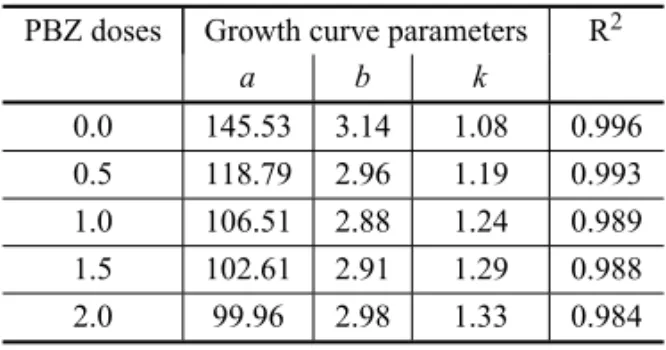
Pseudostem growth reduction could be observed 17 days after application of the product, with a mean reduction of 14% (Fig. 1a). Increased PBZ doses led to shorter pseudostem height at the end of the assess-ment period (Fig. 1b). The parameters estimated confirm that increased PBZ doses provided a reduction in pseu-dostem height(a)and growth mean rate(k), Table II.
Percent difference in pseudostem height at the end of the assessment period, between the control dose and the other doses varied between 18 and 30%, with an approx-imate mean of 26%. Doses between 1.5 and 2.0 g of a.i. of PBZ plant–1 provided similar effects on the growth mean rate and the final pseudostem height. PBZ was found to provide an exponential reduction in plant height (Fig. 1c) at the end of the assessment period, indicating a strong reduction in the endogenous levels of gibberellins,
responsible for pseudostem elongation (Fernández et al. 1995, Winkler and Helentjaris 1995).
Since a relation was visually observed between pseudostem height at the moment of application and the PBZ effect on plant growth, this situation was more carefully evaluated. Figure 1d presents mean height of the plants in the blocs before application and at the end of the assessment period (after product application). Block 1 plants were found to present shorter pseudo-stem height before application and at the end of the evalu-ation period while block 8 plants showed, on an aver-age, the highest height. A regression analysis among pseudostem heights at the moment of PBZ application in function of added pseudostem height after product application presented a positive and significant regres-sion coefficient(p =0.0011). This result indicates that
PBZ inhibiting effect was lower when the plants had a higher height at the moment of application, what could have been explained by an effect of dilution in the to-tal mass of the plant or by some problem associated to the sites of action of the product (less activity and/or less sensitivity). The results found agree with those ob-tained by (Bandara et al. 1998), who, evaluating the ef-fect of time of PBZ application on vase-cultivated pota-toes, observed that the effect of PBZ applied at the ini-tial stages was higher than when applied at advanced culture stages.
TABLE I
F test probability values of the analysis of variance (p), coefficient of variation (CV%) and mean per cultivar for the variables: pseudostem circumference (PSC), number of days from planting to flowering (NDF), pseu-dostem height (PSH), plant height (HEI), total foliar area (TFA), foliar area of the totally expanded youngest leaf (YLA), leaf number (LN), leaf emission rate (LER), sucker number (SN), sucker fresh mass (SFM).
p Means(1)
Variables
Cultivars Dose Dose× CV (%) Prata Anã FHIA 01 cultivar interaction
PSC (cm) 0.409 0.475 0.728 7.66 64.18 a 63.32 a
NDF 0.939 0.090 0.452 9.58 354.48 a 342.44 a
PSH (cm) 0.006 <0.001 0.300 13.27 74.39 b 79.80 a
HEI (cm) 0.014 <0.001 0.915 12.97 157.67 b 169.91 a
TFA (cm2) 0.920 0.180 0.980 21.70 39792.00 a 39918.00 a
YLA (cm2) 0.001 <0.001 0.380 18.13 5119.00 b 5969.00 a
LN <0.001 0.002 0.877 11.65 12.23 a 10.58 b
LER (month leaves–1) <0.001 0.265 0.558 15.19 1.80 a 1.54 b
SN 0.013 0.016 0.935 20.96 6.38 a 5.65 b
SFM (kg) 0.032 0.205 0.602 41.70 10.35 b 12.70 a
(1)Mean pairs followed by same letter, in the lines, do not differ by the F test at 5% de probability.
TABLE II
Parameters estimated for the growth curves,Yi =a/(1+eb−k×ti),
and coefficient of determination (R2) to describe the growth of banana
plants ‘Prata Anã’ and ‘FHIA 01’ under five doses of paclobutrazol (PBZ, g of a.i. plant–1) applied on soil.
PBZ doses Growth curve parameters R2
a b k
0.0 145.53 3.14 1.08 0.996 0.5 118.79 2.96 1.19 0.993 1.0 106.51 2.88 1.24 0.989 1.5 102.61 2.91 1.29 0.988 2.0 99.96 2.98 1.33 0.984
TABLE III
Means of the number of leaves of banana plants ‘Prata Anã’ and ‘FHIA 01’ in function of paclobutrazol doses (PBZ), along the experiment evaluation.
Months PBZ doses (g of a.i. plant–1) Cˆ
0.0 0.5 1.0 1.5 2.0
Number of leaves
March 14.44 14.69 14.25 14.38 13.89 –0.56ns June 9.37 10.19 11.94 11.25 12.50 8.37∗ September 10.31 10.25 12.31 12.06 12.07 5.43+
ˆ
after PBZ application, but without any alterations in the total foliar area of the plant.
PBZ did not influence sucker fresh mass, indicat-ing that the plants, regardless of the paclobutrazol dose applied, had a similar sucker production and that the oc-currences of sucker number variations were due to the appearance of a larger number of lateral buds (Table I). Since it was not possible to adjust a model that could explain the result found for all the doses evaluated for sucker number, we opted for adjusting a simple linear regression model up to the dose of 1.5 g of a.i. plant–1, considering that at the dose of 2.0 of a.i. plant–1 there was an expressive sucker emission reduction (Fig. 1f). (Hamid and Williams 1997) studying the behavior of Swainsona formosaunder the effect of different growth regulators, verified that PBZ application was followed by an increase in the number of lateral shoots, that would be reduced at higher PBZ levels.
RESUMO
Em algumas condições de cultivo o crescimento excessivo do pseudocaule de bananeiras pode ser considerado um fator limi-tante, assim a utilização de reguladores de crescimento pode constituir uma alternativa. O presente trabalho teve por ob-jetivo avaliar a ação do paclobutrazol sobre o crescimento do pseudocaule de bananeiras e outras características do seu de-senvolvimento. Para isso foi instalado um experimento com cinco doses do paclobutrazol (0; 0,5; 1,0; 1,5; e 2,0 g de i.a. planta–1) combinadas com dois cultivares de bananeira (‘Prata Anã’ e ‘FHIA-01’). O paclobutrazol não afetou o número de dias do plantio ao florescimento, a área foliar total e a taxa de emissão de folhas. Contudo, aumentou a permanência das folhas nas plantas e o número de perfilhos, reduziu a área foliar das folhas emitidas após a sua aplicação e proporcionou uma redução média de 26% na altura do pseudocaule.
Palavras-chave: área foliar, análise de crescimento, regu-ladores de crescimento,Musaspp., perfilhos.
REFERENCES
ALVESEJ. 1999. A cultura da banana: aspectos técnicos, socioeconômicos e agroindustriais. 2. Ed. Brasília: Em-brapa – SPI/Cruz das Almas, EmEm-brapa CNPMF, 585 p. BANDARAMS, TANINOKKANDWATERERDR. 1998.
Ef-fect of pot size and timing of plant growth regulator
treat-ments on growth and tuber yield in greenhouse-grown Norland and Russet Burbank potatoes. J Plant Growth Regul 17: 75–59.
BAÑÓN S, GONZÁLEZ A, CANO EA, FRANCO JA AND FERNÁNDEZJA. 2002. Growth, development and colour response of pottedDianthus caryophylluscv. Mondriaan to paclobutrazol treatment. Sci Hortic 94: 371–377. CARVALHO JABS, PEIXOTO CP, SILVASO, LEDO CAS,
PEIXOTOMFSPANDALVESJS. 2005. Uso da gibere-lina GA3na seleção do porte de bananeira das cultivares Prata e Prata-Anã. Rev Bras Frutic 27: 449–453. ELOTMANIM, JABRIKANDSEDKIM. 1992. Paclobutrazol
effect on development of greenhouse-growth banana: 2-year assessments. Acta Hort 296: 89–96.
FERNÁNDEZ JAS, DOUMASP, TEISSONC ANDCÔTE F. 1995. Identificación y cuantificación de giberalinas en plantas variantes somaclónales y normales deMusa(cv. ‘Grande Naine’ AAA) mediante HPLC y espectrometria de masa. Proceeding 11thReunión de la Associación para la Cooperación en Investigación de Banano en El Caribe y en América Tropical, 13-18 February, San José, Costa Rica. Available at<http://musalit.inibap.org/byindex_
result.php?lang=en&index=nomed&idselect=152 &page=12>.
GUBBUKH, PEKMEZCIMANDERKANM. 2004. Produc-tion potential of Cavendish cultivars (Musaspp. AAA) under greenhouse and field conditions in subtropical areas of Turkey. Acta Agric Scand 54: 249–253.
HAMID MMANDWILLIAMSRR. 1997. Effect of differ-ent types and concdiffer-entrations of plant growth retardants on Sturt’s desert pea (Swainsona formosa). Sci Hortic 71:
79–85.
JEYAKUMARP, KUMARNANDKAVINOM. 2003. Physio-logical response of banana cv. ‘Robusta’ (AAA) to foliar applied plant growth regulators on productivity. Madras Agric J 90: 702–706.
KHURSHID T, MCNEIL DL, TROUGHT MCT AND HILL GD. 1997. The response of young ‘Braeburn’ and ‘Ore-gon spur delicious’ apple trees growing under an ultrahigh density planting system to soil-applied paclobutrazol: I. Effect on reproductive and vegetative growth. Sci Hortic 71: 11–24.
LEONELS, GOMESEMANDPEDROSOCJ. 2004. Desem-penho agronômico de bananeiras micropropagadas em Botucatu – SP. Rev Bras Frutic 26: 245–248.
R DEVELOPMENTCORETEAM. 2006. R: A language and environment for statistical computing. R Foundation for Statistical Computing, Vienna, Austria.
RADEMACHERW. 2000. Growth retardants: effects on gib-berellin biosynthesis and other metabolic pathways. Annu Rev Plant Physiol Plant Mol Biol 51: 01–531.
SILVASO, FLORESJCOANDLIMANETOFP. 2002. Avalia-ção de cultivares e híbridos de bananeira em quatro ciclos de produção. Pesq Agropec Bras 37: 1567–1574. STEELGD, TORRIEJHANDDICKEYDA. 1997. Principles
and procedures of statistics: a biometrical approach. 3rd ed., New York: McGraw-Hill, 666 p.
TURNERDW. 2003. An integral method for estimating total leaf area in bananas. Infomusa 12: 15–17.
WINKLER RG AND HELENTJARIS T. 1995. The maize
Dwarf3gene encodes a cytochrome P450-mediated early