ISSN: 2182-1054
Rui M. S. Cruz, Ana I. A. Godinho, Dilek Aslan, Necip F. Koçak and
Margarida C. Vieira
Copyright Notice
Authors who publish in the International Journal of Food Studies agree to the following terms:
Authors retain copyright and grant the journal right of first publication with the work simultaneously licensed under a Creative Commons Attribution License that allows others to share the work with an acknowledgement of the work's authorship and initial publication in this journal. Authors are able to enter into separate, additional contractual arrangements for the non-exclusive distribution of the journal's published version of the work (e.g., post it to an institutional repository or publish it in a book), with an acknowledgement of its initial publication in this journal. Authors are permitted and encouraged to post their work online (e.g., in institutional repositories or on their website) prior to and during the
submission process, as it can lead to productive exchanges, as well as earlier and greater citation of published work.
Modeling the kinetics of peroxidase inactivation,
colour and texture changes of Portuguese
cabbage (Brassica oleracea L. var. costata DC)
during UV-C light and heat blanching
of Food Studies
Modeling the kinetics of peroxidase inactivation, colour and
texture changes of Portuguese cabbage (Brassica oleracea L.
var. costata DC) during UV-C light and heat blanching
Rui M. S. Cruz
a,b, Ana I. A. Godinho
a, Dilek Aslan
c, Necip F. Koc
¸ak
c, and
Margarida C. Vieira
a,b*a Department of Food Engineering, Institute of Engineering, University of Algarve, Campus da Penha,
8005-139 Faro, Portugal
b
MeditBio- Center for Mediterranean Bioresources and Food, University of Algarve, Campus de Gambelas, 8005-139 Faro, Portugal
cDepartment of Food Engineering, University of Gaziantep. Gıda M¨uhendisli˘gi B¨ol¨um¨u, 27310 Gaziantep,
Turkey
*Corresponding author
Tel: +351-289-800151 Fax: +351-289-888405
Received: 29 February 2016; Published online: 18 October 2016
Abstract
The effects of heat blanching and UV-C light followed by heat on Portuguese cabbage peroxidase (POD), colour and texture were studied in the temperature range of 80-95 °C. POD inactivation, lightness (L) and yellowness (b) colour changes were described by a first-order reaction model. The greenness (a) colour and texture (firmness) changes followed a two fraction kinetic model behaviour. The temperature effect was well described by the Arrhenius law.
At lower temperatures the combined treatment showed higher POD inactivation. Colour and texture parameters did not show significant differences between treatments. Long processing times turned the leaves slightly darker, decreased greenness, yellowness and firmness. Short processing times increased the firmness and greenness of the leaves. The treatment at 80°C for 90 seconds reduced 90% of POD, retaining 98% of lightness and 92% of yellowness and improved the green colour (130%) and firmness (125%). At 80°C the heat blanching required 7.4 min to inactivate 90% of the enzyme activity, reducing lightness, greenness, yellowness and firmness to 92%, 68%, 62% and 61%, respectively. The present findings will help to optimize the Portuguese cabbage blanching conditions.
Keywords: Portuguese cabbage; Blanching; UV-C light; Peroxidase; Colour; Texture
1
Introduction
Portuguese cabbage (Brassica oleracea L. var. costata DC) is a very popular cabbage in Por-tugal together with galega cabbage, all very rich in vitamins and mineral salts, being the major ingredient in the traditional kale soup and in the “cozido `a portuguesa” (traditional dish
consist-ing of boiled cabbage with sausages, beef and pork). This cabbage is a perishable product and the application of a freezing process could be a good solution to extend its shelf-life. Many fruits and vegetables are blanched (e.g. immersion in hot water for a short time) before any freezing process, to inactivate oxidative enzymes. Perox-idase (POD) is one of them and acts on the
hy-drogen peroxide (H2O2) present in the cell, lead-ing to oxidation of several cellular compounds, thus causing changes of colour and flavour in veg-etables (Nagodawithana & Reed, 1993). Due to its resistance to thermal treatment, POD is of-ten used as a blanching indicator (Ganjloo, Rah-man, OsRah-man, Bakar, & Bimakr,2011; Szymanek, 2011).
The blanching process has proved to be one of the most effective processes to clean the surface of vegetables, destroy microorganisms and inactivate enzymes. On the other hand, blanching may also cause off-flavours, off-colours, changes in texture, vitamins and minerals (Pa-tras, Tiwari, & Brunton, 2011). Moreover, from an industrial point of view, this process may be extremely water and energy consuming (Aguilar, Rodriguez-Herrera, Montanez-Saenz, Reyes-Vega, & Contreras-Esquivel, 2004). Non-thermal treatments, aimed at reducing microbial content or enzyme activity, while retaining the quality of the product, are promising alternative technologies in food processing. An emerging and challenging technology that can be used by the food industry is the application of ultravio-let (UV) radiation (Allende & Artes,2003). Low intensity light treatments may modify the confor-mation of the enzyme active site without chang-ing its catalyzchang-ing capacity but leadchang-ing to an in-crease of the overall activity. On the other hand, enzyme inactivation may be the result of non-reversible structural changes due to higher inten-sity light treatments (Manzocco, Dri, & Quarta, 2009). Perhaps the weakest point of UV-C light is its poor penetrative capacity, therefore this technique is limited to food surface applications. Nevertheless, the application of physical factors, such as temperature and/or pressure, combined with UV-C light, may result in the increase of the enzymatic activity, followed by further inac-tivation. These techniques used in combination (or sequentially), normally referred to as hur-dle technologies, have been used as less severe heat treatments, resulting in higher quality and safer products than traditional treatments (Man-zocco, Dri, & Quarta, 2009). Moreover, UV-C light has a positive image to the consumer and is considered a low cost non-thermal technology (Koutchma,2009).
On the basis of these considerations and the few
studies available in the literature reporting the effect of blanching treatments on cabbage leaves (Alvarez-Jubete, Valverde, Patras, Mullen, & Marcos,2014; Jaiswal, Gupta, & Abu-Ghannam, 2012), the aim of this work was to evaluate the ki-netics of Portuguese cabbage POD inactivation, colour and texture changes during heat blanch-ing and an alternative blanchblanch-ing process (UV-C light followed by heat blanching) and with the findings help to optimize the Portuguese cabbage blanching conditions.
2
Materials and Methods
2.1
Sample preparation
Portuguese cabbage was purchased at a local market in Faro, Portugal. The leaves were se-lected and the tip of each leaf was cut and then weighed (11 g).
2.2
Heat blanching and combined
treatment processes
The samples were separated in two groups ac-cording to the treatment to be applied: UV-C light followed by heat blanching group and the heat blanching group. The first group was ex-posed to a UV-C radiation intensity of 11 Wm−2 for 90 s (each leaf side) at 25±1 °C in a ven-tilated UV-C chamber (composed of four UV lamps (Philips TUV G8T5 8 W, Holland), each separated by 10 cm). The lamps were placed at 21.5 cm above the processing surface. Dur-ing UV-C radiation processDur-ing, lab coats, pro-tective gloves and safety goggles were worn by staff. UV-C radiation intensity was determined by a photo-radiometer (Delta OHM DO 9721, Caselle di Selvazzano, Italy) and an irradiance probe (Delta OHM LP 9021 UVC, Caselle di Selvazzano, Italy). Then, both groups were im-mersed in an 8 L water bath (Grant W14, Cam-bridgeshire, England), with temperatures rang-ing from 80 to 95°C for different periods of ex-posure (up to 480 s, based in preliminary tests for peroxidase inactivation). After the thermal treatments, the leaves were cooled down in an iced water bath. The temperature was moni-tored by a digital thermometer (Ellab ctd 87,
Roedovre, Denmark) and a thermocouple (1.2 mm needle dia.; constantan-type T). The exper-iments were run in triplicate.
2.3
Peroxidase determination
Peroxidase extraction
Leaves (3 g) were added to 100 ml of potassium phosphate buffer solution, previously prepared with distilled water and mono and dipotassium phosphate (Merck) with a molar concentration of 0.1 M, pH 6.5 and kept at 4 °C (according to the method of (Morales-Blancas, Chandia, & Cisneros-Zevallos,2002), and homogenized for 1 minute with an Ultra-Turrax (IKA T25 Janke & Kunkel, Staufen, Germany). The suspension was then centrifuged in polypropylene tubes for 10 minutes at 18,000×g (Sigma 3 K20, Osterode, Germany) and 4°C. The POD enzymatic extract was then filtered through filter paper Whatman nº 1.
Peroxidase activity measurement
The POD activity was determined by mixing 0.120 ml of enzymatic extract and 3.48 ml of substrate solution in 10 mm-path-length glass cuvettes (Amersham Bioscience). The substrate solution was prepared daily (mixture of 0.1 ml of guaiacol (BDH Chemicals Ltd) (99.5%), 0.1 ml of hydrogen peroxide (Pancreac) (30%) and 99.8 ml of potassium phosphate buffer (0.1 M, pH 6.5)). The POD activity was measured by ab-sorbance increase using an UV/Vis spectropho-tometer (Hitachi U-2000, Tokyo, Japan) at 6 s intervals and 470 nm (absortivity ξ=26.6 mM−1 cm−1 for tetraguaiacol). The reaction was fol-lowed until steady state was reached using a blank prepared with 0.120 ml of distilled water and 3.48 ml of substrate solution.Protein determination
The protein content was determined by Lowry’s method using bovine serum albumin (BSA) (Fluka) as standard. The results were expressed as mg of total protein and the enzyme specific ac-tivity was expressed as µmol min−1mg protein−1 .
Colour determination
Colour was evaluated with the Hunter Lab co-ordinates [L (lightness, 0 for black to 100 for white), a (red-green) and b (yellow–blue)] with a tristimulus colorimeter (Dr Lange Spectro-colour, Berlin, Germany) (Hunterlab,2012). The colorimeter (d/8° geometry, illuminant D65, 10° observer) was calibrated against a standard ce-ramic white tile (X=84.60, Y=89.46, Z=93.85) and a standard ceramic black tile (X=4.12, Y=4.38, Z=4.71). Measurements were taken in triplicate with 5 readings each.
Texture determination
The texture of raw and processed samples was analysed using a texturometer (LFRA Texture Analyser, Brookfield) equipped with a 1.5 kg load cell. Based on the method reported by Tani-waki, Takahashi, Sakurai, Takada, and Nagata (2009), each leaf was sandwiched between two metal plates with a cylindrical hole in the centre (diameter=15 mm). The test speed was set at 2 mm/s and a stainless steel probe (TA-39) with flat end, 2 mm diameter and 20 mm long was used to penetrate the sample. Peak force was used to quantify the firmness (g) of the samples. Measurements were run in triplicate.
pH determination
Two grams of raw Portuguese cabbage were ho-mogenized (Ultra-Turrax T25 Janke and Kunkel) for 1 min at 13,500 rpm in 20 ml of degassed wa-ter (Health Canada-Official Method,1999). The extracts were obtained through agitation with a mechanical shaker (Edmund B¨uhler 7400 T¨ ubin-gen KL2) for 30 min. Afterwards, samples were kept in the dark for an additional hour. The supernatant was decanted and the pH was mea-sured (pH meter Crison micropH 2002) in ten replicates.
Data analysis
Enzyme inactivation, colour and texture changes are well described in the literature by zero, first-order, fractional and two fraction first-order models (Anthon & Barrett, 2002; Cruz, Vieira, & Silva, 2006; Gon¸calves, Pinheiro, Abreu,
Brand˜ao, & Silva, 2007; Lau, Tang, & Swan-son,2000; Morales-Blancas et al.,2002; Soysal & Soylemez,2005; Tijskens, Schijvens, & Biekman, 2001). After preliminary analysis, a first-order reaction model (Eq. 1) was used to fit the ex-perimental data for POD inactivation and L and b parameters colour changes obtained for each blanching process.
Ct= C0e−kt (1)
Where C0is the initial value and Ctthe value at time t.
The temperature dependence of the rate constant (k) followed the Arrhenius behaviour (Eq. 2).
k = krefe − Ea R 1 T− 1 Tref ! (2)
A global model (Eq. 3) was obtained replacing k in Eq. 1 by the Arrhenius equation (Eq. 2) (Arabshahi & Lund,1985):
Ct C0 = e −krefe − Ea R 1 T− 1 Tref t (3)
For texture and a parameter colour changes, a two fraction first-order reaction model (Eq. 4) was used to fit the experimental data.
Ct= C01e−k1t+ C02e−k2t (4)
For both fractions, it was assumed that the first-order rate constants, k1 and k2, dependence on temperature (Eqs. 5 and 6) followed the Arrhe-nius law: k1= kref 1e − Ea1 R 1 T− 1 Tref ! (5) k2= kref 2e − Ea2 R 1 T− 1 Tref ! (6)
A global model (Eq. 7) was obtained replacing k in Eq. 4 by the Arrhenius equation (Eq. 5 and
6) for both fractions.
C = C01e −kref 1e − Ea1 R 1 T− 1 Tref t +C02e −kref 2e − Ea2 R 1 T− 1 Tref t (7)
Experimental data points were normalized, by dividing the values at time t (Ct) by the ini-tial value (C0). An analysis of variance (two-way ANOVA with replication) was performed to assess the effect of blanching time-temperature (tested factors-independent variables) conditions on POD activity, colour and texture changes (dependent variables). The kinetic parameters were estimated directly from the experimental data, by performing a one-step non-linear regres-sion analysis (using least squares estimation and Levenverg–Marquart method), fitting the global model equations 3 (first-order reaction) and 7
(two fractions first-order reaction) (Arabshahi & Lund, 1985) and using the statistical software STATA version 10.0. The reference temperature (Tref) was considered to be the average temper-ature of the experiments (87.5°C) aimed at im-proving parameter estimation. The goodness of fit of the regression was assessed by the coeffi-cient of determination (R2) while normality and randomness of residuals by the predicted vs. ex-perimental data chart; the precision of the pa-rameters was evaluated by confidence intervals at 95%.
3
Results and Discussion
3.1
Peroxidase inactivation
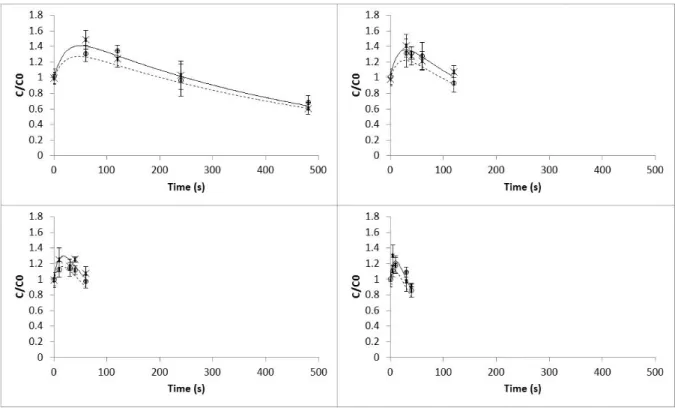
Raw Portuguese cabbage presented a peroxidase activity of 0.30±0.17 µmol min−1 mg protein−1 and a pH of 6.32±0.12. Experimental and pre-dicted values of the POD activity for heat only and the combined treatment are presented in Fig-ure 1. The results at higher temperatures, 90 and 95 °C, showed similar rate of POD inac-tivation between heat and the combined treat-ment (about 100% inactivation in the first 10 s
Figure 1: Effect of temperature and UV-C light over time on POD specific activity in Portuguese cabbage in the temperature range 80-95°C: (x) experimental values of POD specific activity with heat blanching processes; (—) model predicted values for heat blanching processes; (o) experimental values of POD specific activity with combined UV-C light and heat blanching processes; ( ) model predicted values with combined UV-C light and heat blanching processes. Bars represent mean ± standard deviation (n=3)
of processing), meaning that the high tempera-ture was the main factor for this outcome. Nev-ertheless, at lower temperatures (80 and 85 °C) the combined treatment showed a higher POD inactivation rate (about 4-fold at 80 °C and 1 min of exposure) due to the synergistic hurdle effect produced by the UV-C light followed by heat. These results were mainly due to the structural changes on the enzyme active site, leading to a lower enzyme-substrate interaction. Lamikanra, Kueneman, Ukuku, and Bett-Garber (2005) found that UV treatment increases POD activity while lowering esterase and lipase activ-ity. In another study, Manzocco, Quarta, and Dri (2009) showed that exposure of apple derivatives to UV-C light is very effective in polyphenoloxi-dase inactivation. These outcomes are dependent
on the applied methodologies and the different types of food matrices.
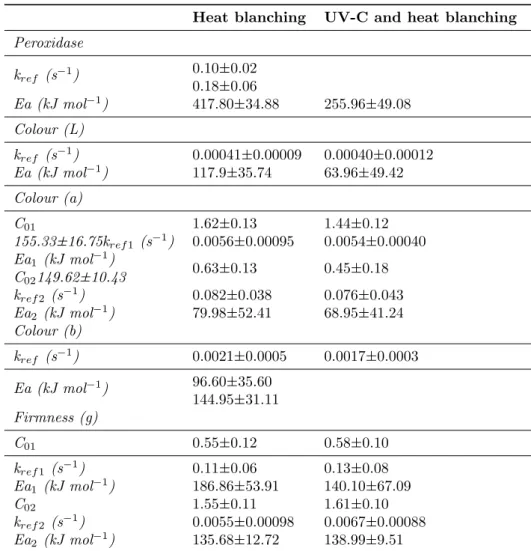
Concerning the kinetic modelling, a first-order kinetic model was well-fitted to results ob-tained for both blanching processes (R2=0.97 and R2=0.98 in table 1), meaning that the en-zyme inactivation could be described by this model. Other studies also proposed this model for POD inactivation, for watercress (Cruz et al., 2006), for carrots (Soysal & Soylemez,2005) and for broccoli (Morales-Blancas et al.,2002). Also, the temperature dependence of the rate constant followed the Arrhenius behaviour. The thermal inactivation reaction rate (kref) and activation energy (Ea) for heat and UV-C+heat blanching treatments are shown on Table 1. The reaction rate for the combined treatment, at the
refer-Table 1: Kinetic parameters for quality changes in Portuguese cabbage Heat blanching UV-C and heat blanching Peroxidase kref (s−1) 0.10±0.02 0.18±0.06 Ea (kJ mol−1) 417.80±34.88 255.96±49.08 Colour (L) kref (s−1) 0.00041±0.00009 0.00040±0.00012 Ea (kJ mol−1) 117.9±35.74 63.96±49.42 Colour (a) C01 1.62±0.13 1.44±0.12 155.33±16.75kref 1 (s−1) 0.0056±0.00095 0.0054±0.00040 Ea1 (kJ mol−1) 0.63±0.13 0.45±0.18 C02149.62±10.43 kref 2 (s−1) 0.082±0.038 0.076±0.043 Ea2 (kJ mol−1) 79.98±52.41 68.95±41.24 Colour (b) kref (s−1) 0.0021±0.0005 0.0017±0.0003 Ea (kJ mol−1) 96.60±35.60 144.95±31.11 Firmness (g) C01 0.55±0.12 0.58±0.10 kref 1 (s−1) 0.11±0.06 0.13±0.08 Ea1 (kJ mol−1) 186.86±53.91 140.10±67.09 C02 1.55±0.11 1.61±0.10 kref 2 (s−1) 0.0055±0.00098 0.0067±0.00088 Ea2 (kJ mol−1) 135.68±12.72 138.99±9.51
ence temperature, was higher (0.18±0.06 s−1) than the value obtained for the heat blanching treatment (0.10±0.02 s−1). The estimated tivation energy for POD inactivation was in ac-cordance with the ones reported by Anthon and Barrett (2002) 480 kJ mol−1 and 478 kJ mol−1 for carrot and potato. In contrast, Soysal and Soylemez (2005) reported values of 148 kJ mol−1 for POD inactivation in carrot. In another study, Cruz et al. (2006) reported activation energy val-ues of Ea1= 421 kJ mol−1 and Ea2= 352 kJ mol−1 in watercress leaves, for heat-labile and heat-resistant fractions, respectively.
Moreover, Neves, Vieira, and Silva (2012) re-ported that UV-C light also contributed to
the increase in POD inactivation rate in zuc-chini. The estimated kinetic parameters were kHeat= 7.37Ö10−7min-−1 and EaHeat= 925 kJ mol−1and kHeat+U V −C= 2.42Ö10−5min−1and EaHeat+U V −C = 596 kJ mol−1.
3.2
Colour changes
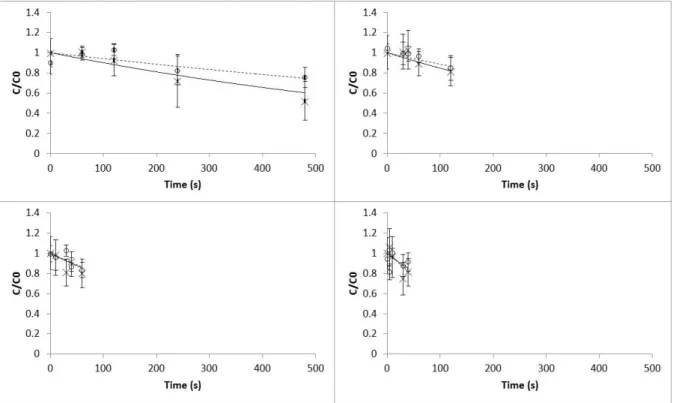
Raw Portuguese cabbage presented values of L, a and b of 36.89±2.73, -7.49±1.17 and 8.39±2.31, respectively. At the end of each blanching pro-cess, these colour parameters did not show signif-icant differences between treatments (ANOVA, p>0.05). The L and b colour parameters
de-Figure 2: Effect of temperature and UV-C light over time on colour L parameter in Portuguese cabbage in the temperature range 80-95°C: (x) experimental values of L parameter with heat blanching processes; (—) model predicted values for heat blanching processes; (o) experimental values of colour L parameter with combined UV-C light and heat blanching processes; ( ) model predicted values for with combined UV-C light and heat blanching processes. Bars represent mean± standard deviation (n=15)
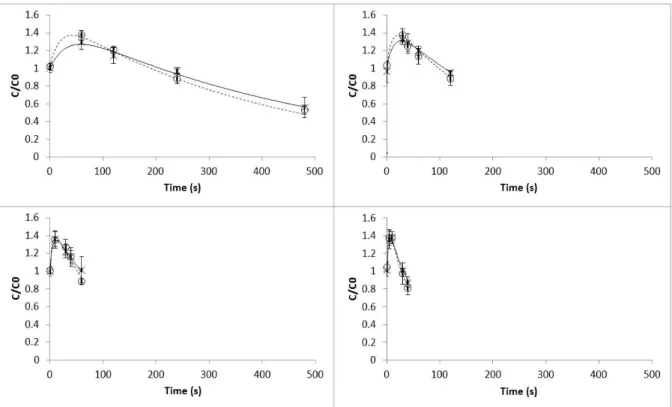
creased in both treatments (traditional and UV-C light followed by heat blanching), showing that the samples after blanching became slightly darker and less yellow (Fig. 2 and Fig. 4, re-spectively). Changes in the a colour param-eter showed two distinct mechanisms. First, the a values increased right at the beginning of the blanching treatments (5-60 s and 80-95 °C) resulting in greener samples, and then de-creased after some time of exposure turning the samples less green (Fig. 3). This decrease might be related to the chlorophylls leaching out into the blanching medium and/or conver-sion of chlorophylls to pheophytins (Schwartz & Vonelbe, 1983). These results are in agree-ment with those reported by Di Cesare, Forni, Viscardi, and Nani (2004), in which leaves of oregano also became greener after blanching. Lin
and Brewer (2005) showed in a study with frozen peas that after microwave and water blanching the peas were also greener. In another study, Brewer, Begum, and Bozeman (1995) reported significant darkening of stems and florets of broc-coli after microwave blanching. Tijskens et al. (2001) presented similar effects on green colour of blanched broccoli and green beans. Recently, Alvarez-Jubete et al. (2014), in a study in which white cabbage samples were blanched at 90-95°C during 3 min, also reported a slight decrease in the L parameter. These colour changes may be related to the replacement of the gases inside the intercellular spaces by the blanching medium, al-tering light refraction from the cell surface (Mac-Dougall,2002).
In terms of kinetic modelling, a first-order model and two fractions first-order model fitted well the
Figure 3: Effect of temperature and UV-C light over time on colour a parameter in Portuguese cabbage in the temperature range 80-95°C: (x) experimental values of a parameter with heat blanching processes; (—) model predicted values for heat blanching processes; (o) experimental values of colour a parameter with combined UV-C light and heat blanching processes; ( ) model predicted values for with combined UV-C light and heat blanching processes. Bars represent mean± standard deviation (n=15)
experimental data for L and b parameters and a parameter, respectively (Table 1) and the tem-perature dependence followed the Arrhenius be-haviour. In all cases, normality and randomness of residuals were verified, and the coefficient of determination, R2, was higher than 0.95. No sig-nificant differences (p>0.05) were detected be-tween the estimated reaction rates and activa-tion energies at the reference temperature (87.5 °C) for both treatments. The activation energy values for colour changes varied between 63.96 and 155.33 kJ mol−1 for L and a parameters in the UV-C and heat blanching treatment, respec-tively. The high activation energies obtained re-vealed that Portuguese cabbage is sensitive to the temperatures applied during the blanching pro-cess. Cruz, Vieira, and Silva (2007) presented higher activation energies for Lab parameters
(EaL=235.83±89.32 kJ mol−1, Eaa=187.70±160 kJ mol−1 and Eab=330.62±128.16 kJ mol−1) in thermosonicated watercress leaves. Recently, Aamir, Ovissipour, Rasco, Tang, and Sablani (2014) determined in blanched spinach leaves (65-85 °C) an activation energy value of 117.7 kJ mol−1 for colour a parameter. In another study, Gon¸calves, Pinheiro, Abreu, Brand˜ao, and Silva (2010), in blanched carrot, reported values of EaL= 187.03±13.60 kJ mol−1, Eaa= 186.39±10.33 kJ mol−1 and Eab= 231.16±17.01 kJ mol−1.
3.3
Texture changes
Raw Portuguese cabbage presented values of firmness of 168.17±35.42 g. Figure 5 shows the effect of heat and UV-C light followed by heat in
Figure 4: Effect of temperature and UV-C light over time on colour b parameter in Portuguese cabbage in the temperature range 80-95°C: (x) experimental values of b parameter with heat blanching processes; (—) model predicted values for heat blanching processes; (o) experimental values of colour b parameter with combined UV-C light and heat blanching processes; ( ) model predicted values for with combined UV-C light and heat blanching processes. Bars represent mean± standard deviation (n=15)
the firmness of the Portuguese cabbage leaves. The firmness of the cabbage leaves showed no significant differences between blanching treat-ments (ANOVA, p>0.05). Texture changes in Portuguese cabbage leaves also showed two dis-tinct mechanisms. First, at short processing times (5-60 s and 80-95°C), the Portuguese cab-bage leaves increased in firmness to 130-140% compared to initial values. Then, the samples be-came softer when the processing time increased. Ni, Lin, and Barrett (2005) also reported that the firmness of a variety of vegetables (broccoli, Pak choy, Chinese cabbage, cabbage, green peppers, sugar snap peas and carrots) blanched at differ-ent temperatures (55, 60, 65, 70, 75, and 80°C) and times of exposure (5, 15, 30, 45 and 60 min) showed between 80 and almost 200% increase in firmness compared to the blanched control (100
°C and 3 min.). Moreover, AnzalduaMorales, Quintero, and Balandran (1996) reported a pro-nounced increase in the firmness of lentils in the initial stage of blanching at 80 °C and 85 °C compared to blanching at 90 and 95 °C. Dur-ing thermal processDur-ing, a range of enzymatic and chemical reactions occur, which alter the texture of processed vegetables. The chemical changes, such as solubilisation and depolymerisation of pectic polysaccharides, affect the constituents of the cell wall and middle lamella, thereby result-ing in a major change in the firmness of veg-etables (Nisha, Singhal, & Pandit, 2006). This increase in firmness may be the result of the availability of calcium ions for cross-link forma-tion with adjacent pectin molecules (Latorre, de Escalada Pl´a, Rojas, & Gerschenson, 2013) and also the role of pectin methyl esterase (PME), in
Figure 5: Effect of temperature and UV-C light over time on texture (firmness) in Portuguese cabbage in the temperature range 80-95 °C: (x) experimental values of texture (firmness) with heat blanching processes; (—) model predicted values for heat blanching processes; (o) experimental values of texture (firmness) with combined UV-C light and heat blanching processes; ( ) model predicted values for with combined UV-C light and heat blanching processes. Bars represent mean± standard deviation (n=3)
hydrolyzing the methyl ester linkages in pectin molecules, releasing methanol and free galac-turonic acid moieties. The resulting free car-boxyl groups may then form cross-links between pectin polymers through salt-bridge formation with divalent cations (particularly Ca2+) nat-urally present in the tissues (Puri, Solomos, & Kramer, 1982; Ni et al., 2005). At higher tem-peratures the permeability of membranes is in-creased, resulting in passive efflux of solutes and an irreversible reduction of cell turgor well before membranes are completely destroyed (De Belie, Herppich, & De Baerdemaeker,2000).
A two fractions first-order model fitted well the experimental data (Table1) and the temperature dependence of firmness also followed the Arrhe-nius behaviour. The estimated reaction rates and activation energies at the reference temperature
(87.5°C) for both treatments where very similar (R2and adjusted R2presented values of 0.99 for both treatments). The activation energy values for texture changes, for each fraction, varied be-tween 135.68 and 186.86 kJ mol−1. Jaiswal et al. (2012) reported a lower activation energy value of 33.88 kJ mol−1 for Irish York cabbage blanched at temperatures varying between 80-100°C dur-ing 2-14 min. Huang and Bourne (1983) reported activation energies ranging from 21.35 to 146.50 kJ mol−1 for different vegetables. (Anzaldu-aMorales et al.,1996) reported activation energy values of 107.50 kJ mol−1, 147.40 kJ mol−1 and 210.50 kJ mol−1for the texture of blanched (80-95°C) white beans, chick peas and broad beans, respectively. Lau et al. (2000) studied the kinet-ics of textural changes in green asparagus during thermal treatments (70-98 °C) and reported an
activation energy value of 100.6 kJ mol−1. In another study Gon¸calves et al. (2007) reported an activation energy value of 72.21 kJ mol−1 in blanched pumpkin (75-95°C). Vu et al. (2004) re-ported an activation energy of 117.6 kJ mol−1 in blanched carrot (80-110°C). Possibly, these vari-ations are related to the differences in the raw material, modelling methodologies and the tem-perature ranges used in each study.
In commercial scenarios, to obtain vegetables that maintain optimum quality during storage, a reduction of 90% of the POD activity af-ter blanching is recommended (Bah¸ceci, Serpen, Gokmen, & Acar, 2005). In the present study, the UV-C light followed by heat treatment, for example at 80°C, required only 1.30 min to re-duce 90% of the POD activity, while maintain-ing 98% of lightness and 92% of yellowness and increasing green colour (130%) and the firmness (125%) of the Portuguese cabbage leaves. On the other hand, the traditional heat blanching treat-ment at 80 °C requires 7.4 min to reduce 90% of the enzyme activity. This treatment reduces lightness, greenness, yellowness and firmness to 92%, 68%, 62% and 61% of initial values, re-spectively. Therefore, for the inactivation of this enzyme, the alternative treatment may be used to minimize colour and texture changes, since processing times can be reduced. It should be also remarked that instead of promoting colour and texture degradation, the applied treatment at lower short processing times led to greener and firmer Portuguese cabbage leaves.
4
Conclusions
The combination of UV-C light followed by heat blanching treatment at 80 and 85 °C was shown to significantly shorten the treatment time needed to inactivate POD in Portuguese cab-bage. Thus, it can be considered effective to be used as a hurdle prior to a heat blanching treat-ment and provide a practical alternative to the traditional blanching treatments for inactivat-ing POD in Portuguese cabbage. Moreover, this combined treatment was revealed to be a better blanching process due to the good quality reten-tion in the treated produce. The present find-ings will help optimize the Portuguese cabbage
blanching conditions by heat blanching combined with UV-C light treatment.
References
Aamir, M., Ovissipour, M., Rasco, B., Tang, J., & Sablani, S. (2014). Seasonality of the thermal kinetics of color changes in whole spinach (spinacia oleracea) leaves under pasteurization conditions. Interna-tional Journal of Food Properties, 17 (9), 2012–2024. doi:10 . 1080 / 10942912 . 2013 . 779701
Aguilar, C. N., Rodriguez-Herrera, R., Montanez-Saenz, J. C., Reyes-Vega, M. D., & Contreras-Esquivel, J. C. (2004). Blanching at low temperatures: a thermal bioprocess applied to fruits and vegetables to improve textural quality. Food Science and Biotechnology, 13 (1), 104–108. Allende, A. & Artes, F. (2003). Uv-c
radia-tion as a novel technique for keeping qual-ity of fresh processed ‘lollo rosso’ lettuce. Food Research International, 36 (7), 739– 746. doi:10.1016/S0963-9969(03)00054-1
Alvarez-Jubete, L., Valverde, J., Patras, A., Mullen, A. M., & Marcos, B. (2014). As-sessing the impact of high-pressure process-ing on selected physical and biochemical attributes of white cabbage (brassica oler-acea l. var. capitata alba). Food and Bio-process Technology, 7 (3), 682–692. doi:10. 1007/s11947-013-1060-5
Anthon, G. E. & Barrett, D. M. (2002). Ki-netic parameters for the thermal inactiva-tion of quality-related enzymes in carrots and potatoes. Journal of Agricultural and Food Chemistry, 50 (14), 4119–4125. doi:10. 1021/jf011698i
AnzalduaMorales, A., Quintero, A., & Balan-dran, R. (1996). Kinetics of thermal soft-ening of six legumes during cooking. Jour-nal of Food Science, 61 (1), 167–170. doi:10. 1111/j.1365-2621.1996.tb14751.x
Arabshahi, A. & Lund, D. B. (1985). Considera-tions in calculating kinetic parameters from experimental data. Journal of Food Process Engineering, 7 (4), 239–251.
Bah¸ceci, K. S., Serpen, A., Gokmen, V., & Acar, J. (2005). Study of lipoxygenase and peroxidase as indicator enzymes in green beans: change of enzyme activity, ascorbic acid and chlorophylls during frozen storage. Journal of Food Engineering, 66 (2), 187– 192. doi:10.1016/j.jfoodeng.2004.03.004
Brewer, M. S., Begum, S., & Bozeman, A. (1995). Microwave and conventional blanching ef-fects on chemical, sensory, and color char-acteristics of frozen broccoli. Journal of Food Quality, 18 (6), 479–493. doi:10.1111/ j.1745-4557.1995.tb00398.x
Cruz, R. M. S., Vieira, M. C., & Silva, C. L. M. (2006). Effect of heat and thermosonication treatments on peroxidase inactivation ki-netics in watercress (nasturtium officinale). Journal of Food Engineering, 72 (1), 8–15. doi:10.1016/j.jfoodeng.2004.11.007
Cruz, R. M. S., Vieira, M. C., & Silva, C. L. M. (2007). Modelling kinetics of watercress (nasturtium officinale) colour changes due to heat and thermosonication treatments. Innovative Food Science & Emerging Tech-nologies, 8 (2), 244–252. doi:10.1016/j.ifset. 2007.01.003
De Belie, N., Herppich, W., & De Baerdemaeker, O. (2000). A kinetic model for turgor loss in red cabbage cells during mild heat treat-ment. Journal of Plant Physiology, 157 (3), 263–272.
Di Cesare, L. F., Forni, E., Viscardi, D., & Nani, R. C. (2004). Influence of drying techniques on the volatile phenolic compounds, chloro-phyll and colour of oregano (origanum vul-gare l. ssp, prismaticum gaudin). Italian Journal of Food Science, 16 (2), 165–175. Ganjloo, A., Rahman, R. A., Osman, A., Bakar,
J., & Bimakr, M. (2011). Kinetics of crude peroxidase inactivation and color changes of thermally treated seedless guava (psid-ium guajava l.) Food and Bioprocess Tech-nology, 4 (8), 1442–1449. doi:10 . 1007 / s11947-009-0245-4
Gon¸calves, E. M., Pinheiro, J., Abreu, M., Brand˜ao, T. R. S., & Silva, C. L. M. (2007). Modelling the kinetics of peroxidase inactivation, colour and texture changes of pumpkin (cucurbita maxima l.) during
blanching. Journal of Food Engineering, 81 (4), 693–701.
Gon¸calves, E. M., Pinheiro, J., Abreu, M., Brand˜ao, T. R. S., & Silva, C. L. M. (2010). Carrot (daucus carota l.) peroxidase in-activation, phenolic content and physical changes kinetics due to blanching. Jour-nal of Food Engineering, 97 (4), 574–581. doi:10.1016/j.jfoodeng.2009.12.005
Health Canada-Official Method. (1999). T-310-Determination of whole tobacco pH. Ot-tawa, Canada.
Huang, Y. T. & Bourne, M. C. (1983). Kinetics of thermal softening of vegetables. Journal of Texture Studies, 14 (1), 1–9. doi:10.1111/ j.1745-4603.1983.tb00329.x
Hunterlab. (2012). Measuring Colour using Hunter L, a, b versus CIE 1976 L*a*b*. AN 1005.00, 1-4.
Jaiswal, A. K., Gupta, S., & Abu-Ghannam, N. (2012). Kinetic evaluation of colour, tex-ture, polyphenols and antioxidant capac-ity of irish york cabbage after blanching treatment. Food Chemistry, 131 (1), 63–72. doi:10.1016/j.foodchem.2011.08.032
Koutchma, T. (2009). Advances in ultraviolet light technology for non-thermal processing of liquid foods. Food and Bioprocess Tech-nology, 2 (2), 138–155. doi: 10.1007/s11947-008-0178-3
Lamikanra, O., Kueneman, D., Ukuku, D., & Bett-Garber, K. L. (2005). Effect of pro-cessing under ultraviolet light on the shelf life of fresh-cut cantaloupe melon. Journal of Food Science, 70 (9), C534–C539. Latorre, M. E., de Escalada Pl´a, M. F.,
Ro-jas, A. M., & Gerschenson, L. N. (2013). Blanching of red beet (beta vulgaris l. var. conditiva) root. effect of hot water or mi-crowave radiation on cell wall character-istics. LWT-Food Science and Technology, 50 (1), 193–203.
Lau, M. H., Tang, J., & Swanson, B. G. (2000). Kinetics of textural and color changes in green asparagus during thermal treat-ments. Journal of Food Engineering, 45 (4), 231–236. doi:10 . 1016 / S0260 - 8774(00 ) 00069-8
Lin, S. & Brewer, M. S. (2005). Effects of blanch-ing method on the quality characteristics
of frozen peas. Journal of Food Quality, 28 (4), 350–360. doi:10.1111/j.1745- 4557. 2005.00038.x
MacDougall, D. B. (2002). Colour in food: im-proving quality. Woodhead Publishing. Manzocco, L., Dri, A., & Quarta, B. (2009).
In-activation of pectic lyases by light exposure in model systems and fresh-cut apple. Inno-vative Food Science & Emerging Technolo-gies, 10 (4), 500–505. doi:10 . 1016 / j . ifset . 2009.06.002
Manzocco, L., Quarta, B., & Dri, A. (2009). Polyphenoloxidase inactivation by light ex-posure in model systems and apple deriva-tives. Innovative Food Science & Emerging Technologies, 10 (4), 506–511. doi:10.1016/ j.ifset.2009.02.004
Morales-Blancas, E. F., Chandia, V. E., & Cisneros-Zevallos, L. (2002). Thermal inac-tivation kinetics of peroxidase and lipoxy-genase from broccoli, green asparagus and carrots. Journal of Food Science, 67 (1), 146–154. doi:10 . 1111 / j . 1365 - 2621 . 2002 . tb11375.x
Nagodawithana, T. & Reed, G. (1993). Enzymes in food processing. (3rd ed., 13, pp. 158– 162). London: Academic Press, Inc. Har-court Brace & Company.
Neves, F. I. G., Vieira, M. C., & Silva, C. L. M. (2012). Inactivation kinetics of peroxidase in zucchini (cucurbita pepo l.) by heat and uv-c radiation. Innovative Food Sci-ence & Emerging Technologies, 13, 158– 162. doi:10.1016/j.ifset.2011.10.013
Ni, L., Lin, D., & Barrett, D. (2005). Pectin methylesterase catalyzed firming effects on low temperature blanched vegetables. Journal of Food Engineering, 70 (4), 546– 556. doi:10.1016/j.jfoodeng.2004.10.009
Nisha, P., Singhal, R. S., & Pandit, A. B. (2006). Kinetic modelling of texture development in potato cubes (solanum tuberosum l.), green gram whole (vigna radiate l.) and red gram splits (cajanus cajan l.) Journal of Food Engineering, 76 (4), 524–530. doi:10. 1016/j.jfoodeng.2005.05.054
Patras, A., Tiwari, B. K., & Brunton, N. P. (2011). Influence of blanching and low tem-perature preservation strategies on antiox-idant activity and phytochemical content
of carrots, green beans and broccoli. LWT-Food Science and Technology, 44 (1), 299– 306. doi:10.1016/j.lwt.2010.06.019
Puri, A., Solomos, T., & Kramer, A. (1982). Partial-purification and characterization of potato pectinesterase. Food Chemistry, 8 (3), 203–213. doi:10.1016/0308- 8146(82) 90042-5
Schwartz, S. J. & Vonelbe, J. H. (1983). Kinet-ics of chlorophyll degradation to pyropheo-phytin in vegetables. Journal of Food Sci-ence, 48 (4), 1303–1306. doi:10 . 1111 / j . 1365-2621.1983.tb09216.x
Soysal, C. & Soylemez, Z. (2005). Kinetics and inactivation of carrot peroxidase by heat treatment. Journal of Food Engineering, 68 (3), 349–356. doi:10 . 1016 / j . jfoodeng . 2004.06.009
Szymanek, M. (2011). Effects of blanching on some physical properties and processing re-covery of sweet corn cobs. Food and Biopro-cess Technology, 4 (7), 1164–1171. doi:10 . 1007/s11947-009-0246-3
Taniwaki, M., Takahashi, M., Sakurai, N., Takada, A., & Nagata, M. (2009). Effects of harvest time and low temperature storage on the texture of cabbage leaves. Posthar-vest Biology and Technology, 54 (2), 106– 110. doi:10.1016/j.postharvbio.2009.06.004
Tijskens, L. M. M., Schijvens, E. P. H. M., & Biekman, E. S. A. (2001). Modelling the change in colour of broccoli and green beans during blanching. Innovative Food Science and Emerging Technologies, 2 (4), 303–313.
Vu, T. S., Smout, C., Sila, D. N., LyNguyen, B., Van Loey, A. M. L., & Hendrickx, M. E. G. (2004). Effect of preheating on thermal degradation kinetics of carrot texture. In-novative food science & emerging technolo-gies, 5 (1), 37–44.