DOI: http://dx.doi.org/10.5455/EJMS/289312/2018 123 The European Journal of Management
Studies is a publication of ISEG, Universidade de Lisboa. The mission of EJMS is to significantly influence the domain of management studies by publishing innovative research articles. EJMS aspires to provide a platform for thought leadership and outreach. Editors-in-Chief:
Luís M. de Castro, PhD
ISEG - Lisbon School of Economics and Management, Universidade de Lisboa, Portugal
Gurpreet Dhillon, PhD
The University of North Carolina, Greensboro, USA
Tiago Cardão-Pito, PhD
ISEG - Lisbon School of Economics and Management, Universidade de Lisboa, Portugal
Managing Editor: Mark Crathorne, MA
ISEG - Lisbon School of Economics and Management, Universidade de Lisboa, Portugal
ISSN: 2183-4172 DOI: 10.5455/EJMS. Volume 23, Issue 2 www.european-jms.com
Copyright © 2018 - ISEG, Universidade de Lisboa
COMPETENCES DEVELOPMENT AND
ORGANISATIONAL COMMITMENT:
MEDIATION THROUGH EMPLOYABILITY
AND MODERATION BY GENERATION
Ana Moreira1, Francisco Cesário2, Maria José Chambel3, and Filipa Castanheira41ISPA – Instituto Universitário, Universidade de Lisboa; 2Instituto Universitário and Universidade
Europeia, Lisboa; 3Faculdade de Psicologia,
Universidade de Lisboa; 4Nova School of Business and Economics, Universidade Nova de Lisboa, Portugal
Abstract
The main objective of this study is to test the mediating effect of perceived internal employability on the relationship between organisational practices of competences development and affective commitment, and also to test the moderating effect of different generations in this mediation. The sample has 302 participants, who are employees in several organisations based in Portuguese territory. We verified the mediating effect of the employability perception in the relationship between organisational practices of competences development (individualised support and functional rotation) and affective commitment. Regarding the moderating effect of the generations, this effect was verified in the relationship between the organisational competences development practices and the affective commitment in the liaison between the organisational practices of competences development and the perception of internal employability and in the connection between the perception of internal employability and affective commitment.
Key words: Organisational Practices of Competences Development, Employability and Affective Commitment.
124
Introduction
In times of constant change of organisations, where the same try to achieve and sustain a competitive edge, it becomes of extreme importance that they invest in practices that aim to develop the competences of their employees. This investment in the development of specific competences can be interpreted in the light of Human Capital Theory, which was developed by Schultz (1961), which considers knowledge and skills to be a form of capital. A high perception of the value of these practices makes employees feel affectively committed with the organisation and to work with more effort to achieve their goals (Arthur, 1994; Wood & Menezes, 1998), thus contributing to the perception of the growth of their value as professionals and a significant increase in the perception of their employability. For Meyer and Allen, (1984), the affective commitment is interpreted as being the emotional connection and the identifying and involvement of the employee with the institution where he works. It is believed that this is the result of an exchange between the organisation and the employee (Colquitt, Baer, Long, & Halvorsen-Ganepola, 2014) as a response to the correct way they are treated by the former. With regards to employability, in the perspective of Rothwell e Arnold (2007), this can be defined as being the employee’s capacity to keep their current job or obtain another should they desire. For Van der Heijde and Van der Heijde, (2005), this can be seen as being the capacity of systematically obtaining or creating a job by the optimisation of competences, which is positively related with the affective commitment to the organisation (Chambel, 2011).
Despite the fact that, in the current context, the development of competences of employees is considered to be a key factor for competitiveness (Prahalad & Hamel, 1990; Saba, 2013), when employees of different generations are found in an organisation, they might value and respond differently to this investment in the development of their professional skills. Therefore, we can question whether the employees of different generations respond in the same way to the organisational practices of competence development.
This study aims, in first place, to study if the perception of employability explains the relationship between the organisational practices of competence development and the affective commitment to the organisation, therefore having a mediating effect, and in second place, to analyse the moderating effect of different generations in this mediation.
Organisational practices of competency development and affective commitment
Organisations should endeavor to achieve the loyalty of their employees, especially of those who possess the highest-valued and more-adjusted competences to the business objectives, their human capital value being the differentiating factor which, according to the “Resource-based view” theory (Barney, 1991), makes them competitive. In an organisation, those available human resources who possess greater competences should be considered a strategic asset, who, by being properly potentiated, contribute to obtaining a sustainable competitive edge.
125 When an organisation implements practices of competences development, it is developing its human resources, thus making these harder to imitate and therefore increasing their value for the organisation (Afiouni, 2007).
In the perspectives of Campion, Cheraskin and Stevens (1994) and also Schneider, Brief and Guzzo (1996), competence development practices are organisational support practices which are perceived by the employees as contributing to their professional development. These can be considered to be all those activities performed by the organisation which contribute to improving the learning, competences and performance of the employees (Forrier & Sels, 2003; De Vos & De Hauw, 2009). The scope of these practices includes: opportunities for employee participation in class training activities, both in workshops/seminars or on-the-job, where their competences can be developed by the interaction with other participants; the participation in coaching programmes destined to develop objectives-aimed competences, in order to improve not only their performance, but also the quality of life inside the organisation (Brock, 2006); by contact with a senior member of the organisation (mentoring) which will help employees in any career-related question and with their insertion in the organisation. Besides these practices, the opportunity for an employee to experience other functions inside the organisation, or contact with other functional parts of the same, can be a factor for competences development. We can therefore group these practices along three axis: training, including action in room, in seminars, or on-the-job; individualised support, which includes coaching and mentoring, and; functional rotation, which includes experience in other areas and functions.
Shore, Tetrick, Lynch and Barksdale (2006) suggest that the highest levels of organisational investment are associated with social exchange relations, in the measure that these create feelings of obligation in the employee. They push the employee to benefit the organisation, making them exceed their functional demands. Therefore, when an organisation invests in its employees, either by providing them with diversified training activities or by supporting them in improving their career development, or even by facilitating the rotation between functions, in exchange, these employees tend to respond with positive attitudes and behaviours. This relationship can be interpreted under the premise of social exchanges, which is a theory developed by Blau (1964), which studies the interaction between parties (employees and organisations) through mutual exchanges and contingents, in order to understand the patterns that are created to initiate, maintain, or close a relationship.
An employee with a strong emotional connection to the organisation will be enthusiastic about the work that they perform, contributing to the success of the former (Allen & Meyer, 1996; Meyer, Becker & Van den Berghe, 2004; Meyer & Herscovitch, 2001). According to such authors as Meyer and Allen (1991) and Meyer, Allen and Topolnytsky (1998), the affective commitment is developed through positive experiences at work. For Gaertner and Nollen (1989), this commitment is related with the opportunities for training that the organisation provides and also with the chance of internal promotion. In a study by Kinicki, Carson and Bohlander (1992), the
126
authors found significant differences in the affective commitment of workers in two organisations, which, according to the authors, diverged in the quality of their competency development practices (training, individualised support and functional rotation). Therefore, we consider, as the first hypothesis of this study:
Hypothesis 1 – Organisational practices of competences development have a positive relationship with affective commitment.
The mediating effect of perceived internal employability
In the current context of work insecurity, in which organisations aim to obtain flexibility, the concept of employability assumes an important role. Flexibilty is, according to Forrier and Sels (2003), a new mechanism which can reduce this perception of labour insecurity and contribute to a more positive attitude from the workers regarding the uncertainty of the labour market when they perceived themselves with higher employability. This concept is, in a general manner, associated with the higher or lower capacity of finding jobs in the market (external employability), either when searching for a first job, or when forced to look for another (Cesário, Gestoso & Peregrin, 2012). The concept of employability can also be applied to the internal context of an organisation, translating into the higher or lower capacity of the employee in changing functions or work post, in case of necessity. This perspective represents the concept of internal employability (De Witte, 2005), whereby the employee considers that they have a greater probability of keeping their current job.
De Cuyper, Bernhard-Oettel, Berntson, De Witte and Alarco (2008), and Forrier and Sels (2003) all underline the importance of competences development for the employee to develop a better perception of employability. When the developed competences are specific and are related to the improvement of their performance in the organisation, the employee develops a greater perception of their internal employability, which means that they will be more likely to maintain their current job, reinforcing their affective commitment to the organisation (De Cuyper & De Witte, 2011; De Witte, 2005).
This is the reason why, in this study, the perception of internal employability is considered as the mechanism that explains the relationship between the organisational practices of competency development and affective commitment, which, in tur, exerts a mediating effect.
This relationship can be interpreted as being on the basis of the premise of social exchanges (Blau, 1964) and of the rule of reciprocity (Gouldner, 1960), as the investments that the organisation makes in the employee, through the development of their competences, in order to improve his perception of internal employability, makes them develop a greater affective commitment to the organisation.
127
Hypothesis 2 – Perceived internal employability has a mediating role in the relationship between organisational practices of competence development and affective commitment to the organisation.
Generations
Recently, the study of the differences between generations has increasingly attracted the interest of organisations, human resources professionals, and researchers. According to Saba (2013), there are three reasons for this interest: different generations claim to have different values and expectations regarding work that are not easily compatible; the period in which these multi-generational employees work together has become increasingly longer with the increase in the retirement age, and; finally, the absence of practices specifically designed for each generation. If different generations have different values and expectations regarding work, then they may have different competences development needs, as well as the need to assign a different value to these practices.
The term generation refers to those people born in the same time period who share the same historical and social experiences, with each generation developing unique characteristics that influence their feelings about authority and organisation, about what they desire from work, and what kind of work they want and how they plan to satisfy their desires (Kupperschmidt, 2000; Smola & Sutton, 2002).
In this study, three generations will be considered: the baby boomers, the Generation X, and the Generation Y (or Millennials). The main characteristics of baby boomers, who were born between 1946 and 1964, are: workaholics, believe in hard work, and sacrifice themselves to achieve success (Santos, Ariente, Diniz & Dovigo, 2011); have respect for the hierarchy and authority (Gursoy, Maier & Chi, 2008); their social competences are superior to their technical competences (Cogin, 2012); value face-to-face communication, get up and go to talk to other colleagues to address work-related issues (Eisner 2005); feel loyal to the organisation (The Ken Blanchard Companies, 2009), and; value the organisation (Gursoy et al., 2008). With regatds to Generation X, born between 1965 and 1981, its main characteristics are: valuation of professional success, but without forgetting the family (Santos et al., 2011); question the system with greater ease (Santos et al., 2011); are more cooperative (Cogin, 2012); like to work as part of a team, are entrepreneurs, are flexible, and like to have feedback and short-term rewards (Tulgan, 2004); their technical competences are superior to their social competences (Reisenwitz & Iyer, 2009); they believe that the best path for job and career security is to develop their competences (Eisner 2005), and; they are more loyal to the profession than to the employing organisation (Cogin, 2012). Finally, the main characteristics of Generation Y (or Millennials), who were born after 1982, are: they have less autonomy and a greater need for supervision (The Ken Blanchard Companies, 2009), possibly because they were raised by parents attempting to supervise all aspects of their life, both socially and educationally and even at work (Glass 2007); challenge authority (Veloso, Silva & Dutra, 2011); are the most experienced in new technologies
128
(Cogin, 2012; Santos et al., 2011); like to have daily feedback and to run after new challenges that push them to the limit (Lancaster & Stillman 2002); value the development of competences for career advancement (Deloitte, 2011); do not value labour stability (Martin 2005), and; and what keeps them engaged and enthusiastic is the meaning and value of their work (Morrison, Erickson & Dychtwald, 2006).
Therefore, it is expected that the participants of the baby boomer generation, when they perceive the existence of practices of competences development, will reinforce their affective connection with the organisation when compared with the other generations, as these participants are loyal to the organisation (The Ken Blanchard Companies, 2009).
Hypothesis 3 – Generations (baby boomer, Generation X and Generation Y) have a moderating effect on the relationship between organisational competences development practices and affective commitment, in such a manner that we expect the relationship between these practices and affective commitment to be stronger for baby boomers when compared to other generations.
It is also expected that the participants of the younger generation, in the presence of the perception of practices of competences development, will have a greater perception of internal employability than those participants belonging to the other generations, as these employees value the practices of the development of competences for their career progression (Deloitte, 2011).
Hypothesis 4 – Generations (baby boomer, Generation X and Generation Y) have a moderating effect on the relationship between organisational competences development practices and perceived internal employability, in such a manner that we expect that the relationship between these practices and the perceived employability is stronger for generation Y when compared to other generations.
In this study, it is also expected that the relationship between the perception of internal employability and affective commitment will be different according to the generation to which the participant belongs, being stronger for the baby boomer generation when the employees consider that the organisation promotes a perception of internal employability, as these employees value seniority in the organisation (Gursoy et al., 2008)
Hypothesis 5 – Generations (baby boomer, Generation X and Generation Y) have a moderating effect on the relationship between perceived internal employability and affective commitment to the organisation. It is expected that the relationship between the perception of internal employability and affective commitment will be stronger for baby boomers than for other generations.
In order to answer the question "will these relationships differ according to the generation to which the participant belongs?" and in order to integrate the various hypotheses formulated, a theoretical model was developed (Figure 1) which aims to synthesise the expected relations and associations between the constructs.
129 Figure 1: Research Model
Method
Procedure
A total of 302 participants participated in this study, all of whom were considered in the subsequent statistical analyses, as they met the required conditions for participation (currently working in organisations based in Portuguese territory). The sampling process was the non-probabilistic, convenience and intentional, snowball type (Trochim, 2000).
The questionnaire that was placed online on the Google Docs platform contained information about the purpose of the study. It also stated that the confidentiality of the replies would be guaranteed. The questionnaire comprised five questions to characterise the sample (age, sex, literacy, seniority in the organization, and type of employment contract) and three scales (organisational skills development practices, affective commitment, and internal employability). Data was collected between December 2014 and March 2015.
Participants
All the participants worked in organisations based in Portuguese territory. They were mostly female (74.2%) and their mean age was 33.97 years (SD = 12.19), ranging from 19 to 64 years. Their literary qualifications were: up to the 12th year (28.1%); Bachelors degree (36.8%); Masters degree or higher (35.1%). The average of their seniority in the organisation was 10.77 years (SD = 11.31). The type of employment contracts were: indefinite (62.6%) and fixed term (37.4%).
130
Data analysis procedure
The first analysis was to test the metric qualities of the instruments used in this study. In order to test the validity of the instruments, confirmatory factorial analyses were performed for each instrument, using the AMOS 24 software for Windows. The procedure followed a logic of "model generation" (Jöreskog & Sörbom, 1993), considering in the analysis of its adjustment, interactively, the results obtained for: the chi-square (χ²) ≤ 5; the Tucker Lewis Index (TLI)> .90; the
goodness-of-fit index (GFI)> .90; the comparative goodness-of-fit index (CFI)> .90, and; the root mean square error of approximation (RMSEA) ≤ .08. We then proceeded to analyse the internal consistency of each
scale by calculating the Cronbach's Alpha, whose value should vary between "0" and "1", never assuming negative values (Hill & Hill, 2002) and being greater than .70, which is the minimum acceptable in organisational studies (Bryman & Cramer, 2003). As for the sensitivity study, we calculated the different measures of central tendency, dispersion, and distribution for the different items of the scales used, thus carrying out a study of normality for all the items and for the various scales. The hypotheses formulated in this study were tested through multiple linear regressions.
Measures utilised
In addition to socio-demographic questions, the questionnaire used in this study was composed of three more scales (organisational practices of competences development, affective commitment, and internal employability).
To measure the organisational practices of competency development, the scale developed by De Vos, De Hauw and Van der Heijden (2011) was used, having been previously been adapted for the Portuguese language, comprising 12 items, classified in a Likert type rating scale of 5 points (from 1 "Never" to 5 "Always"). Its validity was tested through a confirmatory factorial analysis, which confirmed the existence of three dimensions: training (items 1, 2, 3, 4, 5 and 8); individualised support (items 7, 11 and 12), and; functional rotation (9 and 10). It should be noted that there was a need to withdraw Item 6, as it had a low factorial weight. The adjustment indices obtained are adequate (χ²/gl = 2.78; GFI =.94; CFI =.96; TLI =.94; RMSEA =.077). The internal consistency also presents a Cronbach’s Alpha value of .89, which can be considered good, as is the construct reliability of each dimension, which is .95 for the training, .73 for the individualised support, and .81 for the functional rotation.
To measure affective commitment, the organisational commitment instrument subscale, developed by Meyer and Allen (1997) was used, composed of 6 items, classified in a Likert type rating scale of 7 points (from 1 "Strongly Disagree" to 7 "Fully Agree"). The adjustment indices obtained in the confirmatory factorial analysis are also adequate (χ²/gl = 2.35; GFI =.99; CFI =.99; TLI =.98; RMSEA =.067) and a good Cronbach’s Alpha value (α = .89) was obtained for internal consistency.
131 The perception of internal employability was measured using the eight items that make up the two dimensions of the internal employability perception of the De Cuyper and De Witte (2010) instrument, classified in a five-point Likert rating scale (from 1 "Totally Disagree" to 5" Totally Agree "). The two dimensions of perceived internal employability are the following: qualitative perception of internal employability (Items 2, 4, 5 and 8) and quantitative perception of internal employability (Items 1, 3, 6 and 7). According to the authors, the qualitative perception of internal employability refers to the perception that the employee has to occupy a better position than the current one within the same organisation in the event that their job is extinguished. The quantitative perception of internal employability refers to the perception that the employee has of occupying another position equivalent to the current one in the organisation, in case theirs is extinguished. A factorial confirmatory analysis of two factors was performed, however not all adjustment indices obtained were adequate (χ²/gl = 5.74; GFI =.93; CFI =.91; TLI =.87; RMSEA =.125). As the two factors were strongly correlated and as some of the errors had strong correlations outside the factor to which they belonged, it was decided to perform a new one-factor confirmatory analysis. This time, the adjustment indexes were found to be adequate or to have present values very close to the appropriate ones (χ²/gl = 3.36; GFI =.95; CFI =.96; TLI =.93; RMSEA =.089). Given these results, in this study this instrument will be considered as one-dimensional. It also has good internal consistency with a .86 Cronbach’s Alpha.
It was also verified that none of the items that compose the three instruments grossly violates normality.
As for the generations, the classification of Twenge (2010) was followed. Participants indicated their birth year and were subsequently included in the three categories of: baby boomers (1946-1964); Generation X (1965-1981), and; Generation Y (1982-2000). This variable was coded as a
dummy one so that it could be used in linear regressions. Generation X was used as a reference
group.
Control Variables
According to some authors (e.g. Van Dam, 2003), employees with less seniority in the organisation have a more positive attitude towards participation in practices aimed at developing their competences, in order to promote their employability. Additionally, Meyer, Stanley, Herscovitch and Topolnytsky (2002) suggest that in addition to the influence of situational variables on the development of the three components of the commitment, and despite them being the strongest ones, demographic variables such as gender, age, and seniority also have the their contribution. Therefore, the following were used as control variables: the antiquity in the organisation codified in years and gender, coded with "0" for female participants and "1" for male participants.
132 Results
As mentioned, all the instruments used in this study are made up of multiple choice items, with the exception of the "generations" variable, which was coded as a dummy variable. First the association between all variables was tested, using the Pearson correlation study, to calculate the mean and standard deviation for each one (Table 1). Participants who belong to the baby boomer generation have a lower perception of individualised support and internal employability, while the Generation X has a higher perception of internal employability and the Y Generation has a higher perception of individualised support. The higher the qualifications of the participants, the lower their seniority. Participants who have been in the organisation for a longer time have a lower perception of individualised support, but a higher perception of functional turnover, as well as those with an "indefinite" work contract. When participants have a high perception of training, individualised support, and functional rotation, they also show a high affective commitment to the organisation, as well as high perceived internal employability. It should be noted that a higher perception of internal employability also drives the employee to a greater affective commitment. It should be stressed that the responses of the participants of this study, both for training, individualised support, functional rotation, and perceived internal employability, are all below the midpoint of the scale (3), with that for affective commitment being slightly above this value (4).
Average Standard Deviation 1 2 3 4 5 6 7 8.1 8.2 8.3 9 10
1. Gender -
2. Baby Boomer Generation -
3. X Generation - 4. Y Generation - 5. Literary Qualifications b -.04 -.18** -.09 .24*** - 6. Seniority c 10.77 11.31 -.03 .63*** .08 -.64*** -.27*** - 7. Work Contract d -.09 .27*** .19*** -.41*** -.09 .45*** - 8.1. Training 2.49 .10 .00 .02 -.02 .00 .05 .08 .05 - 8.2. Individualised Support 2.24 .99 .08 -.24*** -.03 .24*** .02 -.25*** -.09 .46*** - 8.3. Functional Rotation 1.96 1.06 .09 .02 .04 -.06 -.04 .15* .15** .38*** .39*** - 9. Affective Commitment 4.78 1.50 .02 .01 .09 -.09 -.02 .07 .11 .33*** .35*** .30*** - 10. Employability 2.73 .74 .08 -.14* .14* .01 -.02 -.06 .04 .30*** .38*** .38*** .43*** -
Nota. a Coded as 0 for female gender and 1 for male gender. b Coded as 1 to ≤ 12th grade, 2 for Bachelor Degree and
3 to ≥ Master Degree.
c Quantitative variable. d Coded as 0 to “Indefinite” e 1 to “Fixed Term ” type contracts.
*p ≤ .05;**p < .01;***p < .001
133 To test Hypothesis 1, a multiple linear regression was performed in two steps. In the first step, the control variables were introduced as independent variables, and in the second step, the predictor variables were also introduced. The results are presented in Table 2.
Predictor Variable F R2a Δ β t p
Gender 13.25*** .17 .17 -.01 -.16 .872 Seniority .10 1.76 .079 Training .17** 2.66** .008 Individualised Support .25*** 3.77*** <.001 Functional Rotation .12* 1.97* .05 Note. *p ≤ .05;**p < .01;***p < .001
Table 2: Results for multiple linear regression (Step 2), with affective commitment as the dependent variable (H1)
It was verified that training (β = .17; p <. 01), individualised support (β= .25; p < .001) and functional rotation (β= .12; p = .05) all have a significant and positive impact on affective commitment, and that this model is responsible for 17% of the variability of the same. In this manner, Hypothesis 1 is supported.
In order to test Hypothesis 2, as it is a mediating effect, the procedures of Baron and Kenny (1986) were followed, which were proved by multiple linear regressions (Tables 2, 3 and 4). Afterwards, a multiple linear regression was performed in three steps. In the first step, the control variables were introduced as independent variables, in the second step, the predictor variables were also introduced, and in the third step, the mediator variable was introduced, the results of which are shown in Table 5.
Predictor Variable F R2a Δ Β t p
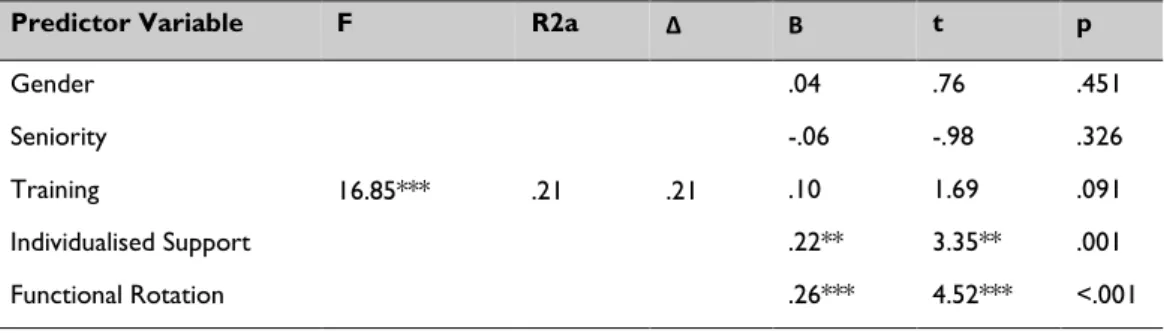
Gender 16.85*** .21 .21 .04 .76 .451 Seniority -.06 -.98 .326 Training .10 1.69 .091 Individualised Support .22** 3.35** .001 Functional Rotation .26*** 4.52*** <.001 Note. *p ≤ .05;**p < .01;***p < .001
Table 3: Results for multiple linear regressions (Step 2), perceived internal employability as a dependent variable (H2)
134
Only individualised support (β = .22; p < .01) and functional rotation (β = .26; p < .001) have a significant and positive impact on the perception of internal employability, this model being responsible for 21% of its variability.
Predictor Variable F R2a Δ β t p
Gender 23.52*** .18 .18 -.01 -0.26 .798 Seniority .10 1.84 .067 Internal Employability .43*** 8.29 <.001 Note. *p ≤ .05;**p < .01;***p < .001
Table 4: Results formultiple linear regression (Step 2) affective commitment as a dependent variable (H3)
The perception of internal employability has a significant and positive impact on affective commitment (β = .43; p <.001), this model being responsible for 18% of its variability.
Independent Variable Step2 Step3
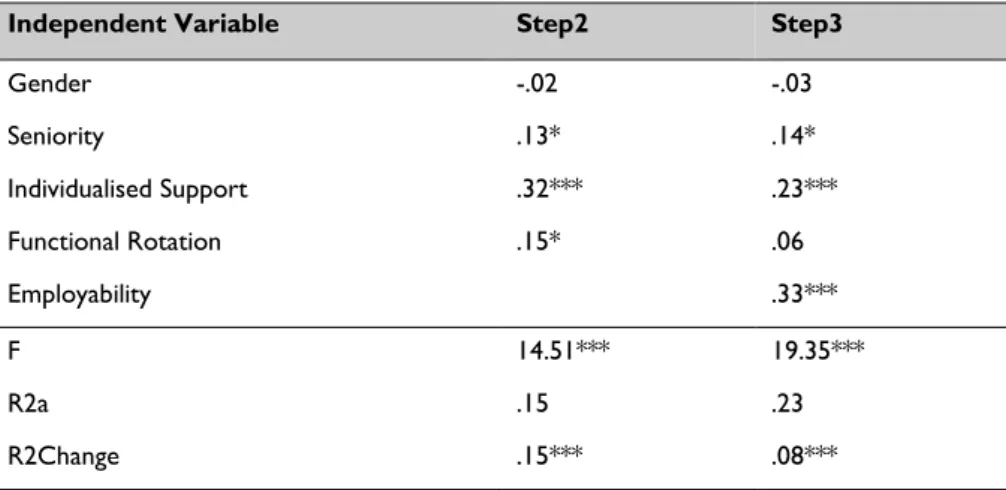
Gender -.02 -.03 Seniority .13* .14* Individualised Support .32*** .23*** Functional Rotation .15* .06 Employability .33*** F 14.51*** 19.35*** R2a .15 .23 R2Change .15*** .08*** Note. *p ≤ .05;**p < .01;***p < .001
Table 5: Results of the second and third steps of the mediating effect test There is a partial mediating effect of the perception of internal employability on the relationship between individualised support and affective commitment, as when the mediator variable is introduced in the linear regression model, there is an impact of individualised support (βSI1 = .32;
135 Regarding the relationship between functional rotation and affective commitment (βRF1 = .15; βRF2
= .06), it is no longer significant to introduce the mediating variable into the regression equation, which indicates that there is an effect of total mediation. It is also seen that there is a significant increase of 8% (p <.001) in the value of the coefficient of determination. The Sobel test was then performed, using the interactive instrument of Preacher and Leonardelli (2001), obtaining a Z = 3.89 with a p <.001 for Individualised Support, and a Z = 4.19 with a p <.001 for the functional rotation, which proves the effect of partial mediation and the effect of total mediation.
In order to test Hypotheses 3, 4 and 5 that presuppose a moderation, it was necessary to focus the variables in order to create the interaction variables, thus avoiding the problems of multicollinearity (Aiken & West, 1991). Finally, multiple linear regressions were performed in two steps: in the first step the control variables, the predictor variable, and the moderator variable were introduced as independent variables, and in the second step, the new interaction variable was introduced. The results of Hypothesis 3 are shown in Table 6.
Dependent Variable Affective Commitment
Predictors β
Step 2
Gender .03 -.00 -.01
Seniority .01 .12 -.03
Baby boomer Generation -.08 -.01 -.06
Y Generation -.13 -.14 -.11 Training .33*** Individualised Support .43*** Functional Rotation .29*** Training x Generation BB .11 Training x Generation Y .11
Indiv. Support x Generation BB .16*
Indiv. Support. x Generation Y .09
Functional Rot. x Generation BB .13
Functional Rot. x Generation Y .12
F 6.46*** 8.72*** 5.00***
R2a .11 .15 .09
R2 Change .01 .02 .01
Note. *p ≤ .05;**p < .01;***p < .001
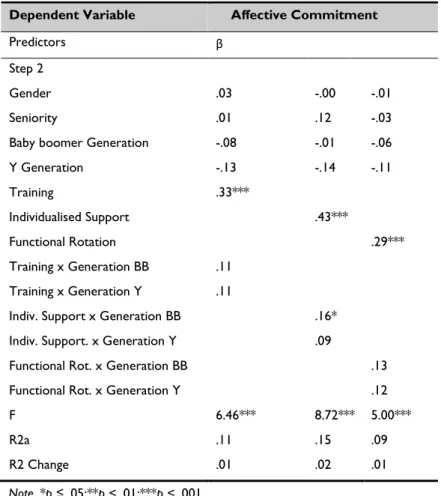
Table 6: Results of Interaction of generations and organisational practices of competence development on affective commitment
136
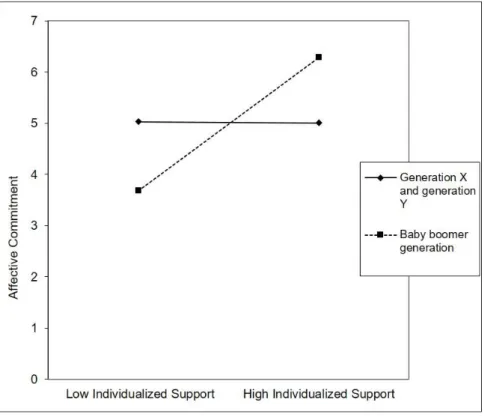
Results suggest that there is only a significant interaction effect of the generational effect on the relationship between individualised support perception and affective commitment, since the perception of individual support in interaction with the baby boomer generation has a significant effect on affective commitment (β = .16; p <.05). With the inclusion of the two terms of interaction, the additional variance in relation to the perception of internal employability had a marginally significant increase (ΔR2 = .02; p = .06).
For the baby boomer generation, when compared to Generations X and Y, individualised support perception is relevant for enhancing their affective commitment to the organisation (Figure 2). These results support the hypothesis formulated.
Figure 2: Interaction of individualised support x baby boomer generation The results of Hypothesis 4 are shown in Table 7.
137
Dependent Variable Internal Employability
Predictors Β
Step 2
Gender .08 .05 .04
Seniority -.04 .04 -.13
Baby boomer Generation -.19** -.13 -.16*
Y Generation -.14 -.16* -.15* Training .30*** Individualised Support .40*** Functional Rotation .39*** Training x Generation BB .12 Training x Generation Y .23***
Indiv. Support x Generation BB .14*
Indiv. Support. x Generation Y .12
Functional Rot. x Generation BB .15*
Functional Rot. x Generation Y .13*
F 8.25*** 9.61*** 10.31***
R2a .14 .17 .18
R2 Change .04** .01 .02
Note. *p ≤ .05;**p < .01;***p < .001
Table 7: Interaction generations and organisational competences development practices in perceived internal employability
The results show that there is a significant interaction effect of the generational effect on the relationship between perceived training and the perception of internal employability, as the perception of training in interaction with Generation Y has a significant effect on the perception of internal employability (β =. 23, p <.001). With the inclusion of these two terms of interaction, the additional variance in relation to the perception of internal employability had a significant increase (ΔR2 = .04, p < .01). These results support the hypothesis formulated. The explanation
138
There is a significant interaction effect of the generational effect on the relationship between individualised support perception and the perception of internal employability, as the perception of individualised support in interaction with the baby boomer generation has a significant effect on the perception of internal employability (β = .14 ; p <.05). With the inclusion of these two terms of interaction, the additional variance in relation to the perception of internal employability had a marginally significant increase (ΔR2 = .04, p = .09). These results support the hypothesis
formulated. The explanation for this interaction is shown in Figure 4.
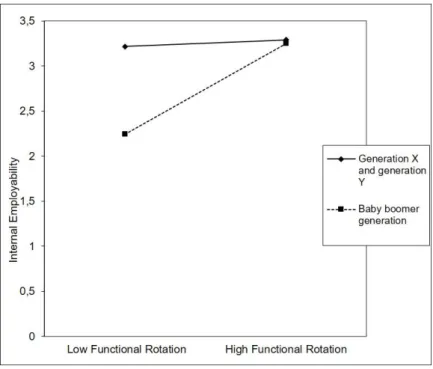
There is a significant interaction effect of the generational effect on the relationship between functional rotation perception and the perception of internal employability, as the perception of individualised support in interaction with the baby boomer generation has a significant effect on the perception of internal employability (β = .15, p <.05), with the same happening in relation to the interaction of functional rotation perception with Generation Y (β = .13; p = .05). Having include these two terms of interaction, the additional variance in relation to the perception of internal employability had a marginally significant increase (ΔR2 = .02, p = .06). These results
support the hypothesis. The explanation for these interactions is shown in Figures 5 and 6. For Generation Y, when compared to the baby boomer and X generations, the perception of training practice is relevant to increase their perceived internal employability (Figure 3).
139 For the baby boomer generation, when compared to the X and Y generations, individualised perceived support is relevant to increase their perceived internal employability (Figure 4). These results do not support the hypothesis formulated.
Figure 4: InteractionIndividualised support x baby boomer generation
For Generation X, functional rotation has no relation to the perception of employability, while for the other generations this practice is relevant to promote this perception. However, this relevance is even greater for the baby boomer generation than for Generation Y (Figures 5 and 6). These results partially support the hypothesis formulated.
140
Figure 5: Interactionfunctional rotation x baby boomer generation
141 The results of Hypothesis 5 are shown in Table 8.
Dependent Variable Affective Commitment
Predictors Β
Step 2
Gender -.01
Seniority .06
Baby boomer Generation -.01
Generation Y -.08
Internal Employability .41***
Internal Employability x generation baby boomer .18* Internal Employability x Generation Y .12
F 11.25***
R2a .19
R2 Change .02*
Note. *p ≤ .05;**p < .01;***p < .001
Table 8: Interaction generations and perception of internal employability on affective commitment
It is verified that there is a significant interaction effect of the generational effect on the relationship between the perception of internal employability and affective commitment to the organisation, since the perception of internal employability in interaction with the baby boomer generation has a significant effect on commitment affective (β = .18; p <.05). With the inclusion of these two terms of interaction, the additional variance in relation to affective commitment had a significant increase (ΔR2 = .02, p < .05). These results support the hypothesis formulated.
For the baby boomer generation, when compared to Generations X and Y, the perceived employability becomes relevant to enhance their affective commitment to the organisation (Figure 7). These results support the hypothesis formulated.
142
Figure 7: Interactionperceived internal employability x baby boomer generation Discussion and Conclusions
The main objective of this study was to test not only the mediating effect of perceived internal employability on the relationship between organisational practices of competences development and affective commitment, but also the moderating effects of different generations in the following relationships: between organisational practices of competences development and affective commitment; between the organisational practices of competences development and the perception of internal employability, and; between the perception of internal employability and affective commitment.
The positive effect (H1) of all the organisational practices of competences development (training, Individualised support and functional rotation) on the affective commitment of the participants to the organisation to which they belong was verified, with the individualised support dimension having the stronger relationship, with the functional rotation being the one with a weaker relationship. According to Virtanen, Kivimäki, Virtanen, Elovainio, and Vahtera, (2003), the organisational practices of competence development installed in employees result in an affective commitment to the organisation, since, by the theory of social exchange (Blau, 1964), they try to give back to the organisation the investment that they consider to have been made in themselves. When an employee considers that there is a greater perception of individualised support, that is to say, when they feel that this support is directed specifically to themselves and that the
143 organisation is investing in them in order to develop their competences as they are part of the human capital that will differentiate it from other organisations (Schultz, 1961), they will reciprocate with a greater affective commitment to the organisation.
With regards to the mediating effect of perceived internal employability on the relationship between organisational practices of competence development and affective commitment (H2), the following effects were observed: a partial mediating effect on the relationship between individualised support and affective commitment and a total mediating effect on the relationship between functional rotation and affective commitment. These results indicate that perceived internal employability weakens the impact of individualised support on affective commitment, but does not negate it, but rather it cancels the direct relationship between functional rotation and affective commitment. The fact that total mediations in all relationships was not confirmed by the results is possibly due to the fact that the participants of this study have a low perception of both the organisational practices of development of competences and of internal employability, and a high affective commitment. However, it is verified that the effect of the perception of organisational practices of competences development in the perception of employability helps to enhance the affective commitment of employees towards the organization, as the increase of variability is significant. These results are in accordance with the literature (De Cuyper & De Witte, 2011).
With respect to the moderating effect of generations on the relationship between organisational skills development practices and affective commitment (H3), it can be seen that for the baby
boomer generation, when compared to other generations (X and Y), individualised support
(coaching and mentoring) has a greater relevance for enhancing their affective commitment to the organisation. These results are also supported by the literature, as members of the baby boomer generation show a preference for face-to-face communication to address work-related issues (Eisner 2005) and have more social than technical competences (Cogin, 2012). If we look at the items in this dimension (i.e., "Have you had a chance to talk to your boss about your career", "Have
you had advice and support from a person in the organisation regarding your professional development"
and "Have you had a "godfather or godmother" in the organisation to support you in any matter"), it is found that face-to-face communication is present in all of these. This moderating effect does not occur in relation to the other practices, possibly because participants in the baby boomer generation, as they are in an advanced stage of their careers, do not value training as much for career progression.
Regarding the moderating effect of generations on the relationship between the perception of organisational practices of competences development and the perception of internal employability (H4), it is verified that: for Generation Y, when compared with the baby boomer and X generations, perception of training is relevant for boosting their perception of internal employability, which confirms the hypothesis formulated; whereas for the baby boomer generation, when compared to Generations X and Y, individualised support perception is
144
relevant for raising perception of internal employability, which does not confirm the formulated hypothesis. In the relationship between the perception of functional rotation and the perception of internal employability, Generation X considers that this relationship is not significant, while the other generations consider this practice to be relevant for promoting the perception of internal employability, this being more relevant for the baby boomer generation, which partially confirms the hypothesis formulated. These results confirm what the literature says about the individuals of Generation Y, who highly value progression in their career and consequently the development of competences (training) that allow them to achieve their objectives (Deloitte, 2011). With regards to the members of the baby boomer generation, as previously mentioned, these value face-to-face communication (Eisner 2005), as well as seniority (Gursoy et al., 2008), which makes them value the hypothesis of changing roles more within the organisation, which does not happen with Generation Y, as the literature tells us that these participants do not value labour stability (Martin 2005) and jump from organisation to organisation.
With respect to the moderating effect of the generations on the relationship between perception of internal employability and affective commitment (H5), it is verified that for the baby boomer generation, when compared to Generations X and Y, the perception of internal employability is relevant to enhance commitment to the organisation. These results also confirm what the literature tells us, as the members of the baby boomer generation are loyal to the organisation (The Ken Blanchard Companies, 2009).
Limitations
One of the main limitations of this study, if not the main one, is the fact that the word "generations" was used, since there is no agreement for the use of this term, or the term "age" in organisational studies. According to some authors, this term refers to individuals who were born during the same period of time, who share the same historical and social experiences, with these being determinant factors for their feelings towards authority and the organisation, and also what they desire from work, which the type of work they desire, and how they plan to satisfy their desires (Kupperschmidt, 2000; Smola & Sutton, 2002), which are all relatively stable throughout their lives (Smola & Sutton, 2002). However, it is known that sometimes the reality of individuals also varies from country to country and from culture to culture. For example, the reality of those who suffered directly from World War II is very different from the reality of those who did not participate in the war, such as in the case of Portugal. Another of the facts related to generations is the lack of consistency regarding the time period considered for each one. For Rhodes (1983), the effects of age are developmental, as they are caused by psychosocial and biological ageing, with young people being expected to become older as the years go by.
There is also a limitation regarding the data collection process, as well as the fact that the questionnaires consisted of self-reporting instruments, with closed questions and mandatory answers, which may condition the responses given by the participants.
145 Finally, we have to face the fact that this was a transversal study, which did not allow for establishing causal relationships between variables. A longitudinal study to test causal relationships needs to be carried out. In order to reduce the impact of the common method variance, several methodological and statistical recommendations were followed (Podsakoff, MacKenzie, Podsakoff & Lee, 2003).
Practical Implications
This study indicates that different generations perceive and value differently the practices of development of competences promoted by organisations, which interferes with the relationship between these practices and other organisational variables, such as affective commitment and perception of internal employability, which, according to Saba (2013), is one of the reasons why it has become so important to study the generational effect.
Accordingly, organisations should implement different practices for different generations, which would lead to their employees having a higher perception of internal employability, as well as a greater affective commitment to the organisation where they work. In this way, employees should try to better understand the career perspectives of each generation, and whether they would like to perform another function within the organisation, what increased difficulties they face in performing their duties, and what competences they would like to develop. One of the relevant practices is individualised support, as it is through this practice that it would be possible to perceive all the aforementioned needs.
References
Afiouni, F. (2007). Human Resource Management and Knowledge Management: A Road Map toward Improving Organizational Performance. Journal of American Academy of Business, 11, 124-130.
Aiken, L. S., and West, S. G. (1991). Multiple Regression: Testing and interpreting interactions. Newbury Park, CA: Sage.
Allen, N. J. and Meyer, J. P. (1996). Affective, continuance, and normative commitment to the organization: An examination of construct validity. Journal of Vocational Behavior, 49, 252-276. Arthur, J. B. (1994). Effects of human resource systems on manufacturing performance and turnover. Academy of Management Journal, 37, 670–687.
Barney, J. B. (1991). Firm resources and sustained competitive advantage. Journal of Management,
146
Baron, R. M. and Kenny, D. A. (1986). The Moderator-Mediator Variable Distinction in Social Psychological Research: Conceptual, Strategic, and Statistical Considerations. Journal of Personality
and Social Psychology, 51, 1173-1182.
Blau, P. (1964). Exchange and Power in Social Life. New York: Wiley.
Brock, V. G. (2006). Who's who in coaching: Who shaped it, who's shaping it? In J. L. Bennet and F. Campone (Eds.), Proceedings of the fourth international coach federation coaching research
symposium (pp. 11-25). Lexington: International Coach Federation.
Bryman, A. and Cramer, D. (2003). Análise de dados em ciências sociais. Introdução às técnicas
utilizando o SPSS para windows (3ª Ed.). Oeiras: Celta
Campion, M. A., Cheraskin, L. and Stevens, M. J. (1994). Career-related antecedents and outcomes of job rotation. Academy of Management Journal, 37, 1518 -1542.
Cesário, F., Gestoso, C. and Peregrin, F. (2012) Contrato de Trabajo, Compromiso y satisfacción: Moderación de la Empleabilidad. RAE 3, 345-359.
Chambel, M. J. (2011). Novos Desafios para a GRH, O Caso dos Trabalhadores Temporários. Lisboa: Editora RH
Cogin, J. (2012). Are generational diferences in work values fact or fiction? Multi-country evidence and implications. The International Journal of Human Resource Management, 23, 2268-2294.
Colquitt, J. A., Baer, M. D., Long, D. M. and Halvorsen-Ganepola, M. D. K. (2014). Scale indicators of social exchange relationships: A comparison of relative content validity. Journal of
Applied Psychology, 99, 599–618.
De Cuyper, N., Bernhard-Oettel, C., Berntson, E., De Witte, H., and Alarco, B. (2008). Employability and employees’ well-being: mediation by job insecurity. Journal of Applied Psychology,
57, 488–509.
De Cuyper, N. and De Witte, H. (2010). Temporary employment and perceived employability: Mediation by impression management. Journal of Career Development, 37, 635-652.
De Cuyper, N. and De Witte, H. (2011), «The management paradox: self-rated employability and organizationall commitment and performance», Personnel Review, 40, 152-172. http://dx.doi.org/10.1108/00483481111106057
De Vos, A., and De Hauw, S. (2009). Building a conceptual process model for competency
development in organizations: an integrated approach. Paper presented at the 14th European
congress of Work and Organizational Psychology.
De Vos, A., De Hauw, S. and Van der Heijden, B. I.J.M. (2011). Competency development and career success: The mediating role of employability. Journal of Vocational Behavior, 79, 438–447.
147 De Witte, H. (2005). Job insecurity: Review of the international literature on definitions, prevalence, antecedents and consequences. South African Journal of Industrial Psychology, 31(4), 1-4. Deloitte. (2012). Talent 2020: Surveying the talent paradox from the employee perspective.
Eisner, S. P. (2005). Managing Generation Y. SAM Advanced Management Journal, 70, 4–12.
Forrier, A. and Sels, L. (2003). The concept employability: a complex mosaic. International Journal
of Human Resources Development and Management, 3(2), 102-124.
Gaertner, K. N. and Nollen, S.D. (1989). Career experiences, perceptions of employment practices, and psychological commitment to the organization. Human Relations, 42, 975-991. Glass, A. (2007). Understanding Generational Differences for Competitive Success. Industrial and
Commercial Training, 39, 98–103.
Gouldner, A. W. (1960). The norm of reciprocity: A preliminary statement. American Sociological
Review, 25, 161–178.
Gursoy, D., Maier, T. and Chi, C. (2008). Generational differences: An examination of work values and generational gaps in the hospitality workforce. International Journal of Hospitality
Management, 27, 448-458.
Hill, M., and Hill, A. (2002). Investigação por Questionário. Lisboa: Edições Sílabo.
Jöreskog, K. G., and Sörbom, D. (1993). LISREL8: Structural equation modelling with the SIMPLIS
command language. Chicago, IL: Scientific Software International.
Lancaster, L.C., and Stillman, D. (2002). When Generations Collide. New York: Harper Collins. Kinicki, A.J., Carson, K.P. and Bohlander, G.W. (1992). Relationship between an organization’s actual human resource efforts and employee attitudes. Group and Organization Management, 17, 135-152.
Kupperschmidt, B. R. (2000). Multigeneration employees: strategies for effective management.
The Health Care Manager, 19, 65–76.
Martin, C. A. (2005). From High Maintenance to High Productivity: What Managers Need to Know About Generation Y. Industrial and Commercial Training, 37, 39–44.
Meyer, J. P. and Allen, N. J. (1984). Testing the “side-bet theory” of organizational commitment: Some methodological considerations. Journal of Applied Psychology, 69, 372–378.
Meyer, J.P. and Allen, NJ. (1991). A three-component conceptualization of organizational commitment. Human Resource Management Review, 1, 61-89.
Meyer, J. P. and Allen, N. J. (1997). Commitment in the workplace: Theory, research, and application. Thousand Oaks, CA: Sage Publications.
148
Meyer, J. P. Allen, N. J. and Topolnytsky, L. (1998). Commitment in a changing world of work.
Canadian Psychology, 39, 83–93.
Meyer, J. P., Becker, T. E. and Van den Berghe, C. (2004). Employee Commitment and motivation: A conceptual analysis and integrative model. Journal of Applied Psychology, 89, 991-1007.
Meyer, J. P. and Herscovitch, L. (2001). Commitment in the workplace: Toward a general model.
Human Resource Management Review, 11, 299-326.
Meyer, J. P., Stanley, D. J., Herscovitch, L. and Topolnytsky, L. (2002). Affective, continuance, and normative commitment to the organization: A meta-analysis of antecedents, correlates, and consequences. Journal of Vocational Behavior, 61, 20–52.
Morrison, R., Erickson, T., and Dychtwald, K. (2006). Managing middlescence. Harvard Business
Review, 84, 79–86.
Podsakoff, P. M., Williams, L. J. and Todor, W. D. (1986). Effects of organizational formalization on alienation among professionals and nonprofessionals. Academy of Management Journal, 29, 820-831.
Prahalad, C. and Hamel, G. (1990). The core competence of the corporation. Harvard Business
Review, 68(3), 79-91.
Preacher, K. J., and Leonardelli, G. J. (2001, March). Calculation for the Sobel test: An interactive calculation tool for mediation tests [Computer software]. [Retirado a 10 de Setembro de 2017]. http://www.unc.edu/ preacher/ sobel/sobel.htm
Reisenwitz, T., and Iyer, R. (2009). Differences in generation X and generation Y: Implications for the organization and marketers. The Marketing Management Journal, 19, 91-103.
Rhodes, S. R. (1983). Age-related differences in work attitudes and behavior: A review and conceptual analysis. Psychological Bulletin, 93, 328-367.
Rothwell, A. and Arnold, J. (2007). Self-perceived employability: development and validation of a scale. Personnel Review, 36(1), 23-41.
Saba, T. (2013). Understanding generational differences in the workplace: Findings and Conclusions. Working paper Industrial Relations Centers – Queens University. Kingston.
Santos, C., Ariente, M., Diniz, M. and Dovigo, A. (2011, Outubro). O processo evolutivo entre as gerações X, Y e Baby Boomers. Comunicação apresentada no XIV SemeAD Seminários em
Administração, São Paulo, Brasil.
Schneider, B., Brief, A. P. and Guzzo, R. A. (1996). Creating a climate and culture for sustainable organizational change. Organizational Dynamics, 24(4), 6–19.
149 Shore, L. M., Tetrick, L. E., Lynch, P. and Barksdale, K. (2006), ‘Social and economic exchange: construct development and validation’, Journal of Applied Social Psychology, 36, 837–867.
Smola, K.W. and Sutton, C.D., 2002. Generational differences: revisiting generational work values for the new millennium. Journal of Organizational Behavior, 23, 363–382.
The Ken Blanchard Companies. (2009). The next generation of workers. Escondido, U.S.A.
Trochim, W. (2000). The Research Methods Knowledge Base. 2nd Edition. Atomic Dog Publishing, Cincinnati, OH.
Tulgan, B. (2004). Trends point to a dramatic generational shift in the future workplace.
Employment Relations Today, 30(4), 23–31.
Twenge, J. (2010). A review of the empirical evidence on generational differences in work attitudes. Journal of Business and Psychology, 25, 201-210.
Van Dam, K. (2003b). Understanding experts’ attitudes toward functional flexibility. International
Journal of Human Resources Development and Management, 3, 138 – 154.
Van der Heijde, C. M., and Van der Heijden, B. I. J. M. (2005). The development and psychometric evaluation of a multi-dimensional measurement instrument of employability and the impact of aging. International Congress Series, 1280, 142-147.
Veloso, E., Silva, R., and Dutra, J. (2011, Setembro). Gerações e carreiras: A relação entre as perceções sobre carreiras inteligentes e sobre crescimento profissional nas Organizações. Comunicação apresentada no XXXV Encontro da ANPAD, Rio de Janeiro.
Virtanen, M., Kivimäki, M., Virtanen, P., Elovainio, M., and Vahtera, J. (2003). Disparity in occupational training and career planning between contingent and permanent employees.
European Journal of Work and Organizational Psychology, 12, 19-36. doi:
10.1080/13594320344000002
Wood, S., and de Menezes, L. (1998). High commitment management in the U.K.: evidence from the Workplace Industrial Relations Survey and Employers’ Manpower and Skills Practices Survey.