1
Brazilian state-agribusiness relations within global processes
of regulatory formation below the corporate food regime
Niels Søndergaard
Brasília
2
NIELS SØNDERGAARD
BRAZILIAN STATE-AGRIBUSINESS RELATIONS
WITHIN GLOBAL PROCESSES OF REGULATORY
FORMATION UNDER THE CORPORATE FOOD
REGIME
Tese apresentada a o Programa de Pós-Graduação em Relações Internacionais da Universidade de Brasília, como requisito parcial para a obtenção do título de Doutor em Relações Internacionais.
Área de Concentração: Política Internacional e Comparada Orientadora: Ana Flávia Granja e Barros
Brasília
3
Resumo
A tese examina os condicionantes estruturais que moldaram as relações Estado-agronegócio no Brasil contemporâneo, e foca na cooperação conjunta destes atores em diferentes processos globais de formação de regulação na área de agricultura. Com ponto de partida conceitual na literatura de Food Regime, a tese inicialmente avalia o impacto da transformação do sistema alimentar global no setor agrícola brasileiro em conjunto com outras mudanças estruturais na economia doméstica até o fim do século XX. A reestruturação setorial e a concomitante cooperação internacional entre instituições públicas e o agronegócio brasileiro são abordadas por meio de análise das transformações econômicas e institucionais neste período. A parte subseqüente da tese foca na dimensão de agência, e escrutiniza o engajamento conjunto público-privado em diferentes arenas globais de formação regulatória a partir do começo do novo milênio. Por meio da inclusão de diferentes perspectivas da área geral de Economia Política, esta parte avalia as modalidades de interação entre Estado e agronegócio com o objetivo de aproximar uma concepção abrangente desta relação como parte da inserção do Brasil na economia global contemporânea.
Abstract
The thesis examines the structural conditionings which have given rise to contemporary Brazilian state-agribusiness relations, and focuses on these actors´ joint cooperation within different global processes of agricultural regulatory formation. With conceptual point of departure in the Food Regime literature, the thesis initially evaluates the impact of the global food regime transformation upon the Brazilian agricultural sector, in conjunction with other structural changes within the domestic economy towards the end of the 20th century. The sectorial rearrangement and concomitant internationally oriented cooperation between Brazilian public institutions and agribusiness is approached through analysis of the economic and institutional changes in this period. The subsequent part of the thesis focuses on the dimension of agency, and scrutinizes the joint public-private engagement within different global arenas of regulatory formation from the dawn of the new millennium. Through inclusion of different perspectives from within the general field of Political Economy, this part evaluates the interactional modalities between state and agribusiness with the goal of approximating a broader conception of this relationship as part of Brazil´s insertion within the contemporary global economy.
4
Banca examinadora
Profa. Dra. Ana Flávia Granja e Barros (IREL-UnB)
Prof. Dr. Antônio Carlos Moraes Lessa (IREL-UnB)
Prof. Dra. Susan Elizabeth Martins Cesar de Oliveira (FUP-UnB)
Prof. Dr. Haroldo Ramanzini Júnior (IERI-UFU)
5
Agradecimentos
Para minha esposa, Eliane
Til min mor, Esther
Muitos agradecimentos para a minha orientadora, Ana-Flávia, e para os professores do IREL, cujas aulas tanto enriqueceram o meu tempo aqui em Brasília
6
Table of contents
Chapter 1: Introduction ... 14
1.1 Positioning the research objectives ... 15
1.2 Research questions ... 20
1.3 General structure of the thesis ... 24
Chapter 2: Theoretical perspectives ... 25
2.1 Neo-Gramscian perspectives ... 26
2.1.1 Worldview and levels of analysis ... 26
2.1.2 Internationalization of the state ... 28
2.1.3 Neo-Gramscian perspectives upon private agency ... 30
2.2 Global Food Regime Perspectives ... 32
2.2.1 Analytical focus ... 32
2.2.2 Historical food regimes ... 33
2.2.3 Dynamics of food regime transformation ... 35
2.2.4 Global agriculture and units of analysis ... 36
2.2.5 Regulatory structures of the food regime ... 39
2.3 State-business theory ... 40
2.3.1 Historical institutionalism ... 40
2.3.2 Perspectives on state-business relations in Brazil ... 43
2.3.3 Neopluralism ... 45
2.3.4 Management literature ... 48
Chapter 3: Methodology ... 53
3.1 The case(s) selected ... 54
3.2 A critical realist standpoint ... 56
3.3 A structure-actor duality ... 57
3.4 Modes of inference and the general analytical model ... 61
3.4.1 Systemic transformation ... 71
3.5 Definition of sub-research questions in the second analytical part ... 73
3.6 Cases and actors analyzed... 79
3.7 Empirical sources... 81
Chapter 4: Food systems transformations and international reorientation of Brazilian agriculture ... 83
4.1 Institutional food system transformation: the surge of commercial multilateralism in relation to agriculture ... 84
7
4.2.1 Productive verticalization ... 92
4.2.2 Financialization ... 100
4.3 Ideational food system transformations ... 103
4.3.1 New Free trade oriented paradigms ... 103
4.3.2 Liberal production paradigms ... 106
4.4 Innovation and expansion within Brazilian agriculture ... 109
4.5 The domestic agricultural reform movement ... 113
4.6 Re-orientation of the state and its commercial international engagement ... 120
4.7 Sectorial reorganization ... 124
4.8 Partial conclusion ... 128
Chapter 5: Brazilian public-private cooperation in the course of the Doha Round ... 137
5.1 The Road to Doha ... 138
5.2 A Curvy path from Doha to Cancun... 143
5.3 Brazil and the G-20 leaving its mark on the July Package ... 151
5.4 Technical issues on the way to Hong Kong ... 157
5.5 Navigating the Troubled Waters Beyond Hong Kong ... 163
5.6 Resurgence and eventual shipwrecking of the Doha Round ... 167
5.7 Partial conclusion ... 171
Chapter 6: Public-private cooperation as part of the Brazilian engagement in the Cotton Dispute ... 175
6.1 Brazilian cotton production ... 176
6.2 Initial deliberations ... 179
6.3 The first consultations and coalition formation around the cotton issue ... 188
6.4 The panel and the appeal phase ... 195
6.5 Concluding analysis ... 204
Chapter 7: Joint lobbying by Itamaraty and UNICA in the formation of the EU Renewable Energy Directive ... 208
7.1 Climate change and the contemporary food system ... 209
7.2 Structural changes within the Brazilian sugarcane sector at the turn of the millennium ... 212
7.3 Initial formulation of an EC biofuel policy framework ... 215
7.4 Transmission of the Renewable Energy Directive in the Parliament and the European Council ... 226
7.5 Efforts to influence the specification of the sustainability criteria below the RED ... 235
8
Chapter 8: Brazilian agribusiness and the formation of the Roundtable of Responsible Soy .. 246
8.1 The surge of private regulation within the global food system ... 247
8.2 Brazilian participation in the development of the Roundtable of Responsible Soy ... 251
8.3 Brazilian divergences regarding the establishment of the principles and criteria for responsible soy ... 257
8.4 Continued engagement and integration of Amaggi and SLC Agriculture within the RTRS ... 264
8.5 Partial Conclusion ... 269
Chapter 9: Reflecting on Brazilian state-agribusiness relations in the 21st century ... 274
9.1 Domestic state-capital relations and food regime conditionings ... 275
9.2 Modalities of public-private cooperation in different global regulatory spheres ... 281
Chapter 10: Conclusion ... 294
9
Index of figures
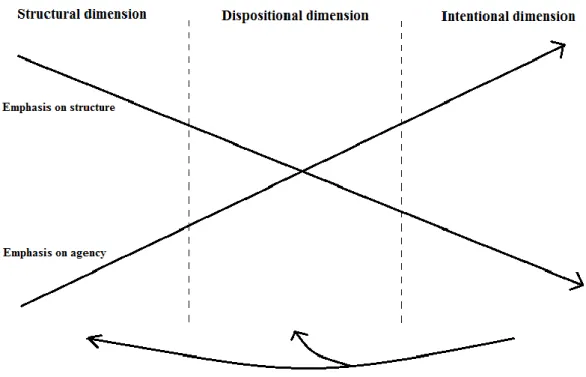
Figure 1: Variation in emphasis upon structure versus agency in relation to different
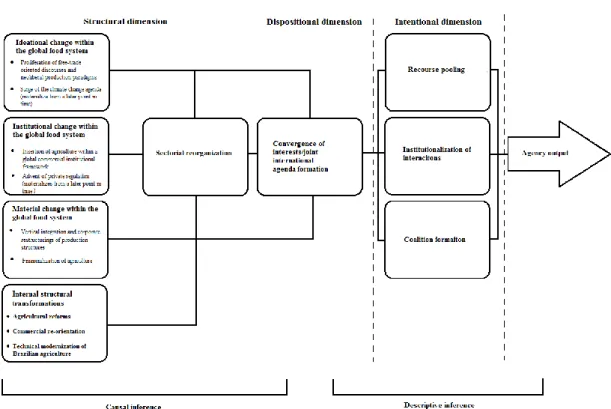
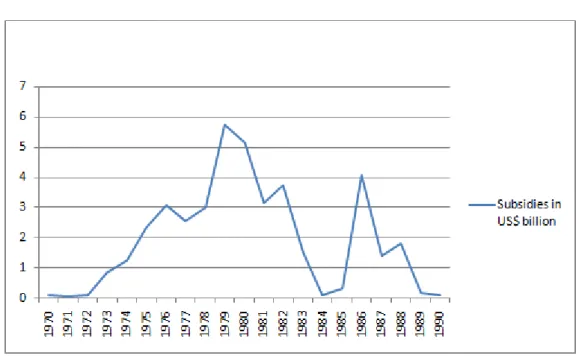
dimensions: ... 60 Figure 2: General analytical model transgressing structural, dispositional and intentional dimensions: ... 62 Figure 3: central analytical variables distributed upon material/productive, institutional and ideational dimensions of the food system conceived of as a historical structure. ... 71 Figure 4: Graph of annual Brazilian exports in thousand US$ from maize, soybeans and refined sugar from 1980-2005 ... 95 Figure 5: Graph of the annual Brazilian exports in thousand US$ from beef, chicken and pork from 1980-2005... 95 Figure 6: Graph of effective annual rural subsidies from 1970-1990 in US$ billion ... 114 Figure 7: impacts of the transformation within the institutional dimension of the global food system on Brazilian agriculture. ... 130 Figure 8: impacts of the transformation within the material/productive dimension of the global food system on Brazilian agriculture. ... 131 Figure 9: impacts of the transformation within the ideational dimension of the global food system on Brazilian agriculture. ... 132 Figure 10: impacts of changes within the ideological orientation of the Brazilian state and the concomitant repercussions of this within the domestic institutional framework for Brazilian agriculture. ... 133 Figure 11: Impacts of agricultural reforms within Brazilian agriculture on the productive forces within the sector ... 134 Figure 12: Impacts from the agricultural modernization and inwards expansion on the
composition of productive forces within Brazilian agriculture ... 135 Figure 13: Effects of food system transformations and domestic restructurings of the
productive sector upon the public-private Brazilian engagement in the Doha negotiations. .. 172 Figure 14: Brazilian annual cotton production in million ton. ... 176 Figure 15: Area planted with cotton in different Brazilian macro regions in thousands of
hectares ... 177 Figure 16: Food system transformations, agricultural reforms and the joint public-private Brazilian engagement in the cotton dispute. ... 204 Figure 17: Graph of cane production and ethanol exports from 2001-2008. ... 213 Figure 18: model of the structural conditioning of the public-private engagement of Brazilian actors in the formation of the RED ... 243 Figure 19: Food system transformations and the engagement of Brazilian agriculture within the Roundtable of Responsible Soy. ... 269 Figure 20: Schematic illustration of the historical structure of the global food system. ... 276 Figure 21: graph of the evolution of the export value of selected primary commodities and manufactures from 2001-2017 in 1000 US$. ... 280 Figure 22: Model of causal rebounding from structural to agential dimension ... 289
10
Index of tables
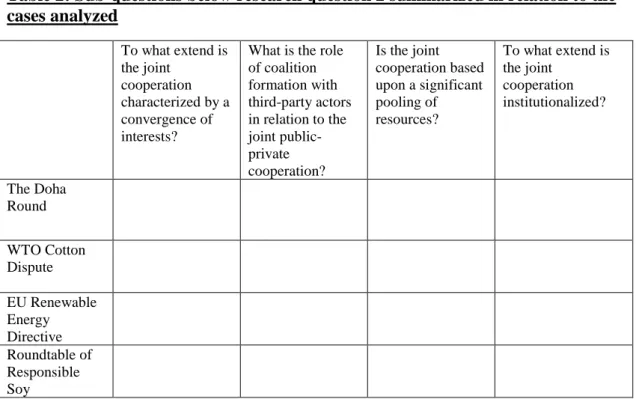
Table 1: Central Brazilian actors in the specific cases examined. ... 79 Table 2: Sub-questions below research question 2 summarized in relation to the cases
analyzed ... 80 Table 3: Aggregate Measures of Support (AMS) within agriculture amongst developed
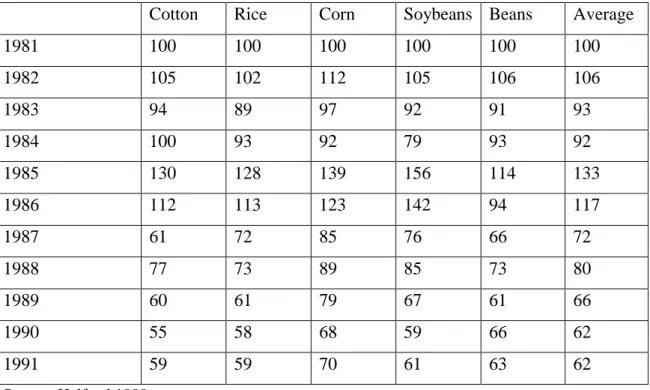
countries from 1995-2001 (in US$ million: ... 89 Table 4: Area in million HA sown dedicated to specific crop production in Brazil in 1990 and 2000. ... 96 Table 5: Volume in ton of Brazilian crop production in 1990 and 2000. ... 97 Table 6: Share of total foreign ownership of different sectors of Brazilian agriculture in 1994 and 1998. ... 99 Table 7: Indices of real support prices for important crops from 1981-1991... 115 Table 8: Quantity of soy produced in Brazil from 1992-2003 in tons. ... 251 Table 9: modalities of internationally oriented Brazilian public-private cooperation in relation to the cases in which this had unfolded ... 282
11
List of Abbreviations
ABAG - Associação Brasileira de Agronegócio
ABCDs - Arthus Daniel Midlands, Bungee, Cargill, Louis Dreyfus ABEF - Associação Brasileira de Produtores e Exportadores de Frango ABOIVE - Associação Brasileira de Indústrias de Óleos Vegetais ABRAPA - Associação Brasileira de Produtores de Algodão ACP - African, Caribbean, and Pacific Group of States. ADM - Arthur Daniel Midlands
AMS - Aggregated Measures of Support
ANEC - Associação Nacional de Exportadores de Cereais AoA - Agreement on Agriculture
APROSOJA - Associação Brasileira de Produtores de Soja AVEs - Ad-Valorem Equivalents
Câmera - Câmera Temática de Negociações Agrícolas Internacionais CAMEX - Câmera de Comércio Exterior
CEB - Coalizão Empresarial Brasileira CGC - Coordenadoria Geral de Contenciosos CNA - Confederação Nacional de Agricultura CNI - Confederação Nacional de Indústria
CONAB - Companhia Nacional de Abastecimento
CONTAG - Confederação Nacional de Trabalhadores na Agricultura COVPA - Contrato de Opções de Venda de Produtos Agrícolas CO2 - Carbondioxide
CSR - Corporate Social Responsibility C4 - The Cotton Four
DG - Development Group DSB - Dispute Settlement Body
EMBRAPA - Empresa Brasileira de Pesquisa Agropecuária EU - European Union
12
EC - European Commission
FAO - Food and Agricultural Organization
FAPRI - The Food and Agricultural Research Institute FIESP - Federação de Indústrias do Estado de São Paulo FIP - The Five Interested Parties
FQD - Fuel Quality Directive FSA - Farm Service Agency
Fórum - Fórum Permanente de Negociações Agrícolas Internacionais GATT - General Agreement on Tariffs and Trade
GHGs - Greenhouse Gasses GM - Genetically Modified GT - Grupo Téchnico G-33 - Group of thirty three G-20 - Group of Twenty G-4 - Group of Four
HCFC - Hydrochlorofluorocarbon HFCs - Hydrofluorocarbonates
IBGE - Instituto Brasileiro de Geografia e Estatística
ICMS - Imposto sobre Circulação de Mercadorias e Serviços
ICONE - Instituto de Estudos de Comércio e Negociações Internacionais ILUC - Indirect Land Use Change
IR - International Relations
IPCC - Intergovernmental Panel on Climate Change IPE - International Political Economy
ITC - International Trade Centre LDCs - Least Developed Countries
MAPA - Ministério de Agricultura, Pecuária e Abastecimento MEP - Member of the European Parliament
13
MDA - Ministério de Desenvolvimento Agrário
MDIC - Ministério de Desenvolvimento, Indústria e Comércio NCC - National Cotton Council
NAC - New Agricultural Country
NAMA - Non-agricultural market access NGO - Non-governmental Organization
OCB - Organização de Cooperativas Brasileiras
OECD - Organization for Economic Cooperation and Development PIN - Plano de Integração Nacional
PEP - Prêmio de Escoamento de Produtos PPP - Public-Private Partnership
PROCEDER - Programma de Cooperação Nipo-Brasileira para o Desenvolvimento dos Cerrados
QUAD - Canada, US, Japan , EU RED - Renewable Energy Directive RTRS - Roundtable of Responsible Soy RSB - Roundtable on Sustainable Biofuels R&D - Research and Development
SSM - Special Safeguard Measures TNC - Transnational Corporation TF - Task Force
TFP - Total Factor Productivity TRQs - Tariff Rate Quotas
UNICA - União de Indústria de Cana-de-Açúcar UN - United Nations
USDA - United States Department of Agriculture USTR - United States Trade Representative WWF - World Wildlife Foundation
14
Chapter 1: Introduction
In recent decades, the Brazilian state and agribusiness sector have formed a close partnership within the country´s foreign engagement. This public-private international cooperation has aimed at influencing a variety of regulatory spheres, so as to enhance the market access of Brazilian agricultural products. A special relationship between Brazilian public institutions and agribusiness has thereby become apparent, which is rooted in the role that agriculture has assumed within the Brazilian economy and export composition in recent decades. This thesis analyses the developments within global and domestic agriculture which have engendered this special relationship, and examines the nature of the contemporary state-agribusiness cooperation within the Brazilian foreign engagement.
The first analytical part focuses on understanding how the transformation of the global food regime, in conjunction with changes within domestic agriculture, have
15
reshaped the relationship between the Brazilian agribusiness sector and the state in recent decades. The second analytical part examines the motivations, patterns, and strategies within the joint public-private cooperation through case studies of processes of agricultural regulatory formation at different global levels. Decision-making processes unfolding at the level of multilateral trade negotiations, commercial dispute settlements, joint lobbying efforts, and multistakeholder governance initiatives are analyzed in order to examine the international dimension of Brazilian state-agribusiness relations. Perspectives from the Global Food Regime theory, neo-Gramscianism, and State-Business literature are applied as the conceptual framework for the study. In accordance with this theoretical approach, a critical realist standpoint is adopted, which implies a focus upon multilevel causality and on the particular processes and mechanisms, through which systemic transformations are transmitted onto the behavior of actors examined. In line with this explanatory objective, a framework of agency-structure duality is employed in order to connect food system transformations at the structural level with the inception of an internationally oriented agency that came to mark the relationship between the Brazilian state and agribusiness in recent decades. The empirical foundation of the study is constituted by a data triangulation strategy, based upon archival research, semi-structured interviews, analysis of policy documents, statistical data, and secondary literature.
1.1 Positioning the research objectives
The Brazilian public-private participation within processes of agricultural policy- and regulatory formation at the international level has intensified since the turn of the millennium. These processes have materialized in a range of different international and transnational spheres, and have either directly or indirectly come to involve a great variety of actors. While relatively incipient at the end of the 1990s, the internationally focused cooperation between Brazilian public institutions and the country´s agribusiness sector has gained momentum throughout recent decades, as Brazil has become an increasingly significant producer and exporter of agricultural commodities. Brazilian actors have thereby obtained a very central position within different governance arenas where the rules for agricultural production and commercialization are defined. The underlying drivers, the functional modality, as well
16
as the external repercussions of this state-agribusiness relationship thereby constitute a compelling object of scholarly inquiry.
A broad strand of contributions within the field of this thesis has been aimed towards analysis of Brazilian participation within multilateral commercial negotiations. This literature comprises of studies that detect an embryonic shift towards a more offensive Brazilian position during the Uruguay Round (FARIAS 2009 & 2010, MARIANO et al. 2015) and some very incipient joint public-private efforts made to influence the agenda at the Seattle Conference in 1999 (CARVALHO 2003; BERALDO 1999). Yet, the bulk of contributions within the area appears to have been aimed at examining the country´s expressive participation within the Doha Negotiations. Attention has thus both been directed towards the domestic determinants of the agenda formation (CARVALHO 2010; HOPEWELL 2013 & 2014; MANCINI 2010; RAMANZINI JÚNIOR & MARIANO 2013) and the processes through which these Brazilian interests have been projected throughout the negotiation arena in cooperation with other developing countries (DOCTOR 2015; EFSTATHOUPOLOUS 2012; HOPEWELL 2016, HURRELL & NARLIKAR 2006; NARLIKAR & TUSSIE 2004; PIMENTA JÚNIOR 2012; RAMANZINI JÚNIOR & VIANA, 2012). Still other contributions within this thematic area have sought to understand the significance of agriculture within the country´s engagement in commercial multilateralism, with analytical point of departure in the broader patterns and shifting lines of Brazilian foreign policy (CASON & POWER 2009; CONCEIÇÃO-HELDT 2013; INOCALLA 2013).
Although multilateral trade negotiations have been central sites for defining the institutional structure within which the field of agriculture is treated globally, other regulatory spheres are also important in this respect. The cooperation between Brazilian agribusiness and public institutions has thus also been aimed at diverse arenas at both the international and transnational level. As locus for the interpretation, specification and dissemination of norms and rules which in many instances have come to delineate the patterns of domestic production and global commercialization of agricultural goods, the WTO dispute settlement system has also become focus of concerted public-private engagement by Brazilian stakeholders. Yet, while the legal significance and broader global repercussions of the high-profile disputes which Brazil successfully initiated against developed countries´ agricultural support regimes have awoken much scholarly interest (LAKATOS & WALSLEY 2014; CHENG 2009; PEREIRA et al. 2012;
17
SHAFFER et al. 2010; OLIVEIRA 2010; RIDLEY & DEVADOSS 2012) less attention has been given to the processes whereby the Brazilian private sector exercised influence upon these cases (BAHRI 2016; SCHIMANSKI 2006).
In spite of having reached a high degree of organizational refinement and broad global projection within an array of different spheres of governance, cooperation between the Brazilian agribusiness and public institutions often escapes official - and academic - records. Due to what might be termed as a highly informal modus operandi, instances when Brazilian private rural entities make their influence count through lobby activity abroad (COMINI & LORENZO, 2013) thus often go "under the radar". The sphere of advocacy and lobby activity nonetheless constitutes a highly relevant area of study of the more subtle modes of influencing global rule-making within the field of agriculture.
As private governance arrangements have become increasingly significant in terms of molding the general field of global agricultural regulation, new modalities of participation, - often excluding public institutions - have become available for Brazilian agricultural entities to seek to shape the rules within this area. The fluid interactions and absence of formal hierarchies within such transnational spheres further blur the perspective and documentation of the private agency at this level. A number of recent contributions have thus treated Brazilian actors´ participation within broader analyses of multistakeholder initiatives (ELGERT 2011 & 2012; GARRET & RAUCH 2016; HOSPES 2014, SCHOUTEN et al. 2012) while a slightly more modest amount of studies specifically have analyzed Brazilian agribusiness´ engagement within these (HOSPES et al. 2012; PERALTA 2013; RODRIGUES 2013; TERÀN 2013).
With the important insights of existing studies on the subject matter in mind, it is sustained within the present thesis, that methodological and theoretical reconsiderations of certain approaches and issues might contribute to the field´s further development. First, the present study seeks to move beyond analysis of single cases of decision-making processes with a more restricted locus in time and space. While such a focus often yields informative analysis of the particular decision-making process at hand, it might not serve to grasp the broader lines of the international dimension of the relationship between public and private actors. The present study departs from the intention of analyzing the essential characteristics of the Brazilian state-agribusiness relationship as it materializes within the international and/or transnational realm. Thus, a broader universe of cases at different sites of regulatory formation has been
18
scrutinized with the objective of identifying more profound characteristics of the relationship between the actors in question, and of eventually qualifying the modality of cooperation across different fields of engagement. This also makes it possible to assess the development of state-agribusiness relations over time, from the point at which a joint international orientation became evident, and towards the present day, when experiences have been accumulated and interactional coordination procedures refined. Secondly, central to the present study is the adoption of an approach which considers the significance of both agency and structure. While many of the studies conducted within this field contain a strong emphasis upon key actors and imply a focus on specific events, the present thesis seeks an understanding of agency which departs from the conditioning structural factors that define its opportunities and limits. State-business relations are thus treated as inherently defined by the domestic institutional context at any given point in history, which itself in turn, is molded by the mode of global insertion of the domestic economy. On the other hand, the collective agency of significant private and public actors also constantly works to rearrange the systemic constraints and possibilities. An analytical approach which considers the duality of structure hereby makes it possible to understand the reciprocal interplay between global political dynamics and trends within agricultural markets on the one hand, and the motivation and interests of Brazilian rural entities and public institutions, on the other. On a theoretical level, the fusion of the Food Regime literature with neo-Gramscian perspectives makes it possible to provide a structurally embedded account of the recent evolution of Brazilian state-agribusiness relations, as the first body of literature provides a useful conceptual base to understand broader developments within global agriculture, while the second critically situates the behavior of economic actors according to their position within the world economy.
Thirdly, another central aspect of this thesis is its emphasis on the significance of ideas. Studies conducted within the area examined often wield a strong focus on either institutional or economic dynamics of change. Existing literature within the field thus appears to be able to benefit from a stronger attention towards the role of ideas and diverse rationalities; not through an analytical approach which is decoupled from more tangible and measurable phenomena, but rather by scrutinizing the causal connections between the ideational, the institutional, and the material dimensions of the object of study. The emphasis upon the significance of ideas is strongly accentuated within the neo-Gramscian perspectives in the field of international relations (APELDOORN et al.
19
2007 & 2012; BIELER & MORTON 2004; COX 1981 & 1987; GILL 1993a & 1993b; PIJL 1989 & 2001). Attentiveness towards this dimension also holds the potential to lead to some novel perspectives upon the subfield of agricultural political economy and governance. In relation to the specific cases of decision-making studied, international commercial negotiations and private interests representation is also often characterized by an emphasis on economic incentives through a monocausal explanatory logic. This line of thought tends to accentuate the rationality of informed agents as the essential motivation behind action. Such perceptions are particularly deep-rooted within the field of international relations, and in spite of the surge of theories increasingly skeptical towards such assumptions, they remain strongly embedded in the explanations offered of processes of international policy-formation. In the present study, the need to consider the significance of dominant structures of knowledge and collectively held ideas is emphasized, not in isolation from concrete reality, but as mechanisms with an effective causal impact upon the events of interest.
Fourth, the present study also implies a strong accentuation of the need to direct analysis towards processes unfolding within the intermestic space. Works on private interest representation related to foreign policy action or commercial negotiations tend to be characterized by a certain decoupling from domestic dynamics of change. Often, a small bridgehead within the national sphere is delineated around a few significant actors within the foreign policy-making processes, while the bulk of the analysis is directed towards events and the international/transnational level. The initial part of the present study seeks to provide an understanding of how the essential determinants of this international engagement by the central actors examined are formed through a reciprocal interplay between structural conditioning factors at both the domestic and the international level.
Fifth, this thesis departs from a conviction of the importance of examining the interconnections between economic and regulatory developments; modes of accumulation are intrinsically linked to corresponding modes of regulation. The dynamics which define regulatory changes are thereby presumed to be rooted in the constitution of market structures and the power relations that follow from them. In the same manner, regulatory frameworks also shape the market structure, and serve to reproduce existing power relations within this. Emphasis is therefore directed towards the structural-economic root causes of the joint international engagement of Brazilian agribusiness and public institutions, and their attempts to influence agricultural
20
regulation. The thesis thereby also departs from this focus upon analysis in the space between these two fields of study.
1.2 Research questions
This thesis is structured around two main research questions, which are examined in the first and the second analytical part. Research question 1 has been formulated as the following:
Research question 1: How have food regime transformations in the 1980-1990s defined the joint international regulatory engagement between the Brazilian state and agribusiness, relative to domestically rooted structural transformations within the agricultural sector in this period?
Research question 1 seeks to assess how structural changes within the global food regime/system from the 1980s, in combination with restructurings of domestic agricultural markets within Brazil, have spurred the joint international engagement between the Brazilian state and agribusiness, with the goal of influencing processes of international agricultural regulatory formation. Liberalization/corporate restructuring constitute central movements and transformational vectors within the global food system, which from this point in time have become manifest within its different dimensions. In this research design, the food regime is treated in a Coxian sense, and is presumed to imply a material, institutional, and ideational dimension. Transformations within these dimensions are therefore treated as the three macro variables within the changes of the global food regime in this period. Below these variables, some more specific central processes of particular relevance to the restructuring of Brazilian agriculture are examined, in order to understand how they have impacted upon the internationalization of Brazilian agriculture.
In the following, some of the central concepts and notions of research question 1 are specified according to the meaning with which they have been attributed in the present study. The concept of the Global Food Regime is treated within the Food Regime literature spearheaded by Phillip McMichael and Harriet Friedmann (1989; 1993; 2005; 2009; 2010). The concept of food regime refers both to the global system for organization, production, financing, commercialization and distribution of food, as well as the regulatory and institutionalized arrangements and the normative and
21
ideational foundations of this system. The notions of "food system" and "food regime" - used interchangeably throughout the thesis - can thereby be perceived as a holistic conceptualization of the general economic, legal, normative, and political structure related to the global production and commercialization of food. Its conceptual roots, partly within World System Theory and the economic Regulationist School, mean that it should be viewed as a historically determined structure, the configuration of which is constantly changing with time. Within this study, the concept is fused with the Gramscian notion of a historical structure, in order to understand its internal processes of transformation and their impact upon Brazilian agriculture.
The notion of food regime transformation has been treated by a range of authors as a central development which has unfolded in parallel to the neoliberal turn of the global economy from the 1980s (BAINES, 2015; FRIEDMANN & MCMICHAEL, 1989; FRIEDMANN 2005). Food system transformations in the 1980-1990s are thereby treated as a broad range of dynamics leading towards an increasingly market-oriented system. These dynamics comprise of both specific changes within national and international regulation of food production and commercialization, but also of changes within the market structure, as well as an ideological and institutional development with a significant impact within the field of agriculture.
The joint international reorientation of the Brazilian state and agribusiness is nonetheless difficult to explain purely according to systemic developments within global agricultural markets. It therefore also becomes important to assess a range of domestically rooted structural transformations within the agricultural sector as endogenous dynamics related to different economic and institutional changes within Brazilian society, and specifically the agricultural sector, in recent decades. The latter have therefore been treated through analysis of the variables of 1) technical modernization of Brazilian agriculture, 2) domestic agricultural reforms, and 3) the reorientation of the Brazilian model for commercial international insertion.
The notion of joint international regulatory engagement refers to the identification of essential interests within the international/transnational sphere by the actors in question, and the subsequent pursuit of those interests at that level through activities meant to influence regulatory formation. Regulation is defined in a broad sense, referring to laws, regimes, accords, and legal decisions that define the general global rule set for agricultural production and commercialization. The international engagement of private entities, - such as those within Brazilian agribusiness - takes
22
place in conjunction with the internationalization of governmental institutions through a process in which a mutual goal related to competitive international insertion is pursued. These tendencies are described within different branches of neo-Gramscian literature (COX 1987; APELDOORN et al. 2012) and a certain overlap with the notion of "the internationalization of the state" within this perspective can be observed.
The term Brazilian agribusiness refers to corporate organizations within the Brazilian agricultural sector, either in the direct production or the initial processing stage. The mixed domestic and foreign ownership structure within certain enterprises and economic groups makes it impossible to completely exclude foreign capital from this definition. The focus of the study is nonetheless directed towards entities with a significant share of domestic ownership, as well as legal registration and operations in Brazil. By their very nature, sectorial organizations represent enterprises operating nationally, and in the case of those analyzed in the present, with significant interests in increased market access beyond Brazil. The sectorial organizations, both covering sub-sectors as well as general confederational organizations, are also implied in the present definition of agribusiness, because they constitute an institutional tool for representing common corporate interests. The specific entities examined vary according to the cases analyzed, but mostly the focus is upon organizations for sectorial representation. The corporate entities analyzed within this study are of a certain economic dimension, which excludes smallholders.
Research question 2, which is explored in the second analytical part, has been formulated in the following manner:
Research question 2: How has the cooperation between the Brazilian state and agribusiness unfolded through processes of international agricultural regulatory formation within the institutional dimension of the global food regime on the levels of; 1) multilateral commercial negotiations, 2) WTO dispute settlement proceedings, 3) joint lobbying, and 4) deliberate multistakeholder governance?
Research question 2 is oriented by an exploratory goal of scrutinizing and eventually classifying the central characteristics that have marked the internationally oriented cooperation between Brazilian public institutions and agribusiness. The research objective is pursued through analysis of cases of regulatory formation at different sites at which rules pertaining to the production and commercialization of
23
agricultural products are defined.
The particular manner in which the joint engagement with agricultural regulatory formation between the Brazilian state and agribusiness has materialized is examined through single-case studies at four different levels of international regulatory formation, as this notion has been defined in the foregoing. This implies 1) multilateral commercial negotiations, though analysis of the case of the Doha Round from 2001-2008, 2) dispute settlement proceedings at the WTO through analysis of the Cotton Dispute between Brazil and the United States from 2003-2005, and 3) joint lobbying through analysis of the public-private cooperation through lobbying efforts of the Brazilian state and UNICA1 in order to influence the EU Renewable Energy Directive, regarding biofuels from 2006-2011, and 4) multistakeholder governance, through analysis of the participation of Brazilian agribusiness in the establishment of the Roundtable of Responsible Soy (RTRS) initiative.
The institutional dimension of the global food regime refers to the broader framework of international law, legal decisions, private standards, commercial treaties, and regional agreements which either in their entirety, or through a significant part of their statutes, address agricultural regulation beyond the sphere of the nation state. As there is no clearly definable delimitation for the boundaries of the regulatory dimension of the global food regime, the processes analyzed in this thesis have been included according to this aforementioned definition. This implies that these cases have been found to constitute arenas within which the phenomenon of interest of the study has unfolded, independently of their highly varying degree of significance for the regulation of global agriculture. Research question 2 focuses on qualifying the manner in which the joint regulatory cooperation between the Brazilian state and agribusiness has taken place, rather than on the result of this engagement.
The term international is used because the processes examined comprise of public and private actors from a broad range of countries. Yet, it should be mentioned that some of the processes also might be said to imply a certain supra-national character, as is the case with the formation of the EU´s Renewable Energy Directive, or transnational nature, as is the case with the Roundtable of Responsible Soy initiative.
1 The sugarcane producers´ sector organization of the state of São Paulo, União de Indústria de
24
1.3 General structure of the thesis
Following this introduction, in which the fundamental object of study has been outlined, gaps in existing research have been identified, and research questions formulated and specified, the thesis proceeds towards sections containing central theoretical and methodological considerations. In chapter 2, the theoretical perspectives applied within the study are reviewed, and central concepts are elaborated with particular emphasis. In chapter 3, the thesis´ methodological approach and central research design is treated. This chapter specifies the study´s scientific-theoretical standpoint, case selection, inference strategy, hypothesis and sub-question elaboration, and the empirical sources applied. Chapter 4 embarks upon the analysis of how structural transformations within the global food system, as well as domestically within the Brazilian agricultural sector, have spurred the pursuit of the joint international strategy between public institutions and agribusiness. The chapters 5-8 treat the cases in which Brazilian efforts to influence decision-making processes with impact on the structure of international and transnational agricultural regulatory formation have unfolded. Chapter 9 summarizes the findings of previous sections and reflects on their broader implications, while chapter 10 contains the conclusion.
25
Chapter 2: Theoretical perspectives
The theory applied in the present study comprises of three main branches of contributions from the Food Regime perspective, neo-Gramscianism, and a compound body of literature referred to in the present as ''State-Business Theory''. The choice of theory has been guided by the nature of the object of the study, in the sense that rather than adhering strictly to, - or seeking to test - any grand theoretical perspectives, the specificness of the processes and problems related to the present queries into state-agribusiness interactions in Brazil have led to a more eclectic selection. Useful conceptualizations and analytical tools related to public-private relations can be found in a variety of literature within the social sciences. The intermestic nature of the present object of study has meant that thinking from both within and outside the confinements of IR theory has been reviewed. The criteria for the inclusion of theory has been related to its capacity to provide a thorough conceptual illustration of the empirical events of
26 interest.
As the processes examined span from macro-structural dimensions, to the field of agency and incentives, the theoretical platforms relied upon have been included in order to cover either of, - and ideally the connection between - these realms. Another ambition within the present study has been to critically engage with the ideational level, and to treat it as an effective part of social reality with causal impact upon other spheres. Elements of the three general bodies of theory which the study makes use of are therefore sensitive to the significance of ideas, in line with a critical realist standpoint, yet, without entering the realm of constructivism. As the main interest of the present study regards the drivers behind, and within, the processes of public-private cooperation around a joint international political strategy, the parts of the theory included with an emphasis on this phenomenon have been accentuated.
2.1 Neo-Gramscian perspectives
The inclusion of the neo-Gramscian perspectives within the present research is mainly minded upon the general analytical framework of a historical structure and historical forces, the process of internationalization of the state, as well as a branch of contributions with focus on corporate agency. This literature wields the potential for critical analysis of structural transformations on different global levels and in different material, institutional, and ideational dimensions, but is also apt to link these systemic changes to the collective agency of public and private actors.
2.1.1 Worldview and levels of analysis
In his prison notebooks, Antonio Gramsci emphasized the importance of ideas and consciousness, as particularly essential elements within central concepts such as that of ''base and superstructure'' (GRAMSCI 1999, p.690). Particular to the Gramscian conceptualization of superstructure is its division into political society and civil society; whereas political society refers to the institutional embodiment of governing forces, civil society refers to the social structures actively shaping ethical foundations and societal consensus (MORERA 1990, p.28). In this regard, the conception of base, political superstructure and civil society superstructure, displays some clear similarities
27
with Robert Cox´s notion of the three fundamental different types of historical forces: material capabilities, institutions, and ideas (COX 1981, p.136). Bieler and Morton (2004) observe about the Coxian ontology, that it implies a conception of reality which not only comprises of materialist aspects, but also of ''the institutional, moral and ideological context that shapes thoughts and actions.'' (p.87). Richard Falk, in a similar manner, stresses the scientific realist elements in Cox´s conceptualizations of power, by pointing towards the vital character of ideas and culture within it, as opposed to a more strict focus on tangible properties (FALK 1997, p.43). Finally, Joseph (2002) tentatively bridges Gramscian thought with a critical realist worldview, and points towards the strongly transcendental nature of the concept of hegemony, inherent in its attempts to capture a multilevel reality (JOSEPH 2002, p.14). Thus, through neo-Gramscian theorizing spearheaded by Robert Cox, the ideational emphasis of Gramsci has been introduced as a central element within the perspectives upon international relations and International Political Economy, through a largely stratified ontology.
Another important feature of neo-Gramscian theorizing has been the effort to expand the classical Gramscian conceptual scope beyond the nation state. In spite of Gramsci´s main attention to domestic power competition, he did hint at a certain interconnection between the national and international levels. This comes both in form of an impact from the international to the national level, as international relations ''both passively and actively'' shape the evolution of socio-political relations domestically (RUPERT 1995, p.34). Yet, in another passage in prison notebooks, Gramsci points towards the reverse relationship, stating that organic innovations in (domestic) social structures modify organic relations at the international level (GRAMSCI 1999, p.398). Such ideas have been profoundly emphasized within neo-Gramscian perspectives, particularly through the focus upon how production structures, as well as the social and institutional ramifications of their evolution, transgress the scope of a particular domestic society.
In his aforementioned 1981 article, Robert Cox displays this relationship through the notion of a historical structure, which is manifest on three levels: 1) the social relations of production, 2) forms of state and, 3) world orders. These levels affect each other, so that changes at one level can produce alterations at the other two, and vice versa. The two triangular conceptualizations of historical structure and historical forces overlap, so that analysis of global developments is directed towards understanding the particular configuration of material, institutional, and ideational historical forces at each
28
level of the historical structure. (COX 1981, p.38)
Through the elaboration of this analytical apparatus, Cox transgresses the domestic versus international divide, and presents an analytical taxonomy with a potential for intermestic analysis, in which the state occupies a central, but not uniquely preeminent position. This general analytical framework is broadly reflected in neo-Gramscian IR and IPE literature, and thereby provides a theoretical apparatus which both captures dynamics at the system level, but also avoids abstraction from their interconnections with sub-level structures and units, as in Waltz (1979) or Wallerstein (1974). By contrast, the ''3 times 3'' framework - the three levels of the historical structure and three types of historical forces - may indeed hold certain advantages for capturing causality transcending different analytical levels of a more glocal nature.
2.1.2 Internationalization of the state
The process through which policies of a country have been brought in line with the requirements of global markets and international productive structures is treated by Robert Cox as the ''internationalization of the state''. Cox notes how the nation state has become integrated with a parallel arrangement of international political institutions (COX 1987, p.253). In his account of the process, Cox seems to primarily emphasize how international pressures provoke a realignment of domestic productive and political structures. This is expressed through an account of how the internationalization of the state reshapes this unit in accordance with its specific position within the global economic division of labour. This happens through a dual process of external pressures and a reorganization of domestic social strata, in order to conform with the exigencies of global markets (Ibid).
The description of internationalization as a mainly externally imposed process, has met some measure of criticism, as is the case with Pinar Bedirhanoglu (2013) who stresses the significance of the transformative potential of internal capitalist structures (BEDIRHANOGLU 2013, p.136-139). In this respect, Cox´s depiction of the externally imposed ties between domestic and international capitalist forces holds some clear resemblances to structuralist IPE literature, such as Cardoso & Faletto´s characterization of ''structural links'' (CARDOSO & FALETTO 1979, p.xvi) and Gunder Frank´s description of the agency of export-oriented classes (FRANK 1978, p.119), - though it may be claimed that the former authors attribute more importance to the autonomous
29
agency of internal classes. Yet, more in likeness with these perspectives, Cox accentuates how the internationalization of the state has connected national and international policy networks with business interests, in a triangular relationship. This has shaped an informal corporate structure which favors economic sectors with internationalization potential (COX 1981, p.146). In their illustration of the process of elite consensus formation which Bieler & Morton deem ''emulative uniformities'' the authors include state officials, along with private business and representatives of international organizations, which serve as a political base for the proliferation of transnational capital (BIELER & MORTON 2004, p.95).
Cox provides a conceptually profound account of the process of internationalization of the state, which he divides into three main points: 1) interstate consensus formation within a general ideological frame related to the exigencies of the world market, 2) a hierarchically structured participation within this consensus formation, and 3) the transformation of the internal governmental structures, so that they are configured towards the national implementation of the global consensus (COX 1987, p.254). Steven Gill addresses this process during the post-Fordist period more directly, as the neoliberal influences on the state structures of major capitalist countries. These have been brought about by the imperatives of integration into a global productive system, in which information and finance are of evermore central significance (GILL 1993b, p.31).
Apeldoorn et al. (2012) provide a layout of the functional features of internationalization, within their notion of ''the state-capital nexus'' which is defined as
the essential internal relationship between the state and capital (APELDOORN 2012, p.475). The authors delineate four main roles of the state within such a market society; 1) market creation, which also includes markets for fictitious commodities such as labor, land and money, etc. 2) market correction as a process by which the state both upholds the subordination of labor to capital, but at the same time mitigates the most harmful consequences of free markets, 3) market direction, implying the supervision and regulation of the process of capital accumulation, when markets fall short of this, and 4) external representation of the interests of domestic capital, which may span from economic diplomacy to the application of coercive means (Ibid, p.473).
Bieler and Morton strongly emphasize the importance of the institutional arrangements at the international level, in providing the supportive mechanisms for the internationalization of state structures (BIELER & MORTON, p.93). Rather than
30
necessarily implying a declining significance of the state, the authors stress that globalization should be seen as a restructuring which is interrelated with an internal struggle between national and international social and economic forces (Ibid, p.102). This viewpoint has also been embraced by Robinson, who emphasizes a general tendency of transnationally oriented groups gaining a foothold within the state, as a ramp for deeper global market integration (ROBINSON 2005, p.5).
The process of transnationalization of society is treated by Kees van der Pijl as another consequence of the internationalization of capital. Apart from exerting influence through states, the author also underlines how the quasi-state structures such as international organizations may serve as a means for the general articulation of collective interests of transnationally oriented capital (PIJL 1989, p.24). The socialization and co-opting of third world elites into the transnational bourgeoisie, Pijl underlines, is also facilitated by international organizations (Ibid p.25). In likeness with earlier mentioned neo-Gramscian theorists, Pijl accentuates the vital role of a national base (the nation state) in making external expansion and surplus appropriation possible for the segments of capital which are engaged beyond the confinements of this unit (PIJL 2001, p. 494-495).
2.1.3 Neo-Gramscian perspectives upon private agency
A series of noticeable contributions that bridge analysis of corporate agency with a more structural critical IPE approach found within neo-Gramscian perspectives have been made by Levy & Egan (2003), Levy & Prakash (2003) and Levy & Newell (2002). Levy & Newell (2002) detect certain lacks in the manner in which much IR theory -including neo-Gramscianism, - tends to perceive private interests as an abstract force, rather than as specific agents with concrete influence in the process of regime construction (LEVY & NEWELL 2002, p. 91). On the other hand, the authors also detect a lack of sensitivity towards the deeper power relations in capitalist societies, within managerial and organizational approaches (Ibid, p. 93). In a similar vein, Levy & Prakash (2003) also accentuate how neo-Gramscian literature has tended to overtly stress the political power of global capital, and to treat it in a relatively diffuse manner (LEVY & PRAKASH 2003, p. 142). Levy & Egan (2003) develop an approach which seeks to analyze corporate political strategy through a combination of Gramscian perspectives with institutional theory, which focuses strongly upon the coordination of
31
both economic, discursive, and organizational strategies (LEVY & EGAN 2003, p.809). Finally, Levy (2008) accentuates how corporations protect their market positions by seeking to shape their external political environments, so that the separations between economic and political spheres become blurred. Industry strategies thereby often reach beyond the specific production networks in which they are inserted, and become projected outwards with the goal of molding institutional structures at the international level (LEVY 2008, p.955).
The aforementioned perspectives contain a strong attention towards the process of international regime formation and governance. Obtaining hegemonic dominance within these areas is referred to as "field stabilization'', and depends on an array of economic, organizational, and ideational resources (LEVY & EGAN 2003, p.810). The diverse corporate strategies to influence international regimes are described by Levy & Newell (2002) in terms of a "war of position" and occurs within different domains:
On the material level, companies develop product and technology strategies to secure existing and future market positions. On the discursive level, companies attempt to challenge the scientific and economic basis for regulation and use public relations to portray themselves and their products as “green,” adopting the language of sustainability, stewardship, and corporate citizenship. On the organizational level, companies build issue-specific coalitions that cross sectorial and geographic boundaries and reach into civil society to include labor and other groups. (LEVY & NEWELL 2002, p.95-96)
The diverse nature of the resources required to establish domination within a governance field also means that MNCs, which in most cases posses abundant economic resources, often will need to make alliances with actors that posses a higher degree of discursive or organizational resources (LEVY & PRAKASH 2003, p.143). Corporate actors therefore often seek to engage in coalitions which span over governmental agencies, NGOs, and intellectuals in order to obtain significant influence within an international policy field (LEVY & EGAN 2003, p.810). This also means that soft power within this process of hegemonic struggle becomes related to the capacity to alter participants´ structure of preferences by any specific framing of certain issues (LEVY & PRAKASH 2003, p.145). The notion of strategy is central within this perspective, and corporate agency aimed at changing social systems is viewed as an integrative approach, which spans over both market and non-market strategies (LEVY & EGAN 2003, p.824). The bargaining process within the establishment of policy fields is described as a range of micro-processes, which ultimately are constrained by a series of macro-processes of structural character, related to some deeply embedded power
32
constellations within relations of production and ideological formations. This means that the bargaining process does not in praxis unfold as an equal pluralistic contest, but becomes strongly affected by these asymmetric power relations (LEVY & NEWELL 2002, p.85). The cooption of public institutions within this process is perceived to be grounded in a structural dependence of the state upon a well performing business sector, but also in the internalization of a market-oriented logic of competitiveness (LEVY & EGAN 2003, p.812-813).
2.2 Global Food Regime Perspectives
The Food Regime perspective contains a broad array of analytical tools that are useful to understand the global political economy of food and agriculture in a hoolistic manner as an interrelated realm. Within this thesis, it constitutes an essential conceptual point of departure and to causally link systemic upheavals to processes at the national and subnational levels. Initial conceptualizations of 'the global food regime' and 'the global food system' have been undertaken by Puchala & Hopkins (1978a; 1978b). While the notion of 'global food system' was related to the interconnected structure for production, distribution and consumption of agricultural products, the concept of a 'global food regime' was established as a reference to the governance dimension of the global food system (in later contributions within the food regime literature, this analytical distinction between food 'system' and 'regime' was dissolved, as these terms became relatively synonymous). Friedmann and McMichael (1989) have further developed the concept of food regime as a description of the interconnection between the international relations of production and consumption of food on one hand, and the specific mode of accumulation and market relations in different historical periods, on the other. The bulk of the literature included in this sub-chapter follows upon the groundbreaking work by Friedmann and McMichael.
2.2.1 Analytical focus
Food regimes and food systems constitute a specific perspective below the general relations of the history of political economy (MCMICHAEL 2005, p.272). Bill Pritchard, who has contributed markedly to the food regime framework, describe them
33
as "relatively stabilized capital-state formations that allow sustained international expansion of accumulation to occur" and furthermore stresses that this perspective "emphasizes the ways capital- state formations determine the speed and characteristics of globalization and, in so doing, places the restructuring experiences of individual commodity systems within the framework of a generalized restructuring process" (PRITCHARD 1998, p.65). An exact delimitation of the global food system can be difficult to draw up, which is why Morrissey et al. (2014) recommend that a certain margin for flexibility of interpretation is left when considering its outer borders, ''The agri-food regime, like most real-world complex systems, is not characterized by neatly defined, easily identifiable boundaries; for analysis purposes, narrowly defined boundaries are likely to underestimate complexity and oversimplify reality'' (MORRISSEY et al. 2014, p.285).
Henry Bernstein identifies a range of key elements which both define the constitution of food regimes in the particular historical locus, but also serve as essential vectors for their analysis, which are formulated as; 1) the inter-state system, 2) the international division of labour and trade patterns, 3) the 'rules', ideologies and discursive legitimation, 4) relations between agriculture and industry, including technical and environmental changes in agricultural production methods, 5) dominant forms of capital and modes of accumulation, 6) social forces, 7) tensions and contradictions within food regimes, as well as, 8) food regime transitions (BERNSTEIN 2016, p.614). Bernstein furthermore underlines that factors that determine agrarian change should be identified on the different levels of the 'countryside', the 'national' and the 'external' (world economy), with particular attention to the interconnectedness of these spheres (Ibid. p.642).
2.2.2 Historical food regimes
Food regimes are treated as historical entities in a particular temporal context within which they are intertwined with the broader global economic and political developments. Friedmann and McMichael identify the first food regime from 1870-1914 (FRIEDMANN & MCMICHAEL 1989, p.95) and the second from the post-war years until the 1980´s (Ibid, p.103). A range of authors also detect a shift from the second to a third food regime from the 1980s (MCMICHAEL 2009; GIMÉNEZ &
34
SHATTUCK 2011; PRITCHARD 1998; PECHLANER & OTERO 2008).
The first global food regime was based upon the imports of staple foods such as wheat and grain from land-abundant settler states in temperate zones, to industrial core zones from the 1870s (FRIEDMANN & MCMICHAEL 1989, p.95). This has been interpreted as the first system of international division of labor within agriculture, which under British dominance played a vital role in order to permit the reproduction of the European industrial proletariat (GOLDFARB 2013, p.194). This system was upheld by capital circuits that spurred the internationalization of agricultural trade in the settler territories, which changed during the restructuring crisis of the 1920-1930s (PRITCHARD 1998, p.67). In the second global food regime, which surged in the post-war years, North American wheat exports came to constitute the basis for another capital circuit which was directed at food markets in newly independent countries (FRIEDMANN & MCMICHAEL 1989, p.104; GOLDFARB 2013, p.194). The dynamics of the restructuring of the second food regime had their source in international agro-food capital (Ibid 1989, p.103) which meant that internationalization within agriculture also was partly driven by international agribusiness localizing production behind the tariff barriers of regulated markets (PRITCHARD 1998, p.67). This led to a higher degree of tension between transnational agricultural capital interests and those with a stronger rootedness in national markets (FRIEDMANN & MCMICHAEL 1989, p.103). McMichael emphasizes that within the second global food regime, national regulation became an important factor in governing agricultural markets, that were highly loaded with international political significance, and furthermore were characterized by a range of different public and private actors (MCMICHAEL 2009, p.142).
Authors from the food regime perspective have conceptualized what they perceive to be a change from the second to a third food regime since the 1980s. Friedmann and McMichael detect a transformation in the food system from the late 20th century through which the dominant structuring role shifts away from the state and towards private capital (FRIEDMANN & MCMICHAEL 1989, p.112). McMichael stresses a central feature of this third food regime as the incorporation of new countries and regions within extended agro-food chains (MCMICHAEL 2009, p.142) as well as the increasing preponderance of corporate actors (Ibid pp.150-152). The author refers to this structure as ´the corporate food regime´ and emphasizes how it is intertwined with a neo-liberal world order, in effect of which free trade regimes within agriculture are
35
imposed upon countries in the Global South, while Northern states uphold subsidies (Ibid, p.148). Finally, McMichael also points towards a fundamental deepening of agribusiness leverage favoring emerging states within international trade institutions, which thereby also spills over into changing interstate power relations, different from those upon which the framework of international trade institutions were initially constructed (Ibid p.157).
Giménez & Shattuck also clearly connect the emergence of the third global food regime to the neoliberal currents within global capitalism and to the dismantling of national regulatory structures and to the domestic institutionalization of liberal policies through international institutional vehicles (GIMÉNEZ & SHATTUCK 2011, p.111). These authors ascribe an unprecedented increase in the profitability and power of agro-food corporations, as one of the marked features of the third agro-food regime (Ibid). The dominant presence of agro-food corporations within the vertical commercialization structures from production to retailer, is similarly stressed by Goldfarb as an essential aspect of the contemporary food system. This both becomes manifest as a physical presence, as well as the influence over the production in any particular region (GOLDFARB 2013, p.195).
2.2.3 Dynamics of food regime transformation
McMichael (2009) describes the food regime concept as a historization of the global food system at any given point in time, which rejects any linear accounts of agricultural modernization. Evolutionary dynamics of the food system are rather seen to be strongly embedded in the global political economy. The notion of food regime is furthermore also meant to conceptually illustrate the contradictions which produce crises, leading towards transformation and transitions of different historical food systems. (MCMICHAEL 2009, p.140) Anderson also highlights the interconnectedness of the food system with broader global dynamics and socio-technical spheres, so that drivers that transform the food regime both may originate within this, but also be rooted outside its general confinements. Such transformational dynamics may also cut across the borders of the food system, and result in a feedback loop as events outside impact it, and in turn, become defined by developments within this. (ANDERSON 2015 p.259) An essential perspective in order to understand the contradictory relations which may alter food regimes, McMichael underlines, can be found in the conception of