1
IMPACT
OF
CYBERLOAFING
AND
PHYSICAL
EXERCISE
ON
PERFORMANCE:
AN
EXPERIMENTAL RESEARCH
Ana Sara Teixeira Santos
Dissertation submitted as partial requirement for the conferral of Master in Human Resources Management
Supervisor:
PhD Aristides Isidoro Ferreira, Assistant Professor, ISCTE Business School, Human Resources and Organizational Behaviour Department
3
Resumo
Todas as empresas ambicionam ser bem sucedidas, e parte desse sucesso está directamente relacionado com a performance dos seus colaboradores. Existem muitos factores que influenciam a performance dos indivíduos sendo por isso importante para as organizações a identificação dos mesmos. O presente estudo tem como objectivo analisar qual o impacto do cyberloafing e do exercício físico na performance dos indivíduos. Construído sob uma perspectiva inovadora, um estudo experimental foi desenvolvido onde 124 participantes realizaram dois tipos de tarefas diferentes, uma tarefa cognitiva e uma tarefa motora, e a sua performance foi avaliada após pausas onde os participantes realizaram actividades de cyberloafing e exercício físico. Os resultados demonstraram que o cyberloafing tem um efeito negativo tanto na performance cognitiva como na performance motora enquanto que o exercício fisico tem um efeito positivo tanto na performance cognitiva como na performance motora. A conscienciosidade e o engagement demonstraram ser factores moderadores destas relações no que respeita à performance cognitiva, mostrando um efeito positivo considerável juntamente com o exercício físico. Implicações teóricas e praticas bem como limitações e áreas para investigação futura foram também exploradas neste estudo.
Palavras-chave: Cyberloafing; Exercício Físico; Performance Cognitiva; Performance
Motora.
4
Abstract
All organizations want to be successful and part of their success is directly connected with their employees’ performance. Many factors influence employees’ performance thus it is important for an organization to identify them. This study aims to analyze the effect that cyberloafing and physical exercise have on individual’s performance. Built upon an innovative perspective, a laboratory experimental research was developed where a total of 124 participants perform two different tasks, a cognitive task and a motor task, and their performance was evaluated after a break doing cyberloafing activities and physical exercise. Results revealed that cyberloafing has a negative effect in both cognitive and motor performance while physical exercise has a positive effect in both cognitive and motor performance. Conscientiousness and engagement were also found to be moderators of these relationships with regard to cognitive performance, showing a huge positive effect along with physical exercise. Theoretical and practical implications as well as limitations of the study and areas for future research were also explored.
Key words: Cyberloafing; Physical Exercise; Motor Performance; Cognitive Performance.
JEL Classification System:
J24 – “Human Capital; Skills; Occupational Choice; Labour Productivity” M54 – “Labour Management”
5
Acknowledgments
I would like to express my immense gratitude to the people who supported me in the process of researching and writing this master thesis.
First of all, I would like to express my special appreciation and gratitude to my supervisor Professor Dr. Aristides Ferreira, a person who I really admire for his wisdom and dedication not only to his own work but also to the work of those surrounding him. I truly thank him for all the time and effort he invested in the guidance of my master thesis, for encouraging my research and for teaching me valuable life lessons. His advice on both research as well as working ethics was priceless.
Secondly, I would also like to thank ISCTE for providing all the logistics needed for this experimental study and to all the students that volunteered to participate in the data collection process.
A special thanks to my family. Words cannot express how grateful I am that they enabled me to follow my dreams and for all their unlimited strength and care.
My next message of gratitude goes to Gonçalo Leal and André Caires, two amazing people I have the pleasure to have in my life and that had a key role throughout this process. Thank you for your relentless effort in supporting and motivating me and most of all thank you for just being there for me every time and every day.
Finally, to my friends, especially my “job family”, essential part in this masters degree, for all the help, motivation, inputs, advices, support and above all friendship.
6
Index
1.Introduction ... 8
2.Literature Review and Hypothesis Construction ... 11
2.1. Rest Breaks ... 11
2.2. Cyberloafing ... 12
2.3. Physical Exercise... 16
2.4.Comparison Between Cyberloafing Breaks, Physical Exercise Breaks and Not Having Breaks ... 19
2.5.The Moderation Role of Engagement to Performance... 20
2.6.The Moderation Role of Conscientiousness to Performance ... 21
3.Methodology ... 24
3.1. Sample ... 24
3.2. Procedure ... 25
3.3. Measures... 29
4. Results ... 31
4.1. Effect of the different breaks on performance... 31
4.2. Comparison Between Groups... 33
4.3. Moderation Effects ... 34
5. Discussion ... 37
5.1. Theoretical Applications... 38
5.2. Practical Applications... 39
5.3. Limitations and Future Research... 41
6. Conclusion... 43
7. References ... 44
8. Annexes... 52
Annex A - Statistical information... 52
7
Index of Figures
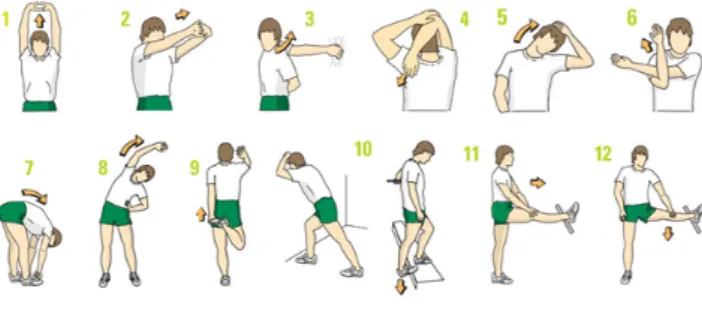
Figure I – Toulouse-Piérron attention test ……….………. 26 Figure II – Papers for the taffles ………. 27 Figure III – Raffles ………. 27 Figure IV – Exercises practiced by the physical exercise break group. …………...………. 27
Índex of Tables
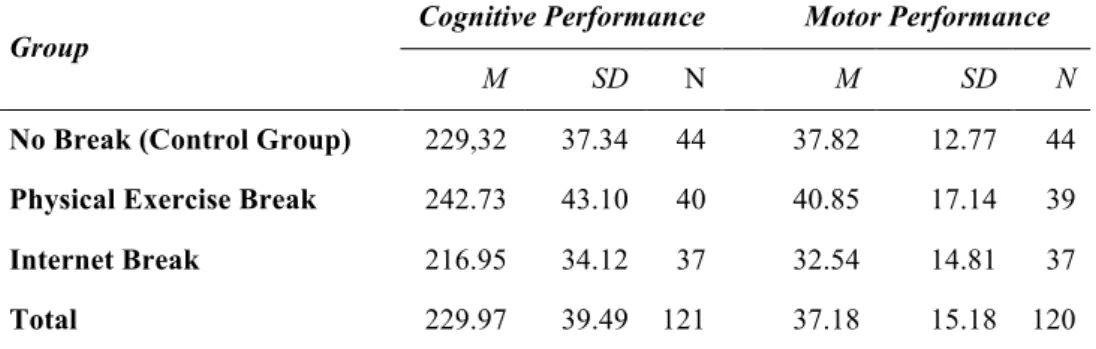
Table I – Resume of the cognitive and motor activities……….. 29 Table II – Descriptive analysis of ANOVA test results for performance during period T3 .. 31
Index of Graphics
Graphic I – Design of the research ………. 28 Graphic II – Mean of cognitive activity (T3) ………. 32 Graphic III – Mean of motor activity (T3) ………. 32 Graphic IV – The moderation effect of conscientiousness on cognitive performance …….. 34 Graphic V - The moderation effect of engagement on cognitive performance ………. 35
8
1. Introduction
Globalization, technology advancements and demographic changes have been revolutionizing organizations and influencing human resources practices and the ways in which work is being carried out. Employees and their performances are key factors to organizations and new trends in the workplace have been emerging to cope with all the changes and innovation.
In recent decades, technological progress has rapidly dominated the world. While the Internet along with technological advancements in the workplace have changed businesses and created new opportunities, they have also increased opportunity for deviational activities (Jandaghi et al., 2015). Cyberloafing, which consists of employees using their company Internet for personal and non-work-related purposes during work hours (Lim, 2002), is one of these deviational activities. Cyberloafing is prevalent and is a perennial cause of concern for many companies (Lim et al., 2002) due to decreases in employees work performance and consequently organizations’ productivity loss (Lim & Chen, 2012). With this in mind, some managers have already started to take measures to prevent or contain cyberloafing behaviors in their organizations. The impact of cyberloafing in work performance is still not consensual among researchers. On one hand, findings show that by allowing employees to take a break from work, cyberloafing is likely to have a positive impact on work performance (Lim & Chen, 2012) and that surfing the web while at work is generally a pleasurable activity (Stanton, 2002) that leaves employee happy and less stressed (Greengard, 2000). On the other hand, cyberloafing behavior can be characterized as an abuse and a bad behavior (Vardi & Wiener, 1996) that distracts employees during work hours (Lim, 2002) leading to lower performance and productivity (Johnson & Rawlins, 2008; Hemp, 2004). Despite the prevalence and costs of cyberloafing, previous research is mainly focus on the potential antecedents and predictors of cyberloafing (Wagner et al, 2012; Garret & Danziger, 2008; Henle & Blanchard, 2008; Lim & Chen, 2012; Sheikh et al., 2015) as well as on the risks and cost associated with cyberloafing and policies to prevent it (Jandaghi et al, 2015; Young & Case, 2004). However, research into consequences of cyberloafing is much less common (Jandaghi et al., 2015) and since there are different results and opinions about this subject, future research is needed to better understand what is the real impact of cyberloafing on performance.
9 Another subject that has seen an increasing attention and concern from employers is employee’s mental and physical health (Rongen et al., 2013). From an organizational management angle, wellbeing is a major factor in quality, performance, productivity and therefore business effectiveness and profit (White et al., 2016, Coulson et al. 2008, Hogan, et al. 2013). Staff wellbeing is an increasingly relevant and necessary consideration in the modern workplace. From the different aspects that evolve around workplace wellbeing, we are starting to see organizations implementing workplace health promotion programs (Rongen et al., 2013), being one of them physical exercise programs at the office and during working hours. With these actions managers hope that keeping employees healthy will hopefully maintain or increase their work performance (Conn, 2009). While most studies focus on the impact of physical exercise on health in general (Conn, 2009), or in cognitive performance of older adults and adolescents (Phillips et al., 2016; Tarp et al., 2016), the impact of physical exercise on performance, productivity and other outcomes of interest in business is a subject that is less studied by researchers (White et al., 2016), but it’s a theme that has been gaining importance in work context, so future research on his topic is equally important.
With this in mind, the opportunity to construct this research emerged. The present study aims to go further, by collecting data that can specifically quantify the effect that both activities have on performance using an experimental research method. In addition to the new approach on data collection, performance measurement is also an improvement in this study since performance is differentiated in two dimensions: cognitive performance and motor performance. An exploratory moderator analysis was also conducted using conscientiousness and engagement as moderators. Conscientiousness is one of the five personality dimensions that best predicts job performance (Barrick & Mount, 1991; Hurtz & Donovan, 2000; Salgado, 1997) given that highly conscientious individuals tend to be more responsible, hardworking, achievement-oriented, persevering (Barrick and Mount, 1991) and have a sense of dutifulness and achievement striving (Costa & McCrae, 1992). According to Schaufeli et al. (2015) a significant relationship between work engagement has been repeatedly confirmed as well. Engaged employees have a sense of energetic and effective connection with their work activities (Schaufeli et al., 2002), are persistent and driven by a solid belief of future success (Sweetman & Luthans, 2010). These moderators were chosen since they have been identified as some of the most consistent predictors of job performance (Hassan et al., 2016; Barrick & Mount, 1991; Rich et all, 2010), thus it is expected that they can have an interesting
10 moderation effect on the relationships between cyberloafing/physical exercise and performance.
In summary, this experimental study aims to explore the following questions:
- Do cyberloafing behaviors have a negative impact or a positive impact on performance?
- Does physical exercise have a positive impact on performance?
- Does the level of conscientiousness affects the impact that cyberloafing and physical exercise have on performance?
- Does the level of engagement affects the impact that cyberloafing and physical exercise have on performance?
In order to answer all these questions and support human resources managers with their organizational challenges on these topics a laboratory experimental research was developed and is presented in this study.
Initially this study discloses the literature that guided the development of the hypothesis and construction of this study. The methodology is the third part of this study, where the methodology used in this research is revealed, with the presentation of the sample, data collection method, procedure, and measures used to evaluate the different topics. In chapter four, the results of the different statistical tests used to test our previously defined hypothesis are displayed. Afterwards, a discussion follows, where theoretical and practical implications, limitations and future research are explored. Finally, the main ideas of the study are gathered in a brief conclusion.
11
2. Literature Review and Hypothesis Construction
The present research was developed with the aim of evaluating the impact of cyberloafing and physical exercise on individuals’ performance and also of investigating some possible moderators of these relations. In this section it is presented the theory and research that served as the basis for the construction of this study.
2.1. Rest Breaks
Earlier studies have shown that taking periodic breaks from work are important as these breaks allow employees to recharge their energy level and are crucial for improving work performance (Sonnentag, 2003). After working for prolonged periods of time, the ability to successfully implement a task is diminished under the condition of fatigue (Li et al., 2016). Industrial environments, where individuals perform monotonous or repetitive tasks during long periods of time (Tang et al., 2016), were found to be associated with physical fatigue, being muscle fatigue identified as an important precursor of work-related musculoskeletal disorders as well as decreased performance (Santos, et al., 2016). Thus, introducing breaks is a key intervention to provide recovery after fatiguing physical work (Mathiassen et al., 2014).
Over the past decades, work has changed to a large extent from demanding physical effort, to demanding mental effort (Boksem & Tops, 2008). Moreover, besides physical fatigue, mental fatigue is also a prevalent problem that office workers have to face daily because of the intense and stressful work (Li et al., 2016). Mental fatigue refers to the feeling that people may experience after or during prolonged periods of cognitive activity, especially in a boring and repetitive task (Boksem & Tops, 2008) and has been associated with impaired cognitive and behavioural performance (Boksem et al., 2005). Individuals under mental fatigue exhibit slower response speed and increased propensity to commit errors (Li et al., 2016).
Rest breaks are commonly administered as a countermeasure to reduce on-the-job fatigue, both physical and mental (Lim et al., 2016). It is believed that rest is able to relieve fatigue and restore resource and energy for the following task execution (Li et al., 2016) and that rest breaks are effective in improving comfort and productivity of workers (Dababneh et al.,
12 2001). In general, regular rest breaks can be an effective means of maintaining performance, managing fatigue and controlling the accumulation of risk over prolonged task performance (Tucker, 2003).
Although no one doubts about the effectiveness of rest breaks, how rest should be administered (duration, number of rest breaks, activities performed during the rest breaks) is still in debate. Several studies reported that the duration, number of breaks and the nature of the activity undertaken during rest breaks are important moderators of how much recovery it affords (Helton and Russell, 2015; Tucker, 2003; Balci & Aghazadeh, 2004). Besides, while at the office, employees are not focusing solely on their jobs (Eddy, D'Abate, & Thurston, 2010) and are engaging in numerous personal activities during work time that also affect their work performance (D’Abate, 2005).
2.2. Cyberloafing
Technological advancements have been revolutionizing the ways in which work is being carried out. The innovation and progression of information technologies had an enormous impact in the way organizations are managed and how businesses are conducted (Weatherbee, 2010). The internet has played an important role in this revolution as well (Lim, 2002). It has been proved to be an efficient business tool helping businesses to reduce costs, shorten product cycle times, and market products and services more effectively (Anandarajan et al., 2000). However, Lim (2002) suggests that the internet is a double-edged sword, which companies should deploy freely to employees with caution. Why? In the same way that every new method, tool or technology, can have multifarious implications in the workplaces, internet use is accompanied by both opportunities and threats as far as work efficiency is concerned (Sheikh et al., 2015). Anandarajan (2002) argued that, in addition to being an efficient business tool, the internet also provides employees access to the world’s biggest playground, opening up new avenues and opportunities for individuals to misbehave leading to a new workplace threat to performance and productivity denominated as cyberloafing (Lim, 2002).
According to Lim (2002) cyberloafing is a specific form of loafing behavior in which employees spend work hours and company internet access to check personal e-mails or visit
13 websites not related to their work, representing this way a form of production deviance. To Weatherbee (2010) the behavior incorporated into this construct consists of employees using organizational information and communication technologies for non-work related activities such as playing games, doing personal banking online, updating their personal blogs or websites during work hours, or frittering away organizational time using personal email. Other activities such as browsing news websites, following sport news, online shopping, mobile and social media messaging, online games and gambling, travel booking planning, downloading music and movies and last but not least viewing adult-oriented websites have all been identified as cyberloafing activities by different authors (Henle, et al., 2009; Liberman et al., 2011; Zoghbi-Manrique-de-Lara, 2011). Several dimensions, forms and categorizations of cyberloafing have been identified in the literature. Blanchard and Henle (2008) categorize cyberloafing activities in two main categories: minor cyberloafing that includes emailing and reading news, and major cyberloafing that includes gambling, visiting adult websites, downloading music, updating one's own webpage and engaging in social media chartrooms. Li and Chung (2006) categorize cyberloafing activities based on the purpose into four types: social (to communicate with people), informational (to retrieve information), leisure (to indulge) and virtual (to pursue and satisfy the wants of the virtual-self) cyberloafing activities.
A number of factors have been verified to contribute to cyberloafing behaviors often referred as cyberloafing antecedents (Sheikh et al., 2015). Conscientiousness was reported to have strong relationship with cyberloafing whereby (self-reported) higher levels of conscientiousness can limit cyberloafing (Blanchard & Henle, 2008). Lower organizational justice has proved to have significant impact on increased cyberloafing (Blau et al., 2006), while some human behavioural traits and characteristics such as impulsivity (Davis, et al., 2002), extraversion (Andreassen, et al, 2014), positive affect (Vitak et al., 2011) and agreeableness (Saleem, et al., 2011) have been shown to have moderate effect on increased cyberloafing. A recent work of Askew et al. (2014) show that, among others, the ability to hide cyberloafing, behavioural attitudes upon cyberloafing and subjective norms are among the main factors leading to and providing the encouraging environment for cyberloafing. Company sanctions toward cyberloafing (Blanchard & Henle, 2008) and organization’s internet policy (Zoghbi-Manrique-de-Lara et al., 2010) are also among other antecedents that have been studied and shown to have moderate correlation with cyberloafing at various settings. Gender and age have often found to relate to cyberloafing as well, with males
14 engaging in more cyberloafing than females and younger employees engaging in more cyberloafing than older employees (Blanchard & Henle, 2008; Lim & Chen, 2012).
Findings from a study developed by Lim and Chen (2012) revealed that cyberloafing is generally prevalent at the workplace and that employees feel that it is acceptable to use their workplace internet access for personal purposes during working hours, spending on average 51 min per workday on cyberloafing. Human resource specialists have estimated that employees waste approximately one hour per working day, on average, engaging in non-work-related activities while surfing the internet (Blanchard & Henle, 2008). Consequently, cyberloafing has been a perennial cause of concern to many companies (Lim et al., 2002) and its direct impact on employee’s performance and organizational overall productivity has been a subject of interest for different researchers in the past years but conclusions are still not clear.
On one hand, is possible that there may be positive consequences of personal activities in the workplace for both the individual and the organization (Eddy et al., 2010). By allowing employees to take a break from work, cyberloafing is likely to have a positive impact on work performance (Lim & Chen, 2012). A study from Greengard (2000) revealed that 56% of employees, who use the internet for personal purposes, said it helps them perform their jobs better, or simply leaves them happier or less stressed. When employees surf the web, they are likely to feel energized and experience positive affect (Lim & Chen, 2012) and according to Stanton (2002) employees feel that surfing the net while at work is generally a pleasurable activity that makes work more interesting (Lim & Chen, 2012). This may be because surfing the web allows employees to temporarily take their mind off work and serve as a palliative coping strategy against negative workplace experiences (Stanton, 2002). Besides people’s personal use of the internet at work can be considered as a response to the blurred border between work and non-work. Since many employees are expected to answer work emails at home they might reciprocate this by answering private emails at work. Thus, personal internet use at work could be understood as border-crossing behavior (Konig & Guardia, 2014).
On the other hand, scholars generally conceptualize cyberloafing as a form of workplace production deviance (Lim, 2002) that can be characterized as an abuse and a bad behavior, especially when employees are using organization resources to engage in their personal businesses during the working time (Vardi & Wiener, 1996). The time spent on the internet
15 for non-work purposes directly distracts workers for their tasks (Corgnet et al., 2015) and according to D’Abate and Eddy (2007) when people are distracted by personal interests and demands their performance may be affected. The problem of workers’ being on the job but not fully functioning can, according to Hemp (2004), lower productivity on the job by one-third or more (for example: lower quantity of output, working more slowly, repeated tasks, lower quality of work, mistakes on the job). Moreover, although employees in general may think surfing the web may help them perform better, a study by Lim and Chen (2012) revealed that women tend to feel that cyberloafing has a negative impact on their work because they believe it distracts them from work and takes time they would rather prefer spend on work finishing tasks. The same study also reported that individuals would need about 8 min to switch back to work after engaging in cyberloafing activities. This becomes a huge concern for organizations if people frequently have the urge to check social media and post updates (Hartanto & Yang, 2016), especially with the recent popularity of smart phones, that brought changes in how people work and take breaks (Rhee & Kim, 2016). Furthermore research on cyberloafing behaviors such as emailing suggested that it negatively affects employees’ work and emotions (Macklem, 2006). This is because personal resources such as energy and attention are required in responding to emails. Consistent with these findings, the results of the study of Lim and Chen (2012) showed that emailing activities are positively related to negative affect and engaging in emailing activities are more likely to report negative affect compared to engaging in browsing activities.
If employees spend substantial amounts of time engaged in cyberloafing during work periods, their productivity decreases (Johnson & Rawlins, 2008) and it’s clear that the costs of this behavior can have a significant impact in an organization (Wagner, et al., 2012). These loafing behaviors are becoming such a big problem in the corporate world, especially when it comes to lower productivity and increasing costs, that many companies are beginning to crack down (Johnson & Rawlins, 2008). The use and abuse of internet is costing American corporations million of dollars a year in lost productivity, network crashes and legal liability (Johnson & Rawlins, 2008). To contain this issue of internet abuse, companies are increasingly using internet surveillance programs and put in place explicit policies and penalty systems tailored to control internet usage in the workplace (Bequai, 1998).
Summing up, although employees may argue that surfing the web may help them feel happier, energized and less stress, the reality is that cyberloafing behaviors are a huge time consumer,
16 that distracts employees from their work, decreasing their performance and organizations overall productivity, thus for the purpose of our study cyberloafing is expected to have a negative impact on performance.
Hypothesis 1 (H1): It is expected that cyberloafing has a negative impact on individual performance.
Hypothesis 1a (H1a): It is expected that cyberloafing has a negative impact on cognitive performance.
Hypothesis 1b (H1b): It is expected that cyberloafing has a negative impact on motor performance.
2.3. Physical Exercise
The basic underlying principle in ergonomics and management science for introducing rest breaks in occupational work is to maintain good productivity and a sustainable health and wellbeing of the individual worker by providing an opportunity to recover from tasks that might otherwise lead to a loss in performance (Wells et al., 2007). Some occupational studies have investigated alternative non-rest break activities, including productive tasks. A majority of these studies have been devoted to physically active breaks, based on the notion that more activity will be a more effective source of variation than simple rest (Mathiassen et al., 2014). This active breaks may have a bigger relevance when dealing with workplaces with a large portion of sedentary occupations or in occupations characterized low-level, long-lasting muscle activity, such as light industrial assembly (where repetitive tasks lead to pronounced fatigue). The findings of Mathiassen et al. (2014) go in accordance with the findings of Santos et al. (2016) that confirm that introducing more physical workload variation in low-load repetitive work is considered an effective ergonomic intervention against muscle fatigue and musculoskeletal disorders in industry sector.
The term physical exercise has been used interchangeably with physical activity, but although they have common elements and are sometimes used to express exercise in general, they are not the same thing. Caspersen, et al. (1985) define physical activity (PA) as any type of bodily movement produced by skeletal muscles that occurs in the course of everyday life that results
17 in energy expenditure. Physical exercise (PE) is a specific subset of PA that is planned, structured repetitive, and for the purpose of improving or preserving physical fitness (Caspersen, et al.,1985).
Scientific guidelines issued by various international bodies, national centres and institutes, and professional organisations have documented that regular PA protects against a vast amount of diseases and chronic disorders (Health et al., 2016). Nevertheless, and although the major part of the studies focus on the impact of PA on health in general (Conn, 2009), the benefits of PA are not limited to the health department. Some studies with children and adolescents report that combine aerobic and resistance exercise programme significantly improve cognitive and memory function, which can consequently improve academic performance (Kim & SO, 2015). PA is believed to preserve cognitive function in older adulthood as well. It is known that cognitive abilities decline across multiple domains with advancing age (Phillips et al., 2016) but adopting a brain healthy life style that includes regular PA may improve cognition function and in addition attenuate and prevent the deterioration of age-related cognitive brain function (Jackson et al., 2016). PA also positively affects psychological and social health, including the improvement of aspects, such as self-esteem, social interactions, anxiety, mood, and depression (Kim & SO, 2015). Studies in animals and humans show that PA has direct effects on brain health by altering mechanisms involved with learning and memory (Jackson et al., 2016). Furthermore, PA is reported to improve cognitive and memory functions (Kim & SO, 2015).
With so many benefits of healthy lifestyles that include regular PA, is remarkably important to understand what is the impact of exercise on performance, productivity and on other outcomes of interest in the business world. Unfortunately, it is surprising that potential relationships between both have not been explored very often and a few studies were published. Nevertheless there are still a few worth mentioning that serve as the base for the hypothesis construction for the present study.
Findings from a study by Coulson et al. (2008) highlight that, compared to days when no exercise was undertaken during the working day, exercising in the workplace improved mood and performance, leading to better concentration, work-based relationships and heightened resilience to stress. Another research has shown that PA has a positive influence on coping skills for work behaviour and for tolerating minor irritations, without becoming stressed
18 (Steptoe et al., 1998). A study from Toker and Biron (2012) revealed that PA attenuates the increase of job burnout and depression, being the increase in job burnout and depression strongest among employees who did not engage in PA and weakest to the point of non significance among those engaging in high PA. Even though studies about the impact of PA in cognitive performance are predominantly with children/adolescents and old adults, overall findings from a study by Hogan, et al. (2013) suggests that exercise may hold important benefits for both affective experience and cognitive performance regardless of age. Higher cardio respiratory fitness levels in cognitively normal adults were also associated with better performance on a spatial memory task and greater volume of the hippocampus (Erickson et al. 2009). These findings document that some workplace PA interventions can improve both health and important worksite outcomes.
Although strong evidence shows that exercisers are healthier than non-exercisers, most adults do not perform enough PA to achieve health and well-being benefits (Conn et al., 2009). One of the big concerns to organizations nowadays is the cost associated with absence from work and consequent loss of productivity due to sickness and work disabilities (White et al., 2016). Research shown that unhealthy employees and those with an unhealthy lifestyle are less productive at work, have decreased work ability, and take more sick days (Rongen et al., 2013). Therefore, the substantial potential benefits of promotion of PA have become a well-established agenda not only for public health agencies and all types of health-care delivery systems worldwide (Health et al., 2016) but also for employers (Rongen et al., 2013). From an organizational management angle, wellbeing is a major factor in quality, performance, productivity and therefore business effectiveness and profit. Given the findings, the workplace becomes an opportune setting to encourage PA and implement possible active breaks such as physical exercise (Hunter et al., 2016).
Since employed adults spend about half of their workday waking hours at workplaces, organizations may offer workplace exercise in hopes of keeping workers healthy and reducing healthcare costs (Conn et al., 2009). Workplace exercise is an intervention with specific physical exercises for workers carried out at the work site, which aims to improve general outcomes, such as quality of life and occupational environment, as well as specific outcomes, such as muscle strength and flexibility (Grande, 2014). According to Hunter et al. (2016) increasing PE in the workplace can provide employee physical and mental health benefits, and employer economic benefits through reduced absenteeism and increased productivity. In
19 addition an interesting finding by Jakobsen et al. 2015 revealed that performing PE at the workplace was more effective in preventing deteriorations in work ability compared to home-based exercise. Some organizations are already implementing workplace health promotion programs (WHPPs) that include PE and aim to improve lifestyle, health, work ability and work productivity (Rongen et al., 2013). Reviews have concluded that WHPPs can improve overall health, decrease work absences due to sickness and increase work ability, which may lead promising effects on work productivity (Rongen et al., 2013).
Based on the previous findings that unfold that physical active breaks have a positive impact in health in general, but also on individual’s performance, we expect that PE has a positive effect on performance.
Hypothesis 2 (H2): It is expected that physical exercise has a positive impact on individual performance.
Hypothesis 2a (H2a): It is expected that physical exercise has a negative impact on cognitive performance.
Hypothesis 2b (H2b): It is expected that physical exercise has a negative impact on motor performance.
2.4. Comparison Between Cyberloafing Breaks, Physical Exercise Breaks and Not
Having Breaks
The theoretical findings uncovered in sections 3.1, 3.2 and 3.3 allow us to conjecture a new set of hypothesis. In general, we’ve seen that general breaks can be an effective mean of maintaining performance, managing fatigue and controlling the accumulation of risk over prolonged task performance (Tucker, 2003). However not all the activities during work time have the same outcomes. Knowing that Cyberloafing can lower productivity on the job by one third (Hemp, 2004), it is more likely that employees who spend their breaks doing cyberloafing activities have lower perfomance when compared to employees that don’t have breaks. Contrary to cyberloafing, PE, as an active break, is expected to have a positive impact on performance when compared to not having breaks, since physical active breaks may be,
20 according to Mathiassen et al. (2014) more effective source of variation than simple rest or than no rest at all. Since, as stated before, cyberloafing has a negative correlation with performance and PE has a positive correlation with performance, we expect that the performance of individuals after PE breaks will be higher that the performance of individuals after internet activity breaks. With these ideas in mind, the following three hypotheses emerged.
Hypothesis 3a (H3a): It is expect that the performance of individuals after internet activity breaks is lower than the performance of individuals that don’t take breaks.
Hypothesis 3b (H3b): It is expect that the performance of individuals after physical exercise breaks is higher that the performance of individuals that don’t take breaks.
Hypothesis 3c (H3c): It is expect that the performance of individuals after physical exercise breaks is higher that the performance of individuals after internet activity breaks.
2.5.The Moderation Role of Engagement to Performance
The relationship between personality and job performance has been studied at length in the last decades (Corgnet et al., 2015). The literature has focused on five fundamental personality traits, which are commonly referred as The Big Five personality traits: extraversion, agreeableness, conscientiousness, emotional stability and openness.
For the purpose of this study we will focus our moderation analysis only on conscientiousness since several meta-analyses have shown that, among the Big Five personality dimensions, conscientiousness is the best personality predictor of job performance (Barrick & Mount, 1991; Hurtz & Donovan, 2000; Salgado, 1997).
Conscientiousness was defined by Digman (1990) as the extent to which a person is able to self-regulate and be purposeful, achievement oriented, responsible, and persistent. It’s indicated by facets such as self-discipline, deliberation, competence, order, dutifulness and achievement striving (Costa & McCrae, 1992). Barrick and Mount (1991) identified the dimensions of conscientiousness as careful, thorough, responsible, organized, hardworking, achievement-oriented, and persevering and Ansari (2003) added afterwards individual’s
21 degree of organization, persistence and motivation in goal-directed behavior as conscientiousness dimensions as well.
Studies on the relationship between conscientiousness and job performance have been develop in the last decades (Corgnet et al., 2015) being conscientiousness consistently identified as one of the most consistent predictors of job performance across a variety of tasks, occupations and cultures (Hassan et al., 2016; Barrick & Mount, 1991). The reason is that highly conscientious individuals are described as organized, reliable and ambitious (Costa & McRea, 1992 ) and have been shown to set more difficult goals (Judge & Ilies, 2002), to be less likely to procrastinate when pursuing goals (Steel, 2007) and to be more likely to employ time management and other effort regulation techniques (Bidjerano & Dai, 2007) all of which are believed to promote job performance.
Since highly conscientious individuals tend to be more responsible, hardworking, achievement-oriented (Barrick and Mount, 1991) and have a sense of dutifulness and achievement striving (Costa & McCrae, 1992), we expect that they exhibit enhanced performance being more connected to the tasks that constitute their role.
Hypothesis 4a (H4a): Conscientiousness moderates the relationship between the type of break and cognitive performance.
Hypothesis 4b (H4b): Conscientiousness moderates the relationship between the type of break and motor performance.
2.6.The Moderation Role of Conscientiousness to Performance
Engagement is a concept that has a fairly brief history but has been consistently linked to job performance (Rich et al., 2010). Originally introduced by Kahn (1990), the term employee engagement was defined as the harnessing of an employee’s full self in terms of physical, cognitive, and emotional energies to work role performances. From then on, employee engagement has been subject of close attention by organizations (Yuan et al., 2015) and has been studied and variously defined by other researchers and practitioners (Nair & Salleh, 2015). More recently, job engagement has been defined by Schaufeli et al. (2002) as a
22 positive, fulfilling, work-related state of mind that is characterized by vigour (high levels of energy while working, willingness to invest effort in work, and persistence in the face of difficulties), dedication (sense of enthusiasm, inspiration, pride, and challenge) and absorption (being happily engrossed in one’s work, whereby time passes quickly and one has difficulties detaching).
Since year 2000, studies on employee engagement have mostly concentrated on its antecedents and consequents in various settings around the world (Nair & Salleh, 2015). For instance, a study by Rich et al. (2010) identified three antecedents of engagement: value congruence, perceived organizational support, and core self-evaluations, and also revealed that engagement mediates the relationships between these antecedents and task performance. Another study by Harter et al. (2002) concluded that employee engagement is related to meaningful business outcomes, including productivity, profitability, customer satisfaction, safety and employee turnover, at a magnitude that is important to many organizations and that these correlations generalize across companies. Popular press articles and business consultants have claimed that engaged employees give companies competitive advantages (Rich et al., 2010).
A significant relationship between work engagement and job performance has been repeatedly confirmed (Schaufeli et al., 2015), with more engaged employees reporting higher levels of job performance (Rich et al., 2010). This may be due to the fact that engaged employees have a sense of energetic and effective connection with their work activities and they see themselves as able to deal completely with the demands of their job (Schaufeli et al., 2002). According to Kahn (1990), engaged employees focus their physical effort on the pursuit of role-related goals, but are also cognitively vigilant and empathically connected to others in the service they are doing. Previous studies demonstrated that more engaged workers are characterized by tenacity and persistence and that they are driven by a solid belief in future success (Xanthopoulou et al., 2009). On the other hand, disengaged employees withhold their physical, cognitive an emotional energies, being emotional absent, detached and passive when completing their work (Kahn, 1990).
Since engaged individuals tend to be more persistent (Xanthopoulou et al., 2009), work with greater intensity on their tasks, pay more attention to and are more focused on responsibilities (Rich et al., 2010) and show more efforts in the pursuit of role-related goals (Kahn, 1990), we
23 expected that they exhibit enhanced performance being more emotionally connected to the tasks that constitute their role.
Hypothesis 5a (H5a): Engagement moderates the relationship between the type of break and cognitive performance.
Hypothesis 5b (H5b): Engagement moderates the relationship between the type of break and motor performance.
24
3. Methodology
All research is about how things are related (Webster & Sell, 2014). There are many different research methods and research designs therefore, when conducting a study it is important to choose the most appropriate method and design to complete a successful research project (Anderson, 2004).
The use of experiments has grown remarkably since World War II and experiments are a recognized part of today’s social sciences techniques (Webster & Sell, 2014). Experimental research involves the active creation or manipulation of a given situation or experience for two or more groups of individuals followed by a measurement of the effect of those experiences on thoughts, feelings or behavior (Stangor, 1998). It is common to refer to the factor that has a casual impact as the independent variable and the effect as the dependent variable, i.e., independent variables are deemed to have a causal influence on the dependent variables (Bryman & Bell, 2015). When scientists are interested in answering questions about how and when changes in independent variables cause changes in dependent variables they employ the experimental research design (Stangor, 1998).
Data collection in the experimental research design can be made in two distinctive ways: field experiments and laboratory experiments. In field experiments data collection occurs in real life settings (such as workplaces or retail places), whereas laboratory experiments data collection takes place in a laboratory or in a contrived setting (Bryman & Bell, 2015).
The laboratory experimental research design is the method chosen to conduct this study, since we want to draw conclusions about the causal relationship among variables. Specifically, this method will allow this study to answer the research questions of whether or not cyberloafing and physical exercise (independent variables) have significant influence on individuals performance (dependent variable).
3.1. Sample
The target used in the present study were students enrolled in the university or that have finished their studies less than 1 year before, comprehending students from different courses,
25 different academic degrees and different years of study.
The initial sample consisted of 126 students with a background in management, from which only 124 students were considered valid. From the total sample, 75 participants (60.5%) were female students and 49 (39.5%) were male. The ages of the participants ranged between 18 and 41 years old (M = 21.41, SD = 3.18).
In terms of education, all students had background in management, with 85.5% of the participants enrolled in a bachelor degree and 14.5% enrolled in a masters degree program.
3.2. Procedure
With the purpose of testing the hypothesis of this thesis a laboratory experimental research was developed to collect all the necessary data.
Initially, an email was sent to all ISCTE students asking for voluntary participants. Later, and because there were not enough participants for the study, professors from different subjects were informed about the development of this research and asked to dismiss their students from a class so they could participate in the research. It is important to stress that in both situations, before the data collection, the research was explained to the participants and their participation on the research was strictly voluntary.
In order to evaluate the two dimensions of this research (cognitive performance and motor performance) two types of activities were defined, one for each dimension.
The cognitive activity was the Toulouse-Piérron Attention Test created by Toulouse & Piéron (Vaschide et al., 1904). This test evaluates concentrated attention, reaction speed and accuracy in executing simple tasks. This tool helps in the investigation of 3 areas related to attention: indices of correct response, no response plus wrong response in executing the test and the time taken to complete the test. In this test participants needed to identify two specific graphic symbols among a larger group of very similar symbols during a period of 10 min.
26
Figure I - Toulouse-Piérron attention test.
The motor activity required participants to wrap paper to make raffles as thin as possible. The goal of this activity was to do as much raffles as possible during a period of 10 min. The papers for the raffles given to the participants had all the same size (5cm x 5cm) and thickness. This activity intended to resemble a monotonous and repetitive task, consistent with those occurring in many industrial settings, for instance in manufacturing.
27 Figure II – Papers for the raffles. Figure III – Raffles.
Before the beginning of the data collection, both activities were explained to the participants and they were asked to complete a pre-experimental questionnaire with their general information such as age, gender, university degree, university, handiness, vision problems, articulation problems and previous experience in both activities.
To ensure that the participants were able to perform as best as they possible could, a prize for the most performing participant in each task was announced. The prize was a card with 25€ to spend in one of the 1100 Sonae stores. The offer of chocolates for all the participants was also announced before the beginning of data collection as an incentive to participate in the study.
Since the goal of the study was to determine whether cyberloafing and physical exercise have an influence in individual’s performance, the participants were randomly assigned to one of three groups:
1) No break group (control group); 2) Internet break group;
28
Graphic I – Design of the research.
Both activities (cognitive and motor) were divided in three parts of 10 minutes each, that from now on will be called T1, T2 and T3. While T1 and T3 were the same for all groups, T2 corresponded to the break and was different in each group:
1) No Break group (control group) – This group did not have a break on T2, spending 30 minutes doing the same activity;
2) Internet Break group - This group spent T2 browsing the web, simulating cyberloafing behaviors. Specific types of websites allowed include those offering news, social networking, online gaming, entertainment, and hobby-related activities.
3) Physical Exercise Break group - This group spent T2 doing simple physical exercise movements such as stretching and moving specific muscles and articulations, such as arms, hands, neck, shoulders and legs. Some of the exercises practiced by this group are showcased in Figure IV.
29
Figure IV – Some of the exercises practiced by the physical exercise break group.
Table I – Resume of the cognitive and motor activities.
Cognitive Activity (30 min) Toulouse-PiéronTest
Motor Activity (30 min) Raffles Group
T1 -10 min T2 -10 min
(Break) T3 - 10 min T1 -10 min
T2 -10 min
(Break) T3 - 10 min
No Break (Control Group) Toulouse-Piéron
Toulouse-Piéron
Toulouse-Piéron Raffles Raffles Raffles
Physical Exercise Break Toulouse-Piéron Physical Exercises Toulouse-Piéron Raffles Physical Exercises Raffles
Internet Break
Toulouse-Piéron Internet Activities Toulouse-Piéron Raffles Internet Activities Raffles
Before being dismissed, the participants were asked to complete a post-experimental questionnaire that measured their levels of psychological engagement and conscientiousness.
3.3. Measures
Cognitive Performance – Cognitive performance was evaluated by the Toulouse-Piéron test
during T3 period and corresponds to the number of graphic symbols correctly identified in that period.
Motor Performance – Motor performance was evaluated in the Raffles activity during T3
period and corresponds to the number of Raffles done in that period.
Engagement – Engagement was evaluated according with the shortened version of Utrecht
30 Salanova et al. (2006) that evaluates the three constituting dimensions of work engagement: vigour, dedication, and absorption. This scale is composed by 9 items scored on a 7-point frequency likert scale (0 = never; 1 = Almost Never; 2 = Rarely; 3 = Sometimes; 4 = Often; 5 = Very Often; 6 = Always) and included items such as “I am proud of the work that I do” and “At my job, I feel strong and vigorous.”
Conscientiousness – Conscientiousness was evaluated using The Big Five Inventory (John,
Donahue & Kentie, 1991) design to measure the Big Five personality traits. In this case we only use the items related with the conscientiousness trait that include items such as “Makes plans and follows through with them” and “Tends to be disorganized”. The scale is composed by 8 items scored on a 5-point frequency likert scale (1 = Totally disagree; 2 = Disagree; 3 = Neither Agree Nor Disagree; 4= Agree; Totally agree).
31
4. Results
In order to verify if there is supported evidence to draw conclusions from our main hypothesis designed earlier, a statistical analysis was performed. All the extracted results as well as tables and graphics presented below were analyzed using IBM SPSS Statistics – Version 23. Given that the samples sizes for each group are very small, a decision of using confidence intervals of 90% was made, which means that p-values smaller that 0,1 will be considered statistically significant.
The results of this study are presented in three different parts. In the first part, different ANOVA’s are conducted to validate the hypotheses related to the effect of the different breaks on performance. In the second part a comparison between the groups is presented and finally in the third part the results of moderation analysis are displayed.
4.1. Effect of the different breaks on performance
Two Univariate ANOVA’s were conducted to compare the effects of different breaks on performance.
Table II – Descriptive analysis of ANOVA test results for performance during period T3.
Cognitive Performance Motor Performance Group
M SD N M SD N
No Break (Control Group) 229,32 37.34 44 37.82 12.77 44 Physical Exercise Break 242.73 43.10 40 40.85 17.14 39 Internet Break 216.95 34.12 37 32.54 14.81 37
Total 229.97 39.49 121 37.18 15.18 120
From the results we can conclude that regarding the cognitive activity the differences on performance were significant, F(2,118) = 4.33, p = 0.02, η2 = 0.07, which means that the type of break significantly influence cognitive performance. By looking for the values of Table II we can see that the physical exercise break group was the group that had higher cognitive performance (M = 242.73; SD = 43.10), followed by the control group (M = 229.32; SD =
32 37.34). The worst performing group was the internet break group (M = 216.95; SD = 34.12).
For the motor performance, results were very similar to the results found for cognitive performance. Regarding the motor activity, the differences on performance were significant, F(2,117) = 3.00, p = 0.05, η2 = 0.05 and therefore we can also conclude that the type of break significantly influence motor performance. Once again concerning motor performance, the physical exercise break group was the group with higher motor performance (M = 40.85; SD = 17.14) followed by the control group (M = 37.82; SD = 12.77) being the internet break group the worst performing group (M = 32.54; SD = 14.81).
In graphics II and III it is possible to see a graphic design resuming the performance results of each group for both activities presented before.
Graphic II – Mean of cognitive activity (T3) Graphic III – Mean of motor activity (T3)
Given the values of the performance means and the results of the ANOVA’s, we can conclude that the hypotheses H1 (It is expected that cyberloafing has a negative impact on individual performance), H1a (It is expected that cyberloafing has a negative impact on cognitive performance) and H1b (It is expected that cyberloafing has a negative impact on motor performance) are confirmed. For the same reasons, H2 (It is expected that physical exercise has a positive impact on individual performance), H2a (It is expected that physical exercise has a positive impact on cognitive performance) and H2b (It is expected that physical
33 exercise has a positive impact on motor performance) are also confirmed.
4.2. Comparison Between Groups
Even though a statistically significant result for both cognitive and motor performance was found, using just the ANOVA test does not tell us where this effect exists. Bonferroni Post Hoc Tests were conducted to compare all different combinations of the groups.
Concerning the comparison of the means between the control group and both internet break and physical exercise break groups the Bonferroni post hoc tests revealed that the mean scores were non significant (p > 0.1) for both motor and cognitive performance.
So although the means between this groups are different we cannot conclude that this differences are significant ant therefore our hypothesis H3a (It is expect that the performance of individuals after internet activity breaks is lower than the performance of individuals that don’t take breaks) and H3b (It is expect that the performance of individuals after physical exercise breaks is higher that the performance of individuals that do not take breaks) are not confirmed.
Regarding the comparison between the internet break group and the physical exercise break group, Bonferroni post hoc tests revealed that the mean scores of performance for the physical exercise break group was statistically significantly different than the means of the internet break group for both cognitive performance (p = 0.01) and motor performance (p = 0.05).
To corroborate this result and compare the performance of the physical exercise break and the internet break groups for both activities, an independent samples t-test was also conducted. Results reveal that there were significant differences in the means of both activities. On average, in the cognitive activity, participants of the physical exercise break group had a higher performance (M = 242.73; SD = 43.10) than the participants of the internet break group (M = 216.95; SD = 34.12) and this difference was statistically significant, being t(73.30) = -2.92, p =0.01. In the motor activity participants of the physical activity break group had a higher performance (M = 40.85; SD = 17.14) than the participants of the internet break group (M = 32.54; SD = 14.81) and this difference was also statistically significant t(73.37) = -2.26,
34 p = 0.05.
Given the results above H3c (It is expect that the performance of individuals after physical exercise breaks is higher than the performance of individuals after internet activity breaks) is confirmed.
4.3. Moderation Effects
To test the moderator effects that engagement and conscientiousness can have on performance a moderation analysis was done. The moderation analysis revealed that both conscientiousness (F(1,73) = 3.40, p = 0.7, η2
p = 0.4) and engagement (F(1,73) = 2.78, p = 0,99, η2p = 0.04) have a positive and significant effect on cognitive performance. No significant results were found for motor performance.
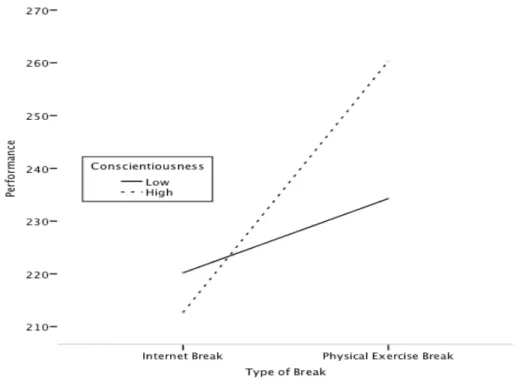
Graphic IV - The moderation effect of conscientiousness on cognitive performance.
Graphic IV shows the plots of moderation effects of conscientiousness on cognitive performance for each type of break. It is possible to see that after the internet break, cognitive performance is higher on individuals with low levels of conscientiousness while after the physical activity break, cognitive performance was higher on individuals with high levels of
35 conscientiousness. Nevertheless, overall results show that individuals with both high and low levels of conscientiousness had better cognitive performance after the physical exercise break than after the internet break, being the cognitive performance notably higher for the individuals with high levels of conscientiousness.
Additionally, graphic V displays the plots of moderations effects of engagement on cognitive performance for each type of break. Results for engagement were very similar to the results of the previous moderator. After the internet break, cognitive performance is higher on individuals with low levels of engagement while after the physical activity break, cognitive performance was higher on individuals with high levels of engagement. Once again, overall results show that individuals with both high and low levels of engagement had better cognitive performance after the physical exercise break than after the internet break, being the cognitive performance notably higher for the individuals with high levels of engagement.
Graphic V - The moderation effect of engagement on cognitive performance.
These results are in accordance with H4a (Conscientiousness moderates the relationship between the type of break and cognitive performance) and H5a (Engagement moderates the relationship between the type of break and cognitive performance). Since no significant results were found for motor performance, we reject H4b (Conscientiousness moderates the relationship between the type of break and motor performance) and H5b (Engagement
36 moderates the relationship between the type of break and motor performance.)
37
5. Discussion
Built upon an innovative perspective, this study aimed to contribute to the literature by using an experimental study design that could quantify the effect of cyberloafing and physical exercise on both motor and cognitive performance. This research also sought to understand if these relationships were moderated by two of the most consistent predictors of job performance: engagement and conscientiousness.
In general, the results found in this study revealed that the type of break individuals carry out influences their performance. On the one hand, testing the hypothesis H1, H1a and H1b revealed that introducing cyberloafing activity breaks has a negative effect on both motor and cognitive performance. These results support findings in the literature that state that cyberloafing has negative outcomes, such as lower quality of work, slower work, more mistakes on the job (Hemp, 2004) and lower productivity (Lim & Chen, 2012; Hemp, 2004; Johnson & Rawlins, 2008; Jandaghi et al, 2015).
On the other hand, regarding H2, H2a and H2b, it was found that introducing physical exercise breaks has a positive effect on both motor and cognitive performance. This evidence is consistent with studies previously published that revealed that exercising in the workplace improved mood, concentration and performance (Coulson et al., 2008), and decreased job burnout and depression (Toker & Biron, 2012).
Since results showed a negative effect of cyberloafing and positive effect of physical exercise on performance, it was not surprising that when comparing both groups, the performance of individuals after physical exercise breaks was higher than the performance of individuals after internet activity breaks, therefore confirming H3c. When comparing the control group with the two groups (H3a and H3b), the results did not allow us to do any inferences, since they were not significant.
On an individual level, conscientiousness and engagement were also found to be moderators of these relationships with regard to cognitive performance (H4a, H5a). The cognitive performance of individuals with high levels of conscientiousness and engagement was higher when introducing physical activity breaks. Results showed that physical breaks are more
38 effective for individuals with high levels of consciousness and engagement, whereas after the internet breaks individuals with low levels of conscientiousness and engagement have better cognitive performance than more conscientious and engaged individuals. This result might be congruent with the fact that less conscientious individuals tend to have lower self control techniques and are easily distracted, thus effortlessly engaging in loafing behaviours such as cyberloafing (McCrae & Löckenhoff, 2010). Regarding motor performance (H4b, H5b) the results didn’t reveal any significant moderation effects. These results may be linked with the fact that when performing the same repetitive task for a period of time, our performance may increase due to the simple fact that we start to excel in the task, and therefore the effects of characteristics such as conscientiousness and engagement may be attenuated.
5.1. Theoretical Applications
The present study provides three important contributions for the management literature. Firstly, this research introduced two differentiated dimensions to measure performance: cognitive and motor performance. This differentiation intended to incorporate two different types of activities, motor activities, predominant in industrial environments where individuals perform monotonous and repetitive tasks during long periods of time (Tang et al., 2016), and cognitive activities, more prevalent nowadays since workplaces demand more mental effort, especially after the industrialization era (Boksem & Tops, 2008).
Secondly, our study also contributes to the cyberloafing literature, since the impact of cyberloafing on work performance hasn’t been consensual among researchers. Some of them argue that cyberloafing at work is generally a pleasure activity (Stanton 2002) that leaves employees happy and less stressed (Greengard, 2000), thus likely having a positive impact on work performance (Lim & Chen, 2012). However our results go in the opposite direction, along with the authors that argue that cyberloafing have negative outcomes since it distracts employees from work during work hours (Lim, 2002), leading to lower performance and productivity (Johnson & Rawlins, 2008; Hemp, 2004). Moreover, most of these authors claim that cyberloafing results in lower task performance, through loss of work time that can be translated into lost productivity. However, that’s not the case with our study. Our research adds to literature by providing evidence that cyberloafing activity breaks decrease individual’s performance and this results is not due to loss of work time, since all individuals spent T3 doing the same activity.
39 Regarding PE, our findings extend previous theoretical contributions that are mainly focus on the impact of PE on health in general (Conn, 2009) and in which predominant target samples are children/adolescents that are still in development stage (Kim & SO, 2015) or older adults whose abilities are declining (Jackson et al., 2016; Phillips et al., 2016). This study went further, by providing evidence that the benefits of PE are not limited to the health department since a significant positive correlation was found between PE and both cognitive and motor performance.
5.2. Practical Applications
Beyond the methodological novelty of this analysis, the results of this study provide managers relevant data that they can use to take actions in their organizations to increase employees’ performance and overall organization productivity and success.
Since cyberfloafing is generally prevalent in the workplace (Lim & Chen, 2012) and results in lower task performance through loss of work time that can be translated into lost productivity and consequently financial losses (Johnson & Rawlins, 2008), it becames a critical issue in the corporate world. To contain this issue of internet abuse, organizations should understand and find control mechanisms and policies to combat and prevent cyberloafing behaviours and harness its potential benefits. There is evidence in the literature that employee surveillance decreases the intention to use the internet in the workplace (Lijiao et al, 2014) and that company sanctions toward cyberloafing (Blanchard & Henle, 2008) and organization’s internet policy (Zoghbi-Manrique-de-Lara et al., 2010) are also among other antecedents that have moderated correlation with cyberloafing. Therefore, organizations can use internet surveillance programs and put in place explicit policies and sanctions tailored to control internet usage in the workplace (Bequai, 1998). Managers may also benefit if they hire employees that are less prone to engage in cyberloafing behaviours since several human behavioural traits have been identified to contribute to cyberloafing behaviours. It is important that organizations consider hiring employees with high levels of conscientiousness since it was reported that higher levels of conscientiousness can limit cyberloafing behaviours (Blanchard & Henle, 2008), but also with low levels of traits and characteristics such as impulsivity (Davis, et al., 2002), extraversion (Andreassen, et al, 2014) and agreeableness (Saleem, et al., 2011) given that they all have been shown to have moderate effect on