Introduction
Motor reaction time is a measure widely used in research as an indicator of sensorimotor performance by analyzing the time spent by subjects when performing tasks1. Researchers have investigated the reaction time in different populations, such as children2, adults3,4, the elderly5,6, and special populations7. Reaction Time (RT) is the time interval between the presenta-tion of a stimulus and the beginning of an answer8. Accordingly, it can be simple reaction time (SRT), when there is a single stimulus to be answered with only one possible answer, or choice reaction time (CRT), when there are two or more stimuli to be answered with the most adequate response among several possible alternatives8.
In broad terms, the TR varies according to the sex, age, and task complexity. Men in general are faster than women9, with maximum performance in this variable being reached between 20 and 30 years old and later declining2.
When the reaction time is extremely fast, conducting research
with this variable requires the use of speciic software to reg -ister the time between the presentation of stimuli and the early movements3. Over time, different tools have been developed for the RT assessment using different stimuli, especially visual and auditory, in simple and complex tasks, among which manual tasks such as pressing a mouse button or keys of a keyboard on a computer are the most common10-12.
Manual tasks have been used in different contexts, however,
to evaluate the reaction rate in more speciic situations, so it is
necessary to create tools that enable the reliable execution of the appropriate tasks in the context in which individuals are
embedded. Thus, in situations where speciic skills are required, such as in occupations involving the use of irearms, it is ap -propriate that the evaluation is as close as possible to reality. In
the case of military professionals, for example, the skill required
to achieve shooting eficiency is acquired by means of learn -ing the fundamentals of shoot-ing in activities where directed attention to important events or objects within a scene in real time is required13,14.
In this regard, it is important that the assessment tool
simu-late, even in a simpliied way, the variable component of real -ity, and reproduce the real system’s main features, which will make the assessment more accurate and reliable. Therefore, the objective of this study was to develop, validate, and establish the reliability of a shooting simulator instrument for the evalu-ation of reaction time.
Method
The study complied with the standards and criteria required by Law 196/96 of the National Health Council (CNS). The research project was submitted to the Ethics Committee on Human Research of the Federal University of Santa Maria (UFSM) and approved under 16764113.5.0000.5346 protocol. All participants were informed about the research purpose and signed an Informed Consent Form (ICF).
Participants and Procedures
The group was intentionally selected, and was composed of male military personnel (n = 90), between 18 and 50 years old, belonging to Infantry Battalions and Air Police from Santa Maria Air Base in (BASM). The factors adopted as inclusion criteria were as follows: being in the pre-determined age group, accomplishing the same shot tasks related to frequency and type Original article (short paper)
Creation, validation, and reliability of a shooting
simulator instrument for reaction time evaluation
Ellen dos Santos Soares Sara Teresinha Corazza
Ana Carla Piovesan Renato Preigschadt de Azevedo Silvio José Lemos Vasconcellos
Universidade Federal de Santa Maria, Santa Maria, RS, Brasil
Abstract — “Creation, validation, and reliability of a shooting simulator instrument for reaction time evaluation.” The aim of this study was to develop, validate, and verify the reliability of a shooting simulator instrument for reaction time evaluation. 90 Santa Maria Air Base military personnel participated on the study. Software was developed for use with an electronic gun where participants performed two shooting task tests: simple reaction time and choice reaction time.
The results of concurrent validity were satisfactory, no signiicant differences were found between the two instruments and good agreement was observed. The reliability results were signiicant in both tests. The instrument can be used for
research purposes, or for the purposes of military training as a simple, low-cost tool involving speed, accuracy, and decision-making shooting tasks.
of training, and having not reported diagnoses of disease, or physical or mental limitations that prevented testing.
All military participating in the study underwent the same training developed by BASM every six months. Training activi-ties involved free shot, in which the individual is positioned at a certain distance from a central target with a total of ten weapon shots; and the instant defense shot, in which targets are presented in black, representing the enemy and in white, representing the
absence of danger, in which the individual must ire shots only
at black targets. The military positioning for these activities can be standing, sitting or squatting.
Assessments occurred on the premises of BASM during working hours. Before starting data collection all participants
were briefed and informed about the objectives and procedures adopted in the research, and they completed an interview with
identiication information. Then an interview about possible variables that could inluence the testing, such as sleepiness or
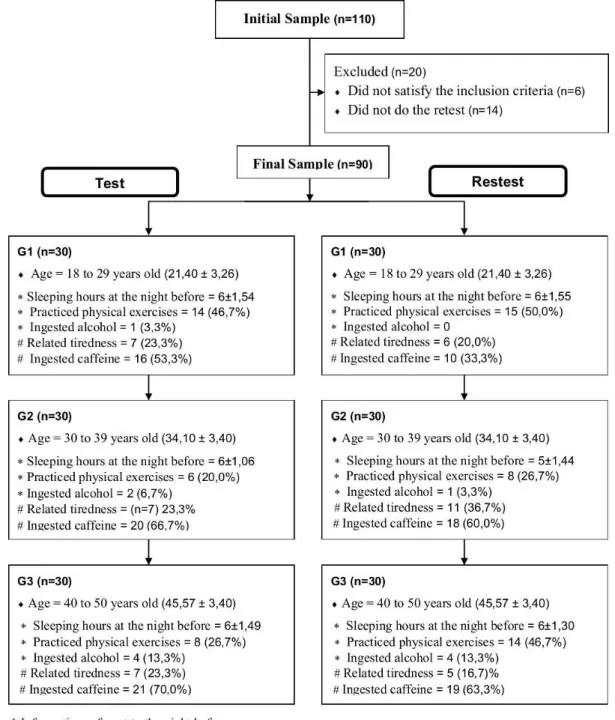
quality of sleep at the night before, tiredness, alcohol or caffeine intake, and physical activity practice was performed (Figure 1). After the tests TRS and TRE were performed. These procedures were performed in two assessment days (test and retest), within an interval of 24 hours.
The subjects were divided into three groups (n=30 in each) according to age: G1 (between 18 and 29 years old); G2 (between 30 and 39 years old) and G3 (between 40 and 50 years old).
Instrument construction
The reaction time in shooting task test (RTST) consisted of
speciic software using an RF Top Gun electronic wireless
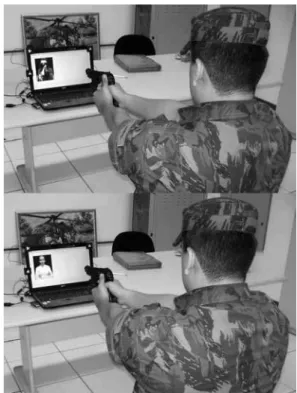
pistol compatible with Windows Vista (32bit), XP (32bit), and all types of screen monitors (CRT/LCD/Plasma/Projectors). The software, built on the Java SE 7 platform, regardless of a computer platform, is composed of two tasks (SRT and CRT) using images that are projected on a computer screen as stimuli in the individual evaluation. The main tasks are to shoot (pulling the trigger) as quickly as possible and select the most appropriate response according to the presented stimulus. For the elaboration of the images used in the software, actors were hired and image rights assigned by contract. In to the test, the stimulus is represented by the image of a subject characterized as a criminal, dressed in black, or the image of a victim, dressed in white (Figure 2). The stimuli are presented twenty times for each task, randomly, with a minimum time of 100 milliseconds.
In order to accomplish the tests, a closed room is needed so that the lighting conditions will not interfere with the action of the gun. The test begins with the individual in a shooting posi-tion (both arms forward and gripping the gun with both hands), with the gun pointing toward the target located on the computer screen (Figure 2). Minimum body movement is required, since the reaction time does not involve performing movements, but only the onset of response.
Figure 2. Positioning for the test realization and representation of im-ages used as stimuli in the tasks of SRT and CRT.
At the end of each task the software generates the mean time, in milliseconds, from the median 10 attempts (excluding the 5 best and worst times) and further, the number of errors in advance or shots off target, as well as response errors. After calculating the mean value, a time of 84 milliseconds is deducted
from mean value due to the transmission error between the output timing of the stimulus of the gun and the arrival of the response on the computer screen, considering the wireless condition of the electronic gun.
Both tasks are described below: Task 1: Simple reaction time
In this task only the gun trigger is used, being pulled with the
index inger of the hand of choice. A single stimulus appears on
the screen represented by the image of a criminal, so that, when viewing the stimulus, the individual should pull the trigger as fast as possible. The SRT mean and the number of anticipation errors is generated.
Task 2: Choice reaction time
In this task two buttons are used (the trigger and a button below the trigger of the gun). The image of the criminal or the victim was randomly presented on the screen. When viewing the image of the criminal, the subject should pull the trigger, whereas when seeing the image of the victim, the subject must press the button that is below the trigger of the gun. To develop this task
the subject is instructed to place the index inger of one hand (of
his choice) on the trigger and the other hand on the button below the trigger. The software calculates the CRT and generates the number of response errors and errors in advance or shots off target.
Statistical Analysis
Data were analyzed using SPSS version 14.0 for Windows
with signiicance level of 5%. For a description of the sample,
we used descriptive statistics (mean, standard deviation, and
percentage frequency). The normality of variables was veriied
by the Shapiro-Wilk test. To analyze the validity of the instru-ment a t test was used for paired samples and the Bland-Altman diagrams for the application of the gold standard method15. We
used the intraclass correlation coeficient to test the reliability of
the instrument, considering ICC > 0.70 as appropriate values16.
Analysis of Concurrent Validity and Reliability
To establish the validity of RTST the gold standard method was used15. The level of concurrent validity was determined by comparing the measurements obtained in the reaction time test that were created and validated in a previous study, and used as a benchmark to measure the proposed new instrument11.A paired samples t test was initially performed to compare the mean
val-ues between the two instruments, and inally the Bland-Altman
diagrams were produced for the analysis of agreement between the two measurements16.
To analyze the reproducibility of the instrument the intraclass
correlation coeficient (ICC) was used based on the parameters
of the repeated measures ANOVA16, as shown below:
ICC = (MSs–MSe) MSs
in which MSs = mean square for subjects MSe = mean square for error
Results
The90 subjects were divided into three groups for analyzation (n=30 in each group) according to age: G1 (between 18 and 29 years old); G2 (between 30 and 39 years old) and G3 (between 40 and 50 years old). The data distribution analysis using the Shapiro-Wilk test showed normality in all groups (p>.05).
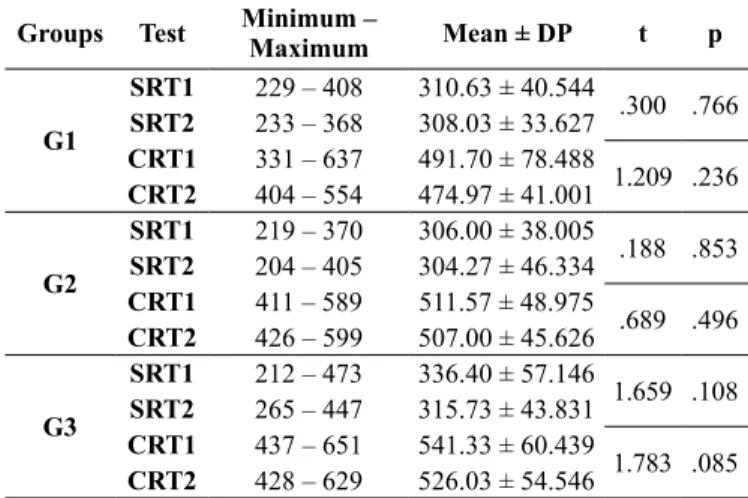
Regarding concurrent validity, as shown in Table 1, for
the three analyzed groups, no signiicant differences (p <.05) between the two tests in the tasks of SRT and CRT were found.
The results of the analysis of agreement between subjects for
the three groups are shown in igures 3 and 4. It is possible to
observe that there was agreement between both instruments in the task of SRT as in the CRT, which demonstrates the validity of RTST in all groups evaluated.
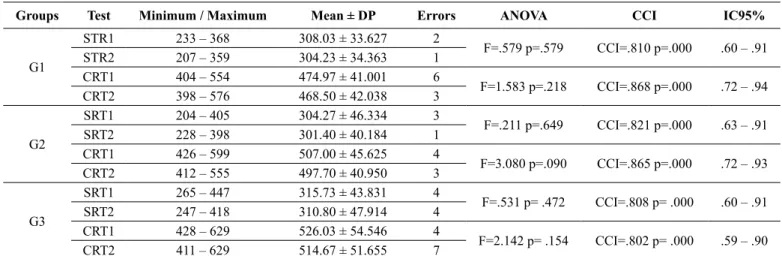
The results concerning the reliability of the instrument by means of test-retest procedure are shown in Table 2.
As shown in table 2, the results for the reliability of RTST
in the three groups were signiicant (p < 0.05) within the refer-ence values considered adequate (ICC > 0.70). ANOVA for
repeated measures found no signiicant differences between
test and retest ratings (p > 0.05), conirming the reproducibility
of the instrument. It is also possible to observe that the values concerning the number of errors in both tests, and the average error by anticipation (SRT) were lower than the average errors of response choice (CRT).
Table 1: Analysis of concurrent validity (t test for paired samples) and descriptive igures for the SRT and CRT (milliseconds) for the reference test and the RTST
Groups Test Minimum –
Maximum Mean ± DP t p
G1
SRT1 229 – 408 310.63 ± 40.544
.300 .766
SRT2 233 – 368 308.03 ± 33.627
CRT1 331 – 637 491.70 ± 78.488
1.209 .236
CRT2 404 – 554 474.97 ± 41.001
G2
SRT1 219 – 370 306.00 ± 38.005
.188 .853
SRT2 204 – 405 304.27 ± 46.334
CRT1 411 – 589 511.57 ± 48.975
.689 .496
CRT2 426 – 599 507.00 ± 45.626
G3
SRT1 212 – 473 336.40 ± 57.146
1.659 .108
SRT2 265 – 447 315.73 ± 43.831
CRT1 437 – 651 541.33 ± 60.439
1.783 .085
CRT2 428 – 629 526.03 ± 54.546 Note: 1: reference test and 2: RTST; SD: standard deviation.
Figure 3. Validity of RTST compared to the reference test for SRT.
Discussion
The RTST was designed based on the use of electronic technolo-gies for shooting tasks simulation. The proposed tests allow the evaluation of reaction times in simple situations where a single answer is possible, and in more complex situations, when it is necessary to choose the most appropriate answer for making the right decision according to the presented situation.
The instruments developed for the assessment of RT usu-ally consist of software using the computer keyboard or mouse to perform manual tasks. These tasks are often used for the evaluation of RT in different contexts and situations. Studies with swimmers3, volleyball players17, soccer players18, military pilots19, among other contexts, were found. However, the tasks using the computer keyboard or mouse are not always suited to situations experienced by individuals under evaluation,
disre-garding the speciicity of the activities developed in the context
of the studied population.
The construction of a measuring instrument requires the
ob-servance of certain fundamental criteria that conirm the results
safely, among which we emphasize the procedures reliability and validity20. A test validity begins at the moment someone considers to build it, and subsists throughout the development, implementation, correction, and results interpretation process21. As to reliability, it is an integral part of validity and refers to the consistency or repeatability of a measurement. Whether a test is not consistent, i.e., if its repetition does not produce the same results, it will not be reliable22.
In this study the procedures for validity and reliability of the proposed instrument were performed by following the steps according to previous studies for the development of measuring steps instruments16,20,22. Concurrent validity analyses showed agreement between the reference test and the RTST,
and the paired t test conirmed no signiicant difference be -tween the two measures. Regarding the analysis of reliability, appropriate values were found related to internal consistency
of the instrument, veriied by the test-retest procedure for the
three groups. Although a value of consensual reference has
not been found, in general, ICC values ≥ .70 are considered
satisfactory16. These results are in agreement with a previ-ous study involving the creation procedures, development, and reproducibility of an RT test11. The authors also found satisfactory reproducibility values for the SRT (ICC = .805) and for the CRT (ICC = .838).
Assessing the differences in the reaction time variable between different age groups was not the aim in this study, but rather to create a valid and reliable instrument to be used
by people of different age groups that perform speciic tasks
related to shooting situations. Accordingly, no instruments
that fulill these particular requirements were found. A study
developed by the Research Laboratory of the United States Army evaluated the performance of military in their simple and procedure (choice) reaction time. For this purpose, a battery for computerized tests (The Automated Neuropsychological Assessment Metric – ANAM) characterized by the presenta-tion of visual stimuli on the computer screen and sequential manual responses by pressing keys on a keyboard was used. Although it is used for RT evaluation of the active military army personnel, the battery does not correspond to more
speciic situations of those professionals’ activities, which mainly involves the iring of weapons12. Another study per-formed with the Rio de Janeiro military’s police of the Special Operations Battalion (BOPE) evaluated the RT through the reaction oculomotor (ruler test). In this test, the individual must catch the ruler, which is released by the evaluator, in the shortest possible time, and the distance the ruler falls is measured. In this case, the evaluation may not reveal accurate
data, since it disregards the speciic daily demands of profes -sional military police23.
It is important to highlight that, although a simulation does not have all the components of a real variable environmental situation, one should seek to reproduce the main features of its demands24. Thus, creating this instrument is justiied by
scientiic research purposes seeking to assess individuals in their most speciic contexts so that the results are as close to
reality as possible.
Table 2. Analysis of RTST (ANOVA and ICC) reliability and descriptive values relating to SRT and CRT (milliseconds) in the test and retest.
Groups Test Minimum / Maximum Mean ± DP Errors ANOVA CCI IC95%
G1
STR1 233 – 368 308.03 ± 33.627 2
F=.579 p=.579 CCI=.810 p=.000 .60 – .91
STR2 207 – 359 304.23 ± 34.363 1
CRT1 404 – 554 474.97 ± 41.001 6
F=1.583 p=.218 CCI=.868 p=.000 .72 – .94
CRT2 398 – 576 468.50 ± 42.038 3
G2
SRT1 204 – 405 304.27 ± 46.334 3
F=.211 p=.649 CCI=.821 p=.000 .63 – .91
SRT2 228 – 398 301.40 ± 40.184 1
CRT1 426 – 599 507.00 ± 45.625 4
F=3.080 p=.090 CCI=.865 p=.000 .72 – .93
CRT2 412 – 555 497.70 ± 40.950 3
G3
SRT1 265 – 447 315.73 ± 43.831 4
F=.531 p= .472 CCI=.808 p= .000 .60 – .91
SRT2 247 – 418 310.80 ± 47.914 4
CRT1 428 – 629 526.03 ± 54.546 4
F=2.142 p= .154 CCI=.802 p= .000 .59 – .90
CRT2 411 – 629 514.67 ± 51.655 7
Conclusion
Based on the results presented in this study it can be inferred that the software created to evaluate the reaction time in the shooting
task is valid and reliable for use in research involving a speciic instrument with weapon iring activity contexts.
Further, the instrument created can be used for military
train-ing as a simple, low cost and eficient tool that involves speed,
accuracy and decision-making task shooting.
References
1. Ribeiro RB, Almeida LS. Reaction time and intelligence: strong data for a week explanation. Aval. Psicol. 2005;4(2):95-103. 2. Lima VF, Oliveira FF, Sinésio T, Vieira MM. Efeitos da prática
sistemática do judô no tempo de reação de crianças. Pensar Prát. 2011;14(1):1-9.
3. Pereira EF, Teixeira CS, Villis JMC, Corazza ST. Tempo de reação e desempenho motor do nado crawl em diferentes estágios de aprendizagem. Fisioter. mov. 2009;22(4):585-594.
4. Rossini JC, Galera C. Stimuli Selection and Analysis in the Visual Search Task. Psicol. Rel. Crít. 2007;21(1):20-27.
5. Côrtes GG, Gama JFR, Dias AG. Mental processing and reaction time in active aged women practicing against-resistance training compared to aged and young sedentary women. Vértices. 2007;9(1):51-60.
6. Corazza ST, Streit IA, Katzer JI, Copetti F, Contreira AR. Reaction time simple and choice of older drivers: a comparison with respect to sex and physical exercise regularly. Biomotriz. 2013;7(1):15-27.
7. Silva GP, Pereira VR, Deprá VV, Gorla JI. Reaction time and eficiency of the goalball player in interception/ defense of throwing/attack. Motri. 2012;6(4):13-22.
8. Schmidt RA, Wrisberg CA. Aprendizagem e performance motora: uma abordagem da aprendizagem baseada no problema. Ed. Porto Alegre, Artmed, 2010.
9. Morales AP, Azevedo MMA, Maciel RN, Barcelos JL, Neto NTA, Silva VF. Eficacy of the mental processing in volleyball players with differential metacognitive levels. Rev. Educ. Fís/ UEM. 2009;20(1):43-50.
10. Capovilla AGS, Capovilla FC, Macedo EC. Validação do software cronofonos para análise de tempo de reação, duração e frequência de segmentação locucionais na leitura em voz alta de itens isolados. Cienc. cogn. 1998;3(2):253-340.
11. Pereira EF, Dias JA, Corazza ST. Creation, development and analysis of reproductiveness of test to evaluate simple and choice reaction times. FIEP Bulletin. 2007;77(01):613-15.
12. Petra EA, Valerie JR. Age Differences in Simple and Procedural Reaction Time Among Healthy Military Personnel. Human Factors Ergon Soc. 2012;56(1):1809-1813.
13. Dias AC, Dantas EHM, Moreira SB, Silva VF. A relação entre o nível de condicionamento aeróbico, execução de uma pista de obstáculos e o rendimento em um teste de tiro. Rev Bras Med Esporte. 2005;11(6):341-346.
14. Vickers JN, Lewinski W. Performing under pressure: Gaze control, decision making and shooting performance of elite and rookie police oficers. Human Mov Sci. 2012;31(1):111-117.
15. Bland JM, Altman DG. Statistical method for assessing agreement between two methods of clinical measurement. Lancet. 1986;327(8476):307-310.
16. Barros MVG, Reis RS, Hallal PC, Florindo AA, Júnior JCF. Análise de dados em saúde. Ed. Londrina, Midiograf, 2012. 17. Maciel RN, Morales AP, Barcelos JL, Nunes WJ, Azevedo MMA,
Silva VF. Relation between reaction time and speciic function in volleyball players. F&P J. 2009;8(6):395-9.
18. Ruschel C, Haupenthal A, Hubert M, Fontana HB, Pereira SM, Roesler H. Simple reaction time in soccer players from differing categories and ield positions. Motri. 2001;7(4):73-82.
19. Russo M, Sing H, Kendall A, Johnson D, Santiago S, Escolas S, et al. Visual perception, light performance, and reaction time impairments in military pilots during 26 hours of continuous wake: implications for automated workload control systems as fatigue management tools. In Strategies to Maintain Combat Readiness during Extended Deployments – A Human Systems Approach. Meeting Proceedings RTO-MP-HFM-124 (pp. 1-16). Available from: http://ftp.rta.nato.int/public/pubfulltext/rto/mp/ rto-mp-hfm-124/mp-hfm-124-27.pdf. [Accessed 15th June 2015]. 20. Martins GA. Sobre coniabilidade e validade. Rev Bras Gestão
Negócios. 2006;8(20):1-12.
21. Raymundo VP. Construção e validação de instrumentos: um desaio para a psicolinguística. Letras de Hoje. 2009;44(3):86-93. 22. Thomas JR, Nelson JK, Silverman SJ. Métodos de pesquisa em
atividade física. Ed. Porto Alegre, Artmed, 2007.
23. Santos MR, Filho JF. Profile study of dermatoglyphics, somatotypical and physical qualities of Bopes’s team (PMERJ) in year 2005. F&P J. 2007;6(2):98-104.
24. Zambon AC, Pereira NA, Politano PR, Delgado SS. Validação e idedignidade de modelos de dinâmica de sistemas. In: Simpósio de Engenharia de Produção; 2006. Available from: http://www. simpep.feb.unesp.br/anais/anais_13/artigos/403.pdf. [Accessed 15th June 2015].
Corresponding author
Ellen dos Santos Soares.
Rua Luiz Castanha, 180. Bairro João Goulart, Santa Maria, RS, Brasil Email: [email protected]
Manuscript received on November 14, 2014 Manuscript accepted on May 06, 2016