www.journalpulmonology.org
ORIGINAL
ARTICLE
Validation
of
NoSAS
(Neck,
Obesity,
Snoring,
Age,
Sex)
score
as
a
screening
tool
for
obstructive
sleep
apnea:
Analysis
in
a
sleep
clinic
J.
Coutinho
Costa
a,∗,
A.
Rebelo-Marques
b,c,
J.N.
Machado
a,
J.M.R.
Gama
d,
C.
Santos
e,
F.
Teixeira
a,e,
J.
Moita
a,eaPneumologyBUnit,UniversityHospitalCentreofCoimbra---HospitalGeral,Coimbra,Portugal
bUSFCondeixa,ACeSBaixoMondego,ARSCentro,Coimbra,Portugal
cFacultyofMedicine,UniversityofCoimbra,Coimbra,Portugal
dCentreofMathematicsandApplications,UniversityofBeiraInterior,Covilhã,Portugal
eSleepMedicineCentre,UniversityHospitalCentreofCoimbra---HospitalGeral,Coimbra,Portugal
Received31October2018;accepted16April2019 Availableonline10June2019
KEYWORDS NoSASscore; Obstructivesleep apnea; Screening; Prioritization; Diagnosis Abstract
Introduction:Screeningmethodshavebecomeincreasinglyimportantduetothegrowing num-berofpatientssuspectedofhavingobstructivesleepapnea(OSA)beingreferredtosleepclinics. TheLausanneNoSAS(Neckcircumference,Obesity,Snoring,Age,Sex)scoretestisasimple, efficient,andeasilyemployedtoolenablingidentificationofindividualsatriskforthedisease. Thescorerangesfrom0to17andthepatienthasahighprobabilityofOSAiftheyhaveaNoSAS scoreof8orhigher.
Objectives: ToevaluatetheperformanceoftheNoSASscoreasascreeningtoolforthediagnosis ofOSAinasleepclinic.
Methods:Prospectively,for12months,weincludedallthepatientsreferredbyprimarycare physicianstooursleepunitforclinicalevaluationwhohadundergonein-labpolysomnography (PSG)andcompletedtheNoSASscore.Thistestassigns4pointsforaneckcircumferenceof morethan40cm,3pointsforabody-massindexof25kg/m2tolessthan30kg/m2or5points
forhavingabody-massindexof30kg/m2ormore,2pointsforsnoring,4pointsforbeingolder
than55yearsofageand2pointsforbeingmale.
Results:Ofthe294patients,70.7%weremale,aged53.5±12.1years,withaneck circumfer-enceof41.0±3.6cmandaBMIof30.8±5.1kg/m2.OSAwaspresentin84.0%ofthepatients,
34.8%withmoderateOSAand36.4%severeOSA.UsingtheNoSASmodelforthepredictionofall
∗Correspondingauthor.
E-mailaddress:[email protected](J.CoutinhoCosta).
https://doi.org/10.1016/j.pulmoe.2019.04.004
2531-0437/©2019SociedadePortuguesadePneumologia.PublishedbyElsevierEspa˜na,S.L.U.ThisisanopenaccessarticleundertheCC BY-NC-NDlicense(http://creativecommons.org/licenses/by-nc-nd/4.0/).
OSA,moderate/severeOSAandsevereOSA,theareaundertheROC(ReceiverOperating Char-acteristic)was0.770(IC95%:(0.703;0.837),p<0.001),0.746(IC95%:(0.691;0.802),p<0.001) and0.686(IC95%:(0.622;0.749),p<0.001),respectively,thusconfirmingthediagnosticability oftheNoSASmodel.
WithaNoSASscore≥7,thesensitivityandpositive predictivevalue(PPV)were94.3%and 87.6%forallOSA,94.9%and62.8%formoderate/severeOSAand100%and33.8%forsevereOSA, respectively.Withthesamecut-off,thenegativepredictivevalue(NPV)formoderate/severe andsevereOSAwere67.9%and100%,respectively.EachincreaseintheNoSASscorewas asso-ciatedwithanincreaseintheprobabilityofOSA,reachinga97%OSAprobabilityforascoreof 17.
Conclusions:The NoSASscore showed high sensitivityandPPVfor OSAwith specificityand diagnosticaccuracysteadily increasingwithhigherscores.Furthermore,alowscoreshowed highpredictivevaluefortheexclusionofmoderate/severeOSA.Overall,ourresultssuggest that,inprimarycare,thisscorecanbeapowerfultoolforstratifyingandprioritizingpatients inthediagnosis ofOSA.Nevertheless,more studiesareneededto evaluatethe efficacyof thisscoreinhospitalhealthcare,inyoungerpopulations,withapredominanceoffemaleand non-obeseindividualsorincardiovasculardisease.
©2019SociedadePortuguesadePneumologia.PublishedbyElsevierEspa˜na,S.L.U.Thisisan openaccessarticleundertheCCBY-NC-NDlicense(
http://creativecommons.org/licenses/by-nc-nd/4.0/).
Introduction
Obstructive sleepapnea syndrome (OSA) is characterized by obstruction of the upper respiratory tract leading to increased respiratory effort with inadequate ventilation. Theobstructioniscausedbythecollapseofthepharynxdue tothedecreaseofthemuscletonethatoccursduringsleep; individualsthatpresentriskfactorsarepredisposedtothis situationoccurring.Theseepisodesareinevitably accompa-niedbydesaturation,increasedactivityofthesympathetic nervoussystemwithfrequentarousals.Snoringanddaytime sleepinessarethemaincomplaintsandobservedapnea is themostspecificsymptom.
Individualswithhiddendiseaseareathighriskof medi-calcomorbidities and of road accidents due to excessive sleepiness. There is an independent association of OSA withincreased morbidity and mortality due to metabolic disorders, neurovascular and cardiovascular disease, and impairedneurocognitivefunction,evenifasymptomatic.1---3
The prevalence of this pathology depends significantly onthe populationstudied andthedefinitionofOSA crite-ria (study methodology and threshold of apnea hypopnea index(AHI)used).4,5AccordingtoHeinzeretal.,the
preva-lenceisabout23.4%inwomenand49.7%inmen.6Estimates
showthatthemale/femaleratiorangesfrom2:1to4:1.It can appearin all age groups, however, studies show that womenhave ahigherincidenceintheagegroupabove65 years,prevalenceincreasingaftermenopause,whileinmen itoccursbetween45and64yearsofage.7
Screeningmethodshavebecomeincreasinglyimportant dueto thegrowing number of patients suspectedof hav-ingobstructivesleepapneabeingreferredtosleepclinics. Thedifficultyofdiagnosisofthispathologyisrelatedtothe availabilityandaccessibilityofcardiorespiratorysleep stud-ies(laboratory diagnosis).Consequently,prioritizationand screeningmethodsthatappropriatelystratifyareessential.
A simple and reliable method of screening certain popu-lations, namelyhigh-risk groups, isneeded. Thechoice of screening method will depend onits ability toachieve a specificobjective:toincludepatientswithOSAfor appropri-atesleeptesting;todetectthosewithmoreseveredisease facilitating earlydiagnosis and treatment; andtoexclude patientswithoutOSAorwithoutsevereOSA,whose evalua-tionandtreatmentislessurgent.
Numerousclinical prediction models have been devel-opedbasedonclinical, demographics andanthropometric variables.8,9 A recently proposed screening method is the
LausanneNoSASScoretest(AppendixA),asimple,efficient, andeasilyemployedtoolenablingidentificationof individu-alsatriskforthedisease.10Thisscoreassess5parameters:
Neckcircumference,Obesity,Snoring,Age,Sexandassigns4 pointsforhavinganeckcircumferenceofmorethan40cm, 3 pointsfor havinga body-massindex of25kg/m2 toless than30kg/m2 or5 pointsfor havingabody-massindexof 30kg/m2 or more,2 pointsforsnoring, 4pointsfor being olderthan55yearsofageand2pointsforbeingmale.The scorerangesfrom0to17andthepatienthasahigh prob-ability of OSA if they have a NoSAS score of 8 or higher. Thus,ithelpstoidentifyindividualsatriskforthedisease and rule out others without risk, witha negative predic-tivevalue(NPV)of90%and98%intwoethnicallydifferent population-basedcohorts.10
Methods
ObjectiveThepresentstudyaimedtoevaluatetheperformanceofthe NoSASscoreasascreeningtoolforthediagnosisofOSAina respiratoryandsleepmedicineclinic.
Studydesign
Prospectivestudy,12monthsinduration,beginningin Jan-uary 2017, we considered consecutively all patients with suspicious sleep disorder, referred by primary care physi-cians to our sleep unit for clinical evaluation and who underwentin-labpolysomnography(PSG).
Duringtheclinicalconsultation,everypatientwasasked if they accepted participation in the study, regardless of thereasonsforbeingreferred,whichincludedreferralfor isolatedsymptoms or clinical suspicionof aspecific sleep disorder(e.g.OSA,insomnia,parasomnia).
All patients included were required to complete the NoSAS questionnaire,10 with information concerning neck
circumference, body mass index (BMI), snore, age and gender, ultimatelycollectedbyaclinician.We also evalu-atedother parametersnamelyEpworth’s score,tiredness, observed apnea and high blood pressure (blood pressure >140/90mmHgormaketreatmentforhypertension).
Theresearchstaffdidnotinterferewiththe interpreta-tionorcompletionofthequestionnaires.
Patients previously diagnosed with OSA, those unable to read and/or write, additional diagnoses obtained throughout the sleepstudy (like central sleepapnea and obesity/hypoventilationsyndrome)andallcasesof techni-cal error during data collection, were excluded from the study.
Sleepstudies,scoringanddiagnosis
At the specialized sleep center, all patients underwent a standardPSG,usingthepatient’susualbedtimeovernight. Astandardized settingmade upofsurface electrodeswas used and included: electrocardiogram, electroencephalo-gram, electrooculogram, submental and lower limb EMG. Besides this data, additional information was collected regardingoronasalairflow(thermistorandpressuresensor), thoracicandabdominalrespiratoryeffort,pulseoximetry, snoringandbodypositionsensoring.AcertifiedPSG techni-cianscoredthePSGrecordings,ensuringcorrectassembly, underthesupervisionofasleepphysicianwhoreviewedand validatedthefinalreports.Thesleepphysicianand techni-cian were both blinded tothe study report (both clinical information and NoSAS). The scoring was done manually, following therecommendations of theAmericanAcademy of Sleep Medicine.11 Apnea was defined asa decrease of
at least 90% of airflow from baseline, lasting 10 second or longer.Hypopneawasdefinedasa decreaseofatleast 30%ofairflowfrombaseline,lasting10second,associated witheitheranarousalora≥3%O2saturationdecrease.The meannumberofapneasandhypopneasperhoursofsleep (apnea---hypopnea index [AHI]) wascalculated. Both diag-nosis and severity of OSA were classified based upon the AHI: >5---15/h---mild, >15---30/h--- moderate,and >30/h ---severe.11,12
Additionaldiagnosesobtainedthroughoutthesleepstudy weredefinedaccordinglytotheInternationalClassification ofSleepdisorders-third edition.13 However,our studywas
exclusively focused on OSA, so all other diagnoses were ignoredorexcluded.
Statisticalanalysis
StatisticalanalysiswasmadeusingtheIBMSPSS® statistical program,version25(theStatisticalPackagefortheSocial Sciences).
Thecategoricalvariablesweredescribed with frequen-cies and percentages and the quantitative variables with mean,median,standarddeviation,maximumandminimum. AllassociationsbetweenthepresenceofOSAandeachofthe possiblerisk factorswereestablishedusinglogistic regres-sion,whichestimatedtheiroddsratios(ORs).
To evaluate the performance of the NoSAS score in predictingOSA, sensitivity, specificity, negativepredictive values (NPVs) and positive predictive values (PPVs) were estimatedfordifferentAHIcut-offs.
TomeasurethediagnosticabilityoftheNoSASscorefor differentAHI cut-offs,wealsodeterminedtheareaunder thereceiveroperatingcharacteristic (ROC)curve andthe value of the score where both sensitivity and specificity maximized.
FortheevaluationoftheinfluenceoftheNoSASscorein theestimationoftheprobabilitiesofOSAseverity,anordinal regressionmodelwasfittedwiththelogitlinkfunction.The Waldtestwasconsideredsignificantwhenitsp-valuedidnot exceed0.05.
Results
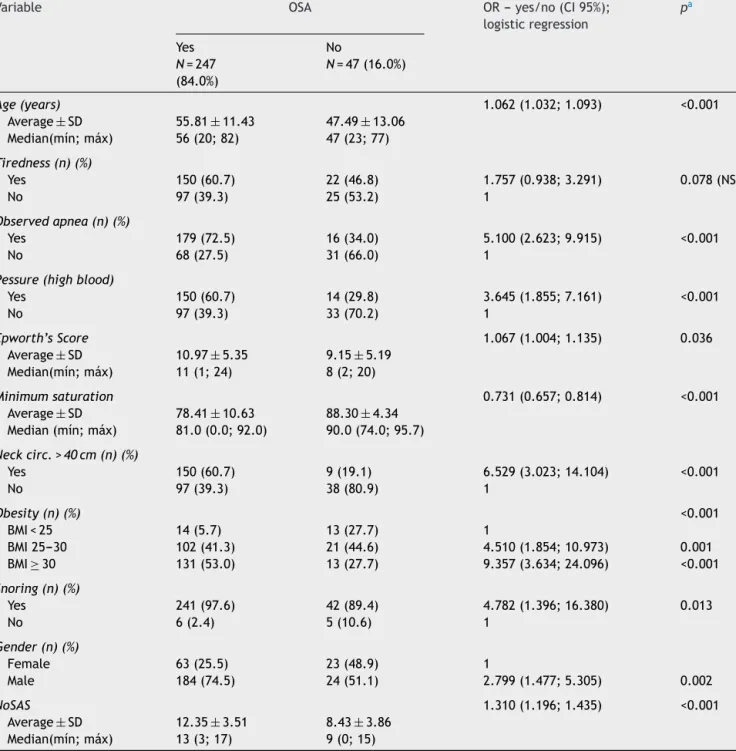
Of the 294 patients, 70.7% were male, aged 53.5±12.1 years, with a neck circumference of 41.0±3.6cm and a BMIof 30.8±5.1kg/m2.OSA waspresent in 84.0% of the patients,28.8%withmildOSA, 34.8%moderateand36.4% severe.
Descriptivesummarystatistics,NoSAScharacteristicsand comparison of OSA and non-OSA groups are displayed in
Table1.Althoughgreater intheOSA group,tirednesswas
theonlycharacteristicwhichwerenotsignificantlydifferent betweentheOSAandnon-OSAgroup.
UsingtheNoSASmodelforthepredictionofallOSA, mod-erate/severeOSAandsevereOSA,theareaundertheROC curve (AUC) was0.770 (IC95%: (0.703; 0.837), p<0.001), 0.746(IC95%: (0.691; 0.802),p<0.001) and 0.686(IC95%: (0.622;0.749),p<0.001),respectively,thusconfirmingthe diagnosticabilityoftheNoSASmodel.
The sensitivity, specificity, PPV, and NPV for all OSA, moderate/severeOSA, and severeOSA aresummarized in
Table2.WithaNoSASscore≥7,thesensitivityandpositive
predictivevalue(PPV)were94.3%e87.6%forallOSA,94.9% and62.8%formoderate/severeOSAand100%and33.8%for severeOSA, respectively. Withthesame cut-off,the neg-ativepredictivevalue(NPV)for allOSA, moderate/severe OSAandsevereOSAwere50%,67.9%and100%,respectively. Asthescoreincreasedfrom7to12,thespecificityandPPV increasedcontinuouslyfrom29.8%to83%and87.6%to94.7% for all OSA, 16.1% to 74.6% and 62.8% to80% for moder-ate/severeOSA,and13.7%to57.8%and33.8%to42.7%for severeOSA,respectively.
The predicted probabilities of having OSA, moder-ate/severeOSA, andsevere OSA areshownin Table3. As NoSASscoreincreasedfrom2to17,theprobabilityof hav-ingOSA,moderate/severe OSA, andsevere OSAincreased
Table1 SummarystatisticsofthepatientpopulationandcomparisonofOSAandnonOSAgroup.
Variable OSA OR---yes/no(CI95%);
logisticregression pa Yes N=247 (84.0%) No N=47(16.0%) Age(years) 1.062(1.032;1.093) <0.001 Average±SD 55.81±11.43 47.49±13.06 Median(mín;máx) 56(20;82) 47(23;77) Tiredness(n)(%) Yes 150(60.7) 22(46.8) 1.757(0.938;3.291) 0.078(NS) No 97(39.3) 25(53.2) 1 Observedapnea(n)(%) Yes 179(72.5) 16(34.0) 5.100(2.623;9.915) <0.001 No 68(27.5) 31(66.0) 1
Pessure(highblood)
Yes 150(60.7) 14(29.8) 3.645(1.855;7.161) <0.001 No 97(39.3) 33(70.2) 1 Epworth’sScore 1.067(1.004;1.135) 0.036 Average±SD 10.97±5.35 9.15±5.19 Median(mín;máx) 11(1;24) 8(2;20) Minimumsaturation 0.731(0.657;0.814) <0.001 Average±SD 78.41±10.63 88.30±4.34 Median(mín;máx) 81.0(0.0;92.0) 90.0(74.0;95.7) Neckcirc.>40cm(n)(%) Yes 150(60.7) 9(19.1) 6.529(3.023;14.104) <0.001 No 97(39.3) 38(80.9) 1 Obesity(n)(%) <0.001 BMI<25 14(5.7) 13(27.7) 1 BMI25---30 102(41.3) 21(44.6) 4.510(1.854;10.973) 0.001 BMI≥30 131(53.0) 13(27.7) 9.357(3.634;24.096) <0.001 Snoring(n)(%) Yes 241(97.6) 42(89.4) 4.782(1.396;16.380) 0.013 No 6(2.4) 5(10.6) 1 Gender(n)(%) Female 63(25.5) 23(48.9) 1 Male 184(74.5) 24(51.1) 2.799(1.477;5.305) 0.002 NoSAS 1.310(1.196;1.435) <0.001 Average±SD 12.35±3.51 8.43±3.86 Median(mín;máx) 13(3;17) 9(0;15) aTestedeWald.
Abbreviations:OR=oddsratio;CI=ConfidenceInterval;BMI:bodymassindex;OSA:obstructivesleepapnea;NS:notsignificant. continuouslyfrom35%to97%, 12%to85%and 5%to53%,
respectively.Thistrend,presentinallgroupsisillustrated inFig.1.
The predicted probabilitiesof havingOSA ofa specific severity are illustrated in Fig. 2. With each incremental increaseinthescorefrom0to7,theprobabilityofhaving nosleepapneadiminished,whiletheprobabilityofhaving mild,moderate, orsevere sleepapneaincreased continu-ously.Withany scoregreater than 7,only the probability ofhavingmoderateorseveresleepapneaincreased.Witha scoregreaterthan13,onlytheprobabilityofhavingsevere sleepapneaincreased.
Discussion
This studyshows that,in apopulation referredtoasleep medicineclinic,aNoSASscore≥7hashighsensitivity(94.3%) andPPV(87.6%)forthediagnosisofOSAandthatthegreater the NoSAS score, reflecting a higher cumulative score of known risk factors, the greater the probability of sleep apnea,particularlymoderatetoseveresleepapnea(Fig.2). TheprobabilityofOSAforascoreof7is67%andincreases continuouslyto73%,78%,86%,91%,95%and97%witha step-wise increase of the NoSASscore to8, 9, 11, 13, 15 and 17. This performance is due tothe increasing probability
Table2 PredictiveparametersofeachNoSASscorecut-offsfordifferentAHIlevels(n,numberofpatientsintheAHIgroup whoscoredtheNoSASscoreindicatedorhigher;percentageoutofthe294patients).
AllOSA(AHI>5)
NoSASscorecut-off N(%) Sensitivity Specificity PPV NPV
≥1 247(84.0) 100 2.1 85.5 100 ≥3 247(84.0) 100 10.6 85.5 100 ≥4 246(83.7) 99.6 10.6 85.4 83.3 ≥5 241(82.0) 97.6 21.3 86.7 62.5 ≥6 235(79.9) 95.1 27.7 87.4 52.0 ≥7 233(79.3) 94.3 29.8 87.6 50.0 ≥8 216(73.5) 87.4 40.4 88.5 38.0 ≥9 210(71.4) 85.0 44.7 89.0 36.2 ≥11 190(64.6) 76.9 55.3 90.0 31.3 ≥12a 142(48.3) 57.5 83.0 94.7 27.1 ≥13 141(48.0) 57.1 83.0 94.6 26.9 ≥15 91(31.0) 36.8 95.7 97.8 22.4 ≥17 42(16.7) 17.0 100 100 18.7 18 0(0.0) 0.0 100 --- 16.0
Moderate/severeOSA(AHI>15)
NoSASscorecut-off N(%) Sensitivity Specificity PPV NPV
≥1 176(59.9) 100 0.8 60.0 100 ≥3 176(59.9) 100 4.2 60.9 100 ≥4 176(59.9) 100 5.1 61.1 100 ≥5 173(58.8) 98.3 11.0 62.2 81.3 ≥6 169(57.5) 96.0 15.3 62.8 72.0 ≥7 167(56.8) 94.9 16.1 62.8 67.9 ≥8 158(53.7) 89.8 27.1 64.8 64.0 ≥9 155(52.7) 88.1 31.4 65.8 63.8 ≥11 142(48.3) 80.7 41.5 67.3 59.0 ≥12 120(40.8) 68.2 74.6 80.0 61.1 ≥13a 120(40.8) 68.2 75.4 80.5 61.4 ≥15 79(26.9) 44.9 88.1 84.9 51.7 ≥17 41(13.9) 23.3 99.2 97.6 46.4 18 0(0.0) 0.0 100 --- 40.1
SevereOSA(AHI>30)
NoSASscorecut-off N(%) Sensitivity Specificity PPV NPV
≥1 90(30.6) 100 0.5 30.7 100 ≥3 90(30.6) 100 2.5 31.1 100 ≥4 90(30.6) 100 2.9 31.3 100 ≥5 90(30.6) 100 7.8 32.4 100 ≥6 90(30.6) 100 12.3 33.5 100 ≥7 90(30.6) 100 13.7 33.8 100 ≥8 85(28.9) 94.4 22.1 34.8 90.0 ≥9 85(28.9) 94.4 26.0 36.0 91.4 ≥11 76(25.9) 84.4 33.8 36.0 83.1 ≥12 64(21.8) 71.1 57.8 42.7 81.9 ≥13a 64(21.8) 71.1 58.3 43.0 82.1 ≥15 44(15.0) 48.9 76.0 47.3 77.1 ≥17 22(7.5) 24.4 90.2 53.4 73.0 18 0(0.0) 0.0 100 --- 69.4
a Cut-offvaluethatmaximizesbothsensitivityandspecificity.
Abbreviations:AHI:Apnea---HypopneaIndex; OSA:obstructivesleepapnea;PPV:positivepredictivevalue;NPV:negativepredictive value.
Table3 PredictedprobabilitiesofeachNoSASscorefordifferentAHIlevels(n,numberofpatientsintheAHIgroupwhoscored theNoSASscoreindicated;percentageoutofthe294patients).
NoSASscorecut-off AllOSA(AHI>5) Mod./severeOSA(AHI>15) SevereOSA(AHI>30)
N(%) Probability N(%) Probability N(%) Probability
0 0(0.0) 0.24 0(0.0) 0.08 0(0.0) 0.03 2 0(0.0) 0.35 0(0.0) 0.12 0(0.0) 0.05 3 1(0.4) 0.41 0(0.0) 0.15 0(0.0) 0.06 4 5(2.0) 0.48 3(1.7) 0.19 0(0.0) 0.08 5 6(2.4) 0.55 4(2.3) 0.23 0(0.0) 0.09 6 2(0.8) 0.61 2(1.1) 0.28 0(0.0) 0.11 7 17(6.9) 0.67 9(5.1) 0.33 5(5.6) 0.13 8 6(2.4) 0.73 3(1.7) 0.39 0(0.0) 0.16 9 20(8.1) 0.78 13(7.4) 0.45 9(10.0) 0.18 11 48(19.4) 0.86 22(12.5) 0.57 12(13.3) 0.25 12 1(0.4) 0.89 0(0.0) 0.63 0(0.0) 0.29 13 50(20.2) 0.91 41(23.3) 0.68 20(22.2) 0.34 15 49(19.8) 0.95 38(21.6) 0.78 22(24.4) 0.43 17 42(17.0) 0.97 41(23.3) 0.85 22(24.4) 0.53
Abbreviations:AHI:apnea---hypopneaindex;OSA:obstructivesleepapnea.
1.00 .90 .80 .70 .60 .50 .40 .30 .20 .10 .00 -1 0 1 2 3 4 5 6 7 8 9 10 11 12 13 14 15 16 17 18 19 NoSAS Probability
All OSA (AHI > 5) Mod./severe OSA (AHI > 15) Severe OSA (AHI > 30) Interpolation line
Figure1 PlotofpredictedprobabilitiesfordifferentAHI lev-elswiththecorrespondingNoSASscore.
,70 ,60 ,50 ,40 ,30 ,20 ,10 ,00 -1 0 1 2 3 4 5 6 7 8 9 10 1112 13 14 1516 17 1819 NoSAS Probability Without OSA Mild OSA Moderate OSA Severe OSA Interpolation line
Figure 2 Plot of predicted probabilities for different OSA severitieswiththecorrespondingNoSASscore.
ofmoderatetosevereOSA foreachscoreabove7, reach-ingapredictedprobabilityof57%,68%,78%and85%fora scoreof11,13,15and17(Table3),respectively.Moreover, ascorelowerthan7showeddiscriminativepowertoexclude moderate/severeOSA,asreflectedbyaNPVof67.9%,72%
and81.3%forascoreof7,6and5,respectively.TheAUC was consistently high confirming the diagnostic ability of theNoSASmodelforallOSAseverities.Furthermore, tired-nesswasstatisticallysimilarbetweentheOSAandnon-OSA groups,althoughtendingtobegreaterandmoreprevalent intheOSAgroup,reflectingtirednessasanequallycommon complaintsamongpatientswithvarioussleepdisordersand diseasesofotherorgans.
Owingtotherelativelyhigh prevalenceofundiagnosed OSA andits comorbidities,a trustworthy screeningtool is needed and mandatory for a prompt prediction of OSA. A quick and reliable screening test can enable clinicians withinaclinicalcontexttomakemoreinformeddiagnostic decisions,particularlywhenstratifyingpatients for unrec-ognized OSA and triage for further diagnostic assessment and treatment. Where theycan be usedand scored eas-ily,aspartofroutinedailypractice,questionnairescanbe appropriate tools for that purpose. Moreover, analysis of the questionnaireperformancein specific populationscan provide clinicians witha set of predictive parametersfor differentlevelsofOSAseverity,whichcanbeusedasa cru-cialguidefor diagnostic andtherapeutic decisions.Inour studythepresentresultsshowthattheNoSASquestionnaire, canaddgreatvalueandbeaveryusefulandpowerfultool in primarycare. Onthe basisofitsability todiscriminate participantswithclinicallysignificantdisorder,itsPPV,and itsNPV,NoSASscorecanbeaveryusefultoolfor triaging patientsdependingontheirscore:scoreof0---5---low proba-bilityofOSA,particularlymoderatetosevereOSA;score≥7 probableOSA;score≥12highprobabilityofOSA,specifically moderatetosevereOSA.
Numerous questionnaires and other clinical screening tools for OSA have been analyzed previously. The study of derivation andvalidationof NoSASscore of Marti-Soler et al., shows 8 asa threshold and the score wasdefined aspositiveifit wasgreaterthan orequal to8pointsand negative if it was less than 8 points, on the basis of its abilitytodiscriminateparticipantswithclinicallysignificant
disorder.10 Thisstudyshows anAUCof0.74,aPPVof47%,
anNPVof90%andtheNoSASscoreperformedsignificantly betterthandidtheSTOP-Bang(AUC0.67)andBerlin(AUC 0.63)scores.10Inourcohort,wepropose7asathresholdand
obtainedanevenhigherperformancewiththeAUC0.770, aPPVof87.6%andaNPVof67.9%.
Moreover,therearesomepapers thatevaluatedNoSAS thatareworthmentioning.AccordingGuichardetal.,NoSAS wassimilartoBerlinandsignificantlybetterthanSTOP-Bang questionnaire(AUCwas0.72forNoSAS,0.66forSTOP-Bang and 0.69 for the Berlin score).14 A study of Tan et al.,
alsoevaluatedNoSASscoreandcompareditsperformance to the STOP-Bang and Berlin questionnaires.15 The
sensi-tivity,specificity, and NPVand PPVof theNoSAS scoreto predictsevere sleepdisorder breathing(definedasanAHI of ≥30events/h), were 69.2%, 73.1%, 95.2%, and 23.7%, respectively.16 They concluded that its performance was
similar to the STOP-Bang and Berlin questionnaires, with AUC values of all three questionnaires clustered around 0.682---0.748.16 AccordingLyeetal.,thesensitivity,
speci-ficity, and NPV and PPV of the NoSAS score to predict severeOSA(AHI≥30events/h)was64.3%,70.0%,63.8%and 70.4%,respectively.16 TheAUCofNoSASscore(0.724)was
higherthanEpworthSleepinessScale(ESS)(0.544).16They
concludedthat overall the NoSAS scoreperformed better than the ESS.16 Moreover,according Cicero et al., a high
NoSASscorewasassociatedwithincreasedarterialstiffness, reducedrenalfunctionandincreasedmeanarterialpressure inalargecohortofhealthyindividuals.17Althoughthisstudy
didnotevaluateNoSASaccuracyanddonotsuggestacausal linkbetweenOSAandcardiovasculardisease,italsoshowed clinicalrelevanceinusingthisscoretoidentifyindividuals whoprobablyhaveOSAandahighercardiovascularrisk.17
InreferencetothevalidationofaPortugueseversionof theSTOP-Bang inprimarycare, byRebelo-Marques etal., usingthismodel for thepredictionof OSA,the diagnostic ability of the STOP-Bangwas relatively superior toNoSAS score(theAUCwas0.847).18
In conclusion, our results agree with and support the original data from Marti-Soher et al.,10 and can help to
implementandgeneralizeitsuseinprimarycare.
However, thisstudy has limitations that must be men-tioned.Thefactthatoursampleconsistedmainlyofobese menwithanaverageageofover50yearsmayhave condi-tionedourresults.
Conclusions
The NoSASscore showedhigh sensitivity and PPVfor OSA with specificity and diagnostic accuracy which steadily increased with higher scores. Furthermore, a low score showed high predictive value for the exclusionof moder-ate/severeOSA.Overall,ourresultssuggestthatthisscore issimple,efficient,andeasytoimplement,itenables iden-tificationofindividualsat riskofthediseaseandcanhelp primarycareclinicianstodecidewhichpatientsto investi-gate furtherwithanocturnal recording.Sothisscore can beapowerfultoolinprimarycareforstratifyingand prior-itizingpatientsinthediagnosisofOSA,dependingontheir score:score of 0---5--- low probabilityof OSA, particularly moderatetosevereOSA;score≥7probableOSA;score≥12
high probability of OSA, particularly moderate to severe OSA. Nevertheless, more studies are needed to evaluate theefficacyofthisscoreinhospitalhealthcare,inyounger populations,withapredominanceoffemaleandnon-obese individualsorincardiovasculardisease.
Conflicts
of
interest
Theauthorshavenoconflictsofinteresttodeclare.
Appendix
A.
NoSAS
score
1. Neckcircumference>40cm---4points 2. Obesity
- BMI25kg/m2to<30kg/m2---3points - BMI≥30kg/m2---5points
3. Snoring--- 2points 4. Age>55years--- 4points 5. Sex:male--- 2points
References
1.YoungT,FinnL, PeppardE,Szklo-CoxeM,AustinD,NietoJ, etal.Sleepdisorderedbreathingandmortality:eighteen-year follow-upoftheWisconsinsleepcohort.Sleep.2008;31:1071---8. 2.MarshallS,WongK,LiuY,CullenR,KnuimanW,GrunsteinR. Sleepapneaasanindependentriskfactorforall-cause mortal-ity:theBusseltonHealthStudy.Sleep.2008;31:1079---85. 3.McNicholasWT,BonsignoreMR.Sleep apnoeaasan
indepen-dentriskfactorforcardiovasculardisease: currentevidence, basic mechanisms and research priorities. Eur Respir J. 2007;29:156---78.
4.JennumP,RihaRL.Epidemiologyofsleepapnoea/hypopnoea syndrome and sleep-disordered breathing. Eur Respir J. 2009;33:907---14.
5.Senaratna CV, Perret JL, Lodge CJ, Lowe AJ, Campbell BE, MathesonMC,etal.Prevalenceofobstructivesleepapneain thegeneral population:asystematic review.SleepMed Rev. 2017;34:70---81.
6.HeinzerR,VatS,MarquesVidalP,Marti-SolerH,AndriesD, Tob-backN,etal.Prevalenceofsleep-disorderedbreathinginthe generalpopulation:theHypnoLausstudy.LancetRespirMed. 2015;3:310---8.
7.LettieriJ,EliassonH,AndradaT,KhramtsovA,RaphaelsonM, KristoA.Obstructivesleepapneasyndrome:arewemissingan at-riskpopulation?JClinSleepMed.2005;1:381---5.
8.RossSD,SheinhaitIA,HarrisonKJ,KvaszM,ConnellyJE,Shea SA,etal.Systematicreviewandmeta-analysisoftheliterature regardingthediagnosisofsleepapnea.Sleep.2000;23:519---32. 9.RowleyJA,AboussouanLS, BadrMS.Theuseofclinical pre-dictionformulasintheevaluationofobstructivesleepapnea. Sleep.2000;23:929---38.
10.Marti-SolerH,HirotsuC,Marques-VidalP,VollenweiderP, Wae-ber G, Preisig M, et al. The NoSAS score for screening of sleep-disorderedbreathing.LancetRespirMed.2016;4:742---8. 11.BerryR,BrooksR,GamaldoC,HardingS,LloydR,QuanS,etal. TheAASMmanualforthescoringofsleepandassociatedevents, Rules,TerminologyandTechnicalSpecificationsversion2.4.J ClinSleepMed.2017;13:665---6.
12.EpsteinL,KristoD,StrolloP,FriedmanN,MalhotraA,PatilS, etal. Clinicalguideline fortheevaluation,management and long-termcareofobstructivesleepapneainadults,taskforce oftheAmericanAcademyofSleepMedicine.JClinSleepMed. 2009;5:263---76.
13.SateiaMJ.International classificationofsleepdisorders-third edition:highlightsandmodifications.Chest.2014;146:1387---94. 14.Guichard K, Marti-Soler H, Micoulaud-Franchi A, Philip P, Marques-Vidal P, Vollenweider P, et al. The NoSAS score: a new and simple screening tool for obstructive sleep apnea syndrome in depressive disorder.J Affect Disord. 2018;227: 136---40.
15.Tan A, Hong Y, Tan LWL, Van Dam RM,Cheung YY, Lee CH. Validation of NoSAS score for screening of sleep-disordered breathing in a multiethnic Asian population. Sleep Breath. 2017;21:1033---8.
16.LyeP,SohR,ChuaA,TanA.UsingNoSASscoretopredictsevere obstructiveSleepapneainaclinic-basedpopulation. Respirol-ogy.2018;23Suppl.2:195.
17.CiceroAFG,RosticciM,PengoMF,HartN,BorghiC.Brisighella HeartStudyGroup,NoSASscoreassociatedwitharterial stiff-nessinalargecohortofhealthyindividuals.LancetRespirMed. 2016;4:e54.
18.Rebelo-MarquesA,VicenteC,ValentimB,AgostinhoM,Pereira R,TeixeiraF,etal.STOP-Bangquestionnaire:thevalidationof aPortugueseversionasascreeningtoolforobstructivesleep apnea(OSA)inprimarycare.SleepBreath.2018;22:757---65.