http://www.uem.br/acta ISSN printed: 1679-9275 ISSN on-line: 1807-8621
Doi: 10.4025/actasciagron.v34i1.10747
Effects of temperature, light regime and substrates on the production
and germination of
Stenocarpella maydis
pycnidiospores
Paulo Roberto Kuhnem Júnior1*, Ricardo Trezzi Casa1, Amauri Bogo2, Lenita Agostineto1,
Jonathan Marcel Bolzan1 and David José Miqueluti1
1
Departamento de Agronomia, Centro de Ciências Agroveterinárias, Universidade do Estado de Santa Catarina, Lages, Santa Catarina, Brazil.
2
Secretaria de Cooperação Institucional e Internacional, Universidade do Estado de Santa Catarina, Av. Madre Benvenuta, 2007, 88035-001, Florianópolis, Santa Catarina, Brazil. *Author for correspondence. E-mail: [email protected].
ABSTRACT. This study aimed to evaluate the production and germination of Stenocarpella maydis
pycnidiospores under in vitro conditions as affected by substrate composition (sorghum, wheat, black oat or barley), light regime (continuous dark, 12-h light dark-1 or continuous light conditions), and incubation
temperature (21, 24, 27, 30 or 33ºC). Each substrate (20 g of grain) was soaked in 100 mL of water for 24h and sterilized twice for 20 min at 127ºC. Three plugs (5 mm diameter) of a single-spored culture of S. maydis were used as inocula for each substrate. Assessments of pycnidiospore production per gram of grain and percent germination were made 14 days after inoculation. Barley, black oat or wheat grains were the
best substrates for the mass production of S. maydis pycnidiospores and the maintenance of high
germination rates. The highest pycnidiospore production (67,600 pycnidiospores g-1) was obtained using
barley grain as a substrate with incubation at 27ºC under a 12-h light dark-1 cycle.
Keywords: Diplodia, ear rot, stalk rot, natural medium.
Efeito de temperatura, regime de luminosidade e substratos sobre a produção e
germinação de picnidioporos de
Stenocarpella maydis
RESUMO. A produção e a germinação de picnidiosporos de Stenocarpella maydis foram avaliadas in vitro sob a influência da composição de substratos (sorgo, trigo, aveia preta e cevada), regime de luminosidade (escuro contínuo, fotoperíodo de 12h ou luz contínua) e temperatura de inbucação (21, 24, 27, 30 ou 33ºC). Três discos de 5 mm de cultura monospórica de S. maydis foram inoculados em cada substrato. A produção e o percentual de germinação de picnidiosporos foram avaliados aos 14 dias após a inoculação. Grãos de cevada, aveia preta e trigo foram os melhores substratos na produção e germinação de picnidiosporos de S. maydis. A maior concentração (67.600 picnidiosporos g-1) foi obtida em grãos de
cevada, à 27ºCe 12h de fotoperíodo.
Palavras-chave: Diplodia, podridão de grãos, podridão de colmo, meio natural.
Introduction
Stenocarpella maydis (Berk.) Sutton [Syn. Diplodia
maydis (Berk.) Sacc.] is an important fungal
pathogen of maize (Zea mays L.) and causes both ear and stalk rots (WHITE, 1999). These diseases are distributed worldwide, and in Brazil, they are most prevalent in areas with no-tilled monoculture systems (CASA et al., 2006; ZAMBOLIM et al., 2000). The pathogen survives on maize plant debris and internally in seeds as pycnidia or mycelium (CASA et al., 1998, 2003). Infected ears can cause kernel rot, which downgrades production values for the maize industry (REIS et al., 2004).
In maize breeding programs, pycnidiospore suspensions are mostly used as inocula in experiments to assess the resistance to disease
induced by S. maydis under conditions of natural infection or artificial inoculation in the field (ANDERSON; WHITE, 1994; KOEHLER, 1951; MÁRIO; REIS, 2003; PAPPELIS et al., 1973). For the latter, a large amount of inoculum may be necessary (MÁRIO; REIS, 2003; ULLSTRUP, 1970).
Previous research has shown that the viability of pycnidiospores decreases with continued exposure to sunlight (BRUNELLI et al., 2006), and polysaccharides such as dextrose but not cerelose are required for growth (KINSEL, 1937). Species of the
Stenocarpella genus usually present fast mycelial
1991) and malt extract-yeast + agar (BIZZETTO et al., 2000) have been used for Stenocarpella mycelial production but result in very low sporulation rates. Morant et al. (1993) observed that adding biotin to the media has a stimulatory effect on S. macrospora sporulation.
In addition to culture media, environmental factors such as temperature and light exposure are essential for fungal sporulation (DHINGRA; SINCLAIR, 1995). According to Griffin (1994), proteins and enzymes that are responsible for fungus cell maturation are stimulated by temperature. However, light exposure and light quality could inhibit the reproductive capacities of some fungal cells (HAWKER, 1957).
Many substrates that are based on oat, rice, barley, corn, soybean and sorghum grains are reported to improve the mycelial growth rates of many different fungi on artificial media (DHINGRA; SINCLAIR, 1995; HARTMAN et al., 1997; KLINGELFUSS et al., 2007; MELGAR; ROY, 1994; TOLEDO et al., 2004). Although Stenocarpella spp. has been grown on maize stalks (CASA et al., 2007), sorghum grains (ULSTRUP, 1970) and oat grains (MORANT et al., 1993), pycnidiospore production was poor, and the incubation period was longer than 30 days on these substrates.
In plant pathological research, the development of affordable and efficient methods to produce abundant, uniform inocula for artificial inoculations is key. Hence, the objective of this study was to develop such a method by evaluating the effect of natural substrates, temperature and light regimes on the production and germination of S. maydis pycnidiospores under in vitro conditions.
Material and methods
Experiments were carried out at the Centro de Ciências Agroveterinárias (CAV), UDESC (Universidade do Estado de Santa Catarina). Maize kernels infected with S. maydis were obtained in a commercial field located in the Abelardo Luz municipality, Santa Catarina State, Brazil. Kernels were disinfested in 1% NaOCl and plated on potato-dextrose agar (PDA). Plates were maintained under cool, white fluorescent lamps (Philips 15W/75) at 25°C for 5 days until mycelial growth reached approximately 3.0 cm in diameter. A virulent S. maydis isolate (SM1) from the CAV culture collection that was tested in previous studies was used in the experiment.
A factorial experiment with three factors, substrate (sorghum, wheat, black oat or barley grains), light regime (continuous dark, 12-h light
dark-1 cycle or continuous light conditions), and
temperature (21, 24, 27, 30 or 33ºC) was designed to evaluate the mass production and percentage of germination of S. maydis pycnidiospores under in
vitro conditions.
Twenty grams of each substrate were soaked with 100 mL of sterilized water in 1 L Erlenmeyer flasks for 24h, after which time the excess water was removed, and the substrates were sterilized twice for 25 min. at 127ºC in intervals of 24h. Three plugs (5 mm in diameter) of mycelial growth from PDA medium containing hyphal tips
of S. maydis were used to inoculate the substrates,
which were incubated for 14 days (FLETT; McLAREN, 2001) for maximum pycnidiospore production. Every 5 days, the flasks were rotated manually and gently for 10 s to homogenize the substrates. Pycnidiospores were harvested by combining 20 mL of distillated water plus 0.05% of Tween-10 and 2 g of the contents of each flask in a 50 mL tube and homogenizing the mixture for 10 s in a vortex at high speed. Four 0.03 mL aliquots of each spore suspension tube were deposited onto a microscope slide. The pycnidiospore concentration per slide was determined using an optical microscope (40 x objective) and converted to the number of spores per gram of substrate. Pycnidiospore germination was determined on a volume of 1 mL of spore suspension in 1% water-agar plates that were incubated for 6h in BOD (biochemical oxygen demand) continuous light systems at 25ºC (CASA et al.,2007), and the percentage of pycnidiospore germination was assessed directly on the plates using an optical microscope (40x objective). A total of 50 pycnidiospores per plate were counted, and the percentage of pycnidiospores showing germ tubes with twice the diameter of the spore, which were considered germinated, was assessed (CASA et al.,2007).
The experiments followed a completely randomized design. The linear model analysis of covariance (ANCOVA) was used to investigate the effects of single and interaction responses of the factors. The two response variables, number of pycnidiospores g-1 and percentage of pycnidiospore germination, were
level of 1% of the significance bounds range distribution (p = 0.0001).
Results and discussion
Stenocarpella maydis pycnidiospores were
produced in all substrates, temperature and light regimes evaluated in this study. However, there were significant effects of light regime, temperature, substrate and their interactions, including a triple interaction, on pycnidiospore production (Table 1).
Stenocarpella maydis responded differently to the
qualitative factors of substrate and light regime for pycnidiospore production and percentage of germination (Table 2).
Table 1. Analysis of covariance (ANCOVA) of pycnidiospore production g-1
and percentage of germination of Stenocarpella maydis for light regime, temperature and substrate.
Mean Square Number of factors
(sources)
Degrees of
freedom Spore production g-1 Germination (%)
Light regime (L) 1 77,670.2* 44.4* Temperature (T) 4 65,552.5* 23.8* Substrate (S) 3 27,814.9* 4.4* L x T x S 12 1,499.3* 1.3*
Error 231 878.9 0.5
Total 251 - -
C.V - 28.72 19.29
*Significance level for F test (p= 0.0001); C.V.- Coefficient of variance.
Table 2. Production and percentage of germination of S. maydis
pycnidiospores for light regime, temperature and substrate. Light regime Substrate Spore production g-1
Germination (%) 12-h light dark cycle-1 - 5,900 a 55 a
Continuous light - 5,700 a 57 a Continuous dark - 660 b 24 b - barley 11,800 a 60 a - black oat 4,100 b 48 b
- wheat 4,100 b 47 b
- sorghum 2,700 c 43 c
*The same letters do not differ by the Bonferroni test(p = 0.0001).
A non-significant difference was observed between the 12-h light dark-1 and continuous light
regimes on pycnidiospore production and the percentage of germination (Table 2). Lower levels of pycnidiospore production and percentage of germination were observed under continuous dark conditions regardless of the temperature or substrate (Table 2). However, the largest numbers of pycnidiospores g-1 (11,800) and 60% germination
efficiency were obtained with the barley grain substrate regardless of the light regime or temperature (Table 2).
The adjusted polynomial regression of all substrates for pycnidiospore production and percentage of germination were significant (p = 0.0001), with the exception of pycnidiospore germination on a wheat substrate with a 12-h light dark-1 cycle and continuous
light and a black oat substrate with a 12-h light dark-1
cycle (data not shown).
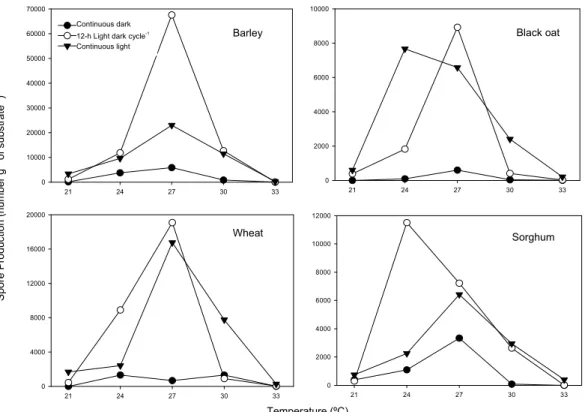
The barley grain substrate at 27ºC under a 12-h light dark-1 cycle yielded the largest number of
pycnidiospores per gram (67,600), 93% of which germinated after 14 days of incubation; therefore, these conditions are recommended for mass inoculum production (Figures 1 and 2).
Hanada et al. (2002) and Brunelli et al. (2006) observed that Mycosphaerella fijiensis (Morelet) Deighton and Cercospora zeae-maydis Tehon & Daniels did not produce conidia in the absence of light. Light exposure has a direct effect on the activation of key enzymes of spore production (MACRAE; YODER, 1988). Nevertheless, some fungal species do not seem to respond to light exposure (PAUL; MUNKVOLD, 2005).
Data from this study corroborate many other reports (BRUNELLI et al., 2006; HANADA et al., 2002; MAFACIOLI et al., 2008; NOZAKI et al., 2004; ULLSTRUP, 1970) in which a temperature between 22 and 27oC was found to be the optimum
interval for inoculum production. Minimum and maximum temperatures of 21 and 33ºC, respectively, resulted in lower S. maydis pycnidiospore production (Figure 1) and percentage of germination (Figure 2) for all substrates tested.
In contrast to our results, Casa et al. (2007) reported a 30% increase in S. macrospora conidia germination on PSA (potato-sucrose-agar) under continuous light compared to continuous dark conditions. The barley grain substrate was best suited for the mass production of pycnidiospores; under these conditions, the pycnidiospores retained 93% of their germination capability. This value is higher than the value found by Morant et al. (1993), who reported S. maydis pycnidiospore germination percentages of 86% and 96% on an oak grain substrate and mineral salt medium, respectively.
When studying mycelial growth and sporulation of S. maydis on sorghum, oak and agar-based substrates, Bizzetto et al. (2000) obtained no more than 10,000 pycnidiospores mL-1
after 15 days of incubation. Previously, Ullstrup (1970) obtained 1,200,000 pycnidiospores mL-1 of
S. maydis after 6 weeks of incubation at 24ºC
under a 12-h light dark-1 cycle. In contrast, a
barley grain substrate at 27ºC under a 12-h light dark-1 cycle yielded approximately 700,000
pycnidiospores g-1 after 14 days of incubation,
Barley
21 24 27 30 33
0 10000 20000 30000 40000 50000 60000 70000
Continuous dark 12-h Light/dark cycle Continuous light
Black oat
21 24 27 30 33
0 2000 4000 6000 8000 10000
Wheat
21 24 27 30 33
0 4000 8000 12000 16000 20000
Sorghum
21 24 27 30 33
0 2000 4000 6000 8000 10000 12000
Temperature (ºC)
Figure 1. Pycnidiospore production (number per gram of substrate) in substrates and temperature for continuous dark, 12-h light dark-1 cycle and continuous light conditions. The ANCOVA performed on the square root-transformed data showed a significant (F0,001 = 60.21) effect of the interaction 'substrate x temperature x light regime,' with BON 0,001 = 14.01. The data in the graph are the original (non-transformed) values.
Barley
21 24 27 30 33
0 20 40 60 80 100
Continuous dark 12-h Light/dark cycle Continuous light
Wheat
21 24 27 30 33
0 20 40 60 80 100
Black oat
21 24 27 30 33
0 20 40 60 80 100
Sorghum
21 24 27 30 33
0 20 40 60 80 100
Temperature (ºC)
Figure 2. Pycnidiospore germination (%) in substrates and temperature for continuous dark,12-h light dark-1 cycle and continuous light conditions. The ANCOVA performed on the square root-transformed data showed a significant (F0.001 = 21.53) effect of the interaction 'substrate x temperature x light regime,' with BON 0.001 = 3.01. The data in the graph are the original (non-transformed) percentage values.
Barley
Sorghum Wheat
Black oat
Barley
Sorghum Wheat
Black oat
Spore P
rodu
ctio
n (
number g
-1 of
s
u
bstrat
e
-1)
Germinatio
n (
%
)
Continuous dark
12-h Light dark cycle-1
Continuous light Continuous dark
12-h Light dark cycle-1
Conclusion
The production of large numbers of S. maydis pycnidiospores while maintaining a high germination rate can be achieved using barley grain as a substrate and incubation at 27ºC under a 12-h light dark-1 cycle.
Light was found to be an essential factor for the asexual reproduction of this fungal species.
Acknowledgements
This research was supported by the “PROMOP” fellowship and “PAP” grant programs of Santa Catarina State University.
References
ANDERSON, B.; WHITE, D. G. Evaluation of methods for identification of corn genotypes with stalk rot and lodging resistance. Plant Disease, v.78, n. 6, p. 590-593, 1994.
BIZZETTO, A.; HOMECHIN, M.; SILVA, H. P.
Técnicas de inoculação de Diplodia maydis em milho.
Fitopatologia Brasileira, v. 25, n. 1, p. 21-29, 2000. BRUNELLI, K. R.; FAZZA, A. C.; ATHAYDE SOBRINHO, C.; CAMARGO, L. E. A. Effect of culture media and light exposure on the sporulation of Cercospora zeae-maydis. Summa Phytopatologica,v. 32, n. 1, p. 92-94, 2006.
CASA, R. T.; REIS, E. M.; ZAMBOLIM, L. Fungos associados à semente de milho produzida nas Regiões Sul e sudeste do Brasil. Fitopatologia Brasileira, v. 23, n. 4, p. 370-373, 1998.
CASA, R. T.; REIS, E. M.; ZAMBOLIM, L. Decomposição dos restos culturais do milho e sobrevivência saprofítica de Stenocarpella macrospora e
Stenocarpella maydis. Fitopatologia Brasileira,v. 28, n. 4, p. 355-361, 2003.
CASA, R. T.; REIS, E. M.; ZAMBOLIM, L. Doenças do
milho causadas por fungos do gênero Stenocarpella.
Fitopatologia Brasileira, v.31, n. 5, p. 427-439, 2006. CASA, R. T.; REIS, E. M.; ZAMBOLIM, L.; MOREIRA, E. M. Efeito da temperatura e de regimes de luz no crescimento do micélio, germinação de conídios e esporulação de Stenocarpella macrospora e Stenocarpella maydis.Fitopatologia Brasileira, v.32, n. 2, p. 137-142, 2007.
DHINGRA, O. D.; SINCLAIR, J. B. Basic plant
pathology methods. Boca Raton: Lewis Publishers,
1995.
FLETT, B. C.; McLAREN, N. W. Incidence of
Stenocarpella maydis ear rot of corn under crop rotation systems. Plant Disease, v.85, n. 7, p. 92-94, 2001.
GRIFFIN, D. H. Fungal physiology. New York:
Wiley-Liss Press, 1994.
HANADA, R. E.; GASPAROTTO, L.; PEREIRA, J. C. R. Esporulação de Mycosphaerella fijiensis em diferentes meios
de cultura. Fitopatologia Brasileira, v. 27, n. 2,
p. 170-173, 2002.
HARTMAN, G. L.; HUANG, Y. H.; NELSON, R. L.;
NOEL, G. R. Germoplasm evaluation of Glycine max for
resistance to Fusarium solani, the causal organism of
sudden death syndrome. Plant Disease, v. 81, n. 5,
p. 515-518, 1997.
HAWKER, L. E. The physiology of reproduction in
fungi. Cambridge: Cambridge University Press, 1957.
JONG, S. C.; EDWARDS, M. J. Catalogue of
filamentous fungi: media formulations. Maryland:
American Type Culture Collection, 1991.
KINSEL, K. Carbohydrate utilization by the corn Diplodias. Phytopathology, v. 27, n. 11, p. 1119-1120, 1937.
KLINGELFUSS, L. H.; YORINORI, J. T.; DESTRO, D. Métodos de inoculação para quantificação de resistência em soja à Fusarium solani f. sp. glycines, em casa-de-vegetação. Fitopatologia Brasileira, v.32, n. 1, p. 50-55, 2007.
KOEHLER, B. Husk coverage and ear declination in relation to corn ear rots. Phytopathology, v. 41, n. 1, p. 22-28, 1951.
MACHADO, A. M.; CONCEIÇÃO, A. R. WinStat.
Sistema de análise estatística para Windows. Versão 1.0. Pelotas: UFPel/Nia, 2009.
MACRAE, W. D.; YODER, O. C. Light has opposite effects on sensitivity of maize protoplasts to T-toxin from
Cochliobolus heterostrophus. Physiological and Molecular Plant Pathology, v. 32, n. 2, p. 293-300, 1988.
MAFACIOLI, R.; TESSMANN, D. J.; SANTOS, A. F.; VIDA, J. B. Variabilidade patogênica e efeito de carboidratos no crescimento micelial, esporulação e
agressividade de Colletotrichum gloeosporioides da
pupunheira. Summa Phytopathologica, v. 34, n. 1,
p. 18-21, 2008.
MÁRIO, J. L.; REIS, E. M. Reação de híbridos de milho à
podridão branca da espiga. Fitopatologia Brasileira,
v.28, n. 2, p. 155-158, 2003.
MELGAR, J.; ROY, K. W. Soybean sudden death syndrome: cultivar reactions to inoculation in a controlled environment and host range and virulence of causal agent. Plant Disease, v.78, n. 3, p. 265-268, 1994.
MORANT, M. A.; WARREN, H. L.; VON QUALEN, S. K. A synthetic medium for mass production of picnidiospores of Stenocarpella species. Plant Disease, v. 77, n. 4, p. 424-426, 1993.
NOZAKI, M. H.; CAMARGO, M.; BARRETO, M. Caracterização de Diaporthe citri em meios de cultura e diferentes condições de temperatura e luminosidade. Fitopatologia Brasileira, v.29, n. 4, p. 429-432, 2004. PAPPELIS, A. J.; MAYAMA, S.; MAYAMA, M. Parenchyma cell death and Diplodia maydis susceptibility in stalks and ears of corn. Plant Disease, v. 57, n. 4, p. 308-310, 1973.
PAUL, P. A.; MUNKVOLD, G. P. Influence of temperature and relative humidity on sporulation of
Cercospora zeae-maydis and expansion of gray leaf spot
lesions on maize leaves. Plant Disease, v. 89, n. 6,
REIS, E. M.; CASA, R. T.; BRESOLIN, A. C. R. Manual
de diagnose e controle de doenças do milho. Lajes:
Graphel Press, 2004.
STEEL, R. G. D.; TORRIE, J. H.; DICKEY, D. A.
Principles and procedures of statistics. A biometrical
approach. 3rd ed. New York: McGraw-Hill, 1997. TOLEDO, J.; REIS, E. M.; FORCELINI, C. A. Efeito do substrato na morfologia de conídios de Bipolaris sorokiniana
e da densidade de inóculo na intensidade da mancha marrom em cevada. Fitopatologia Brasileira, v. 29, n. 1, p. 5-10, 2004.
ULLSTRUP, A. J. Methods for inoculating corn ears with
Gibberella zeae and Diplodia maydis. Plant Disease Reporter, v. 5, n. 8, p. 658-662, 1970.
WHITE, D. G. Compendium of corn diseases. St.
Paul: American Phytopathological Society Press, 1999. ZAMBOLIM, L.; CASA, R. T.; REIS, E. M. Sistema
plantio direto e doenças em plantas. Fitopatologia
Brasileira, v. 25, n. 4, p. 585-595, 2000.
Received on July 27, 2010. Accepted on February 15, 2011.