ORIGIN
AL RESEAR
CH
151
Concordance of different criteria for sarcopenia in
community women of age
Concordância de diferentes critérios de sarcopenia em idosas comunitárias
Concordancia de distintos criterios de sarcopenia en ancianas comunitarias
Lunara dos Santos Viana1, Osmair Gomes de Macedo2, Karla Helena Coelho Vilaça3,Patrícia Azevedo Garcia4
Study performed in the Laboratory for Functional Human Performance at Universidade de Brasília – Brasília (DF), Brazil.
1Physical Therapist by Universidade de Brasília (UnB) – Brasília (DF), Brazil.
2Physical Therapy Committee of Universidade de Brasilia (UnB) – Brasília (DF), Brazil.
3Post-Graduate program in Gerontology of Universidade Católica de Brasília (UCB) – Brasília (DF), Brazil. 4Post-Graduate program in Rehabilitation Sciences of Universidade de Brasilia (UnB) – Brasília (DF), Brazil.
Corresponding address: Patricia Azevedo Garcia – Universidade de Brasília (UnB), Ceilândia campus, Physical Therapy Committee – Centro Metropolitano, Conjunto A, Lote 01, Ceilândia – Brasília (DF), Brazil – Zip Code: 72220-900 – Phone: (61) 3107-8938 – E-mail: [email protected] – Finance source: CNPq Research Scholarship – Conflict of interest: nothing to declare. – Presentation: Jan. 5th, 2017 – Accepted for publication: Apr. 7th, 2018 – Approved by the Research Ethics Committee of the State Department of
Health, under opinion No. 174/2011.
ABSTRACT | The frequency and concordance between different sarcopenia criteria was assessed in community women of age. This is a cross-sectional study with 64 women of age, in which muscle mass was determined by bioelectrical impedance analysis (BIA) and skeletal muscle index calculation, muscle strength was determined with a handgrip strength dynamometer, functional capacity was determined with the tests Timed Up and Go (TUG) and Sit to Stand test (STS). This older population was classified in sarcopenic, pre-sarcopenic, moderate sarcopenic and severe sarcopenic by using different sarcopenia criteria. The data were analyzed with use of Chi-square test and Kappa statistics. The results obtained demonstrated that 37.5% of the women suffered of low muscle mass, 34.4% of muscle weakness, 3.1% of functional impairment to stand and walk and 25.9% to sit and raise from the chair. Considering only muscle mass, 37.5% of the sample was classified as sarcopenic (moderate or severe) and, considering the criteria of the European Working Groups on Sarcopenia in Older People, 15.6% obtained this classification when assessing functional capacity with TUG and 22.4% with STS. Concordance between sarcopenia definitions ranged from moderate to excellent (p<0.001). Among women with muscle mass integrity (n=40), 30% showed low handgrip strength, 2.5% showed impairment in TUG and 25.7% in STS. It was concluded that the women presented high frequency of sarcopenia, regardless of the criteria used. Moderate to excellent concordance was observed between the sarcopenia
criteria investigated. Identification of older people with muscle mass integrity coexisting with muscle weakness and functional impairment reinforces the importance of the evaluation of the three parameters in the clinical scientific setting.
Keywords | Older People; Sarcopenia; Body Composition; Strength.
classificação ao avaliar a capacidade funcional com TUG e 22,4% com STS. A concordância entre as definições de sarcopenia variou de moderada a excelente (p<0,001). Entre as idosas com integridade da massa muscular (n=40), 30% apresentaram fraqueza de preensão palmar, 2,5% incapacidade no TUG e 25,7% no STS. Foi concluído que as idosas apresentaram alta frequência de sarcopenia independentemente do critério utilizado. Observou-se moderada a excelente concordância entre os critérios de sarcopenia investigados. A identificação de idosos com integridade da massa muscular coexistindo com fraqueza muscular e incapacidade funcional reforça a importância da avaliação dos três parâmetros no cenário clínico-científico. Descritores | Idoso; Sarcopenia; Composição Corporal; Força.
RESUMEN | Se determinó la frecuencia y la concordancia entre distintos criterios de sarcopenia en ancianas comunitarias. Se trata de un estudio transversal con 64 ancianas, en el cual se determinó la masa muscular por el análisis de impedancia bioeléctrica (BIA) y cálculo del índice muscular esquelético, la fuerza muscular fue determinada por el dinamómetro de prensión palmar, la capacidad funcional por las pruebas Timed Up and Go (TUG) y Sit to Stand test (STS). Los ancianos fueron clasificados en no sarcopénicos, pre-sarcopénicos, sarcopénicos moderados y graves utilizando distintos criterios
de sarcopenia. Los datos fueron analizados utilizando prueba chi cuadrada y estadística Kappa. Se obtuvo como resultado que el 37,5% de las ancianas presentaron baja masa muscular, el 34,4%, debilidad muscular, el 3,1% presentaron incapacidad funcional para levantarse y caminar y el 25,9% para sentarse y levantarse de la silla. Considerando solamente la masa muscular, el 37,5% de la muestra fue clasificada como sarcopénica (moderada o grave) y, considerando los criterios del European Working Groups on Sarcopenia in Older People, el 15,6% obtuvo esa clasificación al evaluar la capacidad funcional con TUG y el 22,4% con STS. La concordancia entre las definiciones de sarcopenia varió de moderada a excelente (p<0,001). Entre las ancianas con integridad de la masa muscular (n=40), el 30% presentaron debilidad de prensión palmar, el 2,5% incapacidad en el TUG y el 25,7% en el STS. Fue concluido que las ancianas presentaron alta frecuencia de sarcopenia independientemente del criterio utilizado. Se observó moderada la excelente concordancia entre los criterios de sarcopenia investigados. La identificación de ancianos con integridad de la masa muscular coexistiendo con debilidad muscular e incapacidad funcional refuerza la importancia de la evaluación de los tres parámetros en el escenario clínico-científico.
Palabras clave | Anciano; Sarcopenia; Composición Corporal; Fuerza.
INTRODUCTION
The progressive and extensive loss of muscle mass that occurs during aging was initially defined as sarcopenia1. Sarcopenia has been cited as a determining
factor in the decrease of functional capacity, thereby weakening the older population, making it difficult for them to carry out daily life activities, increasing the risk of falls and prolonging hospitalizations2. It is estimated
that, after arriving in their 50s, there is annual loss of 1% in muscle mass, 2% in walking speed and from 1.9 to 5.0% in handgrip strength. This reduction in muscle mass affects about 20% of women3.
However, although it is currently quite a studied topic, there is still no widely accepted consensus in the literature regarding its diagnostic criteria4,5. Although
the presence of sarcopenia may be determined by the mere evaluation of muscle mass, this measure does not seem to provide information related to functional components. At the same time, evaluation of muscle function has been shown to be a more valuable
predictor of disability and mortality of subjects of age when compared with the assessment of muscle mass reduction by itself6. However, the several possibilities
available for determining and classifying sarcopenia hinder the understanding and identification of the signs and symptoms involved in this geriatric syndrome4.
Currently, the study of diagnostic criteria for sarcopenia has become more discussed3, opposing the identification
METHODOLOGY
This is a cross-sectional study performed in the Laboratory for Functional Human Performance at Universidade de Brasilia. This study was approved by the Research Ethics Committee of the State Department of Health (opinion No. 174/2011), and all participants signed an informed consent form. The sample was composed of participants of age in older population health care programs, selected by convenience.
An older population (≥ 60 years) of the female sex was selected, with independent walking in a non-familiar environment (without need for other people’s assistance, but allowed to use aid devices) and without cognitive deficits in the Mini-Mental State Examination7. For
identification of cognitive impairment, cut-off points used by the multicenter project Frailty in Brazilian Older People (Rede Fibra) and presented by Neri et al.7:
17 for illiterate, 22 for one to four years, 24 for five to eight years, and 26 for nine or more years of study. The following were excluded from this study: older people unable to perform the evaluation proposals, with severe sequelae of cerebrovascular accident, and with history of Parkinson’s disease, Alzheimer’s disease, of amputations and/or recent fractures in lower limbs.
For sample characterization were collected age, medicine in continuous use, body mass and height to calculate body mass index – BMI (BMI= body mass (kg)/height2 (m2)) and physical activity level. BMI
enabled the identification of the nutritional status of the older population: underweight (BMI<22kg²), eutrophia (BMI 22-27kg/m²) or overweight (BMI>27 kg/m²)8.
The level of physical activity of this older population was identified with the activity adjusted score (AAS) of the Human Activity Profile questionnaire (HAP), which allowed for the classification of the older population in active (AAS>74), moderately active (AAS 53-74) or inactive (AAS<53)9.
Muscle mass (kg) was estimated through the equation proposed and validated by Janssen et al.10, and
adjusted by height squared for obtaining the skeletal muscle mass index (SMI) (kg/m²)10,11. For identification
of muscle mass deficiency, a cut-off point of 6.76kg/m2
from SMI was used4.
For calculating the equation, resistance (in Ohms) was identified through bioelectrical impedance analysis (BIA) (Maltron BF-900, United Kingdom). BIA was performed on a nonconductive surface, in supine position, with abducted arms and legs (approximately 45°).
The tetrapolar technique was performed by placing two emitter electrodes – positioned on the dorsal surface of the hand, the third metacarpal and in the junction between the second and third metatarsals – and two receiver electrodes – positioned on the joint line of the wrist and ankle – that detect the resistance produced by BIA12. The volunteers were told to empty their bladders
at least 30 minutes before the assessment and to remove any metal objects they might possess from the site where electrodes were placed.
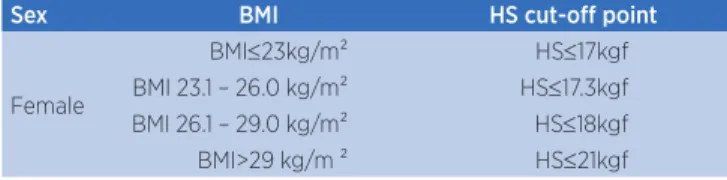
Muscle strength was operationalized by isometric evaluation of handgrip strength (HS) in kilogram-force (kgf ) evaluated through use of the hydraulic dynamometer Saehan (Saehan Corporation, Yangdeok-Dong, Korea). For evaluation, the women were positioned sitting in a chair with backrest, without armrests, with hips and knees flexed to 90°, shoulder in adduction, elbow positioned next to the body and flexed at 90°, with forearm in neutral position. Three attempts on calculating the mean were performed. For identification of low handgrip strength, BMI was adjusted by sex, using the cut-off points proposed by Fried et al.13 (Table 1).
Table 1. Cut-off points for handgrip strength
Sex BMI HS cut-off point
Female
BMI≤23kg/m² HS≤17kgf
BMI 23.1 – 26.0 kg/m² HS≤17.3kgf BMI 26.1 – 29.0 kg/m² HS≤18kgf BMI>29 kg/m ² HS≤21kgf
For evaluation of functional capacity, two clinical tests were performed: Timed Up and Go (TUG) and Five Times Sit to Stand (STS). The TUG test measured the time spent (s) on the task of raising from a chair without hand support after the command “now” of the evaluator, walk a route of three meters, rotate 180°, come back and sit again supporting their back in the backrest. It was oriented that patients executed the test in the fastest way possible. The results obtained from a single attempt after familiarization were employed. For identification of functional impairment in TUG, a cut-off point of 10 seconds was used14,15.
seconds. For identification of functional impairment in STS, a cut-off point of 12 seconds was used16.
Criteria for sarcopenia classification
Sarcopenia was identified by using three different evaluation criteria: i) skeletal mass index (SMI); ii) guidelines from the European Working Group on Sarcopenia in Older People (EWGSOP), using the TUG test to assess functional capacity; and iii) guidelines of EWGSOP with use of STS test to assess functional capacity.
Sarcopenia identification considering SMI as the only parameter was based on the criteria proposed by Cruz-Jentoft et al.4, that allows for classification in
three stages: absence of sarcopenia (SMI≥6.76 kg/m²), moderate sarcopenia (SMI 5.76–6.75 kg/m²) and severe sarcopenia (SMI≤5.75 kg/m²).
Sarcopenia identification using EWGSOP guidelines was based on the decrease in muscle mass, inherently linked to decrease in muscle strength and/or functional impairment, allowing for classification in four stages: absence of sarcopenia, pre-sarcopenia (reduction of muscle mass only); sarcopenia (muscle mass reduction necessarily related to reduced strength or functional capacity) and severe sarcopenia (concurrent functional capacity, muscle mass and strength deficits)4.
Analysis of the data
Differences in variable distribution among women of age with and without muscle mass deficiency were analyzed using the Chi-squared test. Concordance between classifications according to the three criteria investigated was assessed with Kappa statistic. Kappa values above 80% were considered as having excellent concordance, from 60% to 80% as substantial concordance, 40% to 60% as moderate concordance and below 40% as weak concordance17. Analyses were
performed on the program Statistical Package for Social Sciences (SPSS), version 20.0.
RESULTS
Participants characteristics
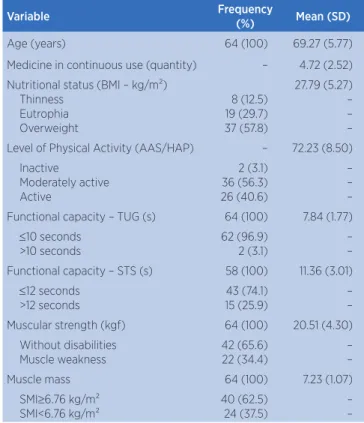
64 women of age participated in this study (69.27±5.77 years), the majority being moderately active (56.3%) and overweight (57.8%) (Table 2).
In physical and functional assessments, 37.5% of the women presented decrease in muscle mass (SMI<6.76kg/m²), 34,4% presented decrease in muscle strength, 3.1% presented functional impairment in TUG and 25.9% presented functional impairment in STS (Table 2).
Table 2. Characteristics of the sample
Variable Frequency
(%) Mean (SD)
Age (years) 64 (100) 69.27 (5.77)
Medicine in continuous use (quantity) – 4.72 (2.52) Nutritional status (BMI – kg/m²)
Thinness Eutrophia Overweight
8 (12.5) 19 (29.7) 37 (57.8)
27.79 (5.27) – – – Level of Physical Activity (AAS/HAP) – 72.23 (8.50)
Inactive
Moderately active Active
2 (3.1) 36 (56.3) 26 (40.6)
– – – Functional capacity – TUG (s) 64 (100) 7.84 (1.77)
≤10 seconds >10 seconds
62 (96.9) 2 (3.1)
– – Functional capacity – STS (s) 58 (100) 11.36 (3.01)
≤12 seconds >12 seconds
43 (74.1) 15 (25.9)
– – Muscular strength (kgf) 64 (100) 20.51 (4.30)
Without disabilities Muscle weakness
42 (65.6) 22 (34.4)
– –
Muscle mass 64 (100) 7.23 (1.07)
SMI≥6.76 kg/m² SMI<6.76 kg/m²
40 (62.5) 24 (37.5)
– –
Sarcopenia classifications in sample
Table 3 presents the frequency of moderate or severe sarcopenia using the assessment criteria of the SMI (37.5%) and the criteria proposed by the EWGSOP with TUG (15.6%) and STS (22.4%). Moderate to excellent concordance was observed between the sarcopenia classifications investigated.
Table 3. Frequency of sarcopenia in sample
Classification SMI Criterion % (n)
EWGSOP criterion using
TUG % (n)
EWGSOP criterion using
STS % (n) Absence of
sarcopenia 62.5 (40) 62.5 (40) 60.4 (35)
Pre-sarcopenia – 21.9 (14) 17.2 (10)
Moderate
sarcopenia 32.8 (21) 14.0 (9) 17.2 (10)
Severe
sarcopenia 4.7 (3) 1.6 (1) 5.2 (3)
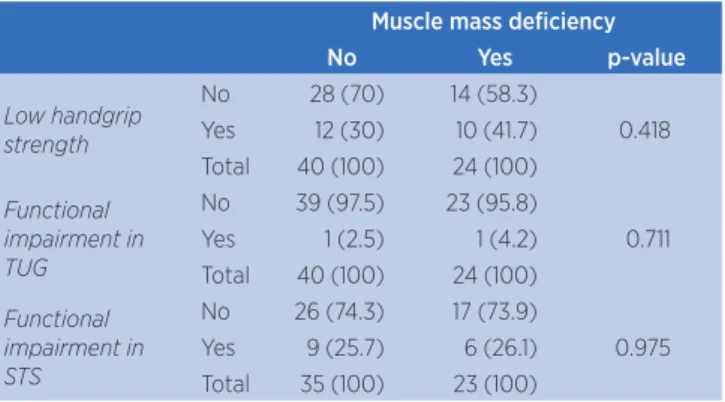
By applying the SMI assessment criteria, among the 40 women of age classified as non-sarcopenic (≥ 6 SMI, 76 kg/m²), it was observed that 30% showed low handgrip strength, 2.5% showed impairment in TUG and 25.7% in STS (Table 4).
Table 4. Distribution of muscle weakness and functional impairment among people of age with and without low muscle mass
Muscle mass deficiency
No Yes p-value
Low handgrip strength
No 28 (70) 14 (58.3)
0.418 Yes 12 (30) 10 (41.7)
Total 40 (100) 24 (100)
Functional impairment in TUG
No 39 (97.5) 23 (95.8)
0.711
Yes 1 (2.5) 1 (4.2)
Total 40 (100) 24 (100)
Functional impairment in STS
No 26 (74.3) 17 (73.9)
0.975 Yes 9 (25.7) 6 (26.1)
Total 35 (100) 23 (100)
DISCUSSION
In this study, when the criterion of exclusive use of SMI for diagnosis is considered, it was observed that 37.5% of the sample showed reduction in muscle mass, resulting in a high frequency of moderate (32.8%) and severe (4.7%) sarcopenia. Previous studies showed varying frequencies while investigating sarcopenia using this same criterion5,11,18,19. Janssen et al.11,18 also used BIA
and observed higher prevalence of moderate (59%) and severe (10%) sarcopenia among women by identifying SMI deviations from normative values of young adults11
and prevalence of 9.4% when adjusting SMI to the total muscle mass by the height squared18. Now with use of
DEXA (Dual-energy X-ray absorptiometry) for SMI calculation, Iannuzzi-Sucich, Prestwood and Kenny19
found prevalence of sarcopenia (SMI≤5.45 kg/m²) of 22.6% among women between 60 and 80 years.
In this study, 41.7% of the women of age showed muscle weakness, 4.2% presented limitation during the activity of stand and walk (TUG) and 26.1% presented difficulty to raise and sit down quickly with the concomitant loss of muscle mass. Therefore, when using EWGSOP criteria to identify sarcopenia, lower frequencies of moderate and severe sarcopenia were observed when compared to the frequency by using the classification where the single criterion was muscle mass. These differences in frequency of moderate and severe
sarcopenia between the criteria appeared because the definition proposed by the EWGSOP also identifies a preclinical stage of sarcopenia, named pre-sarcopenia, which was significant in this study (17.2 and 21.9%). This division in diagnostic aims to identify people of age who exhibit decrease in muscle mass without other physical-functional deficits and that should be monitored for having risk of evolving into moderate and severe sarcopenia4.
Inclusion of this pre-sarcopenia category by the EWGSOP, associated with the methodological differences related to the conditions, the stratified analyses by age group and the research instruments for functional capacity, contributes to the variation of frequency of moderate and severe sarcopenia observed in the literature5,20-22. Patel et al.20 showed that among
septuagenarians, the prevalence of sarcopenia varies from 5 to 13%, whereas among octogenarians this prevalence can vary from 11 to 50%. Lee et al.22 used
the guidelines proposed by EWGSOP and found prevalence of sarcopenia in women of age between 65 and 74 years as being of 1.8%, and 8.2% in women from 75 to 84 years. Bijlsma et al.21 compared seven
different diagnostic criteria for sarcopenia identification in people of age by employing various forms of muscle mass assessment and measuring muscular strength, attesting variation of 0 to 45% in sarcopenia prevalence.
In this study, the possibility of classifying the older populations as pre-sarcopenic by the EWGSOP reduced the concordance of sarcopenia types with this criterion when using SMI. However, the criteria identified the absence of sarcopenia in a similar manner. A recent meta-analysis3 with Brazilians of age reported that
sarcopenia prevalence did not change with the use of diagnostic criteria recommended by EWGSOP (16%) or by measuring only muscle mass with DEXA and Baumgartner’s criteria (17%). In this context, exceptionally in an older population very debilitated and unable to perform functional assessments, analysis of muscle mass as the sole criterion for generically identifying sarcopenic individuals may be too specific.
It was also reported a higher frequency of moderate and severe sarcopenia using the STS test for functional impairment identification when compared to the TUG. Although Woods et al.23 demonstrated
conflicting reports5,23,24. Cooper et al.24 found no
association between lean mass and slowness in TUG. And Salame et al.5 did not identify any criterion for
diagnosis of sarcopenia that determined functional capacity appropriately in TUG. In contrast, use of evaluation of the ability to sit and raise seems to present greater relation with low muscle mass, with non-sarcopenic women executing STS two seconds faster on average than sarcopenic20. In spite of the
differences in screening of functional impairment between the two instruments investigated, excellent concordance (k=0.849) with the criterion of EWGSOP using TUG and STS was observed.
It is noteworthy that, among the 40 women of age classified as non-sarcopenic – and therefore with muscle mass integrity – 30% showed decrease in muscle strength and 25.7% demonstrated impairment to stand up and sit down quickly in a chair. Salame et al.5 also observed that sarcopenic patients showed
low handgrip muscle strength. These findings reinforce the idea that maintenance of muscle mass does not prevent strength reductions since they do not maintain a linear relationship throughout the aging process23.
Around the age of 75, changes in muscle strength occur 2 to 5 times faster than loss of muscle mass25, the
decrease in muscle mass being responsible for only 5% of the changes in age-related muscle strength26. Thus,
although sarcopenia can be detected by using tools that measure body composition, measuring of muscle mass alone does not necessarily provide information on related physical-functional deficits5,6, requiring
a watchful eye from the part of health professionals for early intervention. In this context, currently, several authors consider this criterion simplistic and recommend investigation of a less limited definition with higher clinical relevance4,6,27 that also evaluates the
risk of muscle weakness and functional impairment. In this way, use of the criterion from EWGSOP, of quick and easy implementation, contributes as a guideline for specific clinical practices after the screening of sarcopenia.
CONCLUSION
This study found a high frequency of sarcopenia in community women of age and moderate to excellent concordance between the different criteria investigated.
REFERENCES
1. Rosenberg IH. Sarcopenia: origins and clinical relevance. J Nutr. 1997;127(Suppl 5):990S-1S. doi: 10.1016/j.cger.2011.03.003 2. Cesari M, Landi F, Vellas B, Bernabei R, Marzetti E. Sarcopenia
and physical frailty: two sides of the same coin. Front Aging Neurosci. 2014;28(6):192. doi: 10.3389/fnagi.2014.00192 3. Diz JB, Leopoldino AA, Moreira BS, Henschke N, Dias RC,
Pereira LS, et al. Prevalence of sarcopenia in older Brazilians: a systematic review and meta-analysis. Geriatr Gerontol Int. 2017;17(1):5-16. doi: 10.1111/ggi.12720
4. Cruz-Jentoft AJ, Baeyens JP, Bauer JM, Boirie Y, Cederholm T, Landi F, et al. Sarcopenia: European consensus on definition and diagnosis: report of the European Working Group on Sarcopenia in Older People. Age Ageing. 2010;39(4):412-23. doi: 10.1093/ageing/afq034
5. Salame M, Costa KK, Zottele LV, Muradás RR, Tierno SA, Schettinger MRC, et al. Sarcopenia: evaluation of different diagnostic criteria and its association with muscle strength and functional capacity. Rev Bras Geriatr Gerontol. 2015;18(2):285-94. doi: 10.1590/1809-9823.2015.14025
6. McIntosh EI, Smale KB, Vallis LA. Predicting fat-free mass index and sarcopenia: a pilot study in community-dwelling older adults. Age (Dordr). 2013;35(6):2423-34. doi: 10.1007/s11357-012-9505-8
7. Neri AL, Ongaratto LL, Yassuda MS. Mini-Mental State Examination sentence writing among community-dwelling elderly adults in Brazil: text fluency and grammar complexity. Int Psychogeriatr. 2012;24(11):1732-7. doi: 10.1017/S104161021200097X
8. Lipschitz DA. Screening for nutritional status in the elderly. Prim Care. 1994;21(1):55-67.
9. Souza AC, Magalhaes LC, Teixeira-Salmela LF. Adaptação transcultural e análise das propriedades psicométricas da versão brasileira do Perfil de Atividade Humana. Cad Saude Publica. 2006;22(12):2623-36. doi: 10.1590/S0102-311X2006001200012
10. Janssen I, Heymsfield SB, Baumgartner RN, Ross R. Estimation of skeletal muscle mass by bioelectrical impedance analysis. J Appl Physiol. 2000;89(2):465-71. doi: 10.1152/jappl.2000.89.2.465
11. Janssen I, Heymsfield SB, Ross R. Low relative skeletal muscle mass (sarcopenia) in older persons is associated with functional impairment and physical disability. J Am Geriatr Soc. 2002;50(5):889-96.
12. Guedes DP. Procedimentos clínicos utilizados para análise da composição corporal. Rev Bras Cineantropom Desempenho Hum. 2013;15(1):113-29. doi: 10.5007/1980-0037.2013v15n1p113 13. Fried LP, Tangen CM, Walston J, Newman AB, Hirsch C,
Gottdiener J, et al. Frailty in older adults: evidence for a phenotype. J Gerontol A Biol Sci Med Sci. 2001;56(3):M146-56. 14. Wall JC, Bell C, Campbell S, Davis J. The Timed Get-up-and-Go test revisited: measurement of the component tasks. J Rehabil Res Dev. 2000;37(1):109-13.
community-dwelling and institutionalised elderly women. Age Ageing. 2003;32(3):315-20.
16. Tiedemann A, Shimada H, Sherrington C, Murray S, Lord S. The comparative ability of eight functional mobility tests for predicting falls in community-dwelling older people. Age Ageing. 2008;37(4):430-5. doi: 10.1093/ageing/afn100 17. Portney LG, Watkins MP. Statistical measures of reliability.
In: Portney LG, Watkins MP, editors. Foundations of clinical research: applications to practice. 2nd ed. New Jersey: Prentice-Hall; 2000. p. 557-86.
18. Janssen I, Baumgartner RN, Ross R, Rosenberg IH, Roubenoff R. Skeletal muscle cutpoints associated with elevated physical disability risk in older men and women. Am J Epidemiol. 2004;15;159(4):413-21.
19. Iannuzzi-Sucich M, Prestwood KM, Kenny AM. Prevalence of sarcopenia and predictors of skeletal muscle mass in healthy, older men and women. J Gerontol A Biol Sci Med Sci. 2002;57(12):M772-7.
20. Patel HP, Syddall HE, Jameson K, Robinson S, Denison H, Roberts HC, et al. Prevalence of sarcopenia in community-dwelling older people in the UK using the European Working Group on Sarcopenia in Older People (EWGSOP) definition: findings from the Hertfordshire Cohort Study (HCS). Age Ageing. 2013;42(3):378-84. doi: 10.1093/ageing/afs197 21. Bijlsma AY, Meskers CG, Ling CH, Narici M, Kurrle SE, Cameron
ID, et al. Defining sarcopenia: the impact of different diagnostic criteria on the prevalence of sarcopenia in a large middle aged cohort. Age (Dordr ). 2013;35(3):871-81. doi: 10.1007/s11357-012-9384-z
22. Lee WJ, Liu LK, Peng LN, Lin MH, Chen LK. Comparisons of sarcopenia defined by IWGS and EWGSOP criteria among older people: results from the I-Lan longitudinal aging study. J Am Med Dir Assoc. 2013;14(7):528-7. doi: 10.1016/j.jamda.2013.03.019
23. Woods JL, Iuliano-Burns S, King SJ, Strauss BJ, Walker KZ. Poor physical function in elderly women in low-level aged care is related to muscle strength rather than to measures of sarcopenia. Clin Interv Aging. 2011;6:67-76. doi: 10.2147/CIA.S16979
24. Cooper R, Bann D, Wloch EG, Adams JE, Kuh D. “Skeletal muscle function deficit” in a nationally representative british birth cohort in early old age. J Gerontol A Biol Sci Med Sci. 2015;70(5):604-7. doi: 10.1093/gerona/glu214
25. Mitchell WK, Williams J, Atherton P, Larvin M, Lund J, Narici M. Sarcopenia, dynapenia, and the impact of advancing age on human skeletal muscle size and strength: a quantitative review. Front Physiol. 2012;3:260. doi: 10.3389/fphys.2012.00260
26. Scott D, Hayes A, Sanders KM, Aitken D, Ebeling PR, Jones G. Operational definitions of sarcopenia and their associations with 5-year changes in falls risk in community-dwelling middle-aged and older adults. Osteoporos Int. 2014;25(1):187-93. doi: 10.1007/s00198-013-2431-5