ORIGINAL ARTICLE
Gender-related dimensions of childhood adversities in the
general population
Bruno M. Coeˆlho,
1Geilson L. Santana,
1Maria C. Viana,
2Laura H. Andrade,
1Yuan-Pang Wang
1 1Nu´cleo de Epidemiologia Psiquia´trica (LIM-23), Departamento e Instituto de Psiquiatria, Hospital das Clı´nicas, Faculdade de Medicina,Universidade de Sa˜o Paulo (USP), Sa˜o Paulo, SP, Brazil.2Programa de Po´s-Graduac
¸a˜o em Sau´de Pu´blica, Departamento de Medicina Social, Centro de Cieˆncias da Sau´de, Universidade Federal do Espı´rito Santo (UFES), Vito´ria, ES, Brazil.
Objective:Childhood adversities (CAs) comprise a group of negative experiences individuals may suffer in their lifetimes. The goal of the present study was to investigate the cluster discrimination of CAs through psychometric determination of the common attributes of such experiences for men and women.
Methods:Parental mental illness, substance misuse, criminality, death, divorce, other parental loss, family violence, physical abuse, sexual abuse, neglect, physical illness, and economic adversity were assessed in a general-population sample (n=5,037). Exploratory and confirmatory factor analysis determined gender-related dimensions of CA. The contribution of each individual adversity was explored through Rasch analysis.
Results:Adversities were reported by 53.6% of the sample. A three-factor model of CA dimensions fit the data better for men, and a two-factor model for women. For both genders, the dimension of family maladjustment – encompassing physical abuse, neglect, parental mental disorders, and family violence – was the core cluster of CAs. Women endorsed more CAs than men. Rasch analysis found that sexual abuse, physical illness, parental criminal behavior, parental divorce, and economic adversity were difficult to report in face-to-face interviews.
Conclusion:CAs embrace sensitive personal information, clustering of which differed by gender. Acknowledging CAs may have an impact on medical and psychiatric outcomes in adulthood.
Keywords: Childhood adversities; social environment; gender differences; factor analysis; dimensionality; psychopathology
Introduction
Childhood adversities (CAs) are a group of negative situa-tions children and adolescents may experience during development. This group of early occurrences includes a multitude of unfavorable events, such as parental psycho-pathology, physical and sexual abuse, and family violence. Several studies have explored CAs as risk factors for numerous health outcomes.1-3 They are associated with later-life consequences such as adult psychopathology,4,5 suicidality,3,6 and medical illnesses.7 The propensity for
occurrence of mental and physical diseases in adulthood might arise through alterations in epigenetic expression,8in stress processing,9 in neurogenesis,10 or in neuroplasti-city.11 Although these mechanisms remain to be eluci-dated,12 appropriate characterization of core CAs is the very first step of research. However, few methodologically sound studies have investigated the common attributes of such experiences.
Recent literature has reported some gender-dependent differences in the occurrence of early adversities.13-17In
general, boys were more exposed to physical violence and neglect than girls. Conversely, girls reported more emotional abuse, household dysfunction, and sexual violence than boys.13,18-20 Gender differences in coping styles and in cognitive processing of stressful situations have also been described,21 wherein girls presented a greater ruminative coping style22 and greater cognitive
vulnerability to negative events23than boys. Therefore, it is reasonable to assume that boys and girls experience distinct CA profiles, in terms of exposure liability and cop-ing strategy.
As CAs occur frequently in the general population and do so in a highly comorbid pattern,3,24 describing their dimensional structure, i.e., the non-observable clusters of common CAs, can illuminate critical issues on early nega-tive events, as well as elucidate relationships between adversities. For example, environments of family malfunc-tioning, maltreatment, or neglect may co-occur closely. Also, the differential profile of exposure to such experi-ences during childhood for men and women needs to be determined. From this perspective, the broad range of such events may cluster into fewer common adversities, whose relationship can be estimated as a common latent structure or dimensions. Hence, reducing the number of
Correspondence: Bruno Mendonc¸a Coeˆlho, Nu´cleo de Epidemiolo-gia Psiquia´trica (LIM-23), Instituto de Psiquiatria, Hospital das Clı´nicas, Faculdade de Medicina, Universidade de Sa˜o Paulo,Rua Dr. Ovı´dio Pires de Campos, 785, CEP 05403-010, Sa˜o Paulo, SP, Brazil.
E-mail: [email protected]
Submitted Jun 12 2017, Submitted Sep 26 2017, Epub Jun 11 2018. Brazilian Journal of Psychiatry
Brazilian Psychiatric Association
variables through meaningful statistical methods can ulti-mately reveal shared pathological mechanisms with potential utility for child welfare, health policy-making and health research.
Among approaches for obtaining latent dimensions from multiple variables, factor analysis stands out as one of the most adopted strategies to reduce data into fewer broad concepts.25This method has been widely utilized in studies of CAs24,26,27 to explore latent dimensions, which can indicate common sets of adversities. However, studies using exploratory factor analysis have proposed different solutions to depict the underlying structural dimensions of CAs, in terms of the number of factors extracted.24,26Previous findings have suggested models with one,24two,26and three or more components26,27 as acceptable solutions for the core dimensions of CAs in exploratory factor analysis. Divergences in the number of CAs evaluated, dissimilar methods for factor extraction, possible differences in retention criteria used by research-ers, and heterogeneous samples seem to account for the variability in the number of factors considered.25 The
method of confirmatory factor analysis (CFA) can yield a more stable solution. Therefore, the underlying dimen-sional structure of CAs remains elusive, and warrants additional examination.
Within this context, the present study sought to examine the latent dimensions of CA reported by a representative sample of the general population in the metropolitan area of Sa˜o Paulo, Brazil, considering the overall sample and gender subgroups. To disentangle the role of each specific CA within a plausible dimensional structure, this investiga-tion was supplemented with item response theory (IRT) to estimate the probability of endorsing each adversity.
Materials and Methods
This was a multivariate assessment of the underlying structure of early CAs in the general population. Data were collected cross-sectionally and subjected to factor and latent trait analysis.
Sampling
A stratified multistage area probability sampling strategy was used to select a representative sample of 5,037 non-institutionalized residents, aged 18 years or older, from the Sa˜o Paulo metropolitan area. At the time of the inter-views (May 2005 to May 2007), this large, highly urba-nized area, composed of the city of Sa˜o Paulo proper and 38 circumscribed municipalities, was home to an popula-tion of approximately 20 million. More in-depth descrip-tions of sampling, recruitment, and weighting procedures are available elsewhere.28
The sample characteristics are shown in Table 1. Briefly, most participants were women (56.5%), married (64.5%), and currently employed (60.2%). Balanced age brackets, educational level, and socioeconomic distribu-tion characterized the sample as representative of the general population. The weighted prevalence of each CA and proportion of respondents with two or more adver-sities in the sample are shown in Table 2. More than half
(53.6%) of the sample reported at least one CA, with physical abuse, parental death, and family violence being most prevalent, and sexual abuse, physical illness, and economic adversity being least prevalent. Around half (48.4%) of the sample with CAs reported at least one or more additional CA.
Ethical procedures
The ethics committee of Faculdade de Medicina, Universi-dade de Sa˜o Paulo, approved all procedures. Respondents were interviewed only after informed written consent had been obtained, the nature of the procedures had been fully explained, and assurances of total confidentiality had been given. The investigation was carried out in accordance with the latest version of the Declaration of Helsinki.
Assessment tool
A fully structured interview – the World Mental Health Survey version of the Composite International Diagnostic Interview (WMH-CIDI)29 – was translated and adapted into Brazilian Portuguese language30 and administered face-to-face by lay examiners. Childhood experiences Table 1 Descriptive characteristics of the participants of Sa˜o Paulo Megacity Mental Health Survey (n=5,037)
Variable n (%)
Gender
Male 2,187 (43.42)
Female 2,850 (56.58)
Age (years)
18-29 1,287 (25.55)
30-39 1,193 (23.68
40-49 1,090 (21.64)
50 or older 1,467 (29.12)
Education (years of schooling)
0-4 1,344 (26.68)
5-8 1,262 (25.05)
9-11 1,690 (33.55)
X12 741 (14.71)
Family income*
Low 1,200 (23.82)
Low-average 1,367 (27.14)
High-average 1,212 (24.06)
High 1,258 (24.98)
Marital status
Married/cohabiting 3,250 (64.52)
Previously married 894 (17.75)
Never married 893 (17.73)
Employment status
Employed 3,030 (60.15)
Student 56 (1.11)
Homemaker 836 (16.60)
Retired 494 (9.81)
Unemployed 621 (12.33)
and adversities are assessed in the CAs section of the WMH-CIDI, which encompasses 12 dichotomous vari-ables (yes/no), all referring to events occurred before age 18 years.26 These were evaluated retrospectively and consisted of four groups of events: a) parental maladjust-ment (parent maladjust-mental illness, parent substance misuse, parent criminality, and family violence); b) maltreatment or abuse/neglect (physical abuse, sexual abuse, neglect); c) biological and non-biological parent loss (parental death, parent divorce, and other parent loss); and d) other CAs (life-threatening physical illness and family economic adversity). All variables were coded on whether or not the respondents had ever experienced one of the corresponding CAs before adulthood, in accordance with the criteria stated by the WMH Initiative.24
The CA section of WMH-CIDI was derived from several instruments, all of which are focused on early events occur-ring before age 18 years. Twelve CAs were chosen from the following assessment tools or measures created in previous surveys:
1. The family history research diagnostic criteria interview was designed to assess parent mental illness and parent substance misuse.31
2. Measures on parental criminality were created for the National Comorbidity Survey (NCS)1and used in similar surveys.4,24
3. A modified version of the Conflict Tactics Scale (CTS)32
was used to assess physical abuse and family violence. Experiences included beating, slapping, hitting, pushing, grabbing/shoving/throwing something at the child by the father or mother (biological parents, step-parents, or adop-tive parents), and/or by those who nurtured the child or adolescent.
4. Parental neglect was assessed by questions commonly used in child welfare studies.33This variable inquired about the frequency of having inadequate supervision, having to do age-inappropriate tasks, jobs, or chores, or having inadequate food, clothing, or medical care.33
5. Sexual abuse was assessed by questions about repeated fondling, attempted rape, or rape (including complete inter-course, penetration with a finger or object, sexual assault,
or molestation), but it was infeasible to identify the per-petrator and whether occurrence was within or outside the family.34
6. Parental loss included parental death, parent divorce, or separation and other parent loss by means of measures created for the NCS1 and used in similar surveys.4,24 Other parental loss considered parental absence for 6 or more months for reasons other than separation/divorce (e.g., due to overseas service in the armed forces, imprison-ment, lengthy hospitalization, or attending boarding school). 7. A standard chronic conditions checklist35 assessed
life-threatening physical illness in childhood.
8. Economic adversity was assessed by measures created for the NCS.1
Statistical analysis
Exploratory and confirmatory factor analyses were applied to the whole sample (n=5,037) to determine the latent structure for the data. A cross-validation methodology was used to avoid data overfitting, and subjects were randomly assigned across two half-split subsamples, providing equal distribution of the potential measured and unmeasured covariates (see Table 3). Principal component analysis (PCA) was performed with the first subsample (hence-forward, the ‘‘exploratory’’ subsample; n=2,519), while CFA was performed with the second subsample (henceforward, Table 2 Weighted prevalence and distribution of childhood adversities (CA) in the overall sample, in the sample with any adversities, and stratified by gender (n=5,037)
Prevalence of adversity
Adversities Overall Female Male p
% with 2+adversities among those with any CA
Mean number of CA among those with 2+adversities
Physical abuse 16.0 (1.1) 17.4 (1.5) 14.4 (1.6) 0.327 73.7 (3.3) 3.0 (0.1)
Sexual abuse 0.7 (0.2) 1.2 (0.3) 0.1 (0.1) o0.0001 95.2 (2.7) 3.0 (0.2)
Neglect 11.3 (0.9) 14.1 (1.3) 8.1 (1.1) o0.0001 85.8 (2.2) 3.2 (0.1)
Parental death 16.1 (1.0) 16.8 (1.1) 15.3 (1.7) 0.102 47.1 (4.2) 3.2 (0.1)
Parental divorce 9.5 (0.7) 10.8 (0.9) 8.0 (1.2) 0.444 60.7 (4.3) 3.4 (0.1)
Other parent loss 8.4 (0.9) 11.0 (1.3) 5.5 (0.6) o0.0001 73.8 (3.0) 3.6 (0.1)
Family violence 12.1 (0.8) 15.5 (1.3) 8.4 (1.0) o0.0001 87.5 (2.3) 3.4 (0.1)
Parental mental disorders 11.8 (0.9) 14.4 (1.3) 9.0 (1.0) o0.0001 76.9 (2.5) 3.2 (0.1)
Parental substance use 9.7 (0.9) 11.6 (1.3) 7.7 (1.3) 0.090 78.3 (3.5) 3.6 (0.1)
Parental criminal behavior 3.6 (0.4) 4.3 (0.6) 2.7 (0.7) 0.831 89.1 (4.1) 3.4 (0.2)
Physical illness 1.4 (0.4) 0.8 (0.2) 2.1 (0.6) 0.267 62.2 (13.1) 3.0 (0.2)
Economic adversity 1.0 (0.2) 0.9 (0.2) 1.0 (0.3) 0.467 94.4 (2.9) 2.9 (0.2)
Any adversity 53.6 (1.8) 59.0 (1.7) 47.6 (3.2) o0.0001 48.4 (1.5) 2.9 (0.1)
Data presented as percentage (standard error) except where noted otherwise. Bold type denotes statistical significance.
Table 3 Design of the analysis (n=5,037)
Method n
Principal component analysis 2,519
Men 1,105
Women 1,414
Confirmatory factor analysis 2,518
Men 1,082
Women 1,436
Rasch analysis 5,037
Men 2,187
the ‘‘confirmatory’’ subsample; n=2,518). The analyses (exploratory and confirmatory) were calculated separately for the overall sample and by gender.
The factorability of the samples was verified by squared multiple correlations of variables with all other variables, the Kaiser-Meyer-Olkin (KMO) measure of sampling adequacy,36 correlation matrix determinant, and Bartlett test of sphericity.36,37Strong between-variable correlation (not shown), a high KMO value (0.7359), and significant sphericity (chi-square = 1765.393, po0.0001) provided evidence in favor of data factorability. Both Kaiser’s rule-of-thumb (eigenvalue41.0) and Cattell’s scree plot were
examined to decide the number of components to retain. Both varimax and promax rotation were applied to PCA models to aid interpretation of possible solutions. In the confirmatory subsample, the KMO was 0.6675 and the Bartlett test was significant (chi-square = 1339.896, po0.0001).
Further, CFA was performed in the second subsample through a weighted least squares means and variance (WLSMV) adjusted estimator with standardized coeffi-cients (STDY). The number of components extracted from PCA guided the factors tested in the CFA, starting from four components for the overall sample and for men and five components for women. These iterations deter-mined the most parsimonious model, in accordance to the following model fit indicators: root mean squared error of approximation (RMSEA), comparative fit index (CFI), Tucker-Lewis index (TLI), and weighted root mean squared residual (WRMR).
Finally, we estimated the independent odds of each CA being reported by the subjects, because some adversities presented low communality (h2) and insufficient factor loading in structural models. For this purpose, the one-parameter logistic (1-PL) model of IRT or Rasch analysis38calculated the probability that subjects would endorse each CA during a face-to-face encounter. The Rasch model allows measurement of underlying traits of given variables along a latent dimensiony(theta), such
as abilities and attitudes, assuming that the difficulty to, or the likelihood of, endorsing some items in a scale increa-ses as the individual’s ability to endorse such items also
increases. These latent trait models are represented by an item response function, i.e., the differential effects of the item’s difficulty to be endorsed by respondents39in an item
characteristic curve (ICC).
Data weighting procedures included conventional meth-ods for variance estimation with complex sample survey data. This allowed consideration of the stratified multi-stage sample design employed. Weights were used to adjust for differences in within-household probability of selec-tion and nonresponse, and to make the sample distri-bution comparable to the population distridistri-bution in the year 2000 Census (post-stratification weight) on a cross-classification of sociodemographic variables (see Viana et al.28for details).
A two-tailed test at the 0.05 level evaluated statistical significance, and bootstrapping was used to obtain stan-dard errors. All analyses were performed in Stata 1440 and Mplus 741for CFA.
Results
Principal component analysis (PCA)
The final PCA models, factor loadings, and communalities for each CA are shown in Table 4. Score and loading plots (Supplementary Figure S1, available online only) allowed visual appraisal of data distribution for the overall sub-group and by gender. The total subsample (n=2,519) pre-sented a three-component model as the most plausible solution, explaining 37.1% of data variability. The first component, family violence and parent mental disorders, encompassed physical abuse, neglect, parent mental dis-orders, parent substance use disdis-orders, and family violence (factor loadings: 0.36 to 0.47), and explained 18.3% of data variability. The second component, encompassing parent divorce and sexual abuse, showed factor loadings of 0.33 and 0.66, respectively. Parent criminal behavior and phy-sical illness presented factor loadings below 0.30. The last component, parental loss and economic adversity, encom-passed parent death, other parent loss, and economic adversity (factor loadings: 0.53 to 0.59). Communality among adversities ranged from 0.08 to 0.60, with parent
Table 4 Rotated matrix of factor loadings and communality (h2) for principal component (C) models for the subsample as a whole (n=2,519) and stratified by gender
Total exploratory sample Men’s subsample Women’s subsample
Childhood adversities C1 C2 C3 h2 C1 C2 C3 h2 C1 C2 h2
Physical abuse 0.44 0.02 0.01 0.43 0.40 0.02 0.25 0.47 0.46 -0.05 0.44
Sexual abuse 0.10 0.06 -0.33 0.15 -0.10 0.59 0.02 0.06 0.12 0.13 0.45
Neglect 0.42 0.10 0.00 0.41 0.44 -0.10 0.00 0.48 0.44 0.12 0.38
Parent died -0.01 0.59 -0.42 0.60 -0.15 0.25 0.67 0.35 0.06 0.53 0.61
Parent divorced 0.16 0.16 0.66 0.57 0.31 -0.35 -0.06 0.22 0.18 -0.38 0.30
Other parent loss 0.05 0.53 -0.07 0.34 0.11 -0.15 0.49 0.24 0.06 0.43 0.33
Family violence 0.36 -0.02 0.10 0.49 0.41 0.01 -0.04 0.47 0.36 -0.20 0.48
Parent mental disorders 0.40 -0.10 -0.19 0.29 0.33 0.35 -0.10 0.31 0.37 0.15 0.35
Parent substance use 0.26 -0.03 -0.26 0.41 0.16 0.52 -0.09 0.36 0.21 0.26 0.45
Parent criminal behavior 0.47 -0.02 0.06 0.23 0.44 0.13 0.08 0.20 0.46 -0.01 0.45
Physical illness 0.10 -0.07 0.23 0.08 0.04 0.02 0.20 0.29 0.15 -0.47 0.05
Economic adversity -0.07 0.57 0.32 0.47 -0.02 -0.14 0.43 0.00 -0.01 -0.04 0.23
mental disorders, parent criminal behavior, sexual abuse, and physical illness presenting the lowest communalities (h2
o0.30).
For the male subsample (n=1,105), the three-component model was the best solution (36.9% of data variance). The first component (family violence and parent mental disorders) encompassed physical abuse, neglect, family violence, and parental mental disorder (factor loadings: 0.40 to 0.44). The second component (parent substance use disorders, parent divorce, and sexual abuse) encom-passed parent criminality, parent divorce, parent sub-stance use disorders, and sexual abuse (factor loadings: 0.35 to 0.59). This component is similar to the second component of the overall sample (parental loss and economic adversity), with factor loadings ranging from 0.43 to 0.67. Only physical illness presented an insuffi-cient factor loading (0.20). Theh2ranged from 0.05 to 0.61, with parental divorce, economic adversities, and physical illness (h2o0.30) contributing less to the fac-torial model.
The best model for women in the exploratory sub-sample (n=1,414) was the two-component solution (28.61% of data variance). The first component enpassed the same adversities that formed the first com-ponent of the overall sample (family violence and parent mental disorders). The second component (parental absence and physical illness) encompassed physical illness and the death, loss, or divorce of a parent. Insuffi-cient factor loadings (o0.30) were observed for sexual abuse, parent criminal behavior, and economic adversity.
Notably, physical illness, other parent loss, parental divorce, parent criminal behavior, sexual abuse, and economic adversities contributed little to the model (h2o0.30).
Confirmatory factor analysis (CFA)
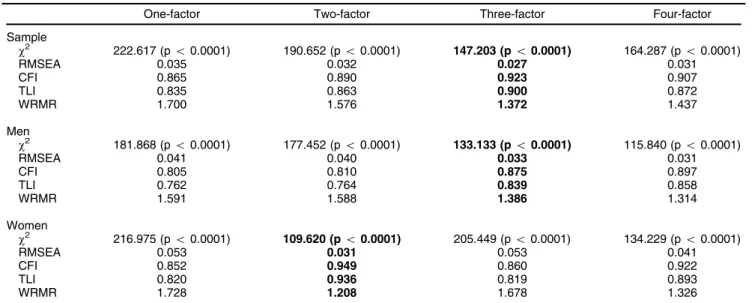
In confirmatory models, the same three-factor solution was replicable from the exploratory model for the over-all sample, and gender differences were consistently observed (Figure 1). Fit indexes of all possible models are shown in Table 5. For the total confirmatory sample (n=2,518), the first factor (family violence and parental maladjustment) encompassed family violence, physical abuse, neglect, parental mental disorders, and parental substance use disorder (coefficients ranging from 0.77 to 0.58). The second factor (parental criminality and sexual abuse) encompassed parental criminal behavior, sexual abuse, parental divorce, and physical illness (coefficients ranging from 0.54 to 0.23). The last factor (parental loss and economic adversity) encompassed other parent loss, parental death, and economic adversity (coefficients ranging from 0.71 to 0.48). The first factor correlated significantly with the second (r = 0.95) and third factors (r= 0.27).
For the men’s subsample (n=1,082), the three-factor model was also the best-fit solution. The first factor (family violence and parental maladjustment) encompassed family violence, physical abuse, neglect, and parental mental
disorders (coefficients ranging from 0.75 to 0.58). The second factor (substance misuse, criminality, and sexual abuse) encompassed parental substance use disorder, parental criminal behavior, sexual abuse, and parental divorce (coefficients ranging from 0.70 to 0.13). The last factor (economic adversity and parental loss) encom-passed economic adversity, other parent loss, and paren-tal death (coefficients ranging from 0.62 to 0.56), as well as physical illness (with a nonsignificant coefficient). The first and second factors (r= 0.81) and the first and third factors (r= 0.32) were significantly correlated.
For the women’s subsample (n=1,436), the two-factor model was the best-fit solution (Figure 1). The first factor (family violence and parental maladjustment) encom-passed family violence, neglect, physical abuse, parental mental disorders, and parental substance use disorders (coefficients ranging from 0.75 to 0.62). The second factor (sexual abuse and parental loss) encompassed the seven remaining adversities (coefficients ranging from 1.16 to 0.28). The two factors were significantly correlated (r= 0.51).
Rasch analysis
The latent trait for each adversity reported by the subjects was indicated by the difficulty parameter (b) of the IRT. Four infrequent adversities (sexual abuse, physical ill-ness, parental criminal behavior, and economic adversity) were at least 3.6 times more difficult to be reported by the whole sample, showing low endorsement probability. Regarding gender differences, women (b coefficient ran-ging from 1.89 to 4.74) more easily reported the expe-rienced adversities than men (branging from 2.02 to 6.79) and than the total sample (b ranging from 1.94 to 5.07) (Table 6). Five adversities were most difficult to be reported: sexual abuse (branging from 4.44 to 5.07), physical illness (b ranging from 4.58 to 6.79), parental criminal behavior
(branging from 3.60 to 3.58), parental divorce (b ranging from 2.48 to 2.65), and economic adversity (b coefficient from 4.44 to 4.64). The results of this Rasch analysis provided further understanding for the contribution of each adversity in previous dimensional models.
Discussion
In this large sample of the general population of a megacity, the negative adversities that commonly occur in early childhood were a heterogeneous group of risk factors. Our results suggest that boys and girls present different exposure profiles to negative experiences during their childhood and adolescence. These events must be considered as clusters of risk factors rather than a single group with common characteristics. Despite the fact that some studies24,26,27 have already explored the dimen-sionality of CAs, to our knowledge, this was the first article to look at clustering of early CAs by using both CFA and latent trait analysis. Taking into account the diversity reflected by the group of adversities, interventions for the general population should be designed with a wide-ranging scope, because respondents found some adversities dif-ficult to disclose. Our findings recommend changes in pre-ventive programs to mitigate CAs from the public heath perspective, including specific strategies for boys and girls. In confirmatory models, the dimensions of CA emerged as heterogeneous, and a common group of four adver-sities co-occurred frequently. This cluster – formed by physical abuse, neglect, parental mental disorders, and family violence – links childhood mistreatment to parental mental disorders, and has already been found across samples.5,24In fact, it has been suggested that living in violent environments and dysfunctional families are the most important characteristics of the home environment during childhood, independently of exposure to a specific adversity.5,24,26
Table 5 Model fit indexes for confirmatory factor analysis (n=2,518)
One-factor Two-factor Three-factor Four-factor
Sample
w2 222.617 (po0.0001) 190.652 (po0.0001) 147.203 (po0.0001) 164.287 (po0.0001)
RMSEA 0.035 0.032 0.027 0.031
CFI 0.865 0.890 0.923 0.907
TLI 0.835 0.863 0.900 0.872
WRMR 1.700 1.576 1.372 1.437
Men
w2 181.868 (po0.0001) 177.452 (po0.0001) 133.133 (po0.0001) 115.840 (po0.0001)
RMSEA 0.041 0.040 0.033 0.031
CFI 0.805 0.810 0.875 0.897
TLI 0.762 0.764 0.839 0.858
WRMR 1.591 1.588 1.386 1.314
Women
w2 216.975 (po0.0001) 109.620 (po0.0001) 205.449 (po0.0001) 134.229 (po0.0001)
RMSEA 0.053 0.031 0.053 0.041
CFI 0.852 0.949 0.860 0.922
TLI 0.820 0.936 0.819 0.893
WRMR 1.728 1.208 1.678 1.326
CFI = comparative fit index; RMSEA = root mean squared error of approximation; TLI = Tucker-Lewis index; WRMR = weighted root mean squared residual.
The high correlation between the two factors involving violence (physical and sexual) in the total sample and in men’s subsample is notable. However, it is possible to infer that a clinical distinction exists between those individuals exposed to sexual abuse and those with no such exposure.42The third factor, encompassing parental loss and economic adversities, was less strongly corre-lated with home-recorre-lated environmental adversities. It also provides a good clinical approximation, since economic difficulties frequently accrue in single-parent households.43 In the women’s subsample, the family maladjustment dimension correlated less with the dimension that con-tained sexual abuse, any parent absence, and parental criminality. Therefore, differences in family organization seem to be related to different types of CAs in terms of vulnerability and profile of parental mental disorders.44For example, the absence of a parent for any reason places girls at a higher risk of sexual abuse.45
Regarding gender differences, sexual abuse showed a unique characteristic in the sample, despite its low prevalence and the fact that it is one of the adversities found most difficult to report by subjects. The literature suggests that boys have a lower prevalence of sexual abuse compared to girls, and that they are also less acknowledged as victims, despite experiencing abuse that is both more recurrent and more severe than that suffered by girls.15Furthermore, the relatively few chronic
offenders are more likely to target boys than girls.14In this regard, girls are often abused in the absence of their parents. Although an association between sexual abuse, parental divorce, and parental criminal behavior was found in all groups of the present study, this association was more closely related to parental substance use disorders in the male subgroup. This implies that sexual abuse is related to more disorganized and maladjusted families, and that interventions in preventive programs should be gender-specific. In clinical practice, these findings might explain the complex interplay between genomic, envir-onmental, and cultural aspects of gender, which would reflect a latent vulnerability.12
Boys living without their fathers are at the highest risk of sexual abuse, and the literature has shown that most
perpetrators of sexual abuse against this group were acqu-aintances, but extra-familial to the victim.14,46Two-thirds of
these perpetrators were previously convicted for some crime, with a twofold likelihood of having been convicted for non-sexual than for sexual crimes.14,47Taking all of these factors into account, the relationship between sexual abuse, parent divorce, and parent criminal behavior repor-ted herein seems in line with the literature on victimology of abuses occurring during childhood.14,46,47Therefore, it would be clinically recommended to investigate sexual abuse, especially in boys in whom parental substance use disorder is accompanied by parental divorce and parental criminal behavior.
Since CAs are, generally, difficult experiences to dis-close, victims rarely reveal the embarrassing experiences they suffered during childhood. Previous studies on early adversities48,49have shown that the type of report used – and the way in which reports were administered – have a differential effect on results when addressing sensitive, shameful, or stigmatized behaviors and experiences. Underreporting is the norm for early abuse and maltreat-ment among boys, the characteristics of which are distinct from those of abuse occurring in girls.15 Rasch models confirm this peculiar help-seeking behavior in our data on CA.50 Interestingly, a recent study on the Maltreatment and Abuse Chronology of Exposure scale51suggested a stepwise methodology on validation and development of the interchangeable component of different kinds of child adversities.
It is important to note that such findings from con-firmatory analysis could also accrue from the list of CAs used in classic studies on this topic.3-6,24,26,52 In these seminal works, there was no theoretical or epidemiological rationale for the decision to investigate particular adver-sities.1,7For instance, a high prevalence of CAs was detec-ted among patients with obesity evaluadetec-ted in a weight reduction program survey.2The set of adversities found in that study was simply replicated in several subsequent papers.3-6,24,26,52 The closest process to a systematic selection was implemented by one of the major studies ever to investigate CAs, the Adverse Childhood Experi-ences53(ACE) study. A broader group of cross-culturally Table 6 Rasch analysis of item response theory model for childhood adversities, stratified by gender
Women (n=2,850) Men (n=2,187) Overall sample (n=5,037)
Variable b SE 95%CI b SE 95%CI b SE 95%CI
1.12 0.05 1.03-1.21 1.11 0.04 1.04-1.18 1.12 0.03 1.07-1.18
Parental death 2.02 0.09 1.85-2.19 1.89 0.07 1.75-2.03 1.98 0.06 1.87-2.09
Parental mental disorder 2.03 0.09 1.86-2.21 1.94 0.07 1.80-2.08 2.18 0.06 2.06-2.30
Physical abuse 2.28 0.10 2.09-2.47 1.96 0.07 1.81-2.10 5.07 0.20 4.68-5.45
Neglect 2.41 0.10 2.21-2.62 2.03 0.08 1.89-2.18 1.94 0.05 1.83-2.05
Family violence 2.45 0.10 2.24-2.65 2.07 0.08 1.92-2.22 2.49 0.07 2.36-2.63
Other parental loss 2.51 0.11 2.30-2.72 2.22 0.08 2.06-2.37 2.07 0.06 1.95-2.18
Parental substance use disorder 2.54 0.11 2.31-2.76 2.30 0.08 2.13-2.46 2.38 0.07 2.25-2.50
Parental divorce 2.65 0.11 2.42-2.87 2.48 0.09 2.30-2.65 2.35 0.06 2.22-2.48
Parental criminal behavior 3.60 0.16 3.27-3.92 3.58 0.14 3.31-3.85 3.57 0.11 3.36-3.78
Economic adversity 4.44 0.23 3.99-4.89 4.64 0.21 4.22-5.06 2.24 0.06 2.11-2.36
Sexual abuse 4.44 0.23 3.99-4.89 4.64 0.21 4.22-5.06 4.53 0.16 4.22-4.83
Physical illness 6.79 0.68 5.47-8.12 4.74 0.22 4.30-5.18 4.58 0.16 4.27-4.89
95%CI = 95% confidence interval;b= difficulty parameter; SE = standard error.
sensitive adversities should include different early CAs and generate dissimilar dimensions with different biop-sychosocial mechanisms.
The present study used a standardized methodology to disentangle the underlying dimensions of CAs in a large, representative, general-population sample. Nevertheless, our results should be interpreted with some limitations in mind. From a methodological standpoint, two key types of bias must be acknowledged. The first is recall bias, due to the time elapsed from the occurrence of the event until the interview, because exposure was inquired retro-spectively.54Furthermore, the list of adversities covered
12 distinctive events, and some experiences suffered in early childhood could have been missed by a different scale, such as the Childhood Trauma Questionnaire.55,56 Although information bias may have occurred, a similar methodology was used in analogous population-based sam-ples and resulted in a comparable prevalence of CA.52,57
The second type of bias concerns data collection. The yes-or-no format of probing questions may have made it easier for respondents to omit or overstate some undesirable experiences. Because of reluctance in reporting such traumatic experiences in face-to-face interviews, the magnitude of prevalence of specific types of CA may have been underestimated. Never-theless, the factor analytical approach provided an opportunity to document core dimensions of previous adversities instead of estimating the proportion of sub-jects exposed to these negative experiences. Willing-ness to report unpleasant experiences and memories is hard to document with accuracy, since some respon-dents will intentionally hide painful, shameful, and/or embarrassing events. The use of Rasch analysis in the present study helped us ascertain the probability that respondents would disclose CAs that are known to be less prevalent and associated with particularly uncom-fortable features. By taking advantage of modern analytical methodology, we were able to depict the latent character-istics of CAs as rarely demonstrated before.
In conclusion, dysfunctional families stand as the most important cluster of negative adversities, but the socio-cultural rearing environment may lead to incremental exposure to other hardships. As a result, boys and girls experience different childhood adversity profiles. For instance, some infrequent events such as sexual abuse must be investigated routinely in boys, insofar as these events were linked to parental criminality and substance misuse. These findings have implications for tailoring childhood welfare programs and preventing future unfa-vorable outcomes in adulthood. Childhood interventions must be designed to take into account these distinct gender profiles of exposure to early negative events.
Continuous improvement in collection of data on CAs should be pursued. Negative and traumatic experiences constitute sensitive personal information, which is rarely reported in face-to-face interviews. In future studies, alter-native self-report questionnaires can be used in addition to face-to-face interviews to avoid underreporting of negative events. Furthermore, a wider range of experiences may be included in health surveys to better understand the nature and impact of CAs.
Acknowledgements
The Sa˜o Paulo Megacity Mental Health Survey was funded by Fundac¸a˜o de Amparo a` Pesquisa do Estado de
Sa˜o Paulo (FAPESP; grants 2003/00204-3 and 2011/ 50517-4; http://www.fapesp.br/materia/176/projeto-tema-tico/projeto-tematico.htm). Instrument development was supported by Fundo de Apoio a` Cieˆncia e Tecnologia do Municı´pio de Vito´ria (FACITEC; grant 002/2003), state of Espı´rito Santo, Brazil. LHA is supported by a grant from Conselho Nacional de Desenvolvimento Cientı´fico e Tecnolo´gico (CNPq; grant 307623/2013-0. The subpro-ject on violence and trauma was supported by Secretaria de Seguranc¸a Pu´blica do Estado de Sa˜o Paulo.
The Sa˜o Paulo Megacity Mental Health Survey was carried out in conjunction with the WHO WMH Survey Initiative. The authors thank the WMH staff for assistance with instrumentation, fieldwork, and data analysis. The authors declare that the funders of the Sa˜o Paulo Mega-city Mental Health Survey had no role in study design, data collection and analysis, decision to publish, or pre-paration of the manuscript.
We thank Dr. Maria de Fa´tima Pessoa Milita˜o de Albuquerque for statistical advice.
Disclosure
The authors report no conflicts of interest.
References
1 Kessler RC, Davis CG, Kendler KS. Childhood adversity and adult psychiatric disorder in the US National Comorbidity Survey. Psychol Med. 1997;27:1101-19.
2 Felitti VJ, Anda RF. The relationship of adverse childhood experi-ences to adult health, well-being, social function, and healthcare. In: Lanius R, Vermetten E, Pain C, editors. The impact of early life trauma on health and disease: the hidden epidemic. Cambridge: Cambridge University; 2010.
3 Coeˆlho BM, Andrade LH, Borges G, Santana GL, Viana MC, Wang YP. Do childhood adversities predict suicidality? Findings from the general population of the metropolitan area of Sao Paulo, Brazil. PLoS One. 2016;11:e0155639.
4 Benjet C, Borges G, Medina-Mora ME. Chronic childhood adversity and onset of psychopathology during three life stages: childhood, adolescence and adulthood. J Psychiatr Res. 2010;44:732-40. 5 McLaughlin KA, Green JG, Gruber MJ, Sampson NA, Zaslavsky AM,
Kessler RC. Childhood adversities and adult psychiatric disorders in the national comorbidity survey replication II: associations with per-sistence of DSM-IV disorders. Arch Gen Psychiatry. 2010;67:124-32. 6 Bruwer B, Govender R, Bishop M, Williams DR, Stein DJ, Seedat S. Association between childhood adversities and long-term suicidality among South Africans from the results of the South African stress and health study: a cross-sectional study. BMJ Open. 2014;4: e004644.
7 Felitti VJ. Long-term medical consequences of incest, rape, and molestation. South Med J. 1991;84:328-31.
8 Meaney MJ, Ferguson-Smith AC. Epigenetic regulation of the neural transcriptome: the meaning of the marks. Nat Neurosci. 2010;13: 1313-8.
9 Meyer-Lindenberg A, Tost H. Neural mechanisms of social risk for psychiatric disorders. Nat Neurosci. 2012;15:663-8.
10 Leuner B, Glasper ER, Gould E. Parenting and plasticity. Trends Neurosci. 2010;33:465-73.
12 Rose N. Neuroscience and the future for mental health? Epidemiol Psychiatr Sci. 2016;25:95-100.
13 Benjet C, Borges G, Medina-Mora ME, Zambrano J, Cruz C, Me´ndez E. Descriptive epidemiology of chronic childhood adversity in Mex-ican adolescents. J Adolesc Health. 2009;45:483-9.
14 Smallbone SW, Wortley RK. Child sexual abuse: offender char-acteristics and modus operandi. Trends Issues Crime Crim Justice. 2001;193:1-6.
15 Watkins B, Bentovim A. The sexual abuse of male children and adolescents: a review of current research. J Child Psychol Psychiatry. 1992;33:197-248.
16 Dube SR, Anda RF, Felitti VJ, Chapman DP, Williamson DF, Giles WH. Childhood abuse, household dysfunction, and the risk of attempted suicide throughout the life span: findings from the Adverse Childhood Experiences Study. JAMA. 2001;286:3089-96.
17 Ystgaard M, Hestetun I, Loeb M, Mehlum L. Is there a specific rela-tionship between childhood sexual and physical abuse and repeated suicidal behavior? Child Abuse Negl. 2004;28:863-75.
18 Mendelson T, Turner AK, Tandon SD. Violence exposure and depres-sive symptoms among adolescents and young adults disconnected from school and work. J Community Psychol. 2010;38:607-21. 19 Evans E, Upchurch D, Grella CE. Gender differences in the effect of
childhood adversity on alcohol, drug, and poly-substance use dis-orders. Drug Alcohol Depend. 2017;171:e60.
20 Benjet C. Childhood adversities of populations living in low-income countries: prevalence, characteristics, and mental health conseq-uences. Curr Opin Psychiatry. 2010;23:356-62.
21 Hyde JS, Mezulis AH, Abramson LY. The ABCs of depression: integrating affective, biological, and cognitive models to explain the emergence of the gender difference in depression. Psychol Rev. 2008;115:291-313.
22 Nolen-Hoeksema S, Girgus JS. The emergence of gender differences in depression during adolescence. Psychol Bull. 1994;115:424-43. 23 Hankin BL, Abramson LY. Development of gender differences in
depression: an elaborated cognitive vulnerability-transactional stress theory. Psychol Bull. 2001;127:773-96.
24 Kessler RC, McLaughlin KA, Green JG, Gruber MJ, Sampson NA, Zaslavsky AM, et al. Childhood adversities and adult psychopathol-ogy in the WHO World Mental Health Surveys. Br J Psychiatry. 2010;197:378-85.
25 Hair JF Jr, Black WC, Babin BJ, Anderson RA. Multivariate data analysis. 6th ed. Upper Saddle River: Pearson Prentice Hall; 2006. 26 Green JG, McLaughlin KA, Berglund PA, Gruber MJ, Sampson NA,
Zaslavsky AM, et al. Childhood adversities and adult psychiatric disorders in the national comorbidity survey replication I: associations with first onset of DSM-IV disorders. Arch Gen Psychiatry. 2010;67: 113-23.
27 Lee S, Guo WJ, Tsang A, He YL, Huang YQ, Zhang MY, et al. The prevalence of family childhood adversities and their association with first onset of DSM-IV disorders in metropolitan China. Psychol Med. 2011;41:85-96.
28 Viana MC, Teixeira MG, Beraldi F, Bassani Ide S, Andrade LH. Sao Paulo megacity mental health survey - a population-based epidemiological study of psychiatric morbidity in the Sao Paulo metropolitan area: aims, design and field implementation. Rev Bras Psiquiatr. 2009;31:375-86.
29 Kessler RC, Ustun TB. The World Mental Health (WMH) survey initiative version of the World Health Organization (WHO) Composite International Diagnostic Interview (CIDI). Int J Methods Psychiatr Res. 2004;13:93-121.
30 Viana MC, Viana-Moldes I, Teixeira M, Basani I, Andrade LH. The World Mental Health Survey Initiative Version of the Composite International Diagnostic Interview (WMH-CIDI): translation and adaptation to Brazilian-Portuguese: the Instrument used in the ‘‘Sa˜o Paulo Megacity Mental Health Survey’’. Printed Version; 2004. 31 Endicott J, Andreasen N, Spitzer RL. Family history research
diag-nostic criteria. New York: New York State Psychiatric Institute; 1978. 32 Straus MA. Measuring intrafamily conflict and violence: the conflict
tactics (CT) scales. J Marriage Fam. 1979;41:75-88.
33 Courtney ME, Piliavin I, Grogan-Kaylor A, Nesmith A. Foster youth transitions to adulthood: a longitudinal view of youth leaving care. Child Welfare. 2001;80:685-717.
34 Molnar BE, Buka SL, Kessler RC. Child sexual abuse and sub-sequent psychopathology: results from the national comorbidity survey. Am J Public Health. 2001;91:753-60.
35 Merikangas KR, Ames M, Cui L, Stang PE, Ustun TB, Von Korff M, et al. The impact of comorbidity of mental and physical conditions on role disability in the US adult household population. Arch Gen Psychiatry. 2007;64:1180-8.
36 Kaiser HF, Rice J. Little Jiffy, Mark Iv. Educ Psychol Meas. 1974;34: 111-7.
37 Bartlett MS. A note on the multiplying factors for variousw2 approx-imations. J R Stat Soc Series B Stat Methodol. 1954;16:296-8. 38 Rasch G. Probabilistic models for some intelligence and attainment
tests. Chicago: University of Chicago; 1980.
39 Kappenburg-ten Holt J. A comparison between factor analysis and item response theory modeling in scale analysis. Rijksuniversiteit Groningen: Groningen; 2014.
40 StataCorp. Stata statistical software: release 14. College Station: StataCorp LP; 2014.
41 Muthe´n LK, Muthe´n BO. Mplus user’s guide. Los Angeles: Muthe´n and Muthe´n; 1998-2012.
42 Nelson EC, Heath AC, Madden PA, Cooper ML, Dinwiddie SH, Bucholz KK, et al. Association between self-reported childhood sexual abuse and adverse psychosocial outcomes: results from a twin study. Arch Gen Psychiatry. 2002;59:139-45.
43 Thomas A, Sawhill I. For love and money? The impact of family structure on family income. Future Child. 2005;15:57-74.
44 Burrell B, Thompson B, Sexton D. Predicting child abuse potential across family types. Child Abuse Negl. 1994;18:1039-49.
45 Kidman R, Palermo T. The relationship between parental presence and child sexual violence: evidence from thirteen countries in sub-Saharan Africa. Child Abuse Negl. 2016;51:172-80.
46 Holmes WC, Slap GB. Sexual abuse of boys: definition, prevalence, correlates, sequelae, and management. JAMA. 1998;280:1855-62. 47 Wortley R, Smallbone S. A criminal careers typology of child sexual
abusers. Sex Abuse. 2014;26:569-85.
48 Pridemore WA, Damphousse KR, Moore RK. Obtaining sensitive information from a wary population: a comparison of telephone and face-to-face surveys of welfare recipients in the United States. Soc Sci Med. 2005;61:976-84.
49 Kelly CA, Soler-Hampejsek E, Mensch BS, Hewett PC. Social desirability bias in sexual behavior reporting: evidence from an interview mode experiment in rural Malawi. Int Perspect Sex Reprod Health. 2013;39:14-21.
50 Mansfield AK, Addis ME, Mahalik JR. ‘Why won’t he go to the doctor?’ The psychology of men’s help seeking. Int J Mens Health. 2003;2:93-109.
51 Teicher MH, Parigger A. The ’Maltreatment and Abuse Chronology of Exposure’ (MACE) scale for the retrospective assessment of abuse and neglect during development. PLoS One. 2015;10: e0117423.
52 Fujiwara T Kawakami N; World Mental Health Japan Survey Group. Association of childhood adversities with the first onset of mental disorders in Japan: results from the World Mental Health Japan, 2002-2004. J Psychiatr Res. 2011;45:481-7.
53 Felitti VJ, Anda RF, Nordenberg D, Williamson DF, Spitz AM, Edwards V, et al. Relationship of childhood abuse and household dysfunction to many of the leading causes of death in adults. The adverse childhood experiences (ACE) study. Am J Prev Med. 1998;14: 245-58.
54 Hardt J, Rutter M. Validity of adult retrospective reports of adverse childhood experiences: review of the evidence. J Child Psychol Psychiatry. 2004;45:260-73.
55 Taillieu TL, Brownridge DA, Sareen J, Afifi TO. Childhood emotional maltreatment and mental disorders: results from a nationally repre-sentative adult sample from the United States. Child Abuse Negl. 2016;59:1-12.
56 Grassi-Oliveira R, Stein LM. Childhood maltreatment associated with PTSD and emotional distress in low-income adults: the burden of neglect. Child Abuse Negl. 2008;32:1089-94.