FREE THEMES
Risk and protective factors for suicide attempt
in emerging adulthood
Abstract The aim of this study was to investi-gate the risk and protective factors for suicide attempt in emerging adulthood. 189 individuals (18 to 30 years old) participated in the study: 63 had already attempted suicide, 63 had a history of suicidal ideation, and 63 have never had suicidal ideation. They all completed an online research protocol about suicidal attempt and ideation, anxiety, self-esteem, self-efficacy, developmen-tal stressors; social expression, and friendship. Those participants with no history of suicidal at-tempt showed higher scores of self-efficacy (M = 35.35, SD = 6.44), self-esteem (M = 41.33, SD = 7.02), and family relationships (M = 59.63, SD = 10.01). The suicidal ideation group showed higher scores of social anxiety (M = 26.03, SD = 10.25). Protective factors were essential to prevent the risk of suicide and help in solving problems in emer-ging adulthood.
Key words Young adults, Suicidal ideation,
Sui-cide attempt, Risk factors, Protective factors Anderson Siqueira Pereira 1
Alice Rodrigues Willhelm 1
Silvia Helena Koller 1
Rosa Maria Martins de Almeida 1
1 Instituto de Psicologia,
Universidade Federal do Rio Grande do Sul. R. Ramiro Barcelos 2600, Santa Cecília. 90035-003 Porto Alegre RS Brasil.
P
er
eir
Introduction
A new developmental phase called emerging adulthood has been identified in industrialized countries, in which young people leaving ado-lescence have postponed the assumption of adult roles such as marriage, financial independence from their parents and the formation of a family1.
Emerging adulthood is characterized by a period of exploration of identity, since in this period of life young people seek greater social and profes-sional identity. It is a time of insecurity, as young people are inserted into new social contexts that will require specific skills, which the young people may not have, leaving them vulnerable1.
Emerg-ing adulthood has also been shown to be a peri-od of exposure to risky situations, such as drug use2 and unprotected sex3. This is because they
are in an extended period of exploration of their identities and due to the fact that they postpone definitive commitments (e.g., marriage, children, regular employment). This can lead them to have feelings of negativity and instability, which may explain their involvement in risk behaviors4. The
emergence of this new phase is due to a series of changes in society, such as the entry of women into the labor market, the relaxation of patterns of sexuality and the need for young people to have more years of study and training to enter a increasingly demanding labor market1,5.
In Brazil, the studies of Dutra-Thomé stand out because they seek to characterize this new phase in young Brazilian adults. In one of these studies6 it was identified that some young people
felt in-between adolescence and adulthood, how-ever, emerging adulthood was more likely to be present in the young people of the higher socio-economic levels than in those of the lower levels. Young people of lower socioeconomic status tend to assume adult roles earlier. This fact may make these young people less likely to experience this period of identity exploration.
During emerging adulthood, there are a number of problems and difficulties that may arise in the lives of young people. The presence of protective factors may mitigate the effects of negative events and the challenges faced by young people7. Protective factors are personal
characteristics (such as self-esteem and self-effi-cacy) or the environment in which they live (such as relationships with friends, family and support network) that strengthen young people and sup-port them in dealing with problem situations8.
These factors do not act in isolation but interact to aid in behavior change, developing an
expe-rience of protection against risk situations and assisting in the solution of problems9. It is also
during emergent adulthood that young people establish a series of social interactions that occu-py a considerable part of their time, in both the circles of friendship and in work and study10,11.
These circles can function as potential support networks to help young people cope with diffi-culties in their lives4. For this, it is necessary that
they present a repertoire of social skills that help them to construct and maintain social relations that can become effective support networks12.
Unlike protective factors, risk factors relate to negative events and characteristics in life, with their presence increasing the chances of the man-ifestation of physical, emotional, and social prob-lems9. These factors tend to increase the
vulner-ability of individuals to adverse situations, with each person reacting differently to these factors. Therefore, it is not only the presence of these fac-tors that defines their impact on the individual’s life, but also the intensity, frequency, and manner in which they are interpreted. Examples of risk factors are: dysfunctional family of origin, eco-nomic instability, experiences of physical/sexual violence, living in violent communities8,9,13 and
unhealthy working conditions14. Risk behaviors
such as drug use3,15 and unprotected sex16 may
also be considered risk factors.
The action of protective factors and how they are reflected in the actions and reactions of young people faced with problems that arise in their lives can mitigate risks, intensify resources to deal better with stressful events and achieve positive outcomes in the situations8. Conversely,
the absence of protective factors and the presence of risk factors generate fewer resources, increas-ing the chances of negative outcomes and caus-ing vulnerability in the development of social and emotional problems8,9. These conditions of
vulnerability can lead young people to drastic solutions such as suicide17.
According to the World Health Organization (WHO), nearly half of the world’s violent deaths are due to suicide18. Suicide rates have increased
since 199919 and every year one million people
die from suicide worldwide20. This shows that
this is a serious public health problem that affects all stages of the life cycle and requires attention. Suicide is a complex phenomenon and is stud-ied within several areas of knowledge21. One of
the definitions of suicide would be to cause the death or murder of oneself, ending one’s life22,23.
aúd
e C
ole
tiv
a,
23(11):3767-3777,
2018
another form of suicide, which would be a patho-logical act without intentionality, but which causes the person’s own death24. In addition, the
rates of attempting to take one’s own life can be up to ten times greater than actual de facto sui-cides17. The process starts with suicidal ideation,
that is, thinking about no longer existing, taking one’s life and wanting to die25. Suicide is still a
taboo in today’s society, and often young people, who are considered a population at risk for sui-cidal ideation, do not find adequate space to talk about it22,25-27.
The process of thinking about taking one’s own life or trying to commit suicide is under-stood as a period of crisis, usually including psy-chological questions related to the difficulty of managing complicated situations in one’s life22.
Factors associated with suicide, such as previous attempts, social isolation, family history of men-tal illness, family history of aggression or abuse, declarations or thoughts of intention, among other biological and socioeconomic factors, also need to be considered17,21,28. Protective factors
that are believed to be related to suicidal ideation include significant interpersonal relationships, such as with family and friends, and a healthy working environment. Personal aspects such as self-esteem, social skills and self-efficacy29,30 are
also considered to be protective factors.
A study developed by Pereira12, to assess social
skills and risk and protective factors in emerging adults, identified that in a sample of 510 partic-ipants there were 63 particpartic-ipants who reported having attempted suicide. Observing the high prevalence (more than 10% of the sample), the presence of risk and protective factors was in-vestigated in this sample of young people with a history of attempted suicide. Thus, the overall aim of this study was to investigate risk and pro-tective factors related to suicide attempts and/or ideation by comparing three groups that were extracted from the database of the main study: individuals who attempted suicide; individuals who presented suicidal ideation, however, had never attempted suicide; and those who had not attempted suicide or had suicidal ideation. In ad-dition, as the specific objective, protective factors were identified for those emerging adults who at-tempted suicide, however, no longer had suicidal ideation, and these were compared to those who had tried and still had ideation.
Method
Sample
This study is part of a larger study aimed to assess social skills and risk and protective fac-tors in emerging adults12. This study had a total
sample of 521 participants and the data collec-tion was performed online through the Survey Monkey platform. The study was disseminated from e-mail lists of universities and educational institutions and social networks on pages relat-ed to topics of interest to emerging adults (such as groups of educational institutions, football, church, discussion groups on various topics). In these two ways, the aims of the study were ex-plained from a text and, after the completion of the questionnaire, the participants were also in-vited to indicate new participants. This study was approved by the Psychology Ethics Committee of the Federal University of Rio Grande do Sul. All participants signed the consent form.
For the performance of the present study, all the participants who had attempted suicide (n = 63) from the database of the larger study were se-lected, which represented 12.09% of the sample. In order to make comparisons, two more groups of participants were selected. For this, numbers were randomly drawn from 63 numbers that corresponded to the protocol numbers of the participants who at some point had had suicid-al ideation, but never tried and others who had never had any ideation or attempted suicide. All the participants were within the age range of 18 to 30 years of age and responded to the online protocol of the main study on the Survey Mon-key platform.
Instruments
Questions related to suicide:a) Have you ever considered killing yourself?; b) Have you tried to kill yourself?; c) If the previous answers is yes, do you still have this thought?
Dimensional Anxiety Scale - Social Anxiety Disorder (SAD-D): a brief, dimensional, self-re-port measure presented in the DSM-5 as a sug-gested measure to diagnose social anxiety symp-toms. The instrument has presented evidence of reliability in community and clinical contexts in both the original version31 and in the version
P
er
eir
scale that aims to assess self-esteem. In its valida-tion study for the Brazilian context, it presented adequate psychometric data, presenting a Cron-bach’s alpha of 0.90.
General Self-Efficacy Scale: A self-report scale with ten items, validated for the Brazilian context by Sbicigo et al.33, presenting good evidence of
validity and reliability, with a Cronbach’s alpha of 0.85.
Questions related to developmental stressors:
21 questions about the occurrence of stressful events in the life of the person: a) The economic level of my family continually declined; b) Some-one in my house is unemployed; c) My parents separated; d) I have been hospitalized in an in-stitution (shelter, orphanage); e) I have run away from home; f) I have lived on the street; g) I have slept on the street; h) I have worked on the street; i.) Someone in my family is or has been in pris-on; j) I suffered a serious accident; l) Someone very important to me passed away; m) I have been hungry; n) My father/mother is married again; o) My father/mother had a child with an-other partner; p) I have been robbed; q) I have completed a socio-educational measure without being incarcerated; r) I have been incarcerated (Closed institution); s) I have appeared before the Guardianship Council; t) I have had prob-lems with the law; u) I have had probprob-lems with the police. These items are part of the Brazilian Youth Questionnaire34.
Multidimensional Scale of Social Expression - Motor Component - EMES-M:Self-report scale composed of 64 items in total, which assess so-cial skills. It was developed by Caballo35, showing
good internal consistency, and was adapted and validated for Brazil by Pereira et al.36, presenting
an alpha of 0.95 for the total scale.
Questionnaire for evaluation of friendship re-lations:based on the MCGill questionnaires to evaluate the quality of friendships. It evaluates the quantity and quality of friendship relation-ships in three open questions and 30 sentences on the impression that the respondents have of their friendships. The items are scored on a 5-point Likert scale (1 - Strongly disagree to 5 Strongly agree).
Data analysis
Descriptive analyses of the data were per-formed to produce means and standard devi-ations. To verify differences between the three groups, ANOVAs were carried out with Bonfer-roni post-hoc tests. A Student’s t-test was also
performed to assess the difference between the participants who had attempted suicide, com-paring those who still had suicidal ideation with those who did not. A significance level of p < 0.05 was adopted.
Results
The mean age of the sample was 22.68 years (SD
= 3.03) and it was predominantly composed of females (69.3%, n = 131). Regarding this female predominance, it should be taken into account that this proportion reflects the female propor-tion of the larger study, which also obtained a larger number of women (66%)12. There was no
statistically significant difference regarding age (p
= 0.299) or gender (p = 0.394) among the three groups. The other sociodemographic data of the sample are presented in Table 1.
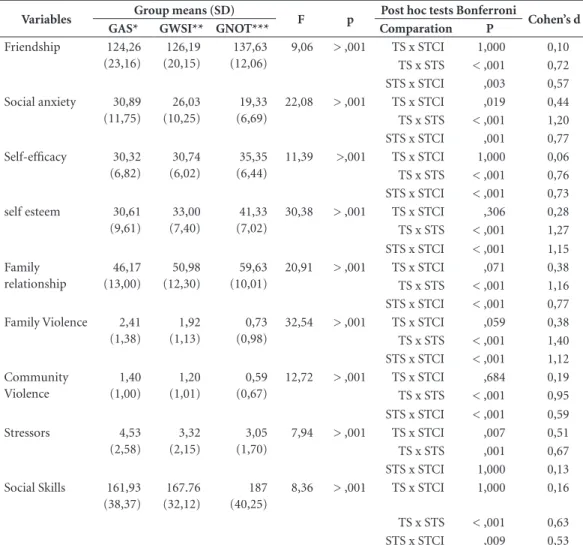
In order to respond to the general objective, ANOVAs were performed, which showed statis-tically significant differences between the means of the groups in all the variables. The Bonfer-roni post-hoc tests showed significant differenc-es among the three groups regarding the social anxiety variable (Table 2). As can be seen in Ta-ble 2, only the social anxiety variaTa-ble presented significant differences among the three groups. The developmental stressors variable presented differences between the group that had suicidal ideation but had never attempted suicide and the group that had made suicide attempts.
In the group comparisons, there was a statis-tically significant difference in the scores of all the variables related to protective factors (friendship, family relationship, social skills, self-esteem and self-efficacy) when comparing the group that did not present suicide ideation or attempts to the other groups. A similar result can be observed in relation to the comparisons of the groups in the variables of family and community violence, in which there was a statistically significant differ-ence only in the comparisons between the group without suicide attempts or ideation and the oth-er groups.
In order to respond to the specific objective and identify differences between people who were able to overcome suicidal ideation and those who had not yet achieved this, Student’s t-tests were performed. In this analysis, the sample of people who had a history of suicide attempts (n
aúd
e C
ole
tiv
a,
23(11):3767-3777,
2018
this anymore (n = 34). The group that did not have ideation anymore had statistically signifi-cant higher means in the self-efficacy, self-esteem and family relationship variables. The group that still had ideation presented statistically signifi-cant higher means in the social anxiety variable. These analyzes can be seen in Table 3.
Discussion
The aims of this study were to investigate risk and protective factors for suicidal ideation and/ or attempts. The results highlighted factors that may be considered protective, such as self-esteem and self-efficacy, and risk factors such as social anxiety and family and community violence.
Emerging adulthood is characterized by the appearance of several new social requirements1.
Faced with these, young people often feel vulner-able if they do not have the resources to deal with the problems that arise, making this population vulnerable to psychological disorders, which can lead to suicidal ideation and attempts17.
Attempting suicide is one of the only alter-natives encountered by people who do not have enough resources in the problem-solving pro-cess, for example, individuals who are excluded
from the family context, who have feelings of worthlessness or feel unable to cope with reali-ty22. Therefore, the interaction of risk and
pro-tective factors can be determinant for a healthy outcome in problem solving9. It is important to
be clear about the concept of resilience, which is a complex process in which a number of factors relate to determine whether people can overcome their problems in a healthy way37.
The means of the protective factors presented a statistically significant difference between the group that had neither ideation nor suicide at-tempts during their lives and the other groups. The factors used in this study can be character-ized into two types: intrinsic factors, that is, the person’s own strengths and abilities that can help in coping and overcoming difficulties (such as self-esteem, self-efficacy and social skills); and extrinsic factors that are characteristics and sup-port of the context in which this person lives that can help in difficult situations (such as the family relationship and friendships)8. The results of this
study indicate that these factors are more present in young people who do not present suicidal ide-ation, which demonstrates their importance in the study of this phenomenon.
Self-esteem can be defined as a set of beliefs about one’s own value as a person and is consid-Table 1. Socio-demographic data of the sample.
GAS* GWSI** GNOT ***
Mean Age (SD) 23,01 (3,13) 22,28 (2,95) 22,74 (3,00)
Sex
Male 23,8% (n = 15) 36,5% (n = 23) 31,7% (n = 20)
Female 76,2% (n = 48) 63,5% (n = 40) 68,3% (n = 43) Race
White 58,7% (n = 37) 65,1% (n = 41) 74,6% (n = 47)
Black 14,3% (n = 9) 1,6% (n = 1) 0%
Brown 20,6% (n = 13) 27% (n = 17) 23,8% (n = 15)
Other 6,4% (n = 4) 1,6% (n = 1) 1,6% (n = 1)
Marital Status
Not Married 84,1% (n = 53) 79,4% (n = 50) 84,1% (n = 53) Married/Living together 11,1% (n = 7) 17,4% (n = 11) 14,2% (n = 9)
Divorced 0% 0% 1,6% (n = 1)
Scholarity
Bellow High School 0% 1,6% (n = 1) 0%
High school 4,8% (n = 3) 9,5% (n = 6) 0%
Undergraduated 73% (n = 46) 65,1% (n = 41) 69,8% (n = 44)
Graduated 22,2% (n = 14) 23,8% (n = 15) 30,2% (n = 19)
P
er
eir
Table 2. Results of ANOVAs comparing the groups with Suicide Attempt (GAS), with suicidal ideation in life (GWSI) and the group that did not have an idea or attempt (GNOT).
Variables Group means (SD) F p Post hoc tests Bonferroni Cohen’s d
GAS* GWSI** GNOT*** Comparation P
Friendship 124,26 (23,16)
126,19 (20,15)
137,63 (12,06)
9,06 > ,001 TS x STCI 1,000 0,10 TS x STS < ,001 0,72 STS x STCI ,003 0,57 Social anxiety 30,89
(11,75)
26,03 (10,25)
19,33 (6,69)
22,08 > ,001 TS x STCI ,019 0,44 TS x STS < ,001 1,20 STS x STCI ,001 0,77 Self-efficacy 30,32
(6,82)
30,74 (6,02)
35,35 (6,44)
11,39 >,001 TS x STCI 1,000 0,06 TS x STS < ,001 0,76 STS x STCI < ,001 0,73 self esteem 30,61
(9,61)
33,00 (7,40)
41,33 (7,02)
30,38 > ,001 TS x STCI ,306 0,28 TS x STS < ,001 1,27 STS x STCI < ,001 1,15 Family
relationship
46,17 (13,00)
50,98 (12,30)
59,63 (10,01)
20,91 > ,001 TS x STCI ,071 0,38 TS x STS < ,001 1,16 STS x STCI < ,001 0,77 Family Violence 2,41
(1,38)
1,92 (1,13)
0,73 (0,98)
32,54 > ,001 TS x STCI ,059 0,38 TS x STS < ,001 1,40 STS x STCI < ,001 1,12 Community
Violence
1,40 (1,00)
1,20 (1,01)
0,59 (0,67)
12,72 > ,001 TS x STCI ,684 0,19 TS x STS < ,001 0,95 STS x STCI < ,001 0,59
Stressors 4,53
(2,58)
3,32 (2,15)
3,05 (1,70)
7,94 > ,001 TS x STCI ,007 0,51
TS x STS ,001 0,67
STS x STCI 1,000 0,13 Social Skills 161,93
(38,37)
167.76 (32,12)
187 (40,25)
8,36 > ,001 TS x STCI 1,000 0,16
TS x STS < ,001 0,63 STS x STCI ,009 0,53
Note: * GAS = Group with Attempted suicide; ** GWSI = Group with suicidal ideation in life; *** GNOT = Group that had neither ideation nor attempt.
Table 3. Comparison of means between the groups with subjects with and without suicide attempt.
Variables Groups means (SD) P Cohen’s d
WT* (n = 28) WNT** (n = 34)
Friendship 119,50 (23,81) 128,24 (22,55) ,147 0,38
Social anxiety 35,32 (10,62) 27,53 (11,66) ,008 0,76
Self-efficacy 27,55 (5,87) 32,32 (6,87) ,006 0,60
self esteem 26,68 (8,47) 33,76 (9,55) ,003 0,82
Family relationship 41,53 (13,18) 49,88 (11,94) ,011 0,66
Family Violence 2,66 (1,21) 2,21 (1,51) ,203 0,00
Community Violence 1,57 (0,99) 1,25 (1,01) ,222 0,00
Stressors 4,07 (2,26) 4,85 (2,82) ,261 0,00
Social Skills 152,96 (31,50) 168,88 (42,82) ,109 0,43
aúd
e C
ole
tiv
a,
23(11):3767-3777,
2018
ered an important indicator of mental health38.
Self-efficacy is the person’s belief in their prob-lem-solving ability33. Self-esteem and
self-effica-cy are related characteristics. Low self-efficaself-effica-cy is related to a sense of vulnerability to adversity and inability to solve problems39, which can lead to
increased anxiety when dealing with problems in life. This can lead to the development of neg-ative beliefs about oneself and the environment in which one lives, with decreased self-esteem and increased psychological disorders such as depression40,41. The results of this study
corrob-orate these findings, which presents self-efficacy and self-esteem as important protective factors for psychological disorders42,43 and for the risk of
suicide8,44.
Social skills can be defined as a specific class of behaviors used in interaction with the other factors12. These behaviors aim to solve and avoid
interpersonal problems and are responsible for maintaining social relationships45,46. Deficits in
social skills are related to difficulties in social interaction, dissatisfaction in relationships, pres-ence of social anxiety, low self-efficacy to solve interpersonal problems and low self-esteem12,35.
Regarding extrinsic factors, during emerg-ing adulthood, relationships with friends and family are considered the most important in the support network of this population4,11,47. It is in
these relationships that young people construct their identity and seek support when faced with problems11. As observed in this study, the quality
levels in these relationships showed a significant difference between the group without suicidal ideation and attempts in their lives and the other groups. Thus, it is assumed that these relation-ships can prevent emerging adults from seeking suicide as an option for solving their problems. In addition, for people who have a history of suicide attempts, the family relationship proved important for overcoming this. It is necessary to consider that, in order to access the support network, these young people need a repertoire of adequate social skills, since without them, even if the relationship is good, they will not have the necessary skills to ask for help when needed12.
Even though there was no significant differ-ence between the suicide attempt group and the group with suicidal ideation in relation to the quality of the family relationships, the difference between the levels of quality of this relationship was borderline (Table 2). This shows that there may be a relationship between the quality of the family relationship and the actual suicide at-tempt. This is highlighted when perceiving that
the quality of the family relationship had a sta-tistically significant difference between the group that had attempted suicide and still had suicid-al ideation and the group that did not have this anymore.
Regarding social anxiety, there was a differ-ence in levels among the three groups, with the suicide attempts group presenting the highest mean, followed by the group with suicidal ide-ation. This result demonstrates that social anxi-ety is a risk factor for both ideation and attempts.
Social anxiety is a serious and debilitating disorder characterized by high levels of anxiety regarding interpersonal relationships34,48. When
faced with these interactions the person feels vulnerable, which can often lead to social iso-lation48. Social anxiety is related to low levels of
self-esteem, self-efficacy, deficits in social skills and depression35,48. People who are affected by
this disorder have difficulty relating to others and cannot effectively build or access the support network, becoming even more vulnerable and helpless when problems arise in life49, which may
explain this difference between groups.
In relation to situations of violence, it can be seen that the presence of both family and com-munity violence differentiated the group without ideation or attempts from the other groups. This data indicates that experiencing situations of vi-olence lead to vulnerability, which means that the individual does not have the resources to deal with the situation. This is due to the presence of violence, especially in childhood, tending to re-sult in a decrease in the self-esteem and self-ef-ficacy of the victims50. The literature indicates
that the presence of cases of violence is related to disorders such as depression, which can result in suicidal ideation and attempts51-53.
Of the variables evaluated in this study, the only variable that exclusively differentiated the group with ideation from the group with sui-cide attempts was the “Developmental Stressors” variable, which is related to issues such as loss of employment and family members, indebtedness, financial crises, change of residence and prob-lems with the law. This result may indicate that the presence of destabilizing experiences may be the trigger for a suicide attempt for people with suicidal ideation.
P
er
eir
anxiety and the occurrence of stressors are risk factors for suicide attempts, since only these vari-ables differentiated the groups.
Regarding the comparison between the par-ticipants who had attempted suicide, but no lon-ger had suicidal ideation and those who still had this, the t-test presented a significant difference in the means of the social anxiety, self-efficacy, self-esteem and family relationship variables. People have a healthier way of perceiving prob-lems and believe that they can solve them when they have more positive beliefs about them-selves8,54. In this way, the presence of positive
be-liefs about oneself (self-esteem) and one’s ability to deal with situations and problems (self-effica-cy) possibly helps the person find ways to solve the problems that resulted in the suicide attempt and, therefore, to abandon the suicidal ideation. Conversely, people with low self-esteem and self-efficacy do not believe in their problem-solv-ing ability, causproblem-solv-ing suicide to remain a plausible “solution” to these situations.
The presence of high levels of social anxiety causes difficulties in establishing effective sup-port networks and, even in their presence, the person will have difficulty accessing them. In this way, it becomes a risk factor because the support networks will become less effective, leaving the individual vulnerable to problems12, without
the support to overcome the suicidal ideation. It was observed that the quality of the family rela-tionships is an important aspect of the support network, since this is usually the closest social relationship in this population. When this rela-tionship is one of quality it can help the person overcome problems and find new ways of solving them. This can lead to a decrease or abandon-ment of thoughts of suicide.
Conclusion
Emerging adulthood is a phase of changes in the lives of young people and, as seen in this study, several factors can contribute to problems that may make life difficult to the point of consid-ering suicide as a solution to these problems. Suicide is a complex phenomenon that presents several related factors (both risk and protective). This study evaluated some of these factors as a
way to better understand this phenomenon in this specific population.
Protective factors, such as self-esteem, self-ef-ficacy, social skills, family relationships and friendships, are important and make a differ-ence to problem solving in emerging adulthood. These factors were shown to be essential for in-dividuals not to present suicidal ideation as an option to deal with challenging situations in their lives. They are also important factors so that af-ter a failed attempt, young people can rethink their lives and seek to overcome their problems in a way that they do not commit new attempts. In this way, interventions with this age group should focus on the development of protective factors, as a way to improve the quality of life of these young people. Therefore, self-esteem and self-efficacy should be promoted, while at the same time strengthening affective bonds with the support network.
For young people who have ideation or have had failed suicide attempts, interventions should focus on organizing an effective support network so they can have someone to turn to when they are unable to cope with their problems. In addi-tion, strategies should be proposed to improve the self-esteem and self-efficacy of these young peo-ple. The lack of further information regarding the age at which the young people carried out their suicide attempts, as well as details of how these at-tempts were made, may be considered limitations of this study. This information would allow other factors associated with overcoming this or not to be identified. In addition, the online data collec-tion meant that only one profile of participants had access to the questionnaire, in this case, young people with internet access and that participated in the groups in which the study was divulged. Accordingly, new studies that seek to reach young people in other contexts should be performed to better understand this phenomenon.
aúd
e C
ole
tiv
a,
23(11):3767-3777,
2018
Collaborations
AS Pereira: Creator of the larger project from which the article was derived, collection and analysis of the data and writing of the article. AW Rodrigues: Analysis of the data and writing of the article. SH Koller: Supervisor of the larger project, writing and supervision of the article. RMM Almeida: Analysis of the data and writing of the article.
Acknowledgments
P
er
eir
References
1. Arnett J. Emerging adulthood(s): The cultural psy-chology of a new life stage. In: Bridging Cultural and Developmental Approaches to Psychology: New Synthesis
in Theory, Research, and Policy. New York: Oxford
Uni-versity Press; 2011. p. 255-275.
2. Peuker AC, Fogaça J, Bizarro L. Expectativas e beber problemático entre universitários. Psicologia: Teoria e
Pesquisa 2006; 22(2):193-200.
3. Cruz JFA, Vilaça T, Sousa AC, Gomes AR, Melo BMTE, Araújo MS, Dias CS, Freitas MC, Ruivo ML. Preven-ção do HIV e do Sida nos adolescentes e jovens adultos: Investigação do conhecimento, atitudes e
comporta-mento sexual. 1997. [acessado 2015 Dez 7].
Disponí-vel em: http://repositorium.sdum.uminho.pt/hand-le/1822/5349
4. Andrade C. Transição para a idade adulta: Das condi-ções sociais às implicacondi-ções psicológicas. Análise Psicoló-gica. 2010; 28(2):255-267.
5. Dutra-Thomé L, Koller SH. O significado do trabalho na visão de jovens brasileiros: uma análise de palavras análogas e opostas ao termo. Rev psicol organ trab 2014; 14(4):367-380.
6. Dutra-Thomé L, Koller SH, Dutra-Thomé L, Koller SH. Emerging Adulthood in Brazilians of Differing So-cioeconomic Status: Transition to Adulthood. Paidéia
(Ribeirão Preto) 2014; 24(59):313-322.
7. Donald M, Dower J, Correa-Velez I, Jones M. Risk and protective factors for medically serious suicide attempts: a comparison of hospital-based with popu-lation-based samples of young adults. Aust N Z J Psy-chiatry 2006; 40(1):87-96.
8. Pesce RP, Assis SG, Santos N, Oliveira RVC. Risco e pro-teção: em busca de um equilíbrio promotor de resiliên-cia. Psicologia: Teoria e Pesquisa 2004; 20(2):135-143. 9. Poletto M, Koller SH. Contextos ecológicos:
promoto-res de promoto-resiliência, fatopromoto-res de risco e de proteção. Estudos
de Psicologia (Campinas) 2008; 25(3):405-416.
10. Delgado Gallego I, Oliva Delgado A, Sánchez Queija I.
Apego a los iguales durante la adolescencia y la adultez
emergente. 2011. [acessado 2015 Dez 7]. Disponível em:
https://digitum.um.es/jspui/handle/10201/26451 11. Zacarés González JJ, Iborra Cuéllar A, Tomás Miguel
JM. El desarrollo de la identidad en la adolescencia y
adultez emergente: Una comparación de la identidad global frente a la identidad en dominios específicos. 2009. [acessado 2015 Dez 7]. Disponível em: https://digitum. um.es/xmlui/handle/10201/14446
12. Pereira AS. Avaliação das habilidades sociais e suas re-lações com fatores de risco e proteção em jovens adultos brasileiros [dissertação]. Porto Alegre: UFRGS; 2015. 13. Marzana D, Pérez-Acosta AM, Marta E, González MI.
The transition to adulthood in Colombia. Avances en
Psicología Latinoamericana 2010; 28(1):99-112.
14. Almeida RMM, Flores ACS, Scheffer M. Ideação sui-cida, resolução de problemas, expressão de raiva e im-pulsividade em dependentes de substâncias psicoativas.
Psicologia: Reflexão e Crítica 2013; 26(1):1-9.
15. Quinn PD, Fromme K. Self-regulation as a protective factor against risky drinking and sexual behavior.
Psy-chol Addict Behav 2010; 24(3):376-385.
16. Camelo SHH, Angerami ELS. Riscos psicossociais no trabalho que podem levar ao estresse: uma análise da literatura. Ciência, Cuidado e Saúde 2008; 7(2):232-240. 17. Abreu KP, Lima MADS, Kohlrausch ER, Soares JSF.
Comportamento suicida: fatores de risco e interven-ções preventivas. Suicidal behavior: risk factors and
preventive interventions. 2010. [acessado 2015 Dez
3]. Disponível em: http://www.lume.ufrgs.br/han-dle/10183/85271
18. McGirr A, Renaud J, Seguin M, Alda M, Benkelfat C, Lesage A, Turecki G. An examination of DSM-IV de-pressive symptoms and risk for suicide completion in major depressive disorder: a psychological autopsy study. J Affect Disord 2007; 97(1-3):203-209.
19. Amadéo S, Rereao M, Malogne A, Favro P, Nguyen NL, Jehel L, Milner A, Kolves K, De Leo D. Testing Brief Intervention and Phone Contact among Subjects with Suicidal Behavior: A Randomized Controlled Trial in French Polynesia in the Frames of the World Health Organization/Suicide Trends in At-Risk Territories Study. Ment Illn 2015; 7(2):5818.
20. World Health Organization (WHO). Public Health
Ac-tion for the PrevenAc-tion of Suicide: A Framework. WHO;
2012. [acessado 2015 Dez 7]. Disponível em: http:// apps.who.int/iris/handle/10665/75166
21. Meneghel SN, Victora CG, Faria NMX, Carvalho LA, Falk JW. Epidemiological aspects of suicide in Rio Grande do Sul, Brazil. Rev Saude Publica 2004; 38(6):804-810.
22. Costa CB, Spies PC. Suicídio: a percepção familiar so-bre aquele que deu fim à própria vida. Revista Psicolo-gia em Foco 2014; 6(8):78-95.
23. Krug EG, Dahlberg LL, Mercy JA, Zwi AB. Informe mundial sobre la violencia y la salud. Revista do
Insti-tuto de Medicina Tropical de São Paulo 2003;
45(3):130-130.
24. Mello MF. O Suicídio e suas relações com a psicopa-tologia: análise qualitativa de seis casos de suicídio racional Suicide and its psychopathological relations: a qualitative analysis of 6 rational suicidal. Cad Saude
Publica 2000; 16(1):163-170.
25. Oliveira CR, Pedron AC, Gurgel LG, Reppold CT. Ex-ecutive functions and sustained attention: compari-son between age groups of 19-39 and 40-59 years old.
Dement neuropsychol 2012; 6(1). [acessado 2015 Dez
7]. Disponível em: http://bases.bireme.br/cgi-bin/ wxislind.exe/iah/online/?IsisScript=iah/iah.xis&src=- google&base=LILACS&lang=p&nextAction=lnk&ex-prSearch=621581&indexSearch=ID
26. Marquetti FC, Kawauchi KT, Pleffken C. O sui-cídio, interditos, tabus e consequências nas
es-tratégias de prevenção. January 2016.
[acessa-do 2016 Jan 6]. Disponível em: http://revpsi.org/ wp-content/uploads/2015/04/Marquetti-Kawau- chi-Pleffken-2015-O-suic%C3%ADdio-inter- ditos-tabus-e-consequ%C3%AAncias-nas-es-trat%C3%A9gias-de-preven%C3%A7%C3%A3o.pdf 27. Sampaio D, Oliveira A, Graça Vinagre M,
aúd
e C
ole
tiv
a,
23(11):3767-3777,
2018
28. Minayo MC de S, Cavalcante FG, Souza ER de. Metho-dological proposal for studying suicide as a complex phenomenon. Cad Saude Publica 2006; 22(8):1587-1596.
29. Osman A, Barrios FX, Gutierrez PM, et al. The Positive and Negative Suicide Ideation (PANSI) Inventory: Psy-chometric evaluation with adolescent psychiatric inpa-tient samples. Journal of Personality Assessment 2002; 79(3):512-530.
30. Sanchez HG. Risk factor model for suicide assessment and intervention. Professional Psychology: Research and Practice 2001; 32(4):351.
31. Lebeau RT, Glenn DE, Hanover LN, Beesdo-Baum K, Wittchen H-U, Craske MG. A dimensional approach to measuring anxiety for DSM-5. Int J Methods Psychiatr Res 2012; 21(4):258-272.
32. Hutz CS, Zanon C. Revisão da apadtação, validação e normatização da escala de autoestima de Rosenberg: Revision of the adaptation, validation, and normatiza-tion of the Roserberg self-esteem scale. Avaliação Psico-lógica 2011; 10(1):41-49.
33. Sbicigo JB, Teixeira MAP, Dias ACG, Dell’Aglio DD. Propriedades Psicométricas da Escala de Autoeficácia Geral Percebida (EAGP). Psico 2012; 43(2). [acessado 2015 Dez 3]. Disponível em: http://revistaseletronicas. pucrs.br/ojs/index.php/revistapsico/article/viewArti-cle/11691
34. Dell’Aglio DD, Koller SH, Cerqueira-Santos E, Colaço V. Revisando o Questionário da Juventude Brasileira: uma nova proposta. In: Dell’Aglio DD, Koller SH, edi-tors. Adolescência e juventude: vulnerabilidade e
contex-tos de proteção. São Paulo: Casa do Psicólogo; 2011. p.
259-270.
35. Caballo VE. Manual de Avaliação E Treinamento Das Habilidades Sociais. São Paulo: Ed. Santos; 2003. 36. Pereira AS, Dutra-Thomé L, Koller SH. Propriedades
psicométricas da Escala Multidimensional de Expres-são Social – Parte Motora (EMES-M) em uma Amostra Brasileira. Avaliação Psicológica 2018; 17(1):131-141. 37. Taboada NG, Legal EJ, Machado N. Resiliência: em
busca de um conceito. Revista brasileira de crescimento
e desenvolvimento humano 2006; 16(3):104-113.
38. Sbicigo JB, Bandeira DR, Dell’Aglio DD. Escala de Au-toestima de Rosenberg (EAR): validade fatorial e con-sistência interna. Psico USF 2010; 15(3):395-403. 39. Pereira AL, Zuppani TS, Gonçalves MN. Crenças De
Autoeficácia E Carreira De Estudantes De Administra-ção. Atos de Pesquisa em Educação 2014; 9(2):535-547. 40. Bandura A. Self-Efficacy: The Exercise of Control. New
York: WH Freeman, Times Books, Henry Holt & Co; 1997.
41. Francisco EMA. A relação da auto-eficácia, ajustamento emocional e qualidade de vida em adultos. 2014. [acessa-do 2015 Dez 3]. Disponível em: http://recil.grupoluso-fona.pt/handle/10437/6472
42. Amparo D, Galvão ACT, Alves PB, Brasil KT, Koller SH. Adolescentes e jovens em situação de risco psicossocial: redes de apoio social e fatores pessoais de proteção. Es-tudos de Psicologia 2008; 13(2):165-174.
43. Martínez Maldonado R, Pedrão LJ, Alonso Castillo MM, López García KS, Oliva Rodríguez NN. Autoes-tima, autoeficacia percibida, consumo de tabaco y al-cohol en estudiantes de educación secundaria de área urbana y rural de Monterrey, Nuevo León, México. Rev
Latino-Am Enfermagem 2008; 16(n. spe.):614-620.
44. Façanha JDN, Erse MPQA, Simões RMP, Amélia L, Santos JC. Prevenção do suicídio em adolescentes: pro-grama de intervenção believe. SMAD Revista eletrônica saúde mental álcool e drogas 2010; 6(1):1-16.
45. Bolsoni-Silva AT, Marturano EM. Práticas educati-vas e problemas de comportamento: uma análise à luz das habilidades sociais. Estudos de psicologia 2002; 7(2):227-235.
46. Del Prette Z, Del Prette A. Desenvolvimento interpes-soal: uma questão pendente no ensino universitário. In: Estudante Universitário: Características E
Experiên-cias de Formação. Taubaté: Cabral; 2003. p. 105-128.
[acessado 2015 Dez 7]. Disponível em: http://www. rihs.ufscar.br/wp-content/uploads/2015/02/desenvol-vimento_interpessoal.pdf
47. Dinis ACAR. Adaptação académica, apoio social e bem -estar subjetivo dos estudantes do ensino superior: um es-tudo nas residências universitárias. October 2013. [aces-sado 2015 Dez 7]. Disponível em: https://estudogeral. sib.uc.pt/jspui/handle/10316/25321
48. Pereira AS, Wagner MF, Oliveira MS. Déficits em ha-bilidades sociais e ansiedade social: avaliação de es-tudantes de psicologia. Psicologia da Educação 2014; (38):113-122.
49. Piccin J, Costa ML-B. Transtorno de Ansiedade Social Resistente ao Tratamento. Transtornos Psiquiátricos
Re-sistentes ao Tratamento: Diagnóstico e Manejo 2015:103.
50. Hildebrand NA, Celeri EHRV, Morcillo AM, Lurdes Zanolli M. Violência Doméstica e Risco para Proble-mas de Saúde Mental em Crianças e Adolescentes. Psi-col reflex crit 2015; 28(2):213-221.
51. Braga LL, Dell’Aglio DD. Exposição à violência em adolescentes de diferentes contextos: família e institui-ções. Estud psicol(Natal) 2012; 17(3):413-420. 52. Correia CM, Gomes NP, Couto TM, Rodrigues AD,
Erdmann AL, Diniz NMF. Representações sobre o sui-cídio para mulheres com história de violência domésti-ca e tentativa do mesmo. Texto & Contexto Enfermagem
2014; 23(1):118-125.
53. Rossi D, Silva JLP e. Indicadores da violência domésti-ca pratidomésti-cada contra crianças e adolescentes. Rev Ciênc
Méd (Campinas) 2005; 14(6):495-502.
54. Maranhão JH, Colaço VFR, Santos WS, Lopes GS, Coelho JPL. Violence, risk and protection in students from public schools. Fractal: Revista de Psicologia 2014; 26(2):429-444.
Artigo apresentado em 26/01/2016 Aprovado em 08/11/2016
Versão final apresentada em 10/11/2016
This is an Open Access article distributed under the terms of the Creative Commons Attribution License